


EN 15377-3:2007
(Main)Heating systems in buildings - Design of embedded water based surface heating and cooling systems - Part 3: Optimizing for use of renewable energy sources
General Information
- Abstract
This document is applicable to water based surface heating and cooling systems in residential, commercial and industrial buildings.
The methods apply to systems integrated into the wall, floor or ceiling construction without any open air gaps.
The methods do not apply to heated or chilled ceiling panels or beams.
This standard is part 3 of a series of standards:
- Part 1: Determination of the design heating and cooling capacity;
- Part 2: Design, dimensioning and installation;
- Part 3:Optimizing for use of renewable energy sources.
The aim of the present standard is to give a guide for the design to promote the use of renewable energy sources and to provide a method for the use of Thermo-Active-Building-Systems (TABS).
The method allows calculation of peak cooling capacity of a thermo-active system, based on heat gains (solar, internal loads, ventilation).
This method also allows calculation of the energy demand on the water side (system) to be used for sizing of the cooling system, e.g. chiller, fluid flow rate.
Steady state heating capacity is calculated according to method B or E of prEN 15377-1 (part 1 of this series of standards).
- Status
- Withdrawn
- Publication Date
- 02-Oct-2007
- Withdrawal Date
- 22-Sep-2026
- Technical Committee
- CEN/TC 228 - Heating systems in buildings
- Drafting Committee
- CEN/TC 228/WG 5 - Heating Systems in Buildings
- Current Stage
- 9960 - Withdrawal effective - Withdrawal
- Start Date
- 05-Aug-2015
- Completion Date
- 23-Sep-2026


Relations
- Effective Date
- 08-Jun-2022
- Effective Date
- 28-Jan-2026
- Effective Date
- 28-Jan-2026
- Effective Date
- 28-Jan-2026
- Refers
EN 1264-4:2021 - Water based surface embedded heating and cooling systems - Part 4: Installation - Effective Date
- 28-Jan-2026
- Refers
EN 1264-3:2021 - Water based surface embedded heating and cooling systems - Part 3: Dimensioning - Effective Date
- 28-Jan-2026
- Effective Date
- 28-Jan-2026
Get Certified
Connect with accredited certification bodies for this standard

DIBt (Deutsches Institut für Bautechnik)
German Institute for Building Technology.
DIN CERTCO
DIN Group product certification.

Aboma Certification B.V.
Specialized in construction, metal, and transport sectors.
Sponsored listings
Frequently Asked Questions
EN 15377-3:2007 is a standard published by the European Committee for Standardization (CEN). Its full title is "Heating systems in buildings - Design of embedded water based surface heating and cooling systems - Part 3: Optimizing for use of renewable energy sources". This standard covers: This document is applicable to water based surface heating and cooling systems in residential, commercial and industrial buildings. The methods apply to systems integrated into the wall, floor or ceiling construction without any open air gaps. The methods do not apply to heated or chilled ceiling panels or beams. This standard is part 3 of a series of standards: - Part 1: Determination of the design heating and cooling capacity; - Part 2: Design, dimensioning and installation; - Part 3:Optimizing for use of renewable energy sources. The aim of the present standard is to give a guide for the design to promote the use of renewable energy sources and to provide a method for the use of Thermo-Active-Building-Systems (TABS). The method allows calculation of peak cooling capacity of a thermo-active system, based on heat gains (solar, internal loads, ventilation). This method also allows calculation of the energy demand on the water side (system) to be used for sizing of the cooling system, e.g. chiller, fluid flow rate. Steady state heating capacity is calculated according to method B or E of prEN 15377-1 (part 1 of this series of standards).
This document is applicable to water based surface heating and cooling systems in residential, commercial and industrial buildings. The methods apply to systems integrated into the wall, floor or ceiling construction without any open air gaps. The methods do not apply to heated or chilled ceiling panels or beams. This standard is part 3 of a series of standards: - Part 1: Determination of the design heating and cooling capacity; - Part 2: Design, dimensioning and installation; - Part 3:Optimizing for use of renewable energy sources. The aim of the present standard is to give a guide for the design to promote the use of renewable energy sources and to provide a method for the use of Thermo-Active-Building-Systems (TABS). The method allows calculation of peak cooling capacity of a thermo-active system, based on heat gains (solar, internal loads, ventilation). This method also allows calculation of the energy demand on the water side (system) to be used for sizing of the cooling system, e.g. chiller, fluid flow rate. Steady state heating capacity is calculated according to method B or E of prEN 15377-1 (part 1 of this series of standards).
EN 15377-3:2007 is classified under the following ICS (International Classification for Standards) categories: 91.140.10 - Central heating systems. The ICS classification helps identify the subject area and facilitates finding related standards.
EN 15377-3:2007 has the following relationships with other standards: It is inter standard links to EN ISO 11855-4:2015, EN 15377-1:2008, EN 16798-1:2019, EN ISO 52016-1:2017, EN 1264-4:2021, EN 1264-3:2021, EN ISO 52017-1:2017. Understanding these relationships helps ensure you are using the most current and applicable version of the standard.
EN 15377-3:2007 is associated with the following European legislation: Standardization Mandates: M/343. When a standard is cited in the Official Journal of the European Union, products manufactured in conformity with it benefit from a presumption of conformity with the essential requirements of the corresponding EU directive or regulation.
EN 15377-3:2007 is available in PDF format for immediate download after purchase. The document can be added to your cart and obtained through the secure checkout process. Digital delivery ensures instant access to the complete standard document.
Standards Content (Sample)
2003-01.Slovenski inštitut za standardizacijo. Razmnoževanje celote ali delov tega standarda ni dovoljeno.Heating systems in buildings - Design of embedded water based surface heating and cooling systems - Part 3: Optimizing for use of renewable energy sourcesRYOMLYLKConception des systemes de chauffage et refroidissement par le sol, le mur et le plafond - Partie 3 : Optimisation pour l'usage des sources d'énergie renouvelableHeizungssysteme in Gebäuden - Planung von eingebetteten Flächenheiz- und kühlsystemen mit Wasser als Arbeitsmedium - Teil 3: Optimierung für die Nutzung erneuerbarer EnergiequellenTa slovenski standard je istoveten z:EN 15377-3:2007SIST EN 15377-3:2007en,de91.140.10Sistemi centralnega ogrevanjaCentral heating systemsICS:SLOVENSKI
STANDARDSIST EN 15377-3:200701-december-2007
EUROPEAN STANDARDNORME EUROPÉENNEEUROPÄISCHE NORMEN 15377-3October 2007ICS 91.140.10 English VersionHeating systems in buildings - Design of embedded water basedsurface heating and cooling systems - Part 3: Optimizing for useof renewable energy sourcesConception des systèmes de chauffage et refroidissementpar le sol, le mur et le plafond - Partie 3 : Optimisation pourl'usage des sources d'énergie renouvelableHeizungsanlagen in Gebäuden - Planung von eingebettetenFlächenheiz- und -kühlsystemen mit Wasser alsArbeitsmedium - Teil 3: Optimierung für die Nutzungerneuerbarer EnergiequellenThis European Standard was approved by CEN on 18 August 2007.CEN members are bound to comply with the CEN/CENELEC Internal Regulations which stipulate the conditions for giving this EuropeanStandard the status of a national standard without any alteration. Up-to-date lists and bibliographical references concerning such nationalstandards may be obtained on application to the CEN Management Centre or to any CEN member.This European Standard exists in three official versions (English, French, German). A version in any other language made by translationunder the responsibility of a CEN member into its own language and notified to the CEN Management Centre has the same status as theofficial versions.CEN members are the national standards bodies of Austria, Belgium, Bulgaria, Cyprus, Czech Republic, Denmark, Estonia, Finland,France, Germany, Greece, Hungary, Iceland, Ireland, Italy, Latvia, Lithuania, Luxembourg, Malta, Netherlands, Norway, Poland, Portugal,Romania, Slovakia, Slovenia, Spain, Sweden, Switzerland and United Kingdom.EUROPEAN COMMITTEE FOR STANDARDIZATIONCOMITÉ EUROPÉEN DE NORMALISATIONEUROPÄISCHES KOMITEE FÜR NORMUNGManagement Centre: rue de Stassart, 36
B-1050 Brussels© 2007 CENAll rights of exploitation in any form and by any means reservedworldwide for CEN national Members.Ref. No. EN 15377-3:2007: E
(informative)
Simplified diagrams.27 Annex B
(normative)
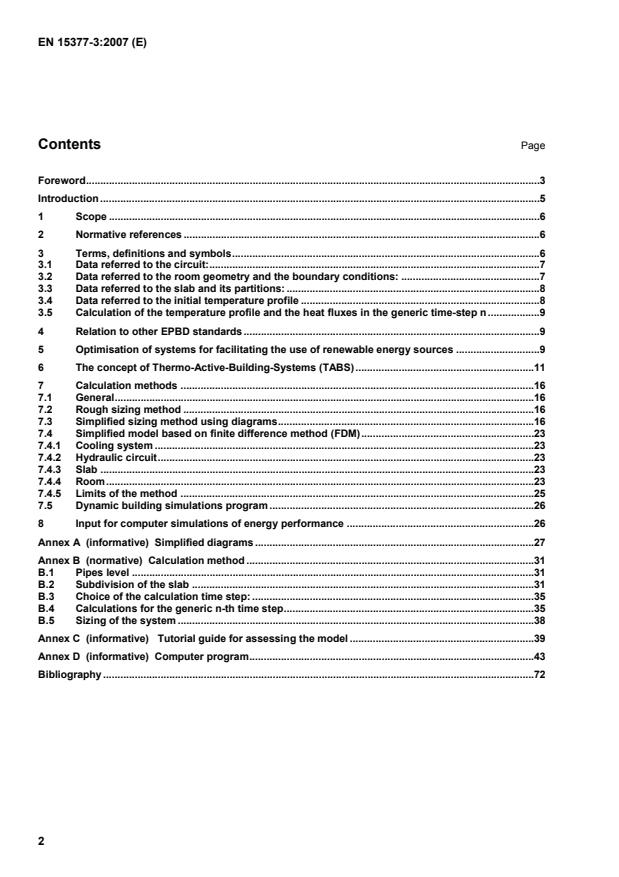
Calculation method.31 B.1 Pipes level.31 B.2 Subdivision of the slab.31 B.3 Choice of the calculation time step:.35 B.4 Calculations for the generic n-th time step.35 B.5 Sizing of the system.38 Annex C
(informative)
Tutorial guide for assessing the model.39 Annex D
(informative)
Computer program.43 Bibliography.72
Where possible, reference is made to other European or International Standards, a.o. product standards. However, use of products complying with relevant product standards is no guarantee of compliance with the system requirements. The requirements are mainly expressed as functional requirements, i.e. requirements dealing with the function of the system and not specifying shape, material, dimensions or the like.
The guidelines describe ways to meet the requirements, but other ways to fulfil the functional requirements might be used if fulfilment can be proved. Heating systems differ among the member countries due to climate, traditions and national regulations. In some cases requirements are given as classes so national or individual needs may be accommodated. In cases where the standards contradict with national regulations, the latter should be followed. prEN 15377 Heating systems in buildings – Design of embedded water based surface heating and cooling systems consists of the following parts: Part 1: Determination of the design heating and cooling capacity Part 2: Design, dimensioning and installation Part 3: Optimizing for use of renewable energy sources
A section in the present standard describes how the design and dimensioning can be improved to facilitate renewable energy sources. Peak loads can be reduced by activating the building mass using pipes embedded in the main concrete structure of the building (Thermo-Active-Building-Systems, TABS). For this type of systems, the steady state calculation of heating and cooling capacity (part 1 of this standard) is not sufficient. Thus, several sections of this standard describe methods for taken into account the dynamic behavior. The proposed methods are used to calculate and verify that the cooling capacity of the system is sufficient and to calculate the cooling requirements on the water side for sizing the cooling system. The energetic assessment of surface heating and cooling systems may also be carried out according to national guidelines accomplishing the goal of this standard.
The method allows calculation of peak cooling capacity of a thermo-active system, based on heat gains (solar, internal loads, ventilation). This method also allows calculation of the energy demand on the water side (system) to be used for sizing of the cooling system, e.g. chiller, fluid flow rate. Steady state heating capacity is calculated according to method B or E of prEN 15377-1 (part 1 of this series of standards). 2 Normative references The following referenced documents are indispensable for the application of this standard. For dated references, only the edition cited applies. For undated references, the latest edition of the referenced document (including any amendments) applies. EN 15251, Indoor environmental input parameters for design and assessment of energy performance of buildings addressing indoor air quality, thermal environment, lighting and acoustics EN 15255, Thermal performance of buildings – Sensible room cooling load calculation – General criteria and validation procedures EN 15265, Energy performance of buildings - Calculation of energy needs for space heating and cooling using dynamic methods - General criteria and validation procedures prEN 15377-1:2005, Heating systems in buildings – Design of embedded water based surface heating and cooling systems — Part 1: Determination of the design heating and cooling capacity prEN 15377-2, Heating systems in buildings — Design of embedded water based surface heating and cooling systems — Part 2: Design, dimensioning and installation 3 Terms, definitions and symbols For the purposes of this document, the terms and definitions given in prEN 15377-1:2005 and the following symbols apply.
kg/ (m2 s) ; cw specific heat capacity of the water
J/ (kg K) ; T pipe spacing m ; da
external diameter of the pipe
m ; sr
thickness of the pipe wall
m ; rλ thermal conductivity of the material of the pipe wall
W/ (m K) ; AFloor area cooled/heated by the circuit m2 ; LR length of the circuit m ; MaxWP maximum cooling (<0) or heating (>0) power for a conditioning plant W ; 0wθ supply water temperature at the beginning of the simulation °C ; limwθ minimum (in the cooling case) or maximum (in the heating case) supply water temperature obtainable by the machine °C . 3.2 Data referred to the room geometry and the boundary conditions: AWalls overall area of vertical walls, external facade excluded m2 ; Fv Floor-Ext Wall view factor floor-external wall; Fv Floor-Ceiling view factor floor-ceiling; Fv Floor-Walls view factor floor-walls; Radd Floor additional resistance covering the upper side of the slab (m2 K)/W ; Radd Ceiling additional resistance covering the lower side of the slab (m2 K)/W ; RWalls resistance of the surface layer of internal walls (m2 K)/W ; hAir-Floor
convective heat transfer coefficient between the air and the floor W/(m2 K) ; hAir-Ceiling
convective heat transfer coefficient between the air and the ceiling W/(m2 K) ; hAir-Walls
convective heat transfer coefficient between the air and the internal walls W/(m2 K) ; hFloor-Walls
radiant heat transfer coefficient between the floor and the internal walls W/(m2 K) ; hFloor-Ceiling
radiant heat transfer coefficient between the floor and the ceiling W/(m2 K) ; hCeiling-Walls
radiant heat transfer coefficient between the ceiling and the internal walls W/(m2 K) ; CWalls average specific thermal inertia of the internal walls J/(m2 K)
t∆ calculation time step s . The following data shall be known for all the day, and the values during the n-th time step from the beginning of the simulation have to be defined:
thickness of the upper part of the slab
m ; s2
thickness of the lower part of the slab
m ; J1 number of material layers constituting the upper part of the slab dimensionless ; J2 number of material layers constituting the lower part of the slab dimensionless ;
As a consequence, J=J1+J2 represents the total number of material layers constituting the slab and J sets of physical properties (ρj, cj, λj, δj, mj, Rj) shall be known or chosen, where: ρj density of the material constituting the j-th layer
kg/m3 ; cj specific heat capacity of the material constituting the j-th layer
J/ (kg K) ; λj thermal conductivity of the j-th layer W/ (m K) ; δj thickness of the j-th layer m ,
δj = 0 if the layer is a mere thermal resistance; mj number of partitions of the j-th layer
dimensionless ; Rj thermal resistance summarizing the j-th layer m2K/W ,
Rj > 0 if the layer is a mere thermal resistance. For geometrical consistency: 2112111sandsJJJjjJjj==∑∑+==δδ. 3.4 Data referred to the initial temperature profile The initial value of the supply water temperature (0wθ) and the interface temperatures of partitions of the slab (0i,Iθ withLii≤≤0) shall be decided. As for the slab, a possible choice could be assigning the same value to all the interfaces, equal to the mean temperature at the start of the simulation.
3.5 Calculation of the temperature profile and the heat fluxes in the generic time-step n The temperature reached at a certain interface at the end of the previous time step is used for calculation of the heat fluxes acting on the building structures and for calculation of the consequent temperatures at the end of the time step in progress. These magnitudes are: nConvq& global specific convective heat gains W/m2 ; nRadq& global specific radiant heat gains W/m2 ; nAirθ air temperature in the room in the present calculation time step °C ; nWallsθ mean temperature of the walls in the present calculation time step °C ; nOpθ operative temperature in the room in the present calculation time step °C ; 1−nwθ supply water temperature at the end of the previous time step °C ; 1−nexitwθ outlet water temperature at the end of the previous time step °C ;
1,−niIθ temperature of the i-th interface, with Lii≤≤0, at the end of the previous time step, °C ; The results obtained at every time step are: nwθ supply water temperature at the end of the time step in progress °C ;
nFθ, nsθ temperature of the upper and lower sides of the slab at the end of the time step in progress °C ; niI,θ temperature of the i-th interface, with Lii≤≤0, at the end of the time step in progress, °C . 4 Relation to other EPBD standards The present standard requires input from the following standards: prEN 15377-1, EN 15251, EN 15255 and EN 15265.
The present standard provides input data to the following standards: EN 15243 and EN ISO 13792. 5 Optimisation of systems for facilitating the use of renewable energy sources Transporting energy by water uses less auxiliary energy for pumps and less installation space than carrying the same amount of energy by air. A further optimizing is to use water at temperatures close to room temperature for heating and cooling: low temperature heating - high temperature cooling.
For Thermo-Active-Building–Systems, a further optimization regarding use of renewable energy sources is made by reducing the peak load, transferring the load to off-peak time periods, downsizing of energy generation systems, and increased efficiency of energy generation due to water temperature level. This facilitates the possible use of energy sources such as solar collectors, ground source heat pumps, free cooling, ground source heat exchangers, aquifers.
6 The concept of Thermo-Active-Building-Systems (TABS) A Thermo-Active-Building-System (TABS) is a water based heating and cooling system, where the pipes are embedded in the central concrete core of a building construction (see Figure 1). The heat transfer takes place between the water (pipes) and the concrete, between the concrete core and the surfaces to the room (ceiling, floor) and between the surfaces and the room.
Key W window
P pipes
R room
C concrete
F floor RI reinforcement Figure 1 – Thermo-active radiant system
where: PL = pipes level 1 = cooling system (machine) 2 = hydraulic circuit 3 = slab including core level with pipes 4 = possible additional resistances (floor covering or suspended ceiling) 5 = room below and room above Figure 2 – Simple scheme of a thermo-active system
Key 1 heat gain X-axis time of the day 2 power needed for conditioning the ventilation air Y-axis cooling power 3 power needed on the water side 4 peak of the required power reduction
Figure 3 – Example of peak-shaving effect
TABS may be used both with natural and mechanical ventilation (depending on weather conditions). Mechanical ventilation with dehumidifying may be required depending on external climate and indoor humidity production. In the example in Figure 3, the required cooling power needed for dehumidifying the air during day time is sufficient for cooling the slab during night time. The designer needs to know if the capacity at a given water temperature is sufficient to keep the room temperature in a given range. The designer needs also to know the heat flow on the water side to be able to dimension the heat distribution system and the chiller/boiler. The present document provides methods for this. Some detailed building-systems calculation models have been developed, e.g. for determination of the heat exchanges under non-steady state conditions in a single room, for determination of thermal and hygrometric balance of the room air, for prediction of comfort conditions, for checking of condensation on surfaces, for availability of control strategies and for calculation of the incoming solar radiation. The use of such detailed calculation models is, however, limited due to the high amount of time needed for the simulations. Development of a more user-friendly tool is required. Such a tool is provided in the following, which allows simulation of thermo-active systems in an easy way. Internal temperature changes only moderately during the day, and the aim of a good design of TABS is to maintain comfort during the day within the range of comfort, i.e. –0,5 < PMV < 0,5, according to EN 15251 (see Figure 4).
Key θmr mean radiant temperature X-axis time of the day θair air temperature Y-axis, left temperature °C θf floor temperature Y-axis, right PMV values θc ceiling temperature θw exit return water temperature PMV Predicted Mean Vote Figure 4 – Example of temperature profiles
The diagram in Figure 5 show an example of the relation between internal heat gains, water supply temperature, heat transfer on the room side, hours of operation and heat transfer on the water side. The diagrams correspond to a concrete slab with raised floor (R=0,45 m2K/W) and a permissible room temperature range of 21 °C to 26 °C. The upper diagram shows on the y-axis the maximum permissible total heat gain in the space (internal gains plus solar gains) in W/m2, and on the x-axis the required water supply temperature in °C. The lines in the diagram correspond to different hours of operation (8 h, 12 h, 16 h, 24 h) and different maximum amounts of energy supplied in Wh/m2 per day. The lower diagram shows the cooling power in W/m2 required on the water side (for dimensioning of the chiller) for thermo-active slabs as a function of supply water temperature and operation time. Further, the amount of energy rejected per day is indicated in Wh/m2 per day. The example shows, that by a maximum internal heat gain of 38 W/m2 and 8 h operation, a supply water temperature of 18,2 °C is required. If, instead, the system is in operation for 12 h, a supply water temperature of 19,3 °C is required. In total, the amount of energy rejected from the room is appr. 335 Wh/m2 per day. The required cooling power on the water side is by 8 h operation 37 W/m2 and by 12 h operation only 25 W/m2. Thus, by 12 h operation, the size of the chiller can be reduced significantly. The total heat rejection on the water side is appr. 300 Wh/m2 per day.
Key A =Maximum total heat gain in space [W/m2 floor area] B = Maximum C = Minimum O&E = occupants and equipment (acc. to SWKI 95-3) L = lighting (acc. to SWKI 95-3) D =Mean cooling power tabs [W/m2 floor area] Figure 5 – Working principle of TABS
7.1 General The following calculation methods can be applied: rough sizing method based on a standard calculation of the cooling load (accuracy 20-30%). To be used based on the knowledge of the peak value for heat gains, see 7.2;
simplified sizing method using diagrams based on 24 one-hour values of the heat gains (accuracy 15-20%), see 7.3; simplified model based on finite difference method, FDM, (accuracy 10-15%). Detailed dynamic simulation for the thermal conduction in the slab via FDM, based on 24 one-hour values of the variable cooling loads of the room as well as the temperatures of the air, see 7.4;
detailed simulation models (accuracy 6-10%). Overall dynamic simulation model for the radiant system and the room, see 7.5.
7.2 Rough sizing method The cooling system shall be sized for 70 % of the peak cooling load (EN 15255, prEN 15377-1 and prEN 15377-2). In this case, calculation of the cooling load has to be carried out using an operative temperature of 24 °C. 7.3 Simplified sizing method using diagrams In this case, calculation of the heat gains has to be carried out by means of 24 hourly calculations with an operative temperature of 24 °C. If heat gains are approximated, 10 % of the solar gain has to be added each hour in order to take into account the gains due to external windows. This method is based on the assumption that the entire conductive slab is at a constant temperature during the whole day. This average temperature of the slab is calculated by the method itself and is related to the supply water temperature of the running time of the circuit. The following data and parameters are involved by this method: Q, which is the specific daily heat load on the room during the design day in kWh/m2 per day. It is the sum of the above mentioned 24 one-hour values of the heat gains divided by the floor area. The pattern of the load profile shall be known; comfort: maximum operative temperature allowed for comfort conditions
°C; Exposure of the room, in order to determine when the peak load from heat gains occurs: East (morning), South (noon) or West (afternoon); Number of active surfaces. in order to distinguish whether the slab works by heat transfer both on the floor side and on the ceiling side or only on the ceiling side (see Figure 6); h: number of hours of fluid flow through the circuits
h; Rint, thermal resistance of the slab in m2K/W. This is the thermal resistance that connects the conductive region of the slab near the pipes level (see Figure 7) to the pipes level. In other words, it is assumed that the conductive region of the slab is maintained at a constant temperature during the occupied period (see Figure 8);
where: 1 = concrete 2 = reinforced concrete where: 1 = wood
2 = air 3 = reinforced concrete where: 1 = wood
2 = concrete 3 = fibreglass 4 = reinforced concrete Example of slab
acting through 2 surfaces Example of slab
acting through 1 surface Example of slab
acting through 1 surface Figure 6 – Number of active surfaces
where: 1 = concrete 2 = reinforced concrete where: 1 = wood
2 = air 3 = reinforced concrete where: 1 = wood
2 = concrete 3 = fibreglass 4 = reinforced concrete Conductive region:
Materials 1 and 2 Conductive region:
Material 3 Conductive region:
Material 4 Figure 7 – Examples of conductive regions
where: CR = conductive region UP = upper part of the conductive region LP = lower part of the conductive region ROS = rest of the slab PL = pipes level Figure 8 – Resistance diagram
Kind of floor Coefficient for calculation of average slab temperature Floor and ceiling C2-4.6816 -5.3696 -5.935 Continuous running mode (24 h) Only ceiling C1 -6.3022 -7.2237 -7.7982 Floor and ceiling I2 -5.5273 -6.1701 -6.7323 Intermittent running mode (8 h) Only ceiling I1 -7.2853 -7.8562 -8.5791
Table 2 - Constant internal heat gains from 8:00 to 12:00 and from 14:00 to 18:00 (two peaks) Exposure of the room EAST SOUTH WEST
Kind of floor Coefficient for calculation of average slab temperature Floor and ceiling
-6.279 -7.1094 -7.3681 Continuous running mode (24 h) Only ceiling
-7.9663 -8.7989 -8.7455 Floor and ceiling
-8.1474 -8.758 -9.3264 Intermittent running mode (8 h) Only ceiling
-10.029 -10.685 -10.967
Once θcomfort is defined, the tables can be summarized by diagrams. For instance, if θcomfort = 26 °C, the diagram for constant internal heat gains from 8:00 to 18:00 is given in Figure 9.
Key: X-axis specific daily energy (kWh/m2 per day) Y-axis average slab temperature coding of lines: operation condition of the circuit (C = continuous, I = intermittent, 8 h) number of active surfaces (1 or 2) exposure of the room (E = East, S = South, W = West) Figure 9 – Diagram for determining the average slab temperature
in the case of constant internal heat gains during the day
• θcomfort: 26 °C
• Exposure of the room: SOUTH
• Kind of
floor:
where: 1 = wood
2 = air 3 = reinforced concrete
• h: 8h
• Rint:
where: CR = conductive region
If λ of the conductive region
= 1,9 W/(m K), then
Rup = Rdown = 0,1/1,9 = 0,053 m2K/W and Rint = 0,013 m2K/W • Cs°=⋅−=6,196,0685,1026θ
• Rt: 0,07 m2K/W
• ()Cw°=⋅+⋅−=38,138100007,0013,06,06,19θ
Key θv inlet water temperature Rz thermal resistance between the inlet water temperature and the supply water tempera-ture along the pipe/circuit length Rw thermal resistance between the supply water temperature in the pipe and the internal surface temperature of the pipe wall
Rr thermal resistance between the internal and external surface temperature of the pipe wall Rx thermal resistance between external surface temperature of the pipe wall and average temperature at the pipes plane Figure 10 – Concept of the Resistance Method 7.4.3 Slab The Resistance Method allows splitting of the slab into two parts, which are analyzed through an explicit finite difference method. 7.4.4 Room An air node is taken into account coupled with the upward and downward surface of the slab and with a fictitious wall-node, via three resistances. Besides, the two surfaces of the slab are coupled together via a
Figure 11 – General scheme of the Resistance Method
where: W is the fictitious node describing the internal walls Figure 12 – Scheme of the heat loads network
where: DWC = design weather conditions TES = transmission through the external surface SG = solar gain CIHL = convective internal heat loads RIHL = radiant internal heat loads Figure 13 – Heat loads involved acting on the room and how they take part in the calculations 7.4.5 Limits of the method The following limitations shall be met: pipe spacing: from 0,15 to 0,3 m usual concrete slab structures have to be considered, λ
= 1,15-2,0 W/(mK), with upward additional materials, which might be acoustic insulation or raised floor. No discontinuous light fillings can be considered in the structures of the lower and upper slabs. If these conditions are not fulfilled, a detailed simulation program has to be applied for dimensioning the thermo-active system (see 7.5). Under the above mentioned conditions, a cooling load calculation or a simulation for a convective system can be carried out for an entire 24 h period and with an internal temperature of 24 °C. The results of this calculation, to be taken into account as input for the present simplified model, are the solar gains and the heat fluxes into the room from the external surface.
For type E, F, and G systems according to prEN 15377-1, this resistance is directly calculated. Both the equivalent inward resistance and outward resistance are calculated.
For type A, B, C and D systems (according to prEN 15377-1 and prEN 1264-2 and -5), the equivalent resistances are calculated from the inward specific heat flow and the outward specific heat flow, taking into account the surface resistance according to: Rx = /qx – 1/ht
Km²/W where: Rx
equivalent resistance, inward (x=i) or outward (x=u), Km²/W
heating/cooling medium temperature difference, K qx specific heat flow, inward (x=i) or outward (x=u), W/m² ht surface heat transfer coefficient, W/Km²
(informative)
Simplified diagrams Based on the simplified calculation method in 7.3, the following diagrams for design of a TABS have been made. The diagrams in Figure A.2 show an example of the relation between internal heat gains, water supply temperature, heat transfer on the room side, hours of operation and heat transfer on the water side. The diagrams correspond to a concrete slab shown in Figure A.1 with a solid concrete floor (thermal conductivity 1,2 W/mK), pipe spacing of 0,15 m and a permissible room temperature range of 21 °C to 26 °C. The upper diagram shows on the y-axis the maximum permissible total heat gain in the space (internal gains plus solar gains) in W/m2, and on the x-axis the required water supply temperature in °C. The lines in the diagram correspond to different hours of operation (8 h, 12 h, 24 h) and different maximum amounts of energy supplied in Wh/m2 per day. The lower diagram shows the cooling power in W/m2 required on the water side (for dimensioning of the chiller) for thermo-active slabs as a function of supply water temperature and operation time. Further, the amount of energy rejected is indicated in Wh/m2 per day. The example shows, that by a maximum internal heat gain of 48 W/m2 and 8 h operation, a supply water temperature of 17,8 °C is required. If, instead, the system is in operation for 24 h, a supply water temperature of 21,3 °C is required. In total, the amount of energy rejected from the room is appr. 460 Wh/m2 per day. The required cooling power on the water side is by 8 h operation 58 W/m2 and by 24 h operation only 20 W/m2. Thus, by 24 h operation, the size of the chiller can be reduced significantly.
dimensions in millimetres
Key A Concrete B Reinforced concrete Figure A.1 – Slab used in the simplified calculations
Key X-axis supply water temperature w y1
cooling load, Q y2
required energy removal on the water side Color and shape coded lines corresponding to system running hours as indicated Lines marked xxx Wh/m2
indicating the total removed energy during the time of operation Figure A.2 – Simple diagram for design of a TABS
Dimensions in millimetres
Key A Wood B Concrete C Fibreglass D Reinforced concrete Figure A.3 – Slab used in the simplified calculations
Key X-axis supply water temperature w y1
cooling load, Q y2
required energy removal on the water side Color and shape coded lines corresponding to system running hours as indicated Lines marked xxx Wh/m2
indicating the total removed energy during the time of operation Figure A.4 – Simple diagram for design of a TABS
(normative)
Calculation method B.1 Pipes level Rt is the total thermal resistance (m2K)/W between the inlet water temperature and the average temperature at the pipes plane, determined by the Resistance Method. Rt can be calculated by: xrwztRRRRR+++= (B.1) where: wspHzcmR⋅⋅=,21& 87.0,13.028⋅⋅−⋅=RspHrawLmsdTR&π
rraarsddTRλπ⋅⋅⋅−⋅=22ln raxdTTRλππ⋅⋅⋅⋅=2ln
Two conditions shall be fulfilled for application of these equations: equation for Rx is valid only if
s1 / T
> 0,3, s2 / T
> 0,3 and da / T
< 0,2 equation for Rz is valid only if
()21,≥++⋅⋅xrwwspHRRRcm& If both conditions are fulfilled, Equation (B.1) can be applied. The machine model is expressed in an explicit way, so the inequality 1,>⋅⋅wspHtcmR& shall be fulfilled in order to avoid calculations instability.
B.2 Subdivision of the slab The slab is composed by J1 material layers constituting the upper part of the slab, total thickness s1, and J2 material layers constituting the lower part of the slab, total thickness s2. As a consequence, J= J1+J2 sets of material layer thickness (δj) and physical properties (ρj, cj, λj) shall be known. For geometrical consistency: 2112111sandsJJJjjJjj==∑∑+==δδ
Key US upper part of the slab L material layer PL pipes level D partition layer LS lower part of the slab Figure B.1 – Example of subdiv
...