


EN 3475-506:2007
(Main)Aerospace series - Cables, electrical, aircraft use - Test methods - Part 506: Plating continuity
Aerospace series - Cables, electrical, aircraft use - Test methods - Part 506: Plating continuity
This standard specifies a method of verifying the continuity of plating on strands which are:
either checked before stranding or screening, or
checked after stranding or screening
It shall be used together with EN 3475-100.
Luft- und Raumfahrt - Elektrische Leitungen für Luftfahrtverwendung - Prüfverfahren - Teil 506: Gleichmäßigkeit des Überzugs
Diese Norm legt ein Verfahren zur Prüfung der Gleichmäßigkeit des Überzuges auf Einzeldrähten fest, die: ⎯ entweder vor dem Verseilen oder Aufbringen der Schirmung; oder ⎯ nach dem Verseilen oder Aufbringen der Schirmung zu prüfen sind. Sie ist in Verbindung mit EN 3475-100 anzuwenden.
Série aérospatiale - Câbles électriques à usage aéronautique - Méthodes d'essais - Partie 506 : Continuité du revêtement
Aeronavtika - Električni kabli za uporabo v zračnih plovilih - Preskusne metode - 506. del: Enakomernost prevleke
General Information
- Status
- Published
- Publication Date
- 28-Aug-2007
- Withdrawal Date
- 28-Feb-2008
- Technical Committee
- ASD-STAN - Aerospace
- Drafting Committee
- ASD-STAN/D 2 - Electrical
- Current Stage
- 9093 - Decision to confirm - Review Enquiry
- Start Date
- 30-Jun-2017
- Completion Date
- 14-Apr-2025
Relations
- Effective Date
- 22-Dec-2008
Overview
EN 3475-506:2007 - "Aerospace series - Cables, electrical, aircraft use - Test methods - Part 506: Plating continuity" defines a laboratory method to verify the continuity and integrity of metallic plating on cable strands and screens used in aircraft electrical wiring. The standard covers plating verification both for strands checked before stranding/screening and for finished stranded or screened conductors. It is intended to be used together with EN 3475-100 (general test methods for aerospace cables).
Key topics and requirements
- Scope: Applies to plated strands (copper, copper-clad aluminium, screens) checked either before or after stranding/screening.
- Specimen preparation:
- Prepare three specimens, minimum 150 mm long; immersed length at least 110 mm.
- Degrease and handle specimens to avoid contamination (do not touch cleaned surfaces with bare fingers).
- For copper-clad aluminium specimens, wind five turns on a mandrel about 12 times the strand diameter to reveal coating weakness.
- For stranded/screened constructions, test whole conductors or selected members per construction (unilay/concentric, rope layers, separated screens).
- Test method:
- Immerse specimens for 30 s in a sodium polysulphide solution (density 1.142 g/cm3 at 20 °C), then rinse in distilled water.
- For silver-plated specimens only: additional immersion 15 s in hydrochloric acid (density 1.088 g/cm3 at 20 °C), then rinse.
- Acceptance criteria:
- Inspect immediately after the solution cycle. There must be no adherent or distinctly visible black spots when examined by the naked eye.
- Any blackening occurring within 15 mm of each end of the specimen is disregarded.
- Normative references: EN 3475-100 and relevant ASTM plating specifications (ASTM B33, B298, B355) are cited for applicability and material definitions.
Applications and users
- Cable manufacturers: Quality control during plating and post-plating inspection to ensure coating continuity and corrosion protection.
- Aerospace OEMs and suppliers: Verifying plated conductors and screens used in aircraft electrical systems meet aerospace test methods.
- Independent test laboratories: Routine acceptance and failure analysis testing of plated wires, copper and copper-clad aluminium conductors, and cable screens.
- Procurement and quality engineers: Specification and verification of plating integrity as part of supplier qualification and incoming inspection.
Related standards
- EN 3475-100 - General test methods for aerospace cables (must be used together with Part 506).
- ASTM B33, B298, B355 - Material specifications referenced for plated wire types.
Keywords: EN 3475-506:2007, plating continuity, aerospace cables, test methods, polysulphide test, copper-clad aluminum, cable screening, plating verification, aircraft electrical wiring.


Frequently Asked Questions
EN 3475-506:2007 is a standard published by the European Committee for Standardization (CEN). Its full title is "Aerospace series - Cables, electrical, aircraft use - Test methods - Part 506: Plating continuity". This standard covers: This standard specifies a method of verifying the continuity of plating on strands which are: either checked before stranding or screening, or checked after stranding or screening It shall be used together with EN 3475-100.
This standard specifies a method of verifying the continuity of plating on strands which are: either checked before stranding or screening, or checked after stranding or screening It shall be used together with EN 3475-100.
EN 3475-506:2007 is classified under the following ICS (International Classification for Standards) categories: 49.060 - Aerospace electric equipment and systems. The ICS classification helps identify the subject area and facilitates finding related standards.
EN 3475-506:2007 has the following relationships with other standards: It is inter standard links to EN 3475-506:2002. Understanding these relationships helps ensure you are using the most current and applicable version of the standard.
EN 3475-506:2007 is available in PDF format for immediate download after purchase. The document can be added to your cart and obtained through the secure checkout process. Digital delivery ensures instant access to the complete standard document.
Standards Content (Sample)
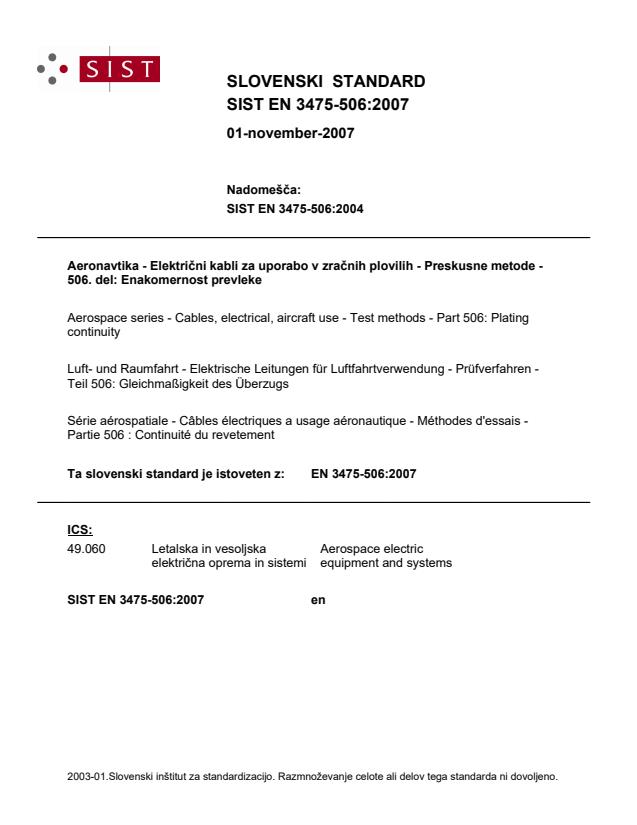
2003-01.Slovenski inštitut za standardizacijo. Razmnoževanje celote ali delov tega standarda ni dovoljeno.Aerospace series - Cables, electrical, aircraft use - Test methods - Part 506: Plating continuitySérie aérospatiale - Câbles électriques a usage aéronautique - Méthodes d'essais - Partie 506 : Continuité du revetementLuft- und Raumfahrt - Elektrische Leitungen für Luftfahrtverwendung - Prüfverfahren - Teil 506: Gleichmaßigkeit des ÜberzugsTa slovenski standard je istoveten z:EN 3475-506:2007SIST EN 3475-506:2007en49.060Aerospace electric equipment and systemsICS:SIST EN 3475-506:20041DGRPHãþDSLOVENSKI
STANDARDSIST EN 3475-506:200701-november-2007
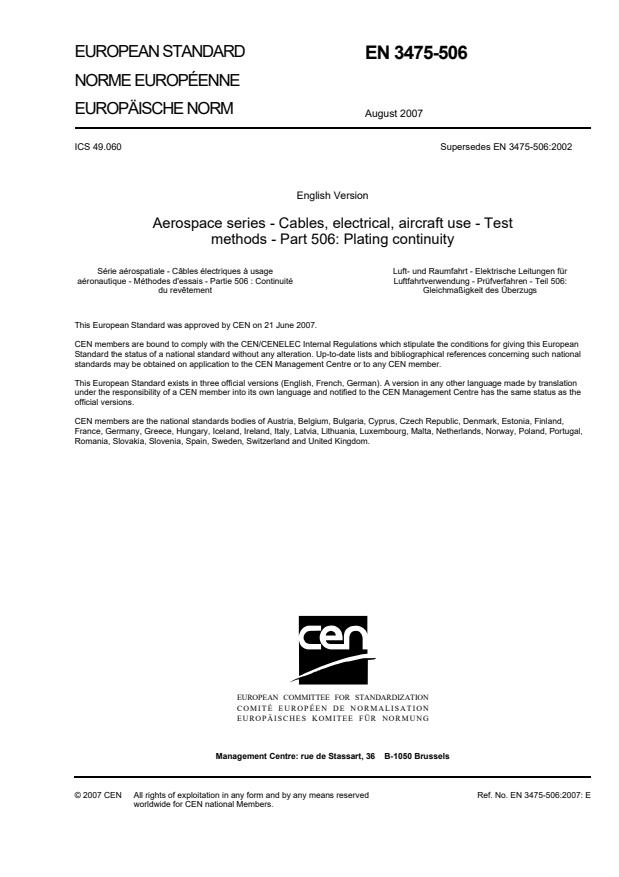
EUROPEAN STANDARDNORME EUROPÉENNEEUROPÄISCHE NORMEN 3475-506August 2007ICS 49.060Supersedes EN 3475-506:2002
English VersionAerospace series - Cables, electrical, aircraft use - Testmethods - Part 506: Plating continuitySérie aérospatiale - Câbles électriques à usageaéronautique - Méthodes d'essais - Partie 506 : Continuitédu revêtementLuft- und Raumfahrt - Elektrische Leitungen fürLuftfahrtverwendung - Prüfverfahren - Teil 506:Gleichmaßigkeit des ÜberzugsThis European Standard was approved by CEN on 21 June 2007.CEN members are bound to comply with the CEN/CENELEC Internal Regulations which stipulate the conditions for giving this EuropeanStandard the status of a national standard without any alteration. Up-to-date lists and bibliographical references concerning such nationalstandards may be obtained on application to the CEN Management Centre or to any CEN member.This European Standard exists in three official versions (English, French, German). A version in any other language made by translationunder the responsibility of a CEN member into its own language and notified to the CEN Management Centre has the same status as theofficial versions.CEN members are the national standards bodies of Austria, Belgium, Bulgaria, Cyprus, Czech Republic, Denmark, Estonia, Finland,France, Germany, Greece, Hungary, Iceland, Ireland, Italy, Latvia, Lithuania, Luxembourg, Malta, Netherlands, Norway, Poland, Portugal,Romania, Slovakia, Slovenia, Spain, Sweden, Switzerland and United Kingdom.EUROPEAN COMMITTEE FOR STANDARDIZATIONCOMITÉ EUROPÉEN DE NORMALISATIONEUROPÄISCHES KOMITEE FÜR NORMUNGManagement Centre: rue de Stassart, 36
B-1050 Brussels© 2007 CENAll rights of exploitation in any form and by any means reservedworldwide for CEN national Members.Ref. No. EN 3475-506:2007: E
...
Questions, Comments and Discussion
Ask us and Technical Secretary will try to provide an answer. You can facilitate discussion about the standard in here.
Loading comments...