


CEN/TR 18048:2024
(Main)Methods of determination of the mechanical properties of self-bonding coating assemblies related to non-oriented electrical steels
Methods of determination of the mechanical properties of self-bonding coating assemblies related to non-oriented electrical steels
This document describes the mechanical testing methods, relevant for self-bonding coating assemblies with non-oriented electrical steels. In particular, it describes the mechanical testing methods, sample preparation, calibration methods, necessary to obtain reliable results that can be considered a reference for quality evaluation.
This document applies only to self-bonding coatings of non-oriented electrical steels.
Verfahren zur Bestimmung der mechanischen Eigenschaften von Backlackverbunden bezogen auf nicht kornorientiertes Elektroband und -blech
Méthodes de détermination des caractéristiques mécaniques des assemblages à base de vernis thermocollant dédiés aux aciers électriques à grains non orientés
Le présent document décrit les méthodes d'essais mécaniques applicables aux assemblages de revêtements thermocollants avec des aciers électriques non orientés. En particulier, il décrit les méthodes d'essai mécaniques, la préparation d'échantillons, les méthodes d’étalonnage, nécessaires afin d’obtenir des résultats fiables qui peuvent être considérés comme une référence lors de l’évaluation de la qualité.
Le présent document ne s’applique qu’aux revêtements thermocollants des aciers électriques non orientés. Les essais peuvent être réalisés indépendamment du temps écoulé entre la production de l'acier électrique revêtu et l'évaluation du procédé d’adhérence de l'empilage assemblé.
Metode določanja mehanskih lastnosti samolepilnih premaznih sklopov, povezanih z neorientiranimi električnimi jekli
Ta dokument opisuje metode mehanskih preskusov, ki so pomembni za samolepilne premazne sklope, povezane z neorientiranimi električnimi jekli. Predvsem opisuje mehanske preskusne metode, pripravo vzorcev in kalibracijske metode, potrebne za pridobitev zanesljivih rezultatov, ki se lahko štejejo kot referenca pri vrednotenju kakovosti.
Ta dokument se uporablja samo za samolepilne premaze neorientiranih električnih jekel.
General Information
- Status
- Published
- Publication Date
- 20-Feb-2024
- Technical Committee
- ECISS/TC 108 - Steel sheet and strip for electrical applications
- Current Stage
- 6060 - Definitive text made available (DAV) - Publishing
- Start Date
- 21-Feb-2024
- Due Date
- 04-Mar-2025
- Completion Date
- 21-Feb-2024
Overview
CEN/TR 18048:2024 provides a practical guideline for the mechanical testing methods used to qualify self-bonding coating assemblies on non‑oriented electrical steels. The Technical Report defines sample preparation, calibration and reporting practices needed to produce reproducible, reference-quality results for supplier qualification, production quality evaluation and design validation. It applies only to self-bonding (bondable) varnishes on non‑oriented electrical steel stacks and does not replace tests of the coating film alone or of the base steel.
Key topics and technical requirements
- Test methods covered:
- Floating roller (peel) test - reference EN 1464. Measures peel resistance per lamination; common stack sizes 25 × 200 mm (Epstein strips 30 mm possible). Report peeling force in N/mm, sample geometry, curing conditions; peel length and crosshead rate (default 100 ± 5 mm/min) must be recorded.
- Lap-shear test - reference EN 1465. Determines tensile lap-shear strength; typical overlap 12.5 × 25 mm, use backing to avoid lamination necking, test speed commonly 10 mm/min; report maximum and mean strength in MPa, geometry and curing conditions.
- T‑peel test - reference EN ISO 11339. Peeling of two laminations simultaneously (commonly 25 × 200 mm samples, peel point ≈ 50 mm from edge). Repeat on multiple stacks and report individual and average N/mm values.
- Pull‑off test - reference EN ISO 4624. Permits perpendicular adhesion checks but has limitations for bonding varnishes because test dollies differ from electrical steel surface.
- Sample preparation and calibration:
- Control cutting burrs (stack burrs in same direction or deburr edges).
- Assemble stacks under specified compression, cure time and temperature; document all curing parameters.
- Report number of replicates (EN methods commonly use 5 samples; floating-roller averages of ≥2 consistent results accepted).
- Environmental and temperature testing:
- Perform tests across operating temperatures (account for glass transition effects) after thermal ageing or exposure to media.
- Thermal endurance (ageing, machine exploitation temperatures, Al die‑casting effects) and environmental endurance (humidity, cooling liquids, oils, impregnation fluids) are explicitly addressed; test profiles agreed between manufacturer and purchaser.
Applications and users
- Primary users: electrical steel manufacturers, coating formulators, motor and generator designers, testing laboratories, procurement and quality engineers.
- Typical applications: qualification of rotor/stator stacks in wind generators, automotive traction motors, and high‑efficiency industrial machines where stack integrity and absence of delamination are critical.
Related standards
- EN 1464 - Floating roller peel method
- EN 1465 - Tensile lap‑shear strength
- EN ISO 11339 - T‑peel test
- EN ISO 4624 - Pull‑off adhesion test
- EN 10342 and EN 10106 / EN 10265 / EN 10303 / EN 10341 - context standards for electrical steel types and supply
Keywords: CEN/TR 18048:2024, self-bonding coating assemblies, non‑oriented electrical steels, mechanical testing methods, floating roller, lap-shear, T-peel, pull-off, thermal endurance, environmental endurance, sample preparation, quality evaluation.

Frequently Asked Questions
CEN/TR 18048:2024 is a technical report published by the European Committee for Standardization (CEN). Its full title is "Methods of determination of the mechanical properties of self-bonding coating assemblies related to non-oriented electrical steels". This standard covers: This document describes the mechanical testing methods, relevant for self-bonding coating assemblies with non-oriented electrical steels. In particular, it describes the mechanical testing methods, sample preparation, calibration methods, necessary to obtain reliable results that can be considered a reference for quality evaluation. This document applies only to self-bonding coatings of non-oriented electrical steels.
This document describes the mechanical testing methods, relevant for self-bonding coating assemblies with non-oriented electrical steels. In particular, it describes the mechanical testing methods, sample preparation, calibration methods, necessary to obtain reliable results that can be considered a reference for quality evaluation. This document applies only to self-bonding coatings of non-oriented electrical steels.
CEN/TR 18048:2024 is classified under the following ICS (International Classification for Standards) categories: 77.140.50 - Flat steel products and semi-products. The ICS classification helps identify the subject area and facilitates finding related standards.
You can purchase CEN/TR 18048:2024 directly from iTeh Standards. The document is available in PDF format and is delivered instantly after payment. Add the standard to your cart and complete the secure checkout process. iTeh Standards is an authorized distributor of CEN standards.
Standards Content (Sample)
SLOVENSKI STANDARD
01-april-2024
Metode določanja mehanskih lastnosti samolepilnih premaznih sklopov,
povezanih z neorientiranimi električnimi jekli
Methods of determination of the mechanical properties of self-bonding coating
assemblies related to non-oriented electrical steels
Verfahren zur Bestimmung der mechanischen Eigenschaften von Backlackverbunden
bezogen auf nicht kornorientiertes Elektroband und -blech
Méthodes de détermination des caractéristiques mécaniques des assemblages à base
de vernis thermocollant dédiés aux aciers électriques à grains non orientés
Ta slovenski standard je istoveten z: CEN/TR 18048:2024
ICS:
77.140.50 Ploščati jekleni izdelki in Flat steel products and semi-
polizdelki products
2003-01.Slovenski inštitut za standardizacijo. Razmnoževanje celote ali delov tega standarda ni dovoljeno.
CEN/TR 18048
TECHNICAL REPORT
RAPPORT TECHNIQUE
February 2024
TECHNISCHER REPORT
ICS 77.140.50
English Version
Methods of determination of the mechanical properties of
self-bonding coating assemblies related to non-oriented
electrical steels
Méthodes de détermination des caractéristiques Verfahren zur Bestimmung der mechanischen
mécaniques des assemblages à base de vernis Eigenschaften von Backlackverbunden bezogen auf
thermocollant dédiés aux aciers électriques à grains nicht kornorientiertes Elektroband und -blech
non orientés
This Technical Report was approved by CEN on 12 February 2024. It has been drawn up by the Technical Committee CEN/TC
459/SC 8.
CEN members are the national standards bodies of Austria, Belgium, Bulgaria, Croatia, Cyprus, Czech Republic, Denmark, Estonia,
Finland, France, Germany, Greece, Hungary, Iceland, Ireland, Italy, Latvia, Lithuania, Luxembourg, Malta, Netherlands, Norway,
Poland, Portugal, Republic of North Macedonia, Romania, Serbia, Slovakia, Slovenia, Spain, Sweden, Switzerland, Türkiye and
United Kingdom.
EUROPEAN COMMITTEE FOR STANDARDIZATION
COMITÉ EUROPÉEN DE NORMALISATION
EUROPÄISCHES KOMITEE FÜR NORMUNG
CEN-CENELEC Management Centre: Rue de la Science 23, B-1040 Brussels
© 2024 CEN All rights of exploitation in any form and by any means reserved Ref. No. CEN/TR 18048:2024 E
worldwide for CEN national Members.
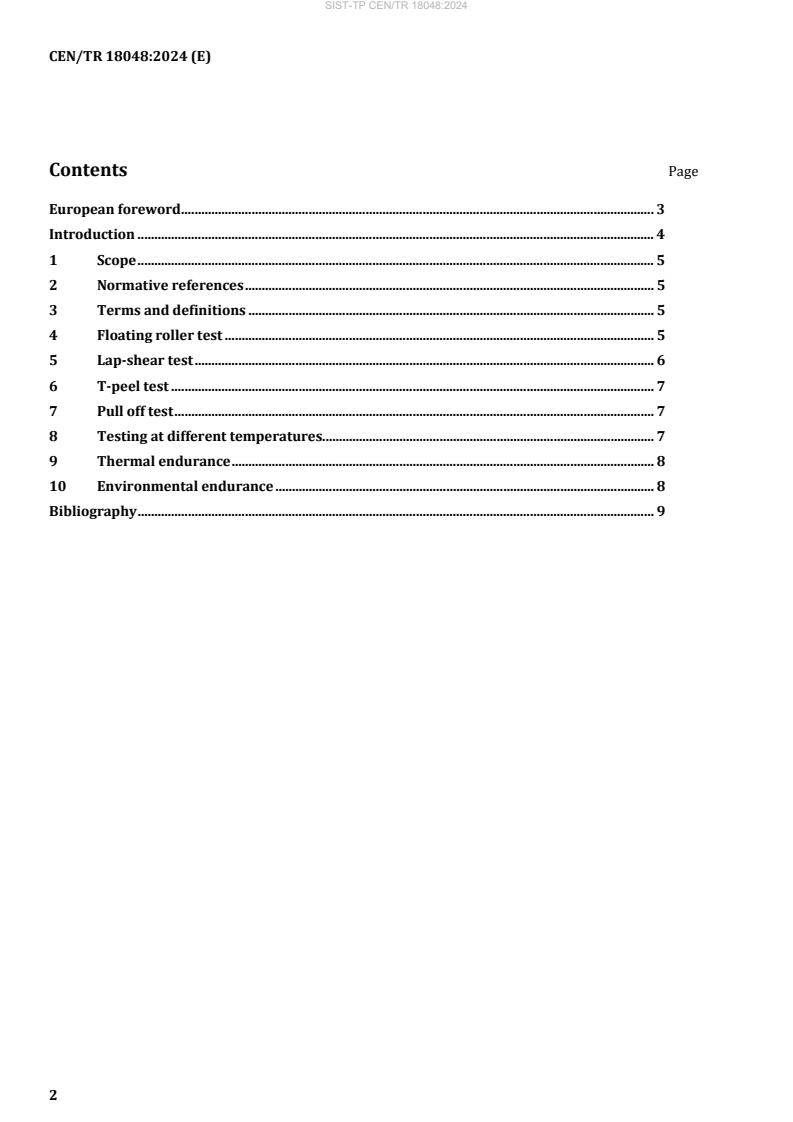
Contents Page
European foreword . 3
Introduction . 4
1 Scope . 5
2 Normative references . 5
3 Terms and definitions . 5
4 Floating roller test . 5
5 Lap-shear test . 6
6 T-peel test . 7
7 Pull off test . 7
8 Testing at different temperatures. 7
9 Thermal endurance . 8
10 Environmental endurance . 8
Bibliography . 9
European foreword
This document (CEN/TR 18048:2024) has been prepared by Technical Committee CEN/TC 459/SC 8
“Steel sheet and strip for electrical applications”, the secretariat of which is held by DIN.
Attention is drawn to the possibility that some of the elements of this document may be the subject of
patent rights. CEN shall not be held responsible for identifying any or all such patent rights.
Any feedback and questions on this document should be directed to the users’ national standards body.
A complete listing of these bodies can be found on the CEN website.
Introduction
EN 10342 describes the electrical steel coating types. The electrical steels ordered according to standards
EN 10106, EN 10265, EN 10303, EN 10341 are supplied either with or without such a coating.
CEN/TR 18048 describes the measurements necessary to qualify these coatings.
The particular case of self-bonding coatings (also called bondable coatings) have as additional
specification, beyond providing an insulation layer, to assure a glued connection between superposed
laminations. This implies the strength of this bonded assembly needs to be assessed, for qualification
purposes. This multi-material assembly needs specific precautions for establishing its mechanical
strength level. Different standards exist, but these are not necessarily dedicated to electrical steel
coatings. The lack of a clear description of which evaluation method to use, with which calibration
methods, sample preparation, etc. brings inconsistency in obtained measurement results. The purpose of
this technical report is to overcome the problem of differences in mechanical assessment of self-bonding
coating assemblies, by combining the aspects of Non-Oriented Electrical Steel self-bonding coating
mechanical testing in a clear guideline. This does not involve the mechanical testing of the coating itself,
nor the mechanical testing of the electrical steel itself.
These self-bonding coating types are used in different electric machine applications such as: wind
generators, high efficiency industry machines, automotive traction motors.
1 Scope
This document describes the mechanical testing methods, relevant for self-bonding coating assemblies
with non-oriented electrical steels. In particular, it describes the mechanical testing methods, sample
preparation, calibration methods, necessary to obtain reliable results that can be considered a reference
for quality evaluation.
This document applies only to self-bonding coatings of non-oriented electrical steels. The tests can be
performed regardless of the time lapse between the coated electrical steel production and the evaluation
of the bonding process of the assembled stack.
2 Normative references
There are no normative references in this document.
3 Terms and definitions
No terms and definitions are listed in this document.
ISO and IEC maintain terminological databases for use in standardization at the following addresses:
— IEC Electropedia: available at https://www.electropedia.org/
— ISO Online browsing platform: available at https://www.iso.org/obp
4 Floating roller test
4.1 General
The purpose of the method is to determine the peel resistance of the adhesive bond in a sample stack,
registering the peel force for each lamination. Identifying the peel force is relevant for a machine stack,
in particular to assure a good shape of the rotor or stator teeth. Also during shrink fitting operations of
the shaft in the rotor or the housing around the stator, it is important that no delamination occurs.
The test as described in EN 1464 represents the reference methodology. The floating roller peel test for
electrical steels, uses samples of self-bonded non-oriented electrical steel stacks consisting of a rigid part
and a peeled off part. Hence, the rigid part is already a stack of bonded laminations.
4.2 Geometries and testing conditions
The cutting method for producing the testing strips can lead to the formation of burrs. Appropriate
methods to avoid the influence of these burrs on the outcome of the floating roller peel test, can be to
stack the strips with the burrs in the same direction, or else to deburr the edges.
The thickness of the rigid part after completing the test is at least 2,5 mm and the thickness of the peeled
off part is related to the thickness o
...
このCEN/TR 18048:2024標準は、非配向電気鋼の自己接着コーティングアセンブリに関連する機械的特性の決定方法について詳細に記述しています。文書の範囲は、自己接着コーティングの機械的試験方法、サンプルの準備、校正方法を含んでおり、信頼性のある結果を得るための重要な情報を提供しています。この標準は、品質評価の参考とすることができるため、業界内での重要な役割を果たします。 この標準の強みは、特定の材料に焦点を当てている点です。非配向電気鋼の自己接着コーティングに関連する機械的特性を明確に評価するための方法論を提供しており、関連する試験手法を網羅しています。特に、試験準備や校正方法に関する具体的なガイドラインを示しているため、検査プロセスの信頼性が高まります。 さらに、この標準は、業界のニーズに即したものであり、自己接着コーティングが使われる多くの用途において、その性能評価を必要としています。そのため、CEN/TR 18048:2024は、品質管理や研究開発においても広く利用される可能性があり、関連する技術的進歩や製品改善に寄与することが期待されます。 全体として、この標準は、非配向電気鋼の自己接着コーティングアセンブリにおける機械的特性の評価に必要な包括的で正確な手法を提供しており、業界の標準として非常に重要な文書です。
The standard CEN/TR 18048:2024 provides a comprehensive framework for evaluating the mechanical properties of self-bonding coating assemblies related to non-oriented electrical steels. This document is pivotal for professionals involved in the testing and quality assessment of these specific materials, as it delineates clear methodologies for mechanical testing, sample preparation, and calibration techniques. One of the primary strengths of this standard is its detailed approach to sample preparation, which is crucial for ensuring that the tests yield reliable and reproducible results. The rigor in defining the preparation procedures helps mitigate variability in testing outcomes, thereby establishing a solid reference point for future quality evaluations of self-bonding coatings. Moreover, the inclusion of calibration methods reinforces the standard's relevance, ensuring that the testing equipment used is accurately measuring the mechanical properties. This emphasis on calibration not only enhances the credibility of the results obtained but also aligns with best practices in materials testing. By focusing specifically on self-bonding coatings of non-oriented electrical steels, CEN/TR 18048:2024 caters to a niche yet important segment of materials science, making it an essential document for manufacturers and quality control specialists. Its well-defined scope ensures that users can apply the methods outlined with confidence, knowing they are adhering to recognized standards in the industry. In summary, the standard CEN/TR 18048:2024 stands out for its thoroughness and specificity in addressing the mechanical properties of self-bonding coating assemblies, ultimately contributing to higher quality outcomes in the production and evaluation of non-oriented electrical steels.
Das Dokument CEN/TR 18048:2024 bietet eine umfassende Anleitung zur Bestimmung der mechanischen Eigenschaften von selbstbindenden Beschichtungsanordnungen, die spezifisch für nicht orientierte Elektro stähle sind. Der Umfang dieser Norm ist klar definiert und bezieht sich ausschließlich auf selbstbindende Beschichtungen, was ihre Relevanz für die Zielgruppe hervorhebt. Eine der größten Stärken dieser Norm ist die detaillierte Beschreibung der mechanischen Prüfmethoden, die speziell für selbstbindende Beschichtungen entwickelt wurden. Diese Methoden sind entscheidend, um die Qualität und Zuverlässigkeit der Beschichtungen zu bewerten. Darüber hinaus legt das Dokument großen Wert auf die Musteraufbereitung und Kalibrierungsverfahren, die für die Erzielung konsistenter und verlässlicher Ergebnisse notwendig sind. Dies ist besonders wichtig in einem technisierten Umfeld, in dem genaue Messergebnisse für die Industrie entscheidend sind. Die Norm CEN/TR 18048:2024 bietet auch klare Richtlinien zur Durchführung der Tests, was eine Standardisierung in der Qualitätssicherung fördert. Durch die Festlegung von Referenzmethoden werden Benchmarking und Vergleichbarkeit zwischen verschiedenen Herstellern und Produkten ermöglicht. In einem Markt, der zunehmend durch Wettbewerbsdruck und technologische Entwicklungen geprägt ist, ist diese Norm von hoher Relevanz, da sie den Herstellern hilft, die Qualität ihrer Produkte zu verbessern und den Anforderungen der Branche gerecht zu werden. Insgesamt ist CEN/TR 18048:2024 ein wertvolles Dokument für die Industrie, das nicht nur die technischen Anforderungen an selbstbindende Beschichtungen von nicht orientierten Elektro stählen klärt, sondern auch ein wichtiges Instrument für die Qualitätssicherung darstellt. Die Norm trägt dazu bei, die technischen Standards und Praktiken innerhalb der Branche zu harmonisieren und ist somit ein unverzichtbares Referenzdokument für Fachleute, die in diesem Bereich tätig sind.
CEN/TR 18048:2024는 비방향 전기강에 대한 자가 접합 코팅 조립체의 기계적 특성 결정 방법을 규정하는 문서로, 해당 분야에서 매우 중요한 역할을 하고 있습니다. 이 표준은 자가 접합 코팅 조립체의 기계적 테스트 방법을 상세히 설명하고 있으며, 샘플 준비 및 교정 방법을 포함하여 신뢰할 수 있는 결과를 획득하기 위한 필수 사항을 다룹니다. 이 문서의 가장 큰 강점은 비방향 전기강과 관련된 자가 접합 코팅의 기계적 특성을 평가하는 데 필요한 포괄적인 지침을 제공한다는 점입니다. 따라서 제조업체와 연구자들이 품질 평가를 위한 일관된 기준을 설정할 수 있도록 돕는 데 큰 도움이 됩니다. 준비된 샘플이 테스트 결과에 미치는 영향과 적절한 교정이 신뢰성 있는 결과를 보장한다는 점을 강조함으로써, 이 표준은 고품질 제품 개발을 지향하는 모든 이해관계자에게 필수적인 참고 자료로 자리잡고 있습니다. CEN/TR 18048:2024는 비방향 전기강의 자가 접합 코팅 조립체에만 적용된다는 점에서 그 적용 범위가 명확하게 정의되어 있습니다. 이는 특정 산업 분야에서 기계적 특성을 측정하고 평가하려는 연구자 및 엔지니어들에게 유용한 리소스를 제공합니다. 이러한 명확한 범위 설정은 사용자가 표준을 쉽게 이해하고 적용할 수 있도록 돕습니다. 결론적으로, CEN/TR 18048:2024는 자가 접합 코팅 조립체의 기계적 특성을 정확하게 평가할 수 있도록 지원하며, 이로 인해 비방향 전기강 관련 산업에서 표준화된 품질 보장을 위한 중요한 문서로 자리잡고 있습니다.
La norme CEN/TR 18048:2024 présente un cadre exhaustif pour la détermination des propriétés mécaniques des assemblages de revêtements auto-collants spécifiquement associés aux aciers électriques non orientés. Son champ d'application se concentre sur les méthodes d'essai mécanique, cruciales pour assurer la qualité et la fiabilité des matériaux dans des applications techniques. Parmi les forces de cette norme, on note la précision des méthodes d'essai décrites, qui incluent des directives détaillées sur la préparation des échantillons et les méthodes d'étalonnage. Ces éléments sont essentiels pour garantir que les résultats obtenus soient cohérents et puissent servir de référence fiable dans l'évaluation de la qualité des revêtements auto-collants. De plus, l'accent mis sur les aciers électriques non orientés rend la norme particulièrement pertinente pour les professionnels du secteur, en répondant à un besoin spécifique de caractérisation des matériaux. La CEN/TR 18048:2024 se distingue également par sa capacité à s'adapter aux exigences industrielles modernes, en permettant un suivi précis et une évaluation objective des performances des revêtements. Cela s'avère essentiel dans un contexte où la fiabilité et l'efficacité des matériaux utilisés sont primordiales pour les applications électrotechniques. En somme, cette norme représente une avancée significative dans la standardisation des méthodes d'essai pour les revêtements auto-collants sur aciers électriques non orientés, offrant à l'industrie un outil crucial pour garantir la qualité et la conformité des matériaux utilisés. Les méthodes clairement établies et la spécificité du champ d'application renforcent sa pertinence et son utilité dans le domaine.
Questions, Comments and Discussion
Ask us and Technical Secretary will try to provide an answer. You can facilitate discussion about the standard in here.
Loading comments...