


prEN 14679
(Main)Execution of special geotechnical works - In-Situ Soil Mixing
Execution of special geotechnical works - In-Situ Soil Mixing
This document specifies general principles for the execution, supervision, inspection, testing and monitoring of in situ soil mixing works (Deep Mixing) carried out by two different methods: dry mixing and wet mixing.
Soil mixing considered in this document is limited to methods which involve:
- mixing by rotating mechanical mixing tools, including jetting and/or compressed air assistance, where the lateral support provided by the surrounding ground is not removed;
- different shapes and configurations of soil mixing elements, either columns, panels, walls or any combination of more than one single element, with or without overlapping;
- treatment of soils and fills, including brownfields, sludges, etc., with possible limited penetration into the rock;
- mass mixing;
- environmental mixing, involving installation of containment and permeable reactive barriers and solidification/stabilization of contaminated soils and sludges.
This standard does not apply to shallow soil stabilization, which consists of granulating the surface soil and mixing it with binder using soil stabilizing machines to improve soil performance as an alternative to soil replacement, typically in road works.
Ausführung von besonderen geotechnischen Arbeiten (Spezialtiefbau) - Tiefreichende Bodenstabilisierung
Dieses Dokument legt allgemeine Grundsätze für die Ausführung, Bauüberwachung, Inspektion, Prüfung und Kontrolle der tiefreichenden Bodenstabilisierungsarbeiten fest, wobei zwischen zwei verschiedenen Verfahren unterschieden wird: dem Trockenmischverfahren und dem Nassmischverfahren.
Die Bodenstabilisierung ist nach diesem Dokument auf Verfahren mit folgenden Eigenschaften beschränkt:
- Mischung durch rotierende mechanische Mischwerkzeuge, einschließlich der Mischung mittels Düsen
strahl und/oder Druckluft, soweit die horizontale Stützung durch den umgebenden Boden nicht beseitigt wird;
- unterschiedliche Geometrien und Anordnungen von Bodenstabilisierungselementen, bestehend aus ein
zelnen Säulen, Mehrfachelementen, Wänden oder Kombinationen von mehr als einem Einzelelement,
schnitten oder nicht überschnitten;
- Behandlung von Böden und Auffüllungen, einschließlich Brownfields, Schlämmen usw., mit einem mögli
chen begrenzten Abbohrvorgang von Felsen;
- Massenmischverfahren;
- Bodenstabilisierung für die Umwelt, einschließlich des Einbaus von Sicherungs- und durchlässigen reak
tiven Barrieren sowie der Verfestigung/Stabilisierung von kontaminierten Böden und Schlämmen.
Diese Norm gilt nicht für die oberflächliche Bodenstabilisierung, bei der der Boden an der Oberfläche granuliert und mit Bindemitteln gemischt wird. Dabei kommen Bodenstabilisierungsmaschinen zum Einsatz, um als Alternative zum Bodenaustausch die Bodenqualität zu verbessern, in der Regel bei Straßenarbeiten.
Exécution des travaux géotechniques spéciaux — Malaxage des sols en place
Le présent document spécifie les principes généraux relatifs à l'exécution, à la vérification des travaux, à
l'inspection des ouvrages réalisés, aux essais de contrôle et au suivi et à la surveillance des travaux de
malaxage des sols traités en place (« deep mixing », éléments de sol en place traité par malaxage) réalisés
selon la technique de malaxage par voie sèche ou selon la technique de malaxage par voie humide.
Les malaxages des sols concernés par le présent document sont ceux qui s'inscrivent dans le cadre défini
ci-après :
- le mélange effectué au moyen d'outils rotatifs mécanique de malaxage, y compris l'assistance par
jets de fluide sous pression et/ou par air comprimé, le sol environnant latéral confinant
l'opération pendant son déroulement ;
- la réalisation de différentes formes et configurations d'éléments de sol traité par malaxage, qu'il
s'agisse de colonnes, de panneaux, de parois ou de toute autre combinaison d'au moins deux
éléments simples, se recoupant ou non ;
- le traitement des sols et des remblais, y compris ceux des friches industrielles , des boues, etc.,
avec une pénétration possiblement limitée dans la roche ;
- le malaxage dans la masse ;
- le malaxage à but environnemental , impliquant l'installation de barrières de confinement et de
barrières réactives perméables, ainsi que la solidification/stabilisation des sols et de boues
contaminés.
Le présent document ne s'applique pas à la stabilisation superficielle des sols qui consiste à broyer le sol de surface et à le mélanger à un liant à l'aide d'engins de compactage des sols afin d'améliorer les performances du sol comme alternative à la purge du sol, généralement dans le cadre de travaux de voirie.
Izvedba posebnih geotehničnih del - Mešanje zemljin na mestu
General Information
- Status
- Not Published
- Publication Date
- 22-Jul-2026
- Technical Committee
- CEN/TC 288 - Execution of special geotechnical works
- Drafting Committee
- CEN/TC 288/WG 22 - Deep mixing
- Current Stage
- 4599 - Dispatch of FV draft to CMC - Finalization for Vote
- Start Date
- 22-Jan-2026
- Due Date
- 26-Jan-2026
- Completion Date
- 22-Jan-2026
Relations
- Effective Date
- 19-May-2021
Overview
prEN 14679:2025 - Execution of special geotechnical works: In‑Situ Soil Mixing (Deep Mixing) is a CEN draft standard that defines general principles for the execution, supervision, inspection, testing and monitoring of in‑situ soil mixing works. It covers both dry mixing and wet mixing methods, and applies to mixing by rotating mechanical tools (including jetting or compressed‑air assistance) where the surrounding ground provides lateral support. The standard addresses treatment of soils, fills, brownfields and sludges, mass mixing, and environmental applications such as containment and permeable reactive barriers. It explicitly excludes shallow surface stabilization used in road works.
Key topics and technical requirements
prEN 14679 organizes construction and quality requirements around practical stages and technical topics:
- Scope and definitions - clear terminology (binder, soilmix, mixing tool, blade rotation number, etc.) to ensure consistent specification and reporting.
- Information & investigation - required project and geotechnical data prior to execution.
- Materials and products - binder types, water quality, bentonite/polymer use, additions and admixtures.
- Execution planning and process design - selection of mixing method and tools, mixing parameters, mixing factor/BRN indicators, and bespoke process design.
- Trials and suitability studies - laboratory and field trials to validate mixes and performance before full production.
- Site execution - equipment, site preparation, mixing cycles (penetration/withdrawal), spoil management, tolerances and reinforcement placement.
- Quality assurance - project‑specific Quality Control Plan (QCP), supervision, inspection, sampling (sample quality classes), testing, monitoring and reporting requirements.
- Environmental considerations - procedures for stabilization/solidification of contaminated soil/sludge and installation of reactive barriers.
Practical applications and users
prEN 14679 is intended for use where in‑situ soil mixing (deep mixing) is specified to improve ground performance or manage contamination. Typical applications:
- Ground improvement for foundation support, settlement control and slope/wall reinforcement.
- Construction of cut‑off walls, panels, columns and mass‑mixed blocks.
- Environmental remediation: in‑place stabilization/solidification and containment/permeable reactive barriers. Primary users:
- Geotechnical and civil engineers (design & specification)
- Specialist soil‑mix contractors and equipment manufacturers
- Site supervisors and quality control inspectors
- Environmental remediation consultants and regulators
- Testing laboratories and project owners
Related standards
prEN 14679 is prepared to work alongside Eurocode and material standards, for example:
- EN 1997‑1 / EN 1997‑2 / EN 1997‑3 (Eurocode 7 geotechnical design)
- EN 197 series (cement standards)
- EN 206 (concrete specification)
These references help integrate material, design and conformity criteria into soil mixing projects.
Keywords: prEN 14679, in‑situ soil mixing, deep mixing, dry mixing, wet mixing, soilmix, geotechnical standard, ground improvement, environmental mixing, quality control.

Get Certified
Connect with accredited certification bodies for this standard

Zavod za gradbeništvo Slovenije (ZAG) - Inšpekcija
ZAG inspection body for construction products, structures, and materials.
Sponsored listings
Frequently Asked Questions
prEN 14679 is a draft published by the European Committee for Standardization (CEN). Its full title is "Execution of special geotechnical works - In-Situ Soil Mixing". This standard covers: This document specifies general principles for the execution, supervision, inspection, testing and monitoring of in situ soil mixing works (Deep Mixing) carried out by two different methods: dry mixing and wet mixing. Soil mixing considered in this document is limited to methods which involve: - mixing by rotating mechanical mixing tools, including jetting and/or compressed air assistance, where the lateral support provided by the surrounding ground is not removed; - different shapes and configurations of soil mixing elements, either columns, panels, walls or any combination of more than one single element, with or without overlapping; - treatment of soils and fills, including brownfields, sludges, etc., with possible limited penetration into the rock; - mass mixing; - environmental mixing, involving installation of containment and permeable reactive barriers and solidification/stabilization of contaminated soils and sludges. This standard does not apply to shallow soil stabilization, which consists of granulating the surface soil and mixing it with binder using soil stabilizing machines to improve soil performance as an alternative to soil replacement, typically in road works.
This document specifies general principles for the execution, supervision, inspection, testing and monitoring of in situ soil mixing works (Deep Mixing) carried out by two different methods: dry mixing and wet mixing. Soil mixing considered in this document is limited to methods which involve: - mixing by rotating mechanical mixing tools, including jetting and/or compressed air assistance, where the lateral support provided by the surrounding ground is not removed; - different shapes and configurations of soil mixing elements, either columns, panels, walls or any combination of more than one single element, with or without overlapping; - treatment of soils and fills, including brownfields, sludges, etc., with possible limited penetration into the rock; - mass mixing; - environmental mixing, involving installation of containment and permeable reactive barriers and solidification/stabilization of contaminated soils and sludges. This standard does not apply to shallow soil stabilization, which consists of granulating the surface soil and mixing it with binder using soil stabilizing machines to improve soil performance as an alternative to soil replacement, typically in road works.
prEN 14679 is classified under the following ICS (International Classification for Standards) categories: 93.020 - Earthworks. Excavations. Foundation construction. Underground works. The ICS classification helps identify the subject area and facilitates finding related standards.
prEN 14679 has the following relationships with other standards: It is inter standard links to EN 14679:2005. Understanding these relationships helps ensure you are using the most current and applicable version of the standard.
prEN 14679 is available in PDF format for immediate download after purchase. The document can be added to your cart and obtained through the secure checkout process. Digital delivery ensures instant access to the complete standard document.
Standards Content (Sample)
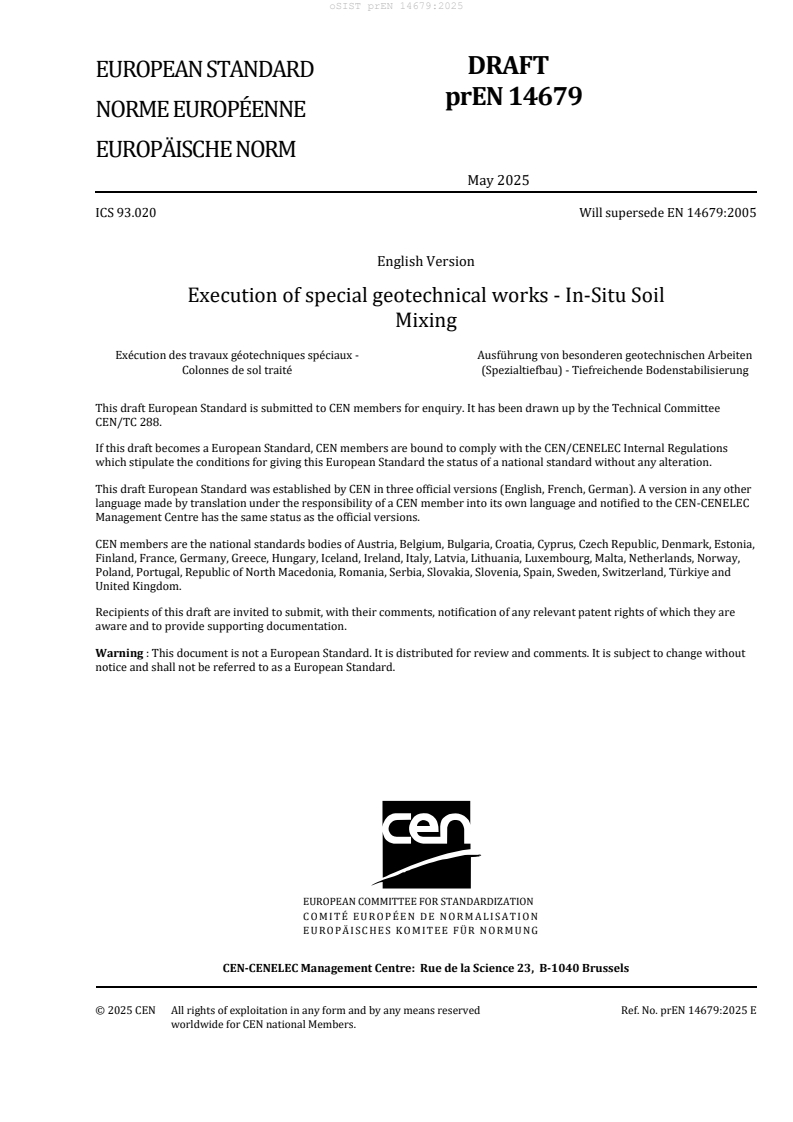
SLOVENSKI STANDARD
01-julij-2025
Izvedba posebnih geotehničnih del - Mešanje zemljin na mestu
Execution of special geotechnical works - In-Situ Soil Mixing
Ausführung von besonderen geotechnischen Arbeiten (Spezialtiefbau) - Tiefreichende
Bodenstabilisierung
Exécution des travaux géotechniques spéciaux — Malaxage des sols en place
Ta slovenski standard je istoveten z: prEN 14679
ICS:
93.020 Zemeljska dela. Izkopavanja. Earthworks. Excavations.
Gradnja temeljev. Dela pod Foundation construction.
zemljo Underground works
2003-01.Slovenski inštitut za standardizacijo. Razmnoževanje celote ali delov tega standarda ni dovoljeno.
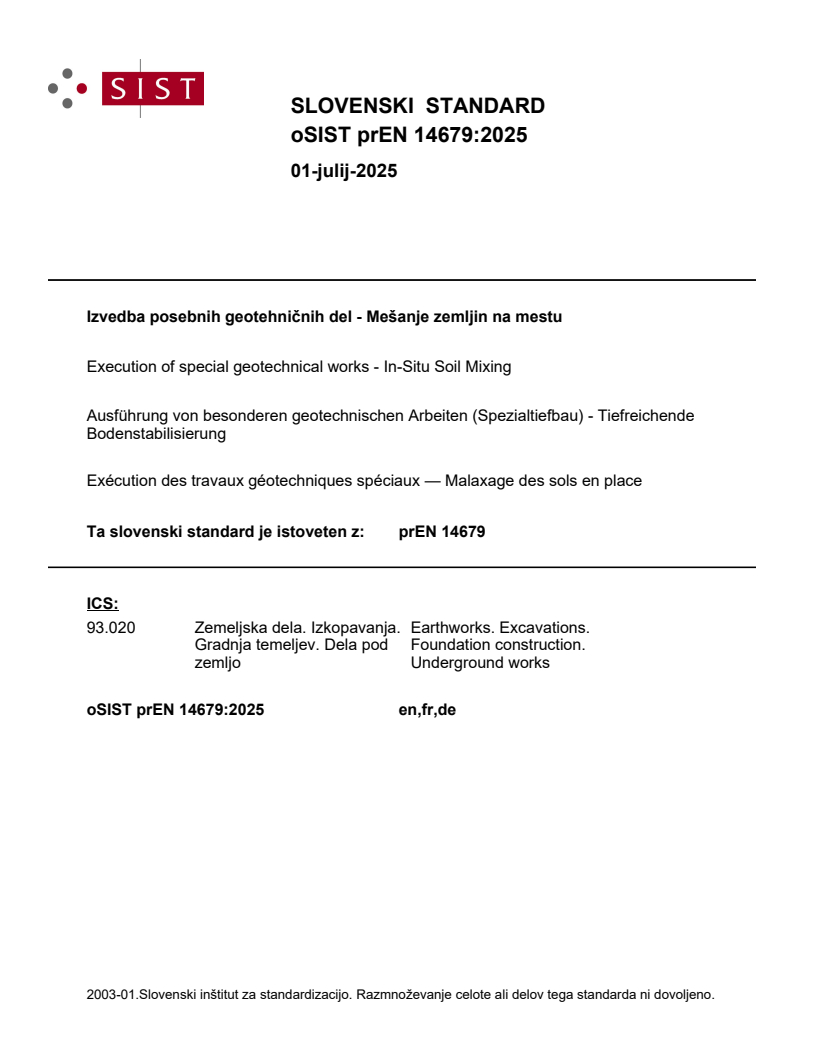
DRAFT
EUROPEAN STANDARD
NORME EUROPÉENNE
EUROPÄISCHE NORM
May 2025
ICS 93.020 Will supersede EN 14679:2005
English Version
Execution of special geotechnical works - In-Situ Soil
Mixing
Exécution des travaux géotechniques spéciaux - Ausführung von besonderen geotechnischen Arbeiten
Colonnes de sol traité (Spezialtiefbau) - Tiefreichende Bodenstabilisierung
This draft European Standard is submitted to CEN members for enquiry. It has been drawn up by the Technical Committee
CEN/TC 288.
If this draft becomes a European Standard, CEN members are bound to comply with the CEN/CENELEC Internal Regulations
which stipulate the conditions for giving this European Standard the status of a national standard without any alteration.
This draft European Standard was established by CEN in three official versions (English, French, German). A version in any other
language made by translation under the responsibility of a CEN member into its own language and notified to the CEN-CENELEC
Management Centre has the same status as the official versions.
CEN members are the national standards bodies of Austria, Belgium, Bulgaria, Croatia, Cyprus, Czech Republic, Denmark, Estonia,
Finland, France, Germany, Greece, Hungary, Iceland, Ireland, Italy, Latvia, Lithuania, Luxembourg, Malta, Netherlands, Norway,
Poland, Portugal, Republic of North Macedonia, Romania, Serbia, Slovakia, Slovenia, Spain, Sweden, Switzerland, Türkiye and
United Kingdom.
Recipients of this draft are invited to submit, with their comments, notification of any relevant patent rights of which they are
aware and to provide supporting documentation.
Warning : This document is not a European Standard. It is distributed for review and comments. It is subject to change without
notice and shall not be referred to as a European Standard.
EUROPEAN COMMITTEE FOR STANDARDIZATION
COMITÉ EUROPÉEN DE NORMALISATION
EUROPÄISCHES KOMITEE FÜR NORMUNG
CEN-CENELEC Management Centre: Rue de la Science 23, B-1040 Brussels
© 2025 CEN All rights of exploitation in any form and by any means reserved Ref. No. prEN 14679:2025 E
worldwide for CEN national Members.
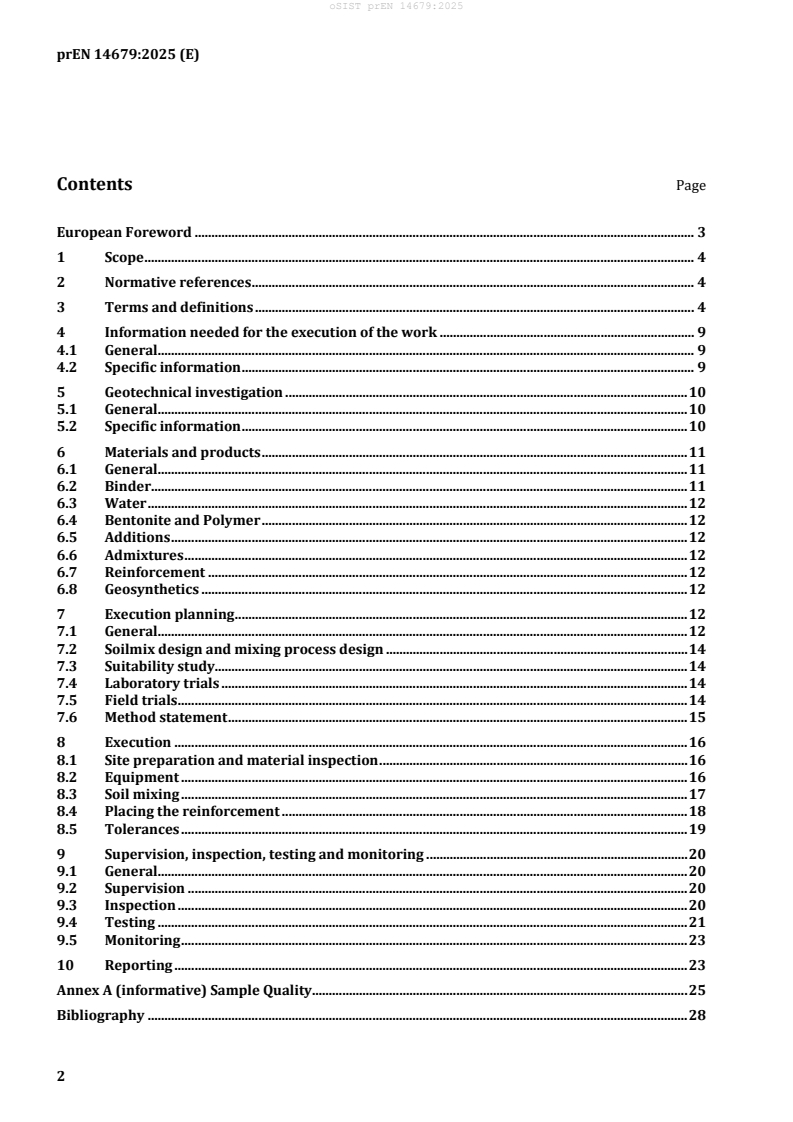
Contents Page
European Foreword . 3
1 Scope . 4
2 Normative references . 4
3 Terms and definitions . 4
4 Information needed for the execution of the work . 9
4.1 General. 9
4.2 Specific information . 9
5 Geotechnical investigation . 10
5.1 General. 10
5.2 Specific information . 10
6 Materials and products . 11
6.1 General. 11
6.2 Binder. 11
6.3 Water . 12
6.4 Bentonite and Polymer . 12
6.5 Additions . 12
6.6 Admixtures . 12
6.7 Reinforcement . 12
6.8 Geosynthetics . 12
7 Execution planning . 12
7.1 General. 12
7.2 Soilmix design and mixing process design . 14
7.3 Suitability study. 14
7.4 Laboratory trials . 14
7.5 Field trials . 14
7.6 Method statement . 15
8 Execution . 16
8.1 Site preparation and material inspection . 16
8.2 Equipment . 16
8.3 Soil mixing . 17
8.4 Placing the reinforcement . 18
8.5 Tolerances . 19
9 Supervision, inspection, testing and monitoring . 20
9.1 General. 20
9.2 Supervision . 20
9.3 Inspection . 20
9.4 Testing . 21
9.5 Monitoring . 23
10 Reporting . 23
Annex A (informative) Sample Quality . 25
Bibliography . 28
European Foreword
This document (prEN 14679:2025) has been prepared by Technical Committee CEN/TC 288 “Execution
of special geotechnical works”, the secretariat of which is held by AFNOR.
This document is currently submitted to CEN Enquiry.
This document will supersede EN 14679:2005.
The document has been prepared to stand alongside EN 1997-1:2024, EN 1997-2:2024 and
EN 1997-3:2025. This document provides full coverage of the construction and supervision
requirements.
1 Scope
This document specifies general principles for the execution, supervision, inspection, testing and
monitoring of in situ soil mixing works (Deep Mixing) carried out by two different methods: dry mixing
and wet mixing.
Soil mixing considered in this document is limited to methods which involve:
— mixing by rotating mechanical mixing tools, including jetting and/or compressed air assistance,
where the lateral support provided by the surrounding ground is not removed;
— different shapes and configurations of soil mixing elements, either columns, panels, walls or any
combination of more than one single element, with or without overlapping;
— treatment of soils and fills, including brownfields, sludges, etc., with possible limited penetration into
the rock;
— mass mixing;
— environmental mixing, involving installation of containment and permeable reactive barriers and
solidification/stabilization of contaminated soils and sludges.
This standard does not apply to shallow soil stabilization, which consists of granulating the surface soil
and mixing it with binder using soil stabilizing machines to improve soil performance as an alternative
to soil replacement, typically in road works.
2 Normative references
The following documents are referred to in the text in such a way that some or all of their content
constitutes requirements of this document. For dated references, only the edition cited applies. For
undated references, the latest edition of the referenced document (including any amendments) applies.
EN 197-1, Cement – Part 1: Composition, specification and conformity criteria for common cements
EN 197-5, Cement – Part 5: Cement Portland-composite cement CEM II/C-M and Composite cement CEM VI
EN 197-6, Cement — Part 6: Cement with recycled building materials
EN 206 (all parts), Concrete – Specification, performance, production and conformity
EN 1997-1, Eurocode 7: Geotechnical design – Part 1: General rules
EN 1997-2, Eurocode 7: Geotechnical design – Part 2: Ground properties
EN 1997-3:2025, Eurocode 7: Geotechnical design – Part 3: Geotechnical structures
EN 1008, Mixing water for concrete - Specification for sampling, testing and assessing the suitability of
water, including water recovered from processes in the concrete industry, as mixing water for concrete
3 Terms and definitions
For the purposes of this document, the following terms and definitions apply.
ISO and IEC maintain terminology databases for use in standardization at the following addresses:
— ISO Online browsing platform: available at https://www.iso.org/obp/
— IEC Electropedia: available at https://www.electropedia.org/
3.1
admixture
constituent added during the mixing process in small quantities related to binder mass to modify soilmix
or binder properties
3.2
addition
additive
fine-grained and inorganic constituent used to improve certain properties of soilmix or to achieve special
properties or to partially replace cement, e.g. filler aggregates, fly ash, granulated blast furnace slag
3.3
binder
chemically reactive material, including cement or similar products, with or without additions and
admixtures
Note 1 to entry: For environmental applications other materials with binder-like properties can be used
to meet the intended purpose
3.4
binder content [kg/m ]
ratio of mass of dry binder to volume of soil to be treated
Note 1 to entry: Binder quantity can also be defined as ratio of mass of dry binder to mass of dry soil, expressed in
percentage.
3.5
binder content in-place [kg/m ]
ratio of mass of dry binder to volume of mixture, which is the volume of the soil to be treated plus the
volume of the slurry for the wet method or the volume of the dry binder for the dry method
3.6
blade rotation number
BRN
indicator for mixing energy, applicable to paddle-type mixing tools, showing the total number of mixing
blade rotations per metre of tool movement
Note 1 to entry: Examples of BRN evaluation include the following formulas:
— for single-stroke wet mixing and slurry injection below the blades
R
R
p
w
BRN = Σ M +
VV
p w
— for single-stroke dry mixing and binder injection above the blades
R
w
BRN = Σ M
V
w
where:
BRN blade rotation number (rev./m),
ΣM total number of mixing blades (a full-diameter blade is counted as two blades, i.e. M = 2)
R rotational speed of the mixing tool during penetration (rev./min),
p
Vp penetration speed (m/min),
R rotational speed of the mixing tool during withdrawal (rev./min),
w
Vw withdrawal speed (m/min),
In the case of multiple restrokes along the entire treatment depth, the resulting blade rotation number is the sum
of the BRN values calculated for each stroke of the mixing tool. Other formulae can also be used to suit a particular
mixing tool configuration and process.
3.7
dry mixing
process of mechanical disaggregation of the soil in situ and its mixing with dry binder
3.8
hybrid mixing
wet mixing with the inclusion of a secondary process to assist or extend the mixing, e.g. using jetting
and/or compressed air
3.9
mass mixing
in situ treatment of the entire soil block, divided into working cells, using dry or wet mixing, carried out
repeatedly in vertical and horizontal directions through the soil mass using various mixing tools
Note 1 to entry: Usual practice is to treat in one sequence a cell of soil within the operational range of the machine.
Treatment depth is typically limited to about 8 m in favourable ground conditions.
3.10
mixing equipment
equipment with different mixing tools rotating around a vertical or horizontal axis, vertical trenching
tools, jet-assisted tools, cutters or drums, in single or multiple arrangements
Note 1 to entry: For tubular mixing, the mixing tools are arranged inside a casing.
3.11
mixing factor
indicator for mixing energy, similar to blade rotation number, but applicable to any soil mixing tool
(horizontal axis rotation, trencher, or other) except paddle-type vertical axis rotation tools
Note 1 to entry: The corresponding formula can be specified by the specialist contractor, along with a specification
of the minimum target mixing factor to be applied.
3.12
mixing process
mechanical disaggregation of the soil structure and dispersion of binder in the soil with or without the
use of added water, jetting or compressed air
3.13
mixing tool
tool used to disaggregate the soil and distribute and mix binder with the soil in situ
3.14
penetration
phase of mixing process cycle in which the mixing tool is delivered to the appropriate depth
3.15
penetration speed [m/min]
vertical movement per unit time of the mixing tool during penetration
Note 1 to entry: Can also be expressed as vertical movement per tool revolution, e.g. mm/rev.
3.16
process design
selection of an appropriate mixing method and mixing tool, and specification of the mixing process
parameters and binder or slurry feeding rates to meet the design requirements of the project
3.17
quality control plan
QCP
document containing the project-specific quality control and quality assurance programme to meet the
design requirements, including supervision, inspection, testing, monitoring and corrective action in case
of nonconformity
3.18
retrieval or withdrawal
phase of mixing process cycle in which the mixing tool is moved from bottom depth to the ground surface
3.19
rotation speed [rev./min]
number of revolutions of the mixing tool per unit time
3.20
sample quality class
classification of the samples extracted from the soil mix element according to their surface, structure,
amount of irregularities and composure
3.21
slurry
colloidal mixture of water and binder that assists in loosening the soil for effective mixing and improving
the characteristics of the in-situ soil upon setting
3.22
soil mixing
in situ ground treatment in which soil is blended with binder
3.23
soilmix design
ratios of soil, binder and water required to meet the design requirements of the treated soil
3.24
soilmix material
product of soil mixing, consisting of a mixture of the in-situ soil and binder, providing a material with
improved strength, hydraulic conductivity, and/or stiffness upon setting compared to the original soil
(also referred to as treated soil)
Note 1 to entry: For environmental applications it can be necessary to consider chemical properties.
3.25
soilmix element
volume of treated soil that is produced in situ during a single installation sequence using a mixing tool
Note 1 to entry: The geometry of the mixing tool and the mixing process determine the shape and size of the cross
section of an element (not applicable to mass mixing).
3.26
spoil return
surplus mixture of disaggregated soil or weak rock and dispersed binder, arising from the mixing process
3.27
stroke
one complete cycle (penetration and withdrawal) of the mixing process along the entire depth of
treatment (not applicable to mass mixing)
3.28
suitability study
laboratory and/or field trials to confirm soilmix design and/or process design
3.29
water to binder ratio
weight of water added to the dry binder divided by the weight of the dry binder
Note 1 to entry: For wet mixing, the total water to binder ratio of the soilmix material is the weight of slurry water
plus the weight of soil water divided by the weight of dry binder.
3.30
wet mixing
process of mechanical disaggregation of the soil in situ and its mixing with slurry
3.31
withdrawal speed [m/min]
vertical movement per unit time of the mixing tool during retrieval
Note 1 to entry: Can also be expressed as vertical movement per tool revolution, e.g. mm/rev.
4 Information needed for the execution of the work
4.1 General
4.1.1 Prior to the execution of the work, all relevant information shall be provided.
4.1.2 This information should include:
— any legal or statutory restrictions;
— the location of main grid lines for setting out element positions;
— the location and conditions of buildings, roads, utilities, etc., adjacent to the work area, including any
necessary surveys;
— a suitable quality management system, including supervision, inspection, testing and monitoring;
— the geometry of the site (boundary conditions, topography, access, slopes, etc.);
— available space for storage, treatment and/or disposal of spoil;
— archaeological constraints;
— potential presence of unexploded ordnance and its location;
— the environmental restrictions, including noise, vibration, pollution;
— future or ongoing construction activities, such as dewatering, tunnelling, deep excavations;
— the preparation and construction details of any working platform required for soil mixing in
accordance with the EFFC/DFI Guide.
4.2 Specific information
4.2.1 The specific information shall cover, where relevant:
— execution specifications;
— required properties of soilmix material;
— previous use of the site;
— adjacent structures and their foundations (types, state, loads and geometry);
— geotechnical information and data as specified in Clause 5;
— presence of any obstructions in the ground (old masonry, anchors, concrete, blocks and boulders,
etc.);
— certificate or written confirmation of removal of all unexploded ordnance;
— presence of headroom restrictions;
— presence of natural and/or man-made cavities (e.g. mines);
— presence of contaminated ground and type, extent and degree of contamination;
— any specific requirements for the soil mixing work, in particular those pertaining to tolerances,
quality of materials and methods of testing;
— where available, previous comparable experience with soil mixing works pertinent or relevant to the
site;
— proposed adjacent enabling or advance works such as underpinning, pre-treatment of soil,
dewatering;
— the extent and type of instrumentation required to monitor potentially affected structures, including
baseline measurements to establish reference conditions.
NOTE For underwater soil mixing operations, further specific information is needed to assess working
conditions and limit uncontrolled spread of spoil.
5 Geotechnical investigation
5.1 General
5.1.1 The investigations shall be sufficient to allow the determination of the ground conditions in
accordance with the requirements of EN 1997-2.
5.2 Specific information
5.2.1 In addition to EN 1997-2, the Ground Investigation Report shall contain the following information
relevant for the execution of soil mixing:
— the composition, lateral extent, thickness and firmness of the surface stratum, tree roots, fill, etc.;
— presence of cobbles or boulders, cemented layers or underlying rock that can cause difficulties for
the execution or could require special methods or tools;
— presence of swelling soil (e.g. montmorillonite);
— overconsolidated stiff clays;
— organic soils (e.g. peat);
— sensitive soils;
— water content of soils;
— cavities, voids or fissures;
— piezometric levels and/or flow of groundwater, its variation and possible artesian pressure.
5.2.2 Where relevant, the following additional information should be provided:
5.2.2.1 Physical and state characteristics of soils to be treated:
— classification in accordance with EN ISO 14688 (all parts);
— consistency limits;
— density;
— grain size distribution;
— mineralogy;
— organic content.
5.2.2.2 Properties of soils to be treated:
— stiffness and degree of consolidation;
— strength;
— hydraulic conductivity.
5.2.2.3 Environmental, chemical and biological characteristics:
— ground and groundwater quality, e.g. contamination, aggressiveness, chemistry, pH- value, type and
concentration of ions and metals.
6 Materials and products
6.1 General
6.1.1 The constituents shall meet the requirements of the respective European Standards and those
given in the project specification.
NOTE For more information, see also local regulations.
6.1.2 The sources of supply for constituents shall be documented and shall not be changed without
prior notification.
6.2 Binder
6.2.1 Cement for soil mixing shall comply with EN 197-1, EN 197-5 or EN 197-6.
6.2.2 The selection of binder in relation to the exposure classes should in general be in accordance with
EN 206 (all parts). Given the differences between concrete and soilmix material, suitability testing or
comparable experience should be used to assist in this selection.
6.2.3 Additions (as defined in EN 206 (all parts)) may be used as cement replacement where the
required performance is proven by suitability testing or comparable experience.
NOTE Other binders can cause adverse reactions with the ground.
6.2.4 Calcium aluminate cement shall not be used.
6.3 Water
6.3.1 In absence of specific standard, mixing water shall comply with EN 1008.
6.3.2 Saline water may be used providing there are no detrimental effects to embedded steel.
NOTE The salinity can also influence the choice of binder.
6.4 Bentonite and Polymer
6.4.1 Bentonite or polymer used shall not contain harmful constituents in such quantities that could be
detrimental to soil mixing elements or their reinforcement.
6.4.2 The chemical and mineralogical composition of the bentonite shall be considered.
6.4.3 The chemical composition of polymer shall be considered.
6.5 Additions
6.5.1 Additions used shall comply with EN 206 (all parts).
6.6 Admixtures
6.6.1 Admixtures used shall comply with EN 206 (all parts).
6.7 Reinforcement
6.7.1 Where reinforcement is used, the material shall comply with the relevant European standard.
6.8 Geosynthetics
6.8.1 Where geosynthetics are required within soilmix elements, they shall comply with the relevant
European standards.
NOTE Interlocking geomembranes can be used to achieve very low permeability.
7 Execution planning
7.1 General
7.1.1 Generalized flow chart of soil mixing projects as shown in Figure 1 should be used prior to and
for execution planning.
Figure 1 — Design and execution flow chart of soil mixing projects
7.1.2 The determination of the properties of the soilmix material shall be in accordance with
EN 1997-3:2025, Clause 12.
7.1.3 The sequence and rate of installation of the soilmix elements shall be planned to avoid localized
soil failure or unacceptable ground movement, taking into account the setting and curing time of the
soilmix material.
NOTE Soilmix elements installed in close proximity to existing structures and foundations can affect their
stability or serviceability.
7.1.4 The execution of other foundation works at a distance of less than 5 m and within a week after
the installation of the soilmix element, that could affect its condition, should be avoided.
NOTE The risk is increased if foundation works (e.g. piling, excavation, compaction, etc.) is carried out during
and immediately after the installation of the soilmix element due to the limited strength at young ages of the soilmix
material.
7.1.5 Where the soilmix element is designed for end-bearing capacity, the mixing tool and process shall
be prescribed to ensure a proper treatment at the base of the element.
7.1.6 In critical ground conditions with unpredictable interactions between the binder and soil,
...
Questions, Comments and Discussion
Ask us and Technical Secretary will try to provide an answer. You can facilitate discussion about the standard in here.
Loading comments...