

EN 3642:1996
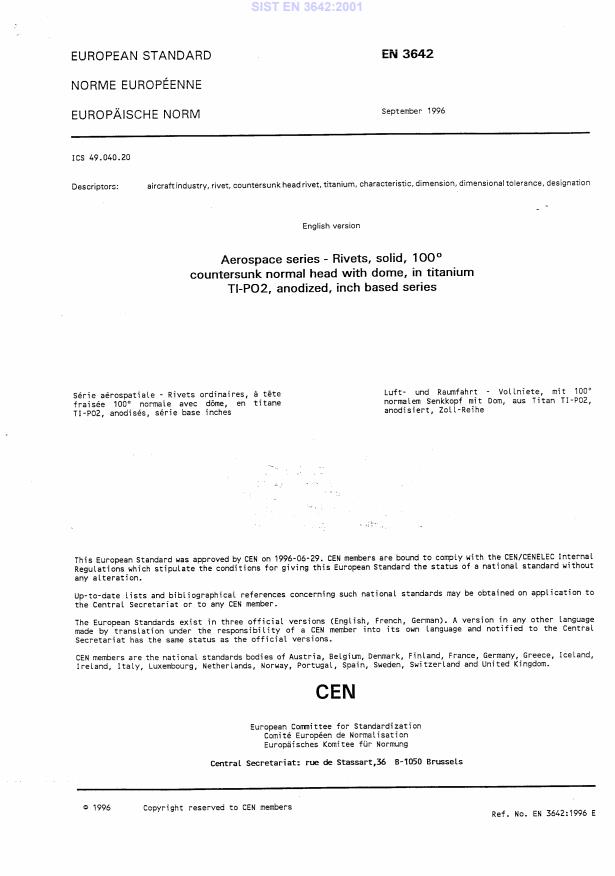
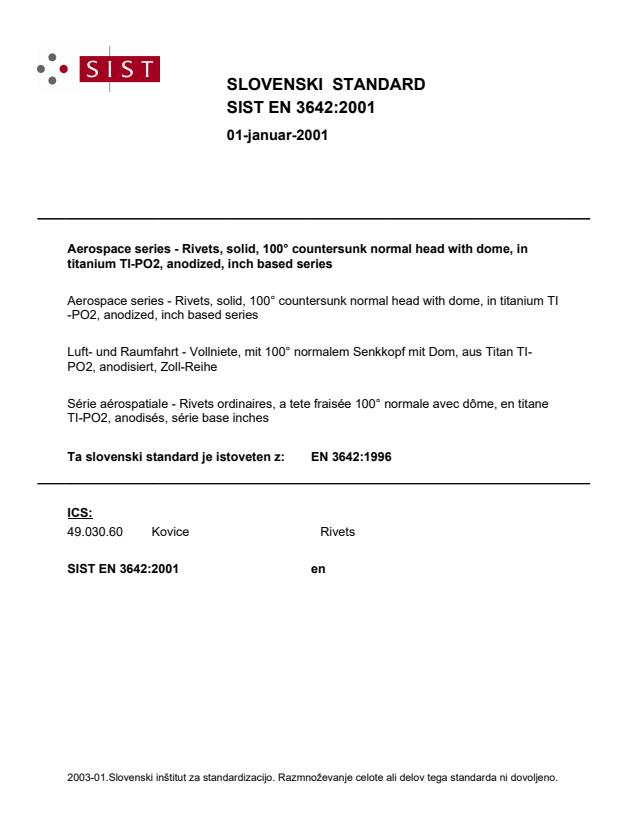
(Main)Aerospace series - Rivets, solid, 100° countersunk normal head with dome, in titanium TI-PO2, anodized, inch based series
- Abstract
This standard specifies the characteristics of solid rivets, with 100° countersunk normal head with dome, in titanium TI-PO2, anodized, inch based series, for maximum operating temperature 315°C.
- Status
- Published
- Publication Date
- 24-Sep-1996
- Withdrawal Date
- 30-Mar-1997
- Technical Committee
- ASD-STAN - Aerospace
- Drafting Committee
- ASD-STAN/D 3 - Mechanical
- Current Stage
- 9093 - Decision to confirm - Review Enquiry
- Start Date
- 31-May-2017
- Completion Date
- 30-Sep-2026

Overview
EN 3642:1996 - Aerospace series - specifies the characteristics of solid rivets, 100° countersunk normal head with dome, made from titanium TI-PO2, anodized, inch based series. The standard is published by CEN and covers rivets intended for aerospace use with a maximum operating temperature of 315 °C. It defines the form, finish and key requirements needed to ensure consistent performance in aircraft and related applications.
Key topics and technical requirements
The standard focuses on the essential characteristics and quality attributes of the specified rivet type. Typical topics addressed include:
- Material and finish: use of titanium grade TI‑PO2 and anodized surface treatment to improve corrosion resistance and appearance.
- Head style and geometry: definition of the 100° countersunk normal head with dome profile in an inch-based size series.
- Operating temperature: suitability and limits - rated for service up to 315 °C.
- Dimensional requirements: standardized diameters, lengths and head dimensions for interchangeability (inch series).
- Mechanical and physical characteristics: requirements that relate to strength, ductility and compatibility with aerospace assemblies.
- Manufacturing and inspection: acceptance criteria, testing and quality checks to verify conformity.
- Marking and documentation: traceability, batch identification and accompanying technical information for procurement and certification.
(Exact dimensional and test values are specified in the standard document.)
Applications and who uses this standard
EN 3642 is intended for organizations who design, manufacture, procure or maintain aerospace structures that require lightweight, corrosion-resistant fastening solutions. Typical users include:
- Aircraft and aerospace component manufacturers specifying fasteners for structural assemblies.
- Fastener suppliers and manufacturers producing titanium countersunk rivets.
- Design and stress engineers selecting rivets for flush surfaces and aerodynamic skins.
- Maintenance, repair and overhaul (MRO) providers replacing rivets to standard conforming parts.
- Quality, procurement and regulatory teams ensuring parts meet aerospace conformity and traceability requirements.
Common use cases: flush fastening of aircraft skins, interior and exterior assemblies requiring low-profile heads, high-temperature locations up to 315 °C, and applications where titanium’s strength-to-weight and corrosion resistance are required.
Related standards
For full compliance and system-level design, users often consult other aerospace fastener and material standards (EN series and manufacturer specifications) covering rivet installation, other rivet head forms, titanium alloys and surface treatments.
Keywords: EN 3642, aerospace rivets, titanium TI‑PO2, 100° countersunk rivet, anodized rivets, inch based series, maximum operating temperature 315 °C, CEN.
Get Certified
Connect with accredited certification bodies for this standard

BUREAU VERITAS Certification Germany
Bureau Veritas certification in Germany.

Element Materials Technology
Materials testing and product certification.

AQMS Ltd.
AQMS provides ISO certification to SMEs across the UK.
Sponsored listings
Frequently Asked Questions
EN 3642:1996 is a standard published by the European Committee for Standardization (CEN). Its full title is "Aerospace series - Rivets, solid, 100° countersunk normal head with dome, in titanium TI-PO2, anodized, inch based series". This standard covers: This standard specifies the characteristics of solid rivets, with 100° countersunk normal head with dome, in titanium TI-PO2, anodized, inch based series, for maximum operating temperature 315°C.
This standard specifies the characteristics of solid rivets, with 100° countersunk normal head with dome, in titanium TI-PO2, anodized, inch based series, for maximum operating temperature 315°C.
EN 3642:1996 is classified under the following ICS (International Classification for Standards) categories: 49.030.99 - Other fasteners. The ICS classification helps identify the subject area and facilitates finding related standards.
EN 3642:1996 is available in PDF format for immediate download after purchase. The document can be added to your cart and obtained through the secure checkout process. Digital delivery ensures instant access to the complete standard document.
Standards Content (Sample)
2003-01.Slovenski inštitut za standardizacijo. Razmnoževanje celote ali delov tega standarda ni dovoljeno.Aerospace series - Rivets, solid, 100° countersunk normal head with dome, in titanium TI-PO2, anodized, inch based seriesLuft- und Raumfahrt - Vollniete, mit 100° normalem Senkkopf mit Dom, aus Titan TI-PO2, anodisiert, Zoll-ReiheSérie aérospatiale - Rivets ordinaires, a tete fraisée 100° normale avec dôme, en titane TI-PO2, a
...