


EN 14626:2024
(Main)Ambient air - Standard method for the measurement of the concentration of carbon monoxide by non-dispersive infrared spectroscopy
Ambient air - Standard method for the measurement of the concentration of carbon monoxide by non-dispersive infrared spectroscopy
This European Standard specifies a continuous measurement method for the determination of the concentration of carbon monoxide present in ambient air based on the non-dispersive infrared spectroscopic measuring principle.
This standard describes the performance characteristics and sets the relevant minimum criteria required to select an appropriate non-dispersive infrared spectroscopic analyser by means of type approval tests. It also includes the evaluation of the suitability of an analyser for use in a specific fixed site so as to meet the data quality requirements as specified in Annex I of Directive 2008/50/EC [1] and requirements during sampling, calibration and quality assurance for use.
The method is applicable to the determination of the mass concentration of carbon monoxide present in ambient air up to 100 mg/m3 carbon monoxide. This concentration range represents the certification range for the type approval test.
NOTE 1 Other ranges may be used depending on the levels present in ambient air.
NOTE 2 When the standard is used for other purposes than for measurements required by Directive 2008/50/EC, the ranges and uncertainty requirements may not apply.
The method covers the determination of ambient air concentrations of carbon monoxide in zones classified as rural areas, urban-background areas and traffic-orientated locations and locations influenced by industrial sources.
The results are expressed in mg/m3 (at 20 °C and 101,3 kPa).
NOTE 3 100 mg/m3 of CO corresponds to 86 μmol/mol of CO.
This standard contains information for different groups of users.
Clauses 5 to 7 and Annexes B, C and D contain general information about the principles of carbon monoxide measurement by non-dispersive infrared spectroscopic analyser and sampling equipment.
Clause 8 and Annex E are specifically directed towards test houses and laboratories that perform type-approval testing of carbon monoxide analysers. These sections contain information about:
− type-approval test conditions, test procedures and test requirements;
− analyser performance requirements;
− evaluation of the type-approval test results;
− evaluation of the uncertainty of the measurement results of the carbon monoxide analyser based on the type approval test results.
Clauses 9 to 11 and Annex F are directed towards monitoring networks performing the practical measurements of carbon monoxide in ambient air. These sections contain information about:
− initial installation of the analyser in the monitoring network and acceptance testing;
− ongoing quality assurance/quality control;
− calculation and reporting of measurement results;
− evaluation of the uncertainty of measurement results under practical monitoring conditions.
Außenluft - Messverfahren zur Bestimmung der Konzentration von Kohlenstoffmonoxid mit nicht-dispersiver Infrarot-Photometrie
Dieses Dokument legt ein kontinuierliches Messverfahren zur Bestimmung der Konzentration von Kohlenstoffmonoxid in Außenluft auf der Grundlage des nicht-dispersiven Infrarotspektroskopie-Messprinzips fest. Dieses Dokument beschreibt die Leistungskenngrößen und legt die zutreffenden Mindestanforderungen für die Auswahl eines geeigneten nicht-dispersiven Infrarotspektroskopie-Messgeräts mit Hilfe der Eignungsprüfung fest. Es beinhaltet auch die Bewertung der Eignung eines Messgeräts für den Einsatz an einem bestimmten ortsfesten Messstandort zur Erfüllung der Anforderungen an die Datenqualität (siehe Anhang I der Richtlinie 2008/50/EG [1] für weitere Informationen) und der Anforderungen für Probennahme, Kalibrierung und Qualitätssicherung für den Gebrauch.
Das Verfahren ist anwendbar zur Bestimmung der Massenkonzentration von Kohlenstoffmonoxid in Außenluft bis 100 mg/m3 Kohlenstoffmonoxid. Dieser Konzentrationsbereich entspricht dem Zertifizierungsbereich für die Eignungsprüfung.
ANMERKUNG 1 Je nach Konzentrationsniveau in der Luft können andere Bereiche verwendet werden.
ANMERKUNG 2 Wird diese Norm für andere Zwecke als für Messungen nach Richtlinie 2008/50/EG eingesetzt, dann könnten die Anforderungen hinsichtlich Anwendungsbereiches und Unsicherheit nicht zur Geltung kommen.
Das Verfahren umfasst die Bestimmung der Konzentration von Kohlenstoffmonoxid in der Außenluft an Standorten, die als ländlicher oder städtischer Hintergrund klassifiziert sind und Messpunkte, die durch Verkehr oder industrielle Quellen beeinflusst werden.
Die Ergebnisse werden in mg/m3 (bei 20 °C und 101,3 kPa) angegeben.
ANMERKUNG 3 100 mg/m3 CO entspricht 86 µmol/mol CO.
Dieses Dokument enthält Informationen für verschiedene Nutzergruppen.
Abschnitt 5 bis Abschnitt 7 und Anhang B, Anhang C und Anhang D enthalten allgemeine Informationen über die Grundlagen der Kohlenstoffmonoxid-Messung mit einem nicht-dispersiven Infrarotspektroskopie-Messgerät sowie über die Probenahmevorrichtung.
Abschnitt 8 und Anhang E richten sich speziell an Prüfinstitute und -laboratorien, die Eignungsprüfungen von Kohlenstoffmonoxid-Messgeräten durchführen. Diese Abschnitte enthalten Informationen über:
- Prüfbedingungen, -verfahren und -anforderungen bei der Eignungsprüfung;
- Anforderungen an die Leistungsfähigkeit des Messgeräts;
- die Bewertung der Ergebnisse der Eignungsprüfung;
- die Bewertung der Unsicherheit der Messung des Kohlenstoffmonoxid-Messgeräts auf der Grundlage der Ergebnisse der Eignungsprüfung.
Abschnitt 9 bis Abschnitt 11 und Anhang F richten sich Betreiber von Messnetzen, die Kohlenstoffmonoxid-Messungen in Außenluft durchführen. Diese Abschnitte enthalten Informationen über:
- die Erstinstallation des Messgeräts im Messnetz und Eignungsbewertung;
- die laufende Qualitätssicherung und -kontrolle;
- die Berechnung und Übermittlung der Messergebnisse;
- die Bewertung der Unsicherheit der Messergebnisse unter praktischen Messbedingungen.
Das vorliegende Dokument stellt eine Weiterentwicklung der vorangegangenen Ausgaben (EN 14626:2005 und EN 14626: 2012) dar.
ANMERKUNG 4 Messgeräte, die vor der Veröffentlichung dieses Dokuments einer Eignungsprüfung unterzogen wurden, können weiterhin für regulatorische Überwachungen verwendet werden. Sobald neuere Versionen der nach diesem Dokument geprüften Messgeräte verfügbar sind, muss die Verwendung eingestellt werden.
Air ambiant - Méthode normalisée de mesurage de la concentration en monoxyde de carbone par spectroscopie à rayonnement infrarouge non dispersif
Le présent document spécifie une méthode de mesurage en continu pour la détermination de la concentration en monoxyde de carbone dans l'air ambiant, selon le principe de mesure par spectroscopie à rayonnement infrarouge non dispersif. Le présent document décrit les caractéristiques de performance et fixe les critères minimaux requis pour sélectionner un analyseur par spectroscopie à rayonnement infrarouge non dispersif à l'aide de l’essai de type. Il présente également l'évaluation de l'aptitude à l'emploi d'un analyseur sur un site fixe spécifique afin de répondre aux exigences de qualité des données (voir l'Annexe I de la Directive 2008/50/CE [1] pour des informations supplémentaires) ainsi qu'aux exigences à observer au cours du prélèvement, de l'étalonnage et de l'assurance qualité.
La méthode s'applique à la détermination de la concentration massique en monoxyde de carbone présent dans l'air ambiant jusqu'à 100 mg/m3. Cette plage de concentration représente l'étendue de mesure certifiée pour l’essai de type.
NOTE 1 D'autres plages peuvent être utilisées selon les niveaux présents dans l'air ambiant.
NOTE 2 Lorsque la norme est utilisée à d'autres fins que la Directive 2008/50/CE, les exigences relatives à la plage et à l'incertitude peuvent ne pas s'appliquer.
La méthode couvre la détermination des concentrations en monoxyde de carbone présent dans l'air ambiant dans les lieux classés comme zones rurales et zones urbaines de fond, ainsi que pour les points de prélèvement influencés par la circulation automobile ou des sources industrielles.
Les résultats sont exprimés en mg/m3 (à 20 °C et 101,3 kPa).
NOTE 3 100 mg/m3 de CO correspondent à 86 µmol/mol de CO.
Le présent document contient des informations pour différents groupes d'utilisateurs.
Les Articles 5 à 7 et les Annexes B, C et D contiennent des informations générales relatives aux principes de mesurage du monoxyde de carbone à l'aide d'un analyseur par spectroscopie à rayonnement infrarouge non dispersif et d'un équipement de prélèvement.
L'Article 8 et l'Annexe E concernent tout particulièrement les entreprises et les laboratoires d'essai qui effectuent l’essai de type des analyseurs de monoxyde de carbone. Ces sections contiennent des informations concernant :
- les conditions de l’essai de type, les procédures de test et les exigences d'essai ;
- les exigences de performance de l'analyseur ;
- l'évaluation des résultats de l’essai de type ;
- l'évaluation de l'incertitude associée au mesurage effectué par l'analyseur de monoxyde de carbone d'après les résultats de l’essai de type.
Les Articles 9 à 11 et l'Annexe F concernent les réseaux de surveillance effectuant les mesurages concrets du monoxyde de carbone dans l'air ambiant. Ces sections contiennent des informations concernant :
- l'installation initiale de l'analyseur dans le réseau de surveillance et l'essai de réception ;
- l'assurance qualité/le contrôle qualité en continu ;
- le calcul et le compte-rendu des résultats de mesurage ;
- l'évaluation de l'incertitude des résultats de mesure sous des conditions de surveillance réelles.
Le présent document représente une évolution par rapport aux éditions antérieures (EN 14626:2005 et EN 14626: 2012).
NOTE 4 Les analyseurs soumis à essai de type avant la publication du présent document peuvent toujours être utilisés à des fins de surveillance réglementaire. Au fur et à mesure que de nouvelles versions des analyseurs testés dans le cadre du présent document sont disponibles, cesser d'utiliser les anciens analyseurs de référence.
Zunanji zrak - Standardna metoda za določanje koncentracije ogljikovega monoksida z nedisperzivno infrardečo spektroskopijo
Ta dokument določa metodo stalnega merjenja za določitev koncentracije ogljikovega monoksida v zunanjem zraku na podlagi nedisperznega infrardečega spektroskopskega merilnega principa. Ta dokument opisuje lastnosti delovanja in vzpostavlja ustrezna minimalna merila, potrebna za izbiro ustreznega nedisperznega infrardečega spektroskopskega analizatorja s tipskimi preskusi. Vključuje tudi oceno ustreznosti analizatorja za uporabo na specifičnem fiksnem mestu, da se izpolnijo zahteve o kakovosti podatkov (za več informacij glej dodatek I Direktive 2008/50/ES [1]) ter zahteve med vzorčenjem, kalibriranjem in zagotavljanjem kakovosti za uporabo.
Metoda se uporablja za določitev masne koncentracije ogljikovega monoksida v zunanjem zraku do vrednosti 100 mg/m3 ogljikovega monoksida. Te koncentracije predstavljajo razpon certificiranja za tipske preskuse.
OPOMBA 1: Uporabiti je mogoče tudi druge koncentracije, odvisno od ravni v zunanjem zraku.
OPOMBA 2: Če se standard uporablja za druge namene, ne za meritve v skladu z Direktivo 2008/50/ES, zahteve glede razponov in negotovosti morda ne veljajo.
Ta metoda zajema določitev koncentracij ogljikovega monoksida v zunanjem zraku na lokacijah, ki so uvrščene med podeželska območja in območja v urbanem okolju, ter za odvzemna mesta, na katera vpliva promet ali industrijski viri.
Rezultati so izraženi v mg/m3 (pri 20 °C in 101,3 kPa).
OPOMBA 3: 100 mg/m3 ogljikovega monoksida (CO) ustreza 86 μmol/mol ogljikovega monoksida.
Ta dokument vsebuje informacije za različne skupine uporabnikov.
Točke od 5 do 7 ter dodatki B, C in D vsebujejo splošne informacije o načelih merjenja ogljikovega monoksida z nedisperznim infrardečim spektroskopskim analizatorjem in opremo za vzorčenje.
Osrednji predmet obravnave v točki 8 in dodatku E so laboratoriji, ki izvajajo tipske preskuse analizatorjev ogljikovega monoksida. Ti razdelki vsebujejo informacije o:
pogojih tipskih preskusov ter preskusnih postopkih in zahtevah;
zahtevah glede učinkovitosti analizatorja;
ocenah rezultatov tipskih preskusov;
oceni povezane negotovosti meritev analizatorja ogljikovega monoksida na podlagi rezultatov tipskih preskusov.
Osrednji predmet obravnave v točkah od 9 do 11 ter dodatku F so mreže za spremljanje, ki izvajajo praktične meritve ogljikovega monoksida v zunanjem zraku. Ti razdelki vsebujejo informacije o:
začetni namestitvi analizatorja v mreži za spremljanje in preskušanju sprejemljivosti;
stalnem zagotavljanju oziroma nadzoru kakovosti;
izračunavanju in sporočanju rezultatov merjenja;
oceni negotovosti rezultatov merjenja v okviru pogojev praktičnega spremljanja.
Ta dokument je nadgradnja prejšnjih različic (EN 14626:2005 in EN 14626: (2012).
OPOMBA 4: Analizatorje, ki so bili tipsko preskušeni pred objavo tega dokumenta, je mogoče še vedno uporabljati za regulirano spremljanje. S pojavom novejših različic analizatorjev, preskušenih v skladu s tem dokumentom, se uporaba starejših referenčnih analizatorjev preneha.
General Information
- Status
- Published
- Publication Date
- 17-Dec-2024
- Technical Committee
- CEN/TC 264 - Air quality
- Current Stage
- 6060 - Definitive text made available (DAV) - Publishing
- Start Date
- 18-Dec-2024
- Due Date
- 18-Dec-2023
- Completion Date
- 18-Dec-2024
Relations
- Effective Date
- 13-Jun-2018
Overview
EN 14626:2024 - Ambient air: Standard method for the measurement of the concentration of carbon monoxide by non-dispersive infrared spectroscopy (NDIR) - is a CEN European Standard that defines a continuous measurement method and minimum performance criteria for CO analysers used in ambient air monitoring. The standard covers type-approval testing, field installation, sampling, calibration, quality assurance and uncertainty evaluation for fixed-site monitoring up to 100 mg/m³ CO (certification range). Results are expressed in mg/m³ (at 20 °C and 101,3 kPa) (100 mg/m³ ≈ 86 μmol/mol).
Key topics and technical requirements
- Measurement principle: Continuous determination of carbon monoxide concentration using non-dispersive infrared spectroscopic analysers (NDIR).
- Performance characteristics required for type approval and field use, including:
- Response time, short-term drift and long-term drift
- Repeatability and reproducibility
- Linearity / lack-of-fit of calibration
- Sensitivity coefficients (sample gas pressure, sample temperature, ambient temperature, electrical voltage)
- Interferent testing and averaging behaviour
- Difference between sample and calibration ports
- Availability and period of unattended operation
- Type testing procedures (Clauses 8, Annex E): laboratory and field type-approval test conditions, test methods, evaluation of results and uncertainty calculation based on type-test data.
- Sampling system requirements (Clauses 5–7, Annex B): sampling location, construction, particle filters, conditioning, flow regulation, pumps and measures to limit CO loss in the system.
- Field operation and QA/QC (Clauses 9–11, Annex F): initial installation and acceptance testing, calibration gas requirements, zero/span checks, routine maintenance, data handling, reporting and calculation of measurement uncertainty to meet data quality objectives.
- Scope of application: suitable for rural, urban-background, traffic-oriented and industrial-influenced monitoring sites.
Applications and typical users
Who uses EN 14626:2024:
- Environmental monitoring networks and air quality authorities implementing fixed-site CO monitoring.
- Instrument manufacturers designing NDIR CO analysers seeking type approval.
- Test houses and calibration laboratories performing type-approval testing and uncertainty evaluation.
- Regulators, consultants and compliance teams assessing suitability of analysers to meet Directive 2008/50/EC data quality requirements. Practical applications include regulatory ambient air monitoring, network quality assurance, and procurement/validation of continuous CO analysers.
Related standards and references
- Directive 2008/50/EC (ambient air quality and cleaner air for Europe) - data quality requirements referenced in the standard.
- CEN organizational context: EN 14626:2024 replaces EN 14626:2012 and is adoptable as a national standard by CEN members.
For organisations implementing or procuring CO monitoring systems, EN 14626:2024 is the authoritative reference for NDIR analyser performance, type approval and practical QA/QC in ambient air monitoring.

Frequently Asked Questions
EN 14626:2024 is a standard published by the European Committee for Standardization (CEN). Its full title is "Ambient air - Standard method for the measurement of the concentration of carbon monoxide by non-dispersive infrared spectroscopy". This standard covers: This European Standard specifies a continuous measurement method for the determination of the concentration of carbon monoxide present in ambient air based on the non-dispersive infrared spectroscopic measuring principle. This standard describes the performance characteristics and sets the relevant minimum criteria required to select an appropriate non-dispersive infrared spectroscopic analyser by means of type approval tests. It also includes the evaluation of the suitability of an analyser for use in a specific fixed site so as to meet the data quality requirements as specified in Annex I of Directive 2008/50/EC [1] and requirements during sampling, calibration and quality assurance for use. The method is applicable to the determination of the mass concentration of carbon monoxide present in ambient air up to 100 mg/m3 carbon monoxide. This concentration range represents the certification range for the type approval test. NOTE 1 Other ranges may be used depending on the levels present in ambient air. NOTE 2 When the standard is used for other purposes than for measurements required by Directive 2008/50/EC, the ranges and uncertainty requirements may not apply. The method covers the determination of ambient air concentrations of carbon monoxide in zones classified as rural areas, urban-background areas and traffic-orientated locations and locations influenced by industrial sources. The results are expressed in mg/m3 (at 20 °C and 101,3 kPa). NOTE 3 100 mg/m3 of CO corresponds to 86 μmol/mol of CO. This standard contains information for different groups of users. Clauses 5 to 7 and Annexes B, C and D contain general information about the principles of carbon monoxide measurement by non-dispersive infrared spectroscopic analyser and sampling equipment. Clause 8 and Annex E are specifically directed towards test houses and laboratories that perform type-approval testing of carbon monoxide analysers. These sections contain information about: − type-approval test conditions, test procedures and test requirements; − analyser performance requirements; − evaluation of the type-approval test results; − evaluation of the uncertainty of the measurement results of the carbon monoxide analyser based on the type approval test results. Clauses 9 to 11 and Annex F are directed towards monitoring networks performing the practical measurements of carbon monoxide in ambient air. These sections contain information about: − initial installation of the analyser in the monitoring network and acceptance testing; − ongoing quality assurance/quality control; − calculation and reporting of measurement results; − evaluation of the uncertainty of measurement results under practical monitoring conditions.
This European Standard specifies a continuous measurement method for the determination of the concentration of carbon monoxide present in ambient air based on the non-dispersive infrared spectroscopic measuring principle. This standard describes the performance characteristics and sets the relevant minimum criteria required to select an appropriate non-dispersive infrared spectroscopic analyser by means of type approval tests. It also includes the evaluation of the suitability of an analyser for use in a specific fixed site so as to meet the data quality requirements as specified in Annex I of Directive 2008/50/EC [1] and requirements during sampling, calibration and quality assurance for use. The method is applicable to the determination of the mass concentration of carbon monoxide present in ambient air up to 100 mg/m3 carbon monoxide. This concentration range represents the certification range for the type approval test. NOTE 1 Other ranges may be used depending on the levels present in ambient air. NOTE 2 When the standard is used for other purposes than for measurements required by Directive 2008/50/EC, the ranges and uncertainty requirements may not apply. The method covers the determination of ambient air concentrations of carbon monoxide in zones classified as rural areas, urban-background areas and traffic-orientated locations and locations influenced by industrial sources. The results are expressed in mg/m3 (at 20 °C and 101,3 kPa). NOTE 3 100 mg/m3 of CO corresponds to 86 μmol/mol of CO. This standard contains information for different groups of users. Clauses 5 to 7 and Annexes B, C and D contain general information about the principles of carbon monoxide measurement by non-dispersive infrared spectroscopic analyser and sampling equipment. Clause 8 and Annex E are specifically directed towards test houses and laboratories that perform type-approval testing of carbon monoxide analysers. These sections contain information about: − type-approval test conditions, test procedures and test requirements; − analyser performance requirements; − evaluation of the type-approval test results; − evaluation of the uncertainty of the measurement results of the carbon monoxide analyser based on the type approval test results. Clauses 9 to 11 and Annex F are directed towards monitoring networks performing the practical measurements of carbon monoxide in ambient air. These sections contain information about: − initial installation of the analyser in the monitoring network and acceptance testing; − ongoing quality assurance/quality control; − calculation and reporting of measurement results; − evaluation of the uncertainty of measurement results under practical monitoring conditions.
EN 14626:2024 is classified under the following ICS (International Classification for Standards) categories: 13.040.20 - Ambient atmospheres. The ICS classification helps identify the subject area and facilitates finding related standards.
EN 14626:2024 has the following relationships with other standards: It is inter standard links to EN 14626:2012. Understanding these relationships helps ensure you are using the most current and applicable version of the standard.
EN 14626:2024 is associated with the following European legislation: EU Directives/Regulations: 2008/50/EC. When a standard is cited in the Official Journal of the European Union, products manufactured in conformity with it benefit from a presumption of conformity with the essential requirements of the corresponding EU directive or regulation.
You can purchase EN 14626:2024 directly from iTeh Standards. The document is available in PDF format and is delivered instantly after payment. Add the standard to your cart and complete the secure checkout process. iTeh Standards is an authorized distributor of CEN standards.
Standards Content (Sample)
SLOVENSKI STANDARD
01-april-2025
Nadomešča:
SIST EN 14626:2012
Zunanji zrak - Standardna metoda za določanje koncentracije ogljikovega
monoksida z nedisperzivno infrardečo spektroskopijo
Ambient air - Standard method for the measurement of the concentration of carbon
monoxide by non-dispersive infrared spectroscopy
Außenluft - Messverfahren zur Bestimmung der Konzentration von Kohlenmonoxid mit
nicht-dispersiver Infrarot-Photometrie
Air ambiant - Méthode normalisée de mesurage de la concentration en monoxyde de
carbone par spectroscopie à rayonnement infrarouge non dispersif
Ta slovenski standard je istoveten z: EN 14626:2024
ICS:
13.040.20 Kakovost okoljskega zraka Ambient atmospheres
2003-01.Slovenski inštitut za standardizacijo. Razmnoževanje celote ali delov tega standarda ni dovoljeno.
EN 14626
EUROPEAN STANDARD
NORME EUROPÉENNE
December 2024
EUROPÄISCHE NORM
ICS 13.040.20 Supersedes EN 14626:2012
English Version
Ambient air - Standard method for the measurement of the
concentration of carbon monoxide by non-dispersive
infrared spectroscopy
Air ambiant - Méthode normalisée de mesurage de la Außenluft - Messverfahren zur Bestimmung der
concentration en monoxyde de carbone par Konzentration von Kohlenmonoxid mit nicht-
spectroscopie à rayonnement infrarouge non dispersif dispersiver Infrarot-Photometrie
This European Standard was approved by CEN on 11 November 2024.
CEN members are bound to comply with the CEN/CENELEC Internal Regulations which stipulate the conditions for giving this
European Standard the status of a national standard without any alteration. Up-to-date lists and bibliographical references
concerning such national standards may be obtained on application to the CEN-CENELEC Management Centre or to any CEN
member.
This European Standard exists in three official versions (English, French, German). A version in any other language made by
translation under the responsibility of a CEN member into its own language and notified to the CEN-CENELEC Management
Centre has the same status as the official versions.
CEN members are the national standards bodies of Austria, Belgium, Bulgaria, Croatia, Cyprus, Czech Republic, Denmark, Estonia,
Finland, France, Germany, Greece, Hungary, Iceland, Ireland, Italy, Latvia, Lithuania, Luxembourg, Malta, Netherlands, Norway,
Poland, Portugal, Republic of North Macedonia, Romania, Serbia, Slovakia, Slovenia, Spain, Sweden, Switzerland, Türkiye and
United Kingdom.
EUROPEAN COMMITTEE FOR STANDARDIZATION
COMITÉ EUROPÉEN DE NORMALISATION
EUROPÄISCHES KOMITEE FÜR NORMUNG
CEN-CENELEC Management Centre: Rue de la Science 23, B-1040 Brussels
© 2024 CEN All rights of exploitation in any form and by any means reserved Ref. No. EN 14626:2024 E
worldwide for CEN national Members.
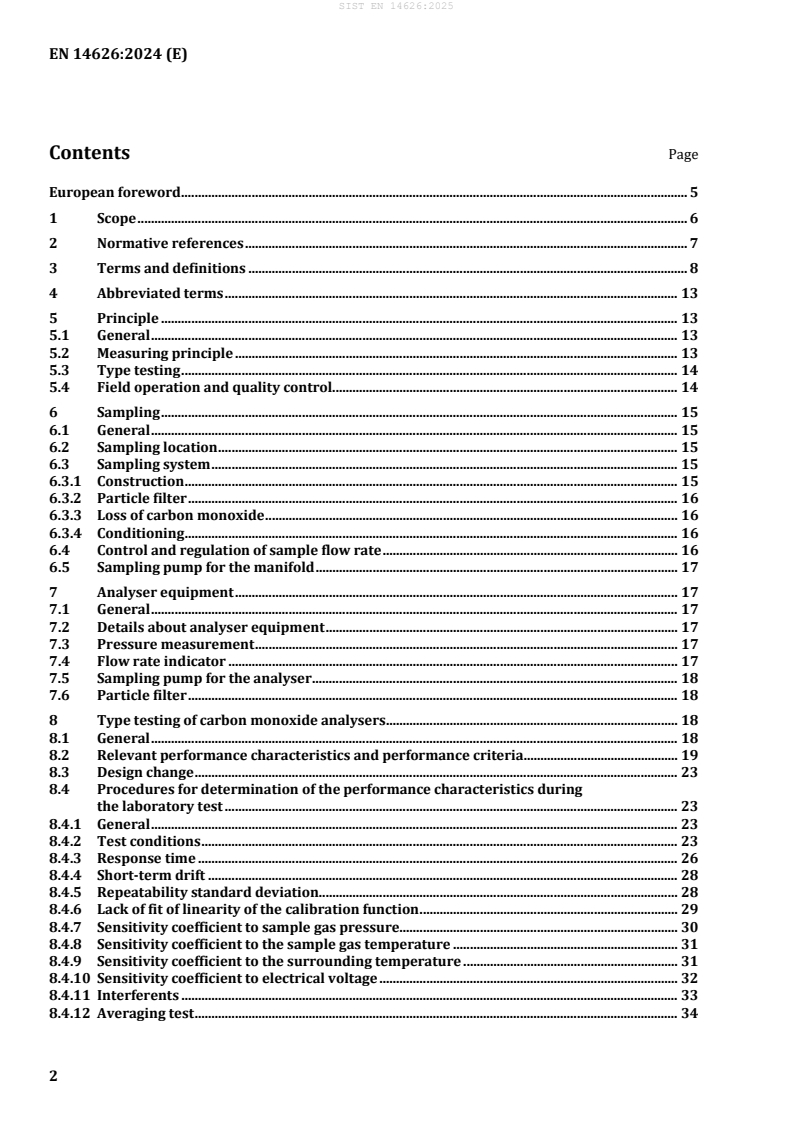
Contents Page
European foreword . 5
1 Scope . 6
2 Normative references . 7
3 Terms and definitions . 8
4 Abbreviated terms . 13
5 Principle . 13
5.1 General . 13
5.2 Measuring principle . 13
5.3 Type testing . 14
5.4 Field operation and quality control. 14
6 Sampling . 15
6.1 General . 15
6.2 Sampling location . 15
6.3 Sampling system . 15
6.3.1 Construction . 15
6.3.2 Particle filter . 16
6.3.3 Loss of carbon monoxide . 16
6.3.4 Conditioning . 16
6.4 Control and regulation of sample flow rate . 16
6.5 Sampling pump for the manifold . 17
7 Analyser equipment . 17
7.1 General . 17
7.2 Details about analyser equipment . 17
7.3 Pressure measurement . 17
7.4 Flow rate indicator . 17
7.5 Sampling pump for the analyser . 18
7.6 Particle filter . 18
8 Type testing of carbon monoxide analysers . 18
8.1 General . 18
8.2 Relevant performance characteristics and performance criteria. 19
8.3 Design change . 23
8.4 Procedures for determination of the performance characteristics during
the laboratory test . 23
8.4.1 General . 23
8.4.2 Test conditions . 23
8.4.3 Response time . 26
8.4.4 Short-term drift . 28
8.4.5 Repeatability standard deviation. 28
8.4.6 Lack of fit of linearity of the calibration function . 29
8.4.7 Sensitivity coefficient to sample gas pressure . 30
8.4.8 Sensitivity coefficient to the sample gas temperature . 31
8.4.9 Sensitivity coefficient to the surrounding temperature . 31
8.4.10 Sensitivity coefficient to electrical voltage . 32
8.4.11 Interferents . 33
8.4.12 Averaging test . 34
8.4.13 Difference sample/calibration port . 35
8.5 Determination of the performance characteristics during the field test . 36
8.5.1 General . 36
8.5.2 Selection of a monitoring station for the field test . 36
8.5.3 Operational requirements . 37
8.5.4 Long-term drift . 38
8.5.5 Reproducibility standard deviation under field conditions . 39
8.5.6 Period of unattended operation . 39
8.5.7 Period of availability of the analyser . 39
8.6 Expanded uncertainty calculation for type testing . 40
9 Field operation and ongoing quality control . 41
9.1 General . 41
9.2 Suitability evaluation . 41
9.2.1 General . 41
9.2.2 Analyser for a monitoring station or task. 41
9.3 Initial installation . 43
9.4 Ongoing quality assurance/quality control . 43
9.4.1 General . 43
9.4.2 Frequency of calibrations, checks and maintenance . 44
9.5 Calibration of the analyser . 47
9.5.1 General . 47
9.5.2 Calibration gases . 48
9.5.3 Data adjustment function . 48
9.5.4 Testing the sampling system . 48
9.5.5 Treatment of data after exceedance of performance criteria . 50
9.6 Checks . 52
9.6.1 Zero and span checks . 52
9.6.2 Lack-of-fit. 53
9.6.3 Testing the sampling system . 54
9.7 Maintenance . 56
9.7.1 Change of particle filters . 56
9.7.2 Maintenance of sampling system . 56
9.7.3 Change of consumables as applicable . 56
9.7.4 Preventive/routine maintenance of components of the analyser . 56
9.8 Data handling and data reports . 56
9.9 Measurement uncertainty . 57
10 Expression of results . 57
11 Test reports and documentation . 58
11.1 Type testing . 58
11.2 Field operation . 59
11.2.1 Suitability evaluation . 59
11.2.2 Documentation . 59
11.2.3 Ambient air quality data reports . 60
Annex A (normative) Test of lack-of-fit . 61
A.1 Establishment of the regression line . 61
A.2 Calculation of the residuals of the averages . 61
Annex B (informative) Sampling equipment . 63
Annex C (informative) Schematics of non-dispersive infrared spectrometer . 65
Annex D (informative) Manifold testing . 67
D.1 Procedure for applying test gas . 67
D.2 Procedure for the cross test . 68
D.2.1 General . 68
D.2.2 Initial stage . 68
D.2.3 Stage 1 . 69
D.2.4 Stage 2 . 69
D.2.5 Data Processing . 69
D.2.6 Evaluation . 69
Annex E (normative) Type testing. 71
E.1 Type testing and uncertainty calculation . 71
E.1.1 Type testing . 71
E.1.2 Uncertainty calculation . 71
E.2 Type testing Requirement a) . 71
E.3 Type testing Requirement b) . 73
E.3.1 General . 73
E.3.2 Calculation of standard uncertainties . 76
E.3.3 Example calculation . 83
E.4 Type testing Requirement c) . 85
E.5 Type testing Requirement d) . 85
E.5.1 General . 85
E.5.2 Combined standard uncertainty . 87
E.5.3 Absolute expanded uncertainty . 87
E.5.4 Relative expanded uncertainty . 88
E.5.5 Calculation of standard uncertainties . 88
E.5.6 Example calculation . 90
Annex F (informative) Calculation of uncertainty in field operation at the 8-hour limit value . 92
F.1 General . 92
F.2 Combined standard uncertainty . 92
F.3 Standard uncertainties . 93
F.3.1 General . 93
F.3.2 Influence quantities . 94
F.3.3 Interferents . 97
F.3.4 Averaging effect . 98
F.3.5 Reproducibility under field conditions . 98
F.3.6 Long-term drift at zero . 98
F.3.7 Long-term drift at level of the 8-hour limit value . 98
F.3.8 Zero gas . 99
F.3.9 Calibration gas . 99
F.3.10 Difference sample/calibration port . 99
F.4 Example calculation . 100
Annex G (informative) Test stand for the test point "sensitivity coefficient of sample gas
pressure" . 102
Annex H (informative) Significant changes . 104
Bibliography . 105
European foreword
This document (EN 14626:2024) has been prepared by Technical Committee CEN/TC 264 “Air quality,
the secretariat of which is held by DIN.
This European Standard shall be given the status of a national standard, either by publication of an
identical text or by endorsement, at the latest by June 2025, and conflicting national standards shall be
withdrawn at the latest by June 2025.
Attention is drawn to the possibility that some of the elements of this document may be the subject of
patent rights. CEN shall not be held responsible for identifying any or all such patent rights.
This document will supersede EN 14626:2012.
In comparison with the previous edition, the technical modifications made are listed in Annex H of this
document.
Any feedback and questions on this document should be directed to the users’ national standards body.
A complete listing of these bodies can be found on the CEN website.
According to the CEN-CENELEC Internal Regulations, the national standards organisations of the
following countries are bound to implement this European Standard: Austria, Belgium, Bulgaria, Croatia,
Cyprus, Czech Republic, Denmark, Estonia, Finland, France, Germany, Greece, Hungary, Iceland, Ireland,
Italy, Latvia, Lithuania, Luxembourg, Malta, Netherlands, Norway, Poland, Portugal, Republic of North
Macedonia, Romania, Serbia, Slovakia, Slovenia, Spain, Sweden, Switzerland, Türkiye and the United
Kingdom.
1 Scope
This document specifies a continuous measurement method for the determination of the concentration
of carbon monoxide present in ambient air based on the non-dispersive infrared spectroscopic measuring
principle. This document describes the performance characteristics and sets the relevant minimum
criteria required to select an appropriate non-dispersive infrared spectroscopic analyser by means
of type testing. It also includes the evaluation of the suitability of an analyser for use in a specific fixed
site in order to meet data quality requirements (see Annex I of Directive 2008/50/EC [1] for additional
information) and requirements during sampling, calibration and quality assurance for use.
The method is applicable to the determination of the mass concentration of carbon monoxide present in
ambient air up to 100 mg/m of carbon monoxide. This concentration range represents the certification
range for type testing.
NOTE 1 Other ranges can be used depending on the levels present in ambient air.
NOTE 2 When the standard is used for other purposes than for measurements required by Directive
2008/50/EC, the ranges and uncertainty requirements might not apply.
The method covers the determination of ambient air concentrations of carbon monoxide in locations
classified as rural areas, urban-background areas, and for sampling points influenced by traffic
or industrial sources.
The results are expressed in mg/m (at 20 °C and 101,3 kPa).
NOTE 3 100 mg/m of CO corresponds to 86 µmol/mol of CO.
This document contains information for different groups of users.
Clause 5 to Clause 7 and Annex B, Annex C and Annex D contain general information about the principles
of carbon monoxide measurement by non-dispersive infrared spectroscopic analyser and sampling
equipment.
Clause 8 and Annex E are specifically directed towards test houses and laboratories that perform type
testing of carbon monoxide analysers. These sections contain information about:
type testing conditions, test procedures and test requirements;
analyser performance requirements;
evaluation of the type testing results;
evaluation of the associated uncertainty of the measurement performed by the carbon monoxide
analyser based on the type testing results.
Clause 9 to Clause 11 and Annex F are directed towards monitoring networks performing the practical
measurements of carbon monoxide in ambient air. These sections contain information about:
initial installation of the analyser in the monitoring network and acceptance testing;
ongoing quality assurance/quality control;
calculation and reporting of measurement results;
evaluation of the uncertainty to the measurement results under practical monitoring conditions.
This document represents an evolution of earlier editions (EN 14626:2005 and EN 14626: 2012).
NOTE 4 Analysers type tested prior to the publication of this document can still be used for regulated monitoring
purposes. As newer versions of analysers tested under this document become available, discontinue the use of older
reference analysers.
2 Normative references
The following documents are referred to in the text in such a way that some or all of their content
constitutes requirements of this document. For dated references, only the edition cited applies.
For undated references, the latest edition of the referenced document (including any amendments)
applies.
EN 15267-1, Air quality - Assessment of air quality monitoring equipment - Part 1: General principles of
certification
EN 15267-2, Air quality - Assessment of air quality monitoring equipment - Part 2: Initial assessment of the
manufacturer’s quality management system and post certification surveillance for the manufacturing
process
EN ISO 6142-1, Gas analysis — Preparation of calibration gas mixtures — Gravimetric method (ISO 6142-
1)
EN ISO 6143, Gas analysis — Comparison methods for determining and checking the composition
of calibration gas mixtures (ISO 6143)
EN ISO 6144, Gas analysis — Preparation of calibration gas mixtures — Static volumetric methods
(ISO 6144)
EN ISO 6145-6, Gas analysis — Preparation of calibration gas mixtures using dynamic volumetric methods
— Part 6: Critical flow orifices (ISO 6145-6)
EN ISO 6145-7, Gas analysis — Preparation of calibration gas mixtures using dynamic volumetric methods
— Part 7: Thermal mass-flow controllers (ISO 6145-7)
EN ISO 14956, Air quality — Evaluation of the suitability of a measurement procedure by comparison with
a required measurement uncertainty (ISO 14956)
ISO 19229:2019, Gas analysis — Purity analysis and the treatment of purity data
3 Terms and definitions
For the purposes of this document, the following terms and definitions apply.
3.1
adjustment of a measuring system
set of operations carried out on a measuring system so that it provides prescribed indications
corresponding to given values of a quantity to be measured
Note 1 to entry: Types of adjustment of a measuring system include zero adjustment of a measuring system, offset
adjustment, and span adjustment (sometimes called gain adjustment).
Note 2 to entry: Adjustment of a measuring system should not be confused with calibration, which is a prerequisite
for adjustment.
Note 3 to entry: In the context of this document, adjustment is performed on measurement data rather than on the
analyser.
[SOURCE: JCGM 200, 3.11 [2]]
3.2
ambient air
outdoor air in the troposphere where provisions concerning health and safety at work apply and to which
members of the public do not have regular access
Note 1 to entry: This excludes workplaces as defined by Directive 89/654/EEC.
[SOURCE: Council Directive 2008/50/EC [1]]
3.3
analyser
measuring system that provides an output signal which is a function of the concentration or
partial pressure of one or more components in a gas mixture and flow or temperature of this gas mixture
3.4
availability of the analyser
fraction of the time period for which valid measuring data of the ambient air concentration is available
from an analyser
3.5
calibration
operation that, under specified conditions, in a first step, establishes a relation between the quantity
values with measurement uncertainties provided by measurement standards and corresponding
indications with associated measurement uncertainties and, in a second step, uses this information
to establish a relation for obtaining a measurement result from an indication
Note 1 to entry: A calibration may be expressed by a statement, calibration function, calibration diagram, calibration
curve, or calibration table. In some cases, it may consist of an additive or multiplicative correction of the indication
with associated measurement uncertainty.
Note 2 to entry: Calibration should not be confused with adjustment of a measuring system, often mistakenly called
“self-calibration”, nor with verification of a calibration.
Note 3 to entry: Often, the first step alone in the above definition is perceived as being calibration.
Note 4 to entry: In the context of this document, calibration is a comparison of the analyser response to a known
gas concentration with a known uncertainty when the information obtained from the comparison is used
for the successive adjustment (if needed) of the analyser.
[SOURCE: JCGM 200, 2.39 [2]]
3.6
certification range
concentration range for which the analyser is type tested
3.7
check
verification that the analyser is still operating within specified performance limits
3.8
combined standard uncertainty
standard uncertainty of the result of a measurement when that result is obtained from the values
of a number of other quantities, equal to the positive square root of a sum of terms, the terms being
the variances or co-variances of these other quantities weighted according to how the measurement
result varies with changes in these quantities
[SOURCE: JCGM 100: 2.3.4 [3]]
3.9
coverage factor
numerical factor used as a multiplier of the combined standard uncertainty in order to obtain
an expanded uncertainty
[SOURCE: JCGM 100: 2.3.6 [3]]
3.10
competent body
organization which can demonstrate its competence for a specific task to the national competent
authority of the Member State
3.11
detection limit
smallest concentration of a measurand that can be reliably detected by a specific measurement process
Note 1 to entry: The detection limit is calculated as 3,3 x (sr,z/B) where sr,z is the standard deviation of analyser
response at zero measurand concentration (see 8.4.5) and B is the slope of the calibration function [4].
3.12
expanded uncertainty
quantity defining an interval about the result of a measurement that may be expected to encompass
a large fraction of the distribution of values that could reasonably be attributed to the measurand
Note 1 to entry: The fraction may be viewed as the coverage probability or level of confidence of the interval.
Note 2 to entry: To associate a specific level of confidence with the interval defined by the expanded uncertainty
requires explicit or implicit assumptions regarding the probability distribution characterised by the measurement
result and its combined standard uncertainty. The level of confidence that may be attributed to this interval can be
known only to the extent to which such assumptions may be justified.
Note 3 to entry: For the purpose of this document, the expanded uncertainty is the combined standard uncertainty
multiplied by a coverage factor k=2 resulting in an interval with a level of confidence of 95 %.
[SOURCE: JCGM 100: 2.3.5 [3]]
3.13
fall time
difference between the response time (fall) and the lag time (fall)
3.14
independent measurement
individual measurement that is not influenced by a previous individual measurement by separating
two individual measurements by at least four response times
Note 1 to entry: The largest value of response time (rise) and response time (fall) are intended.
3.15
individual measurement
measurement averaged over a time period equal to the response time of the analyser
Note 1 to entry: The largest value of response time (rise) and response time (fall) are intended.
Note 2 to entry: This definition differs from the meaning of the concept “individual measurement” in Directive
2008/50/EC [1].
3.16
influence quantity
quantity that is not the measurand but that affects the result of the measurement
[SOURCE: JCGM 100, B.2.10 [3]]
3.17
interferent
component of the air sample, excluding the measured constituent, that affects the output signal
3.18
lack of fit
maximum deviation from the linear regression line of the average of a series of measurement results
at the same concentration
3.19
lag time
time interval from the moment at which a step change of sample concentration occurs at the inlet of the
analyser to the moment at which the output reading reaches a level corresponding to a predefined change
of the stable output reading
3.20
limit value
level fixed on the basis of scientific knowledge, with the aim of avoiding, preventing or reducing harmful
effects on human health and/or the environment as a whole, to be attained within a given period
and not to be exceeded once attained
[SOURCE: Council Directive 2008/50/EC [1]]
3.21
long-term drift
difference between zero or span readings over a determined period of time (e.g. period of unattended
operation)
3.22
monitoring station
enclosure located in the field in which an analyser has been installed to monitor concentrations of one
or more ambient air pollutants
3.23
parallel measurements
measurements from different analysers sampling with the same sampling system, starting at the same
time and ending at the same time
Note 1 to entry: sampling can be performed from one and the same sampling manifold or with identical individual
sampling lines
3.24
performance characteristic
one of the parameters assigned to equipment in order to define its performance
3.25
performance criterion
limiting quantitative numerical value assigned to a performance characteristic, to which conformance
is tested
3.26
period of unattended operation
time period over which the drift complies with the performance criterion for long-term drift
3.27
repeatability of results of measurement
closeness of the agreement between the results of successive individual measurements of carbon
monoxide carried out under the same conditions of measurement
Note 1 to entry: These conditions include:
a) the same measurement procedure;
b) the same observer;
c) the same analyser, used under the same conditions;
d) at the same location;
e) repetition over a short period of time.
3.28
reproducibility under field conditions
closeness of the agreement between the results of simultaneous measurements with two analysers
in ambient air carried out under the same conditions of measurement
Note 1 to entry: These conditions are called field reproducibility conditions and include:
a) the same measurement procedure;
b) two identical analysers, used under the same conditions;
c) at the same monitoring station;
d) the period of unattended operation.
3.29
residence time in the sampling system
time period for the sampled air to be transferred to the inlet of the analyser
3.30
response time
time interval from the instant at which a step change of sample concentration occurs at the inlet of the
analyser to the instant at which the output reading reaches a level corresponding to 90 % of the stable
output reading
3.31
sampled air
part of ambient air that is transferred through the sampling inlet and sampling system for subsequent
measurement
3.32
sample gas temperature
temperature of the sampled gas at the sample inlet
Note 1 to entry: The term ‘gas’ may refer to a test gas used in type testing or to ambient air transferred
to the analyser.
3.33
sampling system
the assembly of components needed to transfer ambient air to the analyser
3.34
short-term drift
difference between zero or span readings at the beginning and end of a 12 h period
3.35
standard uncertainty
uncertainty of the result of a measurement expressed as a standard deviation
[SOURCE: JCGM 100, 2.3.1] [3]]
3.36
surrounding temperature
temperature of the air directly surrounding the analyser
3.37
type testing
examination of two or more analysers of the same design which are submitted by a manufacturer to a
competent body including the tests necessary for approval of the design (determination of fitness
for purpose of a specific device model / of an unambiguous designated analyser)
Note 1 to entry: In EN 15267-1 and -2, type testing is referred to as performance testing.
3.38
uncertainty of measurement
parameter associated with the result of a measurement, that characterises the dispersion of the values
that could reasonably be attributed to the measurand
[SOURCE: JCGM 100, 2.2.3 [3]]
4 Abbreviated terms
AMS automated measuring system (sometimes referred to as continuous automated measurement
system (CAMS))
PFA perfluoro-alkoxy
PTFE polytetrafluoroethylene
5 Principle
5.1 General
This document describes the method for measurement of the concentrations of carbon monoxide
in ambient air by means of non-dispersive infrared spectrometry. The requirements, the specific
components of the infrared analyser and its sampling system are described. A number of performance
characteristics with associated minimum performance criteria are given for the analyser. The actual
values of these performance characteristics for a specific type of analyser shall be determined in a type
testing for which procedures have been described. The type testing comprises laboratory tests and field
tests. The selection of a type-tested analyser for a specific measuring task in the field is based on the
calculation of the expanded uncertainty of the measured values obtained by the measurement method.
In this expanded uncertainty calculation, the actual values of various performance characteristics of a
type-tested analyser and the site-specific conditions at the monitoring station are taken into account (see
Table 7 & 9.9). The expanded uncertainty of the method shall not exceed the limits (this is also specified
in Annex I of Directive 2008/50/EC [1]). Requirements and recommendations for quality assurance and
quality control are given for the measurements in the field (see 9.4).
5.2 Measuring principle
The attenuation of infrared light passing through a sample cell is a measure of the concentration of CO
in the cell. Not only CO but also most hetero-atomic molecules will absorb infrared light; in particular
water and CO have broad bands that can interfere with the measurement of CO. Different technical
solutions have been developed to suppress cross-sensitivity, instability and drift in order to design
continuous monitoring systems with acceptable properties. For instance:
measuring IR absorption of a specific wavelength (4,7 µm for CO);
dual-cell monitors, using a reference cell filled with clean air (compensation for drift), or single-cell
monitors alternating between sample and reference;
gas-filter correlation, "measuring" over a range of wavelengths.
Special attention shall be paid to infrared radiation absorbing gases that specifically absorb in the region
of detection of carbon monoxide.
The concentration of carbon monoxide is expressed in the units provided by the calibration standard.
The final results for reporting are express
...
EN 14626:2024の標準は、非分散赤外線分光法を用いた環境空気中の一酸化炭素の濃度測定に関する重要な規範を提供します。この標準は、連続測定法を明確に定義しており、環境空気中に存在する一酸化炭素の質量濃度を最大100 mg/m³まで測定するために必要な性能特性と最低基準を設定しています。これにより、適切な非分散赤外線分光アナライザーの選定が容易となります。 この標準は、農村地域や都市背景地域、交通指向の位置、工業源の影響を受ける場所など、様々な環境に適用可能であり、幅広いユーザーに有用な情報を提供しています。また、測定結果はmg/m³の単位で表され、温度20°Cおよび圧力101.3 kPaにおける基準が明確に示されています。この一酸化炭素の濃度測定法は、EUの2008/50/EC指令に従ったデータ品質要件を満たすことを目的としています。 さらに、標準の第5条から第7条及び附属書B、C、Dでは、非分散赤外線分光アナライザーおよびサンプリング機器による一酸化炭素測定の原則に関する一般情報が提供されています。第8条と附属書Eは、一酸化炭素アナライザーの型式承認試験を実施する試験所や研究所向けの具体的な情報を含んでおり、試験環境や手順、要求事項、測定結果の不確かさの評価など、技術的な側面が詳述されています。 また、第9条から第11条および附属書Fでは、環境空気中の一酸化炭素の実測を行う監視ネットワークに向けた情報が収められており、アナライザーの初期設置や受入試験、継続的な品質保証および品質管理、測定結果の計算と報告の方法が説明されています。これにより、実際の monitoring conditions における測定結果の不確かさの評価も行うことができます。 これらの特性により、EN 14626:2024は環境空気における一酸化炭素の測定に関する信頼性の高い基準を提供しており、測定手法の標準化が進むことで、データの整合性が向上することが期待されます。この標準は、環境モニタリングにおける品質向上と、一酸化炭素測定の正確性・信頼性の向上に寄与する重要な手段となるでしょう。
La norme EN 14626:2024 constitue un outil essentiel pour la mesure de la concentration de monoxyde de carbone dans l'air ambiant, utilisant une méthode basée sur la spectroscopie infrarouge non dispersive. Son champ d'application est clairement défini, se concentrant sur la détermination continue de la concentration de CO, permettant ainsi une surveillance efficace de la qualité de l'air dans divers environnements, notamment les zones rurales, les zones de fond urbain et les sites affectés par le trafic et les sources industrielles. Parmi ses points forts, la norme décrit en détail les caractéristiques de performance des analyseurs, établissant des critères minimaux pour leur sélection à travers des tests d'approbation de type. Cela garantit que les appareils utilisés respectent des normes strictes de qualité des données, conformément aux exigences de la directive 2008/50/EC. Le fait que le standard couvre des concentrations allant jusqu'à 100 mg/m3 de CO en fait un cadre robuste pour la certification et la validation des instruments de mesure. La norme EN 14626:2024 inclut également des directives précieuses pour différents groupes d'utilisateurs. Les sections spécifiques aux laboratoires et aux maisons d'essai, ainsi qu'à des réseaux de surveillance, offrent des informations sur les conditions d'essai, les procédures, et les exigences de performance des analyseurs de monoxyde de carbone. Cela renforce la confiance dans la fiabilité des mesures effectuées et dans l'application pratique des résultats. De plus, les annexes fournissent des détails opérationnels qui abordent les conditions d'installation, l'acceptation des appareils dans les réseaux de mesure, ainsi que les aspects cruciaux liés à l'assurance qualité et au contrôle qualité des mesures. Ce niveau de précision et d'ordre constitue un atout considérable pour les organismes cherchant à se conformer aux normes environnementales tout en assurant la qualité de l'air ambiant. En somme, la norme EN 14626:2024 se révèle être un socle solide pour la mesure du monoxyde de carbone dans l'air ambiant, répondant à des exigences de performance élevées et pertinent pour une application pratique dans divers contexte environnementaux.
Die EN 14626:2024 ist eine bedeutende europäische Norm, die einen fortlaufenden Messansatz für die Bestimmung der Kohlenmonoxidkonzentration in der Außenluft mittels nicht-dispersiver Infrarotspektroskopie definiert. Ihr Anwendungsbereich ist klar umrissen und umfasst verschiedene Umgebungen, darunter ländliche Gebiete, städtische Hintergrundzonen sowie verkehrsorientierte und industriell beeinflusste Standorte. Ein herausragendes Merkmal dieser Norm ist die detaillierte Beschreibung der Leistungsmerkmale und der festgelegten Mindestkriterien, die für die Auswahl eines geeigneten nicht-dispersiven Infrarotspektroskopie-Analyzers erforderlich sind. Durch die entsprechenden Typgenehmigungsprüfungen werden die Anforderungen an die Genauigkeit und Zuverlässigkeit der Messungen sichergestellt, was die Norm für Hersteller und Prüflabore äußerst relevant macht. Die Norm bietet nicht nur umfassende Informationen für unterschiedliche Nutzergruppen, sondern stellt auch sicher, dass die Messungen den Datenqualitätsanforderungen der Richtlinie 2008/50/EG entsprechen. Besonders bedeutsam ist der Aspekt der kontinuierlichen Überwachung und Qualitätskontrolle, der in den Kapiteln über Monitoring-Netzwerke behandelt wird. Diese Abschnitte sind entscheidend für die Gewährleistung der Messgenauigkeit und für die Bewertung von Unsicherheiten unter praktischen Bedingungen. Die EN 14626:2024 ist somit eine unverzichtbare Ressource für alle, die im Bereich der Luftqualitätsüberwachung tätig sind. Ihre Anwendung sichergestellt durch die Bereitstellung präziser Anleitungen für die Installation, Kalibrierung und langfristige Qualitätssicherung von Kohlenmonoxid-Analysatoren. Die Standardisierung, die diese Norm bietet, trägt dazu bei, konsistente und vergleichbare Ergebnisse in der Luftüberwachung zu gewährleisten und somit die öffentliche Gesundheit und Sicherheit zu fördern.
SIST EN 14626:2025는 대기 중 일산화탄소 농도의 측정을 위한 표준 방법을 제공하는 유럽 표준으로, 비산란 적외선 분광법에 기반한 지속적인 측정 방법을 규정하고 있습니다. 이 표준은 특성 및 성능 기준을 명확히 하여 적절한 비산란 적외선 분광 분석기를 선택하기 위한 최소 기준을 설정하며, 2008/50/EC 지침의 부속서 I에 명시된 데이터 품질 요구 사항을 충족하기 위한 특정 고정 장소에서의 분석기 적합성 평가도 포함하고 있습니다. 일산화탄소의 질량 농도를 측정하는 방법은 최대 100 mg/m3까지의 농도 범위에서 적용 가능하며, 이 범위는 형식 승인 시험의 인증 범위를 나타냅니다. 이 표준은 농촌 지역, 도시 배경 지역, 교통 지향적 위치 및 산업 소스의 영향을 받는 위치에서의 대기 중 일산화탄소 농도를 측정하는 데 적용됩니다. 측정 결과는 20 °C 및 101.3 kPa에서 mg/m3로 표현됩니다. 특히, 본 표준은 비산란 적외선 분광 분석 및 샘플링 장치 원리에 대한 일반 정보를 제공하며, 분석기 형식 승인 시험을 수행하는 테스트 하우스 및 실험실에 대한 특정 정보를 포함합니다. 이에는 시험 절차, 성능 요구 사항, 시험 결과의 평가 및 측정 결과의 불확실성 평가가 포함됩니다. 또한, 관리자 네트워크에서의 실질적인 일산화탄소 측정에 대한 정보도 제공되며, 분석기 설치 및 수락 테스트, 지속적인 품질 보증 및 품질 관리, 측정 결과 계산 및 보고서 작성, 실제 모니터링 조건에서의 측정 결과의 불확실성 평가 등이 포함됩니다. 결론적으로, SIST EN 14626:2025는 대기 중 일산화탄소 측정의 표준화 및 품질 보증을 위한 강력한 틀을 제공하며, 다양한 사용자 그룹을 위한 정보와 요구 사항을 상세히 기술하고 있어, 환경 모니터링 및 관련 산업에 필수적인 기준으로 자리 잡고 있습니다.
The EN 14626:2024 standard significantly enhances the methodology for measuring carbon monoxide concentrations in ambient air through non-dispersive infrared spectroscopy. Its scope is comprehensive, detailing a continuous measurement approach, which is critical for accurate monitoring of carbon monoxide levels in various environmental settings, including rural, urban, and industrial regions. One of the standard's key strengths lies in its clear framework that establishes performance characteristics and minimum criteria, guiding the selection of suitable non-dispersive infrared spectroscopic analysers. This aspect ensures that only high-quality instruments are employed, thereby elevating the reliability of air quality assessments. The inclusion of type approval tests bolsters the standard's credibility and utility, particularly when adhering to the data quality requirements outlined in Directive 2008/50/EC. The standard's applicability to a significant concentration range of carbon monoxide, specifically up to 100 mg/m³, is a substantial advantage. This allows for flexibility in addressing various pollution levels that might be encountered in different ambient air scenarios. Furthermore, the document acknowledges that other concentration ranges may be relevant depending on the environmental context, demonstrating a pragmatic approach to air quality monitoring. Another notable aspect is the division of information catering to different user groups. Clauses 5 to 7, as well as several annexes, provide foundational knowledge on carbon monoxide measurement principles and equipment, making the standard accessible to a wide audience, including professionals operating monitoring networks. Sections directed toward test houses and laboratories (Clauses 8 and annexes E) provide vital protocols for conducting type-approval testing, ensuring consistent and reliable performance across different analysers. Moreover, the guidance for monitoring networks (Clauses 9 to 11) is invaluable, addressing practical considerations such as installation, quality assurance, and reporting. This ensures that users are well-equipped to maintain the integrity of their measurements in real-world conditions. Overall, EN 14626:2024 stands as a vital document in environmental monitoring, particularly in documenting carbon monoxide concentrations. Its meticulous detailing of procedures, performance criteria, and applicability to various environments underscores its relevance in promoting accurate air quality assessments and ensuring compliance with established EU standards.
Questions, Comments and Discussion
Ask us and Technical Secretary will try to provide an answer. You can facilitate discussion about the standard in here.
Loading comments...