

EN 17149-2:2024
(Main)Railway applications - Strength assessment of rail vehicle structures - Part 2: Static strength assessment
General Information
- Abstract
This document specifies a procedure for static strength assessment of rail vehicle structures.
It is part of a series of standards that specifies procedures for strength assessments of structures of rail vehicles that are manufactured, operated and maintained according to standards valid for railway applications.
The assessment procedure of the series is restricted to ferrous materials and aluminium.
This document series does not define design load cases.
This document series is not applicable for corrosive conditions or elevated temperature operation in the creep range.
This series of standards is applicable to all kinds of rail vehicles. However, it does not define in which cases or for which kinds of rail vehicles a static strength assessment is to be undertaken.
- Status
- Published
- Publication Date
- 16-Apr-2024
- Technical Committee
- CEN/TC 256 - Railway applications
- Drafting Committee
- CEN/TC 256/WG 2 - Structural requirements
- Current Stage
- 6060 - Definitive text made available (DAV) - Publishing
- Start Date
- 17-Apr-2024
- Due Date
- 01-May-2023
- Completion Date
- 17-Apr-2024

Overview
EN 17149-2:2024, developed by CEN, specifies the procedure for static strength assessment of rail vehicle structures. As part of a multi-part standard series addressing railway structure strength evaluations, this document focuses on static strength, ensuring that rail vehicle structures, including all types manufactured from ferrous materials and aluminium, fulfill safety and operational standards set for railway applications. This static assessment process is crucial for manufacturers, operators, and maintenance teams seeking compliance with European railway infrastructure requirements.
Key Topics
Scope & Applicability
- Applies to all rail vehicle structures (trains, wagons, trams, etc.) made of ferrous materials and aluminium
- Does not define specific design load cases or mandatory applications per vehicle type
- Excludes use in corrosive environments and for vehicles operating at elevated temperatures within the material's creep range
Assessment Procedures
- Provides a framework for static strength assessment using linear or nonlinear elastic-plastic analysis
- Stresses and strains used as primary assessment metrics, determined through calculation or testing
- Material properties assessed include parent material, heat-affected zones (HAZ), and weld metal
Material Considerations
- Restricted to ferrous materials (various types of steel, cast irons) and aluminium
- Specifies how to address anisotropy, weld quality, and HAZ properties
- Includes use of partial factors for load, material strength, validation, hardening, casting, and stability
Partial Factors & Validation
- Details partial factors to account for uncertainties in loads, material characteristics, casting processes, and validation methods
- Validation of static strength can be via laboratory testing or simulation with compliant models
- Assessment factors help ensure conservative and reliable structural integrity evaluations
Assessment Criteria
- Static strength assessment deemed successful when linear elastic or nonlinear analysis criteria are met for each load case
- Both stress and strain limits are established for exceptional loads and ultimate design loads, considering occurrence frequency and material ductility
Applications
Implementing EN 17149-2:2024 delivers practical value across the rail industry by guiding the static strength verification of new and existing rail vehicles. Its applications include:
Design and Manufacturing
- Assists rolling stock manufacturers in proving compliance with European standards for structural safety and durability during the design and fabrication stages
Testing & Certification
- Provides test methods and calculation models for validating the static strength performance of rail vehicle structures
Maintenance & Refurbishment
- Supplies a standardized approach for assessing structural modifications or repairs, ensuring ongoing alignment with safety requirements
Regulatory Compliance
- Eases the process of meeting regulatory approvals throughout Europe by referencing harmonized criteria in rail structure engineering documentation
Related Standards
For a comprehensive approach to rail vehicle structure strength assessment, EN 17149-2:2024 should be used in conjunction with related standards, including:
- EN 17149-1:2024: Railway applications - Strength assessment of rail vehicle structures - General principles
- EN 12663-1:2010+A2:2023: Structural requirements for locomotives and passenger rolling stock
- EN 12663-2:2010+A1:2023: Structural requirements for freight wagons
- EN 13749:2021: Wheelsets and bogies – Structural requirements
- EN 15227:2020: Crashworthiness requirements for rail vehicles
- EN 15827:2011: Requirements for bogies and running gears
- EN 17343:2023: General railway terms and definitions
- ISO/TR 25901-1:2016: Welding and allied processes vocabulary
Conclusion
EN 17149-2:2024 is an essential standard for ensuring that rail vehicle structures are robust under static load conditions. By establishing clear, harmonized procedures and incorporating relevant partial safety factors, this standard helps guarantee the reliability and safety of railway rolling stock in Europe. Adopting EN 17149-2:2024 supports not only technical compliance but also the consistent quality and safety performance demanded in modern railway applications.
Relations
- Effective Date
- 09-Feb-2026
- Effective Date
- 28-Jan-2026
- Effective Date
- 28-Jan-2026
- Effective Date
- 28-Jan-2026
- Effective Date
- 28-Jan-2026
- Effective Date
- 28-Jan-2026
- Effective Date
- 28-Jan-2026
- Effective Date
- 28-Jan-2026
Get Certified
Connect with accredited certification bodies for this standard

IRIS Certification (UNIFE)
International Railway Industry Standard certification.

TÜV SÜD Rail GmbH
TÜV SÜD railway certification services.

Bureau Veritas Railway Certification
Railway and transportation certification.
Sponsored listings
Frequently Asked Questions
EN 17149-2:2024 is a standard published by the European Committee for Standardization (CEN). Its full title is "Railway applications - Strength assessment of rail vehicle structures - Part 2: Static strength assessment". This standard covers: This document specifies a procedure for static strength assessment of rail vehicle structures. It is part of a series of standards that specifies procedures for strength assessments of structures of rail vehicles that are manufactured, operated and maintained according to standards valid for railway applications. The assessment procedure of the series is restricted to ferrous materials and aluminium. This document series does not define design load cases. This document series is not applicable for corrosive conditions or elevated temperature operation in the creep range. This series of standards is applicable to all kinds of rail vehicles. However, it does not define in which cases or for which kinds of rail vehicles a static strength assessment is to be undertaken.
This document specifies a procedure for static strength assessment of rail vehicle structures. It is part of a series of standards that specifies procedures for strength assessments of structures of rail vehicles that are manufactured, operated and maintained according to standards valid for railway applications. The assessment procedure of the series is restricted to ferrous materials and aluminium. This document series does not define design load cases. This document series is not applicable for corrosive conditions or elevated temperature operation in the creep range. This series of standards is applicable to all kinds of rail vehicles. However, it does not define in which cases or for which kinds of rail vehicles a static strength assessment is to be undertaken.
EN 17149-2:2024 is classified under the following ICS (International Classification for Standards) categories: 45.060.01 - Railway rolling stock in general. The ICS classification helps identify the subject area and facilitates finding related standards.
EN 17149-2:2024 has the following relationships with other standards: It is inter standard links to ISO/TR 25901-1:2016, EN 12663-2:2010+A1:2023, EN 15227:2020, EN 13749:2021, EN 12663-1:2010+A2:2023, EN 15827:2011, EN 17343:2023, EN 17149-1:2024. Understanding these relationships helps ensure you are using the most current and applicable version of the standard.
EN 17149-2:2024 is associated with the following European legislation: EU Directives/Regulations: 2008/57/EC; Standardization Mandates: M/483. When a standard is cited in the Official Journal of the European Union, products manufactured in conformity with it benefit from a presumption of conformity with the essential requirements of the corresponding EU directive or regulation.
EN 17149-2:2024 is available in PDF format for immediate download after purchase. The document can be added to your cart and obtained through the secure checkout process. Digital delivery ensures instant access to the complete standard document.
Standards Content (Sample)
SLOVENSKI STANDARD
01-junij-2024
Železniške naprave - Ocenjevanje odpornosti konstrukcije železniških vozil - 2.
del: Ocena statične odpornosti
Railway applications - Strength assessment of rail vehicle structures - Part 2: Static
strength assessment
Bahnanwendungen - Festigkeitsnachweis von Schienenfahrzeugstrukturen - Teil 2:
Statischer Festigkeitsnachweis
Applications ferroviaires - Évaluation de la résistance des structures de véhicule
ferroviaire - Partie 2 : Évaluation de la résistance statique
Ta slovenski standard je istoveten z: EN 17149-2:2024
ICS:
45.060.01 Železniška vozila na splošno Railway rolling stock in
general
2003-01.Slovenski inštitut za standardizacijo. Razmnoževanje celote ali delov tega standarda ni dovoljeno.
EN 17149-2
EUROPEAN STANDARD
NORME EUROPÉENNE
April 2024
EUROPÄISCHE NORM
ICS 45.060.01
English Version
Railway applications - Strength assessment of rail vehicle
structures - Part 2: Static strength assessment
Applications ferroviaires - Évaluation de la résistance Bahnanwendungen - Festigkeitsnachweis von
des structures de véhicule ferroviaire - Partie 2 : Schienenfahrzeugstrukturen - Teil 2: Statischer
Évaluation de la résistance statique Festigkeitsnachweis
This European Standard was approved by CEN on 27 February 2024.
CEN members are bound to comply with the CEN/CENELEC Internal Regulations which stipulate the conditions for giving this
European Standard the status of a national standard without any alteration. Up-to-date lists and bibliographical references
concerning such national standards may be obtained on application to the CEN-CENELEC Management Centre or to any CEN
member.
This European Standard exists in three official versions (English, French, German). A version in any other language made by
translation under the responsibility of a CEN member into its own language and notified to the CEN-CENELEC Management
Centre has the same status as the official versions.
CEN members are the national standards bodies of Austria, Belgium, Bulgaria, Croatia, Cyprus, Czech Republic, Denmark, Estonia,
Finland, France, Germany, Greece, Hungary, Iceland, Ireland, Italy, Latvia, Lithuania, Luxembourg, Malta, Netherlands, Norway,
Poland, Portugal, Republic of North Macedonia, Romania, Serbia, Slovakia, Slovenia, Spain, Sweden, Switzerland, Türkiye and
United Kingdom.
EUROPEAN COMMITTEE FOR STANDARDIZATION
COMITÉ EUROPÉEN DE NORMALISATION
EUROPÄISCHES KOMITEE FÜR NORMUNG
CEN-CENELEC Management Centre: Rue de la Science 23, B-1040 Brussels
© 2024 CEN All rights of exploitation in any form and by any means reserved Ref. No. EN 17149-2:2024 E
worldwide for CEN national Members.
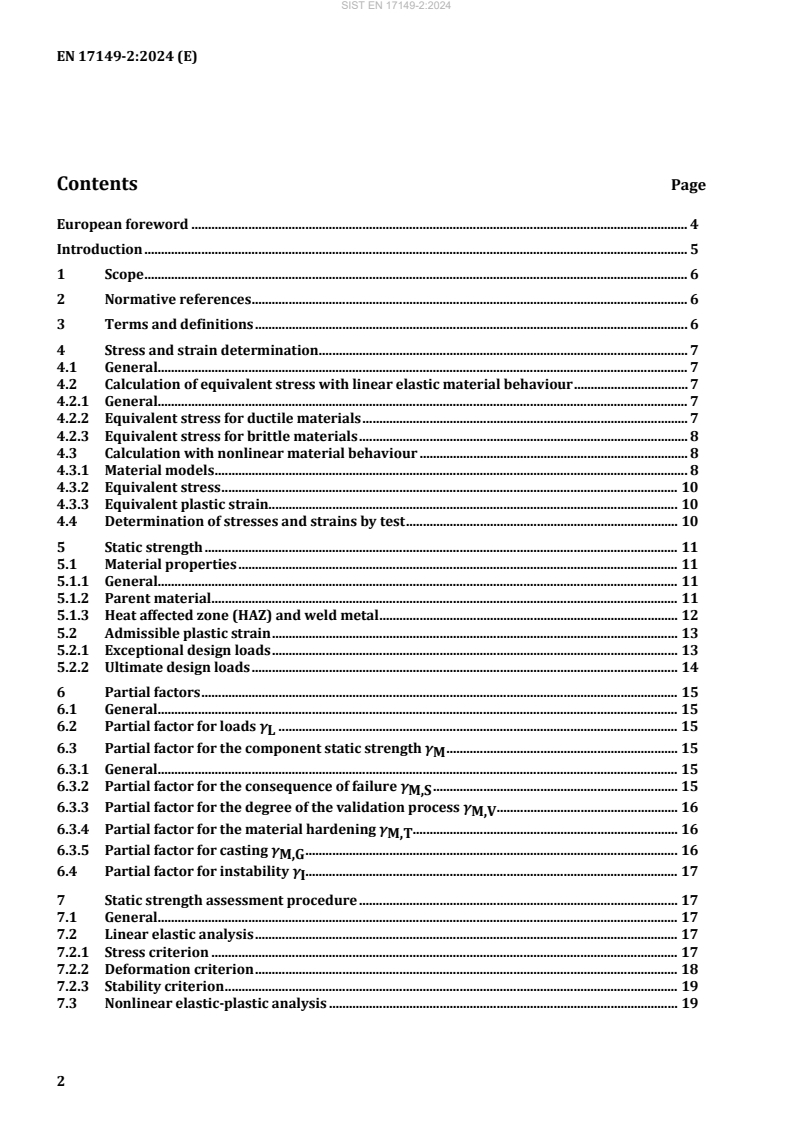
Contents Page
European foreword . 4
Introduction . 5
1 Scope . 6
2 Normative references . 6
3 Terms and definitions . 6
4 Stress and strain determination . 7
4.1 General. 7
4.2 Calculation of equivalent stress with linear elastic material behaviour . 7
4.2.1 General. 7
4.2.2 Equivalent stress for ductile materials . 7
4.2.3 Equivalent stress for brittle materials . 8
4.3 Calculation with nonlinear material behaviour . 8
4.3.1 Material models . 8
4.3.2 Equivalent stress . 10
4.3.3 Equivalent plastic strain. 10
4.4 Determination of stresses and strains by test . 10
5 Static strength . 11
5.1 Material properties . 11
5.1.1 General. 11
5.1.2 Parent material . 11
5.1.3 Heat affected zone (HAZ) and weld metal . 12
5.2 Admissible plastic strain . 13
5.2.1 Exceptional design loads . 13
5.2.2 Ultimate design loads . 14
6 Partial factors . 15
6.1 General. 15
6.2 Partial factor for loads γ . 15
L
6.3 Partial factor for the component static strength γ . 15
M
6.3.1 General. 15
6.3.2 Partial factor for the consequence of failure γ . 15
M,S
6.3.3 Partial factor for the degree of the validation process γ . 16
M,V
6.3.4 Partial factor for the material hardening γ . 16
M,T
6.3.5 Partial factor for casting γ . 16
M,G
6.4 Partial factor for instability γ . 17
I
7 Static strength assessment procedure . 17
7.1 General. 17
7.2 Linear elastic analysis . 17
7.2.1 Stress criterion . 17
7.2.2 Deformation criterion . 18
7.2.3 Stability criterion . 19
7.3 Nonlinear elastic-plastic analysis . 19
7.3.1 General . 19
7.3.2 Stress criterion . 19
7.3.3 Strain criterion . 20
7.3.4 Deformation criterion . 20
7.3.5 Stability criterion. 20
Annex A (informative) Additional information for the section factor n . 21
pl,ε
Bibliography . 22
European foreword
This document (EN 17149-2:2024) has been prepared by Technical Committee CEN/TC 256 “'Railway
applications”, the secretariat of which is held by DIN.
This European Standard shall be given the status of a national standard, either by publication of an
identical text or by endorsement, at the latest by October 2024, and conflicting national standards shall
be withdrawn at the latest by October 2024.
Attention is drawn to the possibility that some of the elements of this document may be the subject of
patent rights. CEN shall not be held responsible for identifying any or all such patent rights.
This document is part of the series EN 17149 Railway applications — Strength assessment of rail vehicle
structures, which consists of the following parts:
— Part 1: General
— Part 2: Static strength assessment
The following part is under preparation:
— Part 3: Fatigue strength assessment based on cumulative damage
This document has been prepared under a mandate given to CEN by the European Commission and the
European Free Trade Association.
Any feedback and questions on this document should be directed to the users’ national standards body.
A complete listing of these bodies can be found on the CEN website.
According to the CEN-CENELEC Internal Regulations, the national standards organisations of the
following countries are bound to implement this European Standard: Austria, Belgium, Bulgaria, Croatia,
Cyprus, Czech Republic, Denmark, Estonia, Finland, France, Germany, Greece, Hungary, Iceland, Ireland,
Italy, Latvia, Lithuania, Luxembourg, Malta, Netherlands, Norway, Poland, Portugal, Republic of North
Macedonia, Romania, Serbia, Slovakia, Slovenia, Spain, Sweden, Switzerland, Türkiye and the United
Kingdom.
Introduction
This document provides procedures and criteria for the static strength assessment based on linear
analysis or nonlinear elastic plastic analysis.
It does not define load cases and does not define in which cases, for which structural components or for
which kinds of rail vehicles a static strength assessment is to be undertaken.
1 Scope
This document specifies a procedure for static strength assessment of rail vehicle structures.
It is part of a series of standards that specifies procedures for strength assessments of structures of rail
vehicles that are manufactured, operated and maintained according to standards valid for railway
applications.
The assessment procedure of the series is restricted to ferrous materials and aluminium.
This document series does not define design load cases.
This document series is not applicable for corrosive conditions or elevated temperature operation in the
creep range.
This series of standards is applicable to all kinds of rail vehicles. However, it does not define in which
cases or for which kinds of rail vehicles a static strength assessment is to be undertaken.
2 Normative references
The following documents are referred to in the text in such a way that some or all of their content
constitutes requirements of this document. For dated references, only the edition cited applies. For
undated references, the latest edition of the referenced document (including any amendments) applies.
EN 12663-1:2010+A2:2023, Railway applications — Structural requirements of railway vehicle bodies —
Part 1: Locomotives and passenger rolling stock (and alternative method for freight wagons)
EN 12663-2:2010+A1:2023, Railway applications — Structural requirements of railway vehicle bodies —
Part 2: Freight wagons
EN 13749:2021, Railway applications — Wheelsets and bogies — Method of specifying the structural
requirements of bogie frames
EN 15227:2020, Railway applications — Crashworthiness requirements for rail vehicles
EN 15827:2011, Railway applications — Requirements for bogies and running gears
EN 17149-1:2024, Railway applications — Strength assessment of rail vehicle structures — Part 1: General
EN 17343:2023, Railway applications — General terms and definitions
ISO/TR 25901-1:2016, Welding and allied processes — Vocabulary — Part 1: General terms
3 Terms and definitions
For the purposes of this document, the terms and definitions, symbols and abbreviations given in
ISO/TR 25901-1:2016, EN 17343:2023 and EN 17149-1:2024 apply.
ISO and IEC maintain terminological databases for use in standardization at the following addresses:
— ISO Online browsing platform: available at https://www.iso.org/obp
— IEC Electropedia: available at https://www.electropedia.org/
4 Stress and strain determination
4.1 General
The assessment procedure is based on stresses or strains. These can be derived from calculation or from
measurement during testing.
Stresses and strains may be determined with linear elastic material behaviour or nonlinear material
behaviour.
For the determination of stresses or strains for the static strength assessment of welded joints, the effects
of the weld throat eccentricity e may be discounted.
W
4.2 Calculation of equivalent stress with linear elastic material behaviour
4.2.1 General
For the calculation of equivalent stress, the plane stress tensor on the surface of the component should
be used as characteristic stress value for the static strength assessment. The stress components of the
plane stress tensor are σ , σ , τ with associated principal normal stresses σ , σ .
x y xy 1 2
The equivalent stress shall be determined in dependence of the ductility of the material.
NOTE Ductile material and brittle material are defined in EN 17149-1:2024.
The equivalent stress for ductile materials shall be based on the Von Mises hypothesis (see Formula (3)).
The equivalent stress for brittle materials shall be determined in accordance with the normal stress
hypothesis (see Formula (4) and Formula (5)).
In case of a material with different tensile proof strength and compressive proof strength (e.g. cast
material) 4.2.2 and 4.2.3 may be applied.
The compressive strength factor f is the ratio of the compressive proof strength over the tensile proof
c
strength. This factor accounts for the enhanced strength of cast materials in the case of a compressive
strength condition. The value of f shall be determined by material properties specified in standards or
c
other validated data. In cases where those material properties are not available, the values given in
Table 1 may be applied.
Table 1 — Parameter f
C
Non-cast
Cast
Material group GS GJS, ADI GJL GJM
materials
aluminium
1,0
f
1,0 1,3 2,5 1,5 1,5
C
As a simplified approach, the compressive strength factor for cast material f may be generally set to 1,0.
c
4.2.2 Equivalent stress for ductile materials
The equivalent stress σ for ductile material may be determined according to the Drucker-Prager
eq
hypothesis in accordance with Formula (1).
f −11f +
CC
(1)
σ 3 σσ+
eq H vM
22f f
CC
=
NOTE 1 For f =1,0 Formula (1) results in σσ= .
eq vM
C
σ is the hydrostatic stress. For the plane stress state σ is calculated in accordance with Formula (2).
H H
σσ+
σ = (2)
H
σ is the equivalent stress according to the Von Mises hypothesis. For the plane stress state σ is
vM vM
calculated in accordance with Formula (3).
σ σ−⋅σσ+σ (3)
vM 1 1 2 2
NOTE 2 Formula (1) is also valid for the general three-dimensional stress state by taking the formulae for σ
H
and σ from the technical literature.
vM
For a material where the compressive proof strength is lower than the tensile proof strength (e.g. in case
of stainless steel in hardened condition), the above method may be applied with an appropriate factor for
f but is limited to a plane stress state.
C
4.2.3 Equivalent stress for brittle materials
The equivalent stress σ for brittle materials is determined according to the normal stress hypothesis
eq
in accordance with Formula (4) and Formula (5).
(4)
σ = max σσ, , σ
( )
eq cc1 2 c3
with the principal normal stress adjusted by the compressive strength factor
σ
1,2,3
forσ < 0
1,2,3
f
σ = (5)
C
c1,c2,c3
σσ for ≥ 0
1,2,3 1,2,3
NOTE For f =1,0 Formula (4) results in σ = max σσ, , σ .
( )
C eq 1 2 3
4.3 Calculation with nonlinear material behaviour
4.3.1 Material models
The real material behaviour (Figure 1) may be approximated by bi-linear (Figure 2), tri-linear (Figure 3),
multilinear or continuous material models. Hardening effects for strains exceeding the proof strength
may be applied but also the application of an elastic ideal-plastic material law is allowed. Also, different
tensile proof strength and compressive proof strength may be accounted for by an appropriate stress-
strain curve.
Depending on the material model, the limit for the elastic behaviour represented by the proof strength
R can be either the upper yield strength R or the 0,2 % proof strength R as defined in
p eH p0,2
EN ISO 6892-1.
NOTE [1] and [2] give hints about the definition of the material law for the nonlinear stress strain calculation.
=
Key
1 true stress strain behaviour
2 engineering stress strain behaviour
Figure 1 — Real material behaviour a) without distinctive yield strength
b) with distinctive yield strength
Key
1 true stress strain behaviour
2 bi-linear approximation
Figure 2 — Bi-linear material model a) without distinctive yield strength
b) with distinctive yield strength
Key
1 true stress strain behaviour
2 tri-linear approximation
Figure 3 — Tri-linear material model a) without distinctive yield strength
b) with distinctive yield strength
4.3.2 Equivalent stress
The calculation of equivalent stress with nonlinear material behaviour follows the procedure for linear
elastic material behaviour given in 4.2.
4.3.3 Equivalent plastic strain
The equivalent plastic strain is generally calculated according to the Von Mises hypothesis and may be
determined following the technical literature or by applying Formula (6).
2 2 2 2 2 2
ε ε++εε+ ε+ε+ε (6)
( ) ( )
p,eq p,x p,y p,z p,xy p,yz p,xz
4.4 Determination of stresses and strains by test
The stresses and strains determined by testing shall be obtained from measured strains on the
component resulting from the application of the test loads. Residual stresses present prior to the
application of the test load, resulting from the manufacturing process may be discounted.
Depending on the kind of assessment procedure (see Clause 7), the stresses shall be determined from
measured strains with linear elastic material behaviour or nonlinear material models as given in 4.3.1.
=
5 Static strength
5.1 Material properties
5.1.1 General
The material properties for the static strength assessment of the parent material and welded joints under
the application temperature within the range given in the material specification are described in 5.1. If
the scope of the application is exceeded, an assessment method shall be chosen which accounts for the
specific application.
NOTE 1 As an example, FKM Guideline [33] gives guidance for higher temperatures.
The material properties shall comply with the component strength values based on a survival probability
of P = 97,5 %. Strength values taken from material standards fulfil these requirements.
S
In accordance with 7.1, at welded joints the assessment is required for the weld metal, the heat affected
zone (HAZ) and the adjacent parent material considering the width of the HAZ. The relevant thickness
and the strength values for each area to be used for the strength assessment are given in Table 2.
NOTE 2 The definition of the heat affected zone (HAZ) is given in ISO/TR 25901-1:2016, 2.1.2.2.
Table 2 — Relevant thickness and strength values
Strength values R , R , A
Area Relevant thickness
p m
Parent material Plate thickness Strength values of the parent material
Minimum of the parent material and the
Heat-affected zone Plate thickness in the heat-affected
a
HAZ zone
HAZ
Minimum of the parent material, the
Weld metal Effective throat thickness a
a b
HAZ and the weld metal
a
If the permanent elongation at rupture A for the HAZ is not available, the value for the parent material may be
applied.
b
Welding results in mixing of the weld metal with the parent material. Therefore, the effective strength value of a
weld can be higher than the minimum value of the weld metal, parent material or heat-affected zone. Higher
strength values for the heat-affected zone may be used if this is demonstrated, e. g. with tensile strength tests.
5.1.2 Parent material
Material properties shall be valid for the assessment location.
If the strength properties of semi-finished products consider the original wall thickness, the influence of
the component size is generally covered.
NOTE Semi-finished products can have significantly varying strength properties over their cross section.
Anisotropy effects due to manufacturing processes are addressed by the anisotropy factor f . For rolled
A
sheets and extrusions an anisotropy factor f shall be considered in the direction transverse to the main
A
direction of rolling in accordance with Table 3, unless this is already considered or explicitly excluded in
the material standard or component specification.
Table 3 — Anisotropy factor f for steel and aluminium
A
Material R f
m,N A
[N/mm ]
Rolled steel ≤ 600 0,9
> 600 ≤ 900 0,86
Rolled sheets and extrusions of aluminium ≤ 200 1,0
> 200 ≤ 400 0,95
> 400 ≤ 600 0,9
All other material applications 1,0
Heat-affected zone 1,0
The static material strength values of parent material for the static strength assessment are given in
Formula (7) and Formula (8).
R fR⋅ (7)
m A m,N
R fR⋅ (8)
p A p,N
5.1.3 Heat affected zone (HAZ) and weld metal
The material properties for the static strength assessment of the weld metal and the heat-affected zone
shall be derived from appropriate standards, material specifications, weld process specifications (see
EN 15085 series) or tech
...