EN 12312-4:2014
(Main)Aircraft ground support equipment - Specific requirements - Part 4: Passenger boarding bridges
Aircraft ground support equipment - Specific requirements - Part 4: Passenger boarding bridges
This European Standard specifies the technical requirements to minimise the hazards listed in Clause 4 which can arise during the commissioning, operation and maintenance of passenger boarding bridges (PBBs) when used as intended, including misuse reasonably foreseeable by the manufacturer, when carried out in accordance with the specifications given by the manufacturer or his authorised representative. It also takes into account some require-ments recognised as essential by authorities, aircraft and ground support equipment (GSE) manufacturers as well as airlines and handling agencies.
This standard applies to:
a) apron-drive bridges;
b) fixed-head bridges (also referred to as nose loaders) or pedestal bridges;
c) suspended bridges,
for embarking/disembarking of passengers. It is applicable from the interface with the terminal building, which
can be movable, e.g. on two levels to separate arrival and departure level to the connection with the aircraft including fixed tunnels.
This standard does not apply to:
a) elevating lounges;
b) passenger stairs;
c) other form of aircraft access equipment;
d) automatic PBB positioning.
This standard does not establish requirements for hazards caused by noise and vibration
NOTE EN 1915-3 and EN 1915-4 provide the general GSE vibration and noise requirements.
This part of EN 12312 is not applicable to PBBs which were manufactured before the date of publication of this standard by CEN.
This part of EN 12312 when used in conjunction with EN 1915-1, EN 1915-2 and EN 1915-4 provides the requirements for PBBs.
Luftfahrt-Bodengeräte - Besondere Anforderungen - Teil 4: Fluggastbrücken
Diese Europäische Norm legt die technischen Anforderungen zur Minimierung der in Abschnitt 4 aufgelisteten Gefährdungen fest, die bei Inbetriebnahme, Betrieb und Wartung von Fluggastbrücken (PBB) bei vorgesehener Verwendung einschließlich vom Hersteller vernünftigerweise vorhersehbarem Missbrauch auftreten können, wenn diese in Übereinstimmung mit den Anweisungen des Herstellers oder seines Bevoll-mächtigten ausgeführt werden. Sie berücksichtigt auch einige Anforderungen, die von offiziellen Stellen, Herstellern von Luftfahrzeugen und Bodengeräten (GSE, en. Ground Support Equipment) sowie Luftverkehrs- und Abfertigungsgesellschaften als wesentlich erachtet werden.
Diese Norm gilt für:
a) Brücken mit Fahrwerk;
b) Brücken mit festem Kopf (auch Noseloader genannt) oder Podestbrücken;
c) frei hängende Brücken;
für das Ein und Aussteigen von Fluggästen. Sie gilt ab der Verbindung mit dem Abfertigungsgebäude, die beweglich sein kann, z. B. auf zwei Ebenen, um die Ankunfts- und die Abflugsebene voneinander zu trennen, bis zur Verbindung mit dem Luftfahrzeug, einschließlich fester Tunnelverbindungen.
Diese Norm gilt nicht für:
a) Lift Lounges;
b) Fluggasttreppen;
c) eine andere Bauart von Einrichtungen zum Einsteigen in Luftfahrzeuge;
d) automatisches Positionieren der Fluggastbrücke.
Diese Norm enthält keine Anforderungen hinsichtlich der Gefährdungen, die durch Lärm und Vibration verursacht werden.
ANMERKUNG EN 1915-3 und EN 1915-4 enthalten allgemeine Anforderungen hinsichtlich Vibration und Lärm von Luftfahrt-Bodengeräten.
Dieser Teil von EN 12312 gilt nicht für Fluggastbrücken, die vor der Veröffentlichung dieser Norm durch CEN hergestellt wurden.
Dieser Teil von EN 12312 legt Anforderungen an Fluggastbrücken fest, wenn er in Verbindung mit EN 1915 1, EN 1915 2 und EN 1915 4 angewendet wird.
Matériel au sol pour aéronefs - Exigences particulières - Partie 4: Passerelles passagers
La présente Norme Européenne spécifie les exigences techniques pour réduire les phénomènes dangereux énumérés à l’Article 4 qui peuvent survenir lors des opérations de mise en œuvre, d’exploitation et de maintenance des passerelles passagers lorsqu’elles sont réalisées conformément aux spécifications données par le fabricant ou son représentant légal. Elle tient également compte de certaines exigences reconnues comme essentielles par les autorités, les constructeurs d’aéronefs et de matériel au sol, ainsi que par les compagnies aériennes et les organismes d’assistance.
La présente norme s’applique aux éléments suivants :
a) passerelles télescopiques ;
b) passerelles à tête fixe ou passerelles sur pied ;
c) passerelles suspendues,
pour l’embarquement et le débarquement des passagers. Elle est applicable depuis l’interface du bâtiment de l’aérogare qui peut être mobile, par exemple, sur deux niveaux de manière à séparer les niveaux arrivée et départ jusqu’au raccordement avec l’aéronef y compris les couloirs fixes.
La présente norme ne s’applique ni aux :
a) autobus élévateurs ;
b) escaliers passagers ;
c) toute autre forme de matériel d’accès aux aéronefs ;
d) positionnement automatique de la passerelle passagers.
La présente norme n’établit pas d’exigences concernant les phénomènes dangereux dus au bruit et aux vibrations.
NOTE Les EN 1915-3 et EN 1915-4 fournissent les exigences générales sur le bruit et les vibrations des matériels au sol.
La présente partie de l’EN 12312 ne s’applique pas aux passerelles passagers fabriquées avant la date de publication de la présente norme par le CEN.
La présente partie de l’EN 12312 lorsqu’elle est utilisée conjointement avec les EN 1915-1, EN 1915-2, EN 1915-3 et l’EN 1915-4 fournit les exigences concernant les passerelles passagers.
Podporna oprema na tleh za letalski promet - Posebne zahteve - 4. del: Mostiči za vkrcanje na potniška letala
Standard EN 12312-4 določa tehnične zahteve za zmanjšanje nevarnosti, navedenih v točki 4, do katerih lahko pride pri začetku uporabe, delovanju in vzdrževanju mostičev za vkrcanje na potniška letala (PBB) pri nameravani uporabi, vključno z morebitno nepravilno uporabo, ki jo predvidi proizvajalec, ko se jih uporablja v skladu s specifikacijami, ki jih določi proizvajalec ali njegov zakoniti zastopnik. Upošteva tudi nekatere zahteve, ki jih vladni organi, proizvajalci letal in podporne opreme na tleh, letalske družbe in agencije za oskrbo letal priznavajo za bistvene. Ta evropski standard velja za: a) mobilne mostiče; b) fiksne mostiče (mostiče za vkrcanje potnikov pri nosu letala); c) viseče mostiče za vkrcavanje/izkrcavanje potnikov. Velja za območje od stika z letališko zgradbo, ki je lahko premičen, npr. razdeljen na dve ravni, ki ločita prihode in odhode, do povezave z letalom, vključno s fiksnimi predori. Ta evropski standard ne velja za: d) dvignjene čakalnice; e) stopnice za potnike; f) druge oblike opreme za dostop do letala; g) sisteme za avtomatsko postavitev mostičev za vkrcanje na potniška letala. Ta evropski standard ne postavlja zahtev za nevarnosti, ki jih povzročajo hrup in vibracije. Ta del standarda EN 12312 se ne uporablja za mostiče za vkrcanje na potniška letala, izdelane, preden je CEN objavil ta standard. Ta del standarda EN 12312 skupaj s standardi EN 1915-1, EN 1915-2, in EN 1915-4 določa zahteve za mostiče za vkrcanje na potniška letala.
General Information
- Status
- Withdrawn
- Publication Date
- 25-Mar-2014
- Withdrawal Date
- 22-Sep-2025
- Technical Committee
- CEN/TC 274 - Aircraft ground support equipment
- Drafting Committee
- CEN/TC 274/WG 1 - Working Group Revision
- Current Stage
- 9960 - Withdrawal effective - Withdrawal
- Start Date
- 23-Oct-2024
- Completion Date
- 23-Sep-2025
Relations
- Effective Date
- 08-Jun-2022
- Effective Date
- 18-Jan-2023
Frequently Asked Questions
EN 12312-4:2014 is a standard published by the European Committee for Standardization (CEN). Its full title is "Aircraft ground support equipment - Specific requirements - Part 4: Passenger boarding bridges". This standard covers: This European Standard specifies the technical requirements to minimise the hazards listed in Clause 4 which can arise during the commissioning, operation and maintenance of passenger boarding bridges (PBBs) when used as intended, including misuse reasonably foreseeable by the manufacturer, when carried out in accordance with the specifications given by the manufacturer or his authorised representative. It also takes into account some require-ments recognised as essential by authorities, aircraft and ground support equipment (GSE) manufacturers as well as airlines and handling agencies. This standard applies to: a) apron-drive bridges; b) fixed-head bridges (also referred to as nose loaders) or pedestal bridges; c) suspended bridges, for embarking/disembarking of passengers. It is applicable from the interface with the terminal building, which can be movable, e.g. on two levels to separate arrival and departure level to the connection with the aircraft including fixed tunnels. This standard does not apply to: a) elevating lounges; b) passenger stairs; c) other form of aircraft access equipment; d) automatic PBB positioning. This standard does not establish requirements for hazards caused by noise and vibration NOTE EN 1915-3 and EN 1915-4 provide the general GSE vibration and noise requirements. This part of EN 12312 is not applicable to PBBs which were manufactured before the date of publication of this standard by CEN. This part of EN 12312 when used in conjunction with EN 1915-1, EN 1915-2 and EN 1915-4 provides the requirements for PBBs.
This European Standard specifies the technical requirements to minimise the hazards listed in Clause 4 which can arise during the commissioning, operation and maintenance of passenger boarding bridges (PBBs) when used as intended, including misuse reasonably foreseeable by the manufacturer, when carried out in accordance with the specifications given by the manufacturer or his authorised representative. It also takes into account some require-ments recognised as essential by authorities, aircraft and ground support equipment (GSE) manufacturers as well as airlines and handling agencies. This standard applies to: a) apron-drive bridges; b) fixed-head bridges (also referred to as nose loaders) or pedestal bridges; c) suspended bridges, for embarking/disembarking of passengers. It is applicable from the interface with the terminal building, which can be movable, e.g. on two levels to separate arrival and departure level to the connection with the aircraft including fixed tunnels. This standard does not apply to: a) elevating lounges; b) passenger stairs; c) other form of aircraft access equipment; d) automatic PBB positioning. This standard does not establish requirements for hazards caused by noise and vibration NOTE EN 1915-3 and EN 1915-4 provide the general GSE vibration and noise requirements. This part of EN 12312 is not applicable to PBBs which were manufactured before the date of publication of this standard by CEN. This part of EN 12312 when used in conjunction with EN 1915-1, EN 1915-2 and EN 1915-4 provides the requirements for PBBs.
EN 12312-4:2014 is classified under the following ICS (International Classification for Standards) categories: 49.100 - Ground service and maintenance equipment. The ICS classification helps identify the subject area and facilitates finding related standards.
EN 12312-4:2014 has the following relationships with other standards: It is inter standard links to EN 12312-4:2003+A1:2009, EN 12312-4:2024. Understanding these relationships helps ensure you are using the most current and applicable version of the standard.
EN 12312-4:2014 is associated with the following European legislation: EU Directives/Regulations: 2006/42/EC; Standardization Mandates: M/396. When a standard is cited in the Official Journal of the European Union, products manufactured in conformity with it benefit from a presumption of conformity with the essential requirements of the corresponding EU directive or regulation.
You can purchase EN 12312-4:2014 directly from iTeh Standards. The document is available in PDF format and is delivered instantly after payment. Add the standard to your cart and complete the secure checkout process. iTeh Standards is an authorized distributor of CEN standards.
Standards Content (Sample)
2003-01.Slovenski inštitut za standardizacijo. Razmnoževanje celote ali delov tega standarda ni dovoljeno.Luftfahrt-Bodengeräte - Besondere Anforderungen - Teil 4: FluggastbrückenMatériel au sol pour aéronefs - Exigences particulières - Partie 4: Passerelles passagersAircraft ground support equipment - Specific requirements - Part 4: Passenger boarding bridges49.100Oprema za servis in vzdrževanje na tlehGround service and maintenance equipmentICS:Ta slovenski standard je istoveten z:EN 12312-4:2014SIST EN 12312-4:2014en01-junij-2014SIST EN 12312-4:2014SLOVENSKI
STANDARDSIST EN 12312-4:2004+A1:20091DGRPHãþD
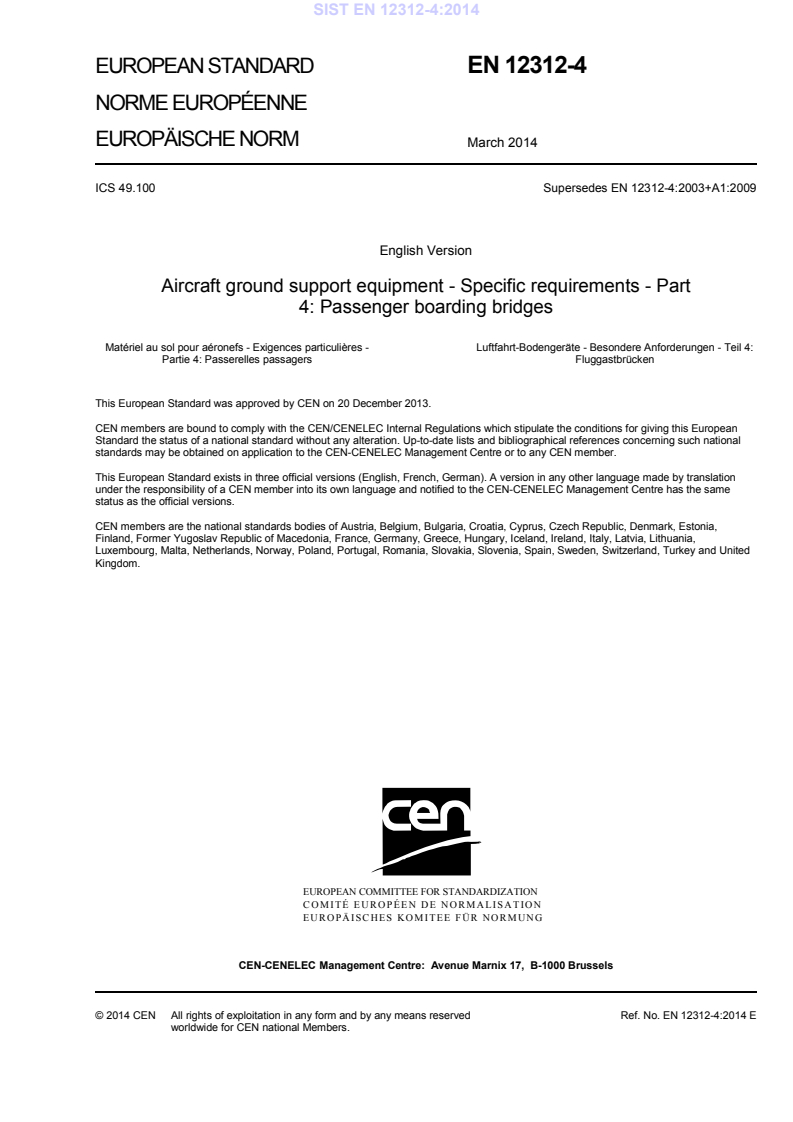
EUROPEAN STANDARD NORME EUROPÉENNE EUROPÄISCHE NORM
EN 12312-4
March 2014 ICS 49.100 Supersedes EN 12312-4:2003+A1:2009English Version
Aircraft ground support equipment - Specific requirements - Part 4: Passenger boarding bridges
Matériel au sol pour aéronefs - Exigences particulières - Partie 4: Passerelles passagers
Luftfahrt-Bodengeräte - Besondere Anforderungen - Teil 4: Fluggastbrücken This European Standard was approved by CEN on 20 December 2013.
CEN members are bound to comply with the CEN/CENELEC Internal Regulations which stipulate the conditions for giving this European Standard the status of a national standard without any alteration. Up-to-date lists and bibliographical references concerning such national standards may be obtained on application to the CEN-CENELEC Management Centre or to any CEN member.
This European Standard exists in three official versions (English, French, German). A version in any other language made by translation under the responsibility of a CEN member into its own language and notified to the CEN-CENELEC Management Centre has the same status as the official versions.
CEN members are the national standards bodies of Austria, Belgium, Bulgaria, Croatia, Cyprus, Czech Republic, Denmark, Estonia, Finland, Former Yugoslav Republic of Macedonia, France, Germany, Greece, Hungary, Iceland, Ireland, Italy, Latvia, Lithuania, Luxembourg, Malta, Netherlands, Norway, Poland, Portugal, Romania, Slovakia, Slovenia, Spain, Sweden, Switzerland, Turkey and United Kingdom.
EUROPEAN COMMITTEE FOR STANDARDIZATION
COMITÉ EUROPÉEN DE NORMALISATION EUROPÄISCHES KOMITEE FÜR NORMUNG
CEN-CENELEC Management Centre:
Avenue Marnix 17,
B-1000 Brussels © 2014 CEN All rights of exploitation in any form and by any means reserved worldwide for CEN national Members. Ref. No. EN 12312-4:2014 ESIST EN 12312-4:2014
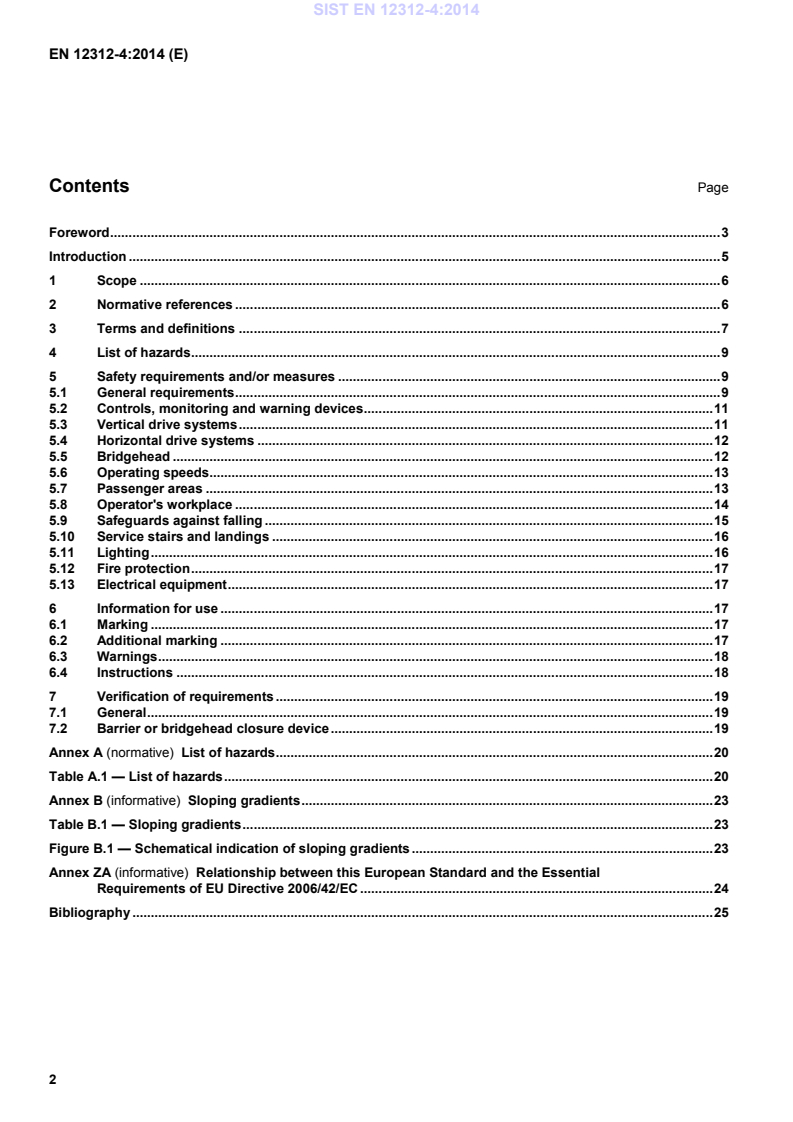
List of hazards . 20 Table A.1 — List of hazards . 20 Annex B (informative)
Sloping gradients . 23 Table B.1 — Sloping gradients . 23 Figure B.1 — Schematical indication of sloping gradients . 23 Annex ZA (informative)
Relationship between this European Standard and the Essential Requirements of EU Directive 2006/42/EC . 24 Bibliography . 25
...
SIST EN 12312-4:2014 표준은 항공기 지상 지원 장비 중 승객 탑승 다리(PBB)에 대한 구체적인 요구 사항을 규정하고 있습니다. 이 표준의 주요 목표는 클로즈 4에 나열된 위험 요소들을 최소화하는 것입니다. 이러한 위험 요소들은 PBB가 의도한 대로 사용되는 경우, 즉 제조업체가 제공한 사양에 따라 운영 및 유지 관리되었을 때 발생할 수 있으며, 제조업체가 합리적으로 예측할 수 있는 오용 개념도 포함됩니다. 이 표준은 다음과 같은 종류의 다리에 적용됩니다: a) 에이프론 드라이브 브리지 b) 고정 헤드 브리지(코주로더라고도 불림) 또는 받침대 브리지 c) 서스펜디드 브리지 이러한 브리지는 승객의 탑승/하차를 위해 설계되었으며, 터미널 건물과의 접촉점에서도 적용됩니다. 이 기준은 이동 가능한 다리를 포함하여 도착 및 출발 수준을 구분하기 위한 두 개의 레벨을 가진 브리지까지 포함됩니다. SIST EN 12312-4:2014 표준의 강점은 다양한 안전 요구 사항을 충족시키기 위해 산업 관계자들의 요구를 충실히 반영하고 있다는 점입니다. 이는 항공사, 항공사 지상 지원 장비 제조업체 및 관련 당국의 필수 요구 사항이 포함되어 있습니다. 이러한 점은 차량이 수송 운영을 할 때 발생할 수 있는 위험성을 효과적으로 관리할 수 있도록 설계되었습니다. 하지만 이 표준은 승객 라운지, 승객 계단, 기타 항공기 접근 장비 또는 자동 PBB 위치 설정과 관련된 요구 사항을 포함하지 않습니다. 또한 소음 및 진동과 관련된 위험에 대한 요구 사항은 설정되어 있지 않으며, 이와 관련해서는 EN 1915-3 및 EN 1915-4가 제공하는 일반적인 GSE 진동 및 소음 요구 사항을 참조해야 합니다. EN 12312-4:2014는 또한 이 표준이 발표되기 전에 제조된 PBB에는 적용되지 않음을 명시하고 있습니다. 이 표준은 EN 1915-1, EN 1915-2 및 EN 1915-4와 함께 사용할 경우 PBB에 대한 보다 포괄적인 요구 사항을 제공합니다. 전체적으로 SIST EN 12312-4:2014는 항공기 지상 지원 장비의 안전성과 효율성을 보장하기 위한 필수적이고 매우 실용적인 표준으로 자리매김하고 있습니다.
The EN 12312-4:2014 standard, titled "Aircraft ground support equipment - Specific requirements - Part 4: Passenger boarding bridges," establishes a comprehensive framework aimed at minimizing risks associated with passenger boarding bridges (PBBs) during their commissioning, operation, and maintenance. The scope of this standard is meticulously defined, addressing various types of PBBs, including apron-drive, fixed-head, and suspended bridges, ensuring that all forms of passenger access equipment used between terminals and aircraft are covered, and therefore directly enhancing safety in the aviation sector. One of the significant strengths of this standard is its focus on foreseeable misuse, which underscores a proactive approach to safety that is crucial in high-traffic environments such as airports. By taking into account potential scenarios that may not align with the manufacturer's intended use, the standard ensures that comprehensive safety measures are integrated into the operational protocols of PBBs. Additionally, the involvement of key stakeholders such as authorities, aircraft and ground support equipment manufacturers, airlines, and handling agencies in recognizing essential safety requirements further bolsters the standard's relevance and applicability, securing wide acceptance across the industry. The document is also attentive to interoperability, specifying that it should be used in conjunction with other standards like EN 1915-1, EN 1915-2, and EN 1915-4. This interaction highlights its role within a broader system of ground support equipment (GSE) standards and ensures that the technical requirements for noise and vibration concerning PBBs are adequately addressed through referenced documents, although it explicitly states that noise and vibration hazards are not covered under this standard. It is important to note the standard's exclusions, which clarify that elevating lounges, passenger stairs, and automatic PBB positioning are not encompassed within its specifications. This delineation ensures that stakeholders clearly understand the applicability of the standard, preventing misinterpretation that could arise from its scope. Furthermore, this standard is not retroactive; it does not apply to PBBs manufactured before its publication date, which also aligns with common practices in standardization to ensure that only current technologies and methodologies are evaluated against its criteria. In summary, EN 12312-4:2014 is a critical resource that systematically outlines the technical requirements for passenger boarding bridges. Its strength lies in its thorough approach to safety and clarity of application, making it a significant document for stakeholders involved in the design, operation, and maintenance of PBBs in the aviation industry.
標準EN 12312-4:2014は、航空機地上支援設備の中で特に乗客用搭乗橋に関する技術要件を定めた重要な文書です。この欧州標準は、搭乗橋(PBB)が意図された通りに使用される際に発生する可能性のある危険を最小限に抑えることを目的としており、製造者またはその公認代理人が提供する仕様に基づいて、目視できる範囲の誤使用を含めています。 この標準の強みは、搭乗橋に対する包括的な視点を提供し、空港の運営に関連するさまざまなステークホルダー-航空会社や地上支援設備(GSE)製造者、運用当局など-の要求を考慮している点です。これにより、搭乗橋が安全に機能するための信頼性が高まります。 標準の適用範囲には、エプロンドライブ橋、固定ヘッド橋(ノーズローダーとも称される)、吊り橋が含まれており、これらは乗客の搭乗および下船のために使用されます。また、設計された通りの使い方においても、ターミナルビルとのインターフェースから航空機への接続までカバーされているため、空港の運用において特に重要な役割を果たします。 一方で、この標準は、昇降ラウンジや乗客の階段、その他の航空機アクセス機器、自動PBB位置決めには適用されない点を明示しており、特定の設備に特化した要件を設けることで、関連する設備に対する明確な指針を示しています。ノイズや振動による危険に関しては、EN 1915-3およびEN 1915-4が一般的な要件を規定しているため、この標準ではその範囲外とされています。 EN 12312-4は、EN 1915-1、EN 1915-2、EN 1915-4と組み合わせて使用することで、搭乗橋に関する包括的な要件を提供し、全体的な安全性と効率性の向上に寄与します。この標準は、製造された日付が発行日前であるPBBには適用されないため、最新の設計と技術が推奨されていることが強調されています。 このように、EN 12312-4:2014は航空機地上支援設備における乗客搭乗橋の安全性と効率性を確保するための基盤を提供しており、業界全体にとって重要な標準であると言えます。
Die Norm EN 12312-4:2014 befasst sich mit den spezifischen Anforderungen an Flugzeugbodenunterstützungsausrüstung, insbesondere im Hinblick auf Passagierbrücken (PBBs). Ihr Anwendungsbereich ist umfassend und schließt die technischen Anforderungen ein, die erforderlich sind, um die in Klausel 4 aufgelisteten Gefahren während der Inbetriebnahme, des Betriebs und der Wartung von PBBs zu minimieren. Diese Norm ist besonders relevant, da sie nicht nur die ordnungsgemäße Verwendung von Passagierbrücken abdeckt, sondern auch mögliche Missbräuche berücksichtigt, die der Hersteller vernünftigerweise vorhersehen kann. Ein wesentlicher Stärke der EN 12312-4:2014 ist die Berücksichtigung von Anforderungen, die als essenziell von Behörden, Herstellern von Flugzeugbödenunterstützungsausrüstung sowie von Fluggesellschaften und Bodenabfertigungsunternehmen anerkannt sind. Dies zeigt, dass die Norm auf den realen Bedürfnissen und Herausforderungen der Branche basiert und somit die Sicherheit und Effizienz im Umgang mit PBBs verbessert. Die Norm definiert klar, welche Arten von Brücken sie umfasst, darunter apron-drive Brücken, feste Kopfbrücken und hängende Brücken, und regelt die Nutzung im Zusammenhang mit dem Boarding und Deplaning von Passagieren. Besonders hervorzuheben ist der Fokus auf die Schnittstelle zwischen der Brücke und dem Terminalgebäude, einschließlich beweglicher Brücken, was die Flexibilität und Anpassungsfähigkeit in modernen Flughafeninfrastrukturen unterstützt. Darüber hinaus ist die Norm präzise in ihrem Ausschluss bestimmter Geräte wie erhöhter Lounges und Passagierstiegen, was dazu beiträgt, den Geltungsbereich klar zu definieren und Missverständnisse zu vermeiden. Es ist auch wichtig zu erwähnen, dass diese Norm keine Anforderungen an die Gefahren von Lärm und Vibrationen festlegt, da dies in andere Normen integriert ist. Insgesamt bietet die EN 12312-4:2014 eine solide Grundlage für Sicherheit und Effizienz im Betrieb von Passagierbrücken und stellt sicher, dass diese kritischen Elemente der Flughafeninfrastruktur sowohl den gesetzlichen Anforderungen als auch den Industriestandards entsprechen.
La norme EN 12312-4:2014 constitue un cadre essentiel pour le développement et la régulation des équipements de soutien au sol des aéronefs, en se concentrant spécifiquement sur les ponts de liaison pour l'embarquement et le débarquement des passagers. Son champ d'application est clairement défini et couvre divers types de ponts, notamment les ponts à entraînement de cour, les ponts à tête fixe, ainsi que les ponts suspendus, garantissant ainsi des solutions adaptées aux besoins variés des opérations aéroportuaires. L'un des points forts de cette norme réside dans son attention à la sécurité, en minimisant les risques liés à l'utilisation des ponts de liaison passagers (PBB) tels que décrits dans le cadre de la clause 4. En intégrant les exigences techniques recommandées par les autorités, les fabricants d'équipements de soutien au sol (GSE), ainsi que par les compagnies aériennes, la norme assure une approche cohérente et collaborative pour le traitement des risques potentiels. Cela permet aux utilisateurs de fonctionner en conformité avec des spécifications rigoureuses, favorisant ainsi un environnement d'opération sécurisé pour le personnel et les passagers. De plus, l'application de la norme s'étend à l'interface avec le bâtiment terminal, garantissant une intégration fluide entre les infrastructures aéroportuaires et les aéronefs. Cette approche modulaire est cruciale, car elle permet aux aéroports de concevoir des systèmes plus efficaces et de réduire les désagréments pour les passagers. En revanche, il est important de noter que cette norme exclut certains équipements, tels que les salons d'élévation et les escaliers pour passagers, ce qui précise son champ d'application et assure une concentration sur les PBB. La non-prise en compte des vibrations et du bruit dans cette partie de la norme, tout en étant déléguée à d'autres standards, comme l'EN 1915-3 et l'EN 1915-4, souligne la volonté de créer des directives précises sans engendrer de redondance. En somme, la norme SIST EN 12312-4:2014 est d'une grande pertinence pour les acteurs du secteur aéroportuaire, leur fournissant des directives précises et bien structurées qui favorisent la sécurité et l'efficacité lors de l'utilisation des ponts de liaison pour passagers. Elle représente un outil incontournable pour assurer la conformité et la sécurité dans un environnement en constante évolution.


Questions, Comments and Discussion
Ask us and Technical Secretary will try to provide an answer. You can facilitate discussion about the standard in here.
Loading comments...