


EN 15273-3:2009
(Main)Railway applications - Gauges - Part 3: Structure gauges
General Information
- Abstract
This standard:
¾ defines the various profiles needed to install, verify and maintain the various structures near the structure
gauge;
- lists the various phenomena to be taken into account to determine the structure gauge;
- defines a methodology that may be used to calculate the various profiles from these phenomena;
- lists the rules to determine the distance between the track centres;
- lists the rules to be complied with when building the platforms;
- lists the rules to determine the pantograph gauge;
- lists the formulae needed to calculate the structure gauges in the catalogue.
- Status
- Withdrawn
- Publication Date
- 22-Dec-2009
- Withdrawal Date
- 07-May-2013
- Technical Committee
- CEN/TC 256 - Railway applications
- Drafting Committee
- CEN/TC 256/WG 32 - Vehicle gauge
- Current Stage
- 9960 - Withdrawal effective - Withdrawal
- Start Date
- 08-May-2013
- Completion Date
- 08-May-2013
- Directive
- Not Harmonized2001/16/EC - Directive 2001/16/EC of the European Parliament and of the Council of 19 March 2001 on the interoperability of the trans-European conventional rail system
Not Harmonized2008/57/EC - DIRECTIVE 2008/57/EC OF THE EUROPEAN PARLIAMENT AND OF THE COUNCIL of 17 June 2008 on the interoperability of the rail system within the Community (Recast)OJ Ref: C, C 214 OJ Date: 20-Jul-2011

Relations
- Effective Date
- 15-May-2013
- Effective Date
- 09-Feb-2026
- Effective Date
- 09-Feb-2026
- Effective Date
- 28-Jan-2026
- Effective Date
- 28-Jan-2026
- Effective Date
- 28-Jan-2026
- Effective Date
- 28-Jan-2026
- Effective Date
- 28-Jan-2026
- Effective Date
- 28-Jan-2026
Get Certified
Connect with accredited certification bodies for this standard

IRIS Certification (UNIFE)
International Railway Industry Standard certification.

TÜV SÜD Rail GmbH
TÜV SÜD railway certification services.

Bureau Veritas Railway Certification
Railway and transportation certification.
Sponsored listings
Frequently Asked Questions
EN 15273-3:2009 is a standard published by the European Committee for Standardization (CEN). Its full title is "Railway applications - Gauges - Part 3: Structure gauges". This standard covers: This standard: ¾ defines the various profiles needed to install, verify and maintain the various structures near the structure gauge; - lists the various phenomena to be taken into account to determine the structure gauge; - defines a methodology that may be used to calculate the various profiles from these phenomena; - lists the rules to determine the distance between the track centres; - lists the rules to be complied with when building the platforms; - lists the rules to determine the pantograph gauge; - lists the formulae needed to calculate the structure gauges in the catalogue.
This standard: ¾ defines the various profiles needed to install, verify and maintain the various structures near the structure gauge; - lists the various phenomena to be taken into account to determine the structure gauge; - defines a methodology that may be used to calculate the various profiles from these phenomena; - lists the rules to determine the distance between the track centres; - lists the rules to be complied with when building the platforms; - lists the rules to determine the pantograph gauge; - lists the formulae needed to calculate the structure gauges in the catalogue.
EN 15273-3:2009 is classified under the following ICS (International Classification for Standards) categories: 45.020 - Railway engineering in general; 45.060.01 - Railway rolling stock in general. The ICS classification helps identify the subject area and facilitates finding related standards.
EN 15273-3:2009 has the following relationships with other standards: It is inter standard links to EN 15273-3:2013, EN 50367:2020, EN 50119:2020, EN 13232-9:2023, EN 15273-2:2025, EN 15273-1:2025, EN 13232-3:2023, EN 15273-1:2009, EN 15273-2:2009. Understanding these relationships helps ensure you are using the most current and applicable version of the standard.
EN 15273-3:2009 is associated with the following European legislation: EU Directives/Regulations: 2001/16/EC, 2008/57/EC, 93/38/EEC, 96/48/EC; Standardization Mandates: M/024, M/275, M/334. When a standard is cited in the Official Journal of the European Union, products manufactured in conformity with it benefit from a presumption of conformity with the essential requirements of the corresponding EU directive or regulation.
EN 15273-3:2009 is available in PDF format for immediate download after purchase. The document can be added to your cart and obtained through the secure checkout process. Digital delivery ensures instant access to the complete standard document.
Standards Content (Sample)
2003-01.Slovenski inštitut za standardizacijo. Razmnoževanje celote ali delov tega standarda ni dovoljeno.Železniške naprave - Profili - 3. del: Svetli profiliBahnanwendungen - Lichtraum - Teil 3: LichtraumprofileApplications ferroviaires - Gabarits - Partie 3: Gabarit des obstaclesRailway applications - Gauges - Part 3: Structure gauges45.060.01Železniška vozila na splošnoRailway rolling stock in generalICS:Ta slovenski standard je istoveten z:EN 15273-3:2009SIST EN 15273-3:2010en,fr,de01-september-2010SIST EN 15273-3:2010SLOVENSKI
STANDARD
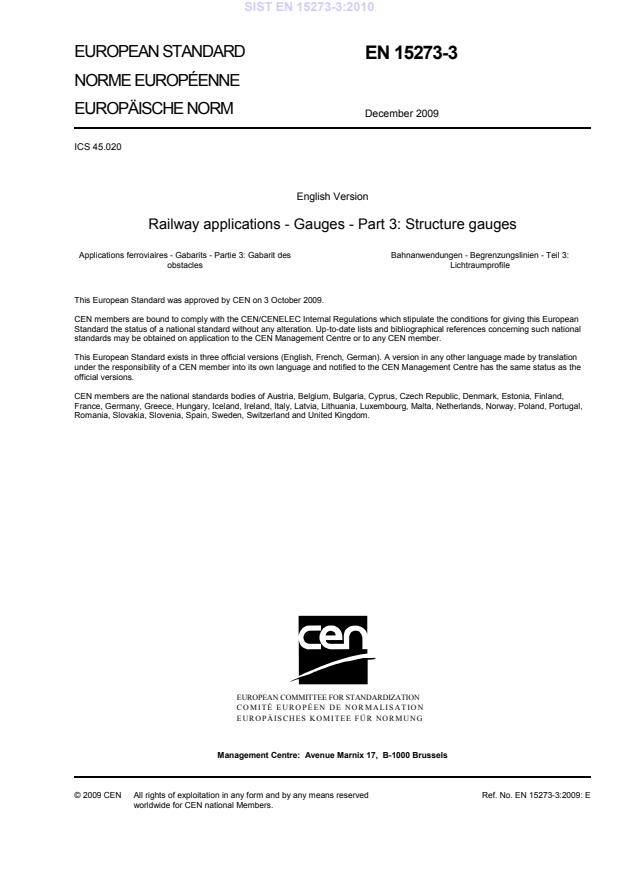
EUROPEAN STANDARD NORME EUROPÉENNE EUROPÄISCHE NORM
EN 15273-3
December 2009 ICS 45.020 English Version
Railway applications - Gauges - Part 3: Structure gauges
Applications ferroviaires - Gabarits - Partie 3: Gabarit des obstacles
Bahnanwendungen - Begrenzungslinien - Teil 3: Lichtraumprofile This European Standard was approved by CEN on 3 October 2009.
CEN members are bound to comply with the CEN/CENELEC Internal Regulations which stipulate the conditions for giving this European Standard the status of a national standard without any alteration. Up-to-date lists and bibliographical references concerning such national standards may be obtained on application to the CEN Management Centre or to any CEN member.
This European Standard exists in three official versions (English, French, German). A version in any other language made by translation under the responsibility of a CEN member into its own language and notified to the CEN Management Centre has the same status as the official versions.
CEN members are the national standards bodies of Austria, Belgium, Bulgaria, Cyprus, Czech Republic, Denmark, Estonia, Finland, France, Germany, Greece, Hungary, Iceland, Ireland, Italy, Latvia, Lithuania, Luxembourg, Malta, Netherlands, Norway, Poland, Portugal, Romania, Slovakia, Slovenia, Spain, Sweden, Switzerland and United Kingdom.
EUROPEAN COMMITTEE FOR STANDARDIZATION
COMITÉ EUROPÉEN DE NORMALISATION EUROPÄISCHES KOMITEE FÜR NORMUNG
Management Centre:
Avenue Marnix 17,
B-1000 Brussels © 2009 CEN All rights of exploitation in any form and by any means reserved worldwide for CEN national Members. Ref. No. EN 15273-3:2009: ESIST EN 15273-3:2010
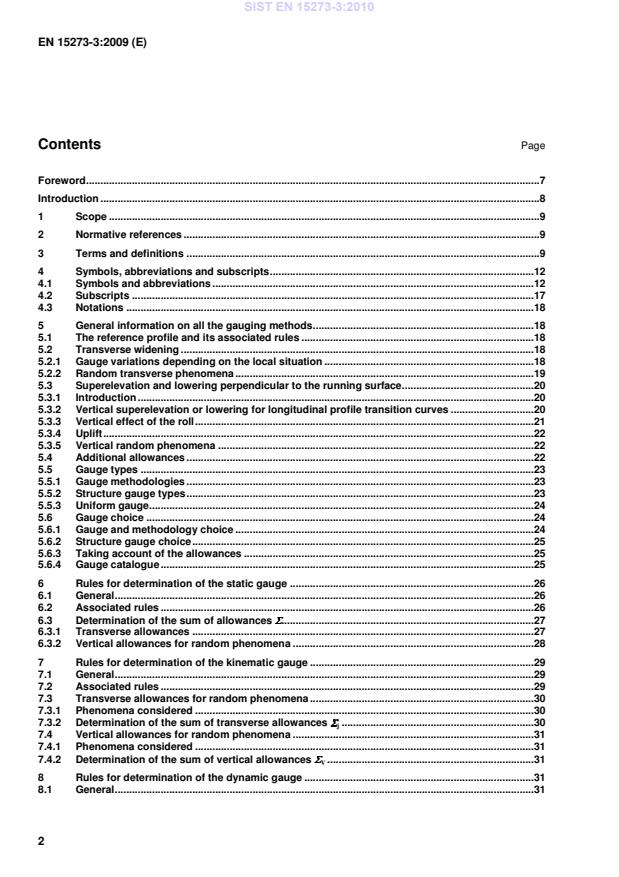
Calculation methodology for structure gauge allowances.61 A.1 Introduction.61 A.2 Formulation in the case of the static or kinematic gauge.61 A.2.1 For the installation nominal gauge.61 A.2.2 For the installation limit gauge.62 A.2.3 Limit gauge.64 A.2.4 For the installation nominal distance between centres.64 A.2.5 For the installation limit distance between centres.65 A.2.6 For the limit distance between centres.65 A.2.7 For the pantograph gauge.65 A.3 Formulation in the case of the dynamic gauge.66 A.3.1 General.66 A.3.2 For the installation nominal gauge.66 A.3.3 For the installation limit gauge.66 A.3.4 Limit gauge.67 A.3.5 For the installation nominal distance between centres.68 A.3.6 For the installation limit distance between centres.68 A.3.7 For the limit distance between centres.69 A.3.8 For the pantograph gauge.69 Annex B (informative)
Recommended values for calculation of the structure gauge and calculation examples.70 B.1 Recommendations for coefficients.70 B.2 Examples of kinematic calculation.71 B.2.1 Limit gauge and installation limit gauge.71 B.2.2 Nominal, installation limit and limit distances between centres.72 B.2.3 Pantograph gauge.73 Annex C (normative)
International gauges G1, GA, GB and GC.80 C.1 General.80 C.1.1 Application.80 C.1.2 Gauge types.80 C.1.3 Parameters and common rules.80 C.1.4 Calculation of distance between centres.81 C.1.5 Pantograph free passage gauge.81 C.1.6 Gauge parts.81 C.2 Gauge for the upper parts (h > 400 mm).82 C.2.1 Gauge G1.82 C.2.2 Gauges GA and GB.83 C.2.3 Gauge GC.84 C.3 Lower parts (h ££££ 0,400 m).85 C.3.1 Lower parts of GIC2 – generally applicable.85 C.3.2 Lower parts of GIC1 – Tracks for rail brake equipment.87 C.3.3 Lower parts for "rolling" roads – GIC3.91 SIST EN 15273-3:2010
Gauges for multilateral and national agreements.94 D.1 Introduction.94 D.2 Kinematic gauges derived from international gauges.94 D.2.1 Gauge G2.94 D.2.2 Gauges GB1 and GB2.96 D.3 Static gauges derived from international gauges.99 D.3.1 Gauge G1.99 D.3.2 Gauge G2.102 D.3.3 Gauges GA, GB and GC.104 D.4 National application gauge.106 D.4.1 Belgian gauges BE1, BE2 and BE3.106 D.4.2 French gauges FR-3.3.109 D.4.3 Portuguese gauges PTb, PTb+ and PTc.111 D.4.4 Finnish gauge FIN1.117 D.4.5 Swedish gauges SEa and SEc.120 D.4.6 German gauge DE1.123 D.4.7 German gauge DE2.124 D.4.8 German gauge DE3.126 D.4.9 Czech gauge Z-GD.128 D.4.10 UK gauge UK1.129 D.4.11 UK gauge UK1 [D].132 D.4.12 UK gauge W6a.133 Annex E (informative)
Calculation example for determination of the gauge at a turnout.136 E.1 Introduction.136 E.2 Methodology.137 E.3 Widening in the curve.137 E.3.1 Widening of the main line.137 E.3.2 Widening in the turnout route.139 E.4 The quasi-static effect.140 E.5 Gauge width at a turnout.141 Annex F (normative)
Determination of reference vehicle characteristics.144 F.1 Introduction.144 F.2 Methodology.144 F.3 Calculation example.145 F.3.1 Introduction.145 F.3.2 Vehicle no.1 (on the inside of the curve).145 F.3.3 Vehicle no.2 (on the outside of the curve).145 F.3.4 Vehicle no.3 (on the inside of the curve).146 F.3.5 Vehicle no.4 (on the outside of the curve).146 F.3.6 Summary.146 F.3.7 International gauge reference vehicles.146 Annex G (normative)
Uniform gauge.149 G.1 Introduction.149 G.2 GU1.149 G.2.1 General.149 G.2.2 Determination of the gauge.149 G.2.3 Equivalent kinematic gauge.151 G.3 GU2.151 G.3.1 General.151 G.3.2 Determination of the gauge.152 G.4 GUC.153 G.4.1 General.153 G.4.2 Determination of the gauge.154 Annex H (informative)
Gauge maintenance guideline.156 H.1 Introduction.156 H.2 Choice of gauge.156 SIST EN 15273-3:2010
A-deviations.159 Annex ZA (informative)
Relationship between this
European
Standard and the Essential Requirements of the 2008/57/EC.161 Bibliography.170
defines the various profiles needed to install, verify and maintain the various structures near the structure gauge; ¾ lists the various phenomena to be taken into account to determine the structure gauge; ¾ defines a methodology that may be used to calculate the various profiles from these phenomena; ¾ lists the rules to determine the distance between the track centres; ¾ lists the rules to be complied with when building the platforms; ¾ lists the rules to determine the pantograph gauge; ¾ lists the formulae needed to calculate the structure gauges in the catalogue.
2 Normative references The following referenced documents are indispensable for the application of this document. For dated references, only the edition cited applies. For undated references, the latest edition of the referenced document (including any amendments) applies. EN 13232-3, Railway applications — Track — Switches and crossings — Part 3: Requirements for wheel/rail interaction EN 13232-9, Railway applications — Track — Switches and crossings — Part 9: Layouts EN 15273-1, Railway applications — Gauges — Part 1: General — Common rules for infrastructure and rolling stock
EN 15273-2, Railway applications — Gauges — Part 2: Rolling stock gauge EN 50119, Railway applications — Fixed installations — Electric traction overhead contact lines EN 50367, Railway applications — Current collection systems —Technical criteria for the interaction between pantograph and overhead line (to achieve free access) 3 Terms and definitions For the purposes of this document, the following terms and definitions apply: 3.1
structure gauge defines the space, relative to the track used called the reference track, to be cleared of all objects or structures and relative to the traffic on adjacent tracks in order to permit safe operation on this reference track.
The structure gauge is defined on the basis of the reference profile by applying the associated rules.
There are three types of structure gauge. SIST EN 15273-3:2010
space not to be encroached upon taking into account a maintenance allowance.
It is to be used to define the structure installation limit Consequently, no structure shall be installed if free passage is desired following normal maintenance operations. 3.4 structure installation nominal gauge space to be cleared for all structures to permit train operation and track maintenance, including adequate allowances.
This space may include allowances for special consignments and other conditions 3.5 distance between track centres distance between the centre points of the two tracks concerned, measured parallel to the running surface of the track used, called the reference track, which is the track with the least cant
NOTE 1 On the track, the distance between centres is often determined on the basis of the space between centres which is the distance between the two rails of the adjacent tracks.
The exact measurement references (guideline, field face, rail centrelines) differ from one network to another.
NOTE 2 The definition of distance between centres adopted in this standard may differ from those used in other applications, such as installation for example.
It is the responsibility of the infrastructure manager to determine the various conversion rules.
Key 1
distance between track centres 2
space between centres measured between the running edges 3
space between centres measured between the rail centrelines 4
space between centres measured between the outside edges of the rails Figure 1 — Distance between track centres SIST EN 15273-3:2010
This distance varies as a function of the local track parameters (e.g. cant, curve radius, etc.)
3.7 installation limit distance between centres minimum distance between adjacent tracks to ensure completely safe passage of traffic within the gauge used on the two tracks by avoiding any risk of interference between the vehicles.
This distance varies as a function of the local track parameters (e.g. cant, curve radius, etc.). It takes into account maintenance allowances
3.8 installation nominal distance between centres distance between centres that generally has a suitable allowance to permit
ease of design, laying, monitoring and maintenance, the operation of special transport or any other aspect.
Outside the small radius zones, the nominal distance between centres is often invariable (determined with fixed parameters)
4 Symbols, abbreviations and subscripts 4.1 Symbols and abbreviations Table 1 — Symbols and abbreviations Symbol Designation Unit Symbol number a Distance between end axles of vehicles not fitted with bogies or between bogie centres
m 1.001 b Semi-width or distance parallel to the running surface, relative to the track centreline or of the vehicle
m 1.007 b’ Semi-width of the pantograph gauge m 3.001 b’q Actual installation distance of the platforms, measured from the rail running edge
m 1.008 bRP Semi-width of the reference profile m 3.002 belec Electrical insulation distance m 3.003 bgap Standard width of the gap between the platform and the step
m 1.019 bstructure Distance parallel to the running surface between the structure and the track centreline m 3.004 bq Semi-width of the platform installation
m 1.021 Db Variation in semi-width b m 3.005 bveh Semi-width of the vehicle
m 1.030 bw Semi-width of the pantograph head
m 1.033 C0 (Reference) roll centre m 3.006 cw Semi-width of the pantograph head insulating horn m 3.007 dg Geometric overthrow m 3.
...