


EN ISO 20433:2024
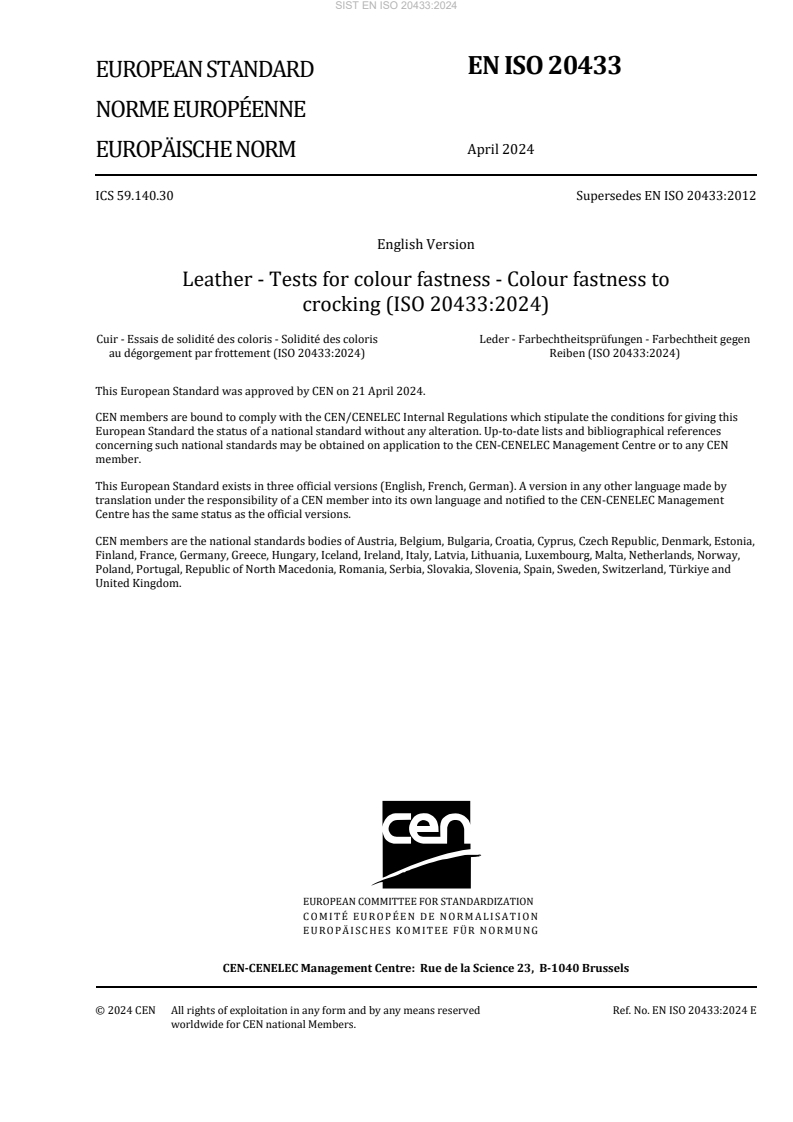
(Main)Leather - Tests for colour fastness - Colour fastness to crocking (ISO 20433:2024)
Leather - Tests for colour fastness - Colour fastness to crocking (ISO 20433:2024)
This document specifies a method to determine the amount of colour transferred from the surface of coloured leather to other surfaces by rubbing.
Two tests are carried out, one with a dry rubbing cloth and one with a wet rubbing cloth.
The method is applicable to all types of coloured leather. Since after‑treatments of the leather as well as surface finishes can affect the degree of colour transfer, the test can be made before and/or after such treatments.
Leder - Farbechtheitsprüfungen - Farbechtheit gegen Reiben (ISO 20433:2024)
Dieses Dokument legt ein Verfahren zur Bestimmung der Farbmenge fest, die von der Oberfläche von farbigem Leder auf andere Oberflächen durch Reiben übertragen wird.
Zwei Prüfungen werden durchgeführt, eine mit einem trockenen und eine mit einem nassen Reibgewebe.
Das Verfahren ist anwendbar für alle Typen von farbigem Leder. Da sowohl Nachbehandlungen von Leder als auch Zurichtungen der Oberfläche den Grad der Farbübertragung beeinflussen können, kann die Prüfung vor und/oder nach derartigen Behandlungen durchgeführt werden.
Cuir - Essais de solidité des coloris - Solidité des coloris au dégorgement par frottement (ISO 20433:2024)
Le présent document spécifie une méthode pour déterminer la quantité de couleur transférée de la surface d’un cuir coloré à d’autres surfaces, par frottement.
Deux essais sont réalisés: l’un avec une étoffe de frottement à sec et l’autre avec une étoffe de frottement humide.
Cette méthode s’applique à tous les types de cuir coloré. Étant donné que les post-traitements du cuir ainsi que les apprêts peuvent avoir une incidence sur le transfert de la couleur, l’essai peut être effectué avant et/ou après ces traitements.
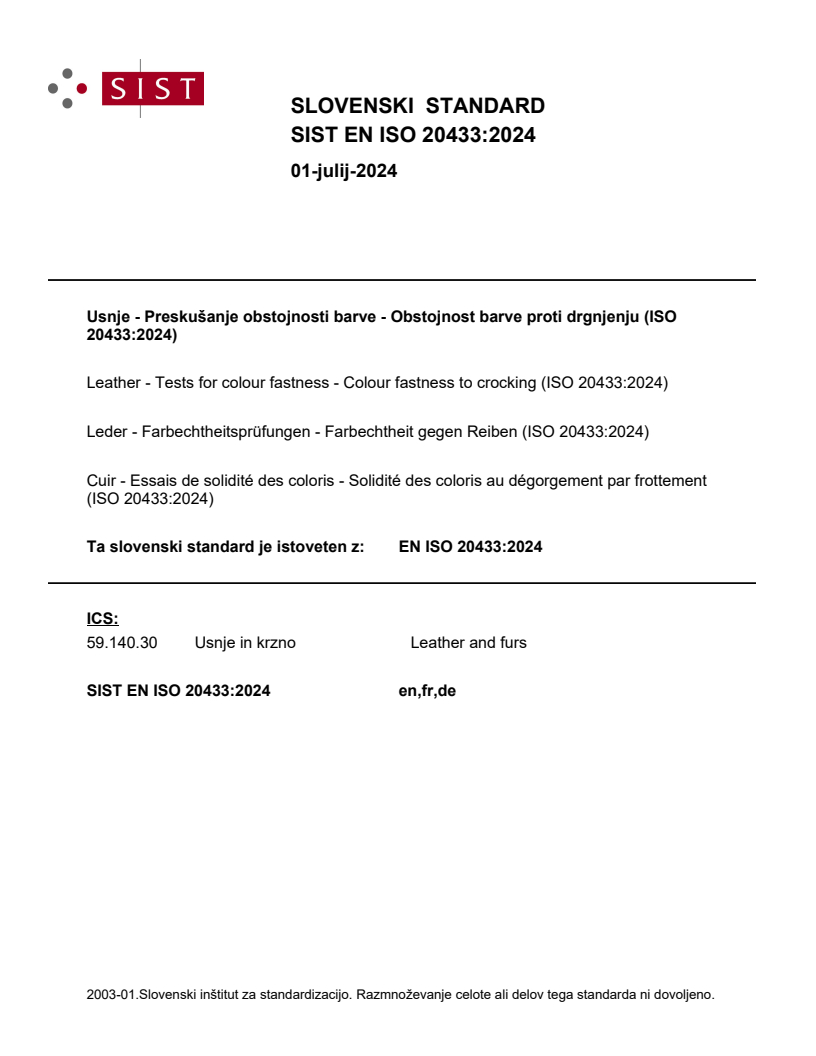
Usnje - Preskušanje obstojnosti barve - Obstojnost barve proti drgnjenju (ISO 20433:2024)
Ta mednarodni standard določa metodo za določevanje količine barve, ki se prenese s površine barvnega usnja na druge površine pri drgnjenju z belo bombažno krpo.
Izvedeta se dva preskusa: eden s suho krpo za drgnjenje in eden z mokro krpo za drgnjenje.
Ta metoda se uporablja za vse vrste barvnega usnja. Naknadna in površinska obdelava usnja lahko vpliva na stopnjo prenosa barve, zato je mogoče preskus izvesti pred in/ali po takšnem postopku.
General Information
- Status
- Published
- Publication Date
- 23-Apr-2024
- Technical Committee
- CEN/TC 289 - Leather
- Drafting Committee
- CEN/TC 289/WG 3 - Fastness test methods
- Current Stage
- 6060 - Definitive text made available (DAV) - Publishing
- Start Date
- 24-Apr-2024
- Completion Date
- 24-Apr-2024
Relations
- Effective Date
- 19-Apr-2023
Overview
EN ISO 20433:2024 - Leather: Tests for colour fastness - Colour fastness to crocking (ISO 20433:2024) defines a standardized laboratory method to measure the amount of colour transferred from coloured leather to other surfaces due to rubbing. Adopted by CEN in 2024 and replacing the 2012 edition, this method applies to all types of coloured leather and can be used before and/or after surface finishes or after‑treatments.
Keywords: EN ISO 20433:2024, colour fastness to crocking, leather crocking test, colour transfer, crockmeter.
Key Topics
- Scope and principle: Quantifies staining on a white cotton rubbing cloth produced by rubbing leather under controlled conditions (dry and wet).
- Test apparatus: A crocking device with a cylindrical rubbing finger (16 mm diameter) moving along a 100 mm ± 5 mm track, applying a 9 N downward force.
- Rubbing media:
- Dry rubbing cloth - white, desized, bleached cotton, ≈50 mm × 50 mm.
- Wet rubbing cloth - conditioned and wetted to ~100% water pick‑up (distilled water).
- Procedure: Each test uses a separate leather test piece (≥140 mm × 50 mm). The rubbing finger is moved reciprocally (10 turns at ~1 turn/s) against the leather; one test for dry, one for wet conditions.
- Evaluation:
- Visual assessment using the grey scale for staining (ISO 105‑A03) after backing the stained cloth with three layers of white cloth.
- Optional instrumental assessment (spectrophotometer/colorimeter) in accordance with ISO 105‑A04 when staining is even.
- Reporting requirements: Reference to ISO 20433:2024, leather type, evaluation method, numerical grey‑scale ratings for dry and wet crocking, deviations, observations and test date.
Applications
Who uses EN ISO 20433:2024:
- Leather manufacturers and tanneries - quality control of dyes and finishes.
- Footwear and leather goods producers - ensuring durability and consumer safety.
- Automotive and upholstery industries - assessing staining risk on adjacent materials.
- Independent testing laboratories and conformity assessors - standardized test reports for specifications and contracts. Practical benefits include consistent measurement of crocking performance, comparison of treatments and finishes, and support for product specifications and claims.
Related Standards
- ISO 105‑A03 - Grey scale for assessing staining
- ISO 105‑A04 - Instrumental assessment of staining
- ISO 2418 - Position and preparation of leather specimens for testing
- ISO 2419 - Specimen conditioning
- ISO 7906 - General principles of testing for colour fastness
EN ISO 20433:2024 provides a clear, repeatable method for evaluating leather colour fastness to crocking, supporting product development, quality assurance and compliance across leather supply chains.


Frequently Asked Questions
EN ISO 20433:2024 is a standard published by the European Committee for Standardization (CEN). Its full title is "Leather - Tests for colour fastness - Colour fastness to crocking (ISO 20433:2024)". This standard covers: This document specifies a method to determine the amount of colour transferred from the surface of coloured leather to other surfaces by rubbing. Two tests are carried out, one with a dry rubbing cloth and one with a wet rubbing cloth. The method is applicable to all types of coloured leather. Since after‑treatments of the leather as well as surface finishes can affect the degree of colour transfer, the test can be made before and/or after such treatments.
This document specifies a method to determine the amount of colour transferred from the surface of coloured leather to other surfaces by rubbing. Two tests are carried out, one with a dry rubbing cloth and one with a wet rubbing cloth. The method is applicable to all types of coloured leather. Since after‑treatments of the leather as well as surface finishes can affect the degree of colour transfer, the test can be made before and/or after such treatments.
EN ISO 20433:2024 is classified under the following ICS (International Classification for Standards) categories: 59.140.30 - Leather and furs. The ICS classification helps identify the subject area and facilitates finding related standards.
EN ISO 20433:2024 has the following relationships with other standards: It is inter standard links to EN ISO 20433:2012. Understanding these relationships helps ensure you are using the most current and applicable version of the standard.
You can purchase EN ISO 20433:2024 directly from iTeh Standards. The document is available in PDF format and is delivered instantly after payment. Add the standard to your cart and complete the secure checkout process. iTeh Standards is an authorized distributor of CEN standards.
Standards Content (Sample)
SLOVENSKI STANDARD
01-julij-2024
Usnje - Preskušanje obstojnosti barve - Obstojnost barve proti drgnjenju (ISO
20433:2024)
Leather - Tests for colour fastness - Colour fastness to crocking (ISO 20433:2024)
Leder - Farbechtheitsprüfungen - Farbechtheit gegen Reiben (ISO 20433:2024)
Cuir - Essais de solidité des coloris - Solidité des coloris au dégorgement par frottement
(ISO 20433:2024)
Ta slovenski standard je istoveten z: EN ISO 20433:2024
ICS:
59.140.30 Usnje in krzno Leather and furs
2003-01.Slovenski inštitut za standardizacijo. Razmnoževanje celote ali delov tega standarda ni dovoljeno.
EN ISO 20433
EUROPEAN STANDARD
NORME EUROPÉENNE
April 2024
EUROPÄISCHE NORM
ICS 59.140.30 Supersedes EN ISO 20433:2012
English Version
Leather - Tests for colour fastness - Colour fastness to
crocking (ISO 20433:2024)
Cuir - Essais de solidité des coloris - Solidité des coloris Leder - Farbechtheitsprüfungen - Farbechtheit gegen
au dégorgement par frottement (ISO 20433:2024) Reiben (ISO 20433:2024)
This European Standard was approved by CEN on 21 April 2024.
CEN members are bound to comply with the CEN/CENELEC Internal Regulations which stipulate the conditions for giving this
European Standard the status of a national standard without any alteration. Up-to-date lists and bibliographical references
concerning such national standards may be obtained on application to the CEN-CENELEC Management Centre or to any CEN
member.
This European Standard exists in three official versions (English, French, German). A version in any other language made by
translation under the responsibility of a CEN member into its own language and notified to the CEN-CENELEC Management
Centre has the same status as the official versions.
CEN members are the national standards bodies of Austria, Belgium, Bulgaria, Croatia, Cyprus, Czech Republic, Denmark, Estonia,
Finland, France, Germany, Greece, Hungary, Iceland, Ireland, Italy, Latvia, Lithuania, Luxembourg, Malta, Netherlands, Norway,
Poland, Portugal, Republic of North Macedonia, Romania, Serbia, Slovakia, Slovenia, Spain, Sweden, Switzerland, Türkiye and
United Kingdom.
EUROPEAN COMMITTEE FOR STANDARDIZATION
COMITÉ EUROPÉEN DE NORMALISATION
EUROPÄISCHES KOMITEE FÜR NORMUNG
CEN-CENELEC Management Centre: Rue de la Science 23, B-1040 Brussels
© 2024 CEN All rights of exploitation in any form and by any means reserved Ref. No. EN ISO 20433:2024 E
worldwide for CEN national Members.
Contents Page
European foreword . 3
European foreword
This document (EN ISO 20433:2024) has been prepared by Technical Committee ISO/IULTCS
"International Union of Leather Technologists and Chemists Societies" in collaboration with Technical
Committee CEN/TC 289 “Leather” the secretariat of which is held by UNI.
This European Standard shall be given the status of a national standard, either by publication of an
identical text or by endorsement, at the latest by October 2024, and conflicting national standards shall
be withdrawn at the latest by October 2024.
Attention is drawn to the possibility that some of the elements of this document may be the subject of
patent rights. CEN shall not be held responsible for identifying any or all such patent rights.
This document supersedes EN ISO 20433:2012.
Any feedback and questions on this document should be directed to the users’ national standards
body/national committee. A complete listing of these bodies can be found on the CEN website.
According to the CEN-CENELEC Internal Regulations, the national standards organizations of the
following countries are bound to implement this European Standard: Austria, Belgium, Bulgaria,
Croatia, Cyprus, Czech Republic, Denmark, Estonia, Finland, France, Germany, Greece, Hungary, Iceland,
Ireland, Italy, Latvia, Lithuania, Luxembourg, Malta, Netherlands, Norway, Poland, Portugal, Republic of
North Macedonia, Romania, Serbia, Slovakia, Slovenia, Spain, Sweden, Switzerland, Türkiye and the
United Kingdom.
Endorsement notice
The text of ISO 20433:2024 has been approved by CEN as EN ISO 20433:2024 without any modification.
International
Standard
ISO
IULTCS
IUF 452
Third edition
Leather — Tests for colour fastness
2024-04
— Colour fastness to crocking
Cuir — Essais de solidité des coloris — Solidité des coloris au
dégorgement par frottement
Reference numbers
ISO 20433:2024(en)
IULTCS/IUF 452:2024(en) © ISO 2024
ISO 20433:2024(en)
IULTCS/IUF 452:2024(en)
© ISO 2024
All rights reserved. Unless otherwise specified, or required in the context of its implementation, no part of this publication may
be reproduced or utilized otherwise in any form or by any means, electronic or mechanical, including photocopying, or posting on
the internet or an intranet, without prior written permission. Permission can be requested from either ISO at the address below
or ISO’s member body in the country of the requester.
ISO copyright office
CP 401 • Ch. de Blandonnet 8
CH-1214 Vernier, Geneva
Phone: +41 22 749 01 11
Email: copyright@iso.org
Website: www.iso.org
Published in Switzerland
ii
ISO 20433:2024(en)
IULTCS/IUF 452:2024(en)
Contents Page
Foreword .iv
1 Scope . 1
2 Normative references . 1
3 Terms and definitions . 1
4 Principle . 1
5 Apparatus and materials . 2
6 Leather specimen and test pieces . 2
7 Procedure . 2
8 Evaluation . 2
9 Test report . 3
Annex A (informative) Apparatus and materials . 4
Bibliography . 5
iii
ISO 20433:2024(en)
IULTCS/IUF 452:2024(en)
Foreword
ISO (the International Organization for Standardization) is a worldwide federation of national standards
bodies (ISO member bodies). The work of preparing International Standards is normally carried out through
ISO technical committees. Each member body interested in a subject for which a technical committee
has been established has the right to be represented on that committee. International organizations,
governmental and non-governmental, in liaison with ISO, also take part in the work. ISO collaborates closely
with the International Electrotechnical Commission (IEC) on all matters of electrotechnical standardization.
The procedures used to develop this document and those intended for its further maintenance are described
in the ISO/IEC Directives, Part 1. In particular, the different approval criteria needed for the different types
of ISO document should be noted. This document was drafted in accordance with the editorial rules of the
ISO/IEC Directives, Part 2 (see www.iso.org/directives).
ISO draws attention to the possibility that the implementation of this document may involve the use of (a)
patent(s). ISO takes no position concerning the evidence, validity or applicability of any claimed patent
rights in respect thereof. As of the date of publication of this document, ISO had not received notice of (a)
patent(s) which may be required to implement this document. However, implementers are cautioned that
this may not represent the
...
Questions, Comments and Discussion
Ask us and Technical Secretary will try to provide an answer. You can facilitate discussion about the standard in here.
Loading comments...