

EN 14444:2005
(Main)Structural adhesives - Qualitative assessment of durability of bonded assemblies - Wedge rupture test (ISO 10354:1992 modified)
- Abstract
This document simulates in a qualitative manner mechanical forces and important environmental influences on an adhesive-bonded joint at a metal polymer interfaces it can also be used as a method of checking the surface preparation of substrates, with a limited detection level.
The test is applicable at the present time to the bonding of aluminium and titanium alloys using thermosetting structural adhesives and primers.
NOTE This method can also be used for assessing surface preparation of other metals. Considerable caution in the evaluation of comparative results should be exercised in the event that the materials (adhesive plus adherend) and the specimen geometry are varied. Like should be compared with like (only similar adherends bonded with similar adhesives can be compared between themselves).
- Status
- Published
- Publication Date
- 18-Oct-2005
- Technical Committee
- CEN/TC 193 - Adhesives
- Drafting Committee
- CEN/TC 193/WG 2 - Structural adhesives
- Current Stage
- 9060 - Closure of 2 Year Review Enquiry - Review Enquiry
- Start Date
- 04-Jun-2026
- Completion Date
- 04-Jun-2026

Overview
EN 14444:2005 - "Structural adhesives - Qualitative assessment of durability of bonded assemblies - Wedge rupture test (ISO 10354:1992 modified)" is a CEN standard that defines a qualitative laboratory test to simulate mechanical forces and environmental influences on adhesive-bonded metal–polymer interfaces. The method is intended primarily for bonding of aluminium and titanium alloys with thermosetting structural adhesives and primers, and it can also be used to check substrate surface preparation at a limited detection level.
Key topics and requirements
- Test principle: progressive insertion of a wedge between bonded plates to initiate and propagate a crack; measure initial and final crack lengths and calculate crack growth caused by ageing.
- Specimen preparation:
- Bond two plates (typical plate dimensions specified in the standard) and cut specimens to standard widths (final specimens commonly 25 mm ± 0.1 mm).
- Control adhesive layer thickness (measure mean thickness with 0.01 mm accuracy).
- Follow surface preparation guidelines (see EN 13887).
- Apparatus:
- Non-reactive wedge (stainless steel recommended) and a device providing slow, regular wedge penetration.
- Binocular magnifier, stopwatch and precise thickness gauge.
- Test procedure:
- Perform the wedge drive, mark and measure initial crack length, age specimens under specified laboratory ageing conditions (refer to EN ISO 9142), re-measure crack length, and examine failure pattern (EN ISO 10365).
- Minimum of 10 specimens is required.
- Results and reporting:
- Report initial and final crack lengths, crack growth (Δl), mean values for each failure type, adhesive and primer identification, adherend details, surface preparation, adhesive layer thickness, ageing conditions and any deviations from the method.
- Limitations:
- The test is qualitative with limited detection sensitivity.
- Comparative evaluations require caution - “like should be compared with like” (similar adherends, adhesives and geometry).
Applications and who uses it
- Quality control and screening of adhesives, primers and surface treatments for metal bonding (especially aluminium/titanium).
- Comparative durability assessment in adhesives R&D and laboratory testing.
- Verification of surface preparation procedures before production bonding.
- Typical users: adhesive manufacturers, test laboratories, aerospace and automotive materials engineers, surface-treatment suppliers, and design engineers specifying bonded joints.
Related standards
- EN 13887 - Surface preparation of metals and plastics prior to adhesive bonding
- EN ISO 9142 - Selection of laboratory ageing conditions for bonded joints
- EN ISO 10365 - Designation of main failure patterns
EN 14444:2005 is a practical, standardized qualitative method to screen bonded assemblies for environmentally influenced interphase weakness and to help validate surface preparation and adhesive/primer combinations. For exact apparatus dimensions, penetration rates and procedural details, consult the full standard text.
Relations
- Effective Date
- 28-Jan-2026
- Effective Date
- 28-Jan-2026
- Effective Date
- 28-Jan-2026
- Effective Date
- 22-Dec-2008
- Effective Date
- 07-Mar-2012
Get Certified
Connect with accredited certification bodies for this standard

DIN CERTCO
DIN Group product certification.

Smithers Quality Assessments
US management systems and product certification.
Sponsored listings
Frequently Asked Questions
EN 14444:2005 is a standard published by the European Committee for Standardization (CEN). Its full title is "Structural adhesives - Qualitative assessment of durability of bonded assemblies - Wedge rupture test (ISO 10354:1992 modified)". This standard covers: This document simulates in a qualitative manner mechanical forces and important environmental influences on an adhesive-bonded joint at a metal polymer interfaces it can also be used as a method of checking the surface preparation of substrates, with a limited detection level. The test is applicable at the present time to the bonding of aluminium and titanium alloys using thermosetting structural adhesives and primers. NOTE This method can also be used for assessing surface preparation of other metals. Considerable caution in the evaluation of comparative results should be exercised in the event that the materials (adhesive plus adherend) and the specimen geometry are varied. Like should be compared with like (only similar adherends bonded with similar adhesives can be compared between themselves).
This document simulates in a qualitative manner mechanical forces and important environmental influences on an adhesive-bonded joint at a metal polymer interfaces it can also be used as a method of checking the surface preparation of substrates, with a limited detection level. The test is applicable at the present time to the bonding of aluminium and titanium alloys using thermosetting structural adhesives and primers. NOTE This method can also be used for assessing surface preparation of other metals. Considerable caution in the evaluation of comparative results should be exercised in the event that the materials (adhesive plus adherend) and the specimen geometry are varied. Like should be compared with like (only similar adherends bonded with similar adhesives can be compared between themselves).
EN 14444:2005 is classified under the following ICS (International Classification for Standards) categories: 83.180 - Adhesives. The ICS classification helps identify the subject area and facilitates finding related standards.
EN 14444:2005 has the following relationships with other standards: It is inter standard links to EN ISO 10365:2022, EN 13887:2003, EN ISO 9142:2003, EN 14444:2005/AC:2008, EN 14680:2015. Understanding these relationships helps ensure you are using the most current and applicable version of the standard.
EN 14444:2005 is available in PDF format for immediate download after purchase. The document can be added to your cart and obtained through the secure checkout process. Digital delivery ensures instant access to the complete standard document.
Standards Content (Sample)
SLOVENSKI STANDARD
01-januar-2006
Konstrukcijska lepila – Kvalitativno ugotavljanje trdnosti lepljenih spojev -
Preskus pretrganja s klinom (ISO 10354:1992, spremenjen)
Structural adhesives - Qualitative assessment of durability of bonded assemblies -
Wedge rupture test (ISO 10354:1992 modified)
Strukturklebstoffe - Qualitative Bestimmung der Beständigkeit geklebter Baugruppen -
Keilberstprüfung (ISO 10354:1992 modifiziert)
Adhésifs structuraux - Évaluation qualitative de la durabilité des assemblages collés -
Essai de clivage au coin (ISO 10354:1992 modifiée)
Ta slovenski standard je istoveten z: EN 14444:2005
ICS:
83.180 Lepila Adhesives
2003-01.Slovenski inštitut za standardizacijo. Razmnoževanje celote ali delov tega standarda ni dovoljeno.
EUROPEAN STANDARD
EN 14444
NORME EUROPÉENNE
EUROPÄISCHE NORM
October 2005
ICS 83.180
English Version
Structural adhesives - Qualitative assessment of durability of
bonded assemblies - Wedge rupture test (ISO 10354:1992
modified)
Adhésifs structuraux - Évaluation qualitative de la durabilité Strukturklebstoffe - Qualitative Bestimmung der
des assemblages collés - Essai de clivage au coin (ISO Beständigkeit geklebter Baugruppen - Keilberstprüfung
10354:1992 modifiée) (ISO 10354:1992 modifiziert)
This European Standard was approved by CEN on 13 June 2005.
CEN members are bound to comply with the CEN/CENELEC Internal Regulations which stipulate the conditions for giving this European
Standard the status of a national standard without any alteration. Up-to-date lists and bibliographical references concerning such national
standards may be obtained on application to the Central Secretariat or to any CEN member.
This European Standard exists in three official versions (English, French, German). A version in any other language made by translation
under the responsibility of a CEN member into its own language and notified to the Central Secretariat has the same status as the official
versions.
CEN members are the national standards bodies of Austria, Belgium, Cyprus, Czech Republic, Denmark, Estonia, Finland, France,
Germany, Greece, Hungary, Iceland, Ireland, Italy, Latvia, Lithuania, Luxembourg, Malta, Netherlands, Norway, Poland, Portugal, Slovakia,
Slovenia, Spain, Sweden, Switzerland and United Kingdom.
EUROPEAN COMMITTEE FOR STANDARDIZATION
COMITÉ EUROPÉEN DE NORMALISATION
EUROPÄISCHES KOMITEE FÜR NORMUNG
Management Centre: rue de Stassart, 36 B-1050 Brussels
© 2005 CEN All rights of exploitation in any form and by any means reserved Ref. No. EN 14444:2005: E
worldwide for CEN national Members.
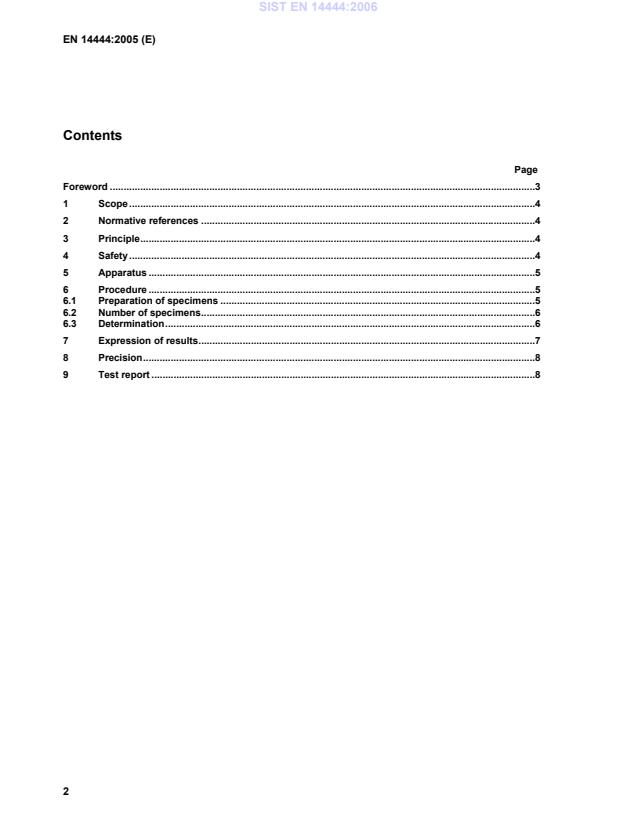
Contents
Page
Foreword .3
1 Scope.4
2 Normative references.4
3 Principle.4
4 Safety.4
5 Apparatus.5
6 Procedure.5
6.1 Preparation of specimens.5
6.2 Number of specimens.6
6.3 Determination.6
7 Expression of results.7
8 Precision.8
9 Test report.8
Foreword
This document (EN 14444:2005) has been prepared by Technical Committee CEN/TC 193 “Adhesives”, the
secretariat of which is held by AENOR.
This European Standard shall be given the status of a national standard, either by publication of an identical
text or by endorsement, at the latest by April 2006, and conflicting national standards shall be withdrawn at the
latest by April 2006.
According to the CEN/CENELEC Internal Regulations, the national standards organizations of the following
countries are bound to implement this European Standard: Austria, Belgium, Cyprus, Czech Republic,
Denmark, Estonia, Finland, France, Germany, Greece, Hungary, Iceland, Ireland, Italy, Latvia, Lithuania,
Luxembourg, Malta, Netherlands, Norway, Poland, Portugal, Slovakia, Slovenia, Spain, Sweden, Switzerland
and United Kingdom.
Endorsement notice
The text of International Standard ISO 10354:1992 was approved by CEN as a European Standard with
agreed common modifications as given below:
the title, scope and precision have been modified.
A “Safety” clause has been introduced
The common modifications have been inserted in the text of the reference document and indicated by a
vertical line in the left margin.
1 Scope
This document simulates in a qualitative manner mechanical forces and important environmental influences
on an adhesive-bonded joint at a metal polymer interfaces it can also be used as a method of checking the
surface preparation of substrates, with a limited detection level.
The test is applicable at the present time to the bonding of aluminium and titanium alloys using thermosetting
structural adhesives and primers.
NOTE This method can also be used for assessing surface preparation of other metals. Considerable
caution in the evaluation of comparative results should be exercised in the event that the materials (adhesive
plus adherend) and the specimen geometry are varied. Like should be compared with like (only similar
adherends bonded with similar adhesives can be compared between themselves).
2 Norma
...