

EN 14843:2007
(Main)Precast concrete products - Stairs
- Abstract
This standard gives specifications for materials, production, properties, requirements and methods of testing for precast concrete monolithic stairs, and for precast concrete elements (e.g. individual steps) used to make reinforced and/or prestressed concrete stairs.
This standard is applicable to structural stairs for indoor or outdoor use.
This standard covers precast concrete stairs and associated landings of monolithic design or constructed from individual steps supported by beams or columns. Supporting elements may include in situ concrete.
This standard covers terminology, performance criteria, verification methods, tolerances, relevant physical properties, special test methods and specific aspects of transport, erection and connection.
Geometrical properties related to functionality of stairs are not covered by this standard and can be found in National regulations or local practice.
Precast concrete stairs are classified into two main product families :
monolithic stairs constructed from precast concrete components consisting of flights, landings or a combination of these. They may include vertical supporting elements ;
stairs constructed from individual steps, whether load bearing or not, assembled on site with, for example, carriages or a central column.
Their shape may be straight or winding.
Stairs may incorporate parapets (on one or both sides) and landings.
Stairs may have simple bearings (e.g. on corbels, walls or beams), bolted connections or they may be connected with reinforcement and in situ concrete.
The surfaces of the precast elements may be exposed or covered by finishes.
- Status
- Published
- Publication Date
- 17-Apr-2007
- Technical Committee
- CEN/TC 229 - Precast concrete products
- Current Stage
- 9092 - Decision on results of review/2YR ENQ - revise - Review Enquiry
- Start Date
- 16-Mar-2018
- Completion Date
- 14-Oct-2026
- Directive
- 305/2011 - Regulation (eu) No 305/2011 of the European Parliament and of the Council of 9 march 2011 laying down harmonised conditions for the marketing of construction products and repealing council directive 89/106/eecOJ Ref: C, C 259 OJ Date: 08-Aug-2014
89/106/EEC - Construction productsOJ Ref: C, C 290 OJ Date: 04-Dec-2007


Overview
EN 14843:2007 - Precast concrete products - Stairs is a CEN product standard that specifies materials, production, properties, requirements and test methods for precast concrete stairs. It applies to structural stairs for indoor and outdoor use, including monolithic flights and landings or assemblies of individual steps (load‑bearing or not) used in reinforced or prestressed concrete stair systems. The standard covers factory production, transport, erection and connection aspects, while geometrical design rules for user functionality are left to national regulations or local practice.
Key topics and technical requirements
- Product families: Monolithic precast stairs (flights, landings, optional vertical supports) and stairs built from individual steps (assembled on carriages or central columns). Shapes may be straight or winding; parapets and finishes are allowed.
- Material & concrete class: Concrete for reinforced or prestressed stairs shall be at least C30/37. Material requirements follow EN 13369 common rules.
- Production requirements: Factory production controls, reinforcement positioning and handling, lifting and transport provisions are defined for consistent quality.
- Finished product requirements:
- Tolerances & geometrical properties - production tolerances and minimum nominal dimensions apply (e.g., minimum step thickness 45 mm; wall thickness 80 mm; parapet 60 mm; hollow element wall 45 mm; column plan dimension 120 mm).
- Surface characteristics - permitted surface deviations and finish considerations (exposed or coated surfaces).
- Mechanical resistance - verification by calculation or by testing (static and dynamic actions considered); special guidance for thin or independent steps.
- Fire, acoustic, thermal and durability requirements are addressed in line with EN 13369 and Eurocode provisions.
- Testing & conformity: Test methods (including informative Annex B), evaluation of conformity, CE marking options and technical documentation requirements (lifting/erection data, reinforcement layout, concrete cover, acceptable joint gaps).
- Documentation & marking: Requirements for product documentation, marking and declarations are included to support regulatory compliance.
Practical applications
- Design and manufacture of factory‑made precast stair flights, landings and step units
- Structural verification and quality control for building projects (residential, commercial, public)
- Guidance for transport, site erection, connection details and on‑site assembly procedures
- Basis for CE marking and declarations when using Eurocode design
Who uses EN 14843:2007
- Precast concrete manufacturers and quality managers
- Structural and precast designers and engineers
- Contractors, erectors and site supervisors
- Certification bodies and building control authorities
- Specifiers preparing procurement and compliance documentation
Related standards
- EN 13369:2004 - Common rules for precast concrete products
- EN 1992-1-1 (Eurocode 2) - Design of concrete structures
- EN 206-1 - Concrete specification and conformity
- Informative annexes in EN 14843 explain terminology, test methods and CE marking procedures
Keywords: EN 14843:2007, precast concrete stairs, precast concrete products, stair components, production tolerances, mechanical resistance, testing, CE marking, C30/37.
Relations
- Effective Date
- 28-Jan-2026
- Effective Date
- 28-Jan-2026
- Effective Date
- 28-Jan-2026
- Effective Date
- 28-Jan-2026
- Effective Date
- 05-Aug-2026
Get Certified
Connect with accredited certification bodies for this standard

DIBt (Deutsches Institut für Bautechnik)
German Institute for Building Technology.
DIN CERTCO
DIN Group product certification.

Aboma Certification B.V.
Specialized in construction, metal, and transport sectors.
Sponsored listings
Frequently Asked Questions
EN 14843:2007 is a standard published by the European Committee for Standardization (CEN). Its full title is "Precast concrete products - Stairs". This standard covers: This standard gives specifications for materials, production, properties, requirements and methods of testing for precast concrete monolithic stairs, and for precast concrete elements (e.g. individual steps) used to make reinforced and/or prestressed concrete stairs. This standard is applicable to structural stairs for indoor or outdoor use. This standard covers precast concrete stairs and associated landings of monolithic design or constructed from individual steps supported by beams or columns. Supporting elements may include in situ concrete. This standard covers terminology, performance criteria, verification methods, tolerances, relevant physical properties, special test methods and specific aspects of transport, erection and connection. Geometrical properties related to functionality of stairs are not covered by this standard and can be found in National regulations or local practice. Precast concrete stairs are classified into two main product families : monolithic stairs constructed from precast concrete components consisting of flights, landings or a combination of these. They may include vertical supporting elements ; stairs constructed from individual steps, whether load bearing or not, assembled on site with, for example, carriages or a central column. Their shape may be straight or winding. Stairs may incorporate parapets (on one or both sides) and landings. Stairs may have simple bearings (e.g. on corbels, walls or beams), bolted connections or they may be connected with reinforcement and in situ concrete. The surfaces of the precast elements may be exposed or covered by finishes.
This standard gives specifications for materials, production, properties, requirements and methods of testing for precast concrete monolithic stairs, and for precast concrete elements (e.g. individual steps) used to make reinforced and/or prestressed concrete stairs. This standard is applicable to structural stairs for indoor or outdoor use. This standard covers precast concrete stairs and associated landings of monolithic design or constructed from individual steps supported by beams or columns. Supporting elements may include in situ concrete. This standard covers terminology, performance criteria, verification methods, tolerances, relevant physical properties, special test methods and specific aspects of transport, erection and connection. Geometrical properties related to functionality of stairs are not covered by this standard and can be found in National regulations or local practice. Precast concrete stairs are classified into two main product families : monolithic stairs constructed from precast concrete components consisting of flights, landings or a combination of these. They may include vertical supporting elements ; stairs constructed from individual steps, whether load bearing or not, assembled on site with, for example, carriages or a central column. Their shape may be straight or winding. Stairs may incorporate parapets (on one or both sides) and landings. Stairs may have simple bearings (e.g. on corbels, walls or beams), bolted connections or they may be connected with reinforcement and in situ concrete. The surfaces of the precast elements may be exposed or covered by finishes.
EN 14843:2007 is classified under the following ICS (International Classification for Standards) categories: 91.100.30 - Concrete and concrete products. The ICS classification helps identify the subject area and facilitates finding related standards.
EN 14843:2007 has the following relationships with other standards: It is inter standard links to EN 1992-1-1:2004, EN 13369:2004, EN 16582-1:2015, EN 16582-1:2015+A1:2021, EN 18190:2026. Understanding these relationships helps ensure you are using the most current and applicable version of the standard.
EN 14843:2007 is associated with the following European legislation: EU Directives/Regulations: 305/2011, 89/106/EEC; Standardization Mandates: M/100. When a standard is cited in the Official Journal of the European Union, products manufactured in conformity with it benefit from a presumption of conformity with the essential requirements of the corresponding EU directive or regulation.
EN 14843:2007 is available in PDF format for immediate download after purchase. The document can be added to your cart and obtained through the secure checkout process. Digital delivery ensures instant access to the complete standard document.
Standards Content (Sample)
2003-01.Slovenski inštitut za standardizacijo. Razmnoževanje celote ali delov tega standarda ni dovoljeno.Precast concrete products - StairsMontažni betonski izdelki - StopniceProduits préfabriqués en béton - EscaliersBetonfertigteile - TreppenTa slovenski standard je istoveten z:EN 14843:2007SIST EN 14843:2007en;de91.100.30Beton in betonski izdelkiConcrete and concrete products91.060.30Stropi. Tla. StopniceCeilings. Floors. StairsICS:SLOVENSKI
STANDARDSIST EN 14843:200701-julij-2007
EUROPEAN STANDARDNORME EUROPÉENNEEUROPÄISCHE NORMEN 14843April 2007ICS 91.100.30 English VersionPrecast concrete products - StairsProduits préfabriqués en béton - EscaliersBetonfertigteile - TreppenThis European Standard was approved by CEN on 17 February 2007.CEN members are bound to comply with the CEN/CENELEC Internal Regulations which stipulate the conditions for giving this EuropeanStandard the status of a national standard without any alteration. Up-to-date lists and bibliographical references concerning such nationalstandards may be obtained on application to the CEN Management Centre or to any CEN member.This European Standard exists in three official versions (English, French, German). A version in any other language made by translationunder the responsibility of a CEN member into its own language and notified to the CEN Management Centre has the same status as theofficial versions.CEN members are the national standards bodies of Austria, Belgium, Bulgaria, Cyprus, Czech Republic, Denmark, Estonia, Finland,France, Germany, Greece, Hungary, Iceland, Ireland, Italy, Latvia, Lithuania, Luxembourg, Malta, Netherlands, Norway, Poland, Portugal,Romania, Slovakia, Slovenia, Spain, Sweden, Switzerland and United Kingdom.EUROPEAN COMMITTEE FOR STANDARDIZATIONCOMITÉ EUROPÉEN DE NORMALISATIONEUROPÄISCHES KOMITEE FÜR NORMUNGManagement Centre: rue de Stassart, 36
B-1050 Brussels© 2007 CENAll rights of exploitation in any form and by any means reservedworldwide for CEN national Members.Ref. No. EN 14843:2007: E
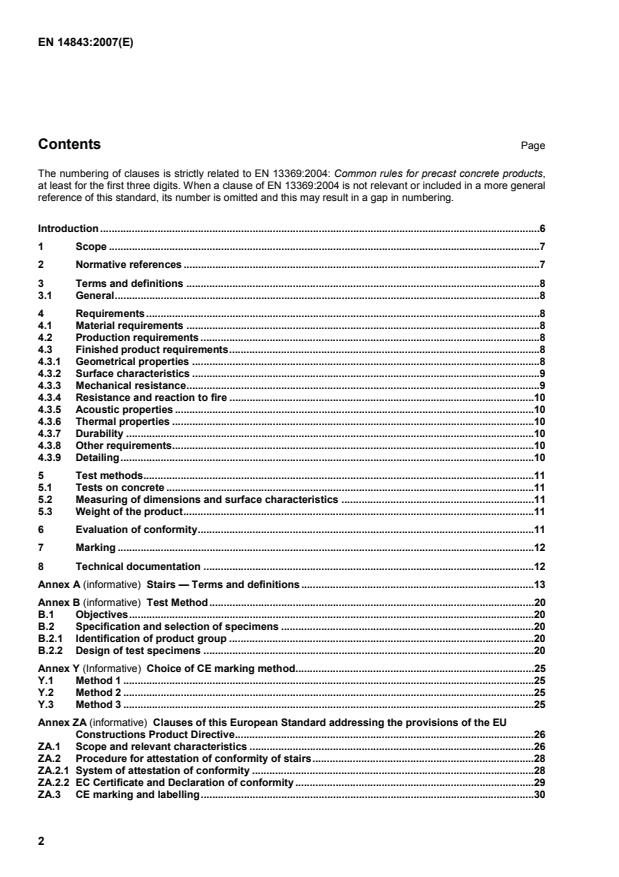
Stairs — Terms and definitions.13 Annex B (informative)
Test Method.20 B.1 Objectives.20 B.2 Specification and selection of specimens.20 B.2.1 Identification of product group.20 B.2.2 Design of test specimens.20 Annex Y (Informative)
Choice of CE marking method.25 Y.1 Method 1.25 Y.2 Method 2.25 Y.3 Method 3.25 Annex ZA (informative)
Clauses of this European Standard addressing the provisions of the EU Constructions Product Directive.26 ZA.1 Scope and relevant characteristics.26 ZA.2 Procedure for attestation of conformity of stairs.28 ZA.2.1 System of attestation of conformity.28 ZA.2.2 EC Certificate and Declaration of conformity.29 ZA.3 CE marking and labelling.30
This European Standard shall be given the status of a national standard, either by publication of an identical text or by endorsement, at the latest by October 2007, and conflicting national standards shall be withdrawn at the latest by January 2009. This document has been prepared under a mandate given to CEN by the European Commission and the European Free Trade Association, and supports essential requirements of EU Construction Products Directive(s) (89/106/EEC). For relationship with EU Directive(s), see informative Annex ZA, which is an integral part of this document. This document is one of a series of product standards for precast concrete products. For common aspects reference is made to EN 13369:2004: Common rules for precast concrete products, from which also the relevant requirements of the EN 206-1: Concrete — Part 1: Specification, performance, production and conformity are taken. The references to EN 13369:2004 by CEN/TC 229 product standards are intended to make them homogeneous and to avoid repetitions of similar requirements. Eurocodes are taken as a common reference for design aspects. The installation of some structural precast concrete products is dealt with by ENV 13670-1: Execution of concrete structures — Part 1: Common rules, which has at the moment the status of a European Prestandard. In all countries it can be accompanied by alternatives for national application and it should not be treated as a European Standard. The programme of standards for structural precast concrete products comprises the following standards, in some cases consisting of several parts : EN 1168, Precast concrete products — Hollow core slabs. EN 12794, Precast concrete products — Foundation piles. EN 12843, Precast concrete products — Masts and poles. EN 13224, Precast concrete products — Ribbed floor elements. EN 13225, Precast concrete products — Linear structural elements. EN 13693, Precast concrete products — Special roof elements. EN 13747, Precast concrete products — Floor plates for floor systems. EN 13978, Precast concrete products — Precast concrete garages. EN 14843, Precast concrete products — Stairs. EN 14844, Precast concrete products — Box culverts.
45 Thickness of a wall 80 Thickness of a parapet 60 Wall thickness of a hollow element 45 Plan dimensions of a column 120 In case of 45 mm of thickness, special care shall be paid to the correct positioning of reinforcement. 4.3.2 Surface characteristics Subclause 4.3.2 of EN 13369:2004 shall apply. The tolerances for surface characteristics listed in Table 3 shall be permitted for precast concrete stair components. Table 3 — Permitted deviations for surface characteristics (sizes in mm) L = length of the reference rulera ∆d = d1 – d2 ∆d ≤ (2 + L / 500) a See 5.2 NOTE A client may inform the producer that specific surfaces are intended to be finished with paint or a thin coating. 4.3.3 Mechanical resistance 4.3.3.1 General Subclause 4.3.3.1 of EN 13369:2004 shall apply. 4.3.3.2 Verification by calculation Subclause 4.3.3.2 of EN 13369:2004 shall apply. Both static and dynamic loading should be considered. NOTE 1 For steps less than 80 mm thick or independent steps, the dynamic coefficient may be defined in National regulations or other rules valid in the place of use of the product. NOTE 2 For accidental actions and robustness requirements see National regulation. 4.3.3.3 Verification by calculation aided by testing Subclause 4.3.3.3 of EN 13369:2004 shall apply. The test methods recommended in Annex B may be used to support verification by calculation.
Key 1 stair corbel 2 reduced cover at the extreme end 3 support 4 non shrink mortar filling placed on site and suitable for the exposure conditions Figure 1b — Stair corbel class B Figure 1 — Definition of classes of stair corbels NOTE Consideration should be given to the use of stainless or protected reinforcement to ensure adequate durability of stair corbel class B. 5 Test methods 5.1 Tests on concrete Subclause 5.1 of EN 13369:2004 shall apply. 5.2 Measuring of dimensions and surface characteristics Subclause 5.2 of EN 13369:2004 shall apply. With reference to Figure J.5 of EN 13369:2004, ruler of 200 mm or 1 000 mm may be used according to the dimensions being verified. 5.3 Weight of the product Subclause 5.3 of EN 13369:2004 shall apply. 6 Evaluation of conformity Clause 6 of EN 13369:2004 shall apply. Table 4 replaces item 2 of Table D.4 of EN 13369:2004.
SUBJECT METHOD PURPOSE FREQUENCY D.4.1 - Product Testing 1 Final inspection Measuring of dimensions (see 5.2) Conformity with the requirements of this standard and the requirements for the manufacturer declared properties At least one stair in every ten per model manufactured. 2 Surface characteristics Measuring according to 5.2. Conformity to 4.3.2 At least one stair in every ten per model manufactured. 7 Marking Clause 7 of EN 13369:2004 shall apply. 8 Technical documentation Clause 8 of EN 13369:2004 shall apply.
Stairs — Terms and definitions Table A.1 — Classification by reference Reference Term Definition 1.1 General See Figure A.1 1.1.1 Stair A succession of horizontal stages (stepsor landings) at a pitch which makes it possible to pass on foot to other levels. 1.1.2 Individual step Precast product providing a single tread and riser. NOTE
Individual steps may have an integral boss at one end to facilitate the construction of the central column of a spiral stair or they may be designed to be assembled into a stair with strings, carriages or other supports. 1.1.3 Prefabricated stair A stair which is manufactured either complete or in component form, later to be installed and/or assembled in its final location. 1.1.4 Stair enclosure The space reserved for accommodating a stair and faces of the walls limiting its volume. 1.1.5 Stairwell The void formed on the inside by the shape of a stair. 1.1.6 Landing A level platform at the endof a flight or between two flights of stairs. It can be part of the stair or of the floor. 1.1.7 String An inclined member supporting the end(s) of steps. 1.1.8 Fixing A component to secure a stair to its support(s). 1.1.9 Bearing A support upon which a precast product rests. 1.1.10 Corbel A projection from an element to form a bearing. 1.1.11 Lap joint (rebated joint) A pair of overlapping corbels transmitting load. 1.1.12 Wall An element which divides or encloses an area. It may be loadbearing or not. 1.1.13 Hollow element A precast element with internal voids. 1.1.14 Parapet An element providing protection against falling over an edge. 1.2 Stair types and layouts See Figure A.2. 1.2.1 Straight stair Stair in which the direction is the same throughout. 1.2.2 Flight An unbroken series of steps between two landings. 1.2.3 Intermediate or rest landing A landing inserted between two floors. 1.2.4 Double return stair Turning stair with one flight to an intermediate landing and two flights from that landing. 1.2.5 Turning stair Stair in which the direction changes. 1.2.6 Left-hand (or right-hand) stair Stair turning to the left hand(or right hand) when ascending. 1.2.7 Winding stair Stair which changes direction by using tapered steps. 1.2.8 Monolithic stair A stair cast as a single piece. 1.2.9 Open well stair Turning stair around a stairwell. "
NOTE
An arrow on this line always indicates the direction of ascent. 1.3.14 Walking zone Notional width occupied by a single person ascending the stair. 1.4 Types of steps See Figure A.4. 1.4.1 Winder A step in which the nosing of the tread is not parallel to the nosing of the step or landing immediately above it. 1.4.2 Top step The uppermost step of
...