

EN 16582-1:2015
(Main)Domestic swimming pools - Part 1: General requirements including safety and test methods
- Abstract
This European Standard specifies the general safety and quality requirements and test methods for domestic swimming pools. These requirements and test methods are applicable to inground, aboveground or recessed swimming pool structures, including their installation and means of access.
This standard does not apply to:
- pools for public use covered by EN 15288-1;
- spas for domestic or public use;
- paddling pools according to EN 71-8.
- Status
- Withdrawn
- Publication Date
- 25-Aug-2015
- Withdrawal Date
- 06-Oct-2026
- Technical Committee
- CEN/TC 402 - Private family Swimming Pools and related materials/equipment and accessories
- Drafting Committee
- CEN/TC 402/WG 1 - Pool structure - design, product and installation
- Current Stage
- 9960 - Withdrawal effective - Withdrawal
- Start Date
- 12-May-2021
- Completion Date
- 07-Oct-2026


Relations
- Effective Date
- 23-Dec-2020
- Effective Date
- 25-Aug-2026
- Effective Date
- 09-Feb-2026
- Effective Date
- 28-Jan-2026
- Refers
EN ISO 9227:2022 - Corrosion tests in artificial atmospheres - Salt spray tests (ISO 9227:2022) - Effective Date
- 28-Jan-2026
- Effective Date
- 28-Jan-2026
- Effective Date
- 28-Jan-2026
- Effective Date
- 28-Jan-2026
- Effective Date
- 28-Jan-2026
- Effective Date
- 28-Jan-2026
- Refers
EN 16165:2021 - Determination of slip resistance of pedestrian surfaces - Methods of evaluation - Effective Date
- 28-Jan-2026
- Effective Date
- 28-Jan-2026
- Effective Date
- 28-Jan-2026
- Effective Date
- 28-Jan-2026
- Effective Date
- 28-Jan-2026
Frequently Asked Questions
EN 16582-1:2015 is a standard published by the European Committee for Standardization (CEN). Its full title is "Domestic swimming pools - Part 1: General requirements including safety and test methods". This standard covers: This European Standard specifies the general safety and quality requirements and test methods for domestic swimming pools. These requirements and test methods are applicable to inground, aboveground or recessed swimming pool structures, including their installation and means of access. This standard does not apply to: - pools for public use covered by EN 15288-1; - spas for domestic or public use; - paddling pools according to EN 71-8.
This European Standard specifies the general safety and quality requirements and test methods for domestic swimming pools. These requirements and test methods are applicable to inground, aboveground or recessed swimming pool structures, including their installation and means of access. This standard does not apply to: - pools for public use covered by EN 15288-1; - spas for domestic or public use; - paddling pools according to EN 71-8.
EN 16582-1:2015 is classified under the following ICS (International Classification for Standards) categories: 97.220.10 - Sports facilities. The ICS classification helps identify the subject area and facilitates finding related standards.
EN 16582-1:2015 has the following relationships with other standards: It is inter standard links to EN 16582-1:2015+A1:2021, ISO 20712-1:2008, HD 60364-7-702:2010, EN 1990:2002, EN ISO 9227:2022, EN 335:2013, EN ISO 4628-2:2016, EN 460:2023, EN ISO 4628-3:2024, EN ISO 1461:2022, EN 16165:2021, EN 351-1:2023, EN ISO 16811:2014, EN 14843:2007, EN 350:2016. Understanding these relationships helps ensure you are using the most current and applicable version of the standard.
EN 16582-1:2015 is available in PDF format for immediate download after purchase. The document can be added to your cart and obtained through the secure checkout process. Digital delivery ensures instant access to the complete standard document.
Standards Content (Sample)
2003-01.Slovenski inštitut za standardizacijo. Razmnoževanje celote ali delov tega standarda ni dovoljeno.Schwimmbäder für private Nutzung - Teil 1: Allgemeine Anforderungen einschließlich sicherheitstechnischer Anforderungen und PrüfverfahrenPiscines privées à usage familial - Partie 1: Exigences générales, exigences de sécurité et méthodes d'essaiDomestic swimming pools - Part 1: General requirements including safety and test methods97.220.10Športni objektiSports facilitiesICS:Ta slovenski standard je istoveten z:EN 16582-1:2015SIST EN 16582-1:2015en,fr,de01-oktober-2015SIST EN 16582-1:2015SLOVENSKI
STANDARD
EUROPEAN STANDARD NORME EUROPÉENNE EUROPÄISCHE NORM
EN 16582-1
August 2015 ICS 97.220.10 English Version
Domestic swimming pools - Part 1: General requirements including safety and test methods
Piscines privées à usage familial - Partie 1 : Exigences générales et de sécurité et méthodes d'essai
Schwimmbäder für private Nutzung - Teil 1: Allgemeine Anforderungen einschließlich sicherheitstechnischer Anforderungen und Prüfverfahren This European Standard was approved by CEN on 20 June 2015.
CEN members are bound to comply with the CEN/CENELEC Internal Regulations which stipulate the conditions for giving this European Standard the status of a national standard without any alteration. Up-to-date lists and bibliographical references concerning such national standards may be obtained on application to the CEN-CENELEC Management Centre or to any CEN member.
This European Standard exists in three official versions (English, French, German). A version in any other language made by translation under the responsibility of a CEN member into its own language and notified to the CEN-CENELEC Management Centre has the same status as the official versions.
CEN members are the national standards bodies of Austria, Belgium, Bulgaria, Croatia, Cyprus, Czech Republic, Denmark, Estonia, Finland, Former Yugoslav Republic of Macedonia, France, Germany, Greece, Hungary, Iceland, Ireland, Italy, Latvia, Lithuania, Luxembourg, Malta, Netherlands, Norway, Poland, Portugal, Romania, Slovakia, Slovenia, Spain, Sweden, Switzerland, Turkey and United Kingdom.
EUROPEAN COMMITTEE FOR STANDARDIZATION
COMITÉ EUROPÉEN DE NORMALISATION EUROPÄISCHES KOMITEE FÜR NORMUNG
CEN-CENELEC Management Centre:
Avenue Marnix 17,
B-1000 Brussels © 2015 CEN All rights of exploitation in any form and by any means reserved worldwide for CEN national Members. Ref. No. EN 16582-1:2015 ESIST EN 16582-1:2015
Safety information in the owner’s manual and instruction sheets accompanying the swimming pool . 42 Annex C (normative)
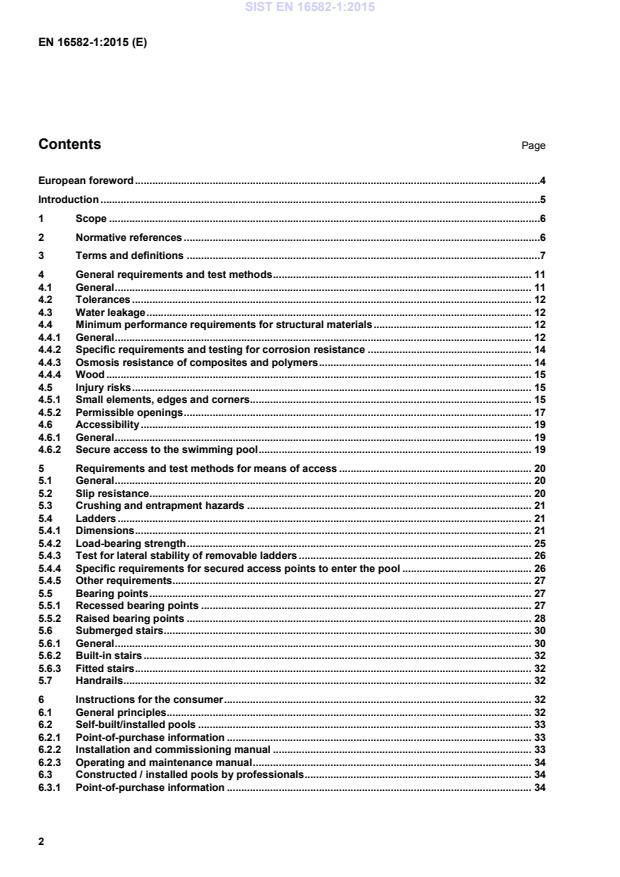
Methods of test for entrapment . 45 C.1 Head and neck entrapment. 45 C.1.1 Apparatus . 45 C.1.2 Test method . 46 C.2 Finger and toe entrapment . 46 C.2.1 Apparatus . 46 C.2.2 Test method . 46 C.3 Foot and hand entrapment . 46 C.3.1 Apparatus . 46 C.3.2 Test method . 47 Annex D (informative) Aesthetic aspects on composite shells . 48 D.1 General . 48 D.2 Scope . 48 D.3 Operating requirements and maintenance . 48 D.3.1 General . 48 D.3.2 Operating requirements . 49 D.3.3 Maintenance . 49 D.3.4 Influence of water quality . 49 D.4 Discolourations and possible origins . 50 D.5 Stains and possible origins . 50 D.6 Repair of the aesthetic coating . 53 D.7 Mechanical disorders affecting only the aesthetic layer . 53 D.7.1 Aesthetic cracks . 53 D.7.2 Surface protuberances . 53 Bibliography . 54
The users of this standard could be either in a Business to consumer (B to C) relationship, such as constructors, installers, retailers, etc. or in a Business to business (B to B) relationship, such as manufacturers, suppliers, distributors, etc. Safe products are the basis of the consumers' safety and therefore, this European Standard should take into account the following topics: — product safety and performance requirements; — safe construction and installation, — safe use, which could include information and red flags for consumers (e.g. “Don’t leave your child unattended in the pool”). Special attention should also be paid to environmental aspects, according to CEN Guide 4 (e.g. minimizing water being wasted, etc.). SIST EN 16582-1:2015
[SOURCE: EN 1990:2002, modified] SIST EN 16582-1:2015
Figure 1 — Grip 3.30 grasp holding of the hand around part of the circumference of a support
Note 1 to entry: See Figure 2. Note 2 to entry: See Table 6. [SOURCE: EN 1176-1:2008, 3.16, modified - Note to entry has been added.]
Figure 2 — Grasp 3.31 thermosetting polymer shell main element of the prefabricated swimming pool (generally a polyester shell), that is a homogeneous structure, which is watertight and whose function is to contain the water 3.32 entrapment hazard presented by the situation in which a body, or part of a body, or clothing can become trapped Note 1 to entry:
Entrapment is only considered where the user is not able to free himself/herself. SIST EN 16582-1:2015
Any combination of different materials in direct contact with each other shall be compatible and not negatively affect each other’s properties or structural integrity. The requirements of this section do not apply to non-structural elements of the swimming pool, including, but not limited to, elements with solely decorative function. When the swimming pool water affects the resistance of the structural material, the requirements for water quality shall be stated and accompany the affected materials. SIST EN 16582-1:2015
Polypropylene (PP) Painting Mineral coat PVC reinforced membrane SIST EN 16582-1:2015
Figure 3 — Template for small elements All edges, protruding parts and corners accessible without use of tools or minimum amount of force of 60 N (±2N) shall be designed not to cause any injury. When necessary they shall be treated appropriately to remove this risk (see Figure 4). For example, edges can be bevelled or rounded, and surfaces shall be smooth and free from burrs. Examples are provided in Figure 4. If they are due to a wall thickness lower than 4 mm, one of the following requirements applies: — they shall be folded, rolled or wound in spirals according to Figure 4 d); — they shall be protected by a plastic coating or by any other suitable means as shown in Figure 4 e). SIST EN 16582-1:2015
Figure 4 — Examples of configuration of edges 4.5.2 Permissible openings 4.5.2.1 Principle To prevent entrapment hazards inside the pool structure, accessible openings with the lowest point located beyond 500 mm below the water surface shall be restricted to the range of opening or gap size dimensions specified in 4.5.2.2 to 4.5.2.4, unless specifically permitted in other clauses/annexes of this standard and/or parts of this standard series. Test methods for entrapment are given in Annex C. If the depth of penetration (see 'a' in Figure 5) is less than 10 mm, no requirements apply. SIST EN 16582-1:2015
Figure 5 — Depth of penetration less than 10 mm Key a
maximum depth penetration t ≤ 10 mm 4.5.2.2 Finger and toe entrapment there there is a risk of finger or toe entrapment, the permissible opening shall be ≤ 8 mm or ≥ 25 mm. 4.5.2.3 Head and neck entrapment Where there is a risk of head or neck entrapment, the permissible opening shall be ≤ 110 mm or ≥ 230 mm. there an opening is ≥ 230 mm it should not permit passage to further entrapment hazards. Where there is a combination of risks, the lesser of the permitted opening sizes shall be used. 4.5.2.4 Other body entrapment Other permissible openings include the range between 25 mm and 110 mm. When such openings are used for construction or installation reasons, the installer shall alert their customer of a potential risk of entrapment. SIST EN 16582-1:2015
the above requirement is not satisfied and/or — the means of access according to the requirements stated in 5.4.4 is not safe; or — no means of access is provided with the swimming pool. Then the manufacturer of the swimming pool shall recommend that the access to the finished swimming pool should be secured by a protection device to prevent children drowning. To prevent children drowning, inground pool manufacturers shall also recommend to secure the access to the finished pool with a protection device. The following warning "In order to prevent children from drowning, it is recommended to secure the access to the pool with a protection device" shall be present for the consumer in the information before purchase and in the safety instructions. EXAMPLE Protection devices to secure the access to the swimming pool can be fences, safety covers, enclosures, etc. NOTE Securing the boundary of the property may be an acceptable way of preventing unauthorized access to the pool. SIST EN 16582-1:2015
4.4, if applicable. Swimming pools intended solely for aboveground installation with a wall height exceeding 850 mm shall be installed with a means of access. When such mean of access is a pool ladder, then it shall meet the ladder design requirements in 5.4 and the safe access requirements in 4.6. Pools intended for multiple types of installation shall include a specification or recommendation for appropriate means of access. 5.2 Slip resistance The risk of a slipping accident in a domestic pool is low, due to the following reasons: — Easily accessible information for users (Annex B); — Close and permanent adult supervision required (Annex B); — Reduced number of simultaneous users. The slip resistance requirements only refer to walking surfaces of slopes, steps and treads located on the inner side of the basin, under the water line or not, and allowing the user to go down into the water. These requirements do not apply to: — slopes or steps that are not intended to enter the water ; — water slides; — starting platforms; — diving boards, or — any similar equipment. Requirements apply to slopes as a means of access with an inclination of more than 15°. If the slope declination is less than 15°, the requirements only apply from the water level to 600 mm depth. The walking surfaces of the relevant means of access have to comply with slip resistance requirements that shall be tested according to the Annex A of CEN/TS 16165. Rating groups are defined in Table 4: Table 4 Rating group Critical angle (.barefoot ) A 12° ≤ .barefoot < 18° B 18° ≤ .barefoot < 24° C 24° ≤ .barefoot SIST EN 16582-1:2015
Dimensions (in mm) or angle (°) Minimum Maximum (a) Usable distance between stiles 320 / (b) Platform depth 250 / (c) Cross-section of parts to be held
Grip (see Figure 1) Shape inscribed in a Î 25 circle Shape inscribed in a Î 50 circle Grasp (see Figure 2) / 60 (d) Stepping height between 2 treads / 330 (e) Entrapment space between 2 treads > 45 and < 110 or > 230 / (f) Height of the 1st treada in relation to the ground, outside of the pool / 400 (g) Difference between the wall height (including coping) and the height of the last tread for external ladders without platform. / 150 (h) Difference between the pool wall height (including coping) and the height of the last tread for internal ladders. 150 300 (i) Height of the handrails in relation to the last tread or the platform or the top of the wall (including coping for internal ladders)c 400 / (j)b Distance between the floor or lower base of the stabilizer and the 1st treada inside the pool > 45 and < 110 or > 230
(k) Angle of inclination of the legs in case of:
- detachable ladders 60 75 - fixed ladders (on the inside of the pool) 60 90 - fixed ladders (on the outside of the pool) 60 80 (l1) Space between the submerged treads and the swimming pool
...