

EN ISO 7787-4:2002
(Main)Dental rotary instruments - Cutters - Part 4: Miniature carbide laboratory cutters (ISO 7787-4:2002)
General Information
- Abstract
This part of ISO 7787 specifies the shape and dimensional characteristics, number of blades, type of toothing and run-out for the ten most common miniature carbide laboratory cutters, which are predominantly used in the dental laboratory.
- Status
- Published
- Publication Date
- 14-Mar-2002
- Technical Committee
- CEN/TC 55 - Dentistry
- Drafting Committee
- CEN/TC 55 - Dentistry
- Current Stage
- 9093 - Decision to confirm - Review Enquiry
- Start Date
- 26-Feb-2008
- Completion Date
- 26-Feb-2008

Overview
EN ISO 7787-4:2002 - "Dental rotary instruments - Cutters - Part 4: Miniature carbide laboratory cutters" is a CEN-endorsed adoption of ISO 7787-4:2002. The standard defines the shapes, dimensional characteristics, number of blades, type of toothing and run‑out for the ten most common miniature tungsten carbide laboratory cutters used in dental laboratories. Its purpose is to ensure interchangeability, consistent performance and safe use of rotary cutters in laboratory workflows.
Key topics and technical requirements
- Material: working parts shall be made of tungsten carbide; shank material shall comply with ISO 1797‑1.
- Shapes & dimensions: specifies allowed shapes (spherical, inverted conical - regular/long, cylindrical - regular/long, hemispherical‑cylindrical, truncated conical domed - regular/long, truncated conical sharp end, egg, torpedo - regular/long, pear, bud) and exact dimensional limits (head diameter d1, neck diameter d2, working length l, angle α) as given in the standard’s Figures and Tables 1–15.
- Number of blades & toothing: blade counts and toothing designations (e.g., Very Fine, Fine, etc.) are defined in Table 16; colour and right/left cutting designations are included.
- Run‑out and testing: run‑out limits and test procedures are specified; clause 5 covers test methods for shapes, dimensions, toothing and run‑out.
- Quality acceptance: sampling and lot inspection use AQL principles referenced to ISO 2859‑1.
- Marking, labelling, packaging: requirements for product marking, package labelling and packaging are included to support traceability and safe handling.
- Normative references: the standard references ISO 1797‑1 (shanks), ISO 6360‑1 (number coding), ISO 8325 (test methods) and ISO 2859‑1 (AQL sampling).
Applications
- Standardizes miniature carbide cutters used in prosthetic, restorative and laboratory finishing operations.
- Supports manufacturers in designing and marking cutters that are interchangeable with existing laboratory equipment.
- Enables dental laboratories, dental technicians and quality managers to select, test and accept cutters that meet defined dimensional and performance criteria.
- Useful in procurement specifications, quality control, regulatory submissions and supplier audits.
Who should use this standard
- Dental rotary instrument manufacturers and designers
- Dental laboratory managers and technicians
- Quality assurance and regulatory professionals in dental device supply chains
- Procurement specialists specifying laboratory cutters
Related standards
- ISO 1797‑1 (Shanks - metals)
- ISO 6360‑1 (Number coding system)
- ISO 8325 (Test methods)
- ISO 2859‑1 (Sampling procedures / AQL)
EN ISO 7787‑4:2002 is essential for anyone needing clear, internationally harmonized requirements for miniature carbide laboratory cutters used in dental lab workflows.
Relations
- Effective Date
- 25-Aug-2026
- Effective Date
- 25-Aug-2026
- Effective Date
- 25-Aug-2026
- Effective Date
- 09-Feb-2026
- Effective Date
- 28-Jan-2026
- Effective Date
- 28-Jan-2026
- Effective Date
- 28-Jan-2026
- Consolidated By
ISO 7787-4:2002 - Dental rotary instruments — Cutters — Part 4: Miniature carbide laboratory cutters - Effective Date
- 12-Feb-2026
Get Certified
Connect with accredited certification bodies for this standard

BSI Group
BSI (British Standards Institution) is the business standards company that helps organizations make excellence a habit.

TÜV Rheinland
TÜV Rheinland is a leading international provider of technical services.

TÜV SÜD
TÜV SÜD is a trusted partner of choice for safety, security and sustainability solutions.
Sponsored listings
Frequently Asked Questions
EN ISO 7787-4:2002 is a standard published by the European Committee for Standardization (CEN). Its full title is "Dental rotary instruments - Cutters - Part 4: Miniature carbide laboratory cutters (ISO 7787-4:2002)". This standard covers: This part of ISO 7787 specifies the shape and dimensional characteristics, number of blades, type of toothing and run-out for the ten most common miniature carbide laboratory cutters, which are predominantly used in the dental laboratory.
This part of ISO 7787 specifies the shape and dimensional characteristics, number of blades, type of toothing and run-out for the ten most common miniature carbide laboratory cutters, which are predominantly used in the dental laboratory.
EN ISO 7787-4:2002 is classified under the following ICS (International Classification for Standards) categories: 11.060.25 - Dental instruments. The ICS classification helps identify the subject area and facilitates finding related standards.
EN ISO 7787-4:2002 has the following relationships with other standards: It is inter standard links to ISO 8325:2004, ISO 2859-1:1999, ISO 6360-1:2004, ISO 1797-1:2011, EN 196-1:1994, CEN/TR 16468:2013, EN ISO 3657:2013, ISO 7787-4:2002. Understanding these relationships helps ensure you are using the most current and applicable version of the standard.
EN ISO 7787-4:2002 is available in PDF format for immediate download after purchase. The document can be added to your cart and obtained through the secure checkout process. Digital delivery ensures instant access to the complete standard document.
Standards Content (Sample)
2003-01.Slovenski inštitut za standardizacijo. Razmnoževanje celote ali delov tega standarda ni dovoljeno.Dental rotary instruments - Cutters - Part 4: Miniature carbide laboratory cutters (ISO 7787-4:2002)Rotierende Dentalinstrumente - Fräser - Teil 4: Miniaturlaborfräser aus Hartmetall (ISO 7787-4:2002)Instruments rotatifs dentaires - Fraises techniques - Partie 4: Fraises techniques miniatures en carbure pour laboratoire (ISO 7787-4:2002)Dental rotary instruments - Cutters - Part 4: Miniature carbide laboratory cutters (ISO 7787-4:2002)11.060.25Dental instrumentsICS:Ta slovenski standard je istoveten z:EN ISO 7787-4:2002SIST EN ISO 7787-4:2002en01-november-2002SIST EN ISO 7787-4:2002SLOVENSKI
STANDARD
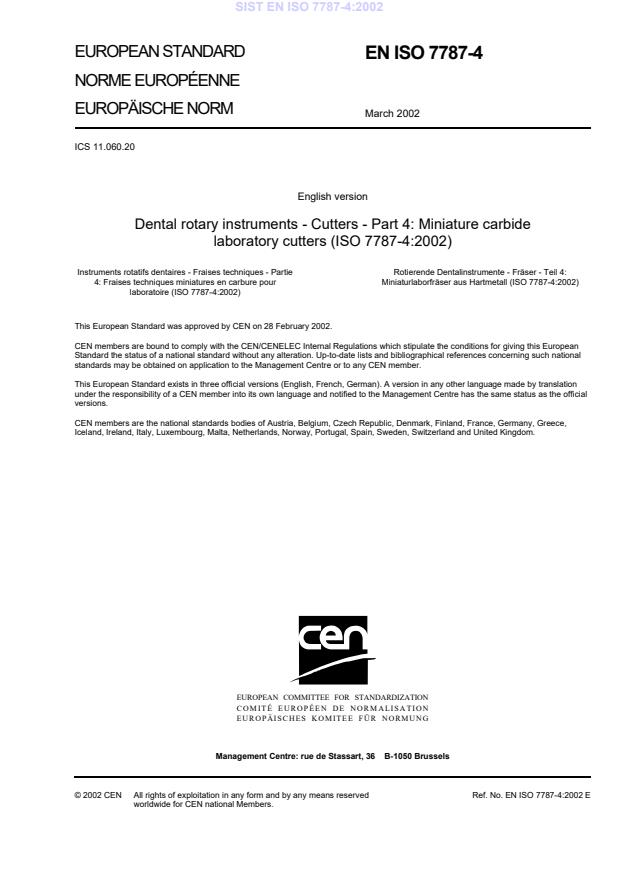
EUROPEAN STANDARDNORME EUROPÉENNEEUROPÄISCHE NORMEN ISO 7787-4March 2002ICS 11.060.20English versionDental rotary instruments - Cutters - Part 4: Miniature carbidelaboratory cutters (ISO 7787-4:2002)Instruments rotatifs dentaires - Fraises techniques - Partie4: Fraises techniques miniatures en carbure pourlaboratoire (ISO 7787-4:2002)Rotierende Dentalinstrumente - Fräser - Teil 4:Miniaturlaborfräser aus Hartmetall (ISO 7787-4:2002)This European Standard was approved by CEN on 28 February 2002.CEN members are bound to comply with the CEN/CENELEC Internal Regulations which stipulate the conditions for giving this EuropeanStandard the status of a national standard without any alteration. Up-to-date lists and bibliographical references concerning such nationalstandards may be obtained on application to the Management Centre or to any CEN member.This European Standard exists in three official versions (English, French, German). A version in any other language made by translationunder the responsibility of a CEN member into its own language and notified to the Management Centre has the same status as the officialversions.CEN members are the national standards bodies of Austria, Belgium, Czech Republic, Denmark, Finland, France, Germany, Greece,Iceland, Ireland, Italy, Luxembourg, Malta, Netherlands, Norway, Portugal, Spain, Sweden, Switzerland and United Kingdom.EUROPEAN COMMITTEE FOR STANDARDIZATIONCOMITÉ EUROPÉEN DE NORMALISATIONEUROPÄISCHES KOMITEE FÜR NORMUNGManagement Centre: rue de Stassart, 36
B-1050 Brussels© 2002 CENAll rights of exploitation in any form and by any means reservedworldwide for CEN national Members.Ref. No. EN ISO 7787-4:2002 ESIST EN ISO 7787-4:2002
2002-04-24ForewordThis document (ISO 7787-4:2002) has been prepared by Technical Committee ISO/TC 106"Dentistry" in collaboration with Technical Committee CEN/TC 55 "Dentistry", the secretariatof which is held by DIN.This European Standard shall be given the status of a national standard, either by publicationof an identical text or by endorsement, at the latest by September 2002, and conflictingnational standards shall be withdrawn at the latest by September 2002.According to the CEN/CENELEC Internal Regulations, the national standards organizations ofthe following countries are bound to implement this European Standard: Austria, Belgium,Czech Republic, Denmark, Finland, France, Germany, Greece, Iceland, Ireland, Italy,Luxembourg, Malta, Netherlands, Norway, Portugal, Spain, Sweden, Switzerland and theUnited Kingdom.Endorsement noticeThe text of the International Standard ISO 7787-4:2002 has been approved by CEN as aEuropean Standard without any modifications.NOTE
Normative references to International Standards are listed in annex ZA (normative).SIST EN ISO 7787-4:2002
Where an International Publication has been modified by common modifications,indicated by (mod.), the relevant EN/HD applies.PublicationYearTitleEN/HDYearISO 1797-11992Dental rotary instruments – Shanks —Part 1: Shanks made of metalsEN ISO 1797-11995ISO 6360-11985Dental rotary instruments — Number codingsystem — Part 1: General characteristicsEN 26360-11990ISO 83251985Dental rotary instruments — Test methodsEN 283251990SIST EN ISO 7787-4:2002
Reference numberISO 7787-4:2002(E)© ISO 2002
INTERNATIONAL STANDARD ISO7787-4First edition2002-03-15Dental rotary instruments — Cutters — Part 4: Miniature carbide laboratory cutters Instruments rotatifs dentaires — Fraises techniques — Partie 4: Fraises techniques miniatures en carbure pour laboratoire
ISO 7787-4:2002(E) PDF disclaimer This PDF file may contain embedded typefaces. In accordance with Adobe's licensing policy, this file may be printed or viewed but shall not be edited unless the typefaces which are embedded are licensed to and installed on the computer performing the editing. In downloading this file, parties accept therein the responsibility of not infringing Adobe's licensing policy. The ISO Central Secretariat accepts no liability in this area. Adobe is a trademark of Adobe Systems Incorporated. Details of the software products used to create this PDF file can be found in the General Info relative to the file; the PDF-creation parameters were optimized for printing. Every care has been taken to ensure that the file is suitable for use by ISO member bodies. In the unlikely event that a problem relating to it is found, please inform the Central Secretariat at the address given below.
©
ISO 2002 All rights reserved. Unless otherwise specified, no part of this publication may be reproduced or utilized in any form or by any means, electronic or mechanical, including photocopying and microfilm, without permission in writing from either ISO at the address below or ISO's member body in the country of the requester. ISO copyright office Case postale 56 • CH-1211 Geneva 20 Tel.
+ 41 22 749 01 11 Fax
+ 41 22 749 09 47 E-mail
copyright@iso.ch Web
www.iso.ch Printed in Switzerland
ii © ISO 2002 – All rights reserved
ISO 7787-4:2002(E) © ISO 2002 – All rights reserved iii Contents Page Foreword.iv Introduction.v 1 Scope.1 2 Normative references.1 3 Symbols.1 4 Requirements.2 4.1 Materials.2 4.2 Shapes.2 4.3 Dimensions and number of blades.2 4.4 Toothing.19 4.5 Run-out.19 5 Test procedure.19 5.1 Shapes.19 5.2 Dimensions and number of blades.19 5.3 Toothing.19 5.4 Run-out.19 6 Acceptance quality limit (AQL).19 7 Designation of toothing and number of blades.19 8 Marking.20 9 Labelling on the package.20 10 Packaging.20
ISO 7787-4:2002(E) iv © ISO 2002 – All rights reserved
Foreword ISO (the International Organization for Standardization) is a worldwide federation of national standards bodies (ISO member bodies). The work of preparing International Standards is normally carried out through ISO technical committees. Each member body interested in a subject for which a technical committee has been established has the right to be represented on that committee. International organizations, governmental and non-governmental, in liaison with ISO, also take part in the work. ISO collaborates closely with the International Electrotechnical Commission (IEC) on all matters of electrotechnical standardization. International Standards are drafted in accordance with the rules given in the ISO/IEC Directives, Part 3. The main task of technical committees is to prepare International Standards. Draft International Standards adopted by the technical committees are circulated to the member bodies for voting. Publication as an International Standard requires approval by at least 75 % of the member bodies casting a vote. Attention is drawn to the possibility that some of the elements of this part of ISO 7787 may be the subject of patent rights. ISO shall not be held responsible for identifying any or all such patent rights. ISO 7787-4 was prepared by Technical Committee ISO/TC 106, Dentistry, Subcommittee SC 4, Dental instruments. ISO 7787 consists of the following parts, under the general title Dental rotary instruments — Cutters: Part 1: Steel laboratory cutters Part 2: Carbide laboratory cutters Part 3: Carbide laboratory cutters for millin
...