

EN 14067-4:2005+A1:2009
(Main + Amendment)Railway applications - Aerodynamics - Part 4: Requirements and test procedures for aerodynamics on open track
- Abstract
This European Standard applies to train-induced aerodynamic loading on open track caused by:
- trains passing a permanent or temporary structure;
- trains passing a person who is alongside the track;
- two trains passing each other.
This European Standard applies to open air structures of any length and closed structures of a length less than 20 m enveloping the tracks. For closed structures enveloping the tracks that are longer than 20 m prEN 14067-5 applies.
For effects caused by cross winds, the aerodynamic phenomena are described in prEN 14067-6.
In addition, this European Standard applies to the resistance of motion for trains in open air.
- Status
- Withdrawn
- Publication Date
- 05-May-2009
- Withdrawal Date
- 29-Oct-2013
- Technical Committee
- CEN/TC 256 - Railway applications
- Drafting Committee
- CEN/TC 256/WG 6 - Aerodynamics
- Current Stage
- 9960 - Withdrawal effective - Withdrawal
- Start Date
- 30-Oct-2013
- Completion Date
- 30-Oct-2013
- Directive
- 2008/57/EC - DIRECTIVE 2008/57/EC OF THE EUROPEAN PARLIAMENT AND OF THE COUNCIL of 17 June 2008 on the interoperability of the rail system within the Community (Recast)OJ Ref: C, C 214 OJ Date: 20-Jul-2011

Relations
- Effective Date
- 23-Mar-2009
- Effective Date
- 01-Jun-2010
- Effective Date
- 25-Aug-2026
- Effective Date
- 28-Jan-2026
- Effective Date
- 28-Jan-2026
- Effective Date
- 28-Jan-2026
Get Certified
Connect with accredited certification bodies for this standard

IRIS Certification (UNIFE)
International Railway Industry Standard certification.

TÜV SÜD Rail GmbH
TÜV SÜD railway certification services.

Bureau Veritas Railway Certification
Railway and transportation certification.
Sponsored listings
Frequently Asked Questions
EN 14067-4:2005+A1:2009 is a standard published by the European Committee for Standardization (CEN). Its full title is "Railway applications - Aerodynamics - Part 4: Requirements and test procedures for aerodynamics on open track". This standard covers: This European Standard applies to train-induced aerodynamic loading on open track caused by: - trains passing a permanent or temporary structure; - trains passing a person who is alongside the track; - two trains passing each other. This European Standard applies to open air structures of any length and closed structures of a length less than 20 m enveloping the tracks. For closed structures enveloping the tracks that are longer than 20 m prEN 14067-5 applies. For effects caused by cross winds, the aerodynamic phenomena are described in prEN 14067-6. In addition, this European Standard applies to the resistance of motion for trains in open air.
This European Standard applies to train-induced aerodynamic loading on open track caused by: - trains passing a permanent or temporary structure; - trains passing a person who is alongside the track; - two trains passing each other. This European Standard applies to open air structures of any length and closed structures of a length less than 20 m enveloping the tracks. For closed structures enveloping the tracks that are longer than 20 m prEN 14067-5 applies. For effects caused by cross winds, the aerodynamic phenomena are described in prEN 14067-6. In addition, this European Standard applies to the resistance of motion for trains in open air.
EN 14067-4:2005+A1:2009 is classified under the following ICS (International Classification for Standards) categories: 45.060.01 - Railway rolling stock in general. The ICS classification helps identify the subject area and facilitates finding related standards.
EN 14067-4:2005+A1:2009 has the following relationships with other standards: It is inter standard links to EN 14067-4:2005, EN 14067-4:2013, ISO 8756:1994, EN 14067-1:2003, EN 2599:2001, EN 14067-4:2024+A1:2025. Understanding these relationships helps ensure you are using the most current and applicable version of the standard.
EN 14067-4:2005+A1:2009 is associated with the following European legislation: EU Directives/Regulations: 2008/57/EC; Standardization Mandates: M/024, M/275, M/334. When a standard is cited in the Official Journal of the European Union, products manufactured in conformity with it benefit from a presumption of conformity with the essential requirements of the corresponding EU directive or regulation.
EN 14067-4:2005+A1:2009 is available in PDF format for immediate download after purchase. The document can be added to your cart and obtained through the secure checkout process. Digital delivery ensures instant access to the complete standard document.
Standards Content (Sample)
2003-01.Slovenski inštitut za standardizacijo. Razmnoževanje celote ali delov tega standarda ni dovoljeno.Železniške naprave - Aerodinamika - 4. del: Zahteve in preskusni postopki pri aerodinamiki na odprti progiBahnanwendungen - Aerodynamik - Teil 4: Anforderungen und Prüfverfahren für Aerodynamik auf offener StreckeApplications ferroviaires - Aérodynamique - Partie 4: Exigences et procédures d'essai pour l'aérodynamique à l'air libreRailway applications - Aerodynamics - Part 4: Requirements and test procedures for aerodynamics on open track45.060.01Železniška vozila na splošnoRailway rolling stock in generalICS:Ta slovenski standard je istoveten z:EN 14067-4:2005+A1:2009SIST EN 14067-4:2006+A1:2009en01-julij-2009SIST EN 14067-4:2006+A1:2009SLOVENSKI
STANDARD
EUROPEAN STANDARD NORME EUROPÉENNE EUROPÄISCHE NORM
EN 14067-4:2005+A1
May 2009 ICS 45.060.01 Supersedes EN 14067-4:2005English Version
Railway applications - Aerodynamics - Part 4: Requirements and test procedures for aerodynamics on open track
Applications ferroviaires - Aérodynamique - Partie 4: Exigences et procédures d'essai pour l'aérodynamique à l'air libre
Bahnanwendungen - Aerodynamik - Teil 4: Anforderungen und Prüfverfahren für Aerodynamik auf offener Strecke This European Standard was approved by CEN on 14 October 2005 and includes Amendment 1 approved by CEN on 5 April 2009.
CEN members are bound to comply with the CEN/CENELEC Internal Regulations which stipulate the conditions for giving this European Standard the status of a national standard without any alteration. Up-to-date lists and bibliographical references concerning such national standards may be obtained on application to the CEN Management Centre or to any CEN member.
This European Standard exists in three official versions (English, French, German). A version in any other language made by translation under the responsibility of a CEN member into its own language and notified to the CEN Management Centre has the same status as the official versions.
CEN members are the national standards bodies of Austria, Belgium, Bulgaria, Cyprus, Czech Republic, Denmark, Estonia, Finland, France, Germany, Greece, Hungary, Iceland, Ireland, Italy, Latvia, Lithuania, Luxembourg, Malta, Netherlands, Norway, Poland, Portugal, Romania, Slovakia, Slovenia, Spain, Sweden, Switzerland and United Kingdom.
EUROPEAN COMMITTEE FOR STANDARDIZATION
COMITÉ EUROPÉEN DE NORMALISATION EUROPÄISCHES KOMITEE FÜR NORMUNG
Management Centre:
Avenue Marnix 17,
B-1000 Brussels © 2009 CEN All rights of exploitation in any form and by any means reserved worldwide for CEN national Members. Ref. No. EN 14067-4:2005+A1:2009: ESIST EN 14067-4:2006+A1:2009
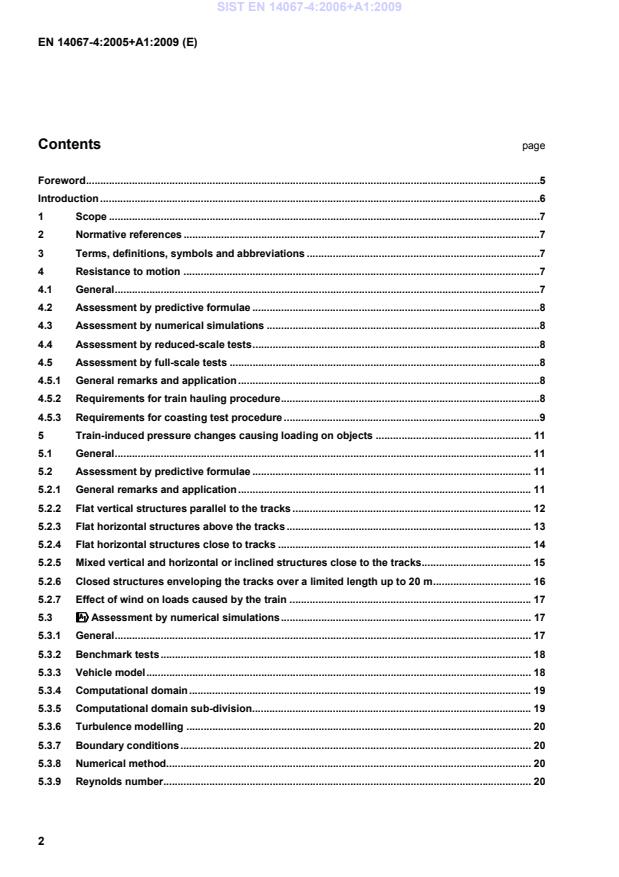
!!!!Relationship between this European Standard and the Essential Requirements of EU Directive 2008/57/EC"""" . 34Bibliography . 37 Figures Figure 1 — Pressure signal at a point on a vertical wall caused by train passing . 11 Figure 2 — Load on flat vertical structures parallel to the tracks . 12 Figure 3 — Load on flat horizontal structures above the tracks . 13 Figure 4 — Load on flat horizontal structures close to the tracks . 14 Figure 5 — Load on mixed vertical and horizontal or inclined structures close to the tracks. 16 Figure 6 — Loads for vertical and horizontal surfaces of structures enclosing two tracks . 17 Figure 7 — !!!!Sketch of the wind tunnel configuration single track ballast (side view)"""" . 19 Figure !!!!8"""" — Example of schematic description of set-up for pressure measurement . 25 Figure !!!!9"""" — Train induced air speeds . 26
Introduction Trains running on open track generate aerodynamic loads on objects and persons they pass. If trains are being passed by other trains, trains are also subject to aerodynamic loading themselves. The aerodynamic loading caused by a train passing an object or a person near the track, or when two trains pass each other, depends mainly on the following parameters: running speed of the train(s); distance between the object and the train(s); geometry of the train(s); geometry of the object; ambient wind effects. Trains running on open track have to overcome a resistance to motion. SIST EN 14067-4:2006+A1:2009
Key 1 Head of train passing 2 Tail of train passing Figure 1 — Pressure signal at a point on a vertical wall caused by train passing 5.2 Assessment by predictive formulae 5.2.1 General remarks and application When calculating the mechanical and fatigue strength of a structure, the aerodynamic loads to be taken into account shall be of an equivalent amplitude at the head, tail, and in the case of nose-to-nose coupled trains, at the coupler as well. This amplitude shall be the largest of the loads during the complete passing time of the train. These aerodynamic loads shall be applied in every case perpendicular to the surface of the structure. They are defined as characteristic pressure values. The following subclauses allow a determination of characteristic pressure values which are in line with those given graphically in EN 1991-2 but allow a wider range of application by use of formulae. It has to be emphasized that the given characteristic pressure values represent the maximum area-averaged (dynamic) loads on a structure. Since a train passing does not result in a static load, these characteristic values cannot be taken as maximum static loads. Fatigue calculations require additional information on the dynamic behaviour of the structure, the number of cycles, more detailed information on the dynamics of the train-induced pressure pulse, etc. SIST EN 14067-4:2006+A1:2009
Figure 2 — Load on flat vertical structures parallel to the tracks The characteristic values p1k of the distributed loads are determined from Equation (4). p112tr1k2Ckvpρ= (4) where Cp1 is the aerodynamic coefficient depending on the distance from track axis Y; k1 is a shape coefficient of the train. The factor Cp1 is obtained from Equation (5). SIST EN 14067-4:2006+A1:2009
Figure 3 — Load on flat horizontal structures above the tracks The values p2k of the distributed loads are determined from Equation (6). p222tr2k2Ckvpρ= (6) Here, k2 takes the same values as k1 given in 5.2.2. SIST EN 14067-4:2006+A1:2009
Figure 4 — Load on flat horizontal structures close to the tracks Values p3k of the loads which depend on Y are determined from Equation (8). SIST EN 14067-4:2006+A1:2009
Figure 5 — Load on mixed vertical and horizontal or inclined structures close to the tracks The equivalent loads are greater in this case than in the case of purely vertical or horizontal surfaces. These values shall be determined from Equation (4) in 5.2.2 except that the following distance should be used in Equation (5): maxmin4,06,0YYY+= (10) where Ymin is the minimum horizontal distance of the surface from the track axis; Ymax is the maximum horizontal distance of the surface from the track axis. If Ymax > 6 m, then Ymax = 6 m is assumed. 5.2.6 Closed structures enveloping the tracks over a limited length up to 20 m The following structures belong to this category: structures containing a horizontal surface above the tracks and at least one vertical surface; concrete mould (e.g. used during bridge deck construction); provisional structures (e.g. service walkways); SIST EN 14067-4:2006+A1:2009
Figure 6 — Loads for vertical and horizontal surfaces of structures enclosing two tracks 5.2.7 Effect of wind on loads caused by the train If the effect of ambient wind has to be included in the estimate of the head pressure pulse during train passage, the wind speed component parallel to the track should be added to the train speed. 5.3 !!!!Assessment by numerical simulations 5.3.1 General The purpose of applying CFD is to determine the train head passing pressure pulse (peak-to-peak pressure change ∆p) adjacent to the front-end of a vehicle in the open air. SIST EN 14067-4:2006+A1:2009
A ballast bed as specified in Figure 1 should be taken into account and extruded through the domain.
Figure 7 — Sketch of the wind tunnel configuration single track ballast (side view) 5.3.5 Computational domain sub-division The type of CFD method chosen dictates whether a volume discretisation or surface discretisation is used. The volume discretisation shall represent, with sufficient resolution, the flow regions where high pressure and velocity gradients are expected such as: boundary layers, shear layers, large vortical structures, stagnation zones, recirculation zones, separation bubbles, wakes etc. Particular regions of interest are e.g. the front end, the coupling device and the snowplough. The volume discretisation should meet basic requirements concerning wall units adjacent to no-slip walls, appropriate for the selected computational method and turbulence model. For RANS simulations, typical values for the dimensionless wall distance y+ to be used for the first cell layer should be of the order of 1 for low Reynolds number near-wall treatment, and typically 30 to 150 for high Reynolds number turbulence models using wall functions. The surface discretisation shall take into account the relevant pressure gradients and the surface geometry. The aerodynamic pressure shall be demonstrated to be sufficiently independent of the volume or surface discretisation used through appropriate sensitivity analyses (e.g. grid convergence study). SIST EN 14067-4:2006+A1:2009
...