

EN ISO 11248:1999
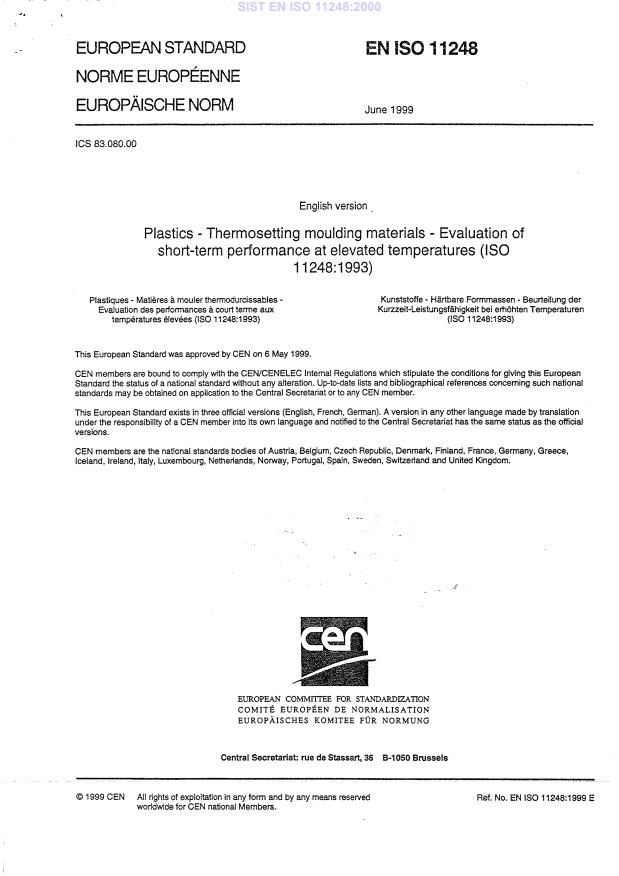
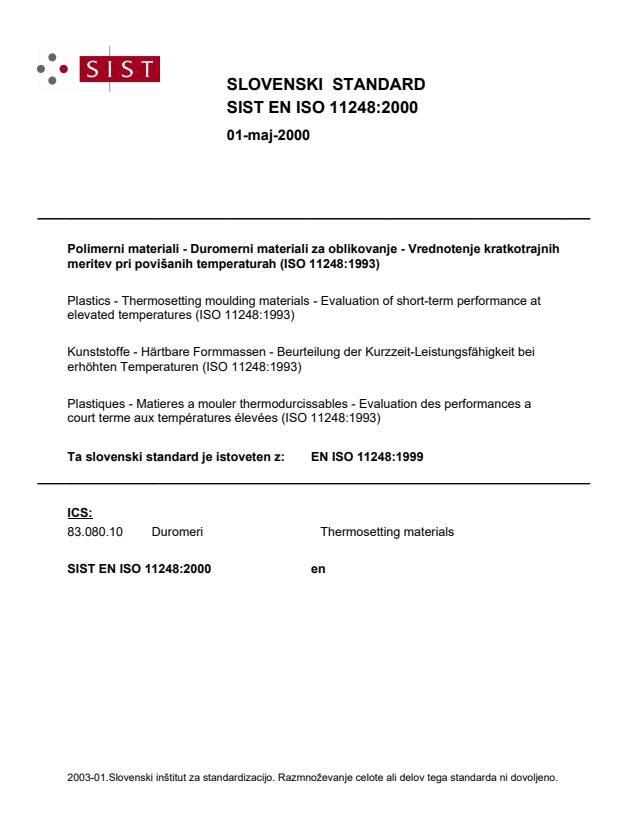
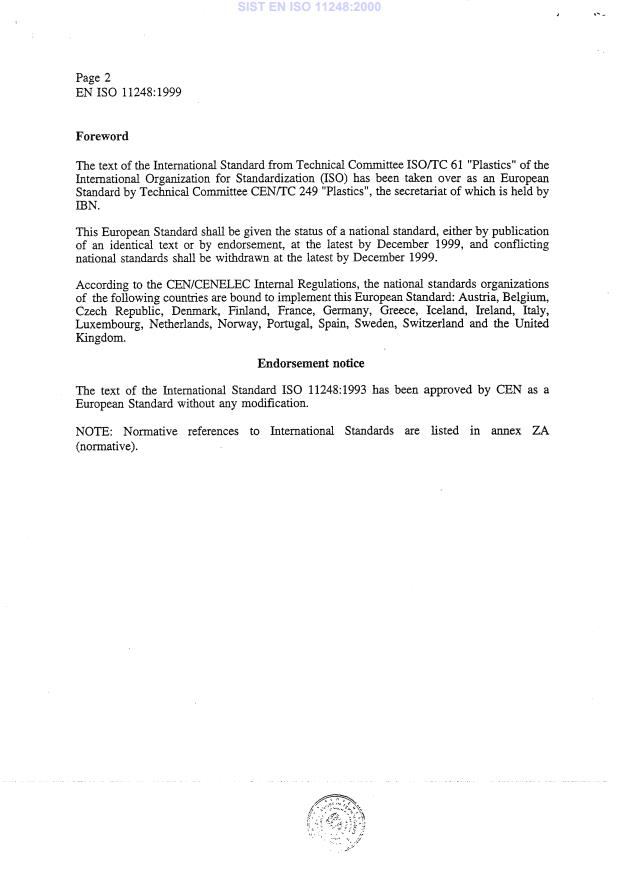
(Main)Plastics - Thermosetting moulding materials - Evaluation of short-term performance at elevated temperatures (ISO 11248:1993)
- Abstract
Specifies a method for the determination of the mechanical, electrical, thermal and other properties of thermosetting moulding materials when tested under defined conditions at elevated temperatures. The method is used for the determination of the relative performance temperature (RPT). Coupled with the long-term property evaluations of polymeric materials, the RPT provides designers and engineers with a more complete picture of the expected performance of materials in use at elevated temperatures.
- Status
- Published
- Publication Date
- 22-Jun-1999
- Withdrawal Date
- 22-Dec-1999
- Technical Committee
- CEN/TC 249 - Plastics
- Drafting Committee
- CEN/TC 249 - Plastics
- Current Stage
- 6060 - Definitive text made available (DAV) - Publishing
- Start Date
- 23-Jun-1999
- Completion Date
- 23-Jun-1999

Overview - EN ISO 11248:1999 (ISO 11248:1993)
EN ISO 11248:1999, published as ISO 11248:1993, specifies a standardized method to evaluate the short-term performance of thermosetting moulding materials at elevated temperatures. The standard defines how to measure mechanical, electrical, thermal and other relevant properties under defined high-temperature conditions and to derive the Relative Performance Temperature (RPT) - a practical index for short-term elevated-temperature behaviour. When combined with long‑term property data, the RPT helps designers and engineers predict material performance in real-world thermal environments.
Key topics and technical requirements
- Scope: Test method for thermosetting moulding materials to determine short-term performance at elevated temperatures and to calculate the RPT.
- Test preparation
- Specimen manufacture per relevant standards (ISO 295, ISO 10724) and post-curing per manufacturer recommendation.
- Conditioning: 24 hours in atmosphere 23/50 (ISO 291).
- Apparatus
- Forced-draught oven with controlled airflow (tubular oven if contamination must be avoided).
- Property-specific test equipment complying with ISO 178, ISO 527-1, ISO 604 or other applicable standards.
- Test procedure
- Establish reference (ambient) property values under atmosphere 23/50.
- Determine an initial test temperature from DMA (glass transition, Tg) or DTUL; round down to the nearest 25 °C multiple.
- Expose specimens 24 h at each test temperature, test after 15 min in fixture.
- Adjust temperature in 25 °C increments until at least four data points are obtained (1–2 below 50% of reference).
- Use linear regression to find the temperature where the property equals 50% of the reference value - this is the RPT.
- Reporting: Must include material identification, moulding parameters, test temperatures and oven type, reference values, RPT (with data plot), post‑cure details, specimen sizes/numbers and visual observations.
Applications and who uses this standard
- Materials engineers and product designers assessing thermosetting compounds for:
- Electrical insulation and connector components
- Automotive and aerospace structural or electrical parts
- Consumer electronics and high‑temperature housings
- Test laboratories and quality control teams performing comparative short‑term thermal evaluations
- OEMs specifying material selection criteria and safety margins for elevated-temperature service
Related standards
- ISO 178 (flexural properties), ISO 527‑1 (tensile properties), ISO 604 (compressive properties)
- ISO 295, ISO 10724 (specimen moulding)
- ISO 291 (conditioning atmospheres), IEC 216‑2 (thermal endurance guidance)
- ISO 2578 (long‑term time‑temperature limits) - for complementary long‑term assessment
Keywords: EN ISO 11248:1999, ISO 11248:1993, thermosetting moulding materials, short-term performance, elevated temperatures, relative performance temperature, RPT, mechanical properties, electrical properties, thermal testing.
Relations
- Effective Date
- 25-Aug-2026
- Effective Date
- 25-Aug-2026
- Effective Date
- 25-Aug-2026
- Effective Date
- 25-Aug-2026
- Effective Date
- 09-Feb-2026
- Effective Date
- 09-Feb-2026
- Effective Date
- 28-Jan-2026
- Effective Date
- 28-Jan-2026
- Effective Date
- 28-Jan-2026
- Effective Date
- 28-Jan-2026
Get Certified
Connect with accredited certification bodies for this standard

DIN CERTCO
DIN Group product certification.

Smithers Quality Assessments
US management systems and product certification.
Sponsored listings
Frequently Asked Questions
EN ISO 11248:1999 is a standard published by the European Committee for Standardization (CEN). Its full title is "Plastics - Thermosetting moulding materials - Evaluation of short-term performance at elevated temperatures (ISO 11248:1993)". This standard covers: Specifies a method for the determination of the mechanical, electrical, thermal and other properties of thermosetting moulding materials when tested under defined conditions at elevated temperatures. The method is used for the determination of the relative performance temperature (RPT). Coupled with the long-term property evaluations of polymeric materials, the RPT provides designers and engineers with a more complete picture of the expected performance of materials in use at elevated temperatures.
Specifies a method for the determination of the mechanical, electrical, thermal and other properties of thermosetting moulding materials when tested under defined conditions at elevated temperatures. The method is used for the determination of the relative performance temperature (RPT). Coupled with the long-term property evaluations of polymeric materials, the RPT provides designers and engineers with a more complete picture of the expected performance of materials in use at elevated temperatures.
EN ISO 11248:1999 is classified under the following ICS (International Classification for Standards) categories: 83.080.01 - Plastics in general. The ICS classification helps identify the subject area and facilitates finding related standards.
EN ISO 11248:1999 has the following relationships with other standards: It is inter standard links to ISO 604:1993, ISO 291:1997, ISO 295:1991, ISO 178:1993, ISO 527-1:1993, ISO 10724:1994, EN 539-2:1998, EN 754-7:1998, EN 1271:1998/A1:2000, EN 12259-1:1999 + A1:2001/A3:2006. Understanding these relationships helps ensure you are using the most current and applicable version of the standard.
EN ISO 11248:1999 is available in PDF format for immediate download after purchase. The document can be added to your cart and obtained through the secure checkout process. Digital delivery ensures instant access to the complete standard document.
Standards Content (Sample)
2003-01.Slovenski inštitut za standardizacijo. Razmnoževanje celote ali delov tega standarda ni dovoljeno.Polimerni materiali - Duromerni materiali za oblikovanje - Vrednotenje kratkotrajnih meritev pri povišanih temperaturah (ISO 11248:1993)Kunststoffe - Härtbare Formmassen - Beurteilung der Kurzzeit-Leistungsfähigkeit bei erhöhten Temperaturen (ISO 11248:1993)Plastiques - Matieres a mouler thermodurcissables - Evaluation des performances a court terme aux températures élevées (ISO 11248:1993)Plastics - Thermosetting moulding materials - Evaluation of short-term performance at elevated temperatures (ISO 11248:1993)83.080.10DuromeriThermosetting materialsICS:Ta slovenski standard je istoveten z:EN ISO 11248:1999SIST EN ISO 11248:2000en01-maj-2000SIST EN ISO 11248:2000SLOVENSKI
STANDARD
INTERNATIONAL STANDARD ISO 11248 First edition 1993-12-01 Plastics - Thermosetting moulding materials - Evaluation of short-term performante at elevated temperatures Plas tiques - Ma tieres 2 mouler thermodurcissables - Evaluation des performances 2 tourt terme aux temp&atures 6lev6es Reference number ISO 11248:1993(E) SIST EN ISO 11248:2000
ISO 11248:1993(E) Foreword ISO (the International Organization for Standardization) is a worldwide federation of national Standards bodies (ISO member bodies). The work of preparing International Standards is normally carried out through ISO technical committees. Esch member body interested in a subject for which a technical committee has been established has the right to be represented on that committee. International organizations, governmental and non-governmental, in liaison with ISO, also take part in the work. ISO collaborates closely with the International Electrotechnical Commission (1 EC) on all matters of electrotechnical standardization. Draft International Standards adopted by the technical committees are circulated to the member bodies for voting. Publication as an International Standard requires approval by at least 75 % of the member bodies casting a vote. International Standard ISO 11248 was prepared by Technical Committee ISO/TC 61, Plastics, Subcommittee SC 12, Thermosetting materiak. 0 ISO 1993 All rights reserved. Unless otherwise specified, no part of this publication may be reproduced or utilized in any form or by any means, electronie or mecha microfilm, without Permission in writing from the publisher, International Organization for Standardization Case Postale 56 l CH-l 21 1 Geneve 20 l Switzerland nical, including photocopying and Printed in Switzerland ii SIST EN ISO 11248:2000
0 ISO ISO 11248:1993(E) Introduction Plastic materials, when exposed to heat, may undergo physical and/or Chemical changes. The extent of such changes is dependent upon tem- perature and exposure time. These changes may or may not be evident when the plastic materials are returned to ambient temperature. In ISO 2578:1993, Plastics - Determination of time-tempera ture limits after prolonged exposure to heat and similar Standards, testing is carried out at ambient temperature. In such Standards it is primarily the perma- nent effects of thermal Oxidation on plastics exposed to elevated tem- peratures for extended periods of time which are addressed. Undefined, however, are any high-temperature physical and or Chemical changes that occur while the materials are exposed to the elevated temperatures. This International Standard is designed to provide data indicating how plastic materials may perform at elevated temperatures under mechanical and/or electrical stress. . . . Ill SIST EN ISO 11248:2000
This page intentionally left blank SIST EN ISO 11248:2000
INTERNATIONAL STANDARD 0 ISO ISO 11248:1993(E) Plastics - Thermosetting moulding materials - Evaluation of short-term Performance at elevated temperatures 1 Scope This International Standard specifies a method for the determination of the mechanical, electrical, thermal and other properties of thermosetting moulding ma- terials when tested under defined conditions at elev- ated temperatures. The method is used for the determination of the rela- tive Performance temperature (RPT) of thermosetting moulding materials. This RPT is necessary in describ- ing the short-term Performance of these materials at elevated temperatures. Coupled with the long-term property evaluations of polymeric materials, the RPT provides designers and engineers with a more com- plete picture of the expected Performance of ma- terials in use at elevated temperatures. ISO 295:1991, Plastics - Compression moulding of test specimens of thermosetting ma terials. ISO 527-1 :1993, Plastics - Determination of tensile properties - Part 1: General principles. ISO 604: 1993, Plastics - Determination of compressive properties. ISO 10724: -l), Plastics - Thermose tting moulding ma terials - Injection moulding of multipurpose test specrmens. I EC 216-2: 1990, Guide for the determination of ther- mal endurante properties of electrical insulating ma- terials - Part 2: Choice of test criteria. 3 Apparatus 2 Normative references The following Standards contain provisions which, through reference in this text, constitute provisions of this International Standard. At the time of publi- cation, the editions indicated were valid. All Standards are subject to revision, and Parties to agreements based on this International Standard are encouraged to investigate the possibility of applying th
...