


EN 13830:2015+A1:2020
(Main)Curtain walling - Product standard
Curtain walling - Product standard
This European Standard specifies requirements of curtain walling kit intended to be used as a building envelope to provide weather resistance, safety in use and energy economy and heat retention and provides test/assessments/calculation methods and compliance criteria of the related performances.
The curtain walling kit covered by this standard should fulfil its own integrity and mechanical stability but does not contribute to the load bearing or stability of the main building structure, and could be replaced independently of it.
This standard applies to curtain walling kit ranging from a vertical position to ± 15° from the vertical. Any sloping parts should be contained within the curtain walling kit.
This standard is applicable to the whole of the curtain walling kits, including the fixings.
Curtain walling according to this standard is intended to be used as part of the building envelope.
This European Standard does not include:
— “Patent glazing” (glazed sloping roofs) kits;
— Roof glazing constructions;
— Façades made of precast concrete panels as part of the wall (see EN 14992).
NOTE 1 Precast concrete panels may be used in curtain walling kits as infill panels.
NOTE 2 Durability of structural sealed glazing infills is not covered by this standard.
Vorhangfassaden - Produktnorm
Diese Europäische Norm legt die Anforderungen an Vorhangfassadenbausätze fest, die zur Verwendung als Gebäude¬hülle vorgesehen sind, um Witterungsbeständigkeit, Nutzungssicherheit, Energieeinsparung und Wärmeschutz zu ermöglichen, und enthält Prüf /Bewertungs /Berechnungsverfahren und Konformitäts¬kriterien für die entsprechenden Leistungen.
Eine Vorhangfassade nach dieser Norm verfügt über ihre eigene mechanische Stabilität und Standsicherheit, sie trägt aber nicht zur Lastabtragung oder Stabilität des Hauptbaukörpers bei und kann unabhängig von diesem ersetzt werden.
Diese Norm gilt für Vorhangfassadenbausätze, die von einer vertikalen Konstruktion bis hin zu Konstruktionen mit einer Neigung von bis zu ±15° von der Vertikalen reichen. Jegliche geneigten Teile sollten im Vorhangfassadenbausatz eingeschlossen sein.
Diese Norm gilt für den gesamten Vorhangfassadenbausatz einschließlich der Befestigungsmittel.
Vorhangfassaden nach dieser Norm sind zur Verwendung als Teil der Gebäudehülle vorgesehen.
Diese Europäische Norm gilt nicht für:
- Bausätze für „Patentverglasungen“ (Schrägdachverglasungen);
- Konstruktionen von Dachverglasungen;
- Fassaden aus Fertigbetonelementen als Teil der Wand (siehe EN 14992).
ANMERKUNG 1 Fertigbetonelemente dürfen in Vorhangfassadenbausätzen als Ausfachungspaneele verwendet werden.
ANMERKUNG 2 Die Dauerhaftigkeit von Ausfachungen aus geklebten Glaskonstruktionen ist nicht Gegenstand dieser Norm.
Façades rideaux - Norme de produit
La présente Norme européenne spécifie les exigences applicables au kit de façades-rideaux destiné à être utilisé comme une enveloppe du bâtiment afin de fournir une résistance aux sollicitations climatiques, une sécurité d'utilisation, de l'économie d'énergie et d’isolation thermique et fournit également des méthodes d’essai/d’évaluation/de calcul et des critères de conformité des performances associées.
Le kit de façade rideau couvert par la présente norme doit contribuer à sa propre intégrité et stabilité, mais sans contribuer à la résistance ou à la stabilité de la structure du bâtiment et pourrait être remplacé de manière indépendante.
La présente norme s’applique au kit de façade rideau variant de la position verticale à une position inclinée de ± 15° par rapport à la verticale. Il convient que toutes pièces inclinées soient contenues dans le kit de façade rideau.
La présente norme s'applique à l'intégralité des kits de façades rideaux, y compris les points d'attache.
Conformément à la présente norme, une façade rideau est conçue pour être utilisée comme une partie de l’enveloppe du bâtiment.
La présente Norme européenne n’inclut pas :
des kits de systèmes de vitrages auto-drainant à joint secs (toits inclinés vitrés) ;
des verrières ;
façades constituées de panneaux en béton préfabriqués faisant partie du mur (voir l'EN 14992).
NOTE 1 Les panneaux de béton préfabriqués peuvent être utilisés dans les kits de façades rideaux comme panneaux de remplissage.
NOTE 2 Durabilité des remplissages de vitrage collés (VEC) ne sont pas couverts par cette norme.
Obešene fasade - Standard za proizvod
General Information
- Status
- Published
- Publication Date
- 26-May-2020
- Technical Committee
- CEN/TC 33 - Doors, windows, shutters and building hardware
- Drafting Committee
- CEN/TC 33/WG 6 - Curtain walling
- Current Stage
- 9093 - Decision to confirm - Review Enquiry
- Start Date
- 06-Dec-2021
- Completion Date
- 14-Apr-2025
Relations
- Effective Date
- 19-Jan-2023
- Effective Date
- 18-Jan-2023
- Effective Date
- 16-Feb-2022
EN 13830:2015+A1:2020 - Overview
EN 13830:2015+A1:2020 is the European product standard for curtain walling used as part of the building envelope. It specifies performance requirements, test/assessment/calculation methods and compliance criteria for curtain walling kits (including fixings) intended to provide weather resistance, safety in use, energy economy and heat retention. The standard applies to curtain walling from vertical up to ±15° from the vertical (including any contained sloping parts) and covers whole kits that do not form part of the load‑bearing structure and can be replaced independently.
Key exclusions: patent glazing (sloping glazed roofs), roof glazing constructions and façades made of precast concrete panels as the main wall (see EN 14992). Durability of structural sealed glazing infills is not covered.
Key Topics and Technical Requirements
The standard addresses a broad range of technical properties and conformity processes, including:
- Weather performance: watertightness, air permeability, water vapour permeability
- Structural behaviour: resistance to own dead load, wind load, snow load (where applicable), live horizontal loads at sill level
- Safety and durability: impact resistance (internal/external), seismic resistance (Annex B, normative), thermal shock resistance, durability of watertightness and thermal performance
- Fire performance: reaction to fire of components, fire resistance and fire propagation to upper levels
- Thermal & acoustic performance: thermal transmittance (U-values), radiation properties, direct airborne sound insulation and flanking transmission
- Assessment & conformity: sampling, type testing, testing methods, Assessment and Verification of Constancy of Performance (AVCP), and Factory Production Control (FPC) requirements (including initial inspection, continuous surveillance and product-specific controls)
- Supporting guidance: Annex A provides guidance on resistance to actions using Eurocodes
These topics are supported by detailed test procedures, sampling rules and compliance criteria provided in the standard.
Practical Applications - Who Uses This Standard
SIST EN 13830 is essential for stakeholders involved in the specification, design, testing, manufacture and regulation of curtain walling systems:
- Façade manufacturers - for product design, type testing and FPC implementation
- Architects and façade engineers - to specify performance criteria (air/water/thermal/structural/fire) and ensure compliance with building envelope requirements
- Testing laboratories - to carry out standardized tests and prepare compliance reports
- Contractors and installers - to understand on‑site requirements and performance verification
- Regulators and certifiers - to assess conformity procedures and support declarations of performance under EU product legislation
Use cases include product development, tender specifications, performance verification for building permits, and supporting conformity documentation.
Related Standards and References
- EN 14992 (precast concrete façade panels) - relevant for façades using precast panels as infill
- Eurocodes - referenced in Annex A for structural actions and design guidance
- Various EN test methods and reaction‑to‑fire standards (normative references listed within the document)
Keywords: EN 13830:2015+A1:2020, curtain walling, product standard, building envelope, watertightness, air permeability, thermal transmittance, fire resistance, seismic resistance, AVCP, factory production control.
Frequently Asked Questions
EN 13830:2015+A1:2020 is a standard published by the European Committee for Standardization (CEN). Its full title is "Curtain walling - Product standard". This standard covers: This European Standard specifies requirements of curtain walling kit intended to be used as a building envelope to provide weather resistance, safety in use and energy economy and heat retention and provides test/assessments/calculation methods and compliance criteria of the related performances. The curtain walling kit covered by this standard should fulfil its own integrity and mechanical stability but does not contribute to the load bearing or stability of the main building structure, and could be replaced independently of it. This standard applies to curtain walling kit ranging from a vertical position to ± 15° from the vertical. Any sloping parts should be contained within the curtain walling kit. This standard is applicable to the whole of the curtain walling kits, including the fixings. Curtain walling according to this standard is intended to be used as part of the building envelope. This European Standard does not include: — “Patent glazing” (glazed sloping roofs) kits; — Roof glazing constructions; — Façades made of precast concrete panels as part of the wall (see EN 14992). NOTE 1 Precast concrete panels may be used in curtain walling kits as infill panels. NOTE 2 Durability of structural sealed glazing infills is not covered by this standard.
This European Standard specifies requirements of curtain walling kit intended to be used as a building envelope to provide weather resistance, safety in use and energy economy and heat retention and provides test/assessments/calculation methods and compliance criteria of the related performances. The curtain walling kit covered by this standard should fulfil its own integrity and mechanical stability but does not contribute to the load bearing or stability of the main building structure, and could be replaced independently of it. This standard applies to curtain walling kit ranging from a vertical position to ± 15° from the vertical. Any sloping parts should be contained within the curtain walling kit. This standard is applicable to the whole of the curtain walling kits, including the fixings. Curtain walling according to this standard is intended to be used as part of the building envelope. This European Standard does not include: — “Patent glazing” (glazed sloping roofs) kits; — Roof glazing constructions; — Façades made of precast concrete panels as part of the wall (see EN 14992). NOTE 1 Precast concrete panels may be used in curtain walling kits as infill panels. NOTE 2 Durability of structural sealed glazing infills is not covered by this standard.
EN 13830:2015+A1:2020 is classified under the following ICS (International Classification for Standards) categories: 91.060.10 - Walls. Partitions. Facades. The ICS classification helps identify the subject area and facilitates finding related standards.
EN 13830:2015+A1:2020 has the following relationships with other standards: It is inter standard links to EN 13830:2015/FprA1, EN 13830:2015, EN 13830:2015+A1:2020/AC:2022. Understanding these relationships helps ensure you are using the most current and applicable version of the standard.
EN 13830:2015+A1:2020 is associated with the following European legislation: EU Directives/Regulations: 305/2011; Standardization Mandates: M/108. When a standard is cited in the Official Journal of the European Union, products manufactured in conformity with it benefit from a presumption of conformity with the essential requirements of the corresponding EU directive or regulation.
You can purchase EN 13830:2015+A1:2020 directly from iTeh Standards. The document is available in PDF format and is delivered instantly after payment. Add the standard to your cart and complete the secure checkout process. iTeh Standards is an authorized distributor of CEN standards.
Standards Content (Sample)
SLOVENSKI STANDARD
01-julij-2020
Nadomešča:
SIST EN 13830:2015
Obešene fasade - Standard za proizvod
Curtain walling - Product standard
Vorhangfassaden - Produktnorm
Façades rideaux - Norme de produit
Ta slovenski standard je istoveten z: EN 13830:2015+A1:2020
ICS:
91.060.10 Stene. Predelne stene. Walls. Partitions. Facades
Fasade
2003-01.Slovenski inštitut za standardizacijo. Razmnoževanje celote ali delov tega standarda ni dovoljeno.
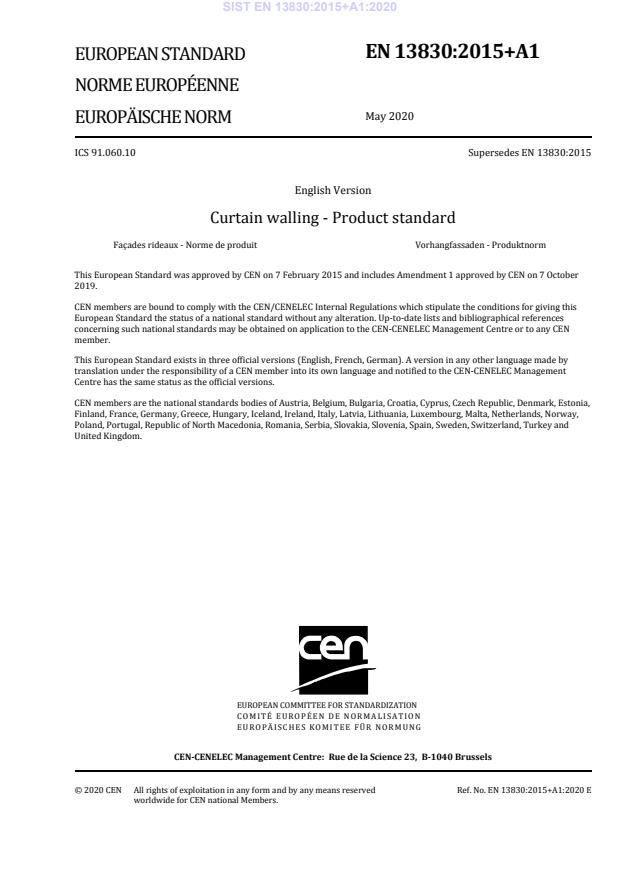
EN 13830:2015+A1
EUROPEAN STANDARD
NORME EUROPÉENNE
May 2020
EUROPÄISCHE NORM
ICS 91.060.10 Supersedes EN 13830:2015
English Version
Curtain walling - Product standard
Façades rideaux - Norme de produit Vorhangfassaden - Produktnorm
This European Standard was approved by CEN on 7 February 2015 and includes Amendment 1 approved by CEN on 7 October
2019.
CEN members are bound to comply with the CEN/CENELEC Internal Regulations which stipulate the conditions for giving this
European Standard the status of a national standard without any alteration. Up-to-date lists and bibliographical references
concerning such national standards may be obtained on application to the CEN-CENELEC Management Centre or to any CEN
member.
This European Standard exists in three official versions (English, French, German). A version in any other language made by
translation under the responsibility of a CEN member into its own language and notified to the CEN-CENELEC Management
Centre has the same status as the official versions.
CEN members are the national standards bodies of Austria, Belgium, Bulgaria, Croatia, Cyprus, Czech Republic, Denmark, Estonia,
Finland, France, Germany, Greece, Hungary, Iceland, Ireland, Italy, Latvia, Lithuania, Luxembourg, Malta, Netherlands, Norway,
Poland, Portugal, Republic of North Macedonia, Romania, Serbia, Slovakia, Slovenia, Spain, Sweden, Switzerland, Turkey and
United Kingdom.
EUROPEAN COMMITTEE FOR STANDARDIZATION
COMITÉ EUROPÉEN DE NORMALISATION
EUROPÄISCHES KOMITEE FÜR NORMUNG
CEN-CENELEC Management Centre: Rue de la Science 23, B-1040 Brussels
© 2020 CEN All rights of exploitation in any form and by any means reserved Ref. No. EN 13830:2015+A1:2020 E
worldwide for CEN national Members.
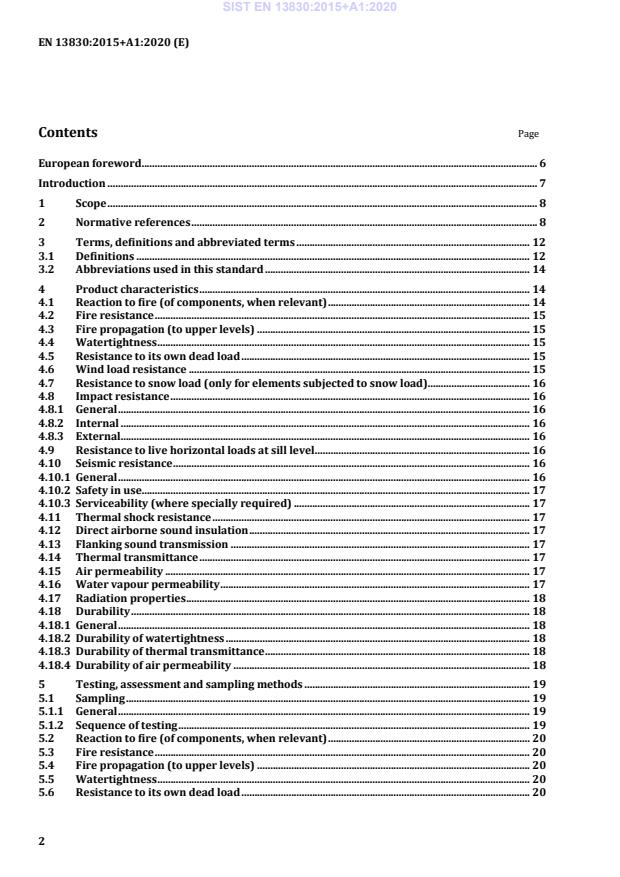
Contents Page
European foreword . 6
Introduction . 7
1 Scope . 8
2 Normative references . 8
3 Terms, definitions and abbreviated terms . 12
3.1 Definitions . 12
3.2 Abbreviations used in this standard . 14
4 Product characteristics . 14
4.1 Reaction to fire (of components, when relevant) . 14
4.2 Fire resistance . 15
4.3 Fire propagation (to upper levels) . 15
4.4 Watertightness . 15
4.5 Resistance to its own dead load . 15
4.6 Wind load resistance . 15
4.7 Resistance to snow load (only for elements subjected to snow load). 16
4.8 Impact resistance . 16
4.8.1 General . 16
4.8.2 Internal . 16
4.8.3 External . 16
4.9 Resistance to live horizontal loads at sill level . 16
4.10 Seismic resistance . 16
4.10.1 General . 16
4.10.2 Safety in use. 17
4.10.3 Serviceability (where specially required) . 17
4.11 Thermal shock resistance . 17
4.12 Direct airborne sound insulation . 17
4.13 Flanking sound transmission . 17
4.14 Thermal transmittance . 17
4.15 Air permeability . 17
4.16 Water vapour permeability . 17
4.17 Radiation properties . 18
4.18 Durability . 18
4.18.1 General . 18
4.18.2 Durability of watertightness . 18
4.18.3 Durability of thermal transmittance . 18
4.18.4 Durability of air permeability . 18
5 Testing, assessment and sampling methods . 19
5.1 Sampling . 19
5.1.1 General . 19
5.1.2 Sequence of testing . 19
5.2 Reaction to fire (of components, when relevant) . 20
5.3 Fire resistance . 20
5.4 Fire propagation (to upper levels) . 20
5.5 Watertightness . 20
5.6 Resistance to its own dead load . 20
5.7 Wind load resistance . 21
5.8 Resistance to snow load (only for elements subject to snow load) . 21
5.9 Impact resistance. 21
5.10 Resistance to live horizontal loads at sill level . 22
5.11 Seismic resistance . 22
5.11.1 Safety in use . 22
5.11.2 Serviceability (where specially required) . 22
5.12 Direct airborne sound insulation . 22
5.13 Flanking sound transmission . 22
5.14 Thermal transmittance. 22
5.15 Air permeability . 23
5.16 Radiation properties . 23
5.17 Durability. 23
5.17.1 General . 23
5.17.2 Durability of watertightness . 23
5.17.3 Durability of thermal transmittance . 24
5.17.4 Durability of air permeability . 24
6 Assessment and verification of constancy of performance (AVCP) . 25
6.1 General . 25
6.2 Type testing . 25
6.2.1 General . 25
6.2.2 Test samples, testing and compliance criteria . 26
6.2.3 Test reports . 27
6.2.4 Cascading determination of the product type results . 27
6.3 Factory production control (FPC) . 28
6.3.1 General . 28
6.3.2 Requirements . 29
6.3.3 Product specific requirements . 32
6.3.4 Initial inspection of factory and of FPC . 32
6.3.5 Continuous surveillance of FPC (only for curtain walling kits covered by AVCP
system 1) . 33
6.3.6 Procedure for modifications . 33
6.3.7 One-off products, pre-production products (e.g. prototypes) and products produced
in very low quantity . 33
Annex A " (informative) Resistance to actions: guidance on the use of Eurocodes . 38
A.1 Introduction of the annex . 38
A.2 Scope of the annex . 38
A.3 Symbols and abbreviations in the annex . 38
A.4 Definition and principle . 39
A.4.1 General . 39
A.4.2 Classes of consequence . 40
A.4.3 Curtain walling kit operating as safety barrier . 40
A.4.4 Loaded area "A" . 40
A.4.5 System redundancy . 42
A.5 Requirements . 42
A.6 Actions . 42
A.6.1 Dead load action . 42
A.6.2 Wind action . 42
A.6.3 Actions for curtain walling serving as parapets . 43
A.7 Assumptions related the combinations of actions . 44
A.7.1 General . 44
A.7.2 Combinations of actions: generalities . 45
Annex B " (normative) Seismic resistance. 50
B.1 General principles . 50
B.1.1 Required performance limits . 50
B.1.2 Factors affecting seismic performance . 50
B.2 Assessment of seismic serviceability limit . 50
B.3 Assessment of seismic safety limit . 51
B.4 Seismic movement regime . 51
B.4.1 General . 51
B.4.2 Principles . 52
B.4.3 Test apparatus. 52
B.4.4 Test procedure . 52
Annex C " (normative) Selection, preparation, mounting and fixing of test specimen for
reaction to fire tests of curtain walling and field of direct application . 58
C.1 General . 58
C.2 EN ISO 11925-2:2010 (Single flame test) . 59
C.2.1 Profile . 59
C.2.2 Infill . 61
C.2.3 Sealing between infill and profile . 61
C.2.4 Organic coating/top layers . 63
C.3 Mounting and fixing for EN 13238 (SBI-test) . 63
C.4 EN ISO 1182 (Non-combustibility test) . 64
C.5 EN ISO 1716 (Determination of the heat of combustion) . 65
C.6 Field of direct application . 65
Annex D " (normative) Characteristics and range of direct application . 67
D.1 General . 67
D.2 Selection of a representative test specimen . 74
Annex E " (informative) Characteristics and performances of curtain walling kit . 77
Annex F " (informative) Interchangeability between characteristics and components . 80
Annex G " (informative) Basic approach to durability . 83
Annex ZA (informative) !Relationship to this European Standard with
Regulation (EU) No.305/2011 (When applying this standard as a harmonized
standard under Regulation (EU) No. 305/2011, manufacturers and Member States
are obliged by this regulation to use this Annex) " . 85
ZA.1 Scope and relevant characteristics . 85
ZA.2 !System of Assessment and Verification of Constancy of Performance (AVCP)" . 87
ZA.3 !Assignment of AVCP tasks . 87
Bibliography . 90
European foreword
This document (EN 13830:2015+A1:2020) has been prepared by Technical Committee CEN/TC 33
“Doors, windows, shutters, building hadware and curtain walling”, the secretariat of which is held by
AFNOR.
This European Standard shall be given the status of a national standard, either by publication of an
identical text or by endorsement, at the latest by November 2020, and conflicting national standards
shall be withdrawn at the latest by February 2023.
Attention is drawn to the possibility that some of the elements of this document may be the subject of
patent rights. CEN [and/or CENELEC] shall not be held responsible for identifying any or all such patent
rights.
This document includes Amendment 1 approved by CEN on 7 October 2019.
This document supersedes !EN 13830:2015".
The start and finish of text introduced or altered by amendment is indicated in the text by tags !".
This document has been prepared under a mandate given to CEN by the European Commission and the
European Free Trade Association, and supports essential requirements of EU Directive(s).
For relationship with EU Directive, see informative Annexe ZA, which is an integral part of this
document.
The new revision extends the scope to sloping parts included in the curtain walling kit and clarifies the
exclusion of the following products:
−
“Patent glazing” (glazed sloping roofs) kits;
−
Roof glazing constructions;
−
Façades made of precast concrete panels as part of the wall (see EN 14992).
Here below the list the most important changes compared with the previous version EN 13830:2003:
−
new characteristics were added;
−
new annexes were introduced, particularly the one for the range of direct application of
characteristics (extension rules);
−
the durability was dealt in details in !Annex G";
−
updated Clause 6 and Annex ZA with the provisions of the EU Construction Product Regulation No.
305/2011.
According to the CEN-CENELEC Internal Regulations, the national standards organisations of the
following countries are bound to implement this European Standard: Austria, Belgium, Bulgaria,
Croatia, Cyprus, Czech Republic, Denmark, Estonia, Finland, France, Germany, Greece, Hungary, Iceland,
Ireland, Italy, Latvia, Lithuania, Luxembourg, Malta, Netherlands, North Macedonia, Norway, Poland,
Portugal, Romania, Serbia, Slovakia, Slovenia, Spain, Sweden, Switzerland, Turkey and the United
Kingdom.
Introduction
This European Standard specifies the technical characteristics of curtain walling kit and includes a
systematic framework of requirements, test methods and compliance criteria to allow the product to
fulfil with it.
Curtain walling kit might not be completed in all respects within a manufacturing area, and some kit
components could be supplied separately on site. Curtain walling kit could be also preassembled in
plant(s) as prefabricated units.
1 Scope
This European Standard specifies requirements of curtain walling kit intended to be used as a building
envelope to provide weather resistance, safety in use and energy economy and heat retention and
provides test/assessments/calculation methods and compliance criteria of the related performances.
The curtain walling kit covered by this standard should fulfil its own integrity and mechanical stability
but does not contribute to the load bearing or stability of the main building structure, and could be
replaced independently of it.
This standard applies to curtain walling kit ranging from a vertical position to ± 15° from the vertical.
Any sloping parts should be contained within the curtain walling kit.
This standard is applicable to the whole of the curtain walling kits, including the fixings.
Curtain walling according to this standard is intended to be used as part of the building envelope.
This European Standard does not include:
— “Patent glazing” (glazed sloping roofs) kits;
— Roof glazing constructions;
— Façades made of precast concrete panels as part of the wall (see EN 14992).
NOTE 1 Precast concrete panels may be used in curtain walling kits as infill panels.
NOTE 2 Durability of structural sealed glazing infills is not covered by this standard.
2 Normative references
The following documents, in whole or in part, are normatively referenced in this document and are
indispensable for its application. For dated references, only the edition cited applies. For undated
references, the latest edition of the referenced document (including any amendments) applies.
EN 410, Glass in building - Determination of luminous and solar characteristics of glazing
EN 1096-2, Glass in building - Coated glass - Part 2: Requirements and test methods for class A, B and S
coatings
EN 1096-3, Glass in building - Coated glass - Part 3: Requirements and test methods for class C and D
coatings
EN 1096-4, Glass in building - Coated glass - Part 4: Evaluation of conformity/Product standard
EN 1279-1, Glass in Building - Insulating glass units - Part 1: Generalities, dimensional tolerances and
rules for the system description
EN 1279-2, Glass in building - Insulating glass units - Part 2: Long term test method and requirements for
moisture penetration
EN 1279-3, Glass in building - Insulating glass units - Part 3: Long term test method and requirements for
gas leakage rate and for gas concentration tolerances
EN 1279-4, Glass in building - Insulating glass units - Part 4: Methods of test for the physical attributes of
edge seals
EN 1279-5, Glass in building - Insulating glass units - Part 5: Evaluation of conformity
EN 1364-3, Fire resistance tests for non-loadbearing elements - Part 3: Curtain walling - Full configuration
(complete assembly)
EN 1364-4, Fire resistance tests for non-loadbearing elements - Part 4: Curtain walling - Part
configuration
EN 1991-1-1, Eurocode 1: Actions on structures - Part 1-1: General actions - Densities, self-weight,
imposed loads for buildings
EN 1991-1-3, Eurocode 1 - Actions on structures - Part 1-3: General actions - Snow loads
EN 1991-1-4, Eurocode 1: Actions on structures - Part 1-4: General actions - Wind actions
EN 1998-1:2004, Eurocode 8: Design of structures for earthquake resistance - Part 1: General rules,
seismic actions and rules for buildings
EN 12152, Curtain walling - Air permeability - Performance requirements and classification
EN 12153, Curtain walling - Air permeability - Test method
EN 12154, Curtain walling - Watertightness - Performance requirements and classification
EN 12155, Curtain walling - Watertightness - Laboratory test under static pressure
EN 12179, Curtain walling - Resistance to wind load - Test method
EN 12354-1, Building Acoustics - Estimation of acoustic performance of buildings from the performance of
elements - Part 1: Airborne sound insulation between rooms
EN 12365-1, Building hardware - Gasket and weatherstripping for doors, windows, shutters and curtain
walling - Part 1: Performance requirements and classification
EN 12365-4, Building hardware - Gasket and weatherstripping for doors, windows, shutters and curtain
walling - Part 4: Recovery after accelerated ageing test method
EN 12412-2, Thermal performance of windows, doors and shutters - Determination of thermal
transmittance by hot box method - Part 2: Frames
EN 12600:2002, Glass in building - Pendulum test - Impact test method and classification for flat glass
EN 12758, Glass in building - Glazing and airborne sound insulation - Product descriptions and
determination of properties
EN 13022-1, Glass in building - Structural sealant glazing - Part 1: Glass products for structural sealant
glazing systems for supported and unsupported monolithic and multiple glazing
EN 13022-2, Glass in building - Structural sealant glazing - Part 2: Assembly rules
EN 13050, Curtain Walling - Watertightness - Laboratory test under dynamic condition of air pressure
and water spray
EN 13116, Curtain walling - Resistance to wind load - Performance requirements
EN 13119, Curtain walling - Terminology
EN 13162, Thermal insulation products for buildings - Factory made mineral wool (MW) products -
Specification
EN 13163, Thermal insulation products for buildings - Factory made expanded polystyrene (EPS) products
- Specification
EN 13164, Thermal insulation products for buildings - Factory made extruded polystyrene foam (XPS)
products - Specification
EN 13165, Thermal insulation products for buildings - Factory made rigid polyurethane foam (PU)
products - Specification
EN 13166, Thermal insulation products for buildings - Factory made phenolic foam (PF) products -
Specification
EN 13167, Thermal insulation products for buildings - Factory made cellular glass (CG) products -
Specification
EN 13168, Thermal insulation products for buildings - Factory made wood wool (WW) products -
Specification
EN 13169, Thermal insulation products for buildings - Factory made expanded perlite board (EPB)
products - Specification
EN 13170, Thermal insulation products for buildings - Factory made products of expanded cork (ICB) -
Specification
EN 13171, Thermal insulation products for buildings - Factory made wood fibre (WF) products -
Specification
EN 13238, Reaction to fire tests for building products - Conditioning procedures and general rules for
selection of substrates
EN 13363-1, Solar protection devices combined with glazing - Calculation of solar and light transmittance
- Part 1: Simplified method
EN 13363-2, Solar protection devices combined with glazing - Calculation of total solar energy
transmittance and light transmittance - Part 2: Detailed calculation method
EN 13501-1, Fire classification of construction products and building elements - Part 1: Classification
using data from reaction to fire tests
EN 13501-2, Fire classification of construction products and building elements - Part 2: Classification
using data from fire resistance tests, excluding ventilation services
EN 13823, Reaction to fire tests for building products - Building products excluding floorings exposed to
the thermal attack by a single burning item
EN 14019, Curtain Walling - Impact resistance - Performance requirements
EN 14509, Self-supporting double skin metal faced insulating panels - Factory made products -
Specifications
EN 15434, Glass in building - Product standard for structural and/or ultra-violet resistant sealant (for use
with structural sealant glazing and/or insulating glass units with exposed seals)
EN 15651-1, Sealants for non-structural use in joints in buildings and pedestrian walkways - Part 1:
Sealants for facade elements
!EN 16612, Glass in building - Determination of the lateral load resistance of glass panes by
calculation"
EN 15651-2, Sealants for non-structural use in joints in buildings and pedestrian walkways - Part 2:
Sealants for glazing
EN ISO 717-1, Acoustics - Rating of sound insulation in buildings and of building elements - Part 1:
Airborne sound insulation (ISO 717-1)
EN ISO 1182, Reaction to fire tests for products - Non-combustibility test (ISO 1182)
EN ISO 1716, Reaction to fire tests for products - Determination of the gross heat of combustion (calorific
value) (ISO 1716)
EN ISO 8339, Building construction - Sealants - Determination of tensile properties (Extension to break)
(ISO 8339)
EN ISO 8340, Building construction - Sealants - Determination of tensile properties at maintained
extension (ISO 8340)
EN ISO 9046, Building construction - Jointing products - Determination of adhesion/cohesion properties of
sealants at constant temperature (ISO 9046)
EN ISO 9047, Building construction - Jointing products - Determination of adhesion/cohesion properties of
sealants at variable temperatures (ISO 9047)
EN ISO 10140-1, Acoustics - Laboratory measurement of sound insulation of building elements - Part 1:
Application rules for specific products (ISO 10140-1)
EN ISO 10140-2, Acoustics - Laboratory measurement of sound insulation of building elements - Part 2:
Measurement of airborne sound insulation (ISO 10140-2)
EN ISO 10140-3, Acoustics - Laboratory measurement of sound insulation of building elements - Part 3:
Measurement of impact sound insulation (ISO 10140-3)
EN ISO 10140-4, Acoustics - Laboratory measurement of sound insulation of building elements - Part 4:
Measurement procedures and requirements (ISO 10140-4)
EN ISO 10140-5, Acoustics - Laboratory measurement of sound insulation of building elements - Part 5:
Requirements for test facilities and equipment (ISO 10140-5)
EN ISO 10590, Building construction - Sealants - Determination of tensile properties of sealants at
maintained extension after immersion in water (ISO 10590)
EN ISO 10591, Building construction - Sealants - Determination of adhesion/cohesion properties of
sealants after immersion in water (ISO 10591)
EN ISO 10848-1, Acoustics - Laboratory measurement of the flanking transmission of airborne and impact
sound between adjoining rooms - Part 1: Frame document (ISO 10848-1)
EN ISO 10848-2, Acoustics - Laboratory measurement of the flanking transmission of airborne and impact
sound between adjoining rooms - Part 2: Application to light elements when the junction has a small
influence (ISO 10848-2)
EN ISO 11600, Building construction - Jointing products - Classification and requirements for sealants (ISO
11600)
EN ISO 11925-2:2010, Reaction to fire tests - Ignitability of products subjected to direct impingement of
flame - Part 2: Single-flame source test (ISO 11925-2:2010)
EN ISO 12567-1, Thermal performance of windows and doors - Determination of thermal transmittance
by the hot-box method - Part 1: Complete windows and doors (ISO 12567-1)
EN ISO 12631, Thermal performance of curtain walling - Calculation of thermal transmittance (ISO
12631)
3 Terms, definitions and abbreviated terms
3.1 Definitions
For the purposes of this document, the terms and definitions given in EN 1279-1, EN 13022-1,
EN 13022-2, EN 13119, EN 15434 and the following apply.
3.1.1
curtain walling
part of the building envelope made of a framework usually consisting of horizontal and vertical profiles,
connected together and anchored to the supporting structure of the building, and containing fixed
and/or openable infills, which provides all the required functions of an internal or external wall or part
thereof, but does not contribute to the load bearing or the stability of the structure of the building.
Curtain walling is designed as a self-supporting construction which transmits dead-loads, imposed
loads, environmental load (wind, snow, etc) and seismic load to the main building structure
3.1.2
curtain walling kit
defined set of components and/or assemblies that when installed on a building, form curtain walling
3.1.3
double skin curtain walling
type of curtain walling kit comprising inner and outer skins and an air cavity, the whole designed as an
integrated system fulfilling the functions of the curtain walling kit
3.1.4
curtain walling system
defined set of components from which a curtain walling kit may be created for subsequent installation
on a building. It can give rise to one or more different kits
3.1.5
curtain walling kit of similar design
curtain walling kit in which the replacement of components (e.g. glazing, hardware, gaskets and
sealants), and/or a change of material specification and/or dimensional change of profile section
and/or methods and means of assembly which will not adversely affect the classification and/or
declared value of a performance characteristic
Note 1 to entry: Certain modifications might cause more favourable values for one or more characteristics, but
also more unfavourable values for other characteristics (see !Annex F").
3.1.6
patent glazing kits
patent glazing is a system of ventilated glazing in which the glass, often supported on only two edges
with open joints, is dry glazed and does not provide an air seal
3.1.7
sloping parts of curtain walling kit
parts of curtain walling kit tilted more than 15° from the vertical
Key
1 curtain walling – ranging from a vertical position to ±15° from the vertical
2 sloping part not included in curtain walling kit (roof glazing construction)
3 sloping part included within curtain walling kit
Figure 1 - Sloping parts of curtain walling kit
3.1.8
sill height (for panels that include openable/fixed infills)
height from the finished floor level at which the live horizontal loads are applied for calculation or
testing, whether or not there is a framing member at that level
3.1.9
curtain walling framework
curtain walling kits assembled using frames, supporting frames and brackets are not loadbearing
structures insofar they are designed as a self supporting framework transferring loads to the main
building structure
3.1.10
composite infill panel (sandwich panel)
non-transparent infill panel incorporated into the framework of curtain walling consisting of two faces
positioned on either side of a core that might be made of thermal insulating material, bonded to both
faces on a way that these components act compositely when under load
3.1.11
non-composite infill panel
non-transparent infill panel incorporated into the framework of curtain walling not acting compositely
when under load. It might comprise an outer pane, a spacer, a core, a vapour barrier and an inner back
pane
3.1.12
openable infill
transparent or non-transparent element incorporated into the framework of curtain walling that can be
both opened and closed
Note 1 to entry: Openable infills are generally dealt with in the relevant product standard, e.g. in EN 14351-1,
EN 12101, EN 13241-1, etc, and they shall be tested accordingly.
3.2 Abbreviations used in this standard
AVCP Assessment and Verification of Constancy of Performance
FPC Factory Production Control
DoP Declaration of Performance
IGU Insulating Glass Unit
NPD No Performance Determined
REACH Registration, Evaluation, Authorisation and Restriction of Chemicals
CEN European Committee for Standardization (fr.: Comité Européen de Normalisation)
CWFT Classification without further testing
4 Product characteristics
4.1 Reaction to fire (of components, when relevant)
When relevant, response of components used in curtain walling kit in contributing by their own
decomposition to a fire to which they are exposed, under specified conditions.
When tested in accordance with 5.2, results shall be classified according to 5.2.
4.2 Fire resistance
Ability of the curtain walling kit to provide integrity (E), integrity and insulation (EI) and integrity and
radiation (EW) in the event of fire, for a given period of time.
When tested in accordance with the test methods indicated in 5.3, the results shall be classified
according to 5.3.
4.3 Fire propagation (to upper levels)
!Ability of curtain walling kit to limit the spread of fire and smoke to adjacent parts (to upper levels)
of the same works for a certain amount of time in relation to one or more of characteristics listed
above."
!deleted text "
When tested in accordance with the test methods indicated in 5.4, the results shall be classified
according to 5.4.
4.4 Watertightness
Ability of the curtain walling kit to prevent rain water penetration into the building that could affect the
hygiene and health indoor conditions. Any water entering the curtain walling should not be retained
within the curtain walling and drained outside.
When tested in accordance with 5.5, results shall be classified according to Table 1 of 5.5.
4.5 Resistance to its own dead load
Ability of the curtain walling kit to support its self-weight including any attachments incorporated into
it by original design. It shall transfer the weight to the building structure via the fixings intended for
that purpose.
The design dead loads likely to act upon the curtain walling kit shall be calculated in accordance with
EN 1991-1-1 taking into account the nationally determined parameters relevant to the place of use. For
the application of the relevant Eurocodes to the design of curtain walling kit see !Annex A".
The engineering stresses induced into infills, framing components, structural brackets and fixings shall
be no greater than those specified within the appropriate materials standard from which the
components and brackets are made. The engineering stresses shall be calculated in accordance with the
appropriate Eurocodes tak
...
記事タイトル:EN 13830:2015+A1:2020 - カーテンウォーリング - 製品基準 記事内容:この欧州規格は、耐候性、安全性、エネルギー効率、断熱性を提供するために建物の外装として使用されるカーテンウォーリングキットの要件を指定し、関連する性能のテスト/評価/計算方法および適合基準を提供します。 この規格によるカーテンウォーリングキットは、独自の完全性と機械的安定性を持たなければなりませんが、主要な建物の構造の荷重または安定性には寄与せず、それに独立して置き換えることができます。 この規格は、垂直位置から垂直から±15度までの範囲のカーテンウォーリングキットに適用されます。傾斜部分はカーテンウォーリングキット内に含まれる必要があります。 この規格は、取り付け具を含むカーテンウォーリングキット全体に適用されます。 この規格に基づくカーテンウォーリングは、建物の外装の一部として使用することを意図しています。 この欧州標準は、次のものは含まれません: - 「パータン グレージング」(傾斜した屋根のガラス張り)キット - 屋根のガラス張り構造 - 壁の一部としてのプレキャストコンクリートパネル(EN 14992 参照) 注1:プレキャストコンクリートパネルは、カーテンウォーリングキットの補填パネルとして使用されることがあります。 注2:構造用シールドグレージングの耐久性は、この規格では対象とされていません。
기사 제목: EN 13830:2015+A1:2020 - 커튼 월링 제품 표준 기사 내용: 이 유럽 표준은 날씨 저항성, 사용상 안전성, 에너지 효율성 및 열 보존을 제공하기 위한 건물 외피로 사용되는 커튼 월링 키트의 요구 사항을 명시하며, 관련 성능의 테스트/평가/계산 방법과 준수 기준을 제공합니다. 이 표준은 기본 건물 구조의 하중 지지 또는 안정성에 기여하지 않으면서 자체의 무결성과 기계적 안정성을 충족하는 커튼 월링 키트에 적용되며 그와 독립적으로 교체될 수 있습니다. 이 표준은 수직 위치에서 수직으로 ± 15 ° 범위 내의 커튼 월링 키트를 대상으로 합니다. 경사 부분은 커튼 월링 키트 내에 포함되어야 합니다. 이 표준은 고정구를 포함한 커튼 월링 키트 전체에 적용됩니다. 이 표준에 따라 만들어진 커튼 월링은 건물 외피의 일부로 사용되도록 되어 있습니다. 이 유럽 표준은 다음을 포함하지 않습니다. - "특허 글레이징" (경사 지붕 글레이징) 키트 - 지붕 글레이징 구조물 - 벽의 일부로 사용되는 시공구역 프리캐스트 콘크리트 패널 (EN 14992 참조) 참고 1: 커튼 월링 키트에서 패널로서 프리캐스트 콘크리트 패널을 사용할 수 있습니다. 참고 2: 이 표준은 구조용 실선 채움 패널의 내구성을 다루지 않습니다.
The European Standard EN 13830:2015+A1:2020 outlines the requirements for curtain walling kits used in building envelopes. These kits should provide weather resistance, safety, energy efficiency, and heat retention. The standard includes test methods, assessments, and compliance criteria for various performance aspects. It is important to note that the curtain walling kit itself should have integrity and mechanical stability but does not contribute to the load-bearing or stability of the main building structure. The standard applies to curtain walling kits that are positioned vertically or up to ±15° from the vertical, with any sloping parts contained within the kit. It covers the entire curtain walling kit, including the fixings. However, it does not include patent glazing kits (glazed sloping roofs), roof glazing constructions, or façades made of precast concrete panels as part of the wall. It is worth mentioning that precast concrete panels can be used as infill panels in curtain walling kits, but the durability of structural sealed glazing infills is not addressed in this standard.
The article discusses the European standard EN 13830:2015+A1:2020, which pertains to curtain walling. The standard outlines requirements for curtain walling kits used as building envelopes, including weather resistance, safety, energy efficiency, and heat retention. It also provides methods for testing, assessing, and calculating the performance of the curtain walling kits. The standard specifies that the curtain walling kit should have its own integrity and mechanical stability but does not contribute to the load-bearing or stability of the main building structure. The standard applies to curtain walling kits that range from a vertical position to ± 15° from the vertical, and any sloping parts should be contained within the kit. It is applicable to the entire curtain walling kit, including the fixings. However, it does not cover patent glazing kits, roof glazing constructions, or precast concrete panels used as part of the wall. The durability of structural sealed glazing infills is also not included in this standard.
記事のタイトル:EN 13830:2015+A1:2020 - カーテンウォーリング - 製品基準 記事内容:このヨーロッパ標準では、建築の外装として使用されるカーテンウォーリングキットの気候耐性、使用時の安全性、省エネおよび断熱性を提供するための要件を規定し、関連する性能のテスト/評価/計算方法と適合基準を提供します。 この標準は、カーテンウォーリングキット自体が独自の完全性と機械的安定性を持つ必要がありますが、主要な建物の構造物の荷重または安定性には寄与せず、独立して交換することができます。 この標準は、垂直位置から垂直に対して±15°の範囲までのカーテンウォーリングキットに適用されます。傾斜部分はカーテンウォーリングキット内に含まれる必要があります。 この標準は、固定具を含むカーテンウォーリングキット全体に適用されます。 この標準に従って作られたカーテンウォーリングは、建物の外装の一部として使用されることを意図しています。 このヨーロッパ標準には次の項目は含まれていません: - "特許グレージング"(傾斜屋根のグレージング)キット - 屋根のグレージング構造 - 壁の一部として使用されるプリキャストコンクリートパネル(EN 14992を参照) 注1:カーテンウォーリングキットにはプリキャストコンクリートパネルを充填パネルとして使用することができます。 注2:構造密封グレージングの耐久性は、この標準では扱われていません。
기사 제목: EN 13830:2015+A1:2020 - 커튼 월링 - 제품 기준 기사 내용: 이 유럽 표준은 날씨 저항성, 사용 안전성, 에너지 절약 및 열 보존을 제공하기 위해 건물 외피로 사용되는 커튼 월링 킷의 요구 사항을 명시하며, 관련 성능의 테스트/평가/계산 방법 및 준수 기준을 제공합니다. 이 표준에 따른 커튼 월링 킷은 자체의 무결성과 기계적 안정성을 충족해야하지만, 주요 건물 구조의 하중 지지 또는 안정성에 기여하지 않으며 독립적으로 대체 될 수 있습니다. 이 표준은 수직 자세에서 ± 15° 범위내의 커튼 월링 킷을 포함합니다. 경사 부분은 커튼 월링 킷 내에 포함되어야 합니다. 이 표준은 픽싱을 포함한 커튼 월링 킷 전체에 적용됩니다. 이 표준에 따른 커튼 월링은 건물 외피의 일부로 사용될 것으로 예상됩니다. 이 유럽 표준은 다음을 포함하지 않습니다: - "페턴 글레이징" (경사진 창고) 킷 - 지붕 유리 건축물 - 벽의 일부로서의 판형 콘크리트 패널 (EN 14992 참조) 참고 1: 콘크리트 패널은 채우기 패널로서 커튼 월링 킷에 사용될 수 있습니다. 참고 2: 구조 봉인 유리 패널의 내구성은이 표준에서 다루지 않습니다.
Questions, Comments and Discussion
Ask us and Technical Secretary will try to provide an answer. You can facilitate discussion about the standard in here.
Loading comments...