

EN 1366-10:2011
(Main)Fire resistance tests for service installations - Part 10: Smoke control dampers
- Abstract
This European Standard specifies test methods for smoke control dampers to assess their performance under elevated temperature or fire conditions.
It needs to be noted that the smoke control damper to be tested should require testing to EN 1366-2 and that this needs to be considered before carrying out these tests.
Smoke control damper tests are required to confirm that the furnace testing requirements of
prEN 12101-8 are met and this European Standard needs to be considered before carrying out these tests.
Smoke control dampers tested to this European Standard may be classified using EN 13501-4 and this European Standard needs to be considered before carrying out these tests.
To this end this European Standard needs to be read in conjunction with prEN 12101-8, EN 13501-4, EN 1366-2 and EN 1363-1, the latter giving further details for fire resistance testing.
For installation details the requirements for smoke extraction ducts need to be considered and these are defined in EN 1366-8 and EN 1366-9.
- Status
- Withdrawn
- Publication Date
- 19-Apr-2011
- Withdrawal Date
- 06-Oct-2026
- Technical Committee
- CEN/TC 127 - Fire safety in buildings
- Drafting Committee
- CEN/TC 127/WG 2 - Services
- Current Stage
- 9960 - Withdrawal effective - Withdrawal
- Start Date
- 05-Apr-2017
- Completion Date
- 07-Oct-2026
Buy Documents


Relations
- Effective Date
- 19-Jan-2023
- Effective Date
- 28-Jan-2026
- Effective Date
- 28-Jan-2026
- Effective Date
- 28-Jan-2026
- Refers
EN 1366-8:2024 - Fire resistance tests for service installations - Part 8: Smoke extraction ducts - Effective Date
- 28-Jan-2026
- Effective Date
- 28-Jan-2026
- Effective Date
- 28-Jan-2026
- Effective Date
- 28-Jan-2026
- Effective Date
- 28-Jan-2026
- Effective Date
- 28-Jan-2026
- Effective Date
- 23-Apr-2014
Buy Documents
Get Certified
Connect with accredited certification bodies for this standard

CIS Institut d.o.o.
Personal Protective Equipment (PPE) certification body. Notified Body NB-2890 for EU Regulation 2016/425 PPE.

Kiwa BDA Testing
Building and construction product certification.
Kmetijski inštitut Slovenije
Agricultural Institute of Slovenia. Soil testing, plant health, agricultural product analysis.
Sponsored listings
Frequently Asked Questions
EN 1366-10:2011 is a standard published by the European Committee for Standardization (CEN). Its full title is "Fire resistance tests for service installations - Part 10: Smoke control dampers". This standard covers: This European Standard specifies test methods for smoke control dampers to assess their performance under elevated temperature or fire conditions. It needs to be noted that the smoke control damper to be tested should require testing to EN 1366-2 and that this needs to be considered before carrying out these tests. Smoke control damper tests are required to confirm that the furnace testing requirements of prEN 12101-8 are met and this European Standard needs to be considered before carrying out these tests. Smoke control dampers tested to this European Standard may be classified using EN 13501-4 and this European Standard needs to be considered before carrying out these tests. To this end this European Standard needs to be read in conjunction with prEN 12101-8, EN 13501-4, EN 1366-2 and EN 1363-1, the latter giving further details for fire resistance testing. For installation details the requirements for smoke extraction ducts need to be considered and these are defined in EN 1366-8 and EN 1366-9.
This European Standard specifies test methods for smoke control dampers to assess their performance under elevated temperature or fire conditions. It needs to be noted that the smoke control damper to be tested should require testing to EN 1366-2 and that this needs to be considered before carrying out these tests. Smoke control damper tests are required to confirm that the furnace testing requirements of prEN 12101-8 are met and this European Standard needs to be considered before carrying out these tests. Smoke control dampers tested to this European Standard may be classified using EN 13501-4 and this European Standard needs to be considered before carrying out these tests. To this end this European Standard needs to be read in conjunction with prEN 12101-8, EN 13501-4, EN 1366-2 and EN 1363-1, the latter giving further details for fire resistance testing. For installation details the requirements for smoke extraction ducts need to be considered and these are defined in EN 1366-8 and EN 1366-9.
EN 1366-10:2011 is classified under the following ICS (International Classification for Standards) categories: 13.220.50 - Fire-resistance of building materials and elements. The ICS classification helps identify the subject area and facilitates finding related standards.
EN 1366-10:2011 has the following relationships with other standards: It is inter standard links to EN 1366-10:2011+A1:2017, EN 1366-2:2015, EN ISO 5167-1:2022, EN 1366-9:2024, EN 1366-8:2024, EN 1507:2006, EN ISO 13943:2010, EN 1751:2024, EN 13501-4:2016, EN 1363-1:2020, EN 1366-10:2011/FprA1. Understanding these relationships helps ensure you are using the most current and applicable version of the standard.
EN 1366-10:2011 is associated with the following European legislation: EU Directives/Regulations: 305/2011, 89/106/EEC; Standardization Mandates: M/117. When a standard is cited in the Official Journal of the European Union, products manufactured in conformity with it benefit from a presumption of conformity with the essential requirements of the corresponding EU directive or regulation.
EN 1366-10:2011 is available in PDF format for immediate download after purchase. The document can be added to your cart and obtained through the secure checkout process. Digital delivery ensures instant access to the complete standard document.
Standards Content (Sample)
2003-01.Slovenski inštitut za standardizacijo. Razmnoževanje celote ali delov tega standarda ni dovoljeno.Preskušanje požarne odpornosti inštalacij - 10. del: Dimoodvodne loputeFeuerwiderstandsprüfungen für Installationen - Teil 10: EntrauchungsklappenEssais de résistance au feu des installations techniques - Partie 10: Volets de désenfumageFire resistance tests for service installations - Part 10: Smoke control dampers13.220.50Požarna odpornost gradbenih materialov in elementovFire-resistance of building materials and elementsICS:Ta slovenski standard je istoveten z:EN 1366-10:2011SIST EN 1366-10:2011en,fr,de01-oktober-2011SIST EN 1366-10:2011SLOVENSKI
STANDARD
EUROPEAN STANDARD NORME EUROPÉENNE EUROPÄISCHE NORM
EN 1366-10
April 2011 ICS 13.220.50 English Version
Fire resistance tests for service installations - Part 10: Smoke control dampers
Essais de résistance au feu des installations techniques - Partie 10: Volets de désenfumage
Feuerwiderstandsprüfungen für Installationen - Teil 10: Entrauchungsklappen This European Standard was approved by CEN on 6 February 2011.
CEN members are bound to comply with the CEN/CENELEC Internal Regulations which stipulate the conditions for giving this European Standard the status of a national standard without any alteration. Up-to-date lists and bibliographical references concerning such national standards may be obtained on application to the CEN-CENELEC Management Centre or to any CEN member.
This European Standard exists in three official versions (English, French, German). A version in any other language made by translation under the responsibility of a CEN member into its own language and notified to the CEN-CENELEC Management Centre has the same status as the official versions.
CEN members are the national standards bodies of Austria, Belgium, Bulgaria, Croatia, Cyprus, Czech Republic, Denmark, Estonia, Finland, France, Germany, Greece, Hungary, Iceland, Ireland, Italy, Latvia, Lithuania, Luxembourg, Malta, Netherlands, Norway, Poland, Portugal, Romania, Slovakia, Slovenia, Spain, Sweden, Switzerland and United Kingdom.
EUROPEAN COMMITTEE FOR STANDARDIZATION
COMITÉ EUROPÉEN DE NORMALISATION EUROPÄISCHES KOMITEE FÜR NORMUNG
Management Centre:
Avenue Marnix 17,
B-1000 Brussels © 2011 CEN All rights of exploitation in any form and by any means reserved worldwide for CEN national Members. Ref. No. EN 1366-10:2011: ESIST EN 1366-10:2011
Cycling test . 51A.1 General . 51A.2 Purpose of the test . 51A.3 Method of Application . 51A.3.1 General . 51A.3.2 Smoke Control Damper with single blade . 51A.3.3 Smoke control damper with multi blades of smaller area . 53A.3.4 Report . 53A.4 Background for the torque value (informative) . 53A.4.1 Threshold rates of the working condition of the system . 53A.4.2 Previous experience . 54SIST EN 1366-10:2011
Leakage calculation from oxygen measurement . 55B.1 General . 55Annex C (normative)
Maintenance of opening calculation . 57C.1 Calculation of the theoretical total mass Mmax of hot gases during the fire test . 57C.1.1 Basis . 57C.1.2 Method. 57C.1.3 Summary . 58C.2 Calculation of the actual total mass Mactual of hot gases during the fire test . 60C.2.1 Basis . 60C.2.2 Method. 60C.2.3 Summary . 61C.3 Graphical representation of typical integral calculation from data . 62Bibliography . 63 SIST EN 1366-10:2011
EN 13501-4. The required temperatures, pressure differentials etc. are stated in EN 12101-8. Completing the tests within this European Standard does not ensure full compliance with
EN 12101-8, as other, additional, requirements are defined in EN 12101-8. Some of these may be required to meet the classification requirements of EN 13501-4 as well. Caution The attention of all persons concerned with managing and carrying out this furnace testing is drawn to the fact that fire testing can be hazardous and that there is a possibility that toxic and/or harmful smoke and gases can be evolved during the test. Mechanical and operational hazards can also arise during the construction of the test elements or structures, their testing and disposal of test residues. An assessment of all potential hazards and risks to health shall be made and safety precautions need to be identified and provided. Written safety instructions need to be issued. Appropriate training needs to be given to relevant personnel. Laboratory personnel need to ensure that they follow written safety instructions at all times. SIST EN 1366-10:2011
EN 12101-8 are met and EN 12101-8 needs to be considered before carrying out these tests. Smoke control dampers tested to this European Standard should be classified using EN 13501-4 and this European Standard needs to be considered before carrying out these tests. To this end this European Standard needs to be read in conjunction with EN 12101-8, EN 13501-4, EN 1366-2 and EN 1363-1, the latter giving further details for fire resistance testing. For installation details the requirements for smoke extraction ducts need to be considered and these are defined in EN 1366-8 and EN 1366-9. 2 Normative references The following referenced documents are indispensable for the application of this document. For dated references, only the edition cited applies. For undated references, the latest edition of the referenced document (including any amendments) applies. EN 1363-1, Fire resistance tests — Part 1: General requirements EN 1366-2, Fire resistance tests for service installations — Part 2: Fire dampers EN 1366-8, Fire resistance tests for service installations — Part 8: Smoke extraction ducts EN 1366-9, Fire resistance tests for service installations — Part 9: Single compartment smoke extraction ducts EN 1507, Ventilation for buildings — Sheet metal air ducts with rectangular section — Requirements for strength and leakage EN 1751, Ventilation for buildings — Air terminal devices — Aerodynamic testing of damper and valves EN 13501-4, Fire classification of construction products and building elements — Part 4: Classification using data from fire resistance tests on components of smoke control systems EN ISO 5167-1, Measurement of fluid flow by means of pressure differential devices inserted in circular cross-section conduits running full — Part 1: General principles and requirements
(ISO 5167-1:2003) EN ISO 13943:2010, Fire safety — Vocabulary (ISO 13943:2008) 3 Terms and definitions For the purposes of this document, the terms and definitions given in EN ISO 13943:2010 and the following apply. SIST EN 1366-10:2011
EN 1366-8, at the position where a smoke control system duct passes through the element, or a smoke control damper or fire damper is mounted in the element 3.15 powered smoke and heat exhaust system smoke and heat ventilation system which utilises a number of smoke control fans having met the requirements of EN 12101-3 for a defined period of time which causes the positive displacement of gases 3.16 pressure differential systems system of fans, ducts, vents, and other features provided for the purposes of creating a lower pressure in the fire zone than in the protected space (see prEN 12101-13) 3.17 remote signalling device device located away from the smoke control damper or fire damper which indicates the damper position, open or closed 3.18 safety position position (open or closed) into which specific projects may require certain dampers to move, depending upon the fire location within the building NOTE Specific projects can require certain smoke control dampers to move to an open or closed position, depending upon the fire location within the building. 3.19 single compartment smoke control dampers smoke control dampers for use in single compartment areas, which may be associated with smoke control ducts tested to EN 1366-9, and/or may be installed in an external wall, floor or roof 3.20 single compartment smoke control system ducts ducts for use within single fire compartment application and that have been tested and met the requirements of EN 1366-9 SIST EN 1366-10:2011
20 °C. The measuring device shall be capable of measuring to an accuracy of ± 5 %. Regardless of whether vertical or horizontal smoke control damper or fire dampers are being tested, the volume flow measuring station shall always be used in a horizontal direction. 4.4 Plenum for High Operating Temperature (HOT) test A steel plenum box shall be mounted on the non fire side of the smoke control damper over the whole face area. This is shown in Figure 18. It shall extend out from the standard supporting construction (wall) by 50 mm or past the edge of any blades that will pass beyond the supporting construction when opening by 50 mm. The box shall have an observation hole in the face opposite the damper blades of 50 mm diameter. 4.5 Cycling equipment Full information on the equipment needed to perform the cycling tests is shown in Annex A. In addition the following shall be considered. Equipment shall be required to control a supply to allow the smoke control damper actuator to be cycled. This equipment shall be able to provide the nominal operating power/supply less 10 %, plus 15 %, and be variable between these values to confirm that the smoke control damper shall operate at the extremes. If the unit to be tested requires a control signal of any type this shall be provided in addition and shall be able to give the device a signal at each extreme and any in between these. Methods of loading the smoke control damper shall be required (See Annex A). NOTE A device that allows the smoke control damper to be cycled automatically, together with a method of recording completed cycles, would be useful, so that a test could be set to run without attendance, noting that each cycle could potentially take 120 s. 4.6 Condensing unit Where materials used in the construction of the test duct or the smoke control damper may generate quantities of steam during the fire test, a condensing unit having provisions for drainage shall be installed between the smoke control damper or fire damper and the flow measuring device. When using the condensing device, the temperature recorded by the thermocouple positioned downstream of the flow measuring device described in 4.3 shall not exceed 40 °C. NOTE A suitable condensing device may be considered to be a water tank fed with water at ambient temperature with (approximately 9 m) of measuring duct immersed in the tank prior to reaching the measuring device providing that there is a means for removal of the condensate. Custom devices designed by individual laboratories that meet the 40 °C condition and allow condensate removal are allowable. 4.7 Gas temperature measuring devices These shall be positioned adjacent to the flow measuring device. A suitable device is a 1,5 mm diameter sheathed thermocouple (Type K) orientated vertically with its measuring junction located at the centre line of the measuring duct and at a distance equal to twice the diameter of the measuring duct downstream from the flow measuring device. A similar thermocouple shall be located at the exit from the connecting duct plenum (see Figures 6, 14 and 15). SIST EN 1366-10:2011
Figures 12a and 12b. The thickness of the plates shall be 2,5 mm. Figure 13 shows details for the mounting of the perforated plate in different duct types. SIST EN 1366-10:2011
...
2003-01.Slovenski inštitut za standardizacijo. Razmnoževanje celote ali delov tega standarda ni dovoljeno.Preskušanje požarne odpornosti inštalacij - 10. del: Dimoodvodne loputeFeuerwiderstandsprüfungen für Installationen - Teil 10: EntrauchungsklappenEssais de résistance au feu des installations techniques - Partie 10: Volets de désenfumageFire resistance tests for service installations - Part 10: Smoke control dampers13.220.50Požarna odpornost gradbenih materialov in elementovFire-resistance of building materials and elementsICS:Ta slovenski standard je istoveten z:EN 1366-10:2011SIST EN 1366-10:2011en,fr,de01-oktober-2011SIST EN 1366-10:2011SLOVENSKI
STANDARD
EUROPÄISCHE NORM EUROPEAN STANDARD NORME EUROPÉENNE
EN 1366-10
April 2011 ICS 13.220.50 Deutsche Fassung
Feuerwiderstandsprüfungen für Installationen - Teil 10: Entrauchungsklappen
Fire resistance tests for service installations - Part 10: Smoke control dampers
Essais de résistance au feu des installations techniques - Partie 10: Volets de désenfumage Diese Europäische Norm wurde vom CEN am 6.Februar 2011 angenommen.
Die CEN-Mitglieder sind gehalten, die CEN/CENELEC-Geschäftsordnung zu erfüllen, in der die Bedingungen festgelegt sind, unter denen dieser Europäischen Norm ohne jede Änderung der Status einer nationalen Norm zu geben ist. Auf dem letzten Stand befindliche Listen dieser nationalen Normen mit ihren bibliographischen Angaben sind beim Management-Zentrum des CEN-CENELEC oder bei jedem CEN-Mitglied auf Anfrage erhältlich.
Diese Europäische Norm besteht in drei offiziellen Fassungen (Deutsch, Englisch, Französisch). Eine Fassung in einer anderen Sprache, die von einem CEN-Mitglied in eigener Verantwortung durch Übersetzung in seine Landessprache gemacht und dem Management-Zentrum mitgeteilt worden ist, hat den gleichen Status wie die offiziellen Fassungen.
CEN-Mitglieder sind die nationalen Normungsinstitute von Belgien, Bulgarien, Dänemark, Deutschland, Estland, Finnland, Frankreich, Griechenland, Irland, Island, Italien, Kroatien, Lettland, Litauen, Luxemburg, Malta, den Niederlanden, Norwegen, Österreich, Polen, Portugal, Rumänien, Schweden, der Schweiz, der Slowakei, Slowenien, Spanien, der Tschechischen Republik, Ungarn, dem Vereinigten Königreich und Zypern.
EUROPÄISCHES KOMITEE FÜR NORMUNG EUROPEAN COMMITTEE FOR STANDARDIZATION
COMITÉ EUROPÉEN DE NORMALISATION
Management-Zentrum:
Avenue Marnix 17,
B-1000 Brüssel © 2011 CEN Alle Rechte der Verwertung, gleich in welcher Form und in welchem Verfahren, sind weltweit den nationalen Mitgliedern von CEN vorbehalten.Ref. Nr. EN 1366-10:2011 DSIST EN 1366-10:2011
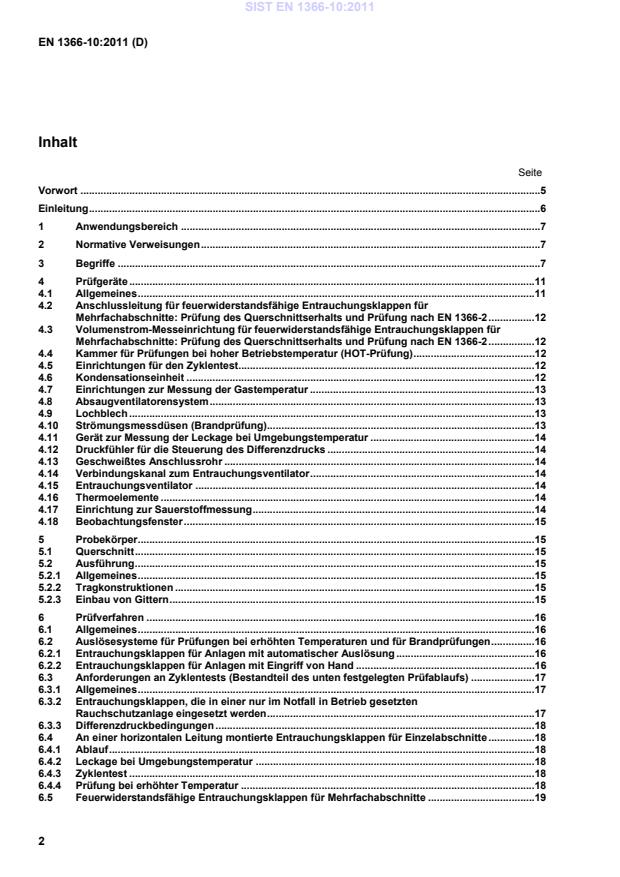
SeiteVorwort.5Einleitung.61 Anwendungsbereich.72 Normative Verweisungen.73 Begriffe.74 Prüfgeräte.114.1 Allgemeines.114.2 Anschlussleitung für feuerwiderstandsfähige Entrauchungsklappen für Mehrfachabschnitte: Prüfung des Querschnittserhalts und Prüfung nach EN 1366-2.124.3 Volumenstrom-Messeinrichtung für feuerwiderstandsfähige Entrauchungsklappen für Mehrfachabschnitte: Prüfung des Querschnittserhalts und Prüfung nach EN 1366-2.124.4 Kammer für Prüfungen bei hoher Betriebstemperatur (HOT-Prüfung).124.5 Einrichtungen für den Zyklentest.124.6 Kondensationseinheit.124.7 Einrichtungen zur Messung der Gastemperatur.134.8 Absaugventilatorensystem.134.9 Lochblech.134.10 Strömungsmessdüsen (Brandprüfung).134.11 Gerät zur Messung der Leckage bei Umgebungstemperatur.144.12 Druckfühler für die Steuerung des Differenzdrucks.144.13 Geschweißtes Anschlussrohr.144.14 Verbindungskanal zum Entrauchungsventilator.144.15 Entrauchungsventilator.144.16 Thermoelemente.144.17 Einrichtung zur Sauerstoffmessung.144.18 Beobachtungsfenster.155 Probekörper.155.1 Querschnitt.155.2 Ausführung.155.2.1 Allgemeines.155.2.2 Tragkonstruktionen.155.2.3 Einbau von Gittern.156 Prüfverfahren.166.1 Allgemeines.166.2 Auslösesysteme für Prüfungen bei erhöhten Temperaturen und für Brandprüfungen.166.2.1 Entrauchungsklappen für Anlagen mit automatischer Auslösung.166.2.2 Entrauchungsklappen für Anlagen mit Eingriff von Hand.166.3 Anforderungen an Zyklentests (Bestandteil des unten festgelegten Prüfablaufs).176.3.1 Allgemeines.176.3.2 Entrauchungsklappen, die in einer nur im Notfall in Betrieb gesetzten Rauchschutzanlage eingesetzt werden.176.3.3 Differenzdruckbedingungen.186.4 An einer horizontalen Leitung montierte Entrauchungsklappen für Einzelabschnitte.186.4.1 Ablauf.186.4.2 Leckage bei Umgebungstemperatur.186.4.3 Zyklentest.186.4.4 Prüfung bei erhöhter Temperatur.186.5 Feuerwiderstandsfähige Entrauchungsklappen für Mehrfachabschnitte.19SIST EN 1366-10:2011
Zyklentest.50A.1 General.50A.2 Zweck der Prüfung.50A.3 Anwendungsverfahren.50A.3.1 Allgemeines.50A.3.2 Entrauchungsklappe mit einem einzelnen Klappenblatt.50A.3.3 Entrauchungsklappen mit mehreren Klappenblättern, die eine kleinere Fläche haben.52A.3.4 Prüfbericht.52A.4 Hintergrundinformationen über das Drehmoment (informativ).52SIST EN 1366-10:2011
Leckageberechnung aus der Sauerstoffmessung.54B.1 Allgemeines.54Anhang C (normativ)
Querschnittserhalt — Berechnung.55C.1 Berechnung der theoretischen Gesamtmasse Mmax der heißen Gase während der Brandprüfung.55C.1.1 Grundlagen.55C.1.2 Vorgehensweise.55C.1.3 Zusammenfassung.56C.2 Berechnung der tatsächlichen Gesamtmasse Mtatsächlich der heißen Gase während der Brandprüfung.58C.2.1 Grundlagen.58C.2.2 Vorgehensweise.58C.2.3 Zusammenfassung.59C.3 Grafische Darstellung einer typischen Integralrechnung.60Literaturhinweise.61
Teil 4: Abdichtungssysteme für Bauteilfugen Teil 5: Installationskanäle und -schächte Teil 6: Doppel- und Hohlböden Teil 7: Förderanlagen und ihre Abschlüsse Teil 8: Entrauchungsleitungen
Teil 9: Entrauchungsleitungen für eine Raumeinheit Teil 10: Entrauchungsklappen Teil 11: Funktionserhalt von elektrischen Kabelanlagen mit Brandschutzsystem (in Vorbereitung) Teil 12: Brandschutzverschlüsse für Lüftungsleitungen (in Vorbereitung) Teil 13: 1-, 2- und 3-seitige Lüftungsleitungen (in Vorbereitung) Entsprechend der CEN/CENELEC-Geschäftsordnung sind die nationalen Normungsinstitute der folgenden Länder gehalten, diese Europäische Norm zu übernehmen: Belgien, Bulgarien, Dänemark, Deutschland, Estland, Finnland, Frankreich, Griechenland, Irland, Island, Italien, Kroatien, Lettland, Litauen, Luxemburg, Malta, Niederlande, Norwegen, Österreich, Polen, Portugal, Rumänien, Schweden, Schweiz, Slowakei, Slowenien, Spanien, Tschechische Republik, Ungarn, Vereinigtes Königreich und Zypern.
zu wechseln; 4) bei geöffneter Stellung eine festgelegte Querschnittsfläche bei erhöhten Temperaturen beizubehalten; 5) in Unterdrucksituationen bei erhöhter Temperatur eine zufrieden stellende Leckageleistung beizubehalten. Für die Prüfungen sind die Entrauchungsklappen der praktischen Anwendung entsprechend einzubauen. Während der Prüfung sind an verschiedenen Teilen der Prüfkonstruktion Temperaturmessungen und Messungen zum Raumabschluss durchzuführen. Die Dichtheit ist durch direkte Messung des Volumenstroms bei den vorgeschriebenen Differenzdrücken zu ermitteln. Die Leckage der Anlagen bei Umgebungstemperatur ist ebenfalls aufzuzeichnen. Die Durchführung dieser Prüfungen muss Produkten die Erfüllung der Anforderungen nach EN 12101-8 und die Klassifizierung nach EN 13501-4 erlauben. Die erforderlichen Temperaturen, Differenzdrücke usw. sind in EN 12101-8 festgelegt. Die Beendigung der Prüfungen nach dieser Europäischen Norm gewährleistet nicht die vollständige Übereinstimmung mit EN 12101-8, da andere, zusätzliche Anforderungen in EN 12101-8 festgelegt sind. Einige dieser zusätzlichen Anforderungen können auch zur Erfüllung der Anforderungen an die Klassifizierung nach EN 13501-4 erforderlich sein. Warnhinweis Alle Personen, die mit der Leitung und Durchführung dieser Feuerwiderstandsprüfung befasst sind, werden darauf hingewiesen, dass Brandprüfungen gefährlich sein können und die Möglichkeit besteht, dass während der Prüfung giftige(r) und/oder schädliche(r) Rauch und Gase austreten können. Beim Aufbau des Probekörpers oder der Prüfkonstruktionen, ihrer Prüfung und der Entsorgung der Prüfrückstände können auch mechanische und ablaufbedingte Gefährdungen auftreten. Es muss eine Abschätzung aller möglichen Gefährdungen und Gesundheitsrisiken durchgeführt werden, und es müssen Sicherheitsvorkehrungen bestimmt und vorgesehen werden. Sicherheitsanweisungen müssen in schriftlicher Form bereitgestellt werden. Das zuständige Personal muss entsprechend geschult werden. Es muss sichergestellt werden, dass das Laborpersonal die schriftlichen Sicherheitsanweisungen stets befolgt.
Luftverteilungssystems - Aerodynamische
Prüfungen von Drossel- und Absperrelementen EN 13501-4, Klassifizierung von Bauprodukten und Bauarten zu ihrem Brandverhalten — Teil 4: Klassifizierung mit den Ergebnissen aus den Feuerwiderstandsprüfungen von Anlagen zur Rauchfreihaltung EN ISO 5167-1, Durchflussmessung von Fluiden mit Drosselgeräten in voll durchströmten Leitungen mit Kreisquerschnitt — Teil 1: Allgemeine Grundlagen und Anforderungen (ISO 5167-1:2003) EN ISO 13943:2010, Brandschutz — Vokabular (ISO 13943:2008) 3 Begriffe Für die Anwendung dieses Dokumentes gelten die in EN ISO 13943:2010 angegebenen und die folgenden Begriffe. SIST EN 1366-10:2011
3.5 erhöhte Temperatur Temperatur, welche die normale Raumlufttemperatur übersteigt und unterhalb jener liegt, die für die Feuerwiderstandsprüfung erforderlich ist, nach der Rauch- und Wärmeabzugsleitungen für Einzelabschnitte geprüft werden 3.6 Brandabschnitt umbauter Bereich, bestehend aus einem durch Bauteile mit einer festgelegten Feuerwiderstandsfähigkeit begrenzten Bereich oder aus mehreren solchen Bereichen zur Verhinderung einer Brandausbreitung (in beide Richtungen) für eine gegebene Zeitdauer ANMKERUNG
Der Begriff „Brandabschnitt" ist bauaufsichtlich besetzt. Er darf nicht mit den Begriffen „Entstehungsraum" und „Brandzelle" verwechselt werden. 3.7 raumlufttechnische Anlage Heizungs- , Lüftungs- und Klimaanlage
3.8 Schnittstellensteuereinheit Vorrichtung, die den Betrieb des Stellantriebs steuert, der sich an der Entrauchungsklappe oder innerhalb des gleichen Brandabschnitts befindet wie die Entrauchungsklappe und üblicherweise mit einem Entrauchungs-/Brandmeldesystem verbunden ist 3.9 größte Ausführung bezieht sich auf die größte lieferbare Ausführung einer einzelnen Entrauchungsklappe (im Gegensatz zu einem Satz von Entrauchungsklappen) 3.10 Modulationsstellantrieb Steuerungsmechanismus der Entrauchungsklappe oder Brandschutzklappe, der steuern kann, dass sich die Entrauchungsklappe oder Brandschutzklappe in einer Stellung oder in einer Anzahl von Stellungen zwischen vollständig geöffnet und vollständig geschlossen befindet SIST EN 1366-10:2011
ANMERKUNG Bestimmte Projekte könnten es erforderlich machen, dass bestimmte Entrauchungsklappen sich in eine geöffnete oder geschlossene Stellung bewegen, je nachdem, wo sich die Brandstelle im Gebäude befindet. 3.19 Entrauchungsklappe für Einzelabschnitte Entrauchungsklappe zur Verwendung in Einzelabschnitten, die mit einer nach EN 1366-9 geprüften Entrauchungsleitung verbunden und/oder in einer Außenwand, einer Decke oder einem Dach eingebaut sein kann 3.20 Entrauchungsleitung für Einzelabschnitte Entrauchungsleitung zur Verwendung in Einzelabschnitten, die geprüft worden ist und die Anforderungen von EN 1366-9 erfüllt SIST EN 1366-10:2011
ANMERKUNG Einmal ausgelöst, lässt die Anlage eine Stellungsänderung der Entrauchungsklappe durch externe Eingabe oder Übersteuerung durch einen Feuerwehrmann zu. 3.32 Rauchschicht Schicht aus Rauch, die sich aufgrund eines Temperaturgradienten unterhalb der Decke stabilisiert 3.33 Rauchabsenkung Zustand innerhalb eines Gebäudes, bei dem die heißen Gase von einem Feuer auf ein Niveau herabsinken, wodurch die sichere Flucht der Gebäudenutzer behindert und der Eintritt der Feuerwehrleute verhindert wird 3.34 Rauchreservoir Bereich innerhalb eines Gebäudes, der durch Rauchschürzen oder Bauteile begrenzt oder umrandet ist und im Brandfall eine thermisch aufwärtsstrebende Rauchschicht umschließt 3.35 Rauchzone einer der Bereiche, in die ein Bauwerk zur Abführung von Rauch und heißen Gasen aufgeteilt ist ANMERKUNG Jede Zone wird von einem Rauch- und Wärmeabzugsgerät (oder von einem Subsystem einer Rauch- und Wärmeabzugsanlage) versorgt, das durch ein Signal von einer Auslösevorrichtung oder einer Gruppe von Auslösevorrichtungen, die mit der Zone verbunden ist, ausgelöst wird. 3.36 Tragkonstuktion Mittel, um die Entrauchungsleitung am Gebäude zu befestigen 3.37 Ansprechzeit der Anlage Zeit zwischen der Auslösung der Entrauchungsanlage und ihrer vollen Wirksamkeit 3.38 thermische Bedienungseinrichtung temperaturempfindliche Einrichtung, die reagiert, um eine nachfolgende Aktion auszulösen 3.39 Auslöseeinrichtung Einrichtung, wie z. B. eine Brandmeldeanlage, ein Rauchmelder oder ein Druckknopf, die ein Auslösesignal an die Auslöseeinrichtung(en) sendet 4 Prüfgeräte 4.1 Allgemeines Zusätzlich zu den in EN 1363-1 festgelegten Prüfgeräten ist Folgendes erforderlich (Beispiele für Prüfanordnungen sind den Bildern 3, 5, 8 und 9 zu entnehmen): SIST EN 1366-10:2011
Die Anschlussleitung muss aus einer Schweißkonstruktion aus Stahlblech mit einer Dicke von (1,5 ± 0,1) mm und einer für die geprüfte Entrauchungs- bzw. Brandschutzklappengröße angemessenen Breite und Höhe bestehen. Die Leitung muss doppelt so lang sein wie die Diagonale der Entrauchungs- bzw. Brandschutzklappe, bis zu einem Höchstmaß von 2 m (siehe Bild 6). Die Anschlussleitung muss mit einem gasdichten Beobachtungsfenster ausgestattet sein. Die allgemeine Prüfanordnung für die Einrichtungen zur Messung des Volumenstromes ist in Bild 6 dargestellt. 4.3 Volumenstrom-Messeinrichtung für feuerwiderstandsfähige Entrauchungsklappen für Mehrfachabschnitte: Prüfung des Querschnittserhalts und Prüfung nach EN 1366-2 Die Volumenstrom-Messeinrichtung muss aus einer Venturidüse, einer Messblende oder einem anderen geeigneten Gerät und (soweit dies erforderlich ist) einem Luftströmungsgleichrichter bestehen, die in geraden Rohrstücken nach EN ISO 5167-1 eingebaut sind. Sie ist zwischen Anschlussleitung und Absaugventilator einzubauen, um den Volumendurchfluss der Gase, welche die zu prüfende Entrauchungs- bzw. Brandschutz-klappe durchströmen, zu bestimmen. Dies muss bei erhöhter Temperatur erfolgen, es sei denn, es wird ein Kondensator verwendet. Die Ergebnisse der Volumenstrommessung sind auf das Volumen bei 20 °C zu korrigieren. Die Messeinrichtung muss mit einer Fehlergrenze von 5 % messen können. Unabhängig davon, ob vertikale oder horizontale Entrauchungs- oder Brandschutzklappen geprüft werden, muss die Volumenstrom-Messeinrichtung immer in horizontaler Ausrichtung eingesetzt werden. 4.4 Kammer für Prüfungen bei hoher Betriebstemperatur (HOT-Prüfung) Es ist eine Kammer aus Stahlblech über die gesamte Fläche der vom Feuer abgewandten Seite der Entrauchungsklappe zu montieren. Die Anordnung ist in Bild 18 dargestellt. Die Kammer muss um 50 mm über die Norm-Tragkonstruktion (Wand) bzw. über die Kanten von über die Tragkonstruktion vorstehenden Klappenblättern hinausragen. Auf der gegenüber von den Klappenblättern befindlichen Seite muss die Kammer ein Beobachtungsfenster mit einem Durchmesser von 50 mm aufweisen. 4.5 Einrichtungen für den Zyklentest Umfassende Informationen über die für die Durchführung der Zyklentests erforderlichen Einrichtungen sind Anhang A zu entnehmen. Darüber hinaus ist das Folgende zu beachten. Um am Stellantrieb der Entrauchungsklappe einen Zyklentest durchführen zu können, ist die Versorgung durch eine Einrichtung zu steuern. Diese muss eine Nennbetriebsleistung/-versorgung einschließlich Abweichungen davon von minus 10 % und plus 15 % liefern können sowie zwischen diesen Werten variabel sein, um zu bestätigen, dass die Entrauchungsklappe auch in Extremfällen funktionsfähig ist. Wenn die zu prüfende Klappe ein Steuersignal benötigt, dann muss dies mitgeliefert werden, damit das Gerät bei jedem der Extremfälle, und auch dazwischen, ein Signal erhält. Verfahren zur Belastung der Entrauchungsklappe sind erforderlich (siehe Anhang A). ANMERKUNG
Ein Gerät, das einen automatischen Zyklentest an der Entrauchungsklappe zulässt, zusammen mit einem Verfahren zur Aufzeichnung vollständiger Zyklen, wäre nützlich, so dass ein Test ohne fremde Hilfe ablaufen könnte, wobei jeder Zyklus potentiell 120 s dauern könnte. 4.6 Kondensationseinheit Wenn die in der Konstruktion der Prüfleitung oder der Entrauchungsklappe verwendeten Materialien während der Brandprüfung Wasserdampf abgeben könnten, dann muss zwischen der Entrauchungs- bzw. Brandschutzklappe und der Volumenstrom-Messeinrichtung eine Kondensationseinheit mit Entwässerungs-einrichtung eingebaut werden. Bei der Verwendung der Kondensationseinheit darf die von dem in 4.3 beschriebenen, stromabwärts von der Volumenstrom-Messeinrichtung angeordneten Thermoelement aufgezeichnete Temperatur 40 °C nicht überschreiten. SIST EN 1366-10:2011
für Entrauchungsleitungen Druckstufe Betriebsdifferenzdruck
bei Umgebungstemperatur Pa Differenzdruck für die Brandprüfung
Pa 1 −500 −150 2 −1 000 −300 3 −1 500 −500
4.10 Strömungsmessdüsen (Brandprüfung) Jede Düse muss entsprechend EN ISO 5167-1 ein Innenmaß von 160 mm aufweisen (siehe Bilder 15 und 16, geeignet für die in 5.2.1 festgelegte Standardgröße der Leitung) und in geeigneter Weise am Ende der Leitung befestigt sein, wobei der piezometrische Ring mit einem entsprechenden Gerät zur Messung des Differenzdrucks verbunden ist. Das Messgerät muss auf ± 5 % genau messen können. SIST EN 1366-10:2011
...