

EN ISO 4135:2022/FprA1
(Amendment)Anaesthetic and respiratory equipment - Vocabulary - Amendment 1 (ISO 4135:2022/FDAM 1:2026)
- Status
- Not Published
- Publication Date
- 18-Jan-2027
- Technical Committee
- CEN/TC 215 - Respiratory and anaesthetic equipment
- Current Stage
- 5060 - Closure of Vote - Formal Approval
- Start Date
- 19-Oct-2026
- Due Date
- 19-Oct-2026
- Completion Date
- 19-Oct-2026
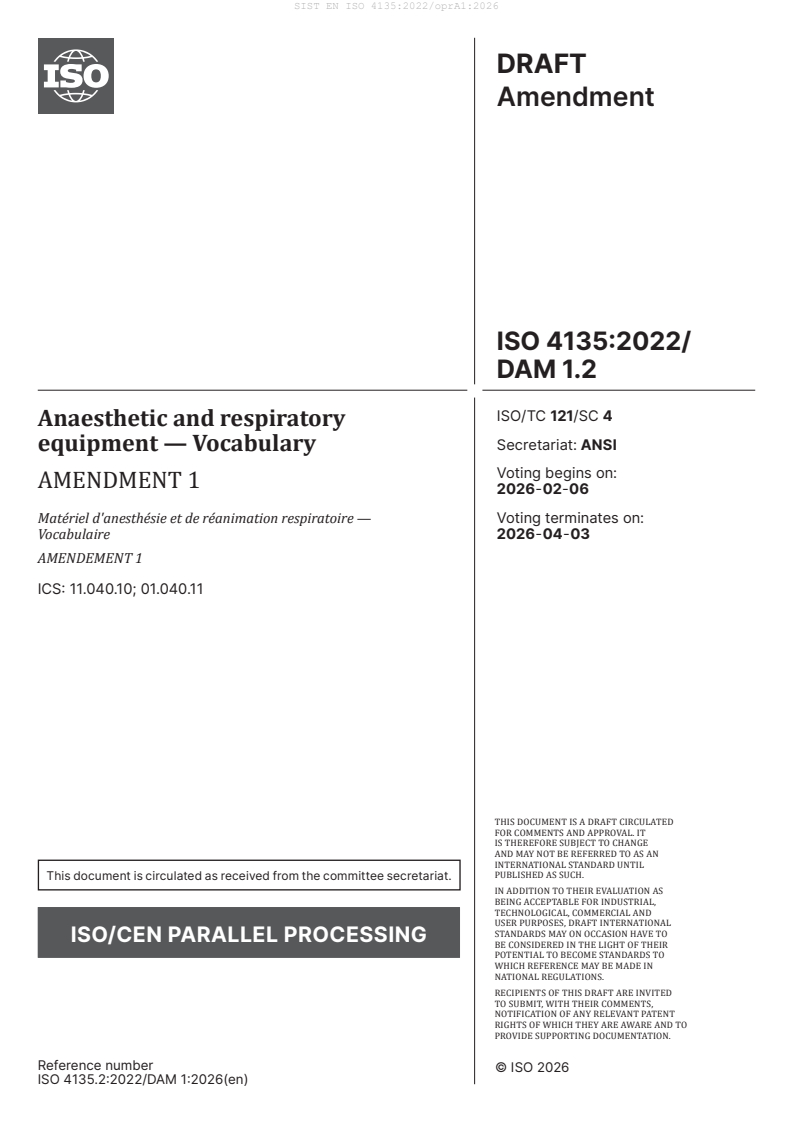

EN ISO 4135:2022/FprA1 is Amendment 1 to the vocabulary for anaesthetic and respiratory equipment, issued in the EN ISO system by CEN and aligned with ISO 4135:2022. It adds two oxygen-related terms and updates the indexing and bibliography so manufacturers, healthcare facilities and regulators can use the same wording when describing oxygen products and oxygen-compatible devices.
What does EN ISO 4135:2022/FprA1 specify?
EN ISO 4135:2022/FprA1 is a vocabulary amendment, not a performance test standard. It revises one existing oxygen entry, adds two new terms, and updates the index and bibliography around those terms.
The amendment organizes its content around:
- the replacement of term 3.1.1.22 with two sub-entries
- an index update for the affected vocabulary terms
- bibliography entries that point to the pharmacopoeial sources reviewed when drafting the oxygen definitions
In practice, this means readers are meant to use the amended wording when specifying oxygen supplies, medical gas descriptions and device compatibility language.
What are the key requirements of EN ISO 4135:2022/FprA1?
EN ISO 4135:2022/FprA1 changes the vocabulary used for oxygen in anaesthetic and respiratory equipment. The main technical point is that it separates a composition-based oxygen term from a pharmacopeia-based oxygen term, so users can state exactly what kind of oxygen they mean.
Oxygen 90+
EN ISO 4135:2022/FprA1 deletes the old oxygen entry and replaces it with oxygen 90+ as a defined gas mixture. The definition sets a minimum oxygen content and upper limits for argon, nitrogen, carbon dioxide, carbon monoxide, nitrogen oxides, sulfur dioxide, water and oils.
For readers, this matters because oxygen 90+ is tied to measurable composition limits rather than to a single production route. Manufacturers can use it to write clearer product descriptions, and buyers or testers can check whether a supplied gas matches the stated composition.
The notes under the definition are important in practice:
- the term is not meant to create a new oxygen product monograph tied to one technology
- it is intended for manufacturers of medical devices that use or administer oxygen, such as ventilators, respiratory care equipment and anaesthesia workstations
- its technical specifications are meant to be agnostic to production method
- the definition was developed after reviewing current pharmacopoeial product monographs and production processes
Pharmacopeial oxygen
EN ISO 4135:2022/FprA1 also adds pharmacopeial oxygen. This term means oxygen that complies with the pharmacopeia required by the regulatory authority or chosen by the healthcare facility.
In practice, this gives hospitals, regulators and suppliers a way to point to the governing pharmacopeia instead of to a fixed composition profile. That matters when procurement, local regulation or hospital policy relies on a specific pharmacopeial monograph.
Index and bibliography updates
EN ISO 4135:2022/FprA1 deletes the index entry for oxygen 93 and adds entries for oxygen 90+ and pharmacopeial oxygen. It also adds bibliography items for the pharmacopoeial oxygen monographs that were reviewed.
That helps users find the revised terms quickly and trace the reference basis behind them.
What terms does EN ISO 4135:2022/FprA1 define?
EN ISO 4135:2022/FprA1 defines two oxygen terms and uses several chemical abbreviations in their wording.
oxygen 90+- a gas mixture with oxygen at no less than 90% and controlled impurity limits, intended as a composition-based oxygen term.pharmacopeial oxygen- oxygen that complies with the pharmacopeia required by the regulator or selected by the healthcare facility.O2- the chemical symbol for oxygen, used to state the oxygen content in the mixture.Ar- the chemical symbol for argon, one of the gases limited in theoxygen 90+definition.N2- the chemical symbol for nitrogen, another controlled component in theoxygen 90+definition.CO2- the chemical symbol for carbon dioxide, listed as a trace impurity with a tight limit.NOx- nitrogen oxides, one of the trace contaminants controlled in theoxygen 90+definition.
Who uses EN ISO 4135:2022/FprA1?
EN ISO 4135:2022/FprA1 is used by people who need consistent wording for oxygen in medical and respiratory contexts. It is especially relevant to:
- manufacturers of ventilators, respiratory care devices and anaesthesia workstations
- suppliers and buyers of medical oxygen
- healthcare facilities that choose a pharmacopeia for oxygen supply
- regulatory and quality teams that document oxygen compatibility, labeling or procurement language
The practical use is simple: it helps these groups state whether they mean a composition-defined oxygen gas or a pharmacopeia-defined oxygen product.
What changed in EN ISO 4135:2022/FprA1 from the previous edition?
EN ISO 4135:2022/FprA1 replaces the former oxygen entry 3.1.1.22 with two new entries, 3.1.1.22.1 oxygen 90+ and 3.1.1.22.2 pharmacopeial oxygen. It also removes the index entry for oxygen 93, adds index entries for the new terms, and adds bibliography references [17] to [26] for the pharmacopoeial sources reviewed.
Which standards are used with EN ISO 4135:2022/FprA1?
EN ISO 4135:2022/FprA1 points to pharmacopoeial references that support the oxygen terminology. The bibliography includes:
- European Pharmacopoeia oxygen monographs, including Oxygen, Oxygen 93 Percent and Oxygen 98 Percent
- USP-NF 2026, Oxygen
- Japanese Pharmacopoeia 18th Edition, Oxygen
- The International Pharmacopoeia, including Medicinal Oxygen, Oxygen 98 %, Oxygen 99,5 % and Oxygen 93 %
These references provide the monograph basis that the amendment reviewed when defining oxygen 90+ and pharmacopeial oxygen.
What does the EN ISO 4135:2022/FprA1 document contain?
EN ISO 4135:2022/FprA1 contains the revised vocabulary entry for oxygen, explanatory notes on intended use and production-method neutrality, and updates to the index and bibliography. The wording focuses on composition criteria for oxygen 90+ and on pharmacopeia-based compliance for pharmacopeial oxygen.
For engineers and quality teams, the useful part is the exact terminology they can adopt in specifications, labels, procedures and supplier documentation. For procurement and regulatory work, the added bibliography shows which pharmacopoeial monographs were considered when drafting the new terms.
Relations
- Consolidated By
ISO 4135:2022/Amd 1 - Anaesthetic and respiratory equipment — Vocabulary — Amendment 1 - Effective Date
- 12-Feb-2026
- Effective Date
- 16-Jul-2025
Get Certified
Connect with accredited certification bodies for this standard

BSI Group
BSI (British Standards Institution) is the business standards company that helps organizations make excellence a habit.

TÜV Rheinland
TÜV Rheinland is a leading international provider of technical services.

TÜV SÜD
TÜV SÜD is a trusted partner of choice for safety, security and sustainability solutions.
Sponsored listings
Frequently Asked Questions
EN ISO 4135:2022/FprA1 is a draft published by the European Committee for Standardization (CEN). Its full title is "Anaesthetic and respiratory equipment - Vocabulary - Amendment 1 (ISO 4135:2022/FDAM 1:2026)". This standard covers: Der bestehende Begriff 3.1.1.22 wird gestrichen und durch die beiden neuen Begriffe 3.1.1.22.1 und 3.1.1.22.2 ersetzt:
Der bestehende Begriff 3.1.1.22 wird gestrichen und durch die beiden neuen Begriffe 3.1.1.22.1 und 3.1.1.22.2 ersetzt:
EN ISO 4135:2022/FprA1 is classified under the following ICS (International Classification for Standards) categories: 01.040.11 - Health care technology (Vocabularies); 11.040.10 - Anaesthetic, respiratory and reanimation equipment. The ICS classification helps identify the subject area and facilitates finding related standards.
EN ISO 4135:2022/FprA1 has the following relationships with other standards: It is inter standard links to ISO 4135:2022/Amd 1, EN ISO 4135:2022. Understanding these relationships helps ensure you are using the most current and applicable version of the standard.
EN ISO 4135:2022/FprA1 is available in PDF format for immediate download after purchase. The document can be added to your cart and obtained through the secure checkout process. Digital delivery ensures instant access to the complete standard document.
Standards Content (Sample)
Contents
- Foreword
- Bibliography
Foreword
ISO (the International Organization for Standardization) is a worldwide federation of national standards bodies (ISO member bodies). The work of preparing International Standards is normally carried out through ISO technical committees. Each member body interested in a subject for which a technical committee has been established has the right to be represented on that committee. International organizations, governmental and non-governmental, in liaison with ISO, also take part in the work. ISO collaborates closely with the International Electrotechnical Commission (IEC) on all matters of electrotechnical standardization. The procedures used to develop this document and those intended for its further maintenance are described in the ISO/IEC Directives, Part 1. In particular, the different approval criteria needed for the different types of ISO documents should be noted. This document was drafted in accordance with the editorial rules of the ISO/IEC Directives, Part 2 (see www.iso.org/directives).
ISO draws attention to the possibility that the implementation of this document may involve the use of (a) patent(s). ISO takes no position concerning the evidence, validity or applicability of any claimed patent rights in respect thereof. As of the date of publication of this document, ISO had not received notice of (a) patent(s) which may be required to implement this document. However, implementers are cautioned that this may not represent the latest information, which may be obtained from the patent database available at www.iso.org/patents. ISO shall not be held responsible for identifying any or all such patent rights. Any trade name used in this document is information given for the convenience of users and does not constitute an endorsement.
...