

EN 2591-422:2002
(Main)Aerospace series - Elements of electrical and optical connection - Test methods - Part 422: Locking wire hole strength
General Information
- Abstract
This standard specifies a method of verifying that the locking wire holes in an element of connection are of sufficient strength to meet normal usage.
It shall be used together with EN 2591-100.
- Status
- Published
- Publication Date
- 18-Jun-2002
- Withdrawal Date
- 30-Dec-2002
- Technical Committee
- ASD-STAN - Aerospace
- Drafting Committee
- ASD-STAN/D 2 - Electrical
- Current Stage
- 9093 - Decision to confirm - Review Enquiry
- Start Date
- 30-Jun-2017
- Completion Date
- 23-Sep-2026

Overview
EN 2591-422:2002 is a European aerospace test method that verifies the mechanical strength of locking wire holes in elements of electrical and optical connection. Prepared under AECMA and adopted by CEN, the standard defines a reproducible procedure to check that locking wire holes will withstand normal usage without tearing or unacceptable damage. It is intended to be used together with EN 2591-100 (general test preparation).
Key topics and requirements
- Scope: Confirms locking wire hole strength for electrical and optical connector elements to meet normal service conditions.
- Specimen preparation:
- Mount the specimen to a connector or suitable simulator, fixed on a rigid plate.
- Thread the locking wire through the hole and secure it to apply an axial load.
- When multiple holes exist, test the hole with the most unfavourable mechanical condition.
- If different material, wire gauge, or axial load are specified in a technical specification, these must be recorded.
- Test apparatus:
- Any suitable means to measure and apply a controlled axial load.
- Test method (mandatory parameters):
- Apply an axial load of (133 ± 0.5) N perpendicular to the hole axis.
- Use stainless steel wire, 0.5 mm diameter.
- Increase load steadily at a rate not exceeding 45 N/s until the specified value is reached.
- Maintain load for 5 minutes.
- Pass/fail criterion:
- The locking wire hole must remain intact.
- No tearing from the hole bore to the outer surface is permitted.
- Small deformations of a knife edge are acceptable.
Applications and users
This standard is practical for:
- Aerospace connector designers validating locking wire provisions during development.
- Qualification and test laboratories performing acceptance or batch testing of connector elements.
- Quality and incoming inspection teams verifying supplier compliance with locking-wire requirements.
- Procurement and certification bodies specifying objective mechanical requirements for electrical and optical connection elements. Use cases include design validation, production verification, supplier acceptance testing, and compliance documentation for aerospace electrical systems.
Related standards
- EN 2591-100 - Aerospace series: Elements of electrical and optical connection - Test methods - Part 100: General (to be used together with EN 2591-422).
- Document origin: prepared by AECMA and published as EN 2591-422:2002 (CEN).
Keywords: EN 2591-422, locking wire hole strength, aerospace connectors, test methods, electrical and optical connection, connector qualification, locking wire test.
Relations
- Effective Date
- 28-Jan-2026
- Effective Date
- 28-Jan-2026
- Effective Date
- 28-Jan-2026
- Effective Date
- 28-Jan-2026
- Effective Date
- 28-Jan-2026
- Effective Date
- 28-Jan-2026
- Effective Date
- 28-Jan-2026
- Effective Date
- 28-Jan-2026
- Effective Date
- 28-Jan-2026
- Effective Date
- 28-Jan-2026
- Effective Date
- 28-Jan-2026
- Effective Date
- 28-Jan-2026
- Effective Date
- 28-Jan-2026
- Effective Date
- 28-Jan-2026
- Effective Date
- 28-Jan-2026
Get Certified
Connect with accredited certification bodies for this standard

BUREAU VERITAS Certification Germany
Bureau Veritas certification in Germany.

Element Materials Technology
Materials testing and product certification.

AQMS Ltd.
AQMS provides ISO certification to SMEs across the UK.
Sponsored listings
Frequently Asked Questions
EN 2591-422:2002 is a standard published by the European Committee for Standardization (CEN). Its full title is "Aerospace series - Elements of electrical and optical connection - Test methods - Part 422: Locking wire hole strength". This standard covers: This standard specifies a method of verifying that the locking wire holes in an element of connection are of sufficient strength to meet normal usage. It shall be used together with EN 2591-100.
This standard specifies a method of verifying that the locking wire holes in an element of connection are of sufficient strength to meet normal usage. It shall be used together with EN 2591-100.
EN 2591-422:2002 is classified under the following ICS (International Classification for Standards) categories: 49.060 - Aerospace electric equipment and systems. The ICS classification helps identify the subject area and facilitates finding related standards.
EN 2591-422:2002 has the following relationships with other standards: It is inter standard links to EN 2591-100:2024, EN 3682-001:2006, EN 3660-015:2008, EN 3155-077:2012, EN 3660-022:2008, EN 3660-012:2008, EN 3155-013:2006, EN 3155-015:2019, EN 3155-014:2019, EN 3660-065:2022, EN 3660-019:2009, EN 3660-026:2009, EN 3155-060:2006, EN 3660-014:2008, EN 3155-071:2019. Understanding these relationships helps ensure you are using the most current and applicable version of the standard.
EN 2591-422:2002 is available in PDF format for immediate download after purchase. The document can be added to your cart and obtained through the secure checkout process. Digital delivery ensures instant access to the complete standard document.
Standards Content (Sample)
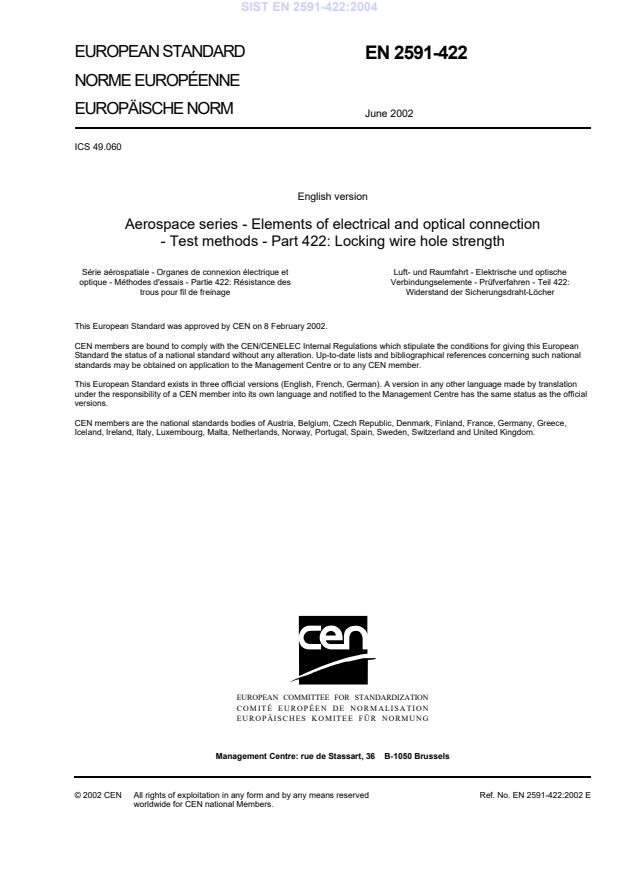
2003-01.Slovenski inštitut za standardizacijo. Razmnoževanje celote ali delov tega standarda ni dovoljeno.Aerospace series - Elements of electrical and optical connection - Test methods - Part 422: Locking wire hole strengthLuft- und Raumfahrt - Elektrische und optische Verbindungselemente - Prüfverfahren - Teil 422: Widerstand der SicherungsdrahtlöcherSérie aérospatiale - Organes de connexion électrique et optique - Méthodes d'essais - Partie 422: Résistance des trous pour fil de freinageAerospace series - Elements of electrical and optical connection - Test methods - Part 422: Locking wire hole strength49.060Aerospace electric equipment and systemsICS:Ta slovenski standard je istoveten z:EN 2591-422:2002SIST EN 2591-422:2004en01-maj-2004SIST EN 2591-422:2004SLOVENSKI
STANDARD
EUROPEAN STANDARDNORME EUROPÉENNEEUROPÄISCHE NORMEN 2591-422June 2002ICS 49.060English versionAerospace series - Elements of electrical and optical connection- Test methods - Part 422: Locking wire hole strengthSérie aérospatiale - Organes de connexion électrique etoptique - Méthodes d'essais - Partie 422: Résistance destrous pour fil de freinageLuft- und Raumfahrt - Elektrische und optischeVerbindungselemente - Prüfverfahren - Teil 422:Widerstand der Sicherungsdraht-LöcherThis European Standard was approved by CEN on 8 February 2002.CEN members are bound to comply with the CEN/CENELEC Internal Regulations which stipulate the conditions for giving this EuropeanStandard the status of a national standard without any alteration. Up-to-date lists and bibliographical references concerning such nationalstandards may be obtained on application to the Management Centre or to any CEN member.This European Standard exists in three official versions (English, French, German). A version in any other language made by translationunder the responsibility of a CEN member into its own language and notified to the Management Centre has the same status as the officialversions.CEN members are the national standards bodies of Austria, Belgium, Czech Republic, Denmark, Finland, France, Germany, Greece,Iceland, Ireland, Italy, Luxembourg, Malta, Netherlands, Norway, Portugal, Spain, Sweden, Switzerland and United Kingdom.EUROPEAN COMMITTEE FOR STANDARDIZATIONCOMITÉ EUROPÉEN DE NORMALISATIONEUROPÄISCHES KOMITEE FÜR NORMUNGManagement Centre: rue de Stassart, 36
B-1050 Brussels© 2002 CENAll rights of exploitation in any form and by any means reservedworldwide for CEN national Members.Ref. No. EN 2591-422:2002 ESIST EN 2591-422:2004
...