

EN 14944-1:2006
(Main)Influence of cementitious products on water intended for human consumption - Test methods - Part 1: Influence of factory made cementitious products on organoleptic parameters
- Abstract
This European Standard specifies a method to determine the influence of factory made cementitious products on the odour, flavour, colour and turbidity of test waters after contact with the products.
This European Standard is applicable to factory made cementitious products, e.g. cement mortar linings to metallic pipes, tanks, concrete pipes etc. intended to be used for the transport and storage of water for human consumption, including raw water used for the production of drinking water.
- Status
- Withdrawn
- Publication Date
- 04-Apr-2006
- Withdrawal Date
- 06-Oct-2026
- Technical Committee
- CEN/TC 164 - Water supply
- Drafting Committee
- CEN/TC 164/WG 3 - Effects of materials in contact with drinking water
- Current Stage
- 9960 - Withdrawal effective - Withdrawal
- Start Date
- 18-Oct-2023
- Completion Date
- 07-Oct-2026


Relations
- Effective Date
- 28-Jan-2023
- Effective Date
- 25-Aug-2026
- Effective Date
- 09-Feb-2026
- Effective Date
- 28-Jan-2026
- Effective Date
- 28-Jan-2026
- Effective Date
- 28-Jan-2026
- Effective Date
- 28-Jan-2026
- Effective Date
- 28-Jan-2026
- Effective Date
- 28-Jan-2026
- Effective Date
- 28-Jan-2026
- Effective Date
- 28-Jan-2026
- Effective Date
- 28-Jan-2026
- Effective Date
- 28-Jan-2026
- Refers
EN 12390-2:2019 - Testing hardened concrete - Part 2: Making and curing specimens for strength tests - Effective Date
- 28-Jan-2026
- Effective Date
- 28-Jan-2026
Get Certified
Connect with accredited certification bodies for this standard

BSI Group
BSI (British Standards Institution) is the business standards company that helps organizations make excellence a habit.

Bureau Veritas
Bureau Veritas is a world leader in laboratory testing, inspection and certification services.

DNV
DNV is an independent assurance and risk management provider.
Sponsored listings
Frequently Asked Questions
EN 14944-1:2006 is a standard published by the European Committee for Standardization (CEN). Its full title is "Influence of cementitious products on water intended for human consumption - Test methods - Part 1: Influence of factory made cementitious products on organoleptic parameters". This standard covers: This European Standard specifies a method to determine the influence of factory made cementitious products on the odour, flavour, colour and turbidity of test waters after contact with the products. This European Standard is applicable to factory made cementitious products, e.g. cement mortar linings to metallic pipes, tanks, concrete pipes etc. intended to be used for the transport and storage of water for human consumption, including raw water used for the production of drinking water.
This European Standard specifies a method to determine the influence of factory made cementitious products on the odour, flavour, colour and turbidity of test waters after contact with the products. This European Standard is applicable to factory made cementitious products, e.g. cement mortar linings to metallic pipes, tanks, concrete pipes etc. intended to be used for the transport and storage of water for human consumption, including raw water used for the production of drinking water.
EN 14944-1:2006 is classified under the following ICS (International Classification for Standards) categories: 13.060.20 - Drinking water; 67.250 - Materials and articles in contact with foodstuffs. The ICS classification helps identify the subject area and facilitates finding related standards.
EN 14944-1:2006 has the following relationships with other standards: It is inter standard links to EN 14944-1:2023, ISO 6058:1984, ISO 10523:1994, EN ISO 7393-2:2018, EN ISO 3696:1995, EN ISO 7887:1994, EN 196-1:2016, EN ISO 7027:1999, EN ISO 16264:2004, EN 1015-11:2019, EN 1622:1997, EN 10088-1:2023, EN 1015-2:1998, EN 12390-2:2019, EN ISO 9963-2:1995. Understanding these relationships helps ensure you are using the most current and applicable version of the standard.
EN 14944-1:2006 is associated with the following European legislation: EU Directives/Regulations: 305/2011, 89/106/EEC; Standardization Mandates: M/136. When a standard is cited in the Official Journal of the European Union, products manufactured in conformity with it benefit from a presumption of conformity with the essential requirements of the corresponding EU directive or regulation.
EN 14944-1:2006 is available in PDF format for immediate download after purchase. The document can be added to your cart and obtained through the secure checkout process. Digital delivery ensures instant access to the complete standard document.
Standards Content (Sample)
2003-01.Slovenski inštitut za standardizacijo. Razmnoževanje celote ali delov tega standarda ni dovoljeno.Influence of cementitious products on water intended for human consumption - Test methods - Part 1: Influence of factory made cementitious products on organoleptic parametersDPHWUHInfluence des produits a base de ciment sur l'eau destinée a la consommation humaine - Méthode d'essai - Partie 1: Influence des produits a base de ciment fabriqués en usine sur les parametres organoleptiquesEinfluss von zementgebundenen Produkten auf Wasser für den menschlichen Gebrauch - Prüfverfahren - Teil 1: Einfluss fabrikmäßig hergestellter zementgebundener Produkte auf organoleptische ParameterTa slovenski standard je istoveten z:EN 14944-1:2006SIST EN 14944-1:2006en67.250Materiali in predmeti v stiku z živiliMaterials and articles in contact with foodstuffs13.060.20Pitna vodaDrinking waterICS:SLOVENSKI
STANDARDSIST EN 14944-1:200601-oktober-2006
EUROPEAN STANDARDNORME EUROPÉENNEEUROPÄISCHE NORMEN 14944-1April 2006ICS 13.060.20; 67.250 English VersionInfluence of cementitious products on water intended for humanconsumption - Test methods - Part 1: Influence of factory madecementitious products on organoleptic parametersInfluence des produits à base de ciment sur l'eau destinéeà la consommation humaine - Méthodes d'essai - Partie 1:Influence des produits à base de ciment fabriqués en usinesur les paramètres organoleptiquesEinfluss von zementgebundenen Produkten auf Wasser fürden menschlichen Gebrauch - Prüfverfahren - Teil 1:Einfluss fabrikmäßig hergestellter zementgebundenerProdukte auf organoleptische ParameterThis European Standard was approved by CEN on 13 February 2006.CEN members are bound to comply with the CEN/CENELEC Internal Regulations which stipulate the conditions for giving this EuropeanStandard the status of a national standard without any alteration. Up-to-date lists and bibliographical references concerning such nationalstandards may be obtained on application to the Central Secretariat or to any CEN member.This European Standard exists in three official versions (English, French, German). A version in any other language made by translationunder the responsibility of a CEN member into its own language and notified to the Central Secretariat has the same status as the officialversions.CEN members are the national standards bodies of Austria, Belgium, Cyprus, Czech Republic, Denmark, Estonia, Finland, France,Germany, Greece, Hungary, Iceland, Ireland, Italy, Latvia, Lithuania, Luxembourg, Malta, Netherlands, Norway, Poland, Portugal, Romania,Slovakia, Slovenia, Spain, Sweden, Switzerland and United Kingdom.EUROPEAN COMMITTEE FOR STANDARDIZATIONCOMITÉ EUROPÉEN DE NORMALISATIONEUROPÄISCHES KOMITEE FÜR NORMUNGManagement Centre: rue de Stassart, 36
B-1050 Brussels© 2006 CENAll rights of exploitation in any form and by any means reservedworldwide for CEN national Members.Ref. No. EN 14944-1:2006: E
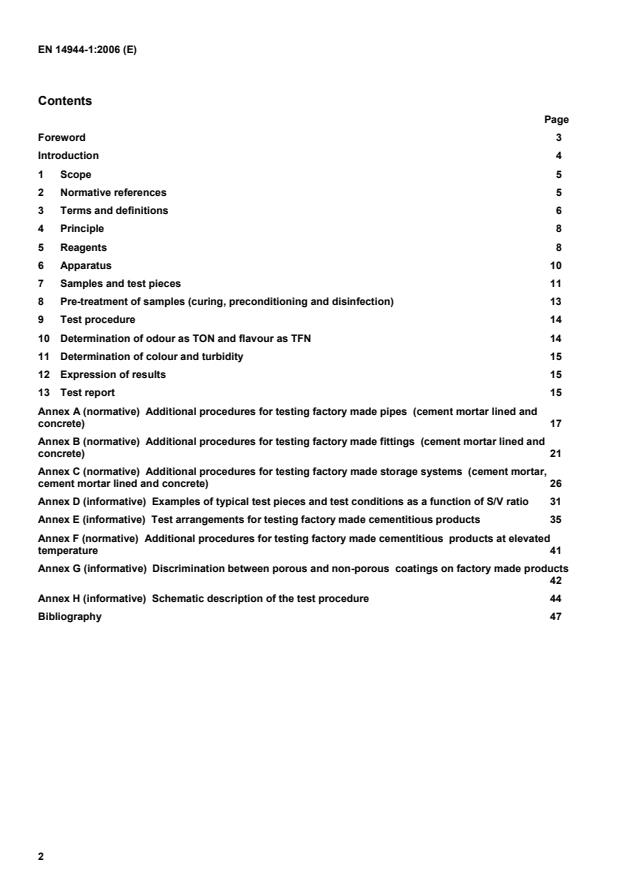
Additional procedures for testing factory made pipes
(cement mortar lined and concrete) 17 Annex B (normative)
Additional procedures for testing factory made fittings
(cement mortar lined and concrete) 21 Annex C (normative)
Additional procedures for testing factory made storage systems
(cement mortar, cement mortar lined and concrete) 26 Annex D (informative)
Examples of typical test pieces and test conditions as a function of S/V ratio 31 Annex E (informative)
Test arrangements for testing factory made cementitious products 35 Annex F (normative)
Additional procedures for testing factory made cementitious
products at elevated temperature 41 Annex G (informative)
Discrimination between porous and non-porous
coatings on factory made products
42 Annex H (informative)
Schematic description of the test procedure 44 Bibliography 47
1 The work on Part 2 of EN 14944 has not yet begun. 2 The work on Part 4 of EN 14944 has not yet begun.
Introduction With respect to any potential adverse effects of products and materials on the quality of water intended for human consumption, it should be understood that relevant national regulations remain in force until verifiable European acceptance criteria are adopted.
1 Scope This European Standard specifies a method to determine the influence of factory made cementitious products on the odour, flavour, colour and turbidity of test waters after contact with the products. This European Standard is applicable to factory made cementitious products, e.g. cement mortar linings to metallic pipes, tanks, concrete pipes etc. intended to be used for the transport and storage of water for human consumption, including raw water used for the production of drinking water. 2 Normative references The following referenced documents are indispensable for the application of this European Standard. For dated references, only the edition cited applies. For undated references the latest edition of the referenced document (including any amendments) applies. EN 196-1,
Methods of testing cement — Part 1: Determination of strength EN 1622:1997,
Water analysis — Method for the determination of threshold odour number (TON) and threshold flavour number (TFN) EN 1015-2,
Methods of test for mortar for masonry — Part 2: Bulk sampling of mortars and preparation of test mortars EN 1015-11,
Methods of test for mortar for masonry — Part 11; Determination of flexural and compressive strength of hardened mortar EN 10088-1,
Stainless steels — Part 1: List of stainless steels EN 12350-1,
Testing fresh concrete — Part 1: Sampling EN 12390-1,
Testing hardened concrete — Part 1: Shape, dimensions and other requirements for specimens and moulds EN 12390-2,
Testing hardened concrete — Part 2: Making and curing specimens for strength tests EN 27888,
Water quality — Determination of electrical conductivity (ISO 7888:1985) EN ISO 3696,
Water for analytical laboratory use — Specification and test methods (ISO 3696:1987) EN ISO 7027:1999,
Water quality — Determination of turbidity (ISO 7027:1999) EN ISO 7887:1994,
Water quality — Examination and determination of colour (ISO 7887:1994) EN ISO 7393-1,
Water quality — Determination of free chlorine and total chlorine — Part 1: Titrimetric method using N, N-diethyl-1, 4-phenylenediamine (ISO 7393-1:1985) EN ISO 7393-2,
Water quality — Determination of free chlorine and total chlorine — Part 2: Colorimetric method using N, N-diethyl-1, 4-phenylenediamine for routine control purposes (ISO 7393-2:1985) EN ISO 9963-2,
Water quality — Determination of alkalinity — Part 2: Determination of carbonate alkalinity (ISO 9963-2:1994) EN ISO 16264,
Water quality — Determination of soluble silicates by flow analysis (FIA and CFA) and photometric detection (ISO 16264:2002) ISO 6058,
Water quality — Determination of calcium content — EDTA titrimetric method ISO 10523,
Water quality — Determination of pH
This applies to either the internal diameter (DN/ID) or the external diameter (DN/OD). 3.21 preconditioning succession of contact periods of a test piece with the preconditioning water (3.22) before contact with the test water 3.22 preconditioning water water used for preconditioning prepared as described in 5.4.1 3.23 reference water water described as without odour, flavour, colour and turbidity conforming to the requirements in 5.4.2 3.24 test water water used for testing purposes prepared as described in 5.4.3 and 5.4.4 3.25 migration water: test water which has been in contact with a test piece under specified conditions 3.26 blank water test water which has been kept at the same specified conditions as migration water but without contact with the test piece
72 h at (23 ± 2) °C for products intended to come into contact with chlorinated or chlorine-free cold water; b)
24 h at a specified elevated temperature for products intended to come into contact with warm or hot chlorine-free water. After each contact period, each migration water is assessed for odour, flavour, colour and turbidity. NOTE The selection of: a)
the appropriate test water, chlorinated and/or chlorine-free, from those made available in this European Standard; b)
the temperature of the test water; c)
the need for chlorination during preconditioning; is specified in product or system standards or in national or European regulations, as appropriate. 5 Reagents 5.1 General requirements Use only reagents of analytical quality unless otherwise stated. 5.2 Chlorine neutralisation reagents 5.2.1 Ascorbic acid solution, prepared by dissolving (4,0 ± 0,1) g of ascorbic acid in one litre of reference water (5.4.2). This ascorbic acid solution shall be replaced on a monthly basis. 5.2.2 Sodium thiosulfate solution, comprising a solution of 3,5 g/l of sodium thiosulfate pentahydrate (Na2S2O3 .5H2O) and stored in the absence of light at a temperature below 10°C, for a maximum of 4 months. 5.3 Disinfection reagents 5.3.1 Sodium hypochlorite solution, prepared from a commercial solution of sodium hypochlorite (NaOCl) and have a known concentration of about 0,1 % by mass of free chlorine determined in accordance with either EN ISO 7393-1 or EN ISO 7393-2. This sodium hypochlorite solution is unstable and shall be prepared on the day of use.
EN 27888 500 ± 50
µS/cm pH
ISO 10523 7,3 ± 0,2 pH unit Calcium
ISO 6058 80 ± 10
mg Ca/l Alkalinity
EN ISO 9963-2 350 ± 50
mg HCO3-/l Silica
EN ISO 16264 15 ± 5
mg SiO2/l Odour
EN 1622 < 2
TON Flavour
EN 1622 < 2
TFN Colour
EN ISO 7887:1994 b < 0,1
m-1 Turbidity
EN ISO 7027:1999 c < 0,1
FNU a
Alternative methods, either calibrated against the reference methods or which have proven comparable analytical performance, may be used. b
Section 3 c
Clause 6
5.4.3 Test water without chlorine content (chlorine-free), shall consist of a batch of reference water (5.4.2) used for contact with test pieces and preparation of the blank water (3.26). 5.4.4 Test water with chlorine content (chlorinated), consisting of reference water (5.4.2) with a free chlorine content of (1,0 ± 0,2) mg/l as Cl2, determined in accordance with either EN ISO 7393-1 or EN ISO 7393-2, after addition of sodium hypochlorite solution (5.3.1) 5.5 Cleaning liquids for apparatus Use one of the following cleaning liquids: — non-perfumed biodegradable detergent; — hydrochloric acid, 2 mol/l; — nitric acid, 10 % or 1,5 mol/l.
Clean the glassware to be used, using detergent (5.5). Rinse the glassware in demineralised water (3.29); b)
Clean the inner surface of the glassware with hydrochloric acid (5.5) and rinse it with demineralised water. For stainless steel, clean with nitric acid (5.5) and then rinse with demineralised water; c)
Before use, rinse the glassware, and appropriate apparatus, at least three times using preconditioning water before preconditioning (8.3) or reference water before the test procedure (Clause 9). 6.2 Apparatus and materials for test piece preparation (see normative Annexes A, B and C) 6.2.1 Stainless steel plates and cylinders 6.2.1.1 Stainless steel Stainless steel shall be austenitic, super austenitic or duplex grades in accordance with the corresponding numerical designations, 1.4301, 1.4436, 1.4429, 1.4259 or 1.4462 in EN 10088-1 for stainless steels. NOTE The grades above are specified for the use of stainless steel as reinforcement in concrete. Therefore they are considered to be inert when used in contact with cementitious proxy samples (see normative Annexes A, B and C of this European Standard). 6.2.1.2 Plates In order to provide a sufficient volume of migration water for assessment, the surface area of one face of a plate should be between 10 000 mm2 and 90 000 mm2. The length/width of the plates should be selected to be consistent with the dimensions of the test container and the volume of test water in which they will be immersed. 6.2.1.3 Cylinders The diameter and length of a cylinder should be consistent with the dimensions of the test piece (see normative Annexes A, B or C and informative Annexes D and E) and the volume of test water appropriate to the specified S/V ratio given in 7.3. 6.2.2 Glass cylinders The diameter and length of a glass cylinder should be consistent with the dimensions of the test piece (see normative Annexes A, B or C and informative Annexes D and E) and the volume of test water appropriate to the specified S/V ratio given in 7.3. Glass cylinders should be provided with suitable external (opaque) shielding for use during migration procedures (test pieces and blanks), in order to minimize exposure of migration waters to ambient light. 6.2.3 Moulds for forming test pieces Moulds for forming prisms of mortar shall conform to the requirements of EN 196-1, as specified for use in EN 1015-11, or to EN 12390-1 for forming cubes/cylinders of concrete, with modifications to materials and dimensional tolerances as specified by the appropriate normative Annex A, B or C of this European Standard. Clean moulds and any filling frame used with a mould, by thoroughly washing with non-perfumed detergent (5.5) and tap water (3.28), rinsing with copious amounts of tap water, followed by a final rinse with demineralised water (3.29) and dry before use. Where a factory made cementitious product has been formed in a process where its entire contact surface has been in contact with a release agent then where proxy samples (3.6) are used, the same release agent shall be applied to the internal surfaces of the mould, otherwise the use of release agents is not permitted by this European Standard.
ensure that test pieces are representative of the finished product;
b)
during the preparation of test pieces, include any procedures which are performed in practice for curing and cleaning; c)
ensure that the minimum age of the test piece, at test, conforms to that recommended by the manufacturer for the product to be ready for use; d)
ensure that the surface area of the test piece is sufficient to fulfil the appropriate surface area to volume (S/V) ratio in accordance with the requirements of 7.3. 7.2.2 Factory made pipes, fittings and storage systems Where possible, use the product or test piece as the test vessel, with dimensions that provide sufficient migration water for assessment. In cases where this is not practicable (e.g. large pipes, storage systems etc.), and where alternatives are specified, use as appropriate, an alternative test piece described in the relevant normative Annex A, B or C to this European Standard and an appropriate test arrangement given in informative Annex E. NOTE Where it is required to discriminate between porous and non-porous coatings already applied to factory made products, use the test procedure given in informative Annex G of this European Standard. 7.3 Surface area-to-volume ratio (S/V) for use in the test procedure 7.3.1 General The following general principles apply for S/V ratios: a)
the surface area to volume ratio (S/V) of the test piece exposed to the test water relates to realistic service conditions; b)
where no difference in material composition and production process exists in the range of sizes produced, only the largest S/V ratio is required to be tested; c)
the ratio of the surface area, S, of the test piece intended to come into contact with volume, V, of the test water is expressed per decimetre, i.e. dm-1. NOTE The unit, dm-1, can also be expressed as dm2/dm3 or dm2/l. 7.3.2 Pipes Test pipes of sizes up to DN/ID 800 by this method at the actual S/V ratio of the pipe diameter. The S/V ratio is calculated, in dm-1, according to the formula: []IDDNVS/400/= …(1) where: [DN/ID] (3.20) is the value of the nominal size related to the internal diameter, in mm.
Test pipes of sizes greater or equal to DN/ID 800 using an S/V ratio of (0,50 ± 0,02 ) dm-1. NOTE 1 But see 7.3.1 (b) for the acceptable minimum requirement for testing pipes that are produced in a range of sizes. NOTE 2 Migration from pipes full of water in the service condition is controlled by the intrinsic S/V ratio of the pipe. In the case of a pipe of diameter DN/ID 800 the intrinsic S/V ratio is 0,5 dm-1. This S/V ratio is the same as that specified in 7.3.4 to be a worst-case test condition for factory made cementitious storage systems. In consequence, an S/V ratio of 0,5 dm-1 has also been specified to be a worst-case test condition for all large diameter cementitious pipes (generally precast concrete) of diameter greater than or equal to DN/ID 800. 7.3.3 Fittings Test fittings of sizes up to DN/ID 800 by this method at the actual S/V ratio of the fitting modified by a factor of 0,4.
Test fittings of sizes greater than of equal to DN/ID 800 using an S/V ratio of (0,20 ± 0,01) dm-1. NOTE 1 But see 7.3.1 (b) for the acceptable minimum requirement for testing fittings that are produced in a range of sizes. NOTE 2 Migration from fittings full of water in the service condition is controlled by the intrinsic S/V ratio of the fitting. In the case of a fitting of diameter DN/ID 800 the intrinsic S/V ratio is 0,5 dm-1. The factor of 0,4 in equation (2) has been specified to be a worst-case test condition to allow for the difference in the service condition between the small contact lengths of fittings in comparison with those of pipes. 7.3.4 Storage systems (cement mortar, cement mortar lined or concrete) Test storage systems at an S/V ratio of (0,50 ± 0,02) dm-1. NOTE The effective limit value of 0,5 dm-1 is the S/V ratio of a storage system of one m3 volume. Smaller storage systems are unlikely to be manufactured using cementitious products. Hence, for test purposes a worst-case S/V ratio has been specified. 8 Pre-treatment of samples (curing, preconditioning and disinfection) 8.1 General The procedures for curing cementitious products are given in 8.2. The procedures for preconditioning and disinfection at (23 ± 2)°C are given in 8.3. 8.2 Curing Ensure that test pieces have been subject either to the curing conditions used in manufacture of the factory made product or, in the case of test pieces formed from proxy samples (3.6), to curing conditions that are representative of those used in the manufacture of the factory made product (see the relevant normative Annex A, B or C to this European Standard). 8.3 Preconditioning 8.3.1 General Precondition test pieces at the appropriate S/V ratio given in 7.3. If disinfection treatment is required, carry out preconditioning in accordance with 8.3.3. If it is not required follow the procedure in 8.3.2. 8.3.2 Preconditioning without disinfection treatment Fill test pieces with, or immerse them in, or otherwise bring them into contact with (see the test arrangements in informative Annex E), preconditioning water (5.4.1) for a succession of five contact periods, without rinsing between contact periods, at a temperature of (23 ± 2)°C as follows: —
three periods of (24 ± 1) h; —
one period of (72 ± 1) h; —
one period of (24 ± 1) h. After the fifth contact period determine the pH of the preconditioning water in accordance with ISO 10523. If the pH exceeds 9,5 stop the testing.
Determine colour and turbidity of each migration water and blank water after each contact period in accordance with section 3 of EN ISO 7887:1994 for colour and Clause 6 of EN ISO 7027:1999 for turbidity. At the end of the migration procedure, if the blank water does not conform to the specification for colour and turbidity in 5.4.2, consider the test invalid and repeat the entire procedure using new test pieces. 12 Expression of results Express the results for each contact period: —
as a threshold odour number (TON) and a threshold flavour number (TFN) in accordance with EN 1622; —
as a spectral absorption coefficient, in m-1, at three wavelengths for colour in accordance with section 3 of EN ISO 7887:1994; —
in units of FNU for turbidity in accordance with Clause 6 of EN ISO 7027:1999. 13 Test report The test report shall include the following information: 13.1 General information a)
date of issue; b)
name and address of testing laboratory and location where the test was carried out when different from the address of the testing laboratory; c)
unique identification of report (such as serial number) and of each page, and total number of pages;
d)
name and address of client; e)
description and identification of the sample/test piece; f)
a signature and title or equivalent marking of person(s) accepting technical responsibility for the test report and date of issue; g)
a statement to the effect that the test results relate only to the test piece(s) tested; h)
a statement that the report shall not be reproduced except in full without the written approval of the testing laboratory. 13.2 Information on the product a)
trade name or designation of the factory made/manufactured product; b)
complete identification and date of receipt of sample/test piece; c)
details of the test piece preparation; d)
the name of the manufacturer for the product, the place of manufacture and date and, where relevant, the body submitting the sample and, where relevant, the body responsible for preparing the samples/test pieces; e)
description of sampling procedure, where relevant. 13.3 Information on the test procedure a)
reference to this European Standard and to the referring product or system standard or national or European regulation as appropriate; b)
dates of start and completion of the test;
number of test pieces used together in the migration procedure; d)
volume, V, of the test water, in litres; e)
surface area of test piece exposed to the test water, S, in square decimetres calculated from the actual dimensions of the test pieces;
f)
actual S/V ratio used in the procedure; g)
disinfection procedure (if applicable); h)
source of reference water; i)
test waters and test temperature; j)
any deviation from the test procedure specified in this standard; k)
any factors which may have affected the results, such as any incidents or any operating details not specified in this European Standard. 13.4 Test results a)
threshold odour number, TON; b)
threshold flavour number, TFN; c)
colour, as a spectral absorption coefficient, in m-1; d)
turbidity, in FNU; e)
for the three contact periods for chlorinated and/or chlorine-free migration waters and blank water; f)
information relevant to the test results for TON and TFN, obtained from EN 1622, including the particular method chosen and the number of test panellists, shall be included.
Additional procedures for testing factory made pipes
(cement mortar lined and concrete) A.1 Sampling, test piece preparation and storage A.1.1 Sampling See also 7.1 and 7.2. Sample factory made cement mortar lined pipes and concrete pipes at the point of release of the factory as finished products, for preparation as test pieces. Where specified, pipes may be sampled indirectly as proxy samples (3.6) of the fresh mortar or concrete used in their manufacture, for preparation as test pieces. A.1.2 Test piece preparation and storage A.1.2.1 General Test pieces prepared from factory made cement mortar lined pipes or concrete pipes shall: a)
be either one of the following: 1) complete pipes; 2) cylindrical sections of pipe sawn from complete pipes using tap-water-cooled/lubricated (3.28) sawing procedures; 3) blocks or cores sawn or cored from complete pipes using tap-water-cooled/lubricated (3.28) sawing or coring procedures; 4) proxy test pieces, where specified, prepared by the manufacturer from samples of fresh mortar or concrete (3.6) used in the manufacture of pipes, in accordance with either A.1.2.3 for mortar or A.1.2.4 for concrete, in order to provide hardened surfaces representative of the contact surface of the finished product; b)
be of sufficient surface area to fulfil the appropriate surface area to volume (S/V) ratio for the migration procedure, in accordance with the requirements of 7.3; c)
be of suitable general dimensions (see informative Annex D) e.g. length, surface area, diameter etc. to provide sufficient migration water for assessment; d)
have their surface area to volume (S/V) ratios (as required in the migration procedure; see 7.3), calculated using their nominal internal diameters (DN/ID) where cylindrical in section; e)
be suitably documented and identified and be free from any surface contamination e.g. adhesive tape, labels, ink or pencil marks; f)
be protected from contamination and mechanical damage in the factory using unused food grade packaging materials when it is necessary to store them prior to despatch to the test laboratory; g)
be subject to comparable conditions for storage in the test laboratory as for storage in the factory; h)
be taken at the point of release, or in the case of proxy samples (3.6), be of a minimum age recommended by the manufacturer for the product to be ready for use, before any testing shall begin.
coated plate shall not be marked for identification purposes but shall be identified in an alternative traceable manner e.g. by mechanical marking on the rear of the test plate; b)
coated plate shall be placed in the vicinity of the pipe that it represents and shall undergo the same curing regime as that applied to the pipe; c)
after curing, the undamaged coated plate shall be stored under the same environmental conditions that apply to the finished pipe during storage at the factory until it reaches the minimum age recommended by the manufacturer for use of the pipe; d)
following the curing/storage period, the coated plate shall be placed in an unused food grade plastics bag and sealed. A damaged plate shall be discarded. A.1.2.3.2.2 Prisms a)
Where test prisms are specified, they shall be prepared from the fresh mortar used in the manufacture of the pipe, sampled in accordance with EN 1015-2, and formed as prisms of dimensions 1,6 dm x 0,4 dm x 0,4 dm, in accordance with EN 196-1, as specified in EN 1015-11, with the following modifications: 1) the tolerances given in EN 1015-11 for shape and dimensions are for guidance only; 2) the joints of moulds shall not be coated with any wax, oil or grease to achieve water tightness; 3) where the factory made cementitious product has been formed in a process where its entire contact surface has been in contact with a release agent, the same release agent shall be applied to the internal surfaces of the mould, otherwise the use of release agents is not permitted by this European Standard. NOTE 1 Where release agents are not permitted, moulds of steel or cast iron may not be suitable for forming test pieces for use in the migration procedure. NOTE 2 Where the S/V ratio specified for use in the test procedure is 0,2 dm-1, a test prism of dimensions 1,6 dm x 0,2 dm x 0,2 dm may be used, prepared in accordance with the procedure given in EN 1015-11 but with the modifications given above. b)
Prisms shall be made and cured in accordance with EN 1015-11 with the following modifications: 1) irrespective of the type of material from which a mould is made, the mould, together with any filling frame, shall be thoroughly washed with non-perfumed detergent (5.5) and water, rinsed with copious amounts of tap water, given a final rinse with demineralised water (3.29) and then dried before use; 2) the prism shall not be marked for identification purposes but shall be identified in an alternative traceable manner;
...