

EN 14944-2:2025
(Main)Influence of cement based products on water intended for human consumption - Test methods - Part 2: Influence of site-applied cement based materials and associated non-cement based products/materials on organoleptic parameters and migration of organic substances (TOC)
- Abstract
This document specifies a method to determine the influence of site-applied cement based materials and associated non-cement based products/materials (including pre-packaged mortars) on the odour, flavour, colour, turbidity and total organic carbon (TOC) of test waters after contact with the products.
This document is applicable to site-applied or site-formed cement based materials intended to be used for the transport and storage of water intended for human consumption, including raw water used for the production of drinking water. It is also applicable to individual constituents of cement based products/materials and to associated non-cement based products/materials.
Site-applied or site-formed cement based materials which cannot be cast as cubes or prisms e.g. some spray applied systems, should be tested as factory made cement based products according to EN 14944−1.
NOTE Tests with the specified test water will not necessarily be representative of materials used in different kinds of waters and especially very soft waters.
- Status
- Published
- Publication Date
- 13-May-2025
- Technical Committee
- CEN/TC 164 - Water supply
- Drafting Committee
- CEN/TC 164/WG 3 - Effects of materials in contact with drinking water
- Current Stage
- 6060 - Definitive text made available (DAV) - Publishing
- Start Date
- 14-May-2025
- Due Date
- 11-Aug-2024
- Completion Date
- 14-May-2025

Overview
EN 14944-2:2025 defines standardized test methods to evaluate the influence of site-applied cement based materials and associated non-cement products on water intended for human consumption. The standard focuses on how these materials affect organoleptic parameters - odour, flavour, colour and turbidity - and on the migration of organic substances measured as total organic carbon (TOC). It applies to site-formed or site-applied cementitious systems (including pre‑packaged mortars) used for transport and storage of drinking water and raw waters used in drinking‑water production. Note: test results may not represent behaviour in all water types, particularly very soft waters.
Key Topics
- Scope and applicability: Site-applied cement based materials, individual constituents, and associated non‑cement materials intended for contact with drinking water.
- Test principle: Preparation of test pieces, preconditioning/curing, controlled contact with test water, and subsequent assessment of organoleptic changes and TOC migration.
- Analyses covered:
- Odour (TON) and flavour (TFN) sensory assessment
- Colour and turbidity measurement
- Determination of TOC and calculation of migrated organic carbon
- Test setup elements:
- Sampling, transport and storage of specimens
- Surface area to volume (S/V) ratios for migration testing
- Reagents, apparatus and cleaning procedures
- Control (blank) samples and reporting requirements
- Supporting annexes:
- Annex A/B: Procedures for constituents of concrete and mortars
- Annex C: Testing of associated non-cement products/materials
- Annexes D–F: Typical test-piece examples, site-applied arrangements and elevated-temperature procedures
Applications
EN 14944-2:2025 is used by:
- Manufacturers of cementitious repair mortars, coatings and site-applied lining systems to demonstrate suitability for potable water contact.
- Testing laboratories and conformity assessment bodies to perform reproducible organoleptic and TOC migration testing.
- Water utilities and drinking-water producers assessing material compatibility for distribution, storage tanks and raw‑water contact surfaces.
- Specifiers, engineers and regulatory authorities setting acceptance criteria for materials in contact with drinking water. Practical outcomes include product selection, quality control, compliance documentation and risk assessment for taste, odour or organic contamination of drinking water.
Related standards
- EN 14944-1 (factory-made cement based products) - for materials that cannot be cast as test pieces (e.g., some spray-applied systems).
- National and regional drinking-water regulations and CEN guidance on materials in contact with potable water (used alongside EN 14944-2 for compliance and specification).
Keywords: EN 14944-2:2025, cement based products, site-applied, organoleptic parameters, TOC, test methods, drinking water, migration, pre-packaged mortars.
Relations
- Effective Date
- 25-Aug-2026
- Effective Date
- 28-Jan-2026
- Effective Date
- 28-Jan-2026
- Effective Date
- 28-Jan-2026
- Effective Date
- 28-Jan-2026
- Effective Date
- 28-Jan-2026
- Effective Date
- 28-Jan-2026
- Effective Date
- 28-Jan-2026
- Effective Date
- 28-Jan-2026
- Effective Date
- 28-Jan-2026
- Effective Date
- 28-Jan-2026
- Effective Date
- 28-Jan-2026
- Effective Date
- 28-Jan-2026
- Effective Date
- 28-Jan-2026
- Effective Date
- 28-Jan-2026
Get Certified
Connect with accredited certification bodies for this standard

BSI Group
BSI (British Standards Institution) is the business standards company that helps organizations make excellence a habit.

Bureau Veritas
Bureau Veritas is a world leader in laboratory testing, inspection and certification services.

DNV
DNV is an independent assurance and risk management provider.
Sponsored listings
Frequently Asked Questions
EN 14944-2:2025 is a standard published by the European Committee for Standardization (CEN). Its full title is "Influence of cement based products on water intended for human consumption - Test methods - Part 2: Influence of site-applied cement based materials and associated non-cement based products/materials on organoleptic parameters and migration of organic substances (TOC)". This standard covers: This document specifies a method to determine the influence of site-applied cement based materials and associated non-cement based products/materials (including pre-packaged mortars) on the odour, flavour, colour, turbidity and total organic carbon (TOC) of test waters after contact with the products. This document is applicable to site-applied or site-formed cement based materials intended to be used for the transport and storage of water intended for human consumption, including raw water used for the production of drinking water. It is also applicable to individual constituents of cement based products/materials and to associated non-cement based products/materials. Site-applied or site-formed cement based materials which cannot be cast as cubes or prisms e.g. some spray applied systems, should be tested as factory made cement based products according to EN 14944−1. NOTE Tests with the specified test water will not necessarily be representative of materials used in different kinds of waters and especially very soft waters.
This document specifies a method to determine the influence of site-applied cement based materials and associated non-cement based products/materials (including pre-packaged mortars) on the odour, flavour, colour, turbidity and total organic carbon (TOC) of test waters after contact with the products. This document is applicable to site-applied or site-formed cement based materials intended to be used for the transport and storage of water intended for human consumption, including raw water used for the production of drinking water. It is also applicable to individual constituents of cement based products/materials and to associated non-cement based products/materials. Site-applied or site-formed cement based materials which cannot be cast as cubes or prisms e.g. some spray applied systems, should be tested as factory made cement based products according to EN 14944−1. NOTE Tests with the specified test water will not necessarily be representative of materials used in different kinds of waters and especially very soft waters.
EN 14944-2:2025 is classified under the following ICS (International Classification for Standards) categories: 13.060.20 - Drinking water; 67.250 - Materials and articles in contact with foodstuffs. The ICS classification helps identify the subject area and facilitates finding related standards.
EN 14944-2:2025 has the following relationships with other standards: It is inter standard links to ISO 6058:1984, EN 10088-1:2023, EN ISO 7393-2:2018, EN ISO 16264:2004, EN 1622:2006, EN 1420:2016, EN ISO 9963-2:1995, EN ISO 7027-1:2016, EN 27888:1993, EN 12971-2:1999, EN ISO 10523:2012, EN 12390-1:2021, EN ISO 7887:2011, EN 1484:1997, EN 14944-1:2023. Understanding these relationships helps ensure you are using the most current and applicable version of the standard.
EN 14944-2:2025 is available in PDF format for immediate download after purchase. The document can be added to your cart and obtained through the secure checkout process. Digital delivery ensures instant access to the complete standard document.
Standards Content (Sample)
SLOVENSKI STANDARD
01-julij-2025
Vpliv cementnih proizvodov na pitno vodo - Preskusne metode - 2. del: Vpliv
prehajanja snovi iz cementnih proizvodov, uporabljenih na terenu, in pripadajočih
necementnih proizvodov na organoleptične parametre
Influence of cementitious products on water intended for human consumption — Test
methods — Part 2: Influence of migration from siteapplied cementitious products and
associated noncementitious products on the organoleptic parameters
Einfluss zementgebundener Produkte auf Wasser für den menschlichen Gebrauch -
Prüfverfahren - Teil 2: Einfluss der Migration von bauseits angewendeten
zementgebundenen Produkten und zugehörigen nicht zementgebundenen Produkten
auf organoleptische Parameter
Influence des produits à base de ciment sur l’eau destinée à la consommation humaine -
Méthodes d’essai - Partie 2 : Influence des matériaux à base de ciment appliqués sur
site et des produits/matériaux associés exempts de ciment sur les paramètres
organoleptiques et la migration des substances organiques (COT)
Ta slovenski standard je istoveten z: EN 14944-2:2025
ICS:
13.060.20 Pitna voda Drinking water
67.250 Materiali in predmeti v stiku z Materials and articles in
živili contact with foodstuffs
91.100.10 Cement. Mavec. Apno. Malta Cement. Gypsum. Lime.
Mortar
2003-01.Slovenski inštitut za standardizacijo. Razmnoževanje celote ali delov tega standarda ni dovoljeno.
EN 14944-2
EUROPEAN STANDARD
NORME EUROPÉENNE
May 2025
EUROPÄISCHE NORM
ICS 13.060.20; 67.250
English Version
InInfluence of cement based products on water intended
for human consumption - Test methods - Part 2: Influence
of site-applied cement based materials and associated
non-cement based products/materials on organoleptic
parameters and migration of organic substances (TOC)
Influence des produits à base de ciment sur l'eau Einfluss zementgebundener Produkte auf Wasser für
destinée à la consommation humaine - Méthodes den menschlichen Gebrauch - Prüfverfahren - Teil 2:
d'essai - Partie 2 : Influence des matériaux à base de Einfluss der Migration von bauseits angewendeten
ciment appliqués sur site et des produits/matériaux zementgebundenen Produkten und zugehörigen nicht
associés exempts de ciment sur les paramètres zementgebundenen Produkten auf organoleptische
organoleptiques et la migration des substances Parameter
organiques (COT)
This European Standard was approved by CEN on 7 April 2025.
CEN members are bound to comply with the CEN/CENELEC Internal Regulations which stipulate the conditions for giving this
European Standard the status of a national standard without any alteration. Up-to-date lists and bibliographical references
concerning such national standards may be obtained on application to the CEN-CENELEC Management Centre or to any CEN
member.
This European Standard exists in three official versions (English, French, German). A version in any other language made by
translation under the responsibility of a CEN member into its own language and notified to the CEN-CENELEC Management
Centre has the same status as the official versions.
CEN members are the national standards bodies of Austria, Belgium, Bulgaria, Croatia, Cyprus, Czech Republic, Denmark, Estonia,
Finland, France, Germany, Greece, Hungary, Iceland, Ireland, Italy, Latvia, Lithuania, Luxembourg, Malta, Netherlands, Norway,
Poland, Portugal, Republic of North Macedonia, Romania, Serbia, Slovakia, Slovenia, Spain, Sweden, Switzerland, Türkiye and
United Kingdom.
EUROPEAN COMMITTEE FOR STANDARDIZATION
COMITÉ EUROPÉEN DE NORMALISATION
EUROPÄISCHES KOMITEE FÜR NORMUNG
CEN-CENELEC Management Centre: Rue de la Science 23, B-1040 Brussels
© 2025 CEN All rights of exploitation in any form and by any means reserved Ref. No. EN 14944-2:2025 E
worldwide for CEN national Members.
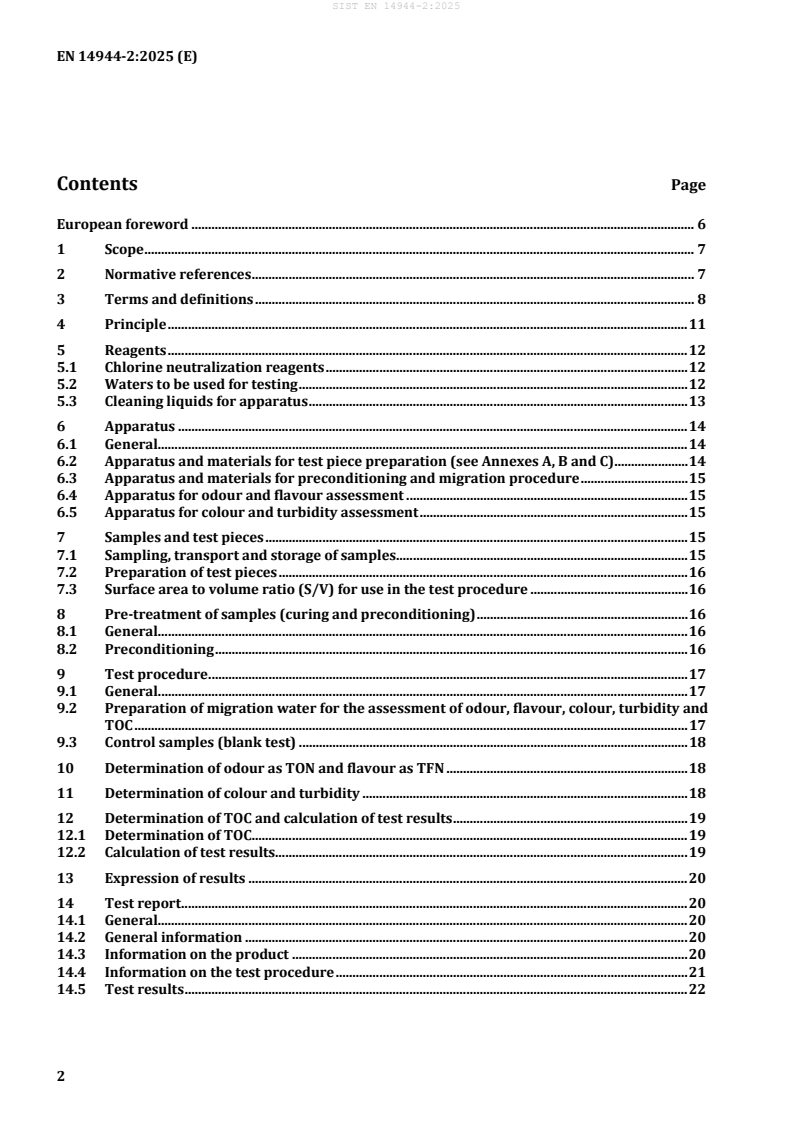
Contents Page
European foreword . 6
1 Scope . 7
2 Normative references . 7
3 Terms and definitions . 8
4 Principle . 11
5 Reagents . 12
5.1 Chlorine neutralization reagents . 12
5.2 Waters to be used for testing . 12
5.3 Cleaning liquids for apparatus . 13
6 Apparatus . 14
6.1 General. 14
6.2 Apparatus and materials for test piece preparation (see Annexes A, B and C) . 14
6.3 Apparatus and materials for preconditioning and migration procedure . 15
6.4 Apparatus for odour and flavour assessment . 15
6.5 Apparatus for colour and turbidity assessment . 15
7 Samples and test pieces . 15
7.1 Sampling, transport and storage of samples. 15
7.2 Preparation of test pieces . 16
7.3 Surface area to volume ratio (S/V) for use in the test procedure . 16
8 Pre-treatment of samples (curing and preconditioning) . 16
8.1 General. 16
8.2 Preconditioning . 16
9 Test procedure . 17
9.1 General. 17
9.2 Preparation of migration water for the assessment of odour, flavour, colour, turbidity and
TOC . 17
9.3 Control samples (blank test) . 18
10 Determination of odour as TON and flavour as TFN . 18
11 Determination of colour and turbidity . 18
12 Determination of TOC and calculation of test results . 19
12.1 Determination of TOC. 19
12.2 Calculation of test results. 19
13 Expression of results . 20
14 Test report . 20
14.1 General. 20
14.2 General information . 20
14.3 Information on the product . 20
14.4 Information on the test procedure . 21
14.5 Test results . 22
Annex A (informative) Testing and assessing organoleptic parameters and migration of organic
substances (TOC) from the constituents of concrete . 23
A.1 General . 23
A.2 Method . 23
A.3 Normative references . 24
A.4 Terms and definitions . 24
A.5 Principle . 24
A.6 Reagents . 25
A.7 Apparatus . 25
A.8 Reference (or control) concrete . 25
A.9 Sampling of constituents . 26
A.10 Control mix, test mixes and test pieces . 26
A.11 Concrete mixing and compacting procedure . 28
A.12 Curing and preconditioning of test pieces . 28
A.13 Surface area to volume (S/V) ratio . 29
A.14 Test procedure . 29
A.15 Test arrangement . 29
A.16 Assessment of unapproved constituents . 30
A.17 Test report . 31
Annex B (informative) Testing and assessing organoleptic parameters and migration of organic
substances (TOC) from the constituents of mortars . 32
B.1 Introduction . 32
B.2 Method . 32
B.3 Normative references . 33
B.4 Terms and definitions . 33
B.5 Principle . 33
B.6 Reagents . 34
B.7 Apparatus . 34
B.8 Reference (or control) mortar . 34
B.9 Sampling of constituents . 35
B.10 Control mix, test mix and test pieces . 35
B.11 Mortar mixing and compacting procedure . 37
B.12 Curing and preconditioning of test pieces . 37
B.13 Surface area to volume (S/V) ratio . 37
B.14 Test procedure . 37
B.15 Test arrangement . 37
B.16 Assessment of unapproved constituents . 38
B.17 Test report . 39
Annex C (normative) Testing and assessing organoleptic parameters and migration of organic
substances (TOC) from associated non-cement based products/materials . 40
C.1 Introduction . 40
C.2 Method . 40
C.3 Normative references . 41
C.4 Terms and definitions . 41
C.5 Principle . 41
C.6 Reagents . 41
C.7 Apparatus . 41
C.8 Reference (or control) concrete/mortar. 41
C.9 Sampling of constituents and unapproved products . 41
C.10 Control mix, test mix and test pieces . 42
C.11 Concrete/mortar mixing and compacting procedure . 42
C.12 Curing and preconditioning of test pieces . 42
C.13 Surface area to volume (S/V) ratio . 43
C.14 Test procedure . 43
C.15 Test arrangement . 43
C.16 Assessment of unapproved products . 43
C.17 Test report . 43
Annex D (informative) Examples of typical test pieces and test conditions as a function of S/V ratio
............................................................................................................................................................................. 45
Annex E (informative) Test arrangements for site-applied cement based materials and associated
non-cement based products/materials . 46
Annex F (informative) Additional procedures for testing site-applied cement based products at
elevated temperature . 48
F.1 General. 48
F.2 Test procedure at elevated temperature . 48
F.3 Control samples (blank test) . 48
F.4 Expression of results . 48
F.5 Reporting . 48
Annex G (informative) Discrimination between porous and non-porous coating on site applied
cement based products . 49
G.1 Principle . 49
G.2 Apparatus . 49
G.3 Materials and reagents . 49
G.4 Test procedure . 49
G.5 Determination of pH . 50
G.6 Expression of results . 50
G.7 Classification criteria . 50
Annex H (informative) Schematic description of the test procedure . 51
H.1 Preconditioning . 51
H.2 Production of migration water at 23 °C . 52
H.3 Typical schedule . 53
Annex I (informative) Procedural tests using standard additions (positive control) . 54
Bibliography . 55
European foreword
This document (EN 14944-2:2025) has been prepared by Technical Committee CEN/TC 164 “Water
supply”, the secretariat of which is held by AFNOR.
This European Standard shall be given the status of a national standard, either by publication of an
identical text or by endorsement, at the latest by November 2025, and conflicting national standards shall
be withdrawn at the latest by November 2025.
Attention is drawn to the possibility that some of the elements of this document may be the subject of
patent rights. CEN shall not be held responsible for identifying any or all such patent rights.
This document describes a test method to determine the influence(s) of site-applied cement based
materials and associated non-cement based products/materials on organoleptic parameters and the
migration of organic substances (TOC) in water intended for human consumption.
This document will result in one of a series of standards that support standards for the approval of
products and materials in contact with water intended for human consumption.
This document is part of a series dealing with the influence of cement based and associated non-cement
based products/materials on water intended for human consumption, including:
— Part 1: Influence of factory-made cement based products on organoleptic parameters and migration of
organic substances (TOC)
— Part 2: Influence of site-applied cement based materials and associated non-cement based
products/materials on organoleptic parameters and migration of organic substances (TOC)
— Part 3: Migration of substances from factory-made cement based products.
— Part 4: Migration of substances from site-applied cement based materials and associated non-cement
based products/materials.
Any feedback and questions on this document should be directed to the users’ national standards body.
A complete listing of these bodies can be found on the CEN website.
According to the CEN-CENELEC Internal Regulations, the national standards organisations of the
following countries are bound to implement this European Standard: Austria, Belgium, Bulgaria, Croatia,
Cyprus, Czech Republic, Denmark, Estonia, Finland, France, Germany, Greece, Hungary, Iceland, Ireland,
Italy, Latvia, Lithuania, Luxembourg, Malta, Netherlands, Norway, Poland, Portugal, Republic of North
Macedonia, Romania, Serbia, Slovakia, Slovenia, Spain, Sweden, Switzerland, Türkiye and the United
Kingdom.
1 Scope
This document specifies a method to determine the influence of site-applied cement based materials and
associated non-cement based products/materials (including pre-packaged mortars) on the odour,
flavour, colour, turbidity and total organic carbon (TOC) of test waters after contact with the products.
This document is applicable to site-applied or site-formed cement based materials intended to be used
for the transport and storage of water intended for human consumption, including raw water used for
the production of drinking water. It is also applicable to individual constituents of cement based
products/materials and to associated non-cement based products/materials.
Site-applied or site-formed cement based materials which cannot be cast as cubes or prisms e.g. some
spray applied systems, are tested as factory made cement based products according to EN 14944−1.
NOTE Tests with the specified test water will not necessarily be representative of materials used in different
kinds of waters and especially very soft waters.
2 Normative references
The following documents are referred to in the text in such a way that some or all of their content
constitutes requirements of this document. For dated references, only the edition cited applies. For
undated references, the latest edition of the referenced document (including any amendments) applies.
EN 1420:2016, Influence of organic materials on water intended for human consumption — Determination
of odour and flavour assessment of water in piping systems
EN 1484, Water analysis — Guidelines for the determination of total organic carbon (TOC) and dissolved
organic carbon (DOC)
EN 1622:2006, Water quality — Determination of the threshold odour number (TON) and threshold flavour
number (TFN)
EN 10088-1:2023, Stainless steels — Part 1: List of stainless steels
EN 12390-1, Testing hardened concrete — Part 1: Shape, dimensions and other requirements for specimens
and moulds
EN 14944-1, Influence of cementitious products on water intended for human consumption — Test methods
- Part 1: Influence of factory made cementitious products on organoleptic parameters
EN 27888, Water quality — Determination of electrical conductivity (ISO 7888:1985)
EN ISO 7027-1, Water quality — Determination of turbidity — Part 1: Quantitative methods
EN ISO 7393-1, Water quality — Determination of free chlorine and total chlorine — Part 1: Titrimetric
method using N,N-diethyl-1,4-phenylenediamine (ISO 7393-1)
EN ISO 7393-2, Water quality — Determination of free chlorine and total chlorine — Part 2: Colorimetric
method using N,N-dialkyl-1,4-phenylenediamine, for routine control purposes (ISO 7393-2)
EN ISO 7887:2011, Water quality — Examination and determination of colour (ISO 7887:2011)
EN ISO 9963-2, Water quality — Determination of alkalinity — Part 2: Determination of carbonate
alkalinity (ISO 9963-2)
EN ISO 10523, Water quality — Determination of pH (ISO 10523)
EN ISO 16264, Water quality — Determination of soluble silicates by flow analysis (FIA and CFA) and
photometric detection (ISO 16264)
ISO 6058, Water quality — Determination of calcium content — EDTA titrimetric method
3 Terms and definitions
For the purposes of this document, the following terms and definitions apply.
ISO and IEC maintain terminology databases for use in standardization at the following addresses:
— ISO Online browsing platform: available at https://www.iso.org/obp/
— IEC Electropedia: available at https://www.electropedia.org/
3.1
appropriate body
certification body, inspection body or test laboratory, as relevant to a particular requirement
3.2
cement based product
factory-made product containing a cement based material supplied in the hardened state with a formed
surface prior to its incorporation into the construction works
3.3
cement based material
material that contains a hydraulic cement in sufficient proportion to act as the main binder by forming a
hydrate structure which governs the performance of the material
3.4
associated non-cement based product
product which is applied to the surface of a cement based product, directly or indirectly, during
manufacture (or construction) and which either provides a porous seal to the product or which remains
as a residue in contact with water, e.g. porous seal coats, formwork release agents and curing compounds
3.5
porous seal coat
polymeric (usually organic) materials applied in a thin (25 μm – 200 μm thickness) surface layer to a
cement mortar lining in order to restrict (but not prevent) interactions between the mortar and conveyed
water (see Annex G)
[SOURCE: ISO 16132]
3.6
proxy sample
sample of fresh mortar or fresh concrete taken from material to be used for the production of a factory-
made product, either applied to one face of a stainless steel plate (6.2.1) using the same process of
application used in the factory (mortar only) or cast into a mould (mortar or concrete) of appropriate
dimensions and compacted (where appropriate), cured and hardened under conditions representative
of those intended for the product
EXAMPLE Standard cube, cylinder or prism, etc.
3.7
fresh concrete
concrete that is fully mixed and still in a condition capable of being compacted
3.8
fresh mortar
cement mortar that is fully mixed and still in a condition of being applied
3.9
odour
sensation perceived by means of the olfactory organ in sniffing certain volatile substances
[SOURCE: EN ISO 5492:2009, definition 3.18]
3.10
flavour
complex combination of the olfactory, gustatory, and trigeminal sensations perceived during tasting
Note 1 to entry: The flavour may be influenced by tactile, thermal, painful and/or kinaesthetic effects
[SOURCE: EN ISO 5492:2009, definition 3.20]
3.11
colour of water
optical property that causes the changing of the spectral composition of transmitted visible light
[SOURCE: EN ISO 7887:2011, 3.1]
3.12
turbidity
reduction of transparency of a liquid caused by the presence of undissolved matter
[SOURCE: EN ISO 7027-1:2016, 3.1]
3.13
threshold odour number
TON
dilution ratio of the migration water with the reference water at the same temperature, beyond which
this diluted sample does not have any perceptible odour
[SOURCE: EN 1622:2006]
3.14
threshold flavour number
TFN
dilution ratio of the migration water with the reference water at the same temperature, beyond which
this diluted sample does not have any perceptible flavour
[SOURCE: EN 1622:2006]
As impacted by EN ISO 5492:2009/A1:2017.
As impacted by EN ISO 5492:2009/A1:2017.
3.15
total organic carbon
TOC
sum of carbon present in water, consisting of, elemental carbon, total carbon dioxide, carbon monoxide,
cyanide, cyanate and thiocyanate
[SOURCE: EN 1484:1997]
3.16
testing panel
group of people meeting the relevant requirements of EN 1622
3.17
test
technical operation that consists of the determination of one or more characteristics of a given product
3.18
test procedure
specified technical method for performing a test
3.19
sample
one or more units, or a specified quantity, drawn from a batch or lot, selected at random for inspection,
e.g. at the factory or in a laboratory
3.20
test piece
the sample or portion which is to be conditioned, treated or otherwise prepared to be tested to obtain a
single test result
3.21
preconditioning
succession of contact periods of a test piece with the preconditioning water (3.22) before contact with
the test water
3.22
preconditioning water
water used for preconditioning, prepared as specified in 5.3.1
3.23
reference water
water specified as without odour, flavour, colour and turbidity conforming to the requirements in 5.3.2
3.24
test water
water used for testing purposes, prepared as specified in 5.3.3 and 5.3.4
3.25
migration water
test water which has been in contact with a test piece under specified conditions
3.26
blank water
test water which has been kept at the same specified conditions as migration water but without contact
with the test piece
3.27
tap water
drinking water distributed by a public supplier
3.28
demineralized water
water of which the mineral matter or salts have been removed by deionization
[SOURCE: ISO 23321:2019, definition 3.1]
3.29
Type I addition
nearly inert additions
Note 1 to entry: General suitability as type I addition is established for:
— filler aggregate conforming to EN 12620 or EN 13055;
— pigments conforming to EN 12878.
[SOURCE: EN 206:2013+A2:2021]
3.30
Type II addition
pozzolanic or latent hydraulic additions
Note 1 to entry: General suitability as type II additions is established for:
— Fly ash conforming to EN 450;
— silica fume conforming to EN 13263-1;
— ground granulated blast-furnace slag conforming to EN 15167-1.
[SOURCE: EN 206:2013+A2:2021]
4 Principle
The procedure specifies the method for producing test pieces (normally in the form of cubes or prisms)
from the site applied or site formed material under test. It also specifies the method of producing concrete
or mortar test pieces for assessing individual unapproved constituents of these materials or associated
non-cement based products/materials.
Each test piece is subjected to a specified preconditioning procedure where the surface which, in practice
will be exposed to water intended for human consumption, is brought into contact with preconditioning
water during five sequential periods: three periods of 24 h, 1 period of 72 h and a final period of 24 h.
The preconditioned test piece is then brought into contact with test water, chlorinated and/or chlorine-
free during three sequential migration periods. A migration period is either:
a) 72 h at (23 ± 2) °C for products intended to come into contact with chlorinated and/or chlorine-free
cold water;
b) 24 h at a specified elevated temperature for products intended to come into contact with warm or
hot chlorine-free water.
After each contact period, each migration water is assessed for odour, flavour, colour, turbidity and TOC.
The selection of:
a) the appropriate test water, chlorinated and/or chlorine-free, from those made available in this
document;
b) the temperature of the test water;
c) the need for chlorination during preconditioning;
is specified in product or system standards or in national or European regulations, as appropriate.
5 Reagents
5.1 Chlorine neutralization reagents
5.1.1 Ascorbic acid solution, prepared by dissolving (4,0 ± 0,1) g of ascorbic acid in one litre of
reference water (5.3.2).
This ascorbic acid solution shall be replaced on a monthly basis.
5.1.2 Sodium thiosulfate solution, comprising a solution of 3,5 g/l of sodium thiosulfate pentahydrate
(Na S O ·5H O) and stored in the absence of light at a temperature below 10 °C, for a maximum of
2 2 3 2
4 months.
5.1.3 Sodium hypochlorite solution, prepared from a commercial solution of sodium hypochlorite
(NaOCl) using test water and having a known concentration of about 0,1 % by mass of free chlorine
determined in accordance with either EN ISO 7393-1 or EN ISO 7393-2.
This sodium hypochlorite solution is unstable and shall be prepared on the day of use.
5.2 Waters to be used for testing
5.3.1 Preconditioning water prepared by dissolving (222 ± 2) mg anhydrous calcium chloride (CaCl )
and (336 ± 2) mg sodium hydrogen-carbonate (NaHCO ) in one litre of demineralized water (3.28). The
pH is determined in accordance with EN ISO 10523 and adjusted to 7,4 ± 0,1 by bubbling air and/or CO
into the solution.
-
NOTE The target total hardness is 200 mg/l as CaCO and the target alkalinity is 244 mg/l as HCO .
3 3
5.3.2 Reference water, a natural water without gas and with parameters that conform to the
requirements given in Table 1.
When the reference water is chlorinated to 1,0 mg/l free chlorine and then dechlorinated after 72 h with
either the ascorbic acid solution (5.1.1) or the sodium thiosulfate solution (5.1.2), its organoleptic
parameters, odour, flavour colour and turbidity shall conform to the requirements given in Table 1.
When the reference water is prepared from demineralized water, dissolve (222 ± 2) mg anhydrous
calcium chloride (CaCl ), (482 ± 2) mg sodium hydrogencarbonate (NaHCO ) and (71 ± 1) mg sodium
2 3
silicate (Na SiO ·9H O) in 1 l of demineralized water (3.28). The pH is determined in accordance with
2 3 2
EN ISO 10523 and adjusted to 7,4 ± 0,1 by bubbling air and/or CO into the solution.
Table 1 — Reference water
Parameter a Requirement Unit
Test method
Conductivity EN 27888 500 ± 50 µS/cm
pH EN ISO 10523 7,3 ± 0,2 pH unit
Calcium ISO 6058 80 ± 10 mg Ca/l
Alkalinity EN ISO 9963-2 350 ± 50 -
mg HCO /l
Silica EN ISO 16264 15 ± 5 mg SiO /l
Odour EN 1622 < 2 TON
Flavour EN 1622 < 2 TFN
Colour b < 0,1 -1
EN ISO 7887 m
Turbidity c < 0,1 FNU
EN ISO 7027
TOC EN 1484 < 0,2 mg C/l
a
Alternative methods, either calibrated against the reference methods or which have proven comparable
analytical performance, may be used.
b
See Clause 5.
c
See Clause 6.
5.3.3 Test water without chlorine content (chlorine-free), shall consist of a batch of reference water
(5.3.2) used for contact with test pieces and preparation of the blank water (3.26).
5.3.4 Test water with chlorine content (chlorinated), shall consist of reference water (see 5.3.2)
with a free chlorine content of (1,0 ± 0,2) mg/l as Cl , determined in accordance with either EN ISO 7393-
1 or EN ISO 7393-2, after addition of sodium hypochlorite solution (5.2).
5.3 Cleaning liquids for apparatus
Use one of the following cleaning liquids:
— non-perfumed biodegradable detergent;
— hydrochloric acid, 2 mol/l;
— nitric acid, 10 % or 1,5 mol/l.
6 Apparatus
6.1 General
For cleaning the glassware, and appropriate apparatus, before use, the following general requirements
apply:
a) clean the glassware to be used, using detergent (5.3). Rinse the glassware in demineralized water
(3.28);
b) clean the inner surface of the glassware with hydrochloric acid (5.3) and rinse it with demineralized
water. For stainless steel, clean with nitric acid (5.3) and then rinse with demineralized water;
c) before use, rinse the glassware, and appropriate apparatus, at least three times using
preconditioning water before preconditioning (8.2) or reference water before the test procedure
(9.2.2).
6.2 Apparatus and materials for test piece preparation (see Annexes A, B and C)
6.2.1 Stainless steel
Stainless steel shall be austenitic, super austenitic or duplex grades in accordance with the corresponding
numerical designations, 1.4301, 1.4436, 1.4429, 1.4529 or 1.4462 in EN 10088-1:2023 for stainless
steels.
NOTE The grades above are specified for the use of stainless steel as reinforcement in concrete. Therefore, they
are considered to be inert when used in contact with cement based proxy samples (see Annexes A, B and C).
6.2.2 Moulds for forming test pieces
Moulds for preparing test pieces of concrete or mortar shall be made from alkali-resistant material that
does not interfere with analyses of migration waters.
A mould used to cast concrete test pieces shall normally give a test specimen with total surface area of
approximately 60 000 mm as appropriate to the tolerance permitted on S/V ratio, see Annex D.
NOTE High density polyethylene (HDPE) containers have been found to be satisfactory for this use.
Where steel moulds conforming to the requirements of EN 12390-1 are used, the joints shall not be
coated with any wax, oil or grease to achieve water tightness.
A mould used to cast mortar test pieces shall give a test specimen with total surface area of approximately
28 800 mm as appropriate to the tolerance permitted on S/V ratio, see Annex D.
Other mould sizes for casting concrete or mortar may be used, provided the permitted tolerance on S/V
ratio can be achieved during testing, see Annex D.
Where a site-applied or site-formed cement based product is not suitable for casting in a mould, e.g. some
spray applied products, it should be applied and tested according to EN 14944-1.
6.2.3 Cleaning and use of moulds
Clean moulds and any filling frame used with a mould, by thoroughly washing with non-perfumed
detergent (5.3) and tap water (3.27), rinsing with copious amounts of tap water, followed by a final rinse
with demineralized water (3.28) and dry before use.
The use of release agents to coat the internal surfaces of moulds is not permitted by this document.
NOTE Release agents for use with site-applied or site-formed cement based materials are examples of
associated non-cement based materials and are tested in accordance with Annex C.
6.3 Apparatus and materials for preconditioning and migration procedure
6.3.1 Vessels, containers, covers, connectors and stoppers, made of materials which do not affect
the odour, flavour, colour and turbidity assessment under the specified test conditions such as glass,
polytetrafluoroethylene (PTFE), steel or stainless steel.
6.3.2 Equipment, capable of maintaining the test temperature (Clause 9) within ±2 °C for the duration
of the test.
6.3.3 If required, use only sealants that do not affect the odour, flavour, colour and turbidity
assessments under the specified test conditions (Clause 9).
6.4 Apparatus for odour and flavour assessment
6.4.1 Erlenmeyer and volumetric flasks, beakers, measuring cylinders, immersion tanks,
volumetric pipettes, funnels and stoppers made of glass, PTFE or stainless steel.
6.4.2 Testing vessels, comprising the following glassware (which shall be reserved for odour and
flavour assessment only and cleaned separately from other items): testing bottles for odour assessment
and testing glasses for flavour assessment conforming to the requirements given in EN 1622.
6.4.3 Waterbath or incubator, conforming to the requirements of EN 1622.
6.5 Apparatus for colour and turbidity assessment
6.5.1 Apparatus for the determination of colour, conforming to the requirements of EN ISO 7887.
6.5.2 Apparatus for the determination of turbidity, conforming to the requirements of EN ISO 7027.
6.6 Apparatus for the determination of TOC, conforming to the requirements of EN 1484.
6.7 Erlenmeyer flasks, 500 ml, with ground stop
...