

EN 14844:2006
(Main)Precast concrete products - Box culverts
- Abstract
This standard deals with both large (structural) and small (non-structural or light structural) box culverts of rectangular cross-section formed monolithically and designed as continuous elements with a joint detail shaped to allow the possible incorporation of sealing materials. Box culverts can be used for creation of voids below ground for conveyance and storage of materials. e.g. conveyance and storage of wastewater, cable tunnels and subways
For the purposes of this standard, box culverts having internal cross-sectional dimensions (W and H in Figure 1) less than or equal to 1 250 mm should be considered as small (non-structural or light structural). All other units should be defined as large. The elements are generally manufactured in factories using either normal weight or lightweight concrete and usually require reinforcing steel. This standard does not include units manufactured from autoclaved aerated concrete, nor prefabricated reinforced box culverts of lightweight concrete with open structure.
Each unit is structurally complete. They are used in combination to form a total structure of appropriate length (including joints) and capacity.
- Status
- Withdrawn
- Publication Date
- 04-Jul-2006
- Withdrawal Date
- 07-Oct-2008
- Technical Committee
- CEN/TC 229 - Precast concrete products
- Current Stage
- 9960 - Withdrawal effective - Withdrawal
- Start Date
- 08-Oct-2008
- Completion Date
- 08-Oct-2008
89/106/EEC - Construction productsOJ Ref: C, C 304 OJ Date: 13-Dec-2006

Relations
- Effective Date
- 22-Dec-2008
- Effective Date
- 22-Dec-2008
Get Certified
Connect with accredited certification bodies for this standard

DIBt (Deutsches Institut für Bautechnik)
German Institute for Building Technology.
DIN CERTCO
DIN Group product certification.

Aboma Certification B.V.
Specialized in construction, metal, and transport sectors.
Sponsored listings
Frequently Asked Questions
EN 14844:2006 is a standard published by the European Committee for Standardization (CEN). Its full title is "Precast concrete products - Box culverts". This standard covers: This standard deals with both large (structural) and small (non-structural or light structural) box culverts of rectangular cross-section formed monolithically and designed as continuous elements with a joint detail shaped to allow the possible incorporation of sealing materials. Box culverts can be used for creation of voids below ground for conveyance and storage of materials. e.g. conveyance and storage of wastewater, cable tunnels and subways For the purposes of this standard, box culverts having internal cross-sectional dimensions (W and H in Figure 1) less than or equal to 1 250 mm should be considered as small (non-structural or light structural). All other units should be defined as large. The elements are generally manufactured in factories using either normal weight or lightweight concrete and usually require reinforcing steel. This standard does not include units manufactured from autoclaved aerated concrete, nor prefabricated reinforced box culverts of lightweight concrete with open structure. Each unit is structurally complete. They are used in combination to form a total structure of appropriate length (including joints) and capacity.
This standard deals with both large (structural) and small (non-structural or light structural) box culverts of rectangular cross-section formed monolithically and designed as continuous elements with a joint detail shaped to allow the possible incorporation of sealing materials. Box culverts can be used for creation of voids below ground for conveyance and storage of materials. e.g. conveyance and storage of wastewater, cable tunnels and subways For the purposes of this standard, box culverts having internal cross-sectional dimensions (W and H in Figure 1) less than or equal to 1 250 mm should be considered as small (non-structural or light structural). All other units should be defined as large. The elements are generally manufactured in factories using either normal weight or lightweight concrete and usually require reinforcing steel. This standard does not include units manufactured from autoclaved aerated concrete, nor prefabricated reinforced box culverts of lightweight concrete with open structure. Each unit is structurally complete. They are used in combination to form a total structure of appropriate length (including joints) and capacity.
EN 14844:2006 is classified under the following ICS (International Classification for Standards) categories: 91.100.30 - Concrete and concrete products. The ICS classification helps identify the subject area and facilitates finding related standards.
EN 14844:2006 has the following relationships with other standards: It is inter standard links to EN 14844:2006+A1:2008, EN 14844:2006/prA1. Understanding these relationships helps ensure you are using the most current and applicable version of the standard.
EN 14844:2006 is associated with the following European legislation: EU Directives/Regulations: 305/2011, 89/106/EEC; Standardization Mandates: M/100. When a standard is cited in the Official Journal of the European Union, products manufactured in conformity with it benefit from a presumption of conformity with the essential requirements of the corresponding EU directive or regulation.
EN 14844:2006 is available in PDF format for immediate download after purchase. The document can be added to your cart and obtained through the secure checkout process. Digital delivery ensures instant access to the complete standard document.
Standards Content (Sample)
2003-01.Slovenski inštitut za standardizacijo. Razmnoževanje celote ali delov tega standarda ni dovoljeno.Precast concrete products - Box culvertsMontažni betonski izdelki - Škatlasti nosilciProduits préfabriqués en béton - Cadres enterrésBetonfertigteile - HohlkastenelementeTa slovenski standard je istoveten z:EN 14844:2006SIST EN 14844:2006en91.100.30Beton in betonski izdelkiConcrete and concrete productsICS:SLOVENSKI
STANDARDSIST EN 14844:200601-december-2006
EUROPEAN STANDARDNORME EUROPÉENNEEUROPÄISCHE NORMEN 14844July 2006ICS 91.100.30 English VersionPrecast concrete products - Box culvertsProduits préfabriqués en béton - Cadres enterrésBetonfertigteile - HohlkastenelementeThis European Standard was approved by CEN on 17 April 2006.CEN members are bound to comply with the CEN/CENELEC Internal Regulations which stipulate the conditions for giving this EuropeanStandard the status of a national standard without any alteration. Up-to-date lists and bibliographical references concerning such nationalstandards may be obtained on application to the Central Secretariat or to any CEN member.This European Standard exists in three official versions (English, French, German). A version in any other language made by translationunder the responsibility of a CEN member into its own language and notified to the Central Secretariat has the same status as the officialversions.CEN members are the national standards bodies of Austria, Belgium, Cyprus, Czech Republic, Denmark, Estonia, Finland, France,Germany, Greece, Hungary, Iceland, Ireland, Italy, Latvia, Lithuania, Luxembourg, Malta, Netherlands, Norway, Poland, Portugal, Romania,Slovakia, Slovenia, Spain, Sweden, Switzerland and United Kingdom.EUROPEAN COMMITTEE FOR STANDARDIZATIONCOMITÉ EUROPÉEN DE NORMALISATIONEUROPÄISCHES KOMITEE FÜR NORMUNGManagement Centre: rue de Stassart, 36
B-1050 Brussels© 2006 CENAll rights of exploitation in any form and by any means reservedworldwide for CEN national Members.Ref. No. EN 14844:2006: E
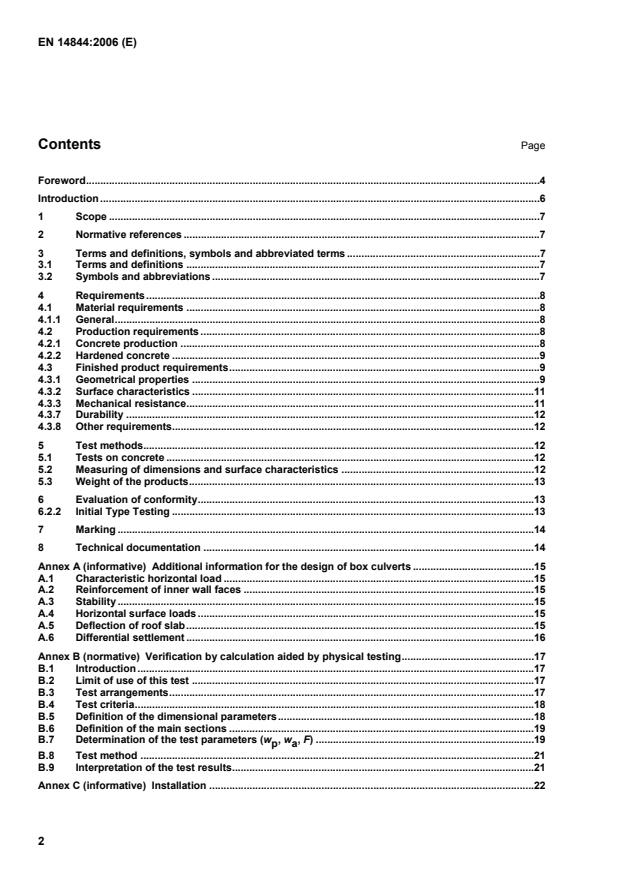
Additional information for the design of box culverts.15 A.1 Characteristic horizontal load.15 A.2 Reinforcement of inner wall faces.15 A.3 Stability.15 A.4 Horizontal surface loads.15 A.5 Deflection of roof slab.15 A.6 Differential settlement.16 Annex B (normative)
Verification by calculation aided by physical testing.17 B.1 Introduction.17 B.2 Limit of use of this test.17 B.3 Test arrangements.17 B.4 Test criteria.18 B.5 Definition of the dimensional parameters.18 B.6 Definition of the main sections.19 B.7 Determination of the test parameters (wp, wa, F).19 B.8 Test method .21 B.9 Interpretation of the test results.21 Annex C (informative)
Installation.22
Choice of CE marking method.24 Y.1 General.24 Y.2 Method 1.24 Y.3 Method 2.24 Y.4 Method 3.24 Annex ZA (informative)
Clauses of this European Standard addressing the provisions of the EU Construction Products Directive.25 ZA.1 Scope and relevant characteristics.25 ZA.2 Procedure(s) for the attestation of conformity of box culvert units.26 ZA.2.1 Systems of attestation of conformity.26 ZA.2.2 EC Certificate and Declaration of conformity.28 ZA.3 CE marking and labelling.29 ZA.3.1 General.29 ZA.3.2 Declaration of geometrical data and material properties.30 ZA.3.3 Declaration of product properties.33 ZA.3.4 Declaration of compliance with a given design specification.36 Bibliography.38
Figure 1a — Unit Length
Figure 1b — Explanation of symbols Figure 1 — Principal dimensions and symbols See Figure 2 for alternative joint configurations. 4 Requirements 4.1 Material requirements 4.1.1 General Subclause 4.1 of EN 13369:2004 shall apply. 4.2 Production requirements 4.2.1 Concrete production Subclause 4.2.1 of EN 13369:2004 shall apply.
4.2.2.1 Strength classes Subclause 4.2.2.1 of EN 13369:2004 shall apply. The minimum concrete strength class shall be C30/37. 4.2.2.2 Compressive strength The compressive strength of hardened concrete shall be declared by the manufacturer. Subclause 4.2.2.2 of EN 13369:2004 shall apply. The design values of strength properties should be based on partial safety factors for material properties, according to Annex C of EN 13369:2004. 4.2.2.3 Drying shrinkage of lightweight aggregate concrete For lightweight concrete, the drying shrinkage shall be declared by the manufacturer. 4.2.2.4 Density of lightweight aggregate concrete The manufacturer shall declare the density of lightweight concrete and it shall be in accordance with EN 206-1:2000, 4.3.2. 4.2.3 Structural reinforcement 4.2.3.1 Processing of reinforcing steel Subclauses 4.2.3 and 4.2.3.1 of EN 13369:2004 shall apply. 4.3 Finished product requirements 4.3.1 Geometrical properties 4.3.1.1 Production tolerances Units shall have an appropriate joint detail capable of providing sealing and location integrity. Typical arrangements are shown in Figure 2 below. Types of joints (see Figure 2): rebated joint (A); nib joint (B); butt joint (C).
2a)
2b)
2c) Figure 2 — Examples of box culvert joints For the types of rebated joint illustrated, the spigot and socket shall have a thickness of not less than 45 mm at the root (a + b) and a nib length (d) of not less than 45 mm. The length of the nib should normally be in the range from 1.3 to 2 times the nib root dimension. Early casts from each mould shall be checked to ensure that joints mate satisfactorily. The maximum permissible tolerance from the manufacturer’s declared dimensions, measured in accordance with 5.2, shall be as follows: thickness of roof/floor slab and wall : ± 10 mm; internal width and height of the opening : ± 1 % (max 15 mm); length of units : ± 1 %; joints: (see Figure 2) ; a, b, c, d, e, f, g : + 6 mm. 4.3.1.2 Minimum dimensions The nominal thickness for roof, floor and wall shall be not less than 100 mm. NOTE The length of unit is determined by the maximum weight and overall dimensions which can conveniently be lifted, transported and placed into the works but is not likely to be less than 1 000 mm except where handling or special considerations apply. 4.3.1.3 Nominal size Box culverts shall be described by their principal dimensions according to 3.2, expressed in sequence: WxHxL The manufacturer shall declare the box culvert nominal dimensions. The opening may be provided with corner splays, which shall not reduce the rectangular area by more than 10 %.
5 Test methods 5.1 Tests on concrete Subclause 5.1 of EN 13369:2004 shall apply. 5.2 Measuring of dimensions and surface characteristics In addition to the requirements of 5.2 of EN 13369:2004, the following requirements for box culverts shall be followed. The tolerances stated in 4.3.1.1 shall be checked using the procedure described below: a) Roof, floor and wall thickness Measure thickness of section at mid position of each face at each end of unit. Compare values with value given in 4.3.1.1. b) Width and depth Measure internal width and depth at each end of unit. Compare values with value given in 4.3.1.1.
c) Length Measure length of each side (from end of spigot to base of socket) at mid position. Compare values with value given in 4.3.1.1. d) Flatness Take measurements at random positions on the walls, floor and roof. Compare values with value given in 4.3.2. e) Squareness With the unit in the "as-laid" position, measure the diagonals of the exposed sides, top and ends. Compare the differences in the diagonals for each face with the values given in 4.3.1.4. 5.3 Weight of the products The method of determining the weight shall be either by weighing or by calculation, in accordance with 5.3 of EN 13369:2004. 6 Evaluation of conformity The evaluation of conformity shall be in accordance with Clause 6 of EN 13369:2004 except that Table D.4 of EN 13369:2004 shall be replaced by Table 1 below and that 6.2.2 of EN 13369:2004 shall be supplemented by the following method of initial type testing. Table 1 — Finished product inspection
SUBJECT METHOD PURPOSE FREQUENCY 1 Final inspection Reference tests as described in the standard Conformity with the requirements of this standard and the requirements for the manufacturer declared properties In accordance with the requirements of factory production control 2 Marking/labelling Visual check Conformity with the requirements of this standard Daily 3 Storage Visual check Conformity with the requirements of this standard Daily 4 Delivery Visual check Correct delivery age, loading and loading documents Daily 6.2.2 Initial Type Testing Initial type testing shall be subject to one of the following methods: a) in case of verification by calculation using 4.3.3.2 of EN 13369:2004, initial type testing shall be based on checking of calculations; b) where appropriate (see 4.3.3.3) physical testing for the mechanical resistance of the units shall be performed according to Annex B.
7 Marking Clause 7 of EN 13369:2004 shall apply. 8 Technical documentation Clause 8 of EN 13369:2004 shall apply. For installation recommendations it should be referred to Annex C.
Additional information for the design of box culverts A.1 Characteristic horizontal load Maximum and minimum horizontal loads from fill pressure should be assessed by the principles of soil mechanics. It should take into account the type of fill, the method of installation of the culvert, the backfilling and possible presence of groundwater. A.2 Reinforcement of inner wall faces Even when analysis indicates that there is no tension in a face, minimum reinforcement being not less than the minimum reinforcement of EN 1992-1–2 should be provided. It should be able to resist an ultimate bending moment of 0,8 3eH kNm/m (where He is the effective span of the wall in metres) but should be not less than the minimum reinforcement required by EN 1992-1-2. This does not apply, however, to the corner splays of culverts or to the inner wall faces of culverts less than 500 mm in internal depth. A.3 Stability Considerations of stability such as allowable bearing pressure and resistance to sliding or overturning may not influence the design of culvert strength and they are not within the scope of this standard. It may be assumed that, if any such investigations are considered to be necessary, they will be undertaken by the engineer responsible for the works that incorporate the box culverts. A.4 Horizontal surface loads It may be assumed that any horizontal loads due to surface traffic will be safely dispersed through a road slab or other surface without effect upon the box culvert. A.5 Deflection of roof slab It is not usually necessary to check the deflection of the roof slab. If however the fill depth is less than the minimum recommended below and an assessment to live load deflection is required, it will be sufficiently accurate to assume that: midspan deflection 3r2eLtMW20=
1) The free span moment is calculated assuming the roof slab to be simply supported over its effective span.
Verification by calculation aided by physical testing B.1 Introduction The test is designed to reproduce, simultaneously, the maximum bending moments for service conditions in the main sections of the box. These main sections are mid-span of roof slab, mid-span of floor slab and corners. B.2 Limit of use of this test The configuration of loading and bearing (see below) creates linear and negative bending moment (external fibre under tension) in all the walls. Therefore, this test is not sufficient in the particular case of service conditions where the walls are subjected to positive bending moments, which can exceed the capacity of the minimum inner wall reinforcement (where positive wall moments are required the testing system will need to be modified to achieve these moments. Alternatively the units can be retested turned through 90° to their in use orientation). B.3 Test arrangements
Key wa Support spacing (m) wp Loading beam spacing (m) F Total test load (kN/m) Figure BB.1 — Test arrangements
...