

EN 1177:2008
(Main)Impact attenuating playground surfacing - Determination of critical fall height
- Abstract
This European Standard specifies a method for determining the impact attenuation of playground surfacing. It defines a “Critical Fall Height" (see 3.2) for surfacing, which represents the upper limit of its effectiveness in reducing head injury when using playground equipment conforming to EN 1176. The test methods described in the European Standard are applicable for tests carried out in a laboratory and for tests on site.
- Status
- Withdrawn
- Publication Date
- 27-May-2008
- Withdrawal Date
- 06-Oct-2026
- Technical Committee
- CEN/TC 136 - Sports, playground and other recreational equipment
- Drafting Committee
- CEN/TC 136/SC 1 - Playground equipment for children
- Current Stage
- 9960 - Withdrawal effective - Withdrawal
- Start Date
- 10-Jan-2018
- Completion Date
- 07-Oct-2026
Buy Documents



Relations
- Replaces
EN 1177:1997/A1:2001 - Impact absorbing playground surfacing - Safety requirements and test methods - Effective Date
- 22-Dec-2008
- Effective Date
- 22-Dec-2008
- Effective Date
- 17-Jan-2018
- Effective Date
- 25-Aug-2026
- Effective Date
- 28-Jan-2026
- Effective Date
- 28-Jan-2026
- Effective Date
- 28-Jan-2026
- Effective Date
- 28-Jan-2026
Buy Documents
Frequently Asked Questions
EN 1177:2008 is a standard published by the European Committee for Standardization (CEN). Its full title is "Impact attenuating playground surfacing - Determination of critical fall height". This standard covers: This European Standard specifies a method for determining the impact attenuation of playground surfacing. It defines a “Critical Fall Height" (see 3.2) for surfacing, which represents the upper limit of its effectiveness in reducing head injury when using playground equipment conforming to EN 1176. The test methods described in the European Standard are applicable for tests carried out in a laboratory and for tests on site.
This European Standard specifies a method for determining the impact attenuation of playground surfacing. It defines a “Critical Fall Height" (see 3.2) for surfacing, which represents the upper limit of its effectiveness in reducing head injury when using playground equipment conforming to EN 1176. The test methods described in the European Standard are applicable for tests carried out in a laboratory and for tests on site.
EN 1177:2008 is classified under the following ICS (International Classification for Standards) categories: 97.200.40 - Playgrounds. The ICS classification helps identify the subject area and facilitates finding related standards.
EN 1177:2008 has the following relationships with other standards: It is inter standard links to EN 1177:1997/A1:2001, EN 1177:1997, EN 1177:2018, ISO 6487:2002, EN 1176-1:2008, EN ISO 23611-4:2011, EN 933-1:2012, EN 1176-10:2008. Understanding these relationships helps ensure you are using the most current and applicable version of the standard.
EN 1177:2008 is available in PDF format for immediate download after purchase. The document can be added to your cart and obtained through the secure checkout process. Digital delivery ensures instant access to the complete standard document.
Standards Content (Sample)
2003-01.Slovenski inštitut za standardizacijo. Razmnoževanje celote ali delov tega standarda ni dovoljeno.Stoßdämpfende Spielplatzböden - Bestimmung der kritischen FallhöheSols d’aires de jeux absorbant l’impact - Détermination de la hauteur de chute critiqueImpact attenuating playground surfacing - Determination of critical fall height97.200.40,JULãþDPlaygroundsICS:Ta slovenski standard je istoveten z:EN 1177:2008SIST EN 1177:2008en,fr,de01-november-2008SIST EN 1177:2008SLOVENSKI
STANDARDSIST EN 1177:1998/A1:2002SIST EN 1177:19981DGRPHãþD
EUROPEAN STANDARDNORME EUROPÉENNEEUROPÄISCHE NORMEN 1177May 2008ICS 97.200.40Supersedes EN 1177:1997
English VersionImpact attenuating playground surfacing - Determination ofcritical fall heightSols d'aires de jeux absorbant l'impact - Détermination dela hauteur de chute critiqueStoßdämpfende Spielplatzböden - Bestimmung derkritischen FallhöheThis European Standard was approved by CEN on 25 April 2008.CEN members are bound to comply with the CEN/CENELEC Internal Regulations which stipulate the conditions for giving this EuropeanStandard the status of a national standard without any alteration. Up-to-date lists and bibliographical references concerning such nationalstandards may be obtained on application to the CEN Management Centre or to any CEN member.This European Standard exists in three official versions (English, French, German). A version in any other language made by translationunder the responsibility of a CEN member into its own language and notified to the CEN Management Centre has the same status as theofficial versions.CEN members are the national standards bodies of Austria, Belgium, Bulgaria, Cyprus, Czech Republic, Denmark, Estonia, Finland,France, Germany, Greece, Hungary, Iceland, Ireland, Italy, Latvia, Lithuania, Luxembourg, Malta, Netherlands, Norway, Poland, Portugal,Romania, Slovakia, Slovenia, Spain, Sweden, Switzerland and United Kingdom.EUROPEAN COMMITTEE FOR STANDARDIZATIONCOMITÉ EUROPÉEN DE NORMALISATIONEUROPÄISCHES KOMITEE FÜR NORMUNGManagement Centre: rue de Stassart, 36
B-1050 Brussels© 2008 CENAll rights of exploitation in any form and by any means reservedworldwide for CEN national Members.Ref. No. EN 1177:2008: ESIST EN 1177:2008
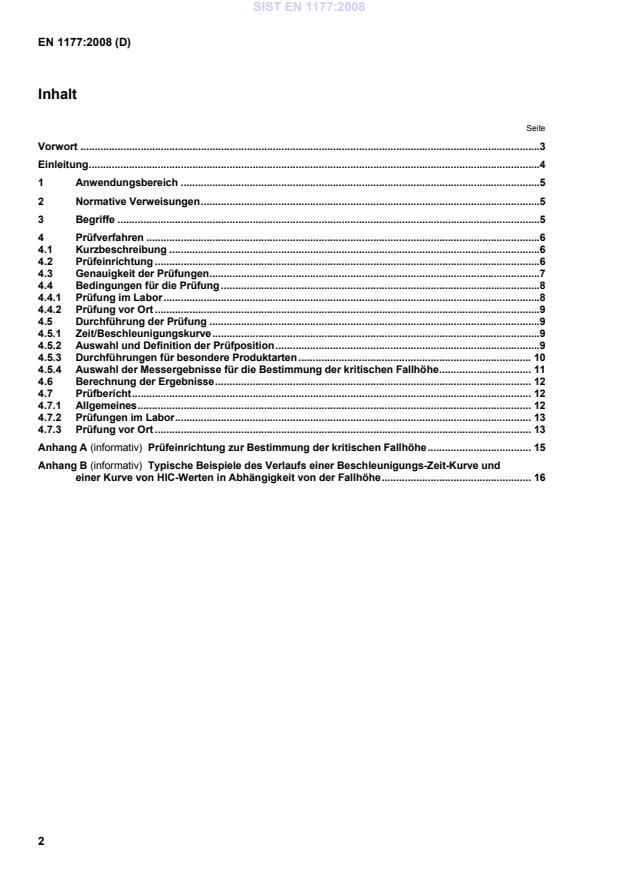
Test rig for determination of critical fall height.15 Annex B (informative)
Typical examples of trace of acceleration against time and curve of HIC values against drop height.16
EN 14960, Inflatable play equipment — Safety requirements and test methods
On the basis of statistical analysis of available data the Head Injury Criterion (HIC) at a tolerance level of 1 000 has been used as the upper limit for the brain injury severity unlikely to have disabling or fatal consequences. By choosing measurement of HIC as the criterion of safety, the method considers only the kinetic energy of the head when it impacts the surface of the impact area. This is considered to be the best model available to predict the likelihood of head injury from falls. Surfaces fulfilling the test requirements of this standard are considered to be in compliance with the requirements for impact attenuation in EN 1176-1. NOTE The HIC value of 1 000 is merely one data point on a risk severity curve where a HIC of 1 000 is equivalent to a 3 % chance of a critical injury (MAIS1) 5), a 18 % probability of a severe (MAIS 4) head injury, a 55 % probability of a serious (MAIS 3) head injury, a 89 % probability of a moderate injury (MAIS 2), and a 99,5 % chance of a minor head injury (MAIS 1), to an average male adult.
There are a variety of materials available providing impact attenuation, including rubber tiles, mats, slabs, continuous synthetic surfacing, either prefabricated or formed 'in-situ', loose particulate material, such as gravel, sand, wood chips, bark, etc. The method in this European Standard can be used to assess any of these surfaces.
1) Maximum Abbreviated Injury Scale, first developed by the Association for the Advancement of Automotive Medicine and used extensively in the automotive industry as an indicator of the severity of head-related injuries. SIST EN 1177:2008
2 Normative references The following referenced documents are indispensable for the application of this document. For dated references, only the edition cited applies. For undated references, the latest edition of the referenced document (including any amendments) applies.
EN 933-1, Tests for geometrical properties of aggregates – Part 1: Determination of particle size distribution –Sieving method EN 1176-1:2008, Playground equipment and surfacing — Part 1: General safety requirements and test
methods EN ISO/IEC 17025, General requirements for the competence of testing and calibration laboratories (ISO/IEC 17025:2005) ISO 6487:2002, Road vehicles – Measurement techniques in impact tests – Instrumentation 3 Terms and definitions For the purposes of this document, the terms and definitions given in EN 1176-1:2008 and the following apply. 3.1 impact attenuation property of a surface, which dissipates the kinetic energy of an impact by localized deformation or displacement such that the acceleration is reduced 3.2 critical fall height maximum free height of fall, for which a surface will provide an acceptable level of impact attenuation, determined as described in 4.4
3.3 head injury criterion (HIC) value criterion for head injuries caused from falls as calculated in accordance with 4.6.1 3.4 test position position on the material to be tested located vertically below the centre of the headform 3.5 drop height distance between the test position on the surfacing and the lowest point of the free falling headform prior to release NOTE In the case of a guided headform this value is calculated from measurement of velocity at impact (see 4.2.6).
3.6 impact measurement HIC value from the recorded acceleration of the headform falling from one fall height onto one test position
Test specimens or installed areas of the impact attenuating material under test are struck by an instrumented headform in a defined series of impacts from different drop heights. The signal emitted by an accelerometer (see Figure B.1) in the headform during each impact is processed to yield a severity from the measured impact energy, defined as head injury criterion (HIC).
The HIC of each impact is plotted and the critical fall height is determined as the lowest drop height producing a HIC value of 1 000 (see Figure B.2).
4.2 Apparatus
4.2.1 Test rig, comprising a headform with accelerometer (4.2.2), optionally with a charge amplifier (4.2.3) and, if using a uniaxial accelerometer, a guidance system (4.2.4) and impact measuring equipment (4.2.8), as shown in Figure A.1. 4.2.2 Headform, consisting of either a) an aluminium alloy ball; or
b) a hemispherical ended aluminium alloy missile. It shall have a diameter of 160 mm ± 5 mm, a mass of 4,6 kg ± 0,05 kg, with a maximum deviation from the hemispheric surface of 0,5 mm, incorporating an accelerometer as follows: c) triaxial accelerometer for free falling headforms, mounted in the centre of gravity of the headform; or d) uniaxial accelerometer for guided headforms, aligned to measure in the vertical axis ± 5° and located directly above the centre of mass. The impacting part of the headform between the lower boundary and accelerometer shall be homogeneous and free from voids. 4.2.3 Charge amplifier (optional)
4.2.4 Guidance system, to guide the headform when using a uniaxial accelerometer, including a means to measure the velocity of the headform immediately prior to impact.
4.2.5 Length measuring equipment, such that for the free-fall impact test, the drop height can be measured directly prior to release of the headform. NOTE Calculating the drop height from the measured time between release and contact of the missile with the surface may be not sufficient because of possible time differences between the start of time measurement and the effective release of the headform (e.g. caused by permanent magnetism in a magnetic release system). In all cases, the drop height shall be measured with an uncertainty of not greater than 1 %. SIST EN 1177:2008
1 000 Hz and having a sufficient response at all frequencies to keep amplitude errors below 5 %, in accordance with ISO 6487. It shall be capable of measuring, recording and displaying the acceleration and time duration of each complete impact. NOTE For a sufficient response at low frequencies, the - 3 dB lower limiting frequency should be less than or equal to 0,3 Hz to reduce the er
...
2003-01.Slovenski inštitut za standardizacijo. Razmnoževanje celote ali delov tega standarda ni dovoljeno.Stoßdämpfende Spielplatzböden - Bestimmung der kritischen FallhöheSols d’aires de jeux absorbant l’impact - Détermination de la hauteur de chute critiqueImpact attenuating playground surfacing - Determination of critical fall height97.200.40,JULãþDPlaygroundsICS:Ta slovenski standard je istoveten z:EN 1177:2008SIST EN 1177:2008en,fr,de01-november-2008SIST EN 1177:2008SLOVENSKI
STANDARDSIST EN 1177:1998/A1:2002SIST EN 1177:19981DGRPHãþD
EUROPÄISCHE NORMEUROPEAN STANDARDNORME EUROPÉENNEEN 1177Mai 2008ICS 97.200.40Ersatz für EN 1177:1997
Deutsche FassungStoßdämpfende Spielplatzböden - Bestimmung der kritischenFallhöheImpact attenuating playground surfacing - Determination ofcritical fall heightSols d'aires de jeux absorbant l'impact - Détermination dela hauteur de chute critiqueDiese Europäische Norm wurde vom CEN am 25.April 2008 angenommen.Die CEN-Mitglieder sind gehalten, die CEN/CENELEC-Geschäftsordnung zu erfüllen, in der die Bedingungen festgelegt sind, unter denendieser Europäischen Norm ohne jede Änderung der Status einer nationalen Norm zu geben ist. Auf dem letzen Stand befindliche Listendieser nationalen Normen mit ihren bibliographischen Angaben sind beim Management-Zentrum des CEN oder bei jedem CEN-Mitglied aufAnfrage erhältlich.Diese Europäische Norm besteht in drei offiziellen Fassungen (Deutsch, Englisch, Französisch). Eine Fassung in einer anderen Sprache,die von einem CEN-Mitglied in eigener Verantwortung durch Übersetzung in seine Landessprache gemacht und dem Zentralsekretariatmitgeteilt worden ist, hat den gleichen Status wie die offiziellen Fassungen.CEN-Mitglieder sind die nationalen Normungsinstitute von Belgien, Bulgarien, Dänemark, Deutschland, Estland, Finnland, Frankreich,Griechenland, Irland, Island, Italien, Lettland, Litauen, Luxemburg, Malta, den Niederlanden, Norwegen, Österreich, Polen, Portugal,Rumänien, Schweden, der Schweiz, der Slowakei, Slowenien, Spanien, der Tschechischen Republik, Ungarn, dem Vereinigten Königreichund Zypern.EUROPÄISCHES KOMITEE FÜR NORMUNGEUROPEAN COMMITTEE FOR STANDARDIZATIONCOMITÉ EUROPÉEN DE NORMALISATIONManagement-Zentrum: rue de Stassart, 36
B-1050 Brüssel© 2008 CENAlle Rechte der Verwertung, gleich in welcher Form und in welchemVerfahren, sind weltweit den nationalen Mitgliedern von CEN vorbehalten.Ref. Nr. EN 1177:2008 DSIST EN 1177:2008
Prüfeinrichtung zur Bestimmung der kritischen Fallhöhe.15 Anhang B (informativ)
Typische Beispiele des Verlaufs einer Beschleunigungs-Zeit-Kurve und einer Kurve von HIC-Werten in Abhängigkeit von der Fallhöhe.16
Der HIC-Wert von 1 000 ist lediglich eine Datenstelle auf einer Kurve des Schweregrades der Verletzung, auf der ein HIC von 1 000 der 3 %igen Möglichkeit einer kritischen Verletzung (MAIS1) 5) entspricht, einer 18 %igen Wahrscheinlichkeit einer schweren Kopfverletzung (MAIS 4), einer 55 %igen Wahrscheinlichkeit einer ernsthaften (MAIS 3) Kopfverletzung, einer 89 %igen Wahrscheinlichkeit einer mittleren Verletzung (MAIS 2) und einer 99,5 %igen Möglichkeit einer minderschweren Kopfverletzung (MAIS 1) bei einem durchschnittlichen männlichen Erwachsenen. Es gibt verschiedene Werkstoffe mit stoßdämpfenden Eigenschaften wie Gummiplatten, Matten, Bretter, nahtlose Kunststoffböden, entweder vorgefertigt oder an Ort und Stelle verlegt, loses Bodenmaterial aus Einzelpartikeln wie Kies, Sand, Holzschnitzel, Rinde usw. Das Prüfverfahren in dieser Norm kann zur Beurteilung aller dieser Böden angewendet werden.
1) Maximum Abbreviated Injury Scale (Einstufung der Verletzung in Schweregrade), die erstmals von der Association for
the Advancement of Autmotive Medicine entwickelt wurde und umfangreich in der Automobilindustrie als Indikator für
Kopfverletzungen eingesetzt wurde. SIST EN 1177:2008
ISO 6487:2002, Road vehicles — Measurement techniques in impact tests — Instrumentation 3 Begriffe Für die Anwendung dieses Dokuments gelten die Begriffe nach EN 1176-1:2008 und die folgenden Begriffe. 3.1 Stoßdämpfung Eigenschaft des Spielplatzbodens, durch die die kinetische Aufprallenergie durch örtlich begrenzte Verformung oder Verdrängung abgebaut wird, so dass die Beschleunigung verringert wird 3.2 kritische Fallhöhe maximale freie Fallhöhe, für die der Spielplatzboden ein akzeptables Maß an stoßdämpfenden Eigenschaften bietet, die wie in 4.4 beschrieben bestimmt wird
3.3 HIC (Head Injury Criterion)-Wert Kriterium für Kopfverletzungen, die durch einen Fall verursacht werden, berechnet nach der Gleichung in 4.6.1 3.4 Prüfposition Position auf dem zu prüfenden Bodenmaterial, welche vertikal unter dem Zentrum des Prüfkopfes angeordnet ist 3.5 Fallhöhe Abstand zwischen der Prüfposition auf dem Spielplatzboden und dem untersten Rand des frei fallenden Prüfkopfes vor Auslösung ANMERKUNG Im Falle eines geführten Prüfkopfes, wird dieser Wert anhand der Geschwindigkeitsmessung beim Aufprall berechnet (siehe 4.2.6). SIST EN 1177:2008
Die Berechnung der Fallhöhe aus der zwischen dem Auslösen und dem Kontakt der Kugel mit dem Boden gemessenen Zeit kann wegen möglicher Zeitdifferenzen zwischen Beginn der Zeitmessung und tatsächlichem Auslösen des Prüfkopfes unzureichend sein (z. B. durch den permanenten Magnetismus in einem magnetischen Auslösesystem). In allen Fällen muss die Fallhöhe mit einer Messunsicherheit von höchstens 1 % gemessen werden. 4.2.6 Geschwindigkeitsmesseinrichtung, so dass für die geführte Aufprallprüfung die theoretische Fallhöhe durch Messen der Geschwindigkeit des Prüfkopfes unmittelbar vor dem Aufprall berechnet werden kann In allen Fällen muss die Geschwindigkeit mit einer Messunsicherheit von höchstens 1 % gemessen werden. ANMERKUNG Zur Berücksichtigung von Reibungsverlusten wird die Geschwindigkeit des Prüfkopfes unmittelbar vor dem Aufprall aufgezeichnet, um die dem Prüfkopf im freien Fall entsprechende Fallhöhe zu berechnen. 4.2.7 Auslösesystem, so dass für die Aufprallprüfung im freien Fall beim Auslösen kein Drehmoment oder andere auf den Prüfkopf wirkende Kräfte geschaffen werden. ANMERKUNG
Ein Drehmoment oder andere auf den Prüfkopf wirkende Kräfte würden nach dem Aufprall im Triax zusätzliche Beschleunigungen verursachen, die zu einem nicht kontrollierbaren Fehler des Ergebnisses der Senkrechtmessung führen. 4.2.8 Aufprallmesseinrichtung bestehend aus einem Beschleunigungsnehmer-Messsystem (4.2.9), einem Aufzeichnungsgerät (4.2.10) und einem Programm zur Berechnung des HIC-Wertes (4.2.11). 4.2.9 Beschleunigungsaufnehmer-Messsystem, das in der Lage ist, alle Frequenzen im Bereich von 0,3 Hz bis 1 000 Hz zu messen und bei allen Frequenzen eine ausreichende Ansprechzeit hat, um nach ISO 6487 Amplitudenfehler unter 5 % zu halten. Es muss geeignet sein für die Messung, Aufzeichnung und Darstellung der Beschleunigung und der Zeitspanne jedes gesamten Aufprallvorgangs. ANMERKUNG
Für eine ausreichende Ansprechzeit bei Niederfrequenzen muss die -3 dB untere Frequenzgrenze ≤ 0,3 Hz betragen, um den Fehler durch Überschreiten der Basislinie nach dem Aufprall und eine Unterbewertung der g-max und HIC Punktwerte insbesondere bei längeren Impulszeiten (siehe Frequenzverlauf-Diagramm in ISO 6487:2002, Bild 1) zu reduzieren. Ein Beschleunigungsaufnehmer mit einer Zeitkonstanten von 2 s oder größer und einer g
...