

EN 14476:2005
(Main)Chemical disinfectants and antiseptics - Virucidal quantitative suspension test for chemical disinfectants and antiseptics used in human medicine - Test method and requirements (phase 2, step 1)
- Abstract
This document specifies test methods and minimum requirements for virucidal activity of chemical disinfectants or antiseptic products for instruments, surfaces, laundry or hands that form a homogeneous physically stable preparation in water.
This document is applicable to a broad spectrum of viruses (see Annex B) and to areas and situations where disinfection is medically indicated. Such indications occur in patient care, for example:
¾ in hospitals, in community medical facilities, and in dental institutions;
¾ clinics of schools, kindergartens, and nursing homes;
and may occur in the workplace and in the home. It may also include services such as laundries and kitchens supplying products directly for the patients.
It is impossible to determine the virucidal activity of the undiluted product as some dilution is always produced by adding the inoculum. However, a disinfectant or antiseptic which is used in undiluted form is tested in 80% concentration and shall pass this test prior to further assessment.
- Status
- Withdrawn
- Publication Date
- 19-Apr-2005
- Withdrawal Date
- 24-Oct-2006
- Technical Committee
- CEN/TC 216 - Chemical disinfectants and antiseptics
- Drafting Committee
- CEN/TC 216/WG 1 - Human medicine
- Current Stage
- 9960 - Withdrawal effective - Withdrawal
- Start Date
- 25-Oct-2006
- Completion Date
- 25-Oct-2006

Relations
- Effective Date
- 18-Jan-2023
- Effective Date
- 22-Dec-2008
Get Certified
Connect with accredited certification bodies for this standard

BSI Group
BSI (British Standards Institution) is the business standards company that helps organizations make excellence a habit.

TÜV Rheinland
TÜV Rheinland is a leading international provider of technical services.

TÜV SÜD
TÜV SÜD is a trusted partner of choice for safety, security and sustainability solutions.
Sponsored listings
Frequently Asked Questions
EN 14476:2005 is a standard published by the European Committee for Standardization (CEN). Its full title is "Chemical disinfectants and antiseptics - Virucidal quantitative suspension test for chemical disinfectants and antiseptics used in human medicine - Test method and requirements (phase 2, step 1)". This standard covers: This document specifies test methods and minimum requirements for virucidal activity of chemical disinfectants or antiseptic products for instruments, surfaces, laundry or hands that form a homogeneous physically stable preparation in water. This document is applicable to a broad spectrum of viruses (see Annex B) and to areas and situations where disinfection is medically indicated. Such indications occur in patient care, for example: ¾ in hospitals, in community medical facilities, and in dental institutions; ¾ clinics of schools, kindergartens, and nursing homes; and may occur in the workplace and in the home. It may also include services such as laundries and kitchens supplying products directly for the patients. It is impossible to determine the virucidal activity of the undiluted product as some dilution is always produced by adding the inoculum. However, a disinfectant or antiseptic which is used in undiluted form is tested in 80% concentration and shall pass this test prior to further assessment.
This document specifies test methods and minimum requirements for virucidal activity of chemical disinfectants or antiseptic products for instruments, surfaces, laundry or hands that form a homogeneous physically stable preparation in water. This document is applicable to a broad spectrum of viruses (see Annex B) and to areas and situations where disinfection is medically indicated. Such indications occur in patient care, for example: ¾ in hospitals, in community medical facilities, and in dental institutions; ¾ clinics of schools, kindergartens, and nursing homes; and may occur in the workplace and in the home. It may also include services such as laundries and kitchens supplying products directly for the patients. It is impossible to determine the virucidal activity of the undiluted product as some dilution is always produced by adding the inoculum. However, a disinfectant or antiseptic which is used in undiluted form is tested in 80% concentration and shall pass this test prior to further assessment.
EN 14476:2005 is classified under the following ICS (International Classification for Standards) categories: 11.080.20 - Disinfectants and antiseptics. The ICS classification helps identify the subject area and facilitates finding related standards.
EN 14476:2005 has the following relationships with other standards: It is inter standard links to EN 14476:2005+A1:2006, EN 14476:2005/prA1. Understanding these relationships helps ensure you are using the most current and applicable version of the standard.
EN 14476:2005 is available in PDF format for immediate download after purchase. The document can be added to your cart and obtained through the secure checkout process. Digital delivery ensures instant access to the complete standard document.
Standards Content (Sample)
2003-01.Slovenski inštitut za standardizacijo. Razmnoževanje celote ali delov tega standarda ni dovoljeno.Chemical disinfectants and antiseptics - Virucidal quantitative suspension test for chemical disinfectants and antiseptics used in human medicine - Test method and requirements (phase 2, step 1)Antiseptiques et désinfectants chimiques - Essai virucide quantitatif de suspension pour les antiseptiques et désinfectants chimiques utilisés en médecine humaine - Méthode d'essai et prescriptions (phase 2, étape 1)Chemische Desinfektionsmittel und Antiseptika - Quantitativer Suspensionsversuch Viruzidie für in der Humanmedizin verwendete chemische Desinfektionsmittel und Antiseptika - Prüfverfahren und Anforderungen (Phase 2, Stufe 1)Ta slovenski standard je istoveten z:EN 14476:2005SIST EN 14476:2005English
or
French or German
language11.080.20Dezinfektanti in antiseptikiDisinfectants and antisepticsICS:SLOVENSKI
STANDARDSIST EN 14476:200501-junij-2005
EUROPEAN STANDARDNORME EUROPÉENNEEUROPÄISCHE NORMEN 14476April 2005ICS 11.080.20English versionChemical disinfectants and antiseptics - Virucidal quantitativesuspension test for chemical disinfectants and antiseptics usedin human medicine - Test method and requirements (phase 2,step 1)Antiseptiques et désinfectans chimique - Essai quantitatifde suspension virucide pour les antiseptiques etdésinfectants chimiques utilisés en médecine humaine -Méthode d'essai et exigences (phase 2, étape 1)Chemische Desinfektionsmittel und Antiseptika -Quantitativer Suspensionsversuch Viruzidie für in derHumanmedizin verwendete chemische Desinfektionsmittelund Antiseptika - Prüfverfahren und Anforderungen (Phase2, Stufe 1)This European Standard was approved by CEN on 3 March 2005.CEN members are bound to comply with the CEN/CENELEC Internal Regulations which stipulate the conditions for giving this EuropeanStandard the status of a national standard without any alteration. Up-to-date lists and bibliographical references concerning such nationalstandards may be obtained on application to the Central Secretariat or to any CEN member.This European Standard exists in three official versions (English, French, German). A version in any other language made by translationunder the responsibility of a CEN member into its own language and notified to the Central Secretariat has the same status as the officialversions.CEN members are the national standards bodies of Austria, Belgium, Cyprus, Czech Republic, Denmark, Estonia, Finland, France,Germany, Greece, Hungary, Iceland, Ireland, Italy, Latvia, Lithuania, Luxembourg, Malta, Netherlands, Norway, Poland, Portugal, Slovakia,Slovenia, Spain, Sweden, Switzerland and United Kingdom.EUROPEAN COMMITTEE FOR STANDARDIZATIONCOMITÉ EUROPÉEN DE NORMALISATIONEUROPÄISCHES KOMITEE FÜR NORMUNGManagement Centre: rue de Stassart, 36
B-1050 Brussels© 2005 CENAll rights of exploitation in any form and by any means reservedworldwide for CEN national Members.Ref. No. EN 14476:2005: E
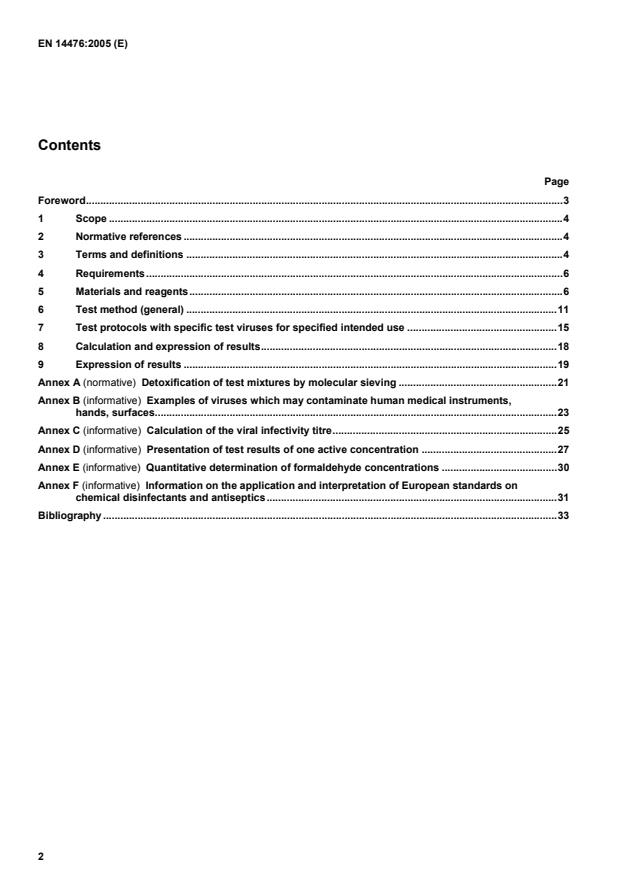
Detoxification of test mixtures by molecular sieving.21 Annex B (informative)
Examples of viruses which may contaminate human medical instruments, hands, surfaces.23 Annex C (informative)
Calculation of the viral infectivity titre.25 Annex D (informative)
Presentation of test results of one active concentration.27 Annex E (informative)
Quantitative determination of formaldehyde concentrations.30 Annex F (informative)
Information on the application and interpretation of European standards on chemical disinfectants and antiseptics.31 Bibliography.33
3.2 cytotoxicity morphological alteration of cells and/or their destruction or their reduced sensitivity to virus multiplication caused by the product
3.3 dirty conditions conditions representative of surfaces which are known to or may contain organic and/or inorganic substances
3.4 inactivation of viruses reduction of infectivity of a virus by a product NOTE Alteration of antigenic reactivity or of any viral component does not necessarily mean reduction of infectivity of a virus.
chemical agent or formulation used as a chemical disinfectant or antiseptic 3.8 reference virus inactivation test test with a defined product (e.g. formaldehyde) in parallel with a product under test for the internal control of the test 3.9 TCID50 50 % infecting dose of a virus suspension or that dilution of the virus suspension that induce a CPE (see 3.10) in 50 % of cell culture units 3.10 viral cytopathic effect (CPE)
morphological alteration of cells and/or their destruction as a consequence of virus multiplication 3.11 viral infectivity ability of a virus to produce infectious progeny in a sensitive cell strain NOTE Viral infectivity may also include the expression of at least part of the virus’ genetic information in cells 3.12 viral plaque
area of lysis formed in a cell monolayer under semisolid medium due to infection by and multiplication of a single infectious virus particle
3.13 virucide product that inactivates viruses under defined conditions NOTE The adjective derived from "virucide" is "virucidal". 3.14 virucidal activity capability of a product to produce a reduction in the number of infectious virus particles of relevant test organisms under defined conditions
3.15 virus titre amount of infectious virus per unit volume present in a cell culture lysate
Requirements A product, when tested in accordance with Clause 6 and Clause 7, shall demonstrate at least a decimal log (lg) reduction of 4 in virus titre of the test strains when tested under the test conditions described in Table 1. Table 1 — Required test conditions Test conditions Instrument and surface disinfectantsHygienic handrub and handwash Chemothermal disinfection procedureTest virus Poliovirus and Adenovirus Poliovirus and Adenovirus Parvovirus Test temperature
20 °C ± 1 °C (except for chemothermal disinfection) 20 °C ± 1 °C (except for chemothermal disinfection) according to the recommendation of the manufacturer, but not higher than 60°C Contact time a) obligatory
b) additional
60 min
5 min, 15 min, 30 min 1 min or 30 s, if manufacturer recommends < 1 min 3 min according to the contact time recommended by the manufacturer, but not longer than 60 min - Interfering substances a) clean
and/or b) dirty
0,3 g/l bovine serum albumin and/or 3,0 g/l bovine serum albumin plus 3,0 ml erythrocytes
PBSa)
-
0,3 g/l bovine serum albumin and/or 3,0 g/l bovine serum albumin plus 3,0 ml erythrocytes
a) Phosphate Buffered Saline NOTE The human immunodeficiency virus (HIV) is not considered a virus which requires testing, because it is a highly fragile virus. Therefore testing of the virucidal activity of chemical disinfectants against HIV is not necessary within the framework of this European Standard, if the product is active against poliovirus. In fact, poliovirus is selected as test virus because it has a high resistance to chemicals, is acid-stable and is unaffected by lipid solvents such as ether, and most detergents or quaternary products. 5 Materials and reagents 5.1 Apparatus and glassware 5.1.1 General Sterilise all glassware and parts of the apparatus that will come into contact with the culture media and reagents or the sample, except those that are supplied sterile, by one of the methods described in 5.1.2.2.
a minimum holding time of 1 h or at (16050+) °C for
a minimum holding time of 2 h. 5.1.2.3 Water bath capable of being controlled at 20 °C ± 1 °C. 5.1.2.4 Refrigerator, capable of being controlled at 2 °C to 8 °C. 5.1.2.5 pH-meter, having an accuracy of calibration of 0,1 pH units at 25 °C. 5.1.2.6 Inverted microscope for reading cell cultures microscopically 5.1.2.7 Stopwatch 5.1.2.8 Electromechanical agitator , e.g. Vortex ® mixer2). 5.1.2.9 Membrane filtration apparatus for filtration of media (0,22 µm pore size). 5.1.2.10 Microtitre plates or tubes, petri dishes and flasks for cell culture use. 5.1.2.11 Magnetic stirrer for keeping cells in suspension before seeding. 5.1.2.12 CO2 incubator (95% air, 5% CO2), capable of being controlled at 36 °C ± 1 °C, for incubation of cell cultures. An incubator at 37 °C ± 1 °C may be used if an incubator at 36 °C ± 1 °C is not available. 5.1.2.13
Ice producing machine or commercially available ice to cool the cell maintenance medium and the reaction mixtures during the test (see 6.1, 6.6.3, and 6.6.6.1). 5.1.2.14 Basin as ice bath with ice and water. 5.1.2.15 Container: sterile test tubes, culture bottles or flasks of suitable capacity. 5.1.2.16 Graduated sterile pipettes, of nominal capacities 10 ml and 1 ml and 0,1 ml. NOTE Calibrated automatic pipettes may be used. 5.1.2.17 Volumetric flasks calibrated at 20 °C. 5.1.2.18 Mechanical shaker 5.1.2.19 Centrifuge
1) Disposable equipment is an acceptable alternative to reusable glassware. 2) Vortex ® is an example of a suitable product available commercially. This information is given for the convenience of users of this document and does not constitute an endorsement by CEN of this product.
5.2.3.3.1 General The interfering substance(s) shall be chosen according to the conditions of use laid down for the product (see Table 1). The interfering substance(s) shall be sterile and prepared at 10 times the final concentration in the test (except the fresh defibrinated sheep blood). The method of preparation and sterilisation together with the composition shall be noted in the test report (9.2). 5.2.3.3.2 Clean conditions (bovine serum albumin) Bovine serum albumin should be used as commercially available product or shall be prepared as follows: dissolve 0,3 g of bovine albumin fraction V (suitable for microbiological purposes) in 100 ml of water (see 5.2.2); sterilise by membrane filtration. The final concentration of bovine serum albumin (BSA) in the test is 0,3 g BSA per litre. 5.2.3.3.3 Dirty conditions a) bovine serum albumin: Bovine serum albumin should be used as commercially available product or shall be prepared as follows: dissolve 3 g of bovine albumin fraction V (suitable for microbiological purposes) in 100 ml of water (see 5.2.2); sterilise by membrane filtration. The final concentration of bovine serum albumin (BSA) in the control is 3 g BSA per litre (see 6.6.3). b) sheep erthrocytes: Sterile defibrinated sheep blood should be used as commercially available product or shall be prepared according to EN 14820. Centrifuge erythrocytes from at least 8 ml fresh defibrinated sheep blood at 800 g (5.1.2.19) for 10 min. After discarding the supernatant, resuspend the erythrocytes in sterile phosphate buffered saline (PBS). Repeat this procedure at least three times (the supernatant should be colourless).
Non-enveloped RNA virus Picornavirus group - poliovirus type 1, LSc-2aba Non-enveloped DNA virus Adenovirus group - adenovirus type 5, strain Adenoid 75, ATCC VR-5 Chemothermal disinfection procedure Bovine Parvovirus, strain Haden, ATCC VR-767 a Only virus material that passed the requirements for the production of oral polio vaccine of the World Health Organisation (WHO) must be used. (Other stocks derived from LSc-2ab cannot be used any longer). 5.3.2 Reference virus suspension Virus suspension of a defined virus strain is maintained in reference centres. Virus suspension of a defined strain may be obtained from a national or international collections (e.g. American Type Culture Collection (ATCC)). In the case of polio virus LSc-2ab only virus material that passed the requirements for the production of oral polio vaccine of the World Health Organisation (WHO) must be used. (Other laboratory strains with the name “LSc-2ab” but that do not fulfil these requirements cannot be used any longer). The virus suspension is kept in small volumes at temperatures below –70 °C or preferably at -196 °C under nitrogen. NOTE Stock virus suspensions are prepared from reference virus suspensions. 5.3.3 Stock virus suspension The virus has to be multiplied on a large scale to obtain a virus suspension of the same characteristics as the reference virus suspension. Due to safety reasons, only 10 passages from the original seed virus are allowed in case of the polio virus vaccine strain. For multiplication and preparation of the virus suspension see Clause 6 and Clause 7. The virus suspension is kept in small volumes below -70 °C or preferably at -196 °C under nitrogen.
6.2 Choice of experimental conditions The selection of contact time, temperature, test virus strains and interfering substance(s) shall be carried out according to the practical use considered for the product: a) contact time: t in min: contact times shall be chosen according to Table 1; b) temperature: θ in °C: temperatures shall be chosen according to Table 1; c) test virus strains: test virus strains shall be chosen according to Table 2; d) interfering substance(s): interfering substances shall be chosen according to 5.2.3.3. 6.3 Preparation of the test virus suspension The stock virus suspension (5.3.3) is multiplied in an appropriate cell line which produces high titres of infectious viruses. The cell debris shall then be separated by low speed centrifugation. This preparation is called "test virus suspension". The test virus suspension is used undiluted for the test procedure (see Clause 6 and Clause 7).
In exceptional cases the virus suspension may be concentrated by appropriate methods (e.g. ultracentrifugation). 6.4 Cell culture preparation for virucidal testing Cell monolayers shall be > 90 % confluent before inoculation. Cell lines and appropriate culture media are selected in accordance with their sensitivity to the test viruses (see 5.3.1 and Clause 7). Cells for virus titration, if used as suspensions in quantal tests, shall be added to the dilutions of the test mixture (6.6.3) in such a density as to enable the formation of a monolayer in at least two days in the cell control. 6.5 Infectivity assay 6.5.1 Quantal tests (endpoint titration) 6.5.1.1 Virus titration on cells in suspension on microtiter plates Transfer 0,1 ml of each dilution (6.1) into six or eight wells of a microtitre plate, beginning with the highest dilution. Add 0,1 ml of cell culture suspension in such a density as to enable the formation of a monolayer (> 90 %) in at least 2 days in the cell control. Six or eight wells will serve as the cell control and does not receive any viral suspension. The viral cytopathic effect is read by using an inverted microscope after the appropriate incubation time (according to the virus type). 6.5.1.2 Virus titration on monolayers of cells on microtiter plates Transfer 0,1 ml of each dilution (6.1) into six or eight wells of a microtiter plate containing a confluent (> 90 %) cell monolayer without any medium. The last row of six or eight wells will receive 0,1 ml of culture medium and will serve as the cell control. After 1 h of incubation at 37 °C, 0,1 ml of cell maintenance medium is added to each well. Change pipettes for tubes or wells when adding medium. 6.5.1.3 Virus titration on monolayers of cells in cell culture tubes 6.5.1.2 applies with the modification that the volumes are multiplied by 5 to 10. 6.5.2 Plaque assay (for poliovirus) Plastic tray wells (surface diameter 30 mm to 35 mm) with confluent cell monolayers are washed once with PBS and inoculated with 0,2 ml of serial dilutions of virus in MEM + 2 % FCS. Three wells are generally used per dilution. After absorption period of 1 h at 37 °C, during which the cell monolayers are kept moist by tilting the dishes every 8 min to 10 min, the inoculum is removed and the cell monolayers are washed once with PBS.
Subsequently, the wells are overlaid with 3 ml of a mixture consisting of 1 % melted agarose or another appropriate semisolid medium and 2 times concentrated MEM with 4 % FCS. The cultures are incubated for 2 to 3 days at 37 °C in a CO2 incubator (see 5.1.2.12). Plaques can be counted (see C.2) after addition of 2 ml of a second overlay with the same composition of the first and also containing 5 % of a 1:1000 solution of neutral red and further incubation (in the dark) at 37 °C for 24 h to 48 h in a CO2 incubator (see 5.1.2.12). Counting can be performed also after addition of crystal violet. The cell monolayers are fixed by adding 2 ml of 10 % trichloroacetic acid (TCA) over the agar overlay for 10 min to 15 min at room temperature. The agar overlay is then removed and 2 ml of 0,1 % crystal violet in 20 % ethanol are added. After 10 min to 15 min at room temperature, the wells are extensively washed with water and the plaques (white spots) are counted (see C.2).
Product test solutions shall be prepared in hard water (see 5.2.2.2) at minimum three different concentrations to include one concentration in the active range and one concentration in the non-active range. The product as received may be used as one of the product test solutions.
Dilutions of ready-to-use products, i.e. products which are not diluted when applied, shall be prepared in water (see 5.2.2.1). For solid products, dissolve the product as received by weighing at least 1,0 g ± 10 mg of the product in a volumetric flask and filling up with hard water (see 5.2.2.2). Subsequent dilutions i.e. lower concentrations shall be prepared in volumetric flasks (see 5.1.2.17) on a volume/volume basis in hard water (see 5.2.2.2).
For liquid products, dilutions of the product shall be prepared with hard water on a volume/volume basis using volumetric flasks (see 5.1.2.17). The product test solutions shall be prepared freshly and used in the test within 2 h. They shall give a physically homogeneous preparation, stable during the whole procedure. If during the procedure a
...