


EN 13776:2023
(Main)LPG equipment and accessories - Filling and discharge procedures for LPG road tankers
LPG equipment and accessories - Filling and discharge procedures for LPG road tankers
This document specifies filling, discharge and emergency procedures for road tankers equipped in accordance with EN 12252 used for the transport of liquefied petroleum gas (LPG).
This document does not apply to “batteries of receptacles”.
Flüssiggas-Geräte und Ausrüstungsteile - Füll- und Entleerungsverfahren für Straßentankfahrzeuge für Flüssiggas (LPG)
Dieses Dokument legt Arbeitsvorgänge zum Befüllen und Entleeren sowie Notfallmaßnahmen für nach EN 12252 ausgestattete Straßentankfahrzeuge fest, die für die Beförderung von Flüssiggas (LPG, en: liquefied petroleum gas) eingesetzt werden.
Dieses Dokument gilt nicht für „Behälterbatterien”.
Équipements et accessoires pour GPL - Procédures de chargement et déchargement des camions-citernes pour GPL
Le présent document spécifie les procédures de chargement, de déchargement et d'urgence pour les camions-citernes équipés conformément à l'EN 12252 et utilisés pour le transport du gaz de pétrole liquéfié (GPL).
Il ne s'applique pas aux « véhicules-batteries ».
Oprema in pribor za utekočinjeni naftni plin (UNP) - Postopek polnjenja in praznjenja cestnih cistern za UNP
Ta dokument določa postopke polnjenja, praznjenja in ravnanja v sili za cestne cisterne, opremljene v skladu s standardom EN 12252, ki se uporabljajo za prevoz utekočinjenega naftnega plina (LPG).
Ta dokument se ne uporablja za »baterije posod«.
General Information
Relations
Overview
EN 13776:2023 - published by CEN - specifies safe filling, discharge and emergency procedures for LPG road tankers equipped in accordance with EN 12252. The standard applies to road tankers used for the transport of liquefied petroleum gas (LPG) and explicitly excludes “batteries of receptacles”. EN 13776:2023 updates and supersedes EN 13776:2013 and aligns some requirements with rail tanker procedures (EN 14841).
Key topics and technical requirements
- Scope and applicability: Procedures for road tankers compliant with EN 12252; excludes battery systems.
- Preparation for operations: Site positioning, vehicle checks, compatibility of product and tanker, and documentation requirements.
- Electrical and ignition control: Non‑essential electrical equipment must be switched off; electrical equipment used during filling must be ATEX‑suitable for the hazardous zone (see EN IEC 60079‑10‑1 and Directive 2014/34/EU).
- Electrostatic equalisation: Equalise electrostatic potential between tanker and loading/discharging installation before connecting hoses or loading arms.
- Connection integrity and leak checks: Inspection of hoses, couplings, seals and loading arms; verify correct connections and perform periodic leakage checks during transfer.
- Valve and sequence control: Open/close valves in prescribed sequences; ensure valves nearest the pressure vessel are closed first on completion.
- Overfill prevention: Monitor gauging devices, respect gross vehicle weight limits, weigh tare where applicable, and remove excess LPG in a controlled manner if accidental overfill occurs.
- Operational controls: Use of anti‑drive‑away interlocks, handbrakes, wheel chocks and tanker loading control systems.
- Discharge specifics: Positioning for access to flow meters and gauges, routing of hoses (preferably in open air), public safety signage when hoses cross pedestrian areas.
- Emergency procedures and PPE: Contains emergency response steps and an Annex A with recommendations for personal protective equipment for personnel.
- Training and documentation: Written procedures and operator training (ADR driver certification referenced) are required; responsibilities must be defined and supervised.
Applications and intended users
- Terminal operators, LPG transport companies and drivers
- Site safety managers, HSE and compliance officers
- Manufacturers and integrators of LPG road tanker equipment
- Training organisations preparing ADR‑certified drivers EN 13776:2023 is used to develop site procedures, operator training, risk assessments, safe transfer protocols and to ensure compliance with ADR/RID and national regulations.
Related standards and references
- EN 12252 (equipping of LPG road tankers)
- EN 14841 (rail tanker transfer procedures)
- CEN/TS 16765 (environmental aspects for LPG equipment)
- CEN/TS 16769 (terminology)
- EN IEC 60079‑10‑1 / ATEX (hazardous area classification)
- ADR / RID (transport of dangerous goods regulations)
- EN ISO 14001 (environmental management guidance)
Keywords: EN 13776:2023, LPG road tankers, filling and discharge procedures, ATEX, EN 12252, ADR, overfill prevention, electrostatic equalisation, PPE, CEN.
Standards Content (Sample)
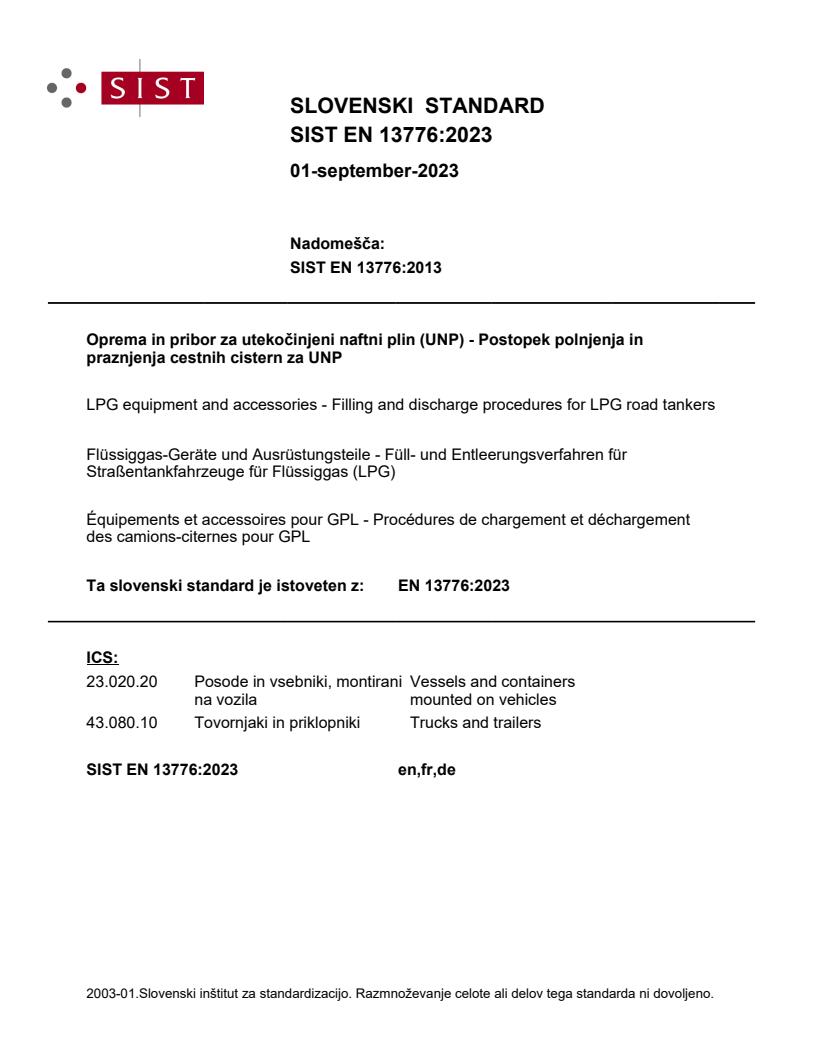
SLOVENSKI STANDARD
01-september-2023
Nadomešča:
SIST EN 13776:2013
Oprema in pribor za utekočinjeni naftni plin (UNP) - Postopek polnjenja in
praznjenja cestnih cistern za UNP
LPG equipment and accessories - Filling and discharge procedures for LPG road tankers
Flüssiggas-Geräte und Ausrüstungsteile - Füll- und Entleerungsverfahren für
Straßentankfahrzeuge für Flüssiggas (LPG)
Équipements et accessoires pour GPL - Procédures de chargement et déchargement
des camions-citernes pour GPL
Ta slovenski standard je istoveten z: EN 13776:2023
ICS:
23.020.20 Posode in vsebniki, montirani Vessels and containers
na vozila mounted on vehicles
43.080.10 Tovornjaki in priklopniki Trucks and trailers
2003-01.Slovenski inštitut za standardizacijo. Razmnoževanje celote ali delov tega standarda ni dovoljeno.
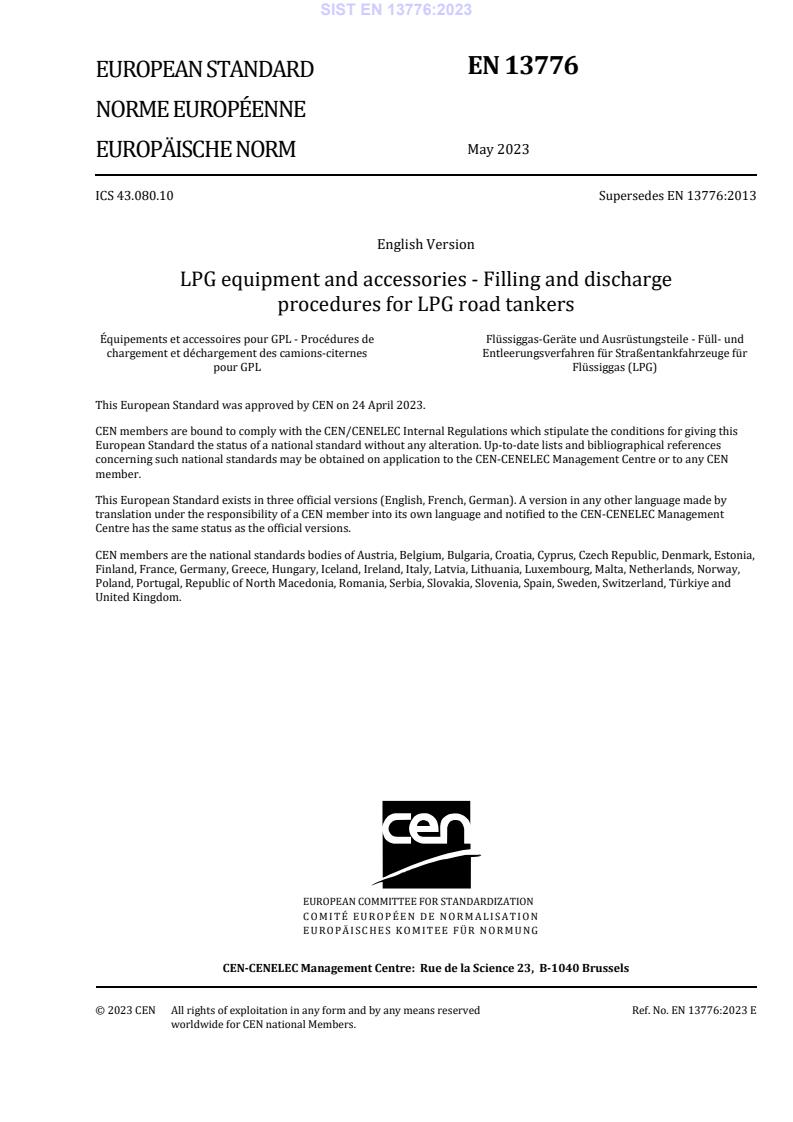
EN 13776
EUROPEAN STANDARD
NORME EUROPÉENNE
May 2023
EUROPÄISCHE NORM
ICS 43.080.10 Supersedes EN 13776:2013
English Version
LPG equipment and accessories - Filling and discharge
procedures for LPG road tankers
Équipements et accessoires pour GPL - Procédures de Flüssiggas-Geräte und Ausrüstungsteile - Füll- und
chargement et déchargement des camions-citernes Entleerungsverfahren für Straßentankfahrzeuge für
pour GPL Flüssiggas (LPG)
This European Standard was approved by CEN on 24 April 2023.
CEN members are bound to comply with the CEN/CENELEC Internal Regulations which stipulate the conditions for giving this
European Standard the status of a national standard without any alteration. Up-to-date lists and bibliographical references
concerning such national standards may be obtained on application to the CEN-CENELEC Management Centre or to any CEN
member.
This European Standard exists in three official versions (English, French, German). A version in any other language made by
translation under the responsibility of a CEN member into its own language and notified to the CEN-CENELEC Management
Centre has the same status as the official versions.
CEN members are the national standards bodies of Austria, Belgium, Bulgaria, Croatia, Cyprus, Czech Republic, Denmark, Estonia,
Finland, France, Germany, Greece, Hungary, Iceland, Ireland, Italy, Latvia, Lithuania, Luxembourg, Malta, Netherlands, Norway,
Poland, Portugal, Republic of North Macedonia, Romania, Serbia, Slovakia, Slovenia, Spain, Sweden, Switzerland, Türkiye and
United Kingdom.
EUROPEAN COMMITTEE FOR STANDARDIZATION
COMITÉ EUROPÉEN DE NORMALISATION
EUROPÄISCHES KOMITEE FÜR NORMUNG
CEN-CENELEC Management Centre: Rue de la Science 23, B-1040 Brussels
© 2023 CEN All rights of exploitation in any form and by any means reserved Ref. No. EN 13776:2023 E
worldwide for CEN national Members.
Contents Page
European foreword . 3
Introduction . 4
1 Scope . 5
2 Normative references . 5
3 Terms and definitions . 5
4 General . 5
5 Filling . 6
5.1 Preparation for filling . 6
5.2 Filling operations . 6
5.3 Completion of filling . 7
5.4 Precautions against overfilling . 7
6 Discharge . 7
6.1 Preparation for discharge . 7
6.2 Discharge operations . 9
6.3 Completion of discharge . 9
7 Emergency procedures . 9
Annex A (informative) Safety recommendations .10
Bibliography .11
European foreword
This document (EN 13776:2023) has been prepared by Technical Committee CEN/TC 286 “Liquefied
petroleum gas equipment and accessories”, the secretariat of which is held by NSAI.
This European Standard shall be given the status of a national standard, either by publication of an
identical text or by endorsement, at the latest by November 2023, and conflicting national standards shall
be withdrawn at the latest by November 2023.
Attention is drawn to the possibility that some of the elements of this document may be the subject of
patent rights. CEN shall not be held responsible for identifying any or all such patent rights.
This document supersedes EN 13776:2013.
In comparison with the previous edition, the following technical modifications have been made:
— Removal of the previous Annex A giving a table of LPG mixtures;
— A new Annex A was added giving recommendations on the personal protection equipment;
— Removal of Annex B on the Environmental checklist;
— Addition of a reference to CEN/TS 16765;
— Updating of the Introduction;
— A requirement was added to 5.1.3 that all electrical equipment required for the filling process shall
be suitable for the hazardous zone according to ATEX;
— Both the filling and the discharge requirements were harmonized with the ones for rail tanker in
EN 14841;
— References and clarifications concerning ADR [5] were added to improve clarity.
This document will be submitted for reference in:
— the RID; and/or
— the technical annexes of the ADR [5].
NOTE These regulations take precedence over any clause of this document. It is emphasized that RID/ADR are
being revised regularly at intervals of two years which can lead to temporary non-compliances with the clauses of
this document.
Any feedback and questions on this document should be directed to the users’ national standards body.
A complete listing of these bodies can be found on the CEN website.
According to the CEN-CENELEC Internal Regulations, the national standards organisations of the
following countries are bound to implement this European Standard: Austria, Belgium, Bulgaria, Croatia,
Cyprus, Czech Republic, Denmark, Estonia, Finland, France, Germany, Greece, Hungary, Iceland, Ireland,
Italy, Latvia, Lithuania, Luxembourg, Malta, Netherlands, Norway, Poland, Portugal, Republic of North
Macedonia, Romania, Serbia, Slovakia, Slovenia, Spain, Sweden, Switzerland, Türkiye and the United
Kingdom.
Introduction
This document calls for the use of substances and procedures that can be injurious to health if adequate
precautions are not taken. It refers only to technical suitability and does not absolve the user from legal
obligations relating to health and safety at any stage.
The frequencies of the different types of pressure vessel inspection are given by the relevant international
regulations concerning the transport of dangerous goods.
Protection of the environment is a key political issue in Europe and elsewhere. For CEN/TC 286 this is
covered in CEN/TS 16765 [1], and this Technical Specification should be read in conjunction with this
document. CEN/TS 16765 provides guidance on the environmental aspects to be considered regarding
equipment and accessories produced for the LPG industry and the following is addressed:
a) design;
b) manufacture;
c) packaging;
d) use and operation; and
e) disposal.
It is recommended that companies using this document develop an environmental management policy.
For guidance, see EN ISO 14001 [2].
It has been assumed in the drafting of this document that the execution of its provisions is entrusted to
appropriately qualified and experienced people.
All pressures are gauge pressures unless otherwise stated.
NOTE This document requires measurement of material properties, dimensions and pressures. All such
measurements are subject to a degree of uncertainty due to tolerances in measuring equipment, etc. It can be
beneficial to refer to the leaflet “Measurement uncertainty leaflet” SP INFO 2000 27 [4].
1 Scope
This document specifies filling, discharge and emergency procedures for road tankers equipped in
accordance with EN 12252 used for the transport of liquefied petroleum gas (LPG).
This document does not apply to “batteries of receptacles”.
2 Normative references
The following documents are referred to in the text in such a way that some or all of their content
constitutes requirements of this document. For dated references, only the edition cited applies. For
undated references, the latest edition of the referenced document (including any amendments) applies.
EN 12252, LPG equipment and accessories - Equipping of LPG road tankers
CEN/TS 16769, LPG equipment and accessories - Terminology
3 Terms and definitions
For the purposes of this document, the terms and definitions given in CEN/TS 16769 apply.
ISO and IEC maintain terminology databases for use in standardization at the following addresses:
— ISO Online browsing platform: available at https://www.iso.org/obp
— IEC Electropedia: available at https://www.electropedia.org/
4 General
4.1 Safety systems as required by EN 12252 shall be used. Personnel carrying out LPG transfer
operations shall wear personal protection equipment. Recommendations for personal protection
equipment are given in Annex A. The operations of filling and discharging shall be done under constant
supervision.
NOTE Recommendations for personal protection equipment are given in Annex A.
4.2 The filling and discharge areas shall be inspected for fire hazards prior to beginning operations.
Suitable fire protection shall be readily available.
NOTE Responsibilities for fire protection are subject to national regulations.
4.3 Written procedures and other appropriate information shall be made readily available, understood
and followed by those undertaking filling and discharging procedures.
NOTE ADR [5] requires drivers to have an ADR driver training certificate as given in part 8 of ADR.
Consideration shall be given to include specific instructions for the use of the road tanker’s LPG
equipment and fixed LPG installation relevant to the operations in the training programme. These
instructions shall be based on risk assessment and address all requirements of Clauses 5 and 6.
4.4 Written procedures shall be readily available, understood and followed. This shall be achieved by
training and supervision. The responsibilities of all persons involved in the operation shall be clearly
defined.
5 Filling
5.1 Preparation fo
...
Frequently Asked Questions
EN 13776:2023 is a standard published by the European Committee for Standardization (CEN). Its full title is "LPG equipment and accessories - Filling and discharge procedures for LPG road tankers". This standard covers: This document specifies filling, discharge and emergency procedures for road tankers equipped in accordance with EN 12252 used for the transport of liquefied petroleum gas (LPG). This document does not apply to “batteries of receptacles”.
This document specifies filling, discharge and emergency procedures for road tankers equipped in accordance with EN 12252 used for the transport of liquefied petroleum gas (LPG). This document does not apply to “batteries of receptacles”.
EN 13776:2023 is classified under the following ICS (International Classification for Standards) categories: 43.080.10 - Trucks and trailers. The ICS classification helps identify the subject area and facilitates finding related standards.
EN 13776:2023 has the following relationships with other standards: It is inter standard links to EN 13776:2013. Understanding these relationships helps ensure you are using the most current and applicable version of the standard.
You can purchase EN 13776:2023 directly from iTeh Standards. The document is available in PDF format and is delivered instantly after payment. Add the standard to your cart and complete the secure checkout process. iTeh Standards is an authorized distributor of CEN standards.
La norme EN 13776:2023 représente une avancée significative dans le domaine des équipements et accessoires pour la manutention du gaz de pétrole liquéfié (GPL). Son champ d'application se concentre sur les procédures de remplissage, de déchargement et d'urgence spécifiques aux camions-citernes conçus selon la norme EN 12252. Cette précision garantit que seules les installations conformes bénéficient des directives claires et des protocoles de sécurité établis pour le transport du GPL. L'un des points forts de cette norme réside dans sa capacité à traiter les procédures d'urgence, un aspect critique pour la sécurité dans ce secteur hautement réglementé. Les mesures standardisées permettent non seulement de minimiser les risques d'accidents lors des opérations de remplissage et de déchargement, mais aussi de garantir une réponse efficace en cas d'incident. Cela renforce la protection des opérateurs tout en assurant également la sécurité du public et de l'environnement. La norme EN 13776:2023 est d'une grande pertinence dans le contexte actuel, alors que le transport de GPL continue de croître en Europe. Elle répond à la nécessité d'assurer des pratiques uniformes qui favorisent la sécurité et l'efficacité opérationnelle. De plus, l'exclusion explicite des "batteries de récipients" clarifie son domaine d'application, évitant ainsi toute confusion dans son utilisation et garantissant que les acteurs concernés peuvent se conformer aisément aux exigences spécifiées. En conclusion, la norme SIST EN 13776:2023 s'affirme comme un document essentiel pour les entreprises et les organisations engagées dans le transport de GPL, offrant des directives précieuses qui sont à la fois pratiques et conformes aux normes de sécurité les plus élevées.
SIST EN 13776:2023 표준은 LPG 장비 및 부속품에 관한 중요한 지침을 제공하며, LPG 도로 탱커를 위한 충전 및 배출 절차를 명확하게 규정하고 있습니다. 이 표준은 EN 12252 규격에 따라 설계된 도로 탱커의 안전하고 효율적인 운송을 위해 충전, 배출 및 비상 절차를 다룹니다. 이 표준의 주요 강점 중 하나는 위험성을 최소화하기 위한 명확한 절차를 제공한다는 점입니다. LPG의 특성을 이해하고, 이를 안전하게 취급하기 위한 실질적인 가이드를 포함하고 있어, 현장 근무자들이 안전하게 작업을 진행할 수 있도록 돕습니다. 또한, 표준은 실제 작업 환경에서의 적용 가능성을 고려하여 작성되어, 사용자들이 쉽게 이해하고 구현할 수 있도록 구성되어 있습니다. SIST EN 13776:2023은 LPG 운송 산업에 있어 매우 중요한 문서로, 규정된 절차와 지침을 따른다면 사고를 예방할 수 있는 효과적인 수단이 됩니다. 이 표준은 특히 운송업자 및 관련 업계에 있어 법적 준수를 보장하고, 안전성을 증대시키며, 전반적인 품질 관리 시스템의 일환으로 기능할 수 있습니다. 끝으로, 이 표준은 기존의 법규 및 안전 기준과 일치하며, 국제적인 기준에 부합하여 글로벌 운송 환경에서도 그 유용성을 인정받고 있습니다. LPG 도로 탱커의 충전 및 배출 절차에 대한 이 표준은 해당 분야의 전문가 및 이해관계자들에게 필수적인 지침서가 될 것입니다.
SIST EN 13776:2023は、液化石油ガス(LPG)を輸送するためにEN 12252に従って装備されたロードタンク車の充填および排出手続きを規定する重要な標準です。この規格は、LPGの安全かつ効率的な取り扱いを確保するための指針を提供し、業界全体のプロセス標準化に貢献しています。 この規格の強みは、その包括的な手続きにあります。充填および排出のプロセスに加え、緊急時の手順も詳細に示されており、リスク管理の向上を図っています。特に、LPGの特性を考慮した安全対策が明確に記載されているため、業界関係者は信頼性の高いガイダンスを得ることができます。 また、EN 13776:2023はロードタンク車に特化した規格であり、現場での適用性が高いことも特筆すべき点です。従来の規格に比べて、状況に応じた柔軟な対応が求められる現代の物流業界において、このような標準化が実務にどのように役立つかを示しています。 ただし、この文書は「レセプタクルのバッテリー」に適用されないため、該当する設備や状況に留意する必要があります。そうした特定の範囲の明確化は、利用者に対する誤解を避ける役割も果たしています。 全体として、SIST EN 13776:2023はLPG運送業界における安全基準の強化と標準化の推進に留意した、非常に関連性のある規格です。その明確な手続きと、強固な安全対策は、業界の実務者にとっての重要なリソースとなるでしょう。
Die SIST EN 13776:2023 stellt ein wichtiges Dokument dar, das die Normen für die Befüllung und Entladung von Straßen-Tankwagen für Flüssiggas (LPG) definiert. In ihrem Umfang behandelt diese Norm die spezifischen Verfahren, die sicherzustellen, dass der Transport und die Handhabung von LPG effizient und sicher durchgeführt werden. Die Norm gilt für Straßen-Tankwagen, die gemäß der EN 12252 ausgestattet sind, und bietet klare Richtlinien für die Befüllung, Entladung und Notfallverfahren. Ein wesentlicher Stärke dieser Norm ist ihr Fokus auf Sicherheitsprotokolle. Die detaillierten Anweisungen minimieren das Risiko von Unfällen während des Transports von LPG und gewährleisten damit nicht nur die Sicherheit der beteiligten Personen, sondern auch den Schutz der Umwelt. In Zeiten zunehmender Regulierungen und hoher Sicherheitsanforderungen bietet die SIST EN 13776:2023 einen praktischen und notwendigen Leitfaden, der es Unternehmen ermöglicht, die Vorschriften einzuhalten und gleichzeitig betriebliche Effizienz zu fördern. Zusätzlich wird durch die Norm eine Standardisierung der Verfahren gefördert, die für alle Hersteller und Betreiber von LPG-Tankwagen von hoher Relevanz ist. Diese Einheitlichkeit erleichtert die Schulung des Personals und fördert bewährte Praktiken in der Branche. Die Tatsache, dass diese Norm nicht auf „Batterien von Behältern“ anwendbar ist, konzentriert sich auf die spezifischen Herausforderungen und Anforderungen im direkten Umgang mit Straßen-Tankwagen für LPG. Insgesamt bietet die SIST EN 13776:2023 eine umfassende, relevante, und gut durchdachte Norm für alle Akteure im Bereich des Transports von Flüssiggas. Sie erfüllt nicht nur die aktuellen Sicherheitsstandards, sondern setzt auch einen Maßstab für zukünftige Entwicklungen in der Branche.
The standard EN 13776:2023 provides essential guidelines for the safe and efficient filling and discharge procedures specifically tailored for LPG road tankers. By focusing on the handling of liquefied petroleum gas (LPG), this standard plays a critical role in the safety management of transporting hazardous materials. One of the primary strengths of EN 13776:2023 is its comprehensive scope, which details not only the procedural operations for filling and discharging LPG but also outlines emergency procedures. This is highly relevant in ensuring that all stakeholders, including operators and emergency response teams, are equipped with the necessary knowledge to handle potentially dangerous situations effectively. The document ensures that LPG equipment and accessories align with the established practices that promote safety in transport, thus significantly reducing the risk of accidents during the transfer processes. Moreover, the specification of road tankers equipped according to EN 12252 illustrates a commitment to integrating industry standards, ensuring that the recommended procedures are applicable and practical within established frameworks. This alignment fosters consistency across the industry and aids in compliance with broader regulatory requirements, enhancing the overall safety of LPG transport. However, it is pertinent to note that this standard explicitly does not apply to “batteries of receptacles,” which helps to clarify its focus and application limits. This delineation strengthens its relevance by concentrating on a specific aspect of LPG handling, thus allowing for a more tailored approach to safety and procedural adherence. Overall, EN 13776:2023 stands as a crucial document for all professionals engaged in the transport of liquefied petroleum gas, offering clear, actionable guidance that enhances the safety and efficiency of filling and discharge operations.
Questions, Comments and Discussion
Ask us and Technical Secretary will try to provide an answer. You can facilitate discussion about the standard in here.
Loading comments...