

EN 2032-001:2014
(Main)Aerospace series - Metallic materials - Part 001: Conventional designation
- Abstract
This European Standard specifies the rules for establishing the conventional designation of unalloyed, commercially pure and alloyed metallic materials used for aerospace applications.
NOTE Information relating to former ASD-STAN designations for nickel base or cobalt base alloys, steel, commercially pure titanium and titanium base alloys, is contained in Annex (informative).
- Status
- Published
- Publication Date
- 29-Jul-2014
- Withdrawal Date
- 30-Jan-2015
- Technical Committee
- ASD-STAN - Aerospace
- Drafting Committee
- ASD-STAN/D 4 - Metallic
- Current Stage
- 9093 - Decision to confirm - Review Enquiry
- Start Date
- 21-Jan-2025
- Completion Date
- 07-Oct-2026



Overview
EN 2032-001:2014 - Aerospace series - Metallic materials - Part 001: Conventional designation (CEN) defines the rules for establishing conventional designations for unalloyed, commercially pure and alloyed metallic materials used in aerospace applications. It sets a consistent alphanumeric system that identifies materials by their basic chemical composition, production method or intended use (structural or joining), and a serial identifier. The standard is part of the EN aerospace metallic materials series and links with EN 4258.
Key topics and requirements
- Scope and purpose: Applies to metallic materials for aerospace components (structural and joining materials). Annexes provide informative details on former ASD‑STAN designations for nickel/cobalt alloys, steels and titaniums.
- Designation structure: The conventional designation uses grouped characters (letters, digits, dashes) to represent:
- A three-character group for the base metal symbol (ISO 80000-9) written in uppercase.
- A five-character group encoding the basic chemical composition (significant alloying elements) and a serial number.
- A single character indicating method of production (structural materials) or use (joining materials).
- Method/use letters: C = cast, P = cast + wrought, R = powder metallurgy; W = filler metal for welding, B = filler metal for brazing.
- Unalloyed and commercially pure metals: Use a specific five-digit format beginning with the letter U and a numeric code for percentage purity (examples and rules in clause 5.1).
- Aluminium alloys: Non-cast aluminium designations reference the Aluminum Association coding (examples: AL-P1050A, AL-R5091-). Cast aluminium follows EN 1780-1 conventions with an aerospace serial character.
- Steels, nickel and cobalt alloys, titanium: Names and material numbers are formed in accordance with EN 10027‑1 / EN 10027‑2 and EN 10020 rules; ASD‑STAN conventions for older designations are kept in informative annexes.
- Uniqueness rule: A conventional designation is intended to uniquely identify one basic chemical composition; serial numbers are incremented when compositions change.
Applications and users
- Who uses it: aerospace materials engineers, metallurgists, procurement specialists, OEMs, suppliers of structural components and filler metals, testing laboratories, and standards committees.
- Practical use cases:
- Standardizing material labels across suppliers and national standards.
- Specifying material requirements in drawings, procurement documents and material data sheets.
- Ensuring consistent identification of cast, wrought and powder metallurgy forms, and of welding/brazing filler metals.
- Mapping legacy ASD‑STAN designations to current EN conventions (informative annexes).
Related standards
- EN 4258 (organization of metallic material standards)
- EN 1780‑1 (aluminium cast designation)
- EN 4500‑001 (rules for drafting material standards)
- EN 10020, EN 10027‑1 / EN 10027‑2 (steel naming/numbering)
- TR 3900 (relationship between AECMA designation systems)
- ISO 80000‑9 (base metal symbols and units)
Keywords: EN 2032-001:2014, aerospace metallic materials, conventional designation, aluminium designation, ASD-STAN, filler metals, steels, titanium, nickel alloys, brazing, welding.
Relations
- Effective Date
- 26-Dec-2012
- Effective Date
- 25-Aug-2026
- Effective Date
- 28-Jan-2026
- Effective Date
- 28-Jan-2026
- Effective Date
- 28-Jan-2026
- Effective Date
- 28-Jan-2026
- Effective Date
- 28-Jan-2026
- Effective Date
- 28-Jan-2026
- Effective Date
- 28-Jan-2026
- Effective Date
- 28-Jan-2026
- Effective Date
- 28-Jan-2026
- Effective Date
- 28-Jan-2026
- Effective Date
- 28-Jan-2026
- Effective Date
- 28-Jan-2026
- Effective Date
- 28-Jan-2026
Get Certified
Connect with accredited certification bodies for this standard

BUREAU VERITAS Certification Germany
Bureau Veritas certification in Germany.

Element Materials Technology
Materials testing and product certification.

AQMS Ltd.
AQMS provides ISO certification to SMEs across the UK.
Sponsored listings
Frequently Asked Questions
EN 2032-001:2014 is a standard published by the European Committee for Standardization (CEN). Its full title is "Aerospace series - Metallic materials - Part 001: Conventional designation". This standard covers: This European Standard specifies the rules for establishing the conventional designation of unalloyed, commercially pure and alloyed metallic materials used for aerospace applications. NOTE Information relating to former ASD-STAN designations for nickel base or cobalt base alloys, steel, commercially pure titanium and titanium base alloys, is contained in Annex (informative).
This European Standard specifies the rules for establishing the conventional designation of unalloyed, commercially pure and alloyed metallic materials used for aerospace applications. NOTE Information relating to former ASD-STAN designations for nickel base or cobalt base alloys, steel, commercially pure titanium and titanium base alloys, is contained in Annex (informative).
EN 2032-001:2014 is classified under the following ICS (International Classification for Standards) categories: 49.025.05 - Ferrous alloys in general; 49.025.15 - Non-ferrous alloys in general. The ICS classification helps identify the subject area and facilitates finding related standards.
EN 2032-001:2014 has the following relationships with other standards: It is inter standard links to EN 2032-1:2001, ISO 80000-9:2009, EN 4500-001:2024, EN 10027-2:2015, EN 10027-1:2016, EN ISO 11608-1:2012, EN 10020:2000, EN 4258:2024, EN 1780-1:2002, EN 4700-007:2025, EN 4500-004:2012, EN 4700-007:2010, EN 4700-003:2010, EN 4800-007:2025, EN 4500-001:2012. Understanding these relationships helps ensure you are using the most current and applicable version of the standard.
EN 2032-001:2014 is available in PDF format for immediate download after purchase. The document can be added to your cart and obtained through the secure checkout process. Digital delivery ensures instant access to the complete standard document.
Standards Content (Sample)
2003-01.Slovenski inštitut za standardizacijo. Razmnoževanje celote ali delov tega standarda ni dovoljeno.HYDQMHLuft- und Raumfahrt - Metallische Werkstoffe - Teil 001: Konventionelle BezeichnungSérie aérospatiale - Matériaux métalliques - Partie 001 : Désignation conventionnelleAerospace series - Metallic materials - Part 001: Conventional designation49.025.05Železove zlitine na splošnoFerrous alloys in generalICS:Ta slovenski standard je istoveten z:EN 2032-001:2014SIST EN 2032-001:2014en,fr,de01-november-2014SIST EN 2032-001:2014SLOVENSKI
STANDARDSIST EN 2032-1:20041DGRPHãþD
EUROPEAN STANDARD NORME EUROPÉENNE EUROPÄISCHE NORM
EN 2032-001
July 2014 ICS 49.025.05; 49.025.15 Supersedes EN 2032-1:2001English Version
Aerospace series - Metallic materials - Part 001: Conventional designation
Série aérospatiale - Matériaux métalliques - Partie 001 : Désignation conventionnelle
Luft- und Raumfahrt - Metallische Werkstoffe - Teil 001: Konventionelle Bezeichnung This European Standard was approved by CEN on 21 March 2013.
CEN members are bound to comply with the CEN/CENELEC Internal Regulations which stipulate the conditions for giving this European Standard the status of a national standard without any alteration. Up-to-date lists and bibliographical references concerning such national standards may be obtained on application to the CEN-CENELEC Management Centre or to any CEN member.
This European Standard exists in three official versions (English, French, German). A version in any other language made by translation under the responsibility of a CEN member into its own language and notified to the CEN-CENELEC Management Centre has the same status as the official versions.
CEN members are the national standards bodies of Austria, Belgium, Bulgaria, Croatia, Cyprus, Czech Republic, Denmark, Estonia, Finland, Former Yugoslav Republic of Macedonia, France, Germany, Greece, Hungary, Iceland, Ireland, Italy, Latvia, Lithuania, Luxembourg, Malta, Netherlands, Norway, Poland, Portugal, Romania, Slovakia, Slovenia, Spain, Sweden, Switzerland, Turkey and United Kingdom.
EUROPEAN COMMITTEE FOR STANDARDIZATION
COMITÉ EUROPÉEN DE NORMALISATION EUROPÄISCHES KOMITEE FÜR NORMUNG
CEN-CENELEC Management Centre:
Avenue Marnix 17,
B-1000 Brussels © 2014 CEN All rights of exploitation in any form and by any means reserved worldwide for CEN national Members. Ref. No. EN 2032-001:2014 ESIST EN 2032-001:2014
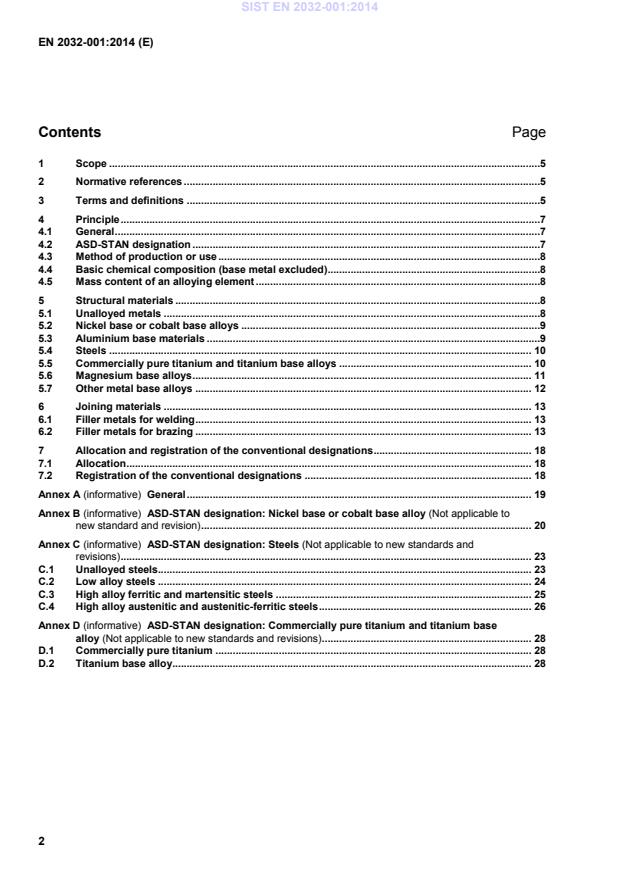
General . 19 Annex B (informative)
ASD-STAN designation: Nickel base or cobalt base alloy (Not applicable to new standard and revision) . 20 Annex C (informative)
ASD-STAN designation: Steels (Not applicable to new standards and revisions) . 23 C.1 Unalloyed steels. 23 C.2 Low alloy steels . 24 C.3 High alloy ferritic and martensitic steels . 25 C.4 High alloy austenitic and austenitic-ferritic steels . 26 Annex D (informative)
ASD-STAN designation: Commercially pure titanium and titanium base alloy (Not applicable to new standards and revisions) . 28 D.1 Commercially pure titanium . 28 D.2 Titanium base alloy. 28
1) Published as ASD-STAN Technical Report at the date of publication of this standard. http://www.asd-stan.org/ SIST EN 2032-001:2014
...