


EN 13598-1:2020
(Main)Plastics piping systems for non-pressure underground drainage and sewerage - Unplasticized poly(vinyl chloride) (PVC-U), polypropylene (PP) and polyethylene (PE) - Part 1: Specifications for ancillary fittings and shallow chambers
Plastics piping systems for non-pressure underground drainage and sewerage - Unplasticized poly(vinyl chloride) (PVC-U), polypropylene (PP) and polyethylene (PE) - Part 1: Specifications for ancillary fittings and shallow chambers
This document specifies the definitions and requirements for ancillary fittings and shallow chambers installed underground in non-pressure drainage and sewerage systems and manufactured from unplasticized poly(vinyl chloride) (PVC-U), polypropylene (PP), polypropylene with mineral modifier (PP-MD) or polyethylene (PE) intended for use for:
- non-pressure underground drainage and sewerage outside the building structure (application area code "U", and
- non-pressure underground drainage and sewerage for both buried in ground within the building structure (application area code "D" and outside the building structure.
This is reflected in the marking of products by "U" and "UD".
It also covers the jointing of the ancillary fittings and shallow chambers to the pipework system.
The ancillary fittings covered by this standard are the following:
- sealed access fittings;
- rodding point covers;
- rodding tees;
- mechanical saddles.
Ancillary fittings according to this document are intended for use in pedestrian areas, except rodding tees and mechanical saddles which can also be used in vehicular trafficked areas.
NOTE 1 Pedestrian areas are as defined in EN 124 1.
Ancillary fittings can be installed to a maximum depth of 6,0 m from ground level, with the exception of rodding point covers.
Shallow chambers according to this document are intended for use in private drains located in pedestrian areas above the ground water table, to a maximum depth of 2,0 m from ground level to the invert of the main channel. This document covers shallow chambers with flow profile bases, and their joints to the piping system.
NOTE 2 Manholes and inspection chambers are specified in FprEN 13598-2 [1].
Ancillary fittings and shallow chambers complying with this document also comply with the general requirements given in EN 476.
Ancillary fittings and shallow chambers can be manufactured by various methods e.g. injection moulding, rotational moulding, spiral winding or fabricated from components made to other standards.
NOTE 3 Products complying with this document can be used with pipes, fittings and other components conforming to any of the plastics products standards listed in Clause 2, providing their dimensions are compatible.
NOTE 4 Products complying with this document can be installed in underground applications without additional static calculation.
NOTE 5 Ancillary fittings and shallow chambers can be subject to national safety regulations and / or local provisions.
Kunststoff-Rohrleitungssysteme für erdverlegte drucklose Abwasserkanäle und ‑leitungen - Weichmacherfreies Polyvinylchlorid (PVC-U), Polypropylen (PP) und Polyethylen (PE) - Teil 1: Anforderungen an Zubehörteile und Schächte mit geringer Einbautiefe
Dieses Dokument legt die Begriffe für und Anforderungen an erdverlegte Zubehörteile und Schächte mit geringer Einbautiefe fest, die in drucklose Abwasserkanäle und leitungen eingebaut werden und aus weichmacherfreiem Polyvinylchlorid (PVC U), Polypropylen (PP), Polypropylen mit mineralischen Additiven (PP MD) oder Polyethylen (PE) hergestellt sind, vorgesehen für die Verwendung in:
- erdverlegten drucklosen Abwasserkanälen und leitungen außerhalb der Gebäudestruktur (Anwendungskennzeichen „U“) sowie
- erdverlegten drucklosen Abwasserkanälen und leitungen, die sowohl innerhalb der Gebäudestruktur (Anwendungskennzeichen „D“) als auch außerhalb der Gebäudestruktur unterirdisch verlegt werden.
Dies wird durch die Produktkennzeichnung „U“ bzw. „UD“ angezeigt.
Es behandelt auch den Anschluss der Zubehörteile und Schächte mit geringer Einbautiefe an das Rohrleitungssystem.
Diese Norm gilt für die folgenden Arten von Zubehörteilen:
- verschließbare Reinigungsrohre;
- Abdeckungen von Reinigungsöffnungen;
- Reinigungsformstücke;
- mechanische Sattelstücke.
Diesem Dokument entsprechende Zubehörteile sind für die Verwendung in Fußgängerbereichen vorgesehen. Dies gilt nicht für Reinigungsformstücke und mechanische Sattelstücke, die auch in Straßenverkehrsbereichen verwendet werden können.
ANMERKUNG 1 Fußgängerbereiche entsprechen der Begriffsbestimmung nach EN 124 1.
Zubehörteile können in einer Tiefe von maximal 6,0 m ab Geländeoberkante eingebaut werden, mit Ausnahme von Abdeckungen von Reinigungsöffnungen.
Diesem Dokument entsprechende Schächte mit geringer Einbautiefe sind für die Verwendung in privaten Abwasserleitungen vorgesehen. Diese befinden sich in Fußgängerbereichen über dem Grundwasserspiegel bis zu einer maximalen Tiefe von 2,0 m, gemessen ab Geländeoberkante bis zur Sohle der Hauptleitung. Dieses Dokument behandelt Schächte mit geringer Einbautiefe, die Schachtunterteile mit Gerinneausbildung aufweisen, sowie ihre Rohrverbindungen zum Rohrleitungssystem.
ANMERKUNG 2 Einsteigschächte und Kontrollschächte werden in EN 13598 2 [1] festgelegt.
Zubehörteile und Schächte mit geringer Einbautiefe nach dem vorliegenden Dokument erfüllen zusätzlich die in EN 476 gegebenen allgemeinen Anforderungen.
Zubehörteile und Schächte mit geringer Einbautiefe können in verschiedenen Verfahren wie z. B. Spritzguss, Rotationsgießen oder spiralförmiges Wickeln, oder auch handgefertigt aus Rohrleitungsteilen, die anderen Normen entsprechen, hergestellt werden.
ANMERKUNG 3 Produkte, die dem vorliegenden Dokument entsprechen, können mit Rohren, Formstücken und anderen Bauteilen verwendet werden, die sämtlichen in Abschnitt 2 aufgelisteten Normen für Kunststoffprodukte entsprechen, sofern die Maße einen Anschluss erlauben.
ANMERKUNG 4 Produkte, die dem vorliegenden Dokument entsprechen, können ohne zusätzliche statische Berechnung in erdverlegte Anwendungen eingebaut werden.
ANMERKUNG 5 Zubehörteile und Schächte mit geringer Einbautiefe können nationalen Sicherheitsvorschriften und/oder örtlichen Regelungen unterliegen.
Systèmes de canalisations en plastique pour les branchements et les collecteurs d’assainissement enterrés sans pression - Poly(chlorure de vinyle) non plastifié (PVC-U), polypropylène (PP) et polyéthylène (PE) - Partie 1: Spécifications relatives aux raccords auxiliaires et aux boîtes d'inspection de branchement peu profondes
Le présent document spécifie les définitions et les exigences relatives aux raccords auxiliaires et boîtes d’inspection et de branchement peu profondes, enterrés et mis en œuvre dans des systèmes de branchements et de collecteurs d’assainissement sans pression et fabriqués en poly(chlorure de vinyle) non plastifié (PVC-U), en polypropylène (PP), en polypropylène avec modificateurs minéraux (PP-MD) ou en polyéthylène (PE) destinés à être utilisés pour :
- les branchements et les collecteurs d’assainissement enterrés sans pression à l’extérieur de la structure du bâtiment (code de zone d’application « U ») ; et
- les branchements et les collecteurs d’assainissement enterrés sans pression aussi bien à l’intérieur de la structure du bâtiment (code de zone d’application « D ») qu’à l’extérieur de celle-ci.
Ceci est repéré au niveau du marquage des produits par « U » et « UD ».
Il couvre également l’assemblage des raccords auxiliaires et des boîtes d’inspection et de branchement peu profondes au système de canalisation.
Les raccords auxiliaires couverts par la présente norme sont les suivants :
- raccords d’accès scellés ;
- points de curage ;
- tés de curage ;
- selles mécaniques.
Les raccords auxiliaires selon le présent document sont destinés à être utilisés dans les zones piétonnes, à l'exception des tés de curage et des selles mécaniques qui peuvent également être utilisés dans les zones sous charges roulantes.
NOTE 1 Les zones piétonnes sont définies dans l'EN 124 1.
Les raccords auxiliaires peuvent être mis en œuvre jusqu’à une profondeur maximale de 6,0 m en dessous du niveau du sol, à l’exception des points de curage.
Les boîtes d’inspection et de branchement peu profondes selon le présent document sont destinées à être utilisées dans les branchements privés situés dans les zones piétonnes au-dessus de la nappe phréatique, jusqu’à une profondeur maximale de 2,0 m en dessous du niveau du sol jusqu’au fil d’eau de la cunette principale. Le présent document traite des boîtes d’inspection et de branchement peu profondes avec des éléments de fond à profil d’écoulement, et de leurs assemblages au système de canalisation.
NOTE 2 Les regards et boîtes d’inspection et de branchement sont spécifiés dans la EN 13598-2 [1].
Les raccords auxiliaires et les boîtes d’inspection et de branchement peu profondes conformes au présent document sont également conformes aux exigences générales données dans l’EN 476.
Les raccords auxiliaires et les boîtes d’inspection et de branchement peu profondes peuvent être fabriqués selon différentes méthodes, par exemple moulage par injection, moulage par rotation, enroulement en spirale ou façonnage à partir de composants fabriqués selon d’autres normes.
NOTE 3 Les produits conformes au présent document peuvent être utilisés avec des tubes, des raccords et d’autres composants conformes à l’une des normes de produits plastiques référencées à l’Article 2, dans la mesure où leurs dimensions sont compatibles.
NOTE 4 Les produits conformes au présent document peuvent être mis en œuvre dans des applications enterrées sans calculs statiques supplémentaires.
NOTE 5 Les raccords auxiliaires et les boîtes d’inspection et de branchement peu profondes peuvent être soumis aux réglementations de sécurité nationales et/ou aux dispositions locales.
Cevni sistemi iz polimernih materialov za odpadno vodo in kanalizacijo, ki delujejo po težnostnem principu in so položeni v zemljo - Nemehčan polivinilklorid (PVC-U), polipropilen (PP) in polietilen (PE) - 1. del: Specifikacije za pomožne fitinge in plitve revizijske jaške
General Information
- Status
- Published
- Publication Date
- 05-May-2020
- Withdrawal Date
- 29-Nov-2020
- Technical Committee
- CEN/TC 155 - Plastics piping systems and ducting systems
- Current Stage
- 6060 - Definitive text made available (DAV) - Publishing
- Start Date
- 06-May-2020
- Due Date
- 05-Feb-2021
- Completion Date
- 06-May-2020
Relations
- Effective Date
- 29-Aug-2018
- Effective Date
- 09-Oct-2024
Overview
EN 13598-1:2020 is a CEN European Standard for plastics piping systems used in non-pressure underground drainage and sewerage. It specifies definitions, material and performance requirements, jointing and marking for ancillary fittings and shallow chambers manufactured from PVC‑U, PP, PP‑MD or PE. The standard covers products intended for use outside buildings (application code “U”) and for combined inside/outside use (code “UD”) and is aimed at gravity drainage and sewerage systems.
Key topics and technical requirements
- Scope and marking
- Applies to ancillary fittings (sealed access fittings, rodding point covers, rodding tees, mechanical saddles) and shallow chambers.
- Products are marked to indicate application area “U” or “UD”.
- Materials
- Acceptable thermoplastics: unplasticized PVC (PVC‑U), polypropylene (PP), PP with mineral modifier (PP‑MD), and polyethylene (PE).
- Manufacture by injection moulding, rotational moulding, spiral winding or fabrication from compliant components.
- Installation limits
- Ancillary fittings: installation depth up to 6.0 m from ground level (except rodding point covers).
- Shallow chambers: for private drains in pedestrian areas, above the groundwater table, to a maximum depth of 2.0 m to the invert of the main channel.
- Performance and characteristics
- Requirements cover geometrical dimensions, mechanical and physical characteristics, sealing rings, adhesives, and jointing to the pipework system.
- Includes test methods and performance criteria (mechanical strength, tightness, resistance to vertical loading).
- Documentation and marking
- Minimum marking and additional documentation requirements for sealed access fittings, rodding tees, mechanical saddles and shallow chambers.
- Compatibility and conformity
- Products conforming to EN 13598‑1 also comply with the general requirements of EN 476 and may be used with pipes/fittings conforming to relevant plastics product standards when dimensions are compatible.
- Annexes
- Normative annexes address use of non‑virgin materials for shallow chambers, test methods for mechanical saddles, and vertical loading resistance.
Applications and users
- Targeted users: manufacturers, product designers, specifiers, civil and drainage engineers, utilities, installers, testing laboratories and authorities.
- Typical applications:
- Access points, rodding points and tees for sewer maintenance in pedestrian areas.
- Mechanical saddles and rodding tees for connections in vehicular trafficked areas (where permitted).
- Shallow inspection chambers for private drains and small networks above groundwater.
- Benefits: ensures consistent product performance, safe jointing to piping systems, clear marking for application area, and regulatory compliance across Europe.
Related standards
- EN 476 - General requirements for components used in drains and sewers
- EN 124 - Gully tops and manhole tops for vehicular and pedestrian areas
- EN 1401‑1, EN 1852‑1, EN 12666‑1 - material and system standards for PVC‑U, PP and PE drainage pipes and fittings
- EN 13598‑2 - Manholes and inspection chambers (separate part)
Keywords: EN 13598-1:2020, plastics piping systems, ancillary fittings, shallow chambers, PVC-U, PP, PE, non-pressure underground drainage, sewerage, rodding tee, mechanical saddle, sealed access fitting.



Frequently Asked Questions
EN 13598-1:2020 is a standard published by the European Committee for Standardization (CEN). Its full title is "Plastics piping systems for non-pressure underground drainage and sewerage - Unplasticized poly(vinyl chloride) (PVC-U), polypropylene (PP) and polyethylene (PE) - Part 1: Specifications for ancillary fittings and shallow chambers". This standard covers: This document specifies the definitions and requirements for ancillary fittings and shallow chambers installed underground in non-pressure drainage and sewerage systems and manufactured from unplasticized poly(vinyl chloride) (PVC-U), polypropylene (PP), polypropylene with mineral modifier (PP-MD) or polyethylene (PE) intended for use for: - non-pressure underground drainage and sewerage outside the building structure (application area code "U", and - non-pressure underground drainage and sewerage for both buried in ground within the building structure (application area code "D" and outside the building structure. This is reflected in the marking of products by "U" and "UD". It also covers the jointing of the ancillary fittings and shallow chambers to the pipework system. The ancillary fittings covered by this standard are the following: - sealed access fittings; - rodding point covers; - rodding tees; - mechanical saddles. Ancillary fittings according to this document are intended for use in pedestrian areas, except rodding tees and mechanical saddles which can also be used in vehicular trafficked areas. NOTE 1 Pedestrian areas are as defined in EN 124 1. Ancillary fittings can be installed to a maximum depth of 6,0 m from ground level, with the exception of rodding point covers. Shallow chambers according to this document are intended for use in private drains located in pedestrian areas above the ground water table, to a maximum depth of 2,0 m from ground level to the invert of the main channel. This document covers shallow chambers with flow profile bases, and their joints to the piping system. NOTE 2 Manholes and inspection chambers are specified in FprEN 13598-2 [1]. Ancillary fittings and shallow chambers complying with this document also comply with the general requirements given in EN 476. Ancillary fittings and shallow chambers can be manufactured by various methods e.g. injection moulding, rotational moulding, spiral winding or fabricated from components made to other standards. NOTE 3 Products complying with this document can be used with pipes, fittings and other components conforming to any of the plastics products standards listed in Clause 2, providing their dimensions are compatible. NOTE 4 Products complying with this document can be installed in underground applications without additional static calculation. NOTE 5 Ancillary fittings and shallow chambers can be subject to national safety regulations and / or local provisions.
This document specifies the definitions and requirements for ancillary fittings and shallow chambers installed underground in non-pressure drainage and sewerage systems and manufactured from unplasticized poly(vinyl chloride) (PVC-U), polypropylene (PP), polypropylene with mineral modifier (PP-MD) or polyethylene (PE) intended for use for: - non-pressure underground drainage and sewerage outside the building structure (application area code "U", and - non-pressure underground drainage and sewerage for both buried in ground within the building structure (application area code "D" and outside the building structure. This is reflected in the marking of products by "U" and "UD". It also covers the jointing of the ancillary fittings and shallow chambers to the pipework system. The ancillary fittings covered by this standard are the following: - sealed access fittings; - rodding point covers; - rodding tees; - mechanical saddles. Ancillary fittings according to this document are intended for use in pedestrian areas, except rodding tees and mechanical saddles which can also be used in vehicular trafficked areas. NOTE 1 Pedestrian areas are as defined in EN 124 1. Ancillary fittings can be installed to a maximum depth of 6,0 m from ground level, with the exception of rodding point covers. Shallow chambers according to this document are intended for use in private drains located in pedestrian areas above the ground water table, to a maximum depth of 2,0 m from ground level to the invert of the main channel. This document covers shallow chambers with flow profile bases, and their joints to the piping system. NOTE 2 Manholes and inspection chambers are specified in FprEN 13598-2 [1]. Ancillary fittings and shallow chambers complying with this document also comply with the general requirements given in EN 476. Ancillary fittings and shallow chambers can be manufactured by various methods e.g. injection moulding, rotational moulding, spiral winding or fabricated from components made to other standards. NOTE 3 Products complying with this document can be used with pipes, fittings and other components conforming to any of the plastics products standards listed in Clause 2, providing their dimensions are compatible. NOTE 4 Products complying with this document can be installed in underground applications without additional static calculation. NOTE 5 Ancillary fittings and shallow chambers can be subject to national safety regulations and / or local provisions.
EN 13598-1:2020 is classified under the following ICS (International Classification for Standards) categories: 23.040.05 - Pipeline and its parts for external sewage systems; 23.040.20 - Plastics pipes; 93.030 - External sewage systems. The ICS classification helps identify the subject area and facilitates finding related standards.
EN 13598-1:2020 has the following relationships with other standards: It is inter standard links to EN 13598-1:2010, prEN 13598-1. Understanding these relationships helps ensure you are using the most current and applicable version of the standard.
You can purchase EN 13598-1:2020 directly from iTeh Standards. The document is available in PDF format and is delivered instantly after payment. Add the standard to your cart and complete the secure checkout process. iTeh Standards is an authorized distributor of CEN standards.
Standards Content (Sample)
SLOVENSKI STANDARD
01-junij-2020
Nadomešča:
SIST EN 13598-1:2011
Cevni sistemi iz polimernih materialov za odpadno vodo in kanalizacijo, ki delujejo
po težnostnem principu in so položeni v zemljo - Nemehčan polivinilklorid (PVC-
U), polipropilen (PP) in polietilen (PE) - 1. del: Specifikacije za pomožne fitinge in
plitve revizijske jaške
Plastics piping systems for non-pressure underground drainage and sewerage -
Unplasticized poly(vinyl chloride) (PVC-U), polypropylene (PP) and polyethylene (PE) -
Part 1: Specifications for ancillary fittings and shallow chambers
Kunststoff-Rohrleitungssysteme für erdverlegte drucklose Abwasserkanäle und
‑leitungen - Weichmacherfreies Polyvinylchlorid (PVC-U), Polypropylen (PP) und
Polyethylen (PE) - Teil 1: Anforderungen an Schächte mit geringer Einbautiefe und
Zubehörteile
Systèmes de canalisations en plastique pour les branchements et les collecteurs
d’assainissement enterrés sans pression - Poly(chlorure de vinyle) non plastifié (PVC-U),
polypropylène (PP) et polyéthylène (PE) - Partie 1 : Spécifications relatives aux raccords
auxiliaires et aux boîtes de branchement peu profondes
Ta slovenski standard je istoveten z: EN 13598-1:2020
ICS:
23.040.05 Cevovodi za zunanje Pipeline and its parts for
sisteme za odpadno vodo in external sewage systems
njihovi deli
93.030 Zunanji sistemi za odpadno External sewage systems
vodo
2003-01.Slovenski inštitut za standardizacijo. Razmnoževanje celote ali delov tega standarda ni dovoljeno.
EN 13598-1
EUROPEAN STANDARD
NORME EUROPÉENNE
May 2020
EUROPÄISCHE NORM
ICS 23.040.05; 23.040.20; 93.030 Supersedes EN 13598-1:2010
English Version
Plastics piping systems for non-pressure underground
drainage and sewerage - Unplasticized poly(vinyl chloride)
(PVC-U), polypropylene (PP) and polyethylene (PE) - Part
1: Specifications for ancillary fittings and shallow
chambers
Systèmes de canalisations en plastique pour les Kunststoff-Rohrleitungssysteme für erdverlegte
branchements et les collecteurs d'assainissement drucklose Abwasserkanäle und -leitungen -
enterrés sans pression - Poly(chlorure de vinyle) non Weichmacherfreies Polyvinylchlorid (PVC-U),
plastifié (PVC-U), polypropylène (PP) et polyéthylène Polypropylen (PP) und Polyethylen (PE) - Teil 1:
(PE) - Partie 1: Spécifications relatives aux raccords Anforderungen an Schächte und Zubehörteile und
auxiliaires et aux boîtes d'inspection de branchement flache Kammern
peu profondes
This European Standard was approved by CEN on 14 March 2020.
CEN members are bound to comply with the CEN/CENELEC Internal Regulations which stipulate the conditions for giving this
European Standard the status of a national standard without any alteration. Up-to-date lists and bibliographical references
concerning such national standards may be obtained on application to the CEN-CENELEC Management Centre or to any CEN
member.
This European Standard exists in three official versions (English, French, German). A version in any other language made by
translation under the responsibility of a CEN member into its own language and notified to the CEN-CENELEC Management
Centre has the same status as the official versions.
CEN members are the national standards bodies of Austria, Belgium, Bulgaria, Croatia, Cyprus, Czech Republic, Denmark, Estonia,
Finland, France, Germany, Greece, Hungary, Iceland, Ireland, Italy, Latvia, Lithuania, Luxembourg, Malta, Netherlands, Norway,
Poland, Portugal, Republic of North Macedonia, Romania, Serbia, Slovakia, Slovenia, Spain, Sweden, Switzerland, Turkey and
United Kingdom.
EUROPEAN COMMITTEE FOR STANDARDIZATION
COMITÉ EUROPÉEN DE NORMALISATION
EUROPÄISCHES KOMITEE FÜR NORMUNG
CEN-CENELEC Management Centre: Rue de la Science 23, B-1040 Brussels
© 2020 CEN All rights of exploitation in any form and by any means reserved Ref. No. EN 13598-1:2020 E
worldwide for CEN national Members.
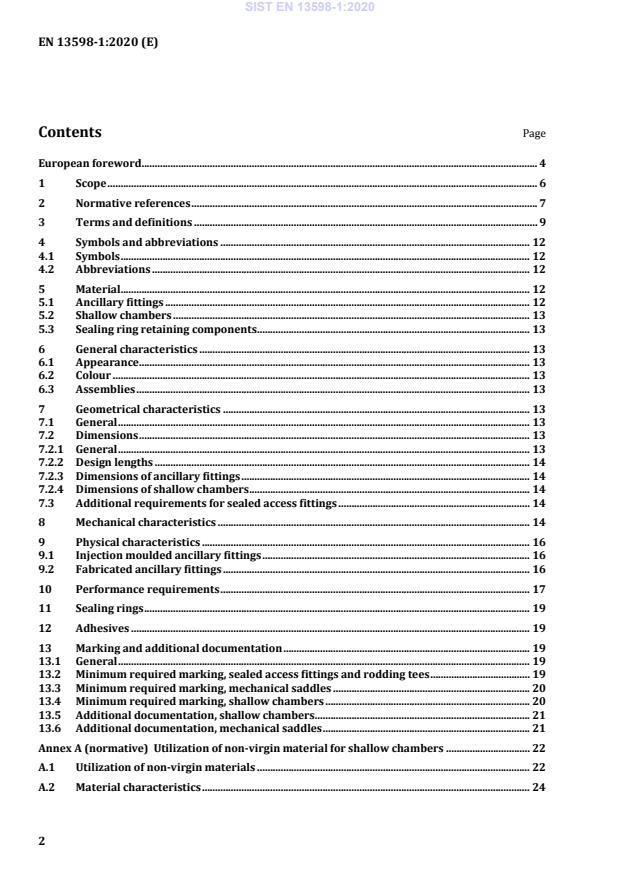
Contents Page
European foreword . 4
1 Scope . 6
2 Normative references . 7
3 Terms and definitions . 9
4 Symbols and abbreviations . 12
4.1 Symbols . 12
4.2 Abbreviations . 12
5 Material . 12
5.1 Ancillary fittings . 12
5.2 Shallow chambers . 13
5.3 Sealing ring retaining components . 13
6 General characteristics . 13
6.1 Appearance . 13
6.2 Colour . 13
6.3 Assemblies . 13
7 Geometrical characteristics . 13
7.1 General . 13
7.2 Dimensions . 13
7.2.1 General . 13
7.2.2 Design lengths . 14
7.2.3 Dimensions of ancillary fittings . 14
7.2.4 Dimensions of shallow chambers . 14
7.3 Additional requirements for sealed access fittings . 14
8 Mechanical characteristics . 14
9 Physical characteristics . 16
9.1 Injection moulded ancillary fittings . 16
9.2 Fabricated ancillary fittings . 16
10 Performance requirements . 17
11 Sealing rings . 19
12 Adhesives . 19
13 Marking and additional documentation . 19
13.1 General . 19
13.2 Minimum required marking, sealed access fittings and rodding tees . 19
13.3 Minimum required marking, mechanical saddles . 20
13.4 Minimum required marking, shallow chambers . 20
13.5 Additional documentation, shallow chambers . 21
13.6 Additional documentation, mechanical saddles . 21
Annex A (normative) Utilization of non-virgin material for shallow chambers . 22
A.1 Utilization of non-virgin materials . 22
A.2 Material characteristics . 24
Annex B (normative) Test methods for mechanical saddles . 26
B.1 General . 26
B.2 Test equipment . 26
B.3 Procedures . 27
B.3.1 Resistance to vertical load – pipe stop test . 27
B.3.2 Mechanical strength . 28
B.3.3 Tightness under deformation . 29
Annex C (normative) Resistance to vertical loading of shallow chambers . 31
Bibliography . 32
European foreword
This document (EN 13598-1:2020) has been prepared by Technical Committee CEN/TC 155 “Plastics
piping systems and ducting systems”, the secretariat of which is held by NEN.
This European Standard shall be given the status of a national standard, either by publication of an
identical text or by endorsement, at the latest by November 2020, and conflicting national standards shall
be withdrawn at the latest by November 2020.
Attention is drawn to the possibility that some of the elements of this document may be the subject of
patent rights. CEN shall not be held responsible for identifying any or all such patent rights.
This document supersedes EN 13598-1:2010.
Compared to the previous version, the main changes are listed below:
1) test methods have been updated to the latest EN ISO standards where applicable;
2) the scope has been amended to clarify the products covered in this part and avoid confusion with the
scope of part 2;
3) terms and definitions have been updated and also now include the product diagrams;
4) dimensional requirements have been updated and clarified;
5) the mechanical characteristics tables have been updated;
6) Annex A has been updated with requirements for the utilization of non-virgin materials for shallow
chambers.
This document is part of a System Standard for plastics piping systems of a particular material for a
specified application. There are a number of such System Standards.
System Standards are based on the results of the work being undertaken in ISO/TC 138 “Plastics pipes,
fittings and valves for the transport of fluids”, which is a Technical Committee of the International
Organization for Standardization (ISO).
They are supported by separate standards on test methods, to which references are made throughout the
System Standard.
The System Standards are consistent with general standards on functional requirements and on
recommended practice for installation.
EN 13598 consists of the following parts under the general title Plastics piping systems for non-pressure
underground drainage and sewerage — Unplasticized poly(vinyl chloride) (PVC-U), polypropylene (PP) and
polyethylene (PE):
— Part 1: Specifications for ancillary fittings and shallow chambers (this document);
— Part 2: Specifications for manholes and inspection chambers (under revision);
— Part 3: Guidance for assessment of conformity (CEN/TS under revision).
According to the CEN-CENELEC Internal Regulations, the national standards organisations of the
following countries are bound to implement this European Standard: Austria, Belgium, Bulgaria, Croatia,
Cyprus, Czech Republic, Denmark, Estonia, Finland, France, Germany, Greece, Hungary, Iceland, Ireland,
Italy, Latvia, Lithuania, Luxembourg, Malta, Netherlands, Norway, Poland, Portugal, Republic of North
Macedonia, Romania, Serbia, Slovakia, Slovenia, Spain, Sweden, Switzerland, Turkey and the United
Kingdom.
1 Scope
This document specifies the definitions and requirements for ancillary fittings and shallow chambers
installed underground in non-pressure drainage and sewerage systems and manufactured from
unplasticized poly(vinyl chloride) (PVC-U), polypropylene (PP), polypropylene with mineral modifier
(PP-MD) or polyethylene (PE) intended for use for:
— non-pressure underground drainage and sewerage outside the building structure (application area
code “U”), and
— non-pressure underground drainage and sewerage for both buried in ground within the building
structure (application area code “D”) and outside the building structure.
This is reflected in the marking of products by “U” and “UD”.
It also covers the jointing of the ancillary fittings and shallow chambers to the pipework system.
The ancillary fittings covered by this standard are the following:
— sealed access fittings;
— rodding point covers;
— rodding tees;
— mechanical saddles.
Ancillary fittings according to this document are intended for use in pedestrian areas, except rodding tees
and mechanical saddles which can also be used in vehicular trafficked areas.
NOTE 1 Pedestrian areas are as defined in EN 124-1.
Ancillary fittings can be installed to a maximum depth of 6,0 m from ground level, with the exception of
rodding point covers.
Shallow chambers according to this document are intended for use in private drains located in pedestrian
areas above the ground water table, to a maximum depth of 2,0 m from ground level to the invert of the
main channel. This document covers shallow chambers with flow profile bases, and their joints to the
piping system.
NOTE 2 Manholes and inspection chambers are specified in EN 13598-2 [1].
Ancillary fittings and shallow chambers complying with this document also comply with the general
requirements given in EN 476.
Ancillary fittings and shallow chambers can be manufactured by various methods e.g. injection moulding,
rotational moulding, spiral winding or fabricated from components made to other standards.
NOTE 3 Products complying with this document can be used with pipes, fittings and other components
conforming to any of the plastics products standards listed in Clause 2, providing their dimensions are compatible.
NOTE 4 Products complying with this document can be installed in underground applications without additional
static calculation.
NOTE 5 Ancillary fittings and shallow chambers can be subject to national safety regulations and / or local
provisions.
2 Normative references
The following documents are referred to in the text in such a way that some or all of their content
constitutes requirements of this document. For dated references, only the edition cited applies. For
undated references, the latest edition of the referenced document (including any amendments) applies.
EN 124 (series), Gully tops and manhole tops for vehicular and pedestrian areas
EN 295-3:2012, Vitrified clay pipe systems for drains and sewers - Part 3: Test methods
EN 476:2011, General requirements for components used in drains and sewers
EN 681-1, Elastomeric seals - Materials requirements for pipe joint seals used in water and drainage
applications - Part 1: Vulcanized rubber
EN 681-2, Elastomeric Seals — Materials requirements for pipe joint seals used in water and drainage
applications — Part 2: Thermoplastic elastomers
EN 681-3, Elastomeric seals — Materials requirements for pipe joint seals used in water and drainage
applications — Part 3: Cellular materials of vulcanized rubber
EN 681-4, Elastomeric seals — Materials requirements for pipe joint seals used in water and drainage
applications — Part 4: Cast polyurethane sealing elements
EN 1253-2:2015, Gullies for buildings - Part 2: Roof drains and floor gullies without trap
EN 1401-1, Plastics piping systems for non-pressure underground drainage and sewerage - Unplasticized
poly(vinyl chloride) (PVC-U) - Part 1: Specifications for pipes, fittings and the system
EN 1852-1, Plastics piping systems for non-pressure underground drainage and sewerage - Polypropylene
(PP) - Part 1: Specifications for pipes, fittings and the system
EN 1905, Plastics piping systems - Unplasticized poly(vinyl chloride) (PVC-U) pipes, fittings and material -
Method for assessment of the PVC content based on total chlorine content
EN 12099, Plastics piping systems - Polyethylene piping materials and components - Determination of
volatile content
EN 12666-1, Plastics piping systems for non-pressure underground drainage and sewerage — Polyethylene
(PE) — Part 1: Specifications for pipes, fittings and the system
EN 13476-1, Plastics piping systems for non-pressure underground drainage and sewerage - Structured-
wall piping systems of unplasticized poly(vinyl chloride) (PVC-U), polypropylene (PP) and polyethylene (PE)
- Part 1:General requirements and performance characteristics
EN 13476-2, Plastics piping systems for non-pressure underground drainage and sewerage - Structured-
wall piping systems of unplasticized poly(vinyl chloride) (PVC-U), polypropylene (PP) and polyethylene (PE)
- Part 2: Specifications for pipes and fittings with smooth internal and external surface and the system, Type
A
EN 13476-3, Plastics piping systems for non-pressure underground drainage and sewerage - Structured-
wall piping systems of unplasticized poly(vinyl chloride) (PVC-U), polypropylene (PP) and polyethylene (PE)
- Part 3: Specifications for pipes and fittings with smooth internal and profiled external surface and the
system, Type B
EN 14680, Adhesives for non-pressure thermoplastics piping systems - Specifications
EN 14814, Adhesives for thermoplastic piping systems for fluids under pressure - Specifications
EN 14758-1, Plastics piping systems for non-pressure underground drainage and sewerage - Polypropylene
with mineral modifiers (PP-MD) - Part 1: Specifications for pipes, fittings and the system
EN ISO 472, Plastics - Vocabulary (ISO 472:2013)
EN ISO 1043-1, Plastics - Symbols and abbreviated terms - Part 1: Basic polymers and their special
characteristics (ISO 1043-1:2011)
EN ISO 1133-1, Plastics - Determination of the melt mass-flow rate (MFR) and melt volume-flow rate (MVR)
of thermoplastics - Part 1: Standard method (ISO 1133-1:2011)
EN ISO 1183-1, Plastics - Methods for determining the density of non-cellular plastics - Part 1: Immersion
method, liquid pycnometer method and titration method (ISO 1183-1:2019, Corrected version 2019-05)
EN ISO 1183-2, Plastics - Methods for determining the density of non-cellular plastics - Part 2: Density
gradient column method (ISO 1183-2:2019)
EN ISO 2507-1, Thermoplastics pipes and fittings - Vicat softening temperature - Part 1: General test
method (ISO 2507-1:1995)
EN ISO 3126, Plastics piping systems - Plastics components - Determination of dimensions (ISO 3126:2005)
EN ISO 3451-1, Plastics - Determination of ash - Part 1: General methods (ISO 3451-1:2019)
EN ISO 3451-5, Plastics - Determination of ash - Part 5: Poly(vinyl chloride) (ISO 3451-5:2002)
EN ISO 11357-6, Plastics - Differential scanning calorimetry (DSC) - Part 6: Determination of oxidation
induction time (isothermal OIT) and oxidation induction temperature (dynamic OIT) (ISO 11357-6:2018)
EN ISO 13254, Thermoplastics piping systems for non-pressure applications - Test method for
watertightness (ISO 13254:2010)
EN ISO 13257:2017, Thermoplastics piping systems for non-pressure applications — Test method for
resistance to elevated temperature cycling (ISO 13257:2010)
EN ISO 13259, Thermoplastics piping systems for underground non-pressure applications - Test method for
leaktightness of elastomeric sealing ring type joints (ISO 13259:2018)
EN ISO 13263, Thermoplastics piping systems for non-pressure underground drainage and sewerage -
Thermoplastics fittings - Test method for impact strength (ISO 13263:2010)
EN ISO 13264, Thermoplastics piping systems for non-pressure underground drainage and sewerage -
Thermoplastics fittings - Test method for mechanical strength or flexibility of fabricated fittings (ISO
13264:2010)
ISO 13268, Thermoplastics piping systems for non-pressure underground drainage and sewerage —
Thermoplastics shafts or risers for inspection chambers and manholes — Determination of ring stiffness
3 Terms and definitions
For the purposes of this document, the terms and definitions given in EN ISO 472, EN ISO 1043-1 and the
following apply.
ISO and IEC maintain terminological databases for use in standardization at the following addresses:
— IEC Electropedia: available at http://www.electropedia.org/
— ISO Online browsing platform: available at https://www.iso.org/obp
3.1
private drain
drainage (discharge) system which is not a part of the public drain or sewer
3.2
sealed access fitting
fitting that permits entry into the system for rodding or inspection and that has a sealed cover
Note 1 to entry: Figure 1 shows examples of sealed access fittings, other designs are possible.
Note 2 to entry: Sealed access fittings are typically buried to a depth of 2m or installed up to 6m when installed
within a chamber
3.3
rodding point cover
fitting installed at ground level with a removable cover that permits the introduction of equipment for
inspection and the clearance of blockages
Note 1 to entry: Figure 2 shows examples of rodding point covers, other designs are possible.
3.4
rodding tee
fitting installed in a drainage or sewerage system that connects to a rodding point at ground level that
permits the introduction of equipment for the clearance of blockages, and also equipment for the
inspection of the connecting pipe work in one or more directions
Note 1 to entry: Figure 3 shows an example of a rodding tee, other designs are possible.
3.5
mechanical saddle
fitting that enables a branch connection to be made to buried drainage/sewerage systems of larger
diameter by cutting a hole in the larger pipe and is retained in position by mechanical means
Note 1 to entry: Figure 4 shows examples of mechanical saddles, other designs are possible.
Note 2 to entry: Preferred nominal angles for mechanical saddle branches are 45° and 90°.
3.6
shallow chamber
fitting installed to a maximum depth of 2,0 m from ground level to the invert of the main channel that
permits the introduction of equipment for the clearance of blockages, cleaning and inspection from
surface level, but does not provide access for personnel and which terminates at ground level with a riser
shaft of DN/ID 180 minimum and DN/ID of less than 800
Note 1 to entry: See also EN 476 for non-circular chambers.
Note 2 to entry: Figure 5 shows examples of shallow chambers, other designs are possible.
3.7
base
bottom part of a shallow chamber, including integrally formed channels with benching as appropriate
Note 1 to entry: In case of a one-piece shallow chamber, for testing purposes the base component ends at a
distance of minimum 300 mm measured from the top of the main channel. Above 300 mm the section should be
considered as a riser and tested accordingly.
Note 2 to entry: The benching is the transition between the formed channel and the inside wall of the base.
3.8
riser
component which is connected onto a base and which defines the nominal size of the shallow chamber
Note 1 to entry: The riser can be supplied either as one or more separate items, for site jointing to the base, or
integrated with the base.
Note 2 to entry: In case of a one-piece shallow chamber, for testing purposes the riser component starts at a
distance of minimum 300 mm measured from the top of the main channel. Below 300 mm the section should be
considered as a base and tested accordingly.
3.9
fabricated fitting
fitting produced from pipe and/or from injection-moulded fittings by thermoforming, adhesive joint or
welding
3.10
virgin material
material in a form such as granules or powder that has not been subjected to use or processing other than
that required for its manufacture and to which no reprocessed or recycled material has been added
Note 1 to entry: It is understood that the addition of additives such as stabilizers and pigments is still resulting
into a virgin material.
3.11
own reprocessed material
material prepared from unused products, including trimmings from the production, that will be
reprocessed in a manufacturer’s plant after having been previously processed by the same manufacturer
3.12
recycled material
material prepared from used thermoplastic products which have been cleaned and crushed or ground
3.13
agreed specification
specification of the relevant material characteristics agreed between the supplier of the non-virgin
material and the manufacturer
Figure 1 — Examples of sealed access fittings
Figure 2 — Examples of rodding point covers
Figure 3 — Example of a rodding tee
Figure 4 — Examples of mechanical saddles
Figure 5 — Examples of shallow chambers
4 Symbols and abbreviations
4.1 Symbols
For the purposes of this document, the following symbols apply.
A length of engagement
d mean outside diameter
em
d nominal outside diameter
n
d mean inside diameter of socket
sm
e minimum wall thickness
min
e2 wall thickness of a socket
e wall thickness in the groove area
L length of spigot
y determined value when tested
4.2 Abbreviations
For the purposes of this document, the following abbreviations apply.
DN nominal size
DN/ID nominal size, inside diameter related
DN/OD nominal size, outside diameter related
DSC differential scanning calorimetry
IR infrared
MFR melt mass-flow rate
NA not applicable
OIT oxidation induction time
PE polyethylene
PP polypropylene
PP-MD polypropylene modified with minerals
PVC-U unplasticized poly(vinyl chloride)
SDR standard dimension ratio
SN nominal ring stiffness
5 Material
5.1 Ancillary fittings
The material shall conform to EN 1401-1, EN 1852-1, EN 12666-1, EN 13476-1, EN 13476-3 or
EN 14758-1 as applicable, including use of non-virgin material.
5.2 Shallow chambers
The material shall conform to EN 1401-1, EN 1852-1, EN 12666-1, EN 13476-1, EN 13476-3 or
EN 14758-1 as applicable, including use of non-virgin material.
Alternatively non-virgin material may also be used up to 100 % in accordance with the conditions and
requirements in Annex A.
5.3 Sealing ring retaining components
It is permitted that sealing rings are retained using means made from polymers other than PVC-U, PP or
PE.
6 General characteristics
6.1 Appearance
When viewed without magnification the following requirements apply:
— the internal and external surfaces shall be smooth, clean and free from grooving, blistering,
impurities and pores and any other surface irregularity likely to prevent their conformity with this
standard;
— spigots shall be cleanly cut and the ends of pipes and fittings shall be square to their axis.
6.2 Colour
Ancillary fittings if manufactured in layers shall have their surface layers coloured throughout. The
outside layer of ancillary fittings should preferably be black, orange brown (approximately RAL 8023 [2])
or dusty grey (approximately RAL 7037 [2]). Other colours may be used.
6.3 Assemblies
Ancillary fitting assemblies can be a combination of two or more plastics components, provided that all
other requirement of this standard are met.
Components of other than plastics materials shall conform to the relevant European Standards.
7 Geometrical characteristics
7.1 General
All dimensions shall be measured in accorda
...
The standard EN 13598-1:2020 focuses on the specifications for ancillary fittings and shallow chambers used in non-pressure underground drainage and sewerage systems, specifically crafted from unplasticized poly(vinyl chloride) (PVC-U), polypropylene (PP), and polyethylene (PE). The scope is comprehensive, detailing the definitions and requirements necessary for ensuring that these fittings are suitable for various applications, including those located within and outside building structures. One significant strength of this standard is its thoroughness in addressing the compatibility of materials. By allowing for the use of PP with mineral modifier (PP-MD) and specifying the interconnectedness with other plastics product standards, it ensures manufacturers can maintain product integrity across a variety of applications. This adaptability is crucial in real-world settings where diverse materials interact within drainage systems. Moreover, the standard provides clear markings for products intended for specific applications, denoting the distinctions between fittings suitable for pedestrian areas versus those that may also be employed in vehicular trafficked environments. This clarity aids manufacturers and builders in selecting appropriate fittings tailored to their project needs while adhering to safety regulations. The installation guidance included in EN 13598-1:2020, allowing ancillary fittings to be installed to a depth of up to 6.0 m and shallow chambers up to 2.0 m, covers crucial safety and operational considerations. Importantly, the standard states that no additional static calculations are necessary for underground applications, simplifying the installation process and reducing the potential for errors, which is a considerable advantage in fast-paced construction environments. Focusing on quality control, the standard also emphasizes the manufacturing methods that can be used for ancillary fittings and shallow chambers, promoting best practices in production. Furthermore, the compliance with general requirements outlined in EN 476 ensures that these fittings not only meet specific performance criteria but also adhere to broader safety and reliability standards. The EN 13598-1:2020 document ultimately serves as a critical framework for manufacturers and engineers involved in the construction and maintenance of drainage and sewerage systems. Its relevance is heightened by the increasing demand for effective drainage solutions that accommodate modern infrastructure's complexities, ensuring compliance within varying regulatory environments. Overall, this standard provides a robust foundation for ensuring that ancillary fittings and shallow chambers are safe, durable, and effective in their designated applications.
EN 13598-1:2020 표준은 비압력 지하 배수 및 하수 시스템에 사용되는 비가소성 폴리염화비닐(PVC-U), 폴리프로필렌(PP), 미네랄 수정 폴리프로필렌(PP-MD), 및 폴리에틸렌(PE)으로 제작된 보조 장비 및 얕은 챔버의 정의와 요구 사항을 명확히 규정하고 있습니다. 이 문서는 비압력 지하 배수 및 하수 시스템에서 설치되는 보조 장비와 얕은 챔버의 사양을 제공하며, 건물 구조 외부 및 내부에 설치될 수 있는 방법에 대한 구체적인 코드를 포함하고 있습니다. 이 표준의 강점은 다양한 구성 요소의 통합성을 보장하며, "U" 및 "UD" 마킹을 통해 사용자에게 명확한 정보 제공을 통해 다양한 환경에서 제품의 사용 가능성을 높인다는 것입니다. 또한, 보조 장비는 보행자 지역에 설치되도록 설계되어 있으며, 차량 통행 지역에서도 사용할 수 있는 특정 제품을 포함하고 있어 실용성을 더합니다. 얕은 챔버는 개인 배수 시스템에서 최대 2.0m 깊이까지 설치할 수 있도록 규정되어 있으며, 흐름 프로파일 바닥을 포함한 다양한 설계가 가능합니다. 이 표준은 EN 476에서 제시된 일반 요구 사항과 결합하여 보다 넓은 규제 준수를 가능하게 하며, 다양한 제조 방법을 통한 제품의 유연성을 보장합니다. 특히, 이 표준은 설치 전 추가적인 정적 계산이 필요하지 않아 비용 및 시간 절약 효과를 가질 수 있으며, 국가 안전 규정 및 지역 규정의 적용을 받을 수 있도록 설계되었습니다. 이러한 점에서 EN 13598-1:2020 표준은 비압력 지하 배수 및 하수 시스템 설계와 설치에 관련된 모든 분야에서 중요한 기준으로 작용할 수 있습니다.
この標準文書EN 13598-1:2020は、圧力がかからない地下排水および下水道システムに使用される非可塑化ポリ塩化ビニル(PVC-U)、ポリプロピレン(PP)、およびポリエチレン(PE)から製造された付属金具および浅い室の仕様を規定しています。本標準の範囲は、地下に設置される付属金具と浅い室の定義や要件を明確にし、特に非圧力地下排水および下水道システムの重要性を強調しています。 この標準の強みは、製品の示標による識別システムにあり、「U」と「UD」のマークを使用することで、建物の外部および内部での適用範囲を明確にしています。これにより、建設業者や設計者は、使用する適切な部品を簡単に識別できるため、効率的な施工が可能になります。また、歩行者エリア用の設計が含まれており、特にトラフィックのない地域において使用されることを意図しているため、安全基準を満たす重要な文書となっています。 浅い室は、地下水位より上にある民間の排水に使用され、最大深度は地面から2.0mです。この点において、製品の使用が確立された基準に従っており、業界全体での一貫性と互換性が保たれています。また、異なる製造方法(射出成形、回転成形、スパイラル巻きなど)を利用できるため、多様なアプローチでの製品開発が可能になり、競争力のある市場を形成しています。 加えて、付属金具と浅い室は、EN 476の一般的要件にも準拠しており、製品が他のプラスチック製品基準と互換性を持つことを保証しています。これにより、様々なコンポーネントと組み合わせて使用することができ、柔軟性を提供します。 この標準は、適切な固定計算なしで地下アプリケーションに設置できる可能性があり、現場での作業を一層効率化するとともに、安全規制や地域の規定に対する柔軟性も持っています。このように、EN 13598-1:2020は、現代の地下排水および下水道システムに必要な要件を包括的に満たし、業界の信頼性と安全性を高めるために重要な役割を果たしています。
Questions, Comments and Discussion
Ask us and Technical Secretary will try to provide an answer. You can facilitate discussion about the standard in here.
Loading comments...