


EN 1964-2:2001
(Main)Transportable gas cylinders - Specification for the design and construction of refillable transportable seamless steel gas cylinders of water capacities from 0,5 litre up to and including 150 litres - Part 2: Cylinders made of seamless steel with an Rm value of 1100 MPa and above
Transportable gas cylinders - Specification for the design and construction of refillable transportable seamless steel gas cylinders of water capacities from 0,5 litre up to and including 150 litres - Part 2: Cylinders made of seamless steel with an Rm value of 1100 MPa and above
This European Standard sets out minimum requirements for the material, design, construction and workmanship, manufacturing processes and tests at manufacture of refillable transportable seamless steel gas cylinders of water capacities from 0,5 litres up to and including 150 litres for compressed, liquefied and dissolved gases.
This standard is applicable to cylinders with a value of Rm max. ³ 1 100 MPa. It does not cover cylinders with diameters > 140 mm where either Rm max. > 1 300 MPa or the design wall thickness > 12 mm. It also does not cover cylinders with diameters £ 140 mm where either Rm max ³ 1 400 MPa or the design wall thickness ³ 6 mm, because beyond these limits additional requirements could possibly apply.
NOTE 1 For compatibility with the intended gas service and operational conditions, of grades and strength ranges of steels used for cylinder manufacture, see 4.1.4.
NOTE 2 This standard is also suitable for the manufacture of cylinders of water capacity less than 0,5 litre.
Ortsbewegliche Gasflachen - Gestaltung und Konstruktion von nahtlosen wiederbefüllbaren ortsbeweglichen Gasflaschen aus Stahl mit einem Fassungsraum von 0,5 Liter bis einschließlich 150 Liter - Teil 2: Nahtlose Flaschen aus Stahl mit einem Rm-Wert von 1100 MPa und darüber
Diese Norm legt Mindestanforderungen bezüglich Werkstoff, der Gestaltung, Konstruktion und Verfahren, Herstellungsprozesse und Versuche bei der Herstellung von wiederbefüllbaren nahtlosen ortsbeweglichen Gasflaschen aus Stahl mit einem Fassungsraum ab 0,5 l bis einschließlich 150 l für verdichtete, verflüssigte und unter Druck gelöste Gase fest.
Diese Norm gilt für Gasflaschen mit einem Wert von Rm max 1 100 MPa. Sie gilt nicht für Gasflaschen mit einem Durchmesser > 140 mm wo entweder der Wert von. Rm max > 1 300 MPa oder die Auslegungswanddicke > 12 mm ist. Sie gilt auch nicht für Flaschen mit einem Durchmesser 140 mm wo entweder Rm max 1 400 MPa oder die Auslegungswanddicke 6 mm ist, weil außerhalb dieser Grenzen möglicherweise zusätzliche Anforderungen anzuwenden wären.
ANMERKUNG 1 Für die Verträglichkeit von Güte- und Festigkeitsbereichen von Stählen, die bei der Gasflaschenherstellung verwendet werden und für den vorgesehenen Gasbetrieb und die vorgesehenen Betriebsbedingungen geeignet sein müssen, siehe 4.1.4.
ANMERKUNG 2 Diese Norm ist auch geeignet für die Herstellung von Flaschen mit einem Fassungsraum kleiner als 0,5 l.
Bouteilles à gaz transportables - Spécifications pour la conception et la fabrication de bouteilles à gaz rechargeables et transportables, en acier sans soudure, de capacité en eau comprise entre 0,5 litre et 150 litres inclus - Partie 2: bouteilles en acier sans soudure d'une valeur Rm égale ou supérieure à 1100 MPa
Domaine d'application
La présente Norme européenne définit les exigences minimales concernant le matériau, la conception, la construction et l'exécution, les modes de fabrication et les essais lors de la fabrication des bouteilles à gaz rechargeables et transportables, en acier sans soudure, d'une capacité en eau comprise entre 0,5 litre et 150 litres inclus destinées aux gaz comprimés, liquéfiés et dissous.
La présente norme s'applique aux bouteilles d'une valeur maximale de Rm * 1 100 MPa. Elle ne concerne ni les bouteilles d'une valeur maximale de Rm > 1 300 MPa, de diamètre > 140 mm ou d'une épaisseur de paroi théorique dépassant 12 mm, ni les bouteilles d'une valeur maximale de Rm * 1 400 MPa, de diamètre * 140 mm ou d'une épaisseur de paroi théorique * 6 mm parce que au-delà de ces limites, des exigences supplémentaires peuvent s'appliquer.
NOTE 1 Pour la compatibilité des nuances et des valeurs de résistance des aciers utilisés dans la fabrication des bouteilles avec l'usage prévu du gaz et avec les conditions d'exploitation, voir 4.1.4.
NOTE 2 La présente norme s'applique également à la fabrication des bouteilles d'une capacité en eau inférieure à 0,5 litre.
Premične plinske jeklenke - Specifikacije za zasnovo in izdelavo ponovno polnljivih jeklenk iz celega iz jekla z vodno prostornino med 0,5 in vključno 150 litri - 2. del: Jeklenke iz celega iz jekla z Rm > 1100 MPa
General Information
- Status
- Withdrawn
- Publication Date
- 18-Sep-2001
- Withdrawal Date
- 14-Apr-2010
- Technical Committee
- CEN/TC 23 - Transportable gas cylinders
- Drafting Committee
- CEN/TC 23/SC 1/WG 1 - Seamless steel cylinders
- Current Stage
- 9960 - Withdrawal effective - Withdrawal
- Start Date
- 15-Apr-2010
- Completion Date
- 15-Apr-2010
Relations
- Effective Date
- 08-Jun-2022
- Effective Date
- 28-Jan-2026



Get Certified
Connect with accredited certification bodies for this standard

Institut za varilstvo d.o.o. (Welding Institute)
Slovenia's leading welding institute since 1952. ISO 3834, EN 1090, pressure equipment certification, NDT personnel, welder qualification. Only IIW Au
Sponsored listings
Frequently Asked Questions
EN 1964-2:2001 is a standard published by the European Committee for Standardization (CEN). Its full title is "Transportable gas cylinders - Specification for the design and construction of refillable transportable seamless steel gas cylinders of water capacities from 0,5 litre up to and including 150 litres - Part 2: Cylinders made of seamless steel with an Rm value of 1100 MPa and above". This standard covers: This European Standard sets out minimum requirements for the material, design, construction and workmanship, manufacturing processes and tests at manufacture of refillable transportable seamless steel gas cylinders of water capacities from 0,5 litres up to and including 150 litres for compressed, liquefied and dissolved gases. This standard is applicable to cylinders with a value of Rm max. ³ 1 100 MPa. It does not cover cylinders with diameters > 140 mm where either Rm max. > 1 300 MPa or the design wall thickness > 12 mm. It also does not cover cylinders with diameters £ 140 mm where either Rm max ³ 1 400 MPa or the design wall thickness ³ 6 mm, because beyond these limits additional requirements could possibly apply. NOTE 1 For compatibility with the intended gas service and operational conditions, of grades and strength ranges of steels used for cylinder manufacture, see 4.1.4. NOTE 2 This standard is also suitable for the manufacture of cylinders of water capacity less than 0,5 litre.
This European Standard sets out minimum requirements for the material, design, construction and workmanship, manufacturing processes and tests at manufacture of refillable transportable seamless steel gas cylinders of water capacities from 0,5 litres up to and including 150 litres for compressed, liquefied and dissolved gases. This standard is applicable to cylinders with a value of Rm max. ³ 1 100 MPa. It does not cover cylinders with diameters > 140 mm where either Rm max. > 1 300 MPa or the design wall thickness > 12 mm. It also does not cover cylinders with diameters £ 140 mm where either Rm max ³ 1 400 MPa or the design wall thickness ³ 6 mm, because beyond these limits additional requirements could possibly apply. NOTE 1 For compatibility with the intended gas service and operational conditions, of grades and strength ranges of steels used for cylinder manufacture, see 4.1.4. NOTE 2 This standard is also suitable for the manufacture of cylinders of water capacity less than 0,5 litre.
EN 1964-2:2001 is classified under the following ICS (International Classification for Standards) categories: 23.020.30 - Pressure vessels, gas cylinders; 23.020.35 - Gas cylinders. The ICS classification helps identify the subject area and facilitates finding related standards.
EN 1964-2:2001 has the following relationships with other standards: It is inter standard links to EN ISO 9809-2:2010, EN 12205:2001. Understanding these relationships helps ensure you are using the most current and applicable version of the standard.
EN 1964-2:2001 is associated with the following European legislation: EU Directives/Regulations: 94/55/EC, 96/49/EC, 96/86/EC, 96/87/EC, TRRTP121; Standardization Mandates: M/086. When a standard is cited in the Official Journal of the European Union, products manufactured in conformity with it benefit from a presumption of conformity with the essential requirements of the corresponding EU directive or regulation.
EN 1964-2:2001 is available in PDF format for immediate download after purchase. The document can be added to your cart and obtained through the secure checkout process. Digital delivery ensures instant access to the complete standard document.
Standards Content (Sample)
2003-01.Slovenski inštitut za standardizacijo. Razmnoževanje celote ali delov tega standarda ni dovoljeno.SRQRYQROrtsbewegliche Gasflachen - Gestaltung und Konstruktion von nahtlosen wiederbefüllbaren ortsbeweglichen Gasflaschen aus Stahl mit einem Fassungsraum von 0,5 Liter bis einschließlich 150 Liter - Teil 2: Nahtlose Flaschen aus Stahl mit einem Rm-Wert von 1100 MPa und darüberBouteilles a gaz transportables - Spécifications pour la conception et la fabrication de bouteilles a gaz rechargeables et transportables, en acier sans soudure, de capacité en eau comprise entre 0,5 litre et 150 litres inclus - Partie 2: bouteilles en acier sans soudure d'une valeur Rm égale ou supérieure a 1100 MPaTransportable gas cylinders - Specification for the design and construction of refillable transportable seamless steel gas cylinders of water capacities from 0,5 litre up to and including 150 litres - Part 2: Cylinders made of seamless steel with an Rm value of 1100 MPa and above23.020.30MHNOHQNHPressure vessels, gas cylindersICS:Ta slovenski standard je istoveten z:EN 1964-2:2001SIST EN 1964-2:2002en01-maj-2002SIST EN 1964-2:2002SLOVENSKI
STANDARD
EUROPEAN STANDARDNORME EUROPÉENNEEUROPÄISCHE NORMEN 1964-2September 2001ICS 23.020.30English versionTransportable gas cylinders - Specification for the design andconstruction of refillable transportable seamless steel gascylinders of water capacities from 0,5 litre up to and including150 litres - Part 2: Cylinders made of seamless steel with an Rmvalue of 1100 MPa and aboveBouteilles à gaz transportables - Spécifications pour laconception et la fabrication de bouteilles à gazrechargeables et transportables, en acier sans soudure, decapacité en eau comprise entre 0,5 litre et 150 litres inclus- Partie 2: bouteilles en acier sans soudure d'une valeur Rmégale ou supérieure à 1100 MPaOrtsbewegliche Gasflachen - Gestaltung und Konstruktionvon nahtlosen wiederbefüllbaren ortsbeweglichenGasflaschen aus Stahl mit einem Fassungsraum von 0,5Liter bis einschließlich 150 Liter - Teil 2: Nahtlose Flaschenaus Stahl mit einem Rm-Wert von 1100 MPa und darüberThis European Standard was approved by CEN on 11 August 2001.CEN members are bound to comply with the CEN/CENELEC Internal Regulations which stipulate the conditions for giving this EuropeanStandard the status of a national standard without any alteration. Up-to-date lists and bibliographical references concerning such nationalstandards may be obtained on application to the Management Centre or to any CEN member.This European Standard exists in three official versions (English, French, German). A version in any other language made by translationunder the responsibility of a CEN member into its own language and notified to the Management Centre has the same status as the officialversions.CEN members are the national standards bodies of Austria, Belgium, Czech Republic, Denmark, Finland, France, Germany, Greece,Iceland, Ireland, Italy, Luxembourg, Netherlands, Norway, Portugal, Spain, Sweden, Switzerland and United Kingdom.EUROPEAN COMMITTEE FOR STANDARDIZATIONCOMITÉ EUROPÉEN DE NORMALISATIONEUROPÄISCHES KOMITEE FÜR NORMUNGManagement Centre: rue de Stassart, 36
B-1050 Brussels© 2001 CENAll rights of exploitation in any form and by any means reservedworldwide for CEN national Members.Ref. No. EN 1964-2:2001 ESIST EN 1964-2:2002
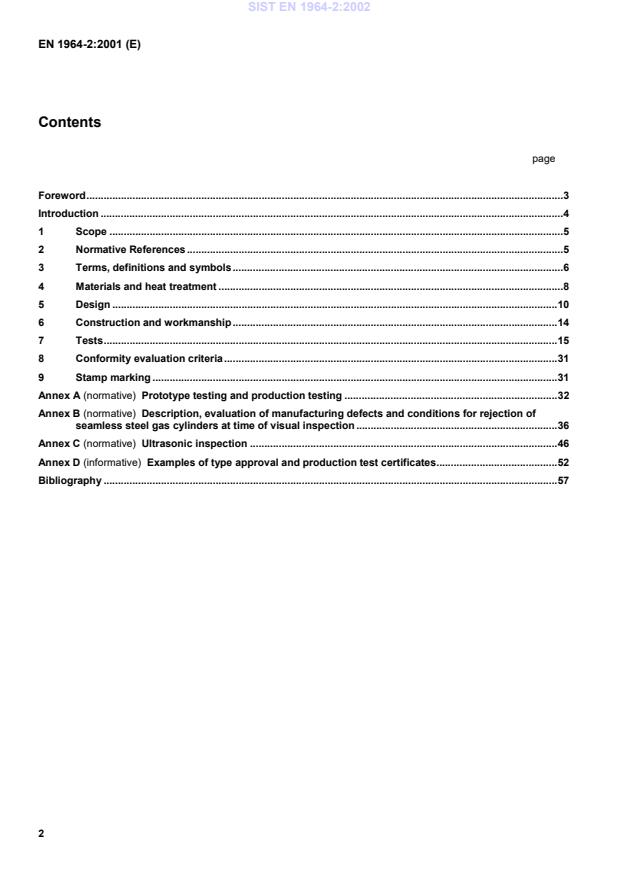
Prototype testing and production testing.32Annex B (normative)
Description, evaluation of manufacturing defects and conditions for rejection ofseamless steel gas cylinders at time of visual inspection.36Annex C (normative)
Ultrasonic inspection.46Annex D (informative)
Examples of type approval and production test certificates.52Bibliography.57SIST EN 1964-2:2002
1 100 MPa. It does not cover cylinders withdiameters > 140 mm where either Rm max. > 1 300 MPa or the design wall thickness
12 mm. It also does notcover cylinders with diameters
140 mm where either Rm max
1 400 MPa or the design wall thickness
6 mm,because beyond these limits additional requirements could possibly apply.NOTE 1For compatibility with the intended gas service and operational conditions, of grades and strength ranges of steelsused for cylinder manufacture, see 4.1.4.NOTE 2This standard is also suitable for the manufacture of cylinders of water capacity less than 0,5 litre.2 Normative ReferencesThis European Standard incorporates, by dated or undated reference, provisions from other publications. Thesenormative references are cited at the appropriate places in the text and the publications are listed hereafter.
Fordated references, subsequent amendments to or revisions of any of these publications apply to this EuropeanStandard only when incorporated in it by amendment or revision. For undated references the latest edition of thepublication referred to applies (including amendments).EN 473, Non destructive testing - Qualification and certification of NDT personnel — General principlesEN 10028-1,
Flat products made of steels for pressure purposes — Part 1: General requirementsEN 1089-1: 1996, Transportable gas cylinders — Gas cylinder identification (excluding LPG) — Part 1:StampmarkingEN 10002-1, Metallic materials — Tensile testing — Part 1: Method of test (at ambient temperature)EN ISO 6506-1, Metallic materials — Brinell hardness test — Part 1: Test method (ISO 6506-1:1999)EN 10045-1, Metallic materials — Charpy impact test — Part 1: Test methodEN 10052, Vocabulary of heat treatment terms for ferrous productsEN ISO 6508-1, Metallic materials — Rockwell hardness test — Part 1: Test method (scales A, B, C, D, E, F, G, H,K, N, T) (ISO 6508-1:1999)EN ISO 11114-1:1997, Transportable gas cylinder - Compatibility of cylinder and valve materials with gas contents— Part 1: Metallic materials (ISO 11114-1:1997)EURONORM 6-55, Bend test for steelSIST EN 1964-2:2002
1) 1 bar = 105 Pa = 0,1 MPaSIST EN 1964-2:2002
In cases where examination of this non-ageing property is required, the criteria by which itis to be specified shall be agreed between the parties.4.1.3The cylinder manufacturer shall establish means to identify the cylinders with the cast of steel from whichthey are made.4.1.4High strength steels in this standard are not normally compatible with corrosive or embrittling gases. (SeeEN ISO 11114-1: 1997).
They may however be used with such gases provided that their compatibility is proven bya recognized method.4.2 Controls on chemical composition4.2.1The chemical composition of all steels shall be specified and recorded, including: maximum sulphur and phosphorus content; carbon, manganese and silicon content; nickel, chromium, molybdenum and all other alloying elements intentionally added.The content of carbon, manganese, silicon and where appropriate, nickel, chromium and molybdenum shall begiven, with tolerances, such that the differences between the maximum and minimum values (maximum range) ofthe cast do not exceed the values shown in Table 1.SIST EN 1964-2:2002
The maximum permissible range for each element is not required to be centred on its nominalcontent. As an example, for a steel with nominal carbon content of 0,10 %, the following threemaximum permissible ranges are equally acceptable:+ 0,00 %, - 0,03 %+ 0,03 %, - 0,00 %+ 0,01 %, - 0,02 %The combined content of the following elements: V, Nb, Ti, B, Zr, shall not exceed 0,15 %.The actual content of all deliberately added elements shall conform to the above specification and be reported.4.2.2Sulphur and phosphorus in the cast analysis of material used for the manufacture of gas cylinders shall notexceed the values shown in Table 2.Table 2 — Sulphur and phosphorus limitsElementContentSulphur0,010 %Phosphorus0,015 %Sulphur + phosphorus0,020 %4.2.3The cylinder manufacturer shall obtain and provide certificates of cast analyses of the steels supplied forthe manufacture of gas cylinders.Should check analyses be required, they shall be carried out either on specimens taken during manufacture frommaterial in the form as supplied by the steel maker to the cylinder manufacturer, or from finished cylinders. In anycheck analysis, the maximum permissible deviation from the limits specified for cast analyses shall conform to thevalues specified in EN 10028-1.NOTEEN 10028-1 is a general standard which cross references the actual permissible deviations given in other parts ofEN 10028.SIST EN 1964-2:2002
120 MPa).However, the actual value of the tensile strength as determined in 7.1.2.1 shall not exceed 1 300 MPa for cylinderswith outside diameter > 140 mm, and 1 400 MPa for cylinders with outside diameter
140 mm.SIST EN 1964-2:2002
1,6(3)shall be satisfied by test.NOTEIf the result of these requirements is a guaranteed thickness of the cylindrical shell (a')
12 mm for diameter D >140 mm, or a guaranteed thickness of the cylindrical shell (a')
6 mm for diameter D
140 mm, then such a design would beoutside the scope of this standard.5.4 Calculation of convex ends (heads and base ends)5.4.1The shapes shown in Figure 1 are typical of convex heads and base ends. Shape A is a base end formedfrom tubing and from plates, shapes C and D are base ends formed during the piercing of a billet, and shape B is ahead.5.4.2When convex base ends are used, the following minimum values are recommended:r = 0,075·Db = 1,5a for 0,40 > H/D
0,20b = a for H/D
0,40In order to obtain a satisfactory stress distribution in the region where the end joins the shell, any thickening of theend that may be required shall be gradual from the point of juncture. For the application of this rule, the point ofjuncture between the shell and the end is defined by the horizontal line indicating dimension H in Figure 1.Shape B shall not be excluded from this requirement.The cylinder manufacturer shall prove by the pressure cycling prototype test as required in A.1 that the design issatisfactory.SIST EN 1964-2:2002
1 % from the nominal design diameter.6.8 StraightnessThe maximum deviation of the cylindrical part of the shell from a straight line shall not exceed 3 mm per metrelength (See Figure 3).6.9 StabilityFor a cylinder designed to stand on its base, the variation from vertical shall be less than 1 % of its height, and theouter diameter of the surface in contact with the ground shall be greater than 75 % of the nominal outside diameter(see Figure 3).7 TestsNOTEFor details of numbers of cylinders to be submitted to test see annex A.7.1 Mechanical tests7.1.1 General requirementsExcept for the requirements set out below, the mechanical tests shall be carried out in accordance with EN 10002-1, EN ISO 6506-1, EN 10045-1 and EURONORM 6-55.All mechanical tests for checking the material properties of gas cylinders shall be carried out on test pieces takenfrom cylinders on which all operations affecting mechanical properties have been completed. Such cylinders neednot have been pressure tested.For location of test pieces, see Figure 4.SIST EN 1964-2:2002
So.The two faces of the test piece representing the inside and outside surfaces of the cylinder shall not be machined.For machined round specimens, the diameter shall be the maximum practicable, with gauge length 5 times gaugediameter. It is recommended that machined round specimens are not used for wall thickness less than 3 mm.Dimensions in millimetresw
4tw
D/8Figure 5 — Rectangular tensile test piece7.1.2.1.3The minimum elongation values shall be 12 % for rectangular specimens, and 14 % for roundspecimens.NOTEAttention is drawn to the method of measurement of elongation described in EN 10002-1, particularly in caseswhere the tensile test piece is tapered, resulting in a point of fracture away from the middle of the gauge length.SIST EN 1964-2:2002
5> 5 to
7,5> 7,5 to
12 3 to
6Test temperature, C- 50- 50- 50- 50CharpyAverage ofA30354060ImpactthreestrengthspecimensB40506060J/cm2NOTE
No individual value shall be less than 70 % of the average value.A- Minimum acceptance value of the average of 3 specimens.B- Values of the average of 3 specimens above which no flawed burst test is required as a batchtest (unless if required according to A.2.2 h))SIST EN 1964-2:2002
1,6 phThe observed yield pressure (py) shall be:hy1pFp7.2.2.3The cylinder shall remain in one piece and shall not fragment.7.2.2.4The main fracture in the cylindrical portion shall not be brittle, i.e. the fracture edges shall be inclinedwith respect to the wall. The tear shall not reveal a significant defect in the metal and the tear shall not extendbeyond the centre line of the cylinder at the neck or the base.7.2.2.5For cylinders with wall thickness less than 7,5 mm, the fracture shall be acceptable only if it conformsto one of the following configurations:a) longitudinal, without branching (Figure 10)b) longitudinal, with a side branching at each end which in no case exceeds 1/3 of the cylinder circumference(Figure 11).7.2.3 Acceptance criteria7.2.3.1Figures 10 and 11 illustrate satisfactory burst test profiles.7.2.3.2If the configuration of the fracture does not conform to Figures 10 or 11, but all other material andmechanical tests are satisfactory, investigation of the cause of the non-conformity shall be undertaken prior toacceptance or rejection of the batch.SIST EN 1964-2:2002
(D x a).The flaw shall be cut with a suitable tool to provide an angle of 45
and a flaw root radius (rc) of 0,25
0,025 mm.The runout radius (c) shall be 25 mm for cylinders with nominal outside diameter less than or equal to 140 mm and32,5 to 40 mm for cylinders with nominal outside diameter greater than 140 mm. A standard Charpy V-notch (CVN)cutter of approximately 12,5 mm thickness is recommended (see EN 10045-1).NOTE
The cutter should be sharpened regularly to ensure tip radius meets requirements.The depth of the flaw () shall be adjusted to obtain a leak by hydropressurisation. “Leak” means that the crackshall not propagate by more than 10 % outside of the machined flaw measured on the external surface, i.e. totallength shall not exceed 1,1 x lo.SIST EN 1964-2:2002
(t/a). The initial flaw depth shall be at least 0,6
a. The test procedureshall be as specified in 7.3.7.7.4 Acceptance criteria7.7.4.1The test result is acceptable only if the following two conditions are simultaneously met:a) Failure pressure pf
ps x (t/a)b) Failure mode is by leak7.7.4.2If failure occurs at pressure pf < ps
(t/a) via a leak, a further test may be performed with a shallowerflaw. In the retest conditions as per 7.7.4.1 shall apply.7.7.4.3If failure occurs at pressure pf > ps
(t/a) via a burst, a further test may be performed with a deeperflaw. In the retest conditions as per 7.7.4.1 shall apply.7.7.4.4If failure occurs at pressure pf < ps
(t/a) via a burst, the cylinder has failed to meet test requirements.SIST EN 1964-2:2002
1 mm.The flaw shall be cut with a suitable tool to provide an angle of 45
and a flaw root radius (rc) of 0,25
0,025 mm.The runout radius (c) shall be 25 mm for cylinders with nominal outside diameter less than or equal to 140 mm and32,5 to 40 mm for cylinders with nominal outside diameter greater than 140 mm. A standard Charpy V-notch (CVN)cutter of approximately 12,5 mm thickness shall be used. The cutter shall be sharpened regularly to ensure tipradius meets requirements.The flaw depth () shall be not less than 0,1t.When measuring the actual flaw depth a deviation not exceeding - 0,10 mm is acceptable (e.g. for an actual wallthickness of 7 mm the flaw depth shall in no case be less than 0,6 mm).7.8.3 Acceptance criteriaThe test result is acceptable if the number of cycles obtained without failure exceeds 3500 as a mean value of thetwo cylinders tested, but with an absolute minimum of 3000 for either cylinder.7.9 Base check (for cylinders made from tube only)A meridian section shall be made in the base of the cylinder and one of the surfaces thus obtained polished forexamination under a magnification of between
5 and
10.The cylinder shall be regarded as defective if the presence of cracks is detected. It shall also be regarded asdefective if the dimensions of any pores or inclusions present reach values considered to pose a threat to safety.In no case shall the sound thickness (i.e. the thickness with no defects) in the base centre be less than theminimum specified thickness (see 5.4.2).SIST EN 1964-2:2002
...
Questions, Comments and Discussion
Ask us and Technical Secretary will try to provide an answer. You can facilitate discussion about the standard in here.
Loading comments...