


EN 16329:2022
(Main)Diesel and domestic heating fuels - Determination of cold filter plugging point - Linear cooling bath method
Diesel and domestic heating fuels - Determination of cold filter plugging point - Linear cooling bath method
This document specifies an automated method for the determination of the cold filter plugging point (CFPP) of diesel and domestic heating fuels using linear cooling.
This document is applicable to fatty-acid methyl esters (FAME) and to distillate fuels as well as paraffinic diesel fuels, including those containing FAME, flow-improvers or other additives, intended for use in diesel engines and domestic heating installations.
The results obtained from the method specified in this document are suitable for estimating the lowest temperature at which a fuel will give trouble-free flow in the fuel system.
NOTE In the case of diesel fuels, the results are usually close to the temperature of failure in service except when the fuel system contains, for example, a paper filter installed in a location exposed to the weather or if the filter plugging temperature is more than 12 °C below the cloud point of the fuel. Domestic heating installations are usually less critical and often operate at a satisfactory level at temperatures somewhat lower than those indicated by the test results.
WARNING - The use of this document can involve hazardous materials, operations and equipment. This document does not purport to address all of the safety problems associated with its use. It is the responsibility of the user of this document to establish appropriate safety and health practices and determine the applicability of regulatory limitations prior to use.
Dieselkraftstoffe und Haushaltsheizöle - Bestimmung des Temperaturgrenzwertes der Filtrierbarkeit - Verfahren mit einem linearen Kühlbad
Dieses Dokument legt ein automatisches Verfahren zur Bestimmung des Temperaturgrenzwertes der Filtrierbarkeit (CFPP, en: cold filter plugging point) von Dieselkraftstoff und Haushaltsheizölen unter Verwendung eines Prüfgerätes mit linearer Abkühlrate fest.
Dieses Dokument ist anwendbar auf Fettsäure-Methylester (FAME, en: fatty-acid methyl esters) und Destillatkraft- und Brennstoffe sowie paraffinische Dieselkraftstoffe, einschließlich jener, die FAME, Flie߬verbesserer oder andere Zusätze enthalten, die für den Gebrauch in Dieselmotoren und Haushaltsheizungs¬anlagen bestimmt sind.
Die durch das in diesem Dokument festgelegte Verfahren erzielten Ergebnisse eignen sich zur Schätzung der niedrigsten Temperatur, bei der ein Kraft- oder Brennstoff störungsfrei im Kraft- oder Brennstoffsystem fließen kann.
ANMERKUNG Bei Dieselkraftstoffen liegen die Ergebnisse gewöhnlich nahe bei der Betriebsstörungstemperatur, ausgenommen dann, wenn sich im Kraftstoffsystem zum Beispiel ein Papierfilter an einer Stelle befindet, die der Witterung ausgesetzt ist, oder wenn der CFPP mehr als 12 °C unterhalb des Cloudpoints des Kraftstoffes liegt. Haushaltsheizungsanlagen sind gewöhnlich weniger kritisch und arbeiten oft auf einem zufriedenstellenden Niveau bei Temperaturen, die etwas niedriger als durch die Prüfergebnisse ausgewiesen sind.
WARNUNG - Die Anwendung dieses Dokuments kann die Anwendung gefährlicher Stoffe, Arbeitsgänge und Geräte mit sich bringen. Dieses Dokument beansprucht nicht, alle damit verbundenen Sicherheitsprobleme zu behandeln. Es liegt in der Verantwortung des Anwenders dieses Dokuments, vor seiner Anwendung angemessene Maßnahmen im Hinblick auf Sicherheit und Gesundheit zu ergreifen und die Anwendbarkeit einschränkender Vorschriften zu ermitteln.
Combustibles pour moteurs diesel et pour installations de chauffage domestique - Détermination de la température limite de filtrabilité - Méthode au bain à refroidissement linéaire
Le présent document spécifie une méthode automatisée pour la détermination de la température limite de filtrabilité (TLF) des combustibles pour moteurs diesel et pour installation de chauffage domestique faisant appel à un refroidissement linéaire.
Le présent document est applicable aux esters méthyliques d’acides gras (EMAG) et aux combustibles distillés, tout autant qu’aux carburants diesel paraffiniques, y compris ceux contenant des EMAG, des additifs améliorateurs d’écoulement ou autres additifs, destinés à être utilisés dans les moteurs diesel et les installations de chauffage domestique.
Les résultats obtenus par la méthode spécifiée dans le présent document conviennent pour estimer la température la plus basse à laquelle un combustible ne présentera pas de problème d’écoulement dans le circuit de combustible.
NOTE Dans le cas des combustibles pour moteurs diesel, les résultats sont généralement proches de la température de défaillance observée en service, sauf lorsque le circuit de combustible comporte, par exemple, un filtre en papier disposé à un emplacement soumis aux intempéries ou si la température de colmatage du filtre est inférieure de plus de 12 °C à celle du point de trouble du combustible. Les installations de chauffage domestique sont généralement moins critiques et fonctionnent souvent à un niveau satisfaisant à des températures quelque peu inférieures à celles indiquées par les résultats des essais.
AVERTISSEMENT — L'utilisation du présent document peut impliquer l'intervention de produits, d'opérations et d'équipements à caractère dangereux. Ce document n'est pas censé aborder tous les problèmes de sécurité concernés par sa mise en œuvre. Il est de la responsabilité de l'utilisateur de consulter et d'établir des règles de sécurité et d'hygiène appropriées et de déterminer l'applicabilité des restrictions réglementaires avant utilisation.
Dizelsko gorivo in kurilno olje za gospodinjstvo - Ugotavljanje filtrirnosti - Metoda linearnega ohlajanja v kopeli
Ta evropski standard določa avtomatizirano metodo za ugotavljanje filtrirnosti (CFPP) dizelskega goriva in kurilnega olja za gospodinjstvo z linearnim ohlajanjem.
Ta evropski standard se uporablja za metilne estre maščobnih kislin (FAME) in destilatna goriva ter parafinska dizelska goriva, vključno s tistimi, ki vsebujejo metilne estre maščobnih kislin, izboljševalce pretočnosti in druge dodatke, namenjene za uporabo v dizelskih motorjih in kurilnih inštalacijah za gospodinjstvo.
Rezultati, pridobljeni z metodo iz tega evropskega standarda, so primerni za oceno najnižje temperature, pri kateri se bo gorivo brez težav pretakalo skozi sistem za gorivo.
OPOMBA: V primeru dizelskih goriv so rezultati običajno blizu temperature odpovedi delovanja, razen če sistem za gorivo vsebuje npr. papirnati filter, ki je nameščen na mestu, izpostavljenem vremenskim vplivom, ali če je temperatura filtrirnosti višja od 12 °C pod motniščem goriva. Kurilne inštalacije za gospodinjstvo so običajno manj kritične in velikokrat zadovoljivo delujejo pri temperaturah, ki so nekoliko nižje od tistih v rezultatih preskušanja.
OPOZORILO: Pri uporabi tega standarda so lahko prisotni nevarni materiali, postopki in oprema. Ta standard ne obravnava vseh varnostnih težav, ki se navezujejo na njegovo uporabo. Za vzpostavitev ustreznih varnostnih in zdravstvenih praks ter za določitev uporabnosti regulativnih omejitev pred uporabo je odgovoren uporabnik tega standarda.
General Information
- Status
- Published
- Publication Date
- 01-Nov-2022
- Technical Committee
- CEN/TC 19 - Petroleum products, lubricants and related products
- Drafting Committee
- CEN/TC 19/WG 14 - Cold flow properties
- Current Stage
- 6060 - Definitive text made available (DAV) - Publishing
- Start Date
- 02-Nov-2022
- Due Date
- 07-Nov-2022
- Completion Date
- 02-Nov-2022
Relations
- Effective Date
- 09-Nov-2022
Overview
EN 16329:2022 - published by CEN - specifies an automated linear cooling bath method for determining the Cold Filter Plugging Point (CFPP) of diesel and domestic heating fuels. The method covers conventional distillate fuels, paraffinic diesel fuels and FAME (fatty-acid methyl esters), including fuels with flow-improvers or other additives. Results estimate the lowest temperature at which a fuel will flow trouble‑free through a fuel system.
Key topics and technical requirements
- Method principle: a test portion is cooled under linear conditions and, at 1 °C intervals, a 20 ml pipette draws sample through a standardized filter under a controlled vacuum until flow is impeded. The last temperature at which filtration began is recorded as the CFPP.
- Linear cooling: the cooling bath is brought from room temperature to −10 °C quickly and then cooled linearly at 30 K/h ± 1,5 K/h until CFPP is reached. This linear profile replaces the multi‑stage cooling of older methods and improves precision.
- Filtration and detection:
- Filter: stainless‑steel wire mesh gauze, nominal aperture 45 μm, specified weave and aperture tolerances.
- Vacuum: regulated to 2 kPa ± 0,05 kPa for aspiration.
- Automated sensors monitor pipette fill (20 ± 0,2 ml) and backflow to ensure valid cycles.
- Thermometry: platinum resistance thermometers (digital) with 0,1 °C resolution and ±0,5 °C accuracy monitor sample and bath temperatures.
- Apparatus and preparation: detailed requirements for jars, jackets, spacers, stoppers, pipette/filter units, cleaning procedures and material compatibility (avoid copper/zinc/brass with bio‑components).
- Quality and traceability: use certified reference materials (CRM) per EN ISO 17034 and follow EN ISO 3170/3171 for sampling where applicable.
- Updates vs previous edition: EN 16329:2022 supersedes EN 16329:2013 and adds a bias‑correction reporting format; inter‑laboratory studies show improved precision compared to EN 116.
Applications - who uses this standard
- Fuel testing laboratories validating CFPP for compliance and specifications.
- Fuel producers and blenders (including biodiesel/FAME blends) for product quality control.
- Engine and burner manufacturers assessing cold‑flow performance in fuel systems.
- Fuel distributors, heating system installers and regulators interested in winter performance and safety of diesel and domestic heating fuels.
Practical notes and safety
- CFPP is a laboratory indicator of the lowest safe flow temperature; in-service failure can be affected by filter type, installation exposure or if filter‑plugging temperature is much lower than cloud point.
- The standard includes safety warnings; users must implement appropriate laboratory safety and regulatory practices when handling hazardous fuels and equipment.
Related standards
- EN 116 (alternative CFPP technique)
- EN ISO 3170 / EN ISO 3171 (sampling)
- EN ISO 17034 (CRMs)
- ISO 3310‑1 (wire mesh testing)
Keywords: EN 16329:2022, CFPP, cold filter plugging point, diesel fuels, domestic heating fuels, FAME, linear cooling bath method, CEN standard.



Frequently Asked Questions
EN 16329:2022 is a standard published by the European Committee for Standardization (CEN). Its full title is "Diesel and domestic heating fuels - Determination of cold filter plugging point - Linear cooling bath method". This standard covers: This document specifies an automated method for the determination of the cold filter plugging point (CFPP) of diesel and domestic heating fuels using linear cooling. This document is applicable to fatty-acid methyl esters (FAME) and to distillate fuels as well as paraffinic diesel fuels, including those containing FAME, flow-improvers or other additives, intended for use in diesel engines and domestic heating installations. The results obtained from the method specified in this document are suitable for estimating the lowest temperature at which a fuel will give trouble-free flow in the fuel system. NOTE In the case of diesel fuels, the results are usually close to the temperature of failure in service except when the fuel system contains, for example, a paper filter installed in a location exposed to the weather or if the filter plugging temperature is more than 12 °C below the cloud point of the fuel. Domestic heating installations are usually less critical and often operate at a satisfactory level at temperatures somewhat lower than those indicated by the test results. WARNING - The use of this document can involve hazardous materials, operations and equipment. This document does not purport to address all of the safety problems associated with its use. It is the responsibility of the user of this document to establish appropriate safety and health practices and determine the applicability of regulatory limitations prior to use.
This document specifies an automated method for the determination of the cold filter plugging point (CFPP) of diesel and domestic heating fuels using linear cooling. This document is applicable to fatty-acid methyl esters (FAME) and to distillate fuels as well as paraffinic diesel fuels, including those containing FAME, flow-improvers or other additives, intended for use in diesel engines and domestic heating installations. The results obtained from the method specified in this document are suitable for estimating the lowest temperature at which a fuel will give trouble-free flow in the fuel system. NOTE In the case of diesel fuels, the results are usually close to the temperature of failure in service except when the fuel system contains, for example, a paper filter installed in a location exposed to the weather or if the filter plugging temperature is more than 12 °C below the cloud point of the fuel. Domestic heating installations are usually less critical and often operate at a satisfactory level at temperatures somewhat lower than those indicated by the test results. WARNING - The use of this document can involve hazardous materials, operations and equipment. This document does not purport to address all of the safety problems associated with its use. It is the responsibility of the user of this document to establish appropriate safety and health practices and determine the applicability of regulatory limitations prior to use.
EN 16329:2022 is classified under the following ICS (International Classification for Standards) categories: 75.160.20 - Liquid fuels. The ICS classification helps identify the subject area and facilitates finding related standards.
EN 16329:2022 has the following relationships with other standards: It is inter standard links to EN 16329:2013. Understanding these relationships helps ensure you are using the most current and applicable version of the standard.
You can purchase EN 16329:2022 directly from iTeh Standards. The document is available in PDF format and is delivered instantly after payment. Add the standard to your cart and complete the secure checkout process. iTeh Standards is an authorized distributor of CEN standards.
Standards Content (Sample)
SLOVENSKI STANDARD
01-januar-2023
Nadomešča:
SIST EN 16329:2013
Dizelsko gorivo in kurilno olje za gospodinjstvo - Ugotavljanje filtrirnosti - Metoda
linearnega ohlajanja v kopeli
Diesel and domestic heating fuels - Determination of cold filter plugging point - Linear
cooling bath method
Dieselkraftstoffe und Haushaltsheizöle - Bestimmung des Temperaturgrenzwertes der
Filtrierbarkeit - Verfahren mit einem linearen Kühlbad
Combustibles pour moteurs diesel et pour installations de chauffage domestique -
Détermination de la température limite de filtrabilité - Méthode au bain à refroidissement
linéaire
Ta slovenski standard je istoveten z: EN 16329:2022
ICS:
75.160.20 Tekoča goriva Liquid fuels
2003-01.Slovenski inštitut za standardizacijo. Razmnoževanje celote ali delov tega standarda ni dovoljeno.
EN 16329
EUROPEAN STANDARD
NORME EUROPÉENNE
November 2022
EUROPÄISCHE NORM
ICS 75.160.20 Supersedes EN 16329:2013
English Version
Diesel and domestic heating fuels - Determination of cold
filter plugging point - Linear cooling bath method
Combustibles pour moteurs diesel et pour installations Dieselkraftstoffe und Haushaltsheizöle - Bestimmung
de chauffage domestique - Détermination de la des Temperaturgrenzwertes der Filtrierbarkeit -
température limite de filtrabilité - Méthode au bain à Verfahren mit einem linearen Kühlbad
refroidissement linéaire
This European Standard was approved by CEN on 16 October 2022.
CEN members are bound to comply with the CEN/CENELEC Internal Regulations which stipulate the conditions for giving this
European Standard the status of a national standard without any alteration. Up-to-date lists and bibliographical references
concerning such national standards may be obtained on application to the CEN-CENELEC Management Centre or to any CEN
member.
This European Standard exists in three official versions (English, French, German). A version in any other language made by
translation under the responsibility of a CEN member into its own language and notified to the CEN-CENELEC Management
Centre has the same status as the official versions.
CEN members are the national standards bodies of Austria, Belgium, Bulgaria, Croatia, Cyprus, Czech Republic, Denmark, Estonia,
Finland, France, Germany, Greece, Hungary, Iceland, Ireland, Italy, Latvia, Lithuania, Luxembourg, Malta, Netherlands, Norway,
Poland, Portugal, Republic of North Macedonia, Romania, Serbia, Slovakia, Slovenia, Spain, Sweden, Switzerland, Türkiye and
United Kingdom.
EUROPEAN COMMITTEE FOR STANDARDIZATION
COMITÉ EUROPÉEN DE NORMALISATION
EUROPÄISCHES KOMITEE FÜR NORMUNG
CEN-CENELEC Management Centre: Rue de la Science 23, B-1040 Brussels
© 2022 CEN All rights of exploitation in any form and by any means reserved Ref. No. EN 16329:2022 E
worldwide for CEN national Members.
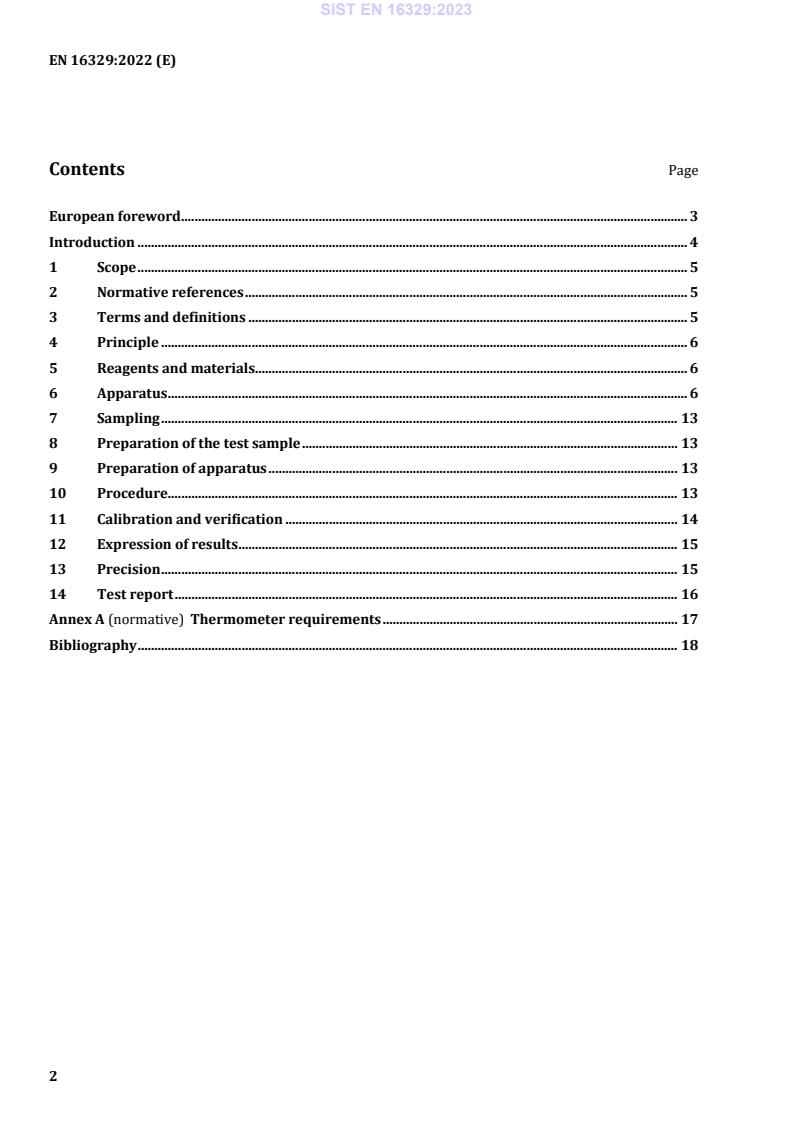
Contents Page
European foreword . 3
Introduction . 4
1 Scope . 5
2 Normative references . 5
3 Terms and definitions . 5
4 Principle . 6
5 Reagents and materials . 6
6 Apparatus . 6
7 Sampling . 13
8 Preparation of the test sample . 13
9 Preparation of apparatus . 13
10 Procedure. 13
11 Calibration and verification . 14
12 Expression of results . 15
13 Precision . 15
14 Test report . 16
Annex A (normative) Thermometer requirements . 17
Bibliography . 18
European foreword
This document (EN 16329:2022) has been prepared by Technical Committee CEN/TC 19 “Gaseous and
liquid fuels, lubricants and related products of petroleum, synthetic and biological origin”, the
secretariat of which is held by NEN.
This European Standard shall be given the status of a national standard, either by publication of an
identical text or by endorsement, at the latest by May 2023, and conflicting national standards shall be
withdrawn at the latest by May 2023.
Attention is drawn to the possibility that some of the elements of this document may be the subject of
patent rights. CEN shall not be held responsible for identifying any or all such patent rights.
This document supersedes EN 16329:2013.
A significant technical difference between this document and the previous edition of EN 16329 is:
— Addition of the bias correction reporting format.
Any feedback and questions on this document should be directed to the users’ national standards body.
A complete listing of these bodies can be found on the CEN website.
According to the CEN-CENELEC Internal Regulations, the national standards organisations of the
following countries are bound to implement this European Standard: Austria, Belgium, Bulgaria,
Croatia, Cyprus, Czech Republic, Denmark, Estonia, Finland, France, Germany, Greece, Hungary, Iceland,
Ireland, Italy, Latvia, Lithuania, Luxembourg, Malta, Netherlands, Norway, Poland, Portugal, Republic of
North Macedonia, Romania, Serbia, Slovakia, Slovenia, Spain, Sweden, Switzerland, Türkiye and the
United Kingdom.
Introduction
The method included in this document is an alternative technique to EN 116 [1]. The cooling bath is no
longer operated in several temperature stages (as in EN 116), but is replaced by a refrigeration unit
with linear cooling.
Inter-laboratories studies (ILS) conducted for this determination method showed improved precision
compared to EN 116. The studies covered currently marketed fuels, including non-fossil components
(FAME-blends) or biofuels and paraffinic diesel fuels. The range of CFPP values for the fuels tested was
from – 47 °C to +11 °C.
1 Scope
This document specifies an automated method for the determination of the cold filter plugging point
(CFPP) of diesel and domestic heating fuels using linear cooling.
This document is applicable to fatty-acid methyl esters (FAME) and to distillate fuels as well as
paraffinic diesel fuels, including those containing FAME, flow-improvers or other additives, intended for
use in diesel engines and domestic heating installations.
The results obtained from the method specified in this document are suitable for estimating the lowest
temperature at which a fuel will give trouble-free flow in the fuel system.
NOTE In the case of diesel fuels, the results are usually close to the temperature of failure in service except
when the fuel system contains, for example, a paper filter installed in a location exposed to the weather or if the
filter plugging temperature is more than 12 °C below the cloud point of the fuel. Domestic heating installations are
usually less critical and often operate at a satisfactory level at temperatures somewhat lower than those indicated
by the test results.
WARNING — The use of this document can involve hazardous materials, operations and equipment.
This document does not purport to address all of the safety problems associated with its use. It is the
responsibility of the user of this document to establish appropriate safety and health practices and
determine the applicability of regulatory limitations prior to use.
2 Normative references
The following documents are referred to in the text in such a way that some or all of their content
constitutes requirements of this document. For dated references, only the edition cited applies. For
undated references, the latest edition of the referenced document (including any amendments) applies.
EN ISO 3170, Petroleum liquids — Manual sampling (ISO 3170)
EN ISO 3171, Petroleum liquids — Automatic pipeline sampling (ISO 3171)
EN ISO 17034, General requirements for the competence of reference material producers (ISO 17034)
ISO 261, ISO general purpose metric screw threads — General plan
3 Terms and definitions
For the purposes of this document, the following terms and definitions apply.
ISO and IEC maintain terminological databases for use in standardization at the following addresses:
— IEC Electropedia: available at https://www.electropedia.org/
— ISO Online browsing platform: available at https://www.iso.org/obp
3.1
cold filter plugging point
CFPP
highest temperature at which a given volume of fuel fails to pass through a standardized filtration
device in a specified time, when cooled under standardized conditions
4 Principle
A test portion of the fuel is cooled under the specified conditions and is drawn at intervals of 1 °C into a
pipette under a controlled vacuum of 2 kPa through a standardized wire mesh filter. The procedure is
repeated, as the fuel continues to cool, for each 1 °C below the first test temperature. Testing is
continued until the amount of wax crystals, which have separated out of solution, is sufficient to stop or
slow down the flow so that the time taken to fill the pipette exceeds 60 s or the fuel fails to return
completely to the test jar before the fuel has cooled by a further 1 °C.
The indicated temperature at which the last filtration was commenced is recorded as the cold filter
plugging point (CFPP).
5 Reagents and materials
5.1 Hydrocarbon solvents, technical grade, e.g. Heptane.
5.2 Light hydrocarbon solvents, technical grade, e.g. Isopentane.
5.3 Lintless filter paper, with particle retention of 30 µm.
5.4 Certified reference materials (CRM), from suppliers according to EN ISO 17034.
NOTE CRM as specified in EN 116 can be used, see Clause 11. CRM can be obtained from the European
Commission's Joint Research Centre (JRC).
6 Apparatus
6.1 General
The equipment is described in detail in 6.2 to 6.12. Unless otherwise stated, all dimensions in the
figures are given in mm.
IMPORTANT — Parts of the apparatus made of copper, zinc or brass can interact with bio-components
like Fatty Acid Methyl Ester (FAME). Care shall be taken. Parts made from alternative materials are
available.
6.2 Test jar, cylindrical, of clear glass, flat bottomed, with an outside diameter of (34 ± 0,5) mm, a
wall thickness of (1,20 ± 0,15) mm and a height of (120 ± 5) mm. The jar shall have a permanent mark
at the 45 ml level.
6.3 Jacket, watertight, cylindrical, flat bottomed, to be used as an air bath. It shall have an inside
diameter of (45 ± 0,25) mm and a height of (115 ± 3) mm.
6.4 Spacer, made from POM-C , except for the stainless steel rods with 2 mm diameter, to be placed
into the jacket (6.3), conforming to the dimensions as shown in Figure 1.
POM-C is Polyoxymethylen Copolymer.
Dimensions in millimetres
Key
1 rod (3 in total)
Figure 1 — Spacer
6.5 Stopper, of oil-resistant and non-thermal conductive material, having three holes to
accommodate the pipette with filter unit (6.6), the thermometer (6.9) and to allow venting of the
system, and able to ensure that pipette and thermometer are safely positioned in the test jar.
6.6 Pipette with filter unit
6.6.1 A pipette of clear glass with a volume of (20 ± 0,2) ml at a point (149 ± 0,5) mm from the
bottom of the pipette (see Figure 2). It shall be connected to the filter unit.
Dimensions in millimetres
Figure 2 — Pipette
6.6.2 A filter unit as in Figure 3, with gen
...
記事のタイトル:EN 16329:2022 - ディーゼル燃料と住宅用暖房燃料 - 冷却フィルタ詰まり点の決定 - 線形冷却浴法 記事内容:この文書は、線形冷却を使用してディーゼル燃料と住宅用暖房燃料の冷却フィルタ詰まり点(CFPP)を自動的に決定する方法を規定しています。 この文書は、脂肪酸メチルエステル(FAME)や蒸留燃料、パラフィン系ディーゼル燃料などのさまざまな種類の燃料に適用されます。これらの燃料は、FAMEや流動改善剤、その他の添加物を含むもので、ディーゼルエンジンや住宅用暖房設備で使用することが想定されています。 この文書で規定された方法で得られた結果は、燃料システム内でトラブルなく流れる最低温度を推定するために適しています。 注:ディーゼル燃料の場合、結果は通常、サービス中の故障温度に近いですが、例えば、天候にさらされた場所に設置された紙フィルターが存在する場合や、フィルターの詰まり温度が燃料の雲点よりも12℃以上低い場合など、結果は異なる場合があります。住宅用暖房設備は通常、より重要ではなく、テスト結果に示された温度よりもやや低い温度で適切に動作する場合があります。 警告:この文書の使用には有害物質、作業および装置が関与することがあります。この文書は、使用に関連するすべての安全上の問題について取り扱っているわけではありません。使用者は、適切な安全および健康な実践を確立し、使用前に規制上の制限の適用可能性を決定する責任があります。
The article discusses EN 16329:2022, a standard that outlines a method for determining the cold filter plugging point (CFPP) of diesel and domestic heating fuels using linear cooling. This method is applicable to various types of fuels including fatty-acid methyl esters (FAME), distillate fuels, and paraffinic diesel fuels with additives. The results obtained from this method can estimate the lowest temperature at which a fuel will flow properly in a fuel system. However, it is noted that the results may vary depending on factors such as the presence of paper filters exposed to weather conditions or if the filter plugging temperature is significantly below the cloud point of the fuel. The article also highlights that the use of this method involves hazardous materials and operations, and users should establish appropriate safety practices and consider regulatory limitations before implementation.
기사 제목: EN 16329:2022 - 디젤과 가정용 난방 연료 - 냉각필터 차단점 결정 - 선형 냉각 욕실 방법 기사 내용: 이 문서는 선형 냉각을 사용하여 디젤과 가정용 난방 연료의 냉각 필터 차단점(CFPP)을 자동으로 결정하는 방법을 규정합니다. 이 문서는 지방산 메틸 에스테르(FAME) 및 증류 연료, 파라핀 디젤 연료, FAME이나 유동 개선제 또는 기타 첨가제를 포함한 디젤 엔진과 가정용 난방 설비에 사용하기 위한 연료에 적용됩니다. 이 문서에서 규정된 방법으로 얻은 결과는 연료 시스템에서 유연하게 흐르는 가장 낮은 온도를 추정하기에 적합합니다. 참고: 디젤 연료의 경우, 결과는 일반적으로 서비스 중 실패하는 온도와 비슷하며, 연로한 위치에 설치된 종이 필터나 필터 막힘 온도가 연료의 구름 포인트보다 12°C 이상 낮은 경우와 같은 특정 상황에서 결과는 다를 수 있습니다. 가정용 난방 설비는 일반적으로 덜 극단적이며 테스트 결과에 표시된 온도보다 낮은 온도에서도 만족스럽게 작동하는 경우가 많습니다. 경고 - 이 문서의 사용은 위험한 물질, 작업 및 장비와 관련될 수 있습니다. 이 문서는 사용에 관련된 모든 안전 문제를 다루지 않습니다. 이 문서의 사용자는 적절한 안전 및 보건 관행을 확립하고 사용 전에 규제 제한의 적용 가능성을 결정하는 것이 사용자의 책임입니다.
Questions, Comments and Discussion
Ask us and Technical Secretary will try to provide an answer. You can facilitate discussion about the standard in here.
Loading comments...