

EN 13381-8:2010
(Main)Test methods for determining the contribution to the fire resistance of structural members - Part 8: Applied reactive protection to steel members
- Abstract
This European Standard specifies a test method for determining the contribution made by applied reactive fire protection systems to the fire resistance of structural steel members, which can be used as beams or columns. It considers only sections without openings in the web. It is not directly applicable to structural tension members without further evaluation. Results from analysis of I or H-sections are directly applicable to angles, channels and T-sections for the same section factor, whether used as individual elements or as bracing. This European Standard does not apply to solid bar or rod.
It covers fire protection systems that involve only reactive materials and not to passive fire protection materials as defined in this document.
The evaluation is designed to cover a range of thicknesses of the applied fire protection material, a range of steel sections, characterized by their section factors, a range of design temperatures and a range of valid fire protection classification periods.
This European Standard contains the fire test procedures, which specifies the tests which should be carried out to determine the ability of the fire protection system to remain coherent and attached to the steelwork, and to provide data on the thermal characteristics of the fire protection system, when exposed to the standard temperature/time curve specified in EN 1363-1.
In special circumstances, where specified in National Building Regulations, there can be a need to subject reactive protection material to a smouldering curve, the test for this and the special circumstances for its use are described in Annex A.
The fire test methodology makes provision for the collection and presentation of data, which can be used as direct input to the calculation of fire resistance of steel structural members in accordance with the procedures given in EN 1993-1-2 and EN 1994-1-2.
(...)
- Status
- Withdrawn
- Publication Date
- 20-Apr-2010
- Withdrawal Date
- 30-Apr-2013
- Technical Committee
- CEN/TC 127 - Fire safety in buildings
- Drafting Committee
- CEN/TC 127/WG 1 - Structural and separating elements
- Current Stage
- 9960 - Withdrawal effective - Withdrawal
- Start Date
- 01-May-2013
- Completion Date
- 01-May-2013

Relations
- Effective Date
- 08-Jun-2022
- Effective Date
- 25-Aug-2026
- Effective Date
- 09-Feb-2026
- Effective Date
- 28-Jan-2026
- Effective Date
- 28-Jan-2026
- Effective Date
- 28-Jan-2026
- Effective Date
- 28-Jan-2026
- Effective Date
- 28-Jan-2026
- Effective Date
- 28-Jan-2026
- Effective Date
- 28-Jan-2026
- Effective Date
- 28-Jan-2026
- Effective Date
- 28-Jan-2026
- Effective Date
- 28-Jan-2026
- Effective Date
- 28-Jan-2026
Get Certified
Connect with accredited certification bodies for this standard

DIBt (Deutsches Institut für Bautechnik)
German Institute for Building Technology.
DIN CERTCO
DIN Group product certification.

Kiwa BDA Testing
Building and construction product certification.
Sponsored listings
Frequently Asked Questions
EN 13381-8:2010 is a standard published by the European Committee for Standardization (CEN). Its full title is "Test methods for determining the contribution to the fire resistance of structural members - Part 8: Applied reactive protection to steel members". This standard covers: This European Standard specifies a test method for determining the contribution made by applied reactive fire protection systems to the fire resistance of structural steel members, which can be used as beams or columns. It considers only sections without openings in the web. It is not directly applicable to structural tension members without further evaluation. Results from analysis of I or H-sections are directly applicable to angles, channels and T-sections for the same section factor, whether used as individual elements or as bracing. This European Standard does not apply to solid bar or rod. It covers fire protection systems that involve only reactive materials and not to passive fire protection materials as defined in this document. The evaluation is designed to cover a range of thicknesses of the applied fire protection material, a range of steel sections, characterized by their section factors, a range of design temperatures and a range of valid fire protection classification periods. This European Standard contains the fire test procedures, which specifies the tests which should be carried out to determine the ability of the fire protection system to remain coherent and attached to the steelwork, and to provide data on the thermal characteristics of the fire protection system, when exposed to the standard temperature/time curve specified in EN 1363-1. In special circumstances, where specified in National Building Regulations, there can be a need to subject reactive protection material to a smouldering curve, the test for this and the special circumstances for its use are described in Annex A. The fire test methodology makes provision for the collection and presentation of data, which can be used as direct input to the calculation of fire resistance of steel structural members in accordance with the procedures given in EN 1993-1-2 and EN 1994-1-2. (...)
This European Standard specifies a test method for determining the contribution made by applied reactive fire protection systems to the fire resistance of structural steel members, which can be used as beams or columns. It considers only sections without openings in the web. It is not directly applicable to structural tension members without further evaluation. Results from analysis of I or H-sections are directly applicable to angles, channels and T-sections for the same section factor, whether used as individual elements or as bracing. This European Standard does not apply to solid bar or rod. It covers fire protection systems that involve only reactive materials and not to passive fire protection materials as defined in this document. The evaluation is designed to cover a range of thicknesses of the applied fire protection material, a range of steel sections, characterized by their section factors, a range of design temperatures and a range of valid fire protection classification periods. This European Standard contains the fire test procedures, which specifies the tests which should be carried out to determine the ability of the fire protection system to remain coherent and attached to the steelwork, and to provide data on the thermal characteristics of the fire protection system, when exposed to the standard temperature/time curve specified in EN 1363-1. In special circumstances, where specified in National Building Regulations, there can be a need to subject reactive protection material to a smouldering curve, the test for this and the special circumstances for its use are described in Annex A. The fire test methodology makes provision for the collection and presentation of data, which can be used as direct input to the calculation of fire resistance of steel structural members in accordance with the procedures given in EN 1993-1-2 and EN 1994-1-2. (...)
EN 13381-8:2010 is classified under the following ICS (International Classification for Standards) categories: 13.220.50 - Fire-resistance of building materials and elements; 91.080.13 - Steel structures. The ICS classification helps identify the subject area and facilitates finding related standards.
EN 13381-8:2010 has the following relationships with other standards: It is inter standard links to EN 13381-8:2013, ISO 8421-2:1987, EN 60584-1:2013, EN ISO 13943:2000, EN 13501-1:2018, EN 1365-4:1999, EN 1993-1-1:2022, EN 12325-2:1999/AC:1999, EN 1363-1:1999, EN 10025-1:2004, EN 1363-2:1999, EN 1365-3:1999, EN 1993-1-2:2024, EN 13381-6:2012. Understanding these relationships helps ensure you are using the most current and applicable version of the standard.
EN 13381-8:2010 is associated with the following European legislation: EU Directives/Regulations: 305/2011, 89/106/EEC; Standardization Mandates: M/117. When a standard is cited in the Official Journal of the European Union, products manufactured in conformity with it benefit from a presumption of conformity with the essential requirements of the corresponding EU directive or regulation.
EN 13381-8:2010 is available in PDF format for immediate download after purchase. The document can be added to your cart and obtained through the secure checkout process. Digital delivery ensures instant access to the complete standard document.
Standards Content (Sample)
2003-01.Slovenski inštitut za standardizacijo. Razmnoževanje celote ali delov tega standarda ni dovoljeno.RQVWUXNFLMVNLKPrüfverfahren zur Bestimmung des Beitrages zum Feuerwiderstand von tragenden Bauteilen - Teil 8: Reaktive Ummantelung von StahlbauteilenMéthodes d'essai pour déterminer la contribution à la résistance au feu des éléments de construction - Partie 8: Protection réactive appliquée aux éléments en acierTest methods for determining the contribution to the fire resistance of structural members - Part 8: Applied reactive protection to steel members91.080.10Kovinske konstrukcijeMetal structures13.220.50Požarna odpornost gradbenih materialov in elementovFire-resistance of building materials and elementsICS:Ta slovenski standard je istoveten z:EN 13381-8:2010SIST EN 13381-8:2010en,fr01-november-2010SIST EN 13381-8:2010SLOVENSKI
STANDARD
EUROPEAN STANDARD NORME EUROPÉENNE EUROPÄISCHE NORM
EN 13381-8
April 2010 ICS 13.220.50 English Version
Test methods for determining the contribution to the fire resistance of structural members - Part 8: Applied reactive protection to steel members
Méthodes d'essai pour déterminer la contribution à la résistance au feu des éléments de construction - Partie 8: Protection réactive appliquée aux éléments en acier
Prüfverfahren zur Bestimmung des Beitrages zum Feuerwiderstand von tragenden Bauteilen -Teil 8: Reaktive Ummantelung von Stahlbauteilen This European Standard was approved by CEN on 4 March 2010.
CEN members are bound to comply with the CEN/CENELEC Internal Regulations which stipulate the conditions for giving this European Standard the status of a national standard without any alteration. Up-to-date lists and bibliographical references concerning such national standards may be obtained on application to the CEN Management Centre or to any CEN member.
This European Standard exists in three official versions (English, French, German). A version in any other language made by translation under the responsibility of a CEN member into its own language and notified to the CEN Management Centre has the same status as the official versions.
CEN members are the national standards bodies of Austria, Belgium, Bulgaria, Croatia, Cyprus, Czech Republic, Denmark, Estonia, Finland, France, Germany, Greece, Hungary, Iceland, Ireland, Italy, Latvia, Lithuania, Luxembourg, Malta, Netherlands, Norway, Poland, Portugal, Romania, Slovakia, Slovenia, Spain, Sweden, Switzerland and United Kingdom.
EUROPEAN COMMITTEE FOR STANDARDIZATION
COMITÉ EUROPÉEN DE NORMALISATION EUROPÄISCHES KOMITEE FÜR NORMUNG
Management Centre:
Avenue Marnix 17,
B-1000 Brussels © 2010 CEN All rights of exploitation in any form and by any means reserved worldwide for CEN national Members. Ref. No. EN 13381-8:2010: ESIST EN 13381-8:2010
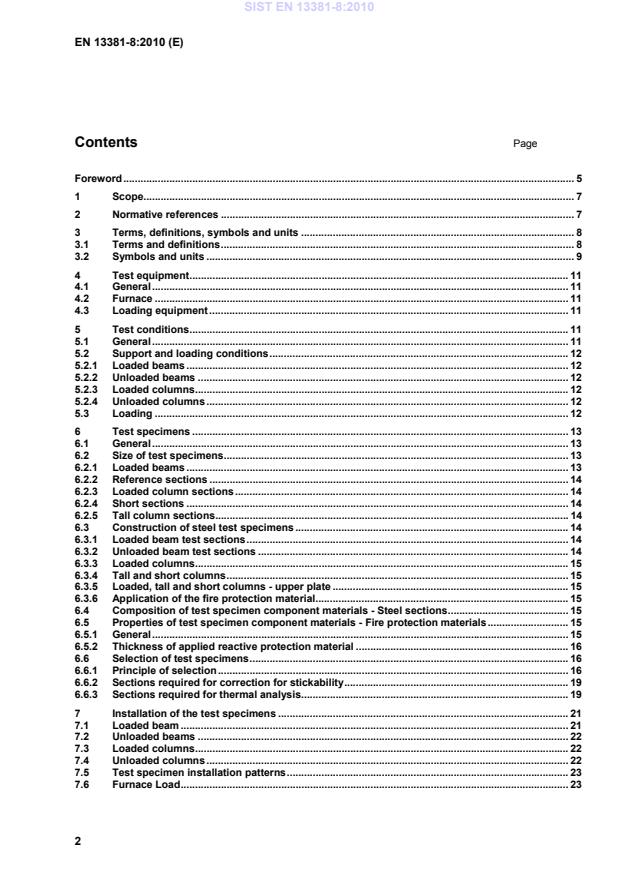
Test method to the smouldering fire (slow heating curve) . 48A.1 Introduction . 48A.2 Test equipment . 48A.3 Test specimens . 48A.4 Termination of test . 49A.5 Evaluation of the results . 49Annex B (normative)
Measurement of properties of fire protection materials . 51B.1 Introduction . 51B.2 Thickness of fire protection materials . 51B.2.1 Dry film thickness . 51B.2.2 Measuring positions . 51B.3 Identification . 52Annex C (normative)
Fixing of thermocouples to steel work and routing of cables. 53SIST EN 13381-8:2010
Correction of data/Nominal thickness . 55D.1 Correction of data . 55D.1.1 Procedure . 55D.1.2 Method. 56D.2 Nominal thickness – Graphical method. 58Annex E (normative)
Methods of Assessment of Fire Protection System Performance . 59E.1 General . 59E.2 Graphical Approach . 59E.2.1 General . 59E.2.2 Input Data . 59E.2.3 Step 1 – Nominal Thickness . 60E.2.4 Step 2 – Graph . 60E.2.5 Step 3 − Line Plotting . 61E.2.6 Step 4 − Compliance with 13.5 . 61E.2.7 Step 5 – Deriving Intercepts . 63E.2.8 Step 6 – Linear Interpolation . 64E.2.9 Step 7 – Reporting of Results . 65E.3 Differential Equation Analysis (variable λλλλ approach) Methodology . 65E.3.1 General . 65E.3.2 Input Data . 65E.3.3 Step 1 – Basic equation . 65E.3.4 Step 2 – Input data . 67E.3.5 Step 3 – Preparation of input data . 67E.3.6 Step 4 – Determination of elementary variable conductivities from each short column. 67E.3.7 Step 5 – Determination of the temperature of protective material . 67E.3.8 Step 6 – Transformation of conductivities . 67E.3.9 Step 7 – Determination of average variable conductivities for the protective material . 68E.3.10 Step 8 – Verification of the fitness of average variable conductivities . 68E.3.11 Step 9 – Adjustment of characteristic variable conductivities. 69E.3.12 Step 10 − Presentation of the results . 69E.3.13 Step 11 – Reporting of the results . 70E.4 Differential Equation Analysis (constant λλλλ approach) Methodology . 70E.4.1 General . 70E.4.2 Input Data . 70E.5 Numerical regression analysis . 71E.5.1 General . 71E.5.2 Input Data . 72E.5.3 Basic Equation . 72E.5.4 Steps 1 to 5: Use of input data from test results . 72Annex F (normative)
Tables of Section Sizes. 74Annex G (normative)
Applied Load in a Loaded I or H Section Beam Test . 76G.1 General . 76G.2 Calculation of applied moment . 76G.3 Calculation of jack loads . 76G.4 Central bending moments . 77Bibliography . 80 SIST EN 13381-8:2010
This European Standard is one of a series of standards for evaluating the contribution to the fire resistance of structural members by applied fire protection materials. Other parts of this series are: Part 1: Horizontal protective membranes Part 2: Vertical protective membranes Part 3: Applied protection to concrete members Part 4: Applied passive protection products to steel members Part 5: Applied protection to concrete/profile sheet steel composite members Part 6: Applied protection to concrete filled hollow steel columns Part 7: Applied protection to timber members CAUTION — The attention of all persons concerned with managing and carrying out this fire resistance test, is drawn to the fact that fire testing can be hazardous and that there is a possibility that toxic and/or harmful smoke and gases can be evolved during the test. Mechanical and operational hazards can also arise during the construction of test elements or structures, their testing and the disposal of test residues. An assessment of all potential hazards and risks to health should be made and safety precautions should be identified and provided. Written safety instructions should be issued.
Appropriate training should be given to relevant personnel. Laboratory personnel should ensure that they follow written safety instructions at all times. The specific health and safety instructions contained within this standard should be followed. According to the CEN/CENELEC Internal Regulations, the national standards organizations of the following countries are bound to implement this European Standard: Austria, Belgium, Bulgaria, Croatia, Cyprus, Czech Republic, Denmark, Estonia, Finland, France, Germany, Greece, Hungary, SIST EN 13381-8:2010
Part 1: Classification using test data from reaction to fire tests EN 60584-1, Thermocouples — Part 1: Reference tables (IEC 60584-1:1995) EN ISO 13943:2000, Fire safety — Vocabulary (ISO 13943:2000) ISO 8421-2:1987, Fire protection — Vocabulary — Part 2: Structural fire protection ETAG 018, Guideline for European Technical Approval of Fire Protective Products — Part 2: Reactive Coatings For Fire Protection of Steel Elements 3 Terms, definitions, symbols and units 3.1 Terms and definitions For the purposes of this document, the terms and definitions given in EN 1363-1:1999, EN ISO 13943:2000 and ISO 8421-2:1987 and the following apply. 3.1.1 steel member element of building construction which is loadbearing and fabricated from steel NOTE For the purpose of this document the steel used in the testing is of the same type. 3.1.2 reactive fire protection material reactive material which is specifically formulated to provide a chemical reaction upon heating such that its physical form changes and in so doing provides fire protection by thermal insulative and cooling effects 3.1.3 passive fire protection material material which does not change its physical form on heating, providing protection by virtue of its physical or thermal properties NOTE This may include materials containing water which, on heating evaporates to produce cooling effects. 3.1.4 fire protection system fire protection material together with a specified primer and top coat if applicable SIST EN 13381-8:2010
fire protection thickness
mean dry film thickness of the reactive fire protection material excluding primer and top coat 3.1.8 stickability ability of a fire protection material to remain sufficiently coherent and in position for a well defined range of deformations, furnace and steel temperatures, such that its ability to provide fire protection is not significantly impaired 3.1.9 section factor
ratio of the fire exposed outer perimeter area of the steel structural member itself, per unit length, to its cross sectional volume per unit length
NOTE See Figure 1. 3.1.10 design temperature
temperature of a steel structural member for structural design purposes 3.1.11 characteristic steel temperature
temperature of the steel structural member which is used for the determination of the correction factor for stickability calculated as (mean temperature + maximum temperature)/2
3.1.12 steel temperature overall mean temperature to be used as input data for the analysis is calculated: for I and H section beams as the mean of the upper flange plus the mean of the web plus the mean of the lower flange divided by 3; for I, H and hollow section columns as the sum of the means of each measuring station divided by the number of measuring stations; for hollow section beams as the mean of the sides plus the mean of the bottom face divided by 2 3.2 Symbols and units Symbol Unit Description LB
loaded beam section UB
unloaded short beam section LC
loaded 3 metre column section SIST EN 13381-8:2010
unloaded tall (2 metre) column section SC
unloaded short column section p
fire protection material a
steel f
furnace d
thickness ρ
density tl minutes time for the loaded or tall section to reach the design temperature t1 minutes time for the reference section to reach the design temperature S m-1 section factor of the loaded or tall section S1 m-1 section factor of the reference section D mm the protection thickness for the loaded or tall section D1 mm protection thickness for the reference section dmax mm maximum protection thickness of the loaded or tall section dmin mm minimum protection thickness of the loaded or tall section di mm protection thickness of the short section kimax
stickability correction factor at maximum protection thickness kimin
stickability correction factor at minimum protection thickness ki
stickability correction factor for the short section at thickness di
Am/V m-1 section factor of the unprotected steel section Ap/V m-1 section factor of the protected steel section A m2 cross sectional area of the steel section V m3/m volume of the steel section per unit length Vv m3/m volume of the fire protection material per unit length H mm depth of the steel section B mm breadth of the steel section tw mm thickness of the web of the steel section tf mm thickness of the flange of the steel section t mm thickness of the wall of a hollow steel section Lexp mm length of beam specimen exposed to heating Lsup mm length of beam specimen between supports dUB mm thickness of fire protection material on an unloaded beam section dSC mm thickness of fire protection material on an unloaded column section dp mm thickness of fire protection material concerned dp(max) mm maximum thickness of fire protection material used dp(min) mm minimum thickness of fire protection material used ρprotection kg/m3 density of fire protection material ρUB kg/m3 density of fire protection material on an unloaded beam section ρSC kg/m3 density of fire protection material on an unloaded column section ρLB kg/m3 density of fire protection material on a loaded beam ρa kg/m3 density of steel (normally 7 850 kg/m3) θLB °C characteristic steel temperature of a loaded beam θUB °C characteristic steel temperature of a short unloaded reference beam θLC °C characteristic steel temperature of a loaded column θTC °C characteristic steel temperature of a tall column θSC °C characteristic temperature of a short reference column.
θc(UB) °C corrected mean temperature of an unloaded beam section θc(SC) °C corrected mean temperature of an unloaded column section SIST EN 13381-8:2010
range factor for thickness
Ks
range factor for section factor
ca J/(kg·K) temperature dependant specific heat capacity of steel as defined in EN 1993-1-2 cp J/(kg·K) temperature independent specific heat capacity of the fire protection material µ
ratio of heat capacity of the fire protection material to that of the steel section t min time from commencement of the start of the test te min time for an unloaded section to reach an equivalent temperature to the loaded beam at time t ∆t min time interval td min time required for a short section to reach the design temperature λp W/(m·K) effective thermal conductivity of the fire protection material λchar(p) W/(m·K) characteristic value of effective conductivity of the fire protection material λave(p) W/(m·K) mean value of λp calculated from all the short sections at a temperature θ λδ(p)
standard deviation of λp calculated from all the short sections at a temperature θ Cn(θ)
constant derived for short section at temperature (θ) K
constant applied to λδ(p) 4 Test equipment 4.1 General The furnace and test equipment shall conform to that specified in EN 1363-1. 4.2 Furnace The furnace shall permit the dimensions of the test specimens to be exposed to heating, as specified in Clause 6 and their installation upon or within the test furnace to be as specified in Clause 7. 4.3 Loading equipment Loading shall be applied according to EN 1363-1. The loading system shall permit loading to be applied to beams as specified in 5.2.1 and to columns as specified in 5.2.3. 5 Test conditions 5.1 General A number of short steel, I or H or hollow test sections, protected by the fire protection system, is heated in a furnace according to the protocol given in EN 1363-1 and Figures 2 to 12. Loaded and unloaded beams or columns that are likewise heated provide information on the ability of the fire protection system to remain intact and adhere to the steel test sections (stickability).
100 mm × 100 mm or 10 000 mm2, they shall be insulated from the steel beam by a suitable insulation material. The ends of loaded beams outside the furnace shall be insulated with a suitable insulation material. 5.2.2 Unloaded beams Each unloaded beam test specimen shall be supported as shown in Figure 3. 5.2.3 Loaded columns For each loaded column provision shall be made for the proper support, positioning and alignment of the column test specimen in the furnace in accordance with EN 1365-4 subject to any amended or additional requirements of this European Standard; an example is given in Figure 8. 5.2.4 Unloaded columns Unloaded column sections shall be supported vertically within the furnace, either installed to the soffit of the furnace cover slabs (see example in Figure 10), or stood on the furnace floor (directly or on plinths). 5.3 Loading The loaded beam test specimens shall be subjected to a total load which represents 60 % of the design moment resistance, according to EN 1993-1-1, calculated using the nominal steel strength and the recommended values given in EN 1993-1-1. The design moment resistance shall be calculated assuming the beam is laterally unrestrained. For I or H section beams tested in accordance with this standard it is assumed that they will be subject to a non-destabilising load. SIST EN 13381-8:2010
The loaded column shall be subjected to an applied test load which represents 60 % of the design buckling resistance, according to EN 1993-1-1, calculated using the nominal steel strength and the recommended values given in EN 1993-1-1. Details of the calculation made to define the test loads shall be included in the test report. Loaded steel test sections shall be tested in accordance with EN 1365-3 or EN 1365-4 subject to any amended or additional requirements of this standard. 6 Test specimens 6.1 General The test sections shall be chosen to suit the scope of the assessment and will include both loaded and unloaded sections. The testing of loaded and tall and reference sections provides the basis for the stickability correction to be applied to the thermal data generated from the unloaded sho
...