


EN 1811:1998
(Main)Reference test method for release of nickel from products intended to come into direct and prolonged contact with the skin
Reference test method for release of nickel from products intended to come into direct and prolonged contact with the skin
This European Standard specifies a method for simulating the release of nickel from articles intended to come into direct and prolonged contact with the skin in order to determine whether such items release nickel at a rate greater than 0,5 ug/cm2/week.
Referenzprüfverfahren zur Bestimmung der Nickellässigkeit von Produkten die in direkten und länger andauernden Kontakt mit der Haut kommen
Méthode d'essai de référence pour la libération du nickel par les produits qui sont destinés à venir en contact direct et prolongé avec la peau
La présente norme européenne spécifie une méthode pour simuler la libération du nickel par les articles venant en contact direct et prolongé avec la peau dans le but de déterminer si ces produits libèrent du nickel à un taux supérieur à 0,5 ug/cm2/semaine.
Primerjalna preskusna metoda za sproščanje niklja iz izdelkov, ki so v neposrednem in daljšem stiku s kožo
General Information
- Status
- Withdrawn
- Publication Date
- 17-Nov-1998
- Withdrawal Date
- 01-Apr-2008
- Technical Committee
- CEN/TC 283 - Precious metalls - Applications in jewellery and associated products
- Drafting Committee
- CEN/TC 283/WG 4 - Health and safety aspects
- Current Stage
- 9960 - Withdrawal effective - Withdrawal
- Start Date
- 02-Apr-2008
- Completion Date
- 02-Apr-2008
Relations
- Effective Date
- 18-Jan-2023
- Effective Date
- 28-Jan-2026
- Effective Date
- 28-Jan-2026
- Effective Date
- 28-Jan-2026
- Effective Date
- 28-Jan-2026
- Effective Date
- 28-Jan-2026
- Referred By
EN ISO 21420:2020 - Protective gloves - General requirements and test methods (ISO 21420:2020) - Effective Date
- 28-Jan-2026
- Effective Date
- 22-Dec-2008

Frequently Asked Questions
EN 1811:1998 is a standard published by the European Committee for Standardization (CEN). Its full title is "Reference test method for release of nickel from products intended to come into direct and prolonged contact with the skin". This standard covers: This European Standard specifies a method for simulating the release of nickel from articles intended to come into direct and prolonged contact with the skin in order to determine whether such items release nickel at a rate greater than 0,5 ug/cm2/week.
This European Standard specifies a method for simulating the release of nickel from articles intended to come into direct and prolonged contact with the skin in order to determine whether such items release nickel at a rate greater than 0,5 ug/cm2/week.
EN 1811:1998 is classified under the following ICS (International Classification for Standards) categories: 39.060 - Jewellery. The ICS classification helps identify the subject area and facilitates finding related standards.
EN 1811:1998 has the following relationships with other standards: It is inter standard links to EN 1811:1998+A1:2008, EN 1384:2017, EN 16711-3:2019, CEN/TS 17946:2023, EN 16473:2014, EN 16471:2014, EN ISO 21420:2020, EN 1811:2011. Understanding these relationships helps ensure you are using the most current and applicable version of the standard.
EN 1811:1998 is associated with the following European legislation: EU Directives/Regulations: 94/27/EC; Standardization Mandates: M/004. When a standard is cited in the Official Journal of the European Union, products manufactured in conformity with it benefit from a presumption of conformity with the essential requirements of the corresponding EU directive or regulation.
EN 1811:1998 is available in PDF format for immediate download after purchase. The document can be added to your cart and obtained through the secure checkout process. Digital delivery ensures instant access to the complete standard document.
Standards Content (Sample)
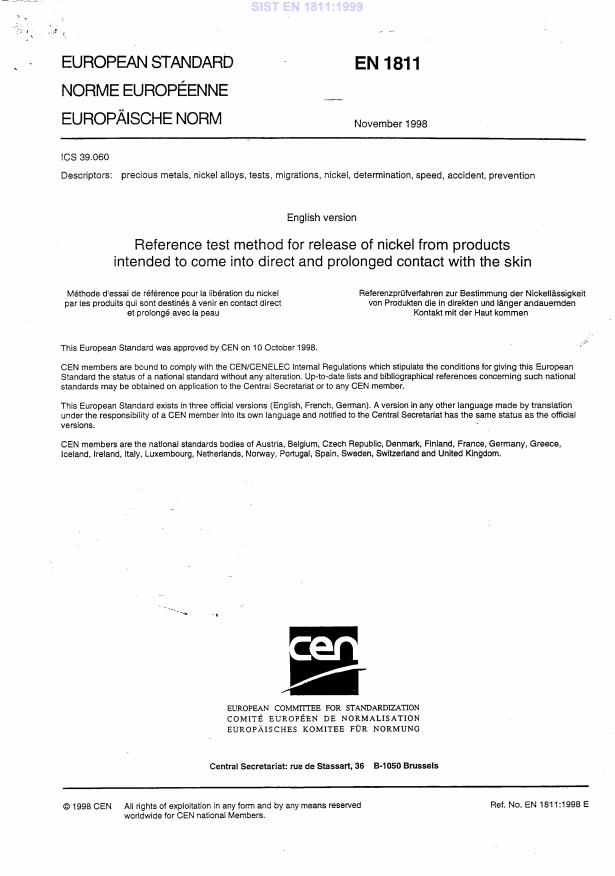
2003-01.Slovenski inštitut za standardizacijo. Razmnoževanje celote ali delov tega standarda ni dovoljeno.Referenzprüfverfahren zur Bestimmung der Nickellässigkeit von Produkten die in direkten und länger andauernden Kontakt mit der Haut kommenMéthode d'essai de référence pour la libération du nickel par les produits qui sont destinés a venir en contact direct et prolongé avec la peauReference test method for release of nickel from products intended to come into direct and prolonged conta
...
Questions, Comments and Discussion
Ask us and Technical Secretary will try to provide an answer. You can facilitate discussion about the standard in here.
Loading comments...