

EN 1811:1998+A1:2008
(Main + Amendment)Reference test method for release of nickel from products intended to come into direct and prolonged contact with the skin
- Abstract
This European Standard specifies a method for simulating the release of nickel from articles intended to come
into direct and prolonged contact with the skin in order to determine whether such items release nickel at a
rate greater than 0,5 µg/cm2/week.
- Status
- Withdrawn
- Publication Date
- 01-Apr-2008
- Withdrawal Date
- 08-Mar-2011
- Technical Committee
- CEN/TC 347 - Methods for analysis of allergens
- Drafting Committee
- CEN/TC 347 - Methods for analysis of allergens
- Current Stage
- 9960 - Withdrawal effective - Withdrawal
- Start Date
- 09-Mar-2011
- Completion Date
- 09-Mar-2011



Relations
- Effective Date
- 18-Jan-2023
- Effective Date
- 08-Jun-2022
- Effective Date
- 08-Jun-2022
Frequently Asked Questions
EN 1811:1998+A1:2008 is a standard published by the European Committee for Standardization (CEN). Its full title is "Reference test method for release of nickel from products intended to come into direct and prolonged contact with the skin". This standard covers: This European Standard specifies a method for simulating the release of nickel from articles intended to come into direct and prolonged contact with the skin in order to determine whether such items release nickel at a rate greater than 0,5 µg/cm2/week.
This European Standard specifies a method for simulating the release of nickel from articles intended to come into direct and prolonged contact with the skin in order to determine whether such items release nickel at a rate greater than 0,5 µg/cm2/week.
EN 1811:1998+A1:2008 is classified under the following ICS (International Classification for Standards) categories: 39.060 - Jewellery. The ICS classification helps identify the subject area and facilitates finding related standards.
EN 1811:1998+A1:2008 has the following relationships with other standards: It is inter standard links to EN 1811:1998, EN 1811:2011, EN 16128:2011. Understanding these relationships helps ensure you are using the most current and applicable version of the standard.
EN 1811:1998+A1:2008 is associated with the following European legislation: EU Directives/Regulations: 2004/96/EC, 76/769/EEC, 94/27/EC; Standardization Mandates: M/004. When a standard is cited in the Official Journal of the European Union, products manufactured in conformity with it benefit from a presumption of conformity with the essential requirements of the corresponding EU directive or regulation.
EN 1811:1998+A1:2008 is available in PDF format for immediate download after purchase. The document can be added to your cart and obtained through the secure checkout process. Digital delivery ensures instant access to the complete standard document.
Standards Content (Sample)
2003-01.Slovenski inštitut za standardizacijo. Razmnoževanje celote ali delov tega standarda ni dovoljeno.Reference test method for release of nickel from products intended to come into direct and prolonged contact with the skinMéthode d'essai de référence pour la libération du nickel par les produits qui sont destinés à venir en contact direct et prolongé avec la peauReferenzprüfverfahren zur Bestimmung der Nickellässigkeit von Produkten die in direkten und länger andauernden Kontakt mit der Haut kommen39.060NakitJewelleryICS:SIST EN 1811:1999+A1:2008en,fr,deTa slovenski standard je istoveten z:EN 1811:1998+A1:200801-julij-2008SIST EN 1811:1999+A1:2008SLOVENSKI
STANDARD
EUROPEAN STANDARD NORME EUROPÉENNE EUROPÄISCHE NORM
EN 1811:1998+A1
April 2008 ICS 39.060 Supersedes EN 1811:1998 English Version
Reference test method for release of nickel from products intended to come into direct and prolonged contact with the skin Méthode d'essai de référence pour la libération du nickel par les produits qui sont destinés à venir en contact direct et prolongé avec la peau
Referenzprüfverfahren zur Bestimmung der Nickellässigkeit von Produkten die in direkten und länger andauernden Kontakt mit der Haut kommen This European Standard was approved by CEN on 10 October 1998 and includes Amendment 1 approved by CEN on 4 February 2008.
CEN members are bound to comply with the CEN/CENELEC Internal Regulations which stipulate the conditions for giving this European Standard the status of a national standard without any alteration. Up-to-date lists and bibliographical references concerning such national standards may be obtained on application to the CEN Management Centre or to any CEN member.
This European Standard exists in three official versions (English, French, German). A version in any other language made by translation under the responsibility of a CEN member into its own language and notified to the CEN Management Centre has the same status as the official versions.
CEN members are the national standards bodies of Austria, Belgium, Bulgaria, Cyprus, Czech Republic, Denmark, Estonia, Finland, France, Germany, Greece, Hungary, Iceland, Ireland, Italy, Latvia, Lithuania, Luxembourg, Malta, Netherlands, Norway, Poland, Portugal, Romania, Slovakia, Slovenia, Spain, Sweden, Switzerland and United Kingdom.
EUROPEAN COMMITTEE FOR STANDARDIZATION
COMITÉ EUROPÉEN DE NORMALISATION EUROPÄISCHES KOMITEE FÜR NORMUNG
Management Centre: rue de Stassart, 36
B-1050 Brussels © 2008 CEN All rights of exploitation in any form and by any means reserved worldwide for CEN national Members. Ref. No. EN 1811:1998+A1:2008: E
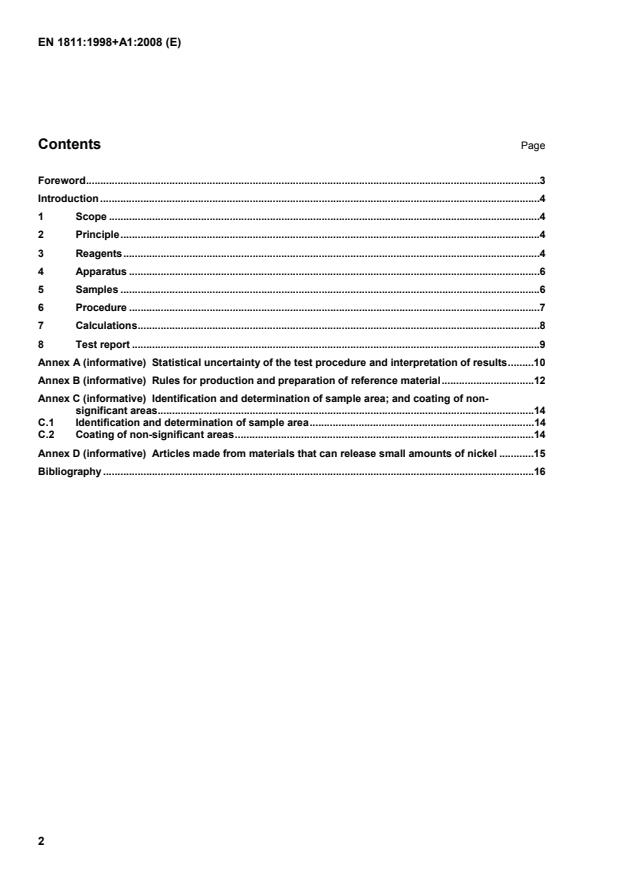
Statistical uncertainty of the test procedure and interpretation of results.10 Annex B (informative)
Rules for production and preparation of reference material.12 Annex C (informative)
Identification and determination of sample area; and coating of non-significant areas.14 C.1 Identification and determination of sample area.14 C.2 Coating of non-significant areas.14 Annex D (informative)
Articles made from materials that can release small amounts of nickel.15 Bibliography.16
According to the CEN/CENELEC Internal Regulations, the national standards organizations of the following countries are bound to implement this European Standard: Austria, Belgium, Bulgaria, Cyprus, Czech Republic, Denmark, Estonia, Finland, France, Germany, Greece, Hungary, Iceland, Ireland, Italy, Latvia, Lithuania, Luxembourg, Malta, Netherlands, Norway, Poland, Portugal, Romania, Slovakia, Slovenia, Spain, Sweden, Switzerland and United Kingdom.
Clinical patch-testing of a small selection of nickel-containing alloys and coatings on nickel-sensitized persons indicates that high and low results achieved with the present analytical method correspond closely with patch-test reactivity. Moreover, a nickel release rate threshold of 0,5 µg/cm2/week has been set in European Parliament and Council Directive 94/27/EC (OJ No. L188 of 22.7.94). In order to ensure that articles yielding values near this figure are not unnecessarily excluded from European trade as a result of the difficulties inherent in the test method, particularly when applied to intricately-shaped articles, the measured release figures are multiplied by a factor of 0,1. Materials recognized as causing sensitisation to nickel would not become acceptable by use of this adjustment. Application of this standard is confidently expected to reduce significantly the development of allergic contact dermatitis due to nickel. Experience of its use and further epidemiological and clinical research may justify changes to test procedure and/or interpretation of the test result.
1 Scope This European Standard specifies a method for simulating the release of nickel from articles intended to come into direct and prolonged contact with the skin in order to determine whether such items release nickel at a rate greater than 0,5 µg/cm2/week.
2 Principle The item to be tested for nickel release is placed in an artificial sweat test solution for 1 week. The concentration of dissolved nickel in the solution is determined by atomic absorption spectrometry, inductively-coupled plasma spectrometry or other appropriate analytical method. The nickel release is expressed in micrograms per square centimetre per week (µg/cm2/week).
3 Reagents Except where indicated, all reagents shall be of recognized pro analysis, p.a., grade or better and shall be free of nickel.
5 Samples 5.1 Sample area 5.1.1 Definition of sample area Only the surface(s) of an item that comes into direct and prolonged contact with the skin shall be analyzed. In this standard such surfaces are defined as "sample area". 5.1.2 Determination of sample area Determination of the sample area (a) in square centimetres is achieved by marking the contour of the sample area assuming that the item is worn or used as intended (see Annex C). In order to achieve the required degree of analytical sensitivity, a minimum sample area of 0,2 cm2 shall be tested. If necessary, identical items may be treated together to obtain this minimum area.
NOTE If, when non-significant surfaces are considered to be part of the sample area, the nickel release from the item is found to be unacceptable, consideration should be given to dismantling the item and testing any internal components for nickel release. If the nickel release from such internal components is significant it might be appropriate to test the external components on their own, assuming that they are available, or the materials from which the item has been manufactured (see Annex D). 5.2 Sample preparation Gently swirl the sample for 2 min in degreasing solution (3.9) at room temperature. Rinse thoroughly with deionized water and dry. After degreasing, items should be handled with plastic forceps or clean protective gloves.
NOTE This cleaning stage is intended to remove extraneous grease and skin secretions due to handling, but not any protective coatings. However, it will also substantially remove any nickel contamination that might be present on the surface of the item. If there is a requirement to determine this nickel the cleaning stage should be omitted. However, it should be appreciated that omission of this cleaning stage might itself affect the nickel release from the item.
5.3 Reference disc As a quality control check, the nickel release from a reference disc may be determined (see Annex A and Annex B).
If used, it is important that both sides of a reference disc are abraded before each test. A minimum of 0,05 mm shall be abraded from each surface using wet emery paper No. 600 followed by No. 1200. The disc is then degreased in the same way as the sample (5.2). 6 Procedure 6.1 Preparation of test solution The test solution representing artificial sweat consists of deionized and aerated water (3.1) containing: - 0,5 % (m/m) sodium chloride (3.2);
- 0,1 % (m/m) lactic acid (3.3);
- 0,1 % (m/m) urea (3.4); and
- ammonia solution, 1 % (3.6). Transfer (1,00 ± 0,01) g of urea, (5,00 ± 0,01) g of sodium chloride and (940 ± 20) µl of lactic acid to a 1000-ml beaker. Add 900 ml of freshly prepared deionized and aerated water (3.1) and stir until all the added reagents are completely dissolved. Calibrate the pH-meter in accordance with the ma
...