


FprEN ISO 19177-1
(Main)Geographic information - Geospatial application programming interface (API) for tiles - Part 1: Core (ISO/FDIS 19177-1:2025)
Geographic information - Geospatial application programming interface (API) for tiles - Part 1: Core (ISO/FDIS 19177-1:2025)
This document specifies the behaviour of web application programming interfaces (APIs) that provide access to tiles of one or more geospatial data resources (collections) that the web API offers.
This document describes how to:
discover which resources offered by the web API can be retrieved as tiles;
get metadata about the available tile sets (including according to which tile matrix set each tile set is partitioned and the limits of that tile set within a common potentially global tile matrix set);
request a tile.
The core conformance class is defined in a way that can be easily included in a web API, even if that API does not conform to the OGC API – Common Standard. A web API can combine some requirements classes of this document with those of other OGC API standards (including OGC API – Common) to extend the scope of the web API by adding functionality.
Information géographique - API géospatiale pour les tuiles - Partie 1: Profil minimal (ISO/FDIS 19177-1:2025)
Le présent document spécifie le comportement des interfaces de programmation d’application (APIs) Web qui fournissent un accès aux tuiles d’une ou plusieurs ressources de données géospatiales (collections) offertes par l’API Web.
Le présent document décrit comment:
découvrir quelles ressources offertes par l’API Web peuvent être récupérées sous forme de tuiles;
obtenir des métadonnées sur les ensembles de tuiles disponibles (y compris en fonction de l’ensemble de matrices de tuiles selon lequel chaque ensemble de tuiles est partitionné et les limites de cet ensemble de tuiles au sein d’un ensemble de matrices de tuiles commun et potentiellement global);
requêter une tuile.
La classe de conformité de base est définie de manière à pouvoir être facilement incluse dans une API web, même si cette API n’est pas conforme à la norme OGC API — Common. Une API Web peut combiner certaines classes d’exigences du présent document avec celles d’autres normes API de l’OGC (y compris la norme OGC API — Common) afin d’étendre la portée de l’API Web en ajoutant des fonctionnalités.
Geografske informacije - Geoprostorski API za informacije v obliki ploščic - 1. del: Osrednji profil (ISO/FDIS 19177-1:2025)
General Information
- Status
- Not Published
- Publication Date
- 18-Feb-2027
- Technical Committee
- CEN/TC 287 - Geographic Information
- Drafting Committee
- CEN/TC 287 - Geographic Information
- Current Stage
- 5060 - Closure of Vote - Formal Approval
- Start Date
- 17-Dec-2025
- Due Date
- 15-Dec-2026
- Completion Date
- 17-Dec-2025
Relations
- Consolidated By
ISO 19177-1:2026 - Geographic information — Geospatial application programming interface (API) for tiles — Part 1: Core - Effective Date
- 12-Feb-2026
Overview
FprEN ISO 19177-1 - Geographic information: Geospatial API for tiles - Part 1: Core (ISO/FDIS 19177-1:2025) is the core specification for a standardized web geospatial API for tiles. Published under the Vienna agreement with ISO lead and CEN parallel processing, this document (draft ISO/DIS 19177-1:2024) defines the fundamental resources, parameters and conformance rules that enable consistent delivery and consumption of tiled geospatial content across web APIs.
Key points:
- Defines the Core requirements for tile retrieval and resource descriptions.
- Aligns with ISO/TC 211 and builds on existing OGC Web API evolution.
- Targets web-friendly, interoperable tile services for maps, imagery and geospatial data.
Key topics and technical requirements
The standard organizes technical obligations into requirements classes and resource types. Important topics covered include:
- Conformance and declaration: Classes for conformance, how implementations declare compliance.
- Tile resource model: Definition of a tile and its operation, including parameters such as tileMatrix, tileRow, tileCol, and optional tileMatrixSetId.
- Responses and error conditions: Expected response formats and error handling for tile requests.
- Tileset and Tilesets list: Resource paths and response structures for individual tilesets, and the listing of multiple tilesets.
- Dataset and GeoData tilesets: How dataset-specific and geospatial-data tilesets are represented and queried.
- Conventions: Identifiers, link relations, use of HTTPS, and general conventions for web APIs.
- Web API landing page and TileMatrixSet: Metadata and discovery endpoints to support client interoperability.
The table of contents also indicates sections on normative references, terms and definitions, overview, evolution from OGC Web Services and relationships with other OGC API standards.
Applications and users
Practical applications include:
- Web map and slippy-tile servers delivering basemaps, raster imagery and vector tiles.
- GIS platforms exposing tiled dataset endpoints for web and mobile clients.
- Map tile caches and CDNs providing interoperable tile access for third-party clients.
- Data portals and national mapping agencies standardizing tile access for discovery and reuse.
Who should use this standard:
- GIS developers and API architects implementing tile APIs.
- Software vendors building map servers, clients and tile processing pipelines.
- Standards bodies and implementers aligning OGC/ISO API interoperability.
- System integrators and data providers aiming for consistent tile delivery and conformance reporting.
Related standards
- OGC API standards and previous OGC Web Services (referenced in the draft).
- ISO/TC 211 geographic information standards (terminology, metadata, web API profiles).
This core part provides the foundation for interoperable, discoverable and conformant tile-based geospatial services (ISO 19177 series).

Get Certified
Connect with accredited certification bodies for this standard

BSI Group
BSI (British Standards Institution) is the business standards company that helps organizations make excellence a habit.

NYCE
Mexican standards and certification body.
Sponsored listings
Frequently Asked Questions
FprEN ISO 19177-1 is a draft published by the European Committee for Standardization (CEN). Its full title is "Geographic information - Geospatial application programming interface (API) for tiles - Part 1: Core (ISO/FDIS 19177-1:2025)". This standard covers: This document specifies the behaviour of web application programming interfaces (APIs) that provide access to tiles of one or more geospatial data resources (collections) that the web API offers. This document describes how to: discover which resources offered by the web API can be retrieved as tiles; get metadata about the available tile sets (including according to which tile matrix set each tile set is partitioned and the limits of that tile set within a common potentially global tile matrix set); request a tile. The core conformance class is defined in a way that can be easily included in a web API, even if that API does not conform to the OGC API – Common Standard. A web API can combine some requirements classes of this document with those of other OGC API standards (including OGC API – Common) to extend the scope of the web API by adding functionality.
This document specifies the behaviour of web application programming interfaces (APIs) that provide access to tiles of one or more geospatial data resources (collections) that the web API offers. This document describes how to: discover which resources offered by the web API can be retrieved as tiles; get metadata about the available tile sets (including according to which tile matrix set each tile set is partitioned and the limits of that tile set within a common potentially global tile matrix set); request a tile. The core conformance class is defined in a way that can be easily included in a web API, even if that API does not conform to the OGC API – Common Standard. A web API can combine some requirements classes of this document with those of other OGC API standards (including OGC API – Common) to extend the scope of the web API by adding functionality.
FprEN ISO 19177-1 is classified under the following ICS (International Classification for Standards) categories: 07.040 - Astronomy. Geodesy. Geography; 35.240.70 - IT applications in science. The ICS classification helps identify the subject area and facilitates finding related standards.
FprEN ISO 19177-1 has the following relationships with other standards: It is inter standard links to ISO 19177-1:2026. Understanding these relationships helps ensure you are using the most current and applicable version of the standard.
FprEN ISO 19177-1 is available in PDF format for immediate download after purchase. The document can be added to your cart and obtained through the secure checkout process. Digital delivery ensures instant access to the complete standard document.
Standards Content (Sample)
SLOVENSKI STANDARD
oSIST prEN ISO 19177-1:2024
01-oktober-2024
Geografske informacije - Geoprostorski API za informacije v obliki ploščic - 1. del:
Osrednji profil (ISO/DIS 19177-1:2024)
Geographic information - Geospatial API for tiles - Part 1: Core (ISO/DIS 19177-1:2024)
Ta slovenski standard je istoveten z: prEN ISO 19177-1
ICS:
07.040 Astronomija. Geodezija. Astronomy. Geodesy.
Geografija Geography
35.240.70 Uporabniške rešitve IT v IT applications in science
znanosti
oSIST prEN ISO 19177-1:2024 en,fr,de
2003-01.Slovenski inštitut za standardizacijo. Razmnoževanje celote ali delov tega standarda ni dovoljeno.
oSIST prEN ISO 19177-1:2024
oSIST prEN ISO 19177-1:2024
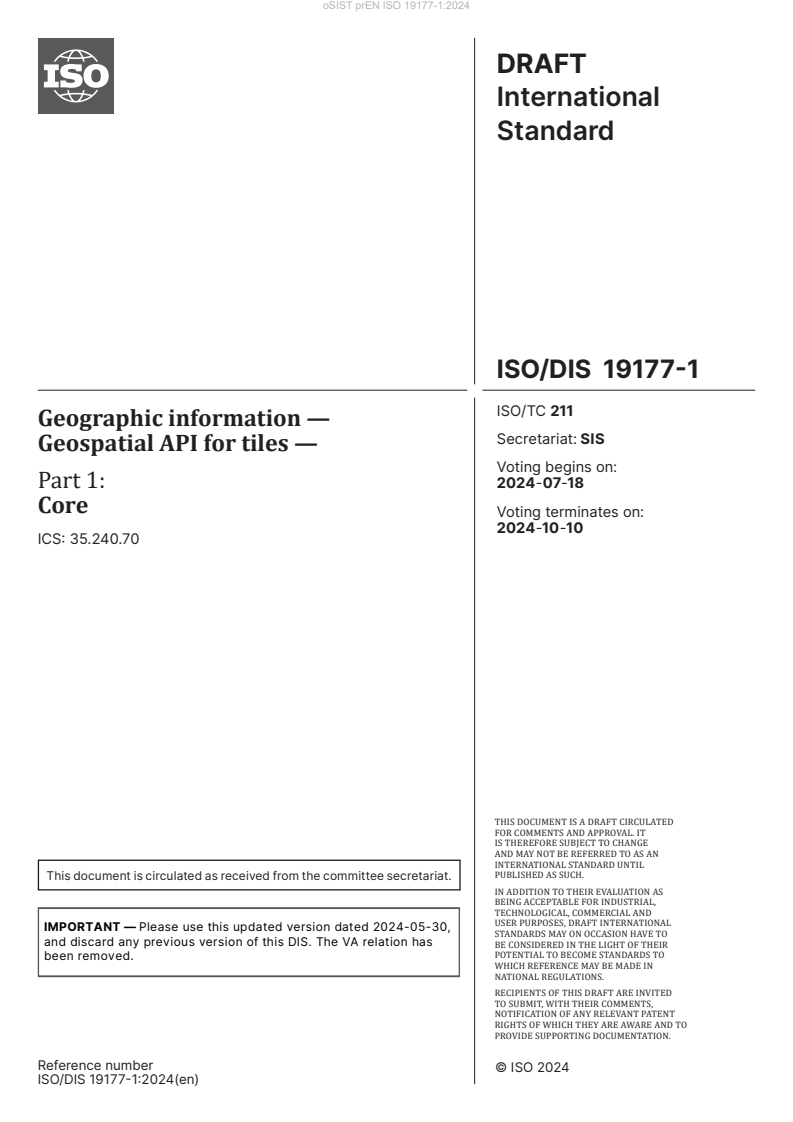
DRAFT
International
Standard
ISO/DIS 19177-1
ISO/TC 211
Geographic information —
Secretariat: SIS
Geospatial API for tiles —
Voting begins on:
Part 1: 2024-07-18
Core
Voting terminates on:
2024-10-10
ICS: 35.240.70
THIS DOCUMENT IS A DRAFT CIRCULATED
FOR COMMENTS AND APPROVAL. IT
IS THEREFORE SUBJECT TO CHANGE
AND MAY NOT BE REFERRED TO AS AN
INTERNATIONAL STANDARD UNTIL
PUBLISHED AS SUCH.
This document is circulated as received from the committee secretariat.
IN ADDITION TO THEIR EVALUATION AS
BEING ACCEPTABLE FOR INDUSTRIAL,
TECHNOLOGICAL, COMMERCIAL AND
USER PURPOSES, DRAFT INTERNATIONAL
IMPORTANT — Please use this updated version dated 2024-05-30,
STANDARDS MAY ON OCCASION HAVE TO
and discard any previous version of this DIS. The VA relation has
BE CONSIDERED IN THE LIGHT OF THEIR
POTENTIAL TO BECOME STANDARDS TO
been removed.
WHICH REFERENCE MAY BE MADE IN
NATIONAL REGULATIONS.
RECIPIENTS OF THIS DRAFT ARE INVITED
TO SUBMIT, WITH THEIR COMMENTS,
NOTIFICATION OF ANY RELEVANT PATENT
RIGHTS OF WHICH THEY ARE AWARE AND TO
PROVIDE SUPPORTING DOCUMENTATION.
Reference number
ISO/DIS 19177-1:2024(en)
oSIST prEN ISO 19177-1:2024
DRAFT
ISO/DIS 19177-1:2024(en)
International
Standard
ISO/DIS 19177-1
ISO/TC 211
Geographic information —
Secretariat: SIS
Geospatial API for tiles —
Voting begins on:
Part 1:
Core
Voting terminates on:
ICS: 35.240.70
THIS DOCUMENT IS A DRAFT CIRCULATED
FOR COMMENTS AND APPROVAL. IT
IS THEREFORE SUBJECT TO CHANGE
AND MAY NOT BE REFERRED TO AS AN
INTERNATIONAL STANDARD UNTIL
PUBLISHED AS SUCH.
This document is circulated as received from the committee secretariat.
IN ADDITION TO THEIR EVALUATION AS
BEING ACCEPTABLE FOR INDUSTRIAL,
© ISO 2024
TECHNOLOGICAL, COMMERCIAL AND
USER PURPOSES, DRAFT INTERNATIONAL
All rights reserved. Unless otherwise specified, or required in the context of its implementation, no part of this publication may
STANDARDS MAY ON OCCASION HAVE TO
ISO/CEN PARALLEL PROCESSING
be reproduced or utilized otherwise in any form or by any means, electronic or mechanical, including photocopying, or posting on
BE CONSIDERED IN THE LIGHT OF THEIR
the internet or an intranet, without prior written permission. Permission can be requested from either ISO at the address below
POTENTIAL TO BECOME STANDARDS TO
WHICH REFERENCE MAY BE MADE IN
or ISO’s member body in the country of the requester.
NATIONAL REGULATIONS.
ISO copyright office
RECIPIENTS OF THIS DRAFT ARE INVITED
CP 401 • Ch. de Blandonnet 8
TO SUBMIT, WITH THEIR COMMENTS,
CH-1214 Vernier, Geneva
NOTIFICATION OF ANY RELEVANT PATENT
Phone: +41 22 749 01 11
RIGHTS OF WHICH THEY ARE AWARE AND TO
PROVIDE SUPPORTING DOCUMENTATION.
Email: copyright@iso.org
Website: www.iso.org
Published in Switzerland Reference number
ISO/DIS 19177-1:2024(en)
ii
oSIST prEN ISO 19177-1:2024
ISO/DIS 19177-1:2024(en)
Contents Page
Foreword .vi
Introduction .vii
1 Scope . 1
2 Normative references . 1
3 Terms and definitions . 2
4 Conformance . 4
4.1 General .4
4.2 Requirements classes defining resources .4
4.3 Requirements Classes defining data origins .5
4.4 Requirements classes defining query parameters .6
4.5 Requirements classes for specific resource representations .6
4.6 Declaration of conformance.7
5 Conventions . 7
5.1 General .7
5.2 Identifiers .7
5.3 Link relations .8
5.4 Use of HTTPS .9
6 Overview . 9
6.1 Introduction .9
6.2 Evolution from OGC Web Services .10
6.3 Relationship to other OGC API standards .11
6.4 Using this standard independently . 12
6.4.1 Description of the domain. 12
6.4.2 Description of the observed or measured properties . 12
6.4.3 Available formats and tile response expectations . 12
6.4.4 Limitations . 13
6.5 How to approach an implementation of an OGC API Standard . 13
6.6 Why we call them “tiles” . 15
7 Requirements Class “Core”. 17
7.1 General .17
7.2 A tile .17
7.2.1 General .17
7.2.2 Operation .17
7.2.3 Parameter tileMatrix .18
7.2.4 Parameter tileRow .18
7.2.5 Parameter tileCol .19
7.2.6 Parameter tileMatrixSetId (optional).19
7.2.7 Response . .19
7.2.8 Error conditions .21
7.3 Declaration of conformance classes .21
7.3.1 General .21
7.3.2 Response . .21
8 Requirements Class “TileSet”.22
8.1 Overview . 22
8.2 Tileset resource . 23
8.2.1 General . 23
8.2.2 Tileset path . 23
8.2.3 Response . . 23
8.3 Web API-defined TileMatrixSets . 26
8.3.1 General . 26
8.3.2 Web API Landing Page. 26
8.3.3 TileMatrixSets .27
iii
oSIST prEN ISO 19177-1:2024
ISO/DIS 19177-1:2024(en)
8.3.4 TileMatrixSet . 28
9 Requirements Class “Tilesets List” .28
9.1 Overview . 28
9.2 Tilesets list . 28
9.2.1 General . 28
9.2.2 Tilesets path . 28
9.2.3 Response . . 29
10 Requirements Class “Dataset Tilesets” .30
10.1 Overview . 30
10.2 General . 30
10.3 Web API Landing Page . 30
10.3.1 General . 30
10.3.2 Response . . 30
10.4 Dataset tilesets .31
10.4.1 General .31
10.4.2 Operation .31
10.4.3 Response . .31
10.5 Tiles .32
10.5.1 General .32
10.5.2 Response . .32
11 Requirements Class “GeoData Tilesets”.32
11.1 Overview .32
11.2 General .32
11.3 Geospatial data resources . 33
11.4 Geospatial data resources tilesets list. 34
11.4.1 General . 34
11.4.2 Operation . 34
11.4.3 Response . . 34
11.5 Tiles . 34
12 Requirements Class “Collections Selection” .34
12.1 Overview . 34
12.2 Operation . 35
12.2.1 General . 35
12.2.2 Parameter collections . 35
12.2.3 Response . . 35
12.2.4 Error conditions . 36
13 Requirements Class “DateTime” .36
13.1 Overview . 36
13.2 Describing the temporal extent . 36
13.3 datetime query parameter request and response . 36
13.4 subset=datetime query parameter request and response . 38
13.5 Actual date & time response header . 39
13.6 Closest date & time permission . 39
14 Requirements Class “OpenAPI Specification 3.0” .40
14.1 Overview . 40
14.2 Web API OpenAPI description . 40
14.2.1 General . 40
14.2.2 Response . . 40
15 Requirements class “XML Tileset Metadata” .43
15.1 Overview .43
15.2 TileSet and TileSets List XML representation . 44
15.2.1 General . 44
15.2.2 Operation . 44
15.2.3 Response . . 44
16 Requirements classes for tile encodings . .45
iv
oSIST prEN ISO 19177-1:2024
ISO/DIS 19177-1:2024(en)
16.1 General .45
16.2 Overview .45
16.3 Requirements Class “PNG” .45
16.4 Requirements Class “JPEG” . 46
16.5 Requirements Class “TIFF”.47
16.6 Requirements Class “NetCDF” .47
16.7 Requirements Class “GeoJSON” . 48
16.8 Requirements Class “Mapbox Vector Tiles” . 49
Annex A (normative) Abstract Test Suite .50
Bibliography .62
v
oSIST prEN ISO 19177-1:2024
ISO/DIS 19177-1:2024(en)
Foreword
ISO (the International Organization for Standardization) is a worldwide federation of national standards
bodies (ISO member bodies). The work of preparing International Standards is normally carried out through
ISO technical committees. Each member body interested in a subject for which a technical committee
has been established has the right to be represented on that committee. International organizations,
governmental and non-governmental, in liaison with ISO, also take part in the work. ISO collaborates closely
with the International Electrotechnical Commission (IEC) on all matters of electrotechnical standardization.
The procedures used to develop this document and those intended for its further maintenance are described
in the ISO/IEC Directives, Part 1. In particular, the different approval criteria needed for the different types
of ISO documents should be noted. This document was drafted in accordance with the editorial rules of the
ISO/IEC Directives, Part 2 (see www.iso.org/directives).
ISO draws attention to the possibility that the implementation of this document may involve the use of (a)
patent(s). ISO takes no position concerning the evidence, validity or applicability of any claimed patent
rights in respect thereof. As of the date of publication of this document, ISO [had/had not] received notice of
(a) patent(s) which may be required to implement this document. However, implementers are cautioned that
this may not represent the latest information, which may be obtained from the patent database available at
www.iso.org/patents. ISO shall not be held responsible for identifying any or all such patent rights.
Any trade name used in this document is information given for the convenience of users and does not
constitute an endorsement.
For an explanation of the voluntary nature of standards, the meaning of ISO specific terms and expressions
related to conformity assessment, as well as information about ISO's adherence to the World Trade
Organization (WTO) principles in the Technical Barriers to Trade (TBT), see www.iso.org/iso/foreword.html.
This document was prepared by Technical Committee ISO/TC 211, Geographic information/Geomatics, in
collaboration with the European Committee for Standardization (CEN) Technical Committee CEN/TC 287,
Geographic Information, in accordance with the Agreement on technical cooperation between ISO and CEN
(Vienna Agreement) and in collaboration with the Open Geospatial Consortium Inc. (OGC).
This document defines the OGC API — Tiles — Part 1: Core Standard. A Web API conforming to this document
can serve tiles of spatially referenced data or maps with predefined content, extent, and resolution. Suggested
additions, changes and comments on this document are welcome and encouraged. Such suggestions may be
submitted using the issues log on the GitHub repository: https://github.com/opengeospatial/ogcapi-tiles.
A list of all parts in the ISO 19177 series can be found on the ISO website.
Any feedback or questions on this document should be directed to the user’s national standards body. A
complete listing of these bodies can be found at www.iso.org/members.html.
vi
oSIST prEN ISO 19177-1:2024
ISO/DIS 19177-1:2024(en)
Introduction
The OGC API — Tiles Standard defines building blocks for implementing Web APIs that support the retrieval
of tiled geospatial information. A Web API is an application programming interface for either a web server or
a web browser [Wikipedia, 2022].
The OGC suite of Web API standards is an extensible framework for building HTTP based services that can
be accessed in different applications on different platforms such as the Web, desktop, mobile, etc. The OGC
API — Tiles Standard specifies how different forms/types of geospatial resources are supported, such as
tiles of vector features (“vector tiles”), coverages, and maps (or imagery). Although OGC API — Tiles can
be used independently, the building blocks can be combined with other OGC API Standards for additional
capabilities or increased interoperability for specific types of data. The OGC API — Tiles Standard references
the OGC Two-Dimensional Tile Matrix Set (TMS) and Tile Set Metadata Standard [OGC 17-083r4]. That Standard
defines logical models and encodings for specifying tile matrix sets and describing tile sets. A tile matrix set
is a tiling scheme that enables an application to partition and index space based on a set of regular grids
defined for multiple scales in a Coordinate Reference System (CRS).
The OGC API — Tiles Standard is an alternative to the OGC’s Web Map Tile Service (WMTS) Standard. Instead
of a fixed Web interface, OGC API — Tiles focuses on simple reusable REST API building blocks which can
be described using the OpenAPI specification. Whereas WMTS focused on map tiles, the OGC API — Tiles
Standard is designed to support any form of tiled data.
vii
oSIST prEN ISO 19177-1:2024
oSIST prEN ISO 19177-1:2024
DRAFT International Standard ISO/DIS 19177-1:2024(en)
Geographic information — Geospatial API for tiles —
Part 1:
Core
1 Scope
The OGC API — Tiles Standard specifies the behavior of Web APIs that provide access to tiles of one or more
geospatial data resources (collections) that the Web API offers. This document defines how to discover
which resources offered by the Web API can be retrieved as tiles, get metadata about the available tile sets
(including according to which tile matrix set each tile set is partitioned and the limits of that tile set within
a common potentially global tile matrix set) and how to request a tile. This document is sometimes referred
to as the Tiles API.
The core conformance class is defined in a way that could be easily included in a web API, even if that API
does not conform to the OGC API — Common Standard. A web API can combine some requirements classes of
this OGC API Standard with those of other OGC API Standards (including OGC API — Common) to extend the
scope of the Web API by adding functionality.
2 Normative references
The following documents are referred to in the text in such a way that some or all of their content constitutes
requirements of this document. For dated references, only the edition cited applies. For undated references,
the latest edition of the referenced document (including any amendments) applies.
Reed C. OGC 19-014r3, Topic 22 — Core Tiling Conceptual and Logical Models for 2D Euclidean Space. Open
Geospatial Consortium (2020). https:// docs .ogc .org/ as/ 19 -014r3/ 19 -014r3 .html.
Masó J., Jacovella-St-Louis J. OGC 17-083r4, OGC Two Dimensional Tile Matrix Set and Tile Set Metadata.
Open Geospatial Consortium (2022). https:// docs .ogc .org/ is/ 17 -083r4/ 17 -083r4 .html.
Heazel C., OGC API — Common — Part 1: Core (Draft). OGC 19-072, Open Geospatial Consortium, https://
docs .ogc .org/ DRAFTS/ 19 -072 .html
Heazel C., OGC API — Common — Part 2: Geospatial Data (Draft). OGC 20-024, Open Geospatial Consortium,
https:// docs .ogc .org/ DRAFTS/ 20 -024 .html
Domenico B. OGC 10-090r3, OGC Network Common Data Form (NetCDF) Core Encoding Standard version 1.0.
Open Geospatial Consortium (2011). https:// portal .ogc .org/ files/ ?artifact id=43732.
Butler H., Daly M., Doyle A., Gillies S., Hagen S., Schaub T. IETF RFC 7946, The GeoJSON Format. (2016).
https:// www .rfc -editor .org/ info/ rfc7946.
Adobe Developers Association, TIFF Specification Revision 6.0. (1992)
Devys E., Habermann T., Heazel C., Lott R., Rouault E. OGC 19-008r4, OGC GeoTIFF Standard. Open
Geospatial Consortium (2019). https:// docs .ogc .org/ is/ 19 -008r4/ 19 -008r4 .html.
ISO/IEC ISO/IEC 10918-1, Information technology — Digital compression and coding of continuous-tone
still images: Requirements and guidelines. International Organization for Standardization, International
Electrotechnical Commission, Geneva https:// www .iso .org/ standard/ 18902 .html.
oSIST prEN ISO 19177-1:2024
ISO/DIS 19177-1:2024(en)
ISO/IEC ISO/IEC 15948, Information technology — Computer graphics and image processing — Portable
Network Graphics (PNG): Functional specification. International Organization for Standardization,
International Electrotechnical Commission, Geneva https:// www .iso .org/ standard/ 29581 .html.
3 Terms and definitions
For the purposes of this document, the following terms and definitions apply.
ISO and IEC maintain terminological databases for use in standardization at the following addresses:
— ISO Online browsing platform: available at https:// www .iso .org/ obp
— IEC Electropedia: available at https:// www .electropedia .org/
3.1
coverage tile
tile that contains information, often in a gridded form, where the values represent observations or
measurements as a count, or quantity using some unit of measure
Note 1 to entry: Coverage tiles are generated in combination with OGC API — Coverages, and can also be generated by
combining a subset (trim) and resampling operation. Usually, visualizing a coverage tile on a rendering device implies
mapping those values to colors.
3.2
dataset
a set of data, published or curated by a single agent, and available for access or download in one or more
representations (modified from DCAT: https:// www .w3 .org/ TR/ vocab -dcat -2/ #dcat -scope)
Note 1 to entry: A Web API implementing OGC API — Common often gives access to a single dataset which may be
comprised of one or more geospatial data resources.
3.3
geospatial data resource
web accessible resource that consists of a set of geospatial data
Note 1 to entry: In Web APIs implementing OGC API — Common — Part 2: Geospatial Data, geospatial data resources
are referred to as collections and are defined in the collections conformance class.
Note 2 to entry: geodata is sometimes used in this document as an abbreviation of geospatial data
3.4
geospatial resource aspect
web accessible resource that represents a component of geospatial information (metadata, schemas…) or
geospatial data accessed using a particular mechanism and data model (e.g., feature items, tiles, maps,
coverages,…) of a more generic geospatial data resource (e.g., a collection)
Note 1 to entry: Not to be confused with a web accessible resource representation. While resource representations
share the same path and are selected by format negotiation, geospatial aspects use different paths. Commonly a
geospatial aspect is a subpath of a geospatial data resource.
3.5
landing page
any page whose primary purpose is to contain a description of something else. Landing pages often provide
summaries or additional information about the thing that they describe. (W3C, URLs in Data Primer) In
the context of the OGC API Standards, a landing page serves as the root node of the API Resource tree and
provides the information needed to navigate all the resources exposed through the API. The landing page
provides access to the root of a dataset.
oSIST prEN ISO 19177-1:2024
ISO/DIS 19177-1:2024(en)
3.6
map tile
tile that contains information in a raster form where the values of cells are colors which can be readily
displayed on rendering devices
Note 1 to entry: Map tiles are generated in combination with OGC API — Maps.
3.7
tile
geometric shape with known properties that may or may not be the result of a tiling (tessellation) process.
A tile consists of a single connected “piece” without “holes” or “lines” (topological disc) In the context of a
2D tile matrix, a tile is one of the rectangular regions of space, which can be uniquely identified by row and
column integer indices, making up the tile matrix. In the context of a geospatial data tile set, a tile contains
data for such a partition of space as part of an overall set of tiles for that tiled geospatial data.
Note 1 to entry: From OGC 19-014r1: Core Tiling Conceptual and Logical Models for 2D Euclidean Space
Note 2 to entry: From OGC 17-083r4: OGC Two Dimensional Tile Matrix Set and Tile Set Metadata standard
Note 3 to entry: Tiles are useful to efficiently request, transfer, cache, display, store and process geospatial data for
a specific resolution and area of interest, providing deterministic performance and scalability for arbitrarily large
datasets.
Note 4 to entry: Tiles can contain a variety of data types, such as grid-based pictorial representations (map tiles),
coverage subsets (coverage tiles), or feature-based representations (vector tiles).
3.8
tile matrix
tiling grid in a given 2D coordinate reference system, associated to a specific scale and partitioning space
into regular conterminous tiles, each of which being assigned a unique identifier
Note 1 to entry: From OGC 17-083r4: OGC Two Dimensional Tile Matrix Set and Tile Set Metadata standard.
Note 2 to entry: Each tile of a tile matrix is uniquely identifiable by integer indices for the row and the column. The
number of rows is referred to as the matrix height, while the maximum number of columns is referred to as the matrix
width (the number of columns can vary for different rows in variable width tile matrices).
3.9
tile matrix set
tiling scheme consisting of a set of tile matrices defined at different scales covering approximately the same
area and having a common coordinate reference system
Note 1 to entry: From OGC 17-083r4: OGC Two Dimensional Tile Matrix Set and Tile Set Metadata standard
3.10
tile indexing scheme
scheme to uniquely reference a tile in a tiling scheme by the use of a unique identifier (or set of identifiers),
and reversely, which unique identifier (or unique set of identifiers) corresponds to a space satisfying the
geometric properties of a specific tile
Note 1 to entry: From OGC 17-083r4: OGC Two Dimensional Tile Matrix Set and Tile Set Metadata standard.
3.11
tile set
a set of tiles resulting from tiling data according to a particular tiling scheme
Note 1 to entry: From OGC 19-014r1: Core Tiling Conceptual and Logical Models for 2D Euclidean Space, but adapted to
clarify that in the context of this document, a tile set refers specifically to a set of tiles containing data and following a
common tiling scheme.
oSIST prEN ISO 19177-1:2024
ISO/DIS 19177-1:2024(en)
3.12
tiling scheme
scheme that defines how space is partitioned into individual tiles, potentially featuring multiple levels
of detail (each tiling at a different granularity to reflect a different resolution or scale) A tiling scheme
defines the spatial reference system and the geometric properties of each tile defined by the scheme. Those
properties include which space each tile occupies (the tile’s spatial extent), as well as a tile coordinate origin
if a particular corner of origin convention is established.
Note 1 to entry: A tiling scheme can be defined on top of a CRS as well as other spatial reference systems such as DGGS
and other organizations including irregular ones. In this document, only tiling schemes based on CRSs are supported.
Note 2 to entry: From OGC 17-083r4: OGC Two Dimensional Tile Matrix Set and Tile Set Metadata standard.
3.13
tile set metadata
additional metadata beyond the common properties defining the tile set. Such metadata could be an abstract,
the owner, the author, or other common metadata. [OGC 19-014r3] metadata describing common properties
defining a tile set, layers and styles used to produce the tile set, the limits of the tile matrix with actual data
and common metadata such as abstract, owner, author, etc.
Note 1 to entry: From OGC 17-083r4: OGC Two Dimensional Tile Matrix Set and Tile Set Metadata standard.
3.14
vector tile
tiled vector feature data
tile that contains vector data that has been generalized (simplified) at the tile scale resolution and clipped by
the tile boundaries
Note 1 to entry: From OGC 17-083r4: OGC Two Dimensional Tile Matrix Set and Tile Set Metadata standard.
3.15
Web API
API using an architectural style that is founded on the technologies of the Web.
[SOURCE: OGC API — Features — Part 1: Core]
Note 1 to entry: See Best Practice 24: Use Web Standards as the foundation of APIs (W3C Data on the Web Best
Practices) for more detail.
3.16
Web API based implementation
a server software that implements a Web API.
Note 1 to entry: The Web
...
Questions, Comments and Discussion
Ask us and Technical Secretary will try to provide an answer. You can facilitate discussion about the standard in here.
Loading comments...