

EN 12516-2:2014+A1:2021
(Main + Amendment)Industrial valves - Shell design strength - Part 2: Calculation method for steel valve shells
- Abstract
This European Standard specifies the method for the strength calculation of the shell with respect to internal pressure of the valve.
- Status
- Published
- Publication Date
- 26-Oct-2021
- Withdrawal Date
- 29-Apr-2022
- Technical Committee
- CEN/TC 69 - Industrial valves
- Drafting Committee
- CEN/TC 69/WG 1 - Basic standards
- Current Stage
- 9093 - Decision to confirm - Review Enquiry
- Start Date
- 10-Jun-2026
- Completion Date
- 07-Oct-2026



Overview
EN 12516-2:2014+A1:2021 - Industrial valves - Shell design strength - Part 2: Calculation method for steel valve shells - specifies the procedure to calculate the mechanical strength of steel valve shells under internal pressure. This European Standard (EN 12516-2 with Amendment A1:2021) provides the analytical calculation methods designers and manufacturers need to determine required wall thicknesses, assess covers/bonnets and flanges, and demonstrate conformity with pressure-related safety requirements.
Key topics and technical requirements
The standard covers a comprehensive set of technical subjects for steel valve shells:
- Scope & general conditions for strength calculation and definition of symbols/units.
- Design pressure determination and its role in shell sizing.
- Nominal design stresses (allowable stresses) for various steel and cast-steel types, including provisions for austenitic and ferritic materials and creep conditions.
- Wall thickness calculation methods for valve bodies and branches:
- Cylindrical, spherical and conical shapes
- Oval and rectangular cross-sections
- Crotch (branch junction) areas and pressure-loaded section comparisons
- Bonnet and cover calculations, including flat plates, domed/spherical ends, dished heads and reinforcement around openings.
- Flange design methods, including flange types, tapered necks, bolt diameter calculation and load cases.
- Gland and gland flange design, bolt loads and related components.
- Fatigue considerations, marking requirements and informative annexes:
- Annex A: characteristic values for gaskets and joints
- Annex B: calculation procedures
- Annex ZA: relationship to Directive 2014/68/EU (PED)
The document contains formulae, figures and tables to support calculations (recent amendments added and revised several formulae, figures and tables).
Practical applications and users
This standard is intended for professionals who design, manufacture, test or certify industrial valves subject to internal pressure. Typical users include:
- Valve designers and mechanical engineers performing shell strength and wall-thickness calculations
- Valve manufacturers developing drawings, lists of materials and fabrication tolerances
- Pressure equipment certification bodies and notified bodies assessing compliance with PED and national regulations
- Inspection and maintenance engineers verifying structural integrity and fatigue life
- Procurement/specification writers who require standardized calculation-based acceptance criteria
Using EN 12516-2 helps ensure safe, reliable valve shells, consistent documentation, and easier regulatory compliance.
Related standards
- EN 12516-1: Tabulation method for steel valve shells (complementary)
- EN 12516-3: Experimental method
- EN 12516-4: Calculation method for valve shells in metallic materials other than steel
- Relevant European directives and the Pressure Equipment Directive (2014/68/EU) - see Annex ZA for linkage
Keywords: industrial valves, shell design strength, steel valve shells, wall thickness calculation, design pressure, nominal design stresses, flange design, valve strength calculation, PED compliance.
Relations
- Effective Date
- 19-Jan-2023
- Effective Date
- 19-Jan-2023
- Effective Date
- 28-Jan-2026
- Effective Date
- 28-Jan-2026
- Effective Date
- 28-Jan-2026
- Effective Date
- 28-Jan-2026
- Effective Date
- 28-Jan-2026
- Effective Date
- 28-Jan-2026
- Effective Date
- 28-Jan-2026
- Effective Date
- 28-Jan-2026
- Effective Date
- 28-Jan-2026
- Effective Date
- 28-Jan-2026
- Effective Date
- 28-Jan-2026
- Effective Date
- 28-Jan-2026
- Effective Date
- 28-Jan-2026
Get Certified
Connect with accredited certification bodies for this standard

Institut za varilstvo d.o.o. (Welding Institute)
Slovenia's leading welding institute since 1952. ISO 3834, EN 1090, pressure equipment certification, NDT personnel, welder qualification. Only IIW Au
Sponsored listings
Frequently Asked Questions
EN 12516-2:2014+A1:2021 is a standard published by the European Committee for Standardization (CEN). Its full title is "Industrial valves - Shell design strength - Part 2: Calculation method for steel valve shells". This standard covers: This European Standard specifies the method for the strength calculation of the shell with respect to internal pressure of the valve.
This European Standard specifies the method for the strength calculation of the shell with respect to internal pressure of the valve.
EN 12516-2:2014+A1:2021 is classified under the following ICS (International Classification for Standards) categories: 23.060.01 - Valves in general. The ICS classification helps identify the subject area and facilitates finding related standards.
EN 12516-2:2014+A1:2021 has the following relationships with other standards: It is inter standard links to EN 12516-2:2014, EN 12516-2:2014/FprA1, EN 13445-3:2014/A5:2018, EN 13445-3:2014/A3:2017, EN 12266-1:2012, EN 13445-3:2014/A1:2015, EN 19:2016, EN 13445-3:2014/A8:2019, EN 16668:2016+A1:2018, EN 13445-3:2014/A2:2016, EN 12266-2:2012, EN 13445-3:2014/A7:2019, EN 13445-3:2014/A6:2019, EN 13445-3:2014, EN 1092-1:2018. Understanding these relationships helps ensure you are using the most current and applicable version of the standard.
EN 12516-2:2014+A1:2021 is associated with the following European legislation: EU Directives/Regulations: 2014/68/EU; Standardization Mandates: M/071. When a standard is cited in the Official Journal of the European Union, products manufactured in conformity with it benefit from a presumption of conformity with the essential requirements of the corresponding EU directive or regulation.
EN 12516-2:2014+A1:2021 is available in PDF format for immediate download after purchase. The document can be added to your cart and obtained through the secure checkout process. Digital delivery ensures instant access to the complete standard document.
Standards Content (Sample)
SLOVENSKI STANDARD
01-december-2021
Industrijski ventili - Trdnost ohišja - 2. del: Metoda za izračun ohišij jeklenih
ventilov
Industrial valves - Shell design strength - Part 2: Calculation method for steel valve shells
Industriearmaturen - Gehäusefestigkeit - Teil 2: Berechnungsverfahren für
drucktragende Gehäuse von Armaturen aus Stahl
Robinetterie industrielle - Résistance mécanique des enveloppes - Partie 2 : Méthode de
calcul relative aux enveloppes d'appareils de robinetterie en acier
Ta slovenski standard je istoveten z: EN 12516-2:2014+A1:2021
ICS:
23.060.01 Ventili na splošno Valves in general
2003-01.Slovenski inštitut za standardizacijo. Razmnoževanje celote ali delov tega standarda ni dovoljeno.
EN 12516-2:2014+A1
EUROPEAN STANDARD
NORME EUROPÉENNE
October 2021
EUROPÄISCHE NORM
ICS 23.060.01 Supersedes EN 12516-2:2014
English Version
Industrial valves - Shell design strength - Part 2:
Calculation method for steel valve shells
Robinetterie industrielle - Résistance mécanique des Industriearmaturen - Gehäusefestigkeit - Teil 2:
enveloppes - Partie 2 : Méthode de calcul relative aux Berechnungsverfahren für drucktragende Gehäuse von
enveloppes d'appareils de robinetterie en acier Armaturen aus Stahl
This European Standard was approved by CEN on 9 August 2014 and includes Amendment 1 approved by CEN on 6 September
2021.
CEN members are bound to comply with the CEN/CENELEC Internal Regulations which stipulate the conditions for giving this
European Standard the status of a national standard without any alteration. Up-to-date lists and bibliographical references
concerning such national standards may be obtained on application to the CEN-CENELEC Management Centre or to any CEN
member.
This European Standard exists in three official versions (English, French, German). A version in any other language made by
translation under the responsibility of a CEN member into its own language and notified to the CEN-CENELEC Management
Centre has the same status as the official versions.
CEN members are the national standards bodies of Austria, Belgium, Bulgaria, Croatia, Cyprus, Czech Republic, Denmark, Estonia,
Finland, France, Germany, Greece, Hungary, Iceland, Ireland, Italy, Latvia, Lithuania, Luxembourg, Malta, Netherlands, Norway,
Poland, Portugal, Republic of North Macedonia, Romania, Serbia, Slovakia, Slovenia, Spain, Sweden, Switzerland, Turkey and
United Kingdom.
EUROPEAN COMMITTEE FOR STANDARDIZATION
COMITÉ EUROPÉEN DE NORMALISATION
EUROPÄISCHES KOMITEE FÜR NORMUNG
CEN-CENELEC Management Centre: Rue de la Science 23, B-1040 Brussels
© 2021 CEN All rights of exploitation in any form and by any means reserved Ref. No. EN 12516-2:2014+A1:2021 E
worldwide for CEN national Members.
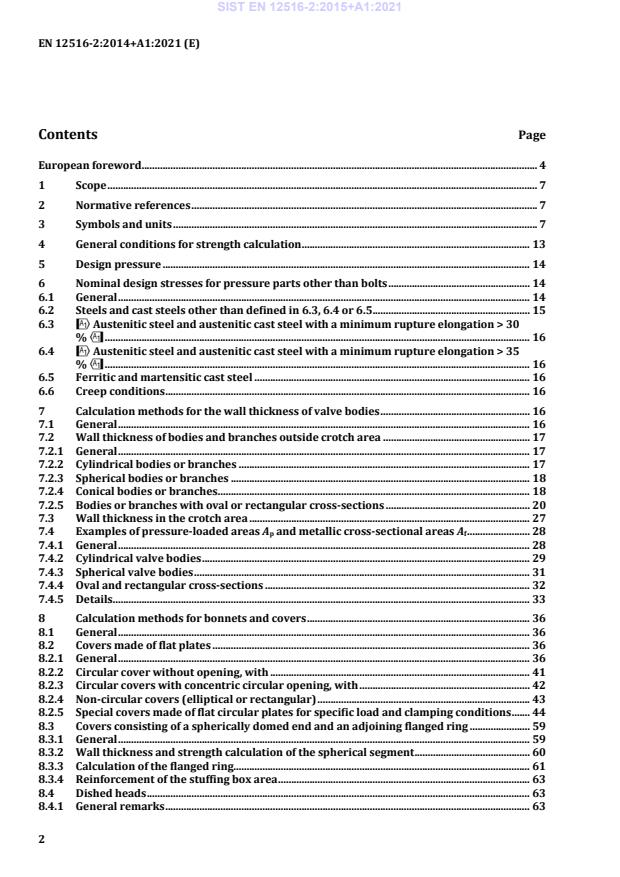
Contents Page
European foreword . 4
1 Scope . 7
2 Normative references . 7
3 Symbols and units . 7
4 General conditions for strength calculation . 13
5 Design pressure . 14
6 Nominal design stresses for pressure parts other than bolts . 14
6.1 General . 14
6.2 Steels and cast steels other than defined in 6.3, 6.4 or 6.5. 15
6.3 !Austenitic steel and austenitic cast steel with a minimum rupture elongation > 30
%" . 16
6.4 !Austenitic steel and austenitic cast steel with a minimum rupture elongation > 35
%" . 16
6.5 Ferritic and martensitic cast steel . 16
6.6 Creep conditions . 16
7 Calculation methods for the wall thickness of valve bodies . 16
7.1 General . 16
7.2 Wall thickness of bodies and branches outside crotch area . 17
7.2.1 General . 17
7.2.2 Cylindrical bodies or branches . 17
7.2.3 Spherical bodies or branches . 18
7.2.4 Conical bodies or branches . 18
7.2.5 Bodies or branches with oval or rectangular cross-sections . 20
7.3 Wall thickness in the crotch area . 27
7.4 Examples of pressure-loaded areas Ap and metallic cross-sectional areas Af . 28
7.4.1 General . 28
7.4.2 Cylindrical valve bodies . 29
7.4.3 Spherical valve bodies . 31
7.4.4 Oval and rectangular cross-sections . 32
7.4.5 Details . 33
8 Calculation methods for bonnets and covers . 36
8.1 General . 36
8.2 Covers made of flat plates . 36
8.2.1 General . 36
8.2.2 Circular cover without opening, with . 41
8.2.3 Circular covers with concentric circular opening, with . 42
8.2.4 Non-circular covers (elliptical or rectangular) . 43
8.2.5 Special covers made of flat circular plates for specific load and clamping conditions . 44
8.3 Covers consisting of a spherically domed end and an adjoining flanged ring . 59
8.3.1 General . 59
8.3.2 Wall thickness and strength calculation of the spherical segment . 60
8.3.3 Calculation of the flanged ring. 61
8.3.4 Reinforcement of the stuffing box area . 63
8.4 Dished heads . 63
8.4.1 General remarks . 63
8.4.2 Solid dished heads . 64
8.4.3 Dished heads with opening . 65
8.4.4 Allowances on the wall thickness . 67
9 Calculation method for pressure sealed bonnets and covers. 68
10 Calculation methods for flanges . 70
10.1 General . 70
10.2 Circular flanges . 70
10.2.1 General . 70
10.2.2 Flanges with tapered neck . 71
10.2.3 Flanges greater than DN 1 000. 73
10.2.4 Welding neck with tapered neck according to Figure 48 . 74
10.2.5 Weld-on flanges . 75
10.2.6 Reverse flanges . 78
10.2.7 Loose flanges . 78
10.3 Oval flanges . 80
10.3.1 Oval flanges in accordance with Figure 54 . 80
10.3.2 Oval flanges in accordance with Figure 55 . 82
10.4 Rectangular or square flanges . 84
10.4.1 Rectangular or square flanges in accordance with Figure 57 . 84
10.4.2 Rectangular slip-on flanges in accordance with Figure 58 . 85
10.5 Calculation of the bolt diameter . 86
10.5.1 Design temperature . 86
10.5.2 Diameter of the nominal tensile stress . 86
10.5.3 Load cases . 86
10.5.4 Safety factors and allowances . 87
11 Calculation methods for glands . 87
11.1 Loads . 87
11.2 Gland bolts . 88
11.3 Gland flanges . 88
11.4 Other components . 88
12 Fatigue . 88
13 Marking . 88
Annex A (informative) Characteristic values of gaskets and joints . 89
Annex B (informative) Calculation procedure . 102
Annex ZA (informative) !Relationship between this European Standard and the essential
requirements of Directive 2014/68/EU aimed to be covered" . 104
Bibliography . 105
European foreword
This document (EN 12516-2:2014+A1:2021) has been prepared by Technical Committee CEN/TC 69
“Industrial valves”, the secretariat of which is held by AFNOR.
This European Standard shall be given the status of a national standard, either by publication of an identical
text or by endorsement, at the latest by April 2022, and conflicting national standards shall be withdrawn at
the latest by April 2022.
Attention is drawn to the possibility that some of the elements of this document may be the subject of patent
rights. CEN shall not be held responsible for identifying any or all such patent rights.
This document includes Amendment 1 approved by CEN on 6 September 2021.
This document supersedes !EN 12516-2:2014".
The start and finish of text introduced or altered by amendment is indicated in the text by tags !".
This document has been prepared under a Standardization Request given to CEN by the European
Commission and the European Free Trade Association, and supports essential requirements of EU
Directive(s) / Regulation(s).
For relationship with EU Directive(s) / Regulation(s), see informative Annex ZA, which is an integral part of
this document.
!In comparison with the previous edition EN 12516-2:2004, the following significant changes have been
made in the new edition EN 12516-2:2014:"
a) the normative references were updated;
b) all formulae and figures have been renumbered; in particular 10.6 “Design temperature” became 10.5
“Calculation of the bolt diameter”;
c) some formulae were changed:
1) Formulae (3) to (6) for calculated wall thickness have been added;
2) Formulae (9) and (10) for calculation of e in case of d / d > 1,7 have been added;
o i
c
3) Formulae (17) and (20) for conical bodies or branches have been added;
d) the figures were changed and/or updated:
1) a new Figure 1 “Composition of section thickness and tolerance allowances” has been added;
2) Figure 2 “Cone calculation coefficient” has been over-worked;
3) former Figures 6a and 6b are now combined in Figure 7 “Calculation coefficient B for rectangular
n
cross-sections”;
4) Figures 23, 24, and 25 used to establish the calculation coefficients C , C and C were moved to
x y z
8.2.1;
5) the new Figure 46 “Types of flange connections” has been added;
e) tables were updated:
1) Table 1 giving the symbols characteristics and units has been revised;
2) a column for test conditions in Table 2 “Nominal design stresses (allowable stresses)” has been
added;
3) Table 5 “Flat circular plates and annular plates — Bending moments as a function of load cases and
clamping conditions” has been revised;
4) Table 7 “Lever arms of the forces in the moment formulae” has been revised;
f) Clause 6 “Nominal design stresses for pressure parts other than bolts” now contains references to
PED 97/23/EC;
g) Clause 7 “Calculation methods for the wall thickness of valve bodies” has been restructured; and 7.1 now
contains information on calculation of the surface-comparison;
h) Subclauses 8.2.2 and 8.2.3 now draw a distinction between “direct loading” and “not subjected to direct
loading”; and 8.2.3 now contains a warning regarding the mean support diameter d ;
mA
i) there is a new Subclause 8.3.3.5 regarding the diameter of centre of gravity;
j) Clause 10 “Calculation methods for flanges” has been over-worked;
k) the former informative Annex A “Allowable stresses” has been deleted;
l) the Annex “Characteristic values of gaskets and joints” has been over-worked;
m) Annex ZA has been updated.
EN 12516, Industrial valves — Shell design strength, consists of four parts:
— Part 1: Tabulation method for steel valve shells;
— Part 2: Calculation method for steel valve shells (the present document);
— Part 3: Experimental method;
— Part 4: Calculation method for valve shells manufactured in metallic materials other than steel.
Any feedback and questions on this document should be directed to the users’ national standards body. A
complete listing of these bodies can be found on the CEN website.
According to the CEN-CENELEC Internal Regulations, the national standards organisations of the following
countries are bound to implement this European Standard: Austria, Belgium, Bulgaria, Croatia, Cyprus, Czech
Republic, Denmark, Estonia, Finland, France, Germany, Greece, Hungary, Iceland, Ireland, Italy, Latvia,
Lithuania, Luxembourg, Malta, Netherlands, Norway, Poland, Portugal, Republic of North Macedonia,
Romania, Serbia, Slovakia, Slovenia, Spain, Sweden, Switzerland, Turkey and the United Kingdom.
Introduction
EN 12516, Industrial valves — Shell design strength, is composed of four parts. EN 12516-1 and EN 12516-2
specify methods for determining the thickness of steel valve shells by tabulation and calculation methods
respectively. EN 12516-3 establishes an experimental method for assessing the strength of valve shells in
steel, cast iron and copper alloy by applying an elevated hydrostatic pressure at ambient temperature.
EN 12516-4 specifies methods for calculating the thickness for valve shells in metallic materials other than
steel.
The calculation method, EN 12516-2, is similar in approach to the former DIN 3840 where the designer is
required to calculate the wall thickness for each point on the pressure temperature curve using the
allowable stress at that temperature for the material he has chosen (see Bibliography, reference [1]). The
allowable stress is calculated from the material properties using safety factors that are defined in EN 12516-
2. The formulae in EN 12516-2 consider the valve as a pressure vessel and ensure that there will be no
excessive deformation or plastic instability.
The tabulation method, EN 12516-1, is similar in approach to ASME B16.34 (see Bibliography, reference [2])
in that the designer can look up the required minimum wall thickness dimension of the valve body from a
table. The internal diameter of the inlet bore of the valve gives the reference dimension from which the
tabulated wall thickness of the body is calculated.
The tabulated thicknesses in EN 12516-1 are calculated using the thin cylinder formula that is also used in
EN 12516-2. The allowable stress used in the formula is equal to 120,7 MPa and the operating pressure, p , in
c
MPa, varies for each PN and Class designation. EN 12516-1 gives these p values for all the tabulated PN and
c
Class designations.
EN 12516-1 specifies PN, Standard Class and Special Class pressure temperature ratings for valve shells with
bodies having the tabulated thickness. These tabulated pressure temperature ratings are applicable to a
group of materials and are calculated using a selected stress, which is determined from the material
properties representative of the group, using safety factors defined in EN 12516-1.
Each tabulated pressure temperature rating is given a reference pressure designation to identify it.
The tabulation method gives one thickness for the body for each PN (see EN 12516-1:2014, 3.1 PN (Body))
or Class designation depending only on the inside diameter, D , of the body at the point where the thickness
i
is to be determined.
The calculated pressure is limited by the ceiling pressure which sets up an upper boundary for high strength
materials and limits the deflection.
A merit of the tabulation method, which has a fixed set of shell dimensions irrespective of the material of the
shell, is that it is possible to have common patterns and forging dies. The allowable pressure temperature
rating for each material group varies proportionally to the selected stresses of the material group to which
the material belongs, using the simple rules above.
A merit of the calculation method is that it allows the most efficient design for a specific application using the
allowable stresses for the actual material selected for the application.
The two methods are based on different assumptions, and as a consequence the detail of the analysis is
different (see Bibliography, reference [3]). Both methods offer a safe and proven method of designing
pressure-bearing components for valve shells.
1 Scope
This European Standard specifies the method for the strength calculation of the shell with respect to internal
pressure of the valve.
2 Normative references
The following documents, in whole or in part, are normatively referenced in this document and are
indispensable for its application. For dated references, only the edition cited applies. For undated references,
the latest edition of the referenced document (including any amendments) applies.
!EN 19:2016, Industrial valves — Marking of metallic valves"
!EN 1092-1:2018, Flanges and their joints — Circular flanges for pipes, valves, fittings and accessories, PN
designated — Part 1: Steel flanges"
EN 1591-1:2013, Flanges and their joints — Design rules for gasketed circular flange connections — Part 1:
Calculation
EN 10269:2013, Steels and nickel alloys for fasteners with specified elevated and/or low temperature
properties
EN 12266-1:2012, Industrial valves — Testing of metallic valves — Part 1: Pressure tests, test procedures and
acceptance criteria — Mandatory requirements
EN 12266-2:2012, Industrial valves — Testing of metallic valves — Part 2: Tests, test procedures and
acceptance criteria — Supplementary requirements
!EN 13445-3:2014, Unfired pressure vessels — Part 3: Design"
!EN 16668:2016+A1:2018, Industrial valves — Requirements and testing for metallic valves as pressure
accessories"
!EN ISO 3506-1:2020, Fasteners — Mechanical properties of corrosion-resistant stainless steel fasteners —
Part 1: Bolts, screws and studs with specified grades and property classes (ISO 3506 1:2020)"
3 Symbols and units
The following symbols are used:
!Table 1 — Symbols and units
Symbol Unit Description
a
mm lever arm for horizontal force
H
a
mm lever arm for bolt force
S
a
mm lever arm for vertical force
V
B — calculation coefficient to determine the thickness of the flange
B
— calculation coefficient for oval and rectangular cross-sections
1…3
As impacted by EN 13445-3:2014/A1:2015, EN 13445-3:2014/A2:2016, EN 13445-3:2014/A3:2017, EN 13445-3:2014/A4:2018,
EN 13445-3:2014/A5:2018, EN 13445-3:2014/A6:2019, EN 13445-3:2014/A7:2019 and EN 13445-3:2014/A8:2019.
Symbol Unit Description
B
— correction factor for oval flanges
B , B
— calculation coefficient for flat circular plates
FI FII
B
— calculation coefficient to determine the thickness of the flange
h
B , B
— calculation coefficient for flat circular plates
MI MII
B , B
— calculation coefficient for flat circular plates
PI PII
b mm double flange width
b
mm minor width in oval and rectangular cross section
b
mm major width in oval and rectangular cross section
b , b
mm width of the seal
D1 D2
b’
mm width in oval and rectangular cross section
b
mm width of the seal
D
b
mm effective width for reinforcement
s
C ,C ,C
— calculation coefficient for covers made of flat plates
x y z
C — calculation coefficient for lens-shaped gaskets
c mm design allowance for bolts
c
mm fabrication tolerance
c
mm standardized corrosion and erosion allowance
d
mm outside diameter
o
d , d'
mm diameter in base body
0 0
d , d mm diameter for self-sealing closure
01 02
d
mm diameter in branch
d
mm diameter in further branch
d
mm outside diameter of collar flange
d
mm outside diameter of the plate/cover
A
d
mm outside flange diameter
a
d
mm inside diameter
i
d
mm diameter of the biggest inscribed circle
f
d
mm diameter in knuckle
k
d
mm diameter in corner welds
K
d
mm hole diameter
L
Symbol Unit Description
d'
mm reduced bolt hole diameter
L
d
mm mean diameter of the plate/cover
m
d
mm mean diameter of the face (see Figure 28)
mA
d'
mm mean diameter
m
d
mm mean diameter of the seal
D
d
mm required bolt diameter
s
d
mm bold circle diameter/reference circle diameter
t
d
mm diameter of centre of gravity
p
d
mm stuffing box outside diameter
ast
d
mm stuffing box inside diameter
ist
d
mm calculated bolt diameter without design allowance
S0
d
mm diameter of the vertical force at the cone
V
E MPa modulus of elasticity
E
MPa modulus of elasticity for material of the seal
D
e
mm wall thickness
n
e
mm wall thickness (final/actual)
an
e actual wall thickness less c and c
mm
acn 1 2
e
mm thickness of flange neck
acF
e calculated theoretical minimum wall thickness, without c and c
mm
cn 1 2
F
N minimum bolt force for the assembly condition
DV
F
N flange force
F
F
N horizontal component force
H
F
N bolt force for operating conditions
S
F
N minimum bolt force
SB
F
N bolt force for assembly conditions
S0
F
N tensile force
T
F
N vertical force at the cone
V
F
N additional force
Z
f MPa nominal design stress
f
MPa
d maximum value of the nominal design stress for normal operating load
Symbol Unit Description
cases
f
MPa nominal design stress for design conditions at temperature t °C
d/t
g , g
mm welding throat depth
1 2
h mm plate thickness
h
mm minimum height for the seating shoulder
h
mm minimum height of the inserted ring
h
mm minimum depth of the sealing ledge
D
h
mm plate thickness
r
h
mm height of flange hub
A
h
mm plate thickness
c
h
mm thickness of flange
F
h
mm reduced plate thickness
N
k
— welding factor
c
l mm length
l
mm effective length for cylindrical bodies
0…3
l' mm length which is influenced by the entry nozzle
l’
mm length for calculating body shapes in cross section II
∩l3 mm length for calculating body shapes in cross section II
M Nm external moment
M summary of moments M , M , M
Nm
i P F M
M
Nm external moment
a
M
Nm moment for assembly condition
a0
M
Nm moment for operation condition
aB
M
Nm single force (point force)
F
M
Nm maximum bending moment
max
M
Nm rim moment
M
M
Nm resulting moment from internal pressure
P
M
Nm bending moment in radial direction
r
M
Nm bending moment in tangential direction
t
m — gasket coefficient
n — number of bolts
Symbol Unit Description
n
— load carrying factor
p MPa pressure
p
MPa calculation pressure
c
p
MPa design pressure
d
p
MPa contact pressure
F
PS MPa maximum allowable pressure
R mm radius for calculating load cases
R
MPa upper yield strength
eH
R
MPa upper yield strength at temperature t °C
eH/t
R
mm inner Radius of spherical cap
i
R
MPa tensile strength
m
R
MPa tensile strength at temperature t °C
m/t
R
MPa creep rupture strength for T hours at temperature t °C
m/T/t
R
MPa 0,2 % - proof strength
p0,2
R
MPa 0,2 % - proof strength at temperature t °C
p0,2/t
R
MPa 0,2 % - proof strength at test temperature t °C
p0,2/t Test
R
MPa 1,0 % - proof strength at test temperature t °C
p1,0/t Test
R
MPa 1,0 % - proof strength
p1,0
R
MPa 1,0 % - proof strength at temperature t °C
p1,0/t
R
MPa 1,0 % - creep proof strength for T hours at temperature t °C
p1,0/T/t
r mm radius
r
mm radius for calculating load cases
r
mm radius for calculating load cases
r
mm outside radius
o
r
mm inside radius
i
r
mm radius to the middle of the support plate for the seal
D
r radius to F
mm
F 1
S
— safety factor for gasket value
D
SF — safety factor
distance of the centre of gravity of the half circular ring from the
s mm
centreline
Symbol Unit Description
s
mm thickness of weld
N
S
mm centre of gravity
S
S , S
— centre of gravity
1 2
s , s
mm distance of the centre of gravity or distance
1 2
s
mm distance
T h time
t °C temperature
t
°C design temperature
d
U
mm mean circumference
D
V — correction factor of bolt hole diameter
W, W , W ,
I II
flange resistance
mm
W
III
W , W 3
flange resistance in cross-section
avI avII mm
W 3
flange resistance in operating condition
req1 mm
W 3
flange resistance in assembly condition
req2 mm
X mm distance variable
Y mm distance variable
Z coefficient
Z 3
coefficient
1 mm
γ ° angle of lenticular gasket
α — form factor
β — calculation factor = α/δ
η — machining quality factor
μ — Poisson's ratio
δ — ratio of bolt forces against pressure forces
δ
— proof stress ratio
φ ° angle for corner welds
φ
° angle in knuckle area
k
Φ ° angle of body branch
Φ
° angle for valve bodies with oblique branch
A
χ — calculation factor depending on the gasket material
σ MPa stress in the cross sections or branches
Symbol Unit Description
σ
MPa minimum sealing constant assembly state
VU
σ
MPa maximum sealing constant assembly state
VO
σ
MPa maximum sealing constant operating state
BO
σ σ , σ
MPa stress in the cross section I, II, III
I, II III
"
4 General conditions for strength calculation
Formulae (1) and (2) apply to mainly static internal pressure stressing. The extent to which these formulae
can also be applied to pulsating internal pressure stressing is described in Clause 12.
The total wall thickness is found by adding the following allowances:
(1)
e= e++cc
0 c0 12
e= e++c c (2)
1 c1 1 2
ee≥ (3)
a00
e ≥ e (4)
a11
where
e , e are the calculated wall thicknesses in accordance with the rules given in this standard at
c0 c1
different locations on the valve shell (see Figures 1a and 2);
c is a manufacturer tolerance allowance;
c is a standardized corrosion and erosion allowance.
The values of the corrosion allowance are:
c = 1 mm for ferritic and ferritic-martensitic steels;
c = 0 mm for all other steels;
c = 0 mm if e ≥ 30 mm or if e ≥ 30 mm.
2 c0 c1
When checking the wall thickness of existing pressure retaining shells these allowances shall be subtracted
from the actual wall thickness.
e = e−−cc (5)
ac0 a0 1 2
e = e−−cc (6)
ac1 a1 1 2
a) for new design b) for verification of existing wall thickness
!
Key
e wall thickness c fabrication tolerance
d diameter c corrosion allowance
a actual e calculated wall thickness
c
c calculated e actual minimum wall thickness less c and c
ac 1 2
i inner e actual wall thickness
a
o outer
ee≥
ac c
"
e ≥ ec+ + c
a c 12
Figure 1 — Composition of section thickness and tolerance allowances
5 Design pressure
All reasonably foreseeable conditions shall be taken into account, which occur during operation and standby.
Therefore the design pressure p shall not be less than the maximum allowable pressure PS. In formulae, p
d d
is shortly written as p.
6 Nominal design stresses for pressure parts other than bolts
6.1 General
!deleted text"
The calculation of the test conditions is optional.
!Table 2 — Nominal design stresses (allowable stresses)
Test and assembly
Material Design conditions Creep conditions
b
conditions
f = min (R / 1,5 ; R /
p0,2/t m/20
f = R /,1 05
Steel as defined in 6.2 f = R / 1,5
m/100 000/t p0,2/t
Test
2,4)
Austenitic steel and
f = min (R / 1,5 ; R /
p1,0/t m/20
f = R /,1 05
austenitic cast steel as f = R / 1,5
m/100 000/t p1,0/t
Test
2,4)
defined in 6.2
Austenitic steel and
austenitic cast steel as
f = R /,1 05
f = R / 1,5 f = R / 1,5
p1,0/t m/100 000/t
p1,0/t
Test
defined in 6.3 with rupture
elongation > 30 %
Austenitic steel and
austenitic cast steel as f = max [R / 1,5;
p1,0/t
f = R /,1 05
f = R / 1,5
m/100 000/t p1,0/t
Test
defined in 6.4 with rupture min (R / 1,2; R / 3,0)]
p1,0/t m/t
elongation > 35 %
f = min (R / 1,9; R /
p0,2/t m/20
f = R /,1 33
Cast steel as defined in 6.5 f = R / 1,9
m/100 000/t p0,2/t
Test
3,0)
f = min (R / 1,5; R /
Weld-on ends on cast steel p0,2/t m/20
f = R /,1 05
f = Rm/100 000/t / 1,5
p0,2/t
Test
a
as defined in 6.2
2,4)
a
The transition zone situated immediately outside the effective length l0 or l1 may be calculated with this higher
nominal design strength if the length of the transition zone ≥ 3 ∙ec, however = 50 mm min. and the angle of the
transition ≤ 30°.
b
For the calculation of the test pressure, EN 12266-1 or EN 12266-2 shall be used.
"
!For the selection of the material, the relevant requirements outlined in EN 16668 shall be applied. When
using shell materials conforming a minimum rupture elongation of ≥ 14 % and a minimum impact energy
measured on a Charpy-V-notch impact test specimen of ≥ 27 J, the nominal design stresses (allowable
stresses) shall be calculated in accordance with Table 2. If a shell material is considered which satisfies
lower elongation values and/or lower values for a Charpy-V-notch impact test, appropriate measures shall
be taken to compensate for these lower values and the specific requirements shall be verifiable."
!
NOTE The nominal design stresses of this clause are in accordance with the European Legislation for Pressure
Equipment. The term “nominal design stress” means the “permissible general membrane stress” in the context of this
European Legislation for Pressure Equipment."
6.2 Steels and cast steels other than defined in 6.3, 6.4 or 6.5
The maximum value of the nominal design stress for normal operating load cases f shall not exceed the
d
smaller of the following two values:
— the yield strength R or 0,2 % proof strength R at calculation temperature, as given in the material
eH/t p0,2/t
standard, divided by the safety factor SF = 1,5. For austenitic steels and cast steels with a rupture
elongation less than 30 % and with a relationship at 20 °C between proof and tensile strength less than
or equal 0,5 the 1,0 % proof strength R can be used, divided by the safety factor SF = 1,5;
p1,0/t
— the minimum tensile strength R at 20 °C as given in the material standard, divided by the safety factor
m
SF = 2,4.
6.3 !Austenitic steel and austenitic cast steel with a minimum rupture elongation > 30
%"
The maximum value of the nominal design stress for normal operating load cases f shall not exceed the
d
1,0 % proof strength R at calculation temperature, as given in the material standard, divided by the
p1,0/t
safety factor SF = 1,5.
6.4 !Austenitic steel and austenitic cast steel with a minimum rupture elongation > 35
%"
The maximum value of the nominal design stress for normal operating load cases f shall not exceed the
d
greater of the following two values:
at calculation temperature, as given in the material standard, divided by
a) the 1,0 % proof strength Rp1,0/t
the safety factor SF = 1,5;
b) the smaller of the two values:
1) the 1,0 % proof strength R at calculation temperature, as given in the material standard, divided
p1,0/t
by the safety factor SF = 1,2;
2) the minimum tensile strength R at calculation temperature divided by the safety factor SF = 3,0.
m/t
6.5 Ferritic and martensitic cast steel
The maximum value of the nominal design stress for normal operating load cases f shall not exceed the
d
smaller of the following two values:
— the yield strength R or 0,2 % proof strength R at calculation temperature, as given in the material
eH/t p0,2/t
standard, divided by the safety factor SF = 1,9;
— the minimum tensile strength R at 20 °C as given in the material standard, divided by the safety factor
m
SF = 3,0.
6.6 Creep conditions
The maximum value of the nominal design stress for normal operating load cases shall not exceed the
average creep rupture strength at calculation temperature R divided by the safety factor SF = 1,5 for the
m/T/t
T = 100 000 h value.
The nominal design stress calculated in 6.2 to 6.5 shall be compared with the nominal design stress
calculated in this clause and the lower value shall be used.
For cast steel defined in 6.5 the safety factor SF = 1,9 for the T = 100 000 h value.
For limited operating times and in certain justified cases, creep rupture strength values for shorter times
may be used for calculations but not less than T = 10 000 h.
7 Calculation methods for the wall thickness of valve bodies
7.1 General
Valve bodies are considered to be hollow bodies penetrating each other with different angles, i.e. basic
bodies with branches.
Basic bodies and branches can be tubes, balls or conical hollow parts with cylindrical, spherical, elliptical or
rectangular cross-sections.
In special cases the body consists only of a basic body.
The basic body-part is the part of the body with the larger diameter or cross-section, with the symbol d . For
the branches, the symbols are for example, d , d .
1 2
It follows that: d ≥ d ; b ≥ d , see Figure 9 a) and Figure 9 b).
0 1 2 1
For the calculation of the surface-comparison, the completed wall thickness shall apply, c and c shall be
1 2
stripped from the side in contact with the operating medium according to Figure 1 b).
!The calculation needs two steps:
— the calculation of the wall thickness of the basic body and the branches outside of the intersection or
crotch area, see 7.2;
— the calculation of the wall thickness in the crotch area, see 7.3.
A check of the wall thickness of the crotch area is necessary by considering the equilibrium of forces, see
7.3."
7.2 Wall thickness of bodies and branches outside crotch area
7.2.1 General
Outside the intersection or crotch area means that the calculated hollow body is without openings or
cutaways in this zone (e.g. a smooth tube).
The welding factor k in the following formulae is a calculation factor dependent on the level of destructive
c
and non-destructive testing to which the weld or series of welds is subject.
!The values of the welding factor k shall not exceed:
c
— 1 for equipment subject to destructive and non-destructive testing which confirms that the whole series
of joints show no significant imperfections;
— 0,85 for equipment subject to random non-destructive testing;
— 0,7 for equipment not subject to non-destructive testing other than visual inspection."
All the calculated wall thicknesses are wall thicknesses excluding allowances.
— d = inside diameter
i
— r = inside radius
i
— d = outside diameter
o
— r = outside radius
o
7.2.2 Cylindrical bodies or branches
d / d ≤ 1,7
o i
If this condition is not met, the procedure shall be according to 7.4.5, Figure 20.
⋅ p
d
i
= (7)
e
c
( 2 ⋅⋅ fp - )
k
c
or
p⋅
d
o
= (8)
e
c
( 22 ⋅−f p ) ⋅ + p⋅
k
c
d / d > 1,7
o i
d f ⋅+k p
i c
e −1 (9)
c
2 f ⋅−k p
c
or
d f ⋅−k p
oc
e 1− (10)
c
2 f ⋅+k p
c
!Formulae (7) and (8) respectively (9) and (10) are equivalent when d = d − 2 ∙ e ."
i o c
7.2.3 Spherical bodies or branches
d / d ≤ 1,2
o i
⋅ p
r i
= (11)
ec
( 2 ⋅⋅ fp - )
k c
or
⋅ p
r
o
= (12)
ec
( 2 ⋅⋅ f - p p) +
k c
1,2 < d / d ≤ 1,5
o i
2 ⋅ p
= ⋅ 1 + -1 (13)
ec r i
( 2 ⋅⋅ fp - )
k
c
or
2 ⋅ p
1 + -1
( 2 ⋅⋅f - p )
k c
= ⋅ (14)
ec r o
2 ⋅ p
1 +
( 2 ⋅⋅ fp - )
k
c
!Formulae (11) and (12) respectively (13) and (14) are equivalent when r = r – e ."
i o c
7.2.4 Conical bodies or branches
e / d > 0,005 (15)
a o
=
=
Figure 2 — Cone calculation coefficient
pd⋅ 1
con
e ⋅ (16)
con
(2⋅−f p) ⋅ k cos()ϕ
c
d = d− 21(er+−( cosϕϕ)+ x sin ) (17)
con o cK
Wall thickness in the knuckle or in a corner weld:
⋅⋅p β
d o
= (18)
e
cK
4 ⋅⋅f
k c
x
e is also required in the zone x and
cK
x = ⋅ (19)
de
o ac
e ≤ e − c − c (20)
ac a 1 2
k is now a factor for a weld situated in the knuckle or in the influence zone of the knuckle running in
c
meridian directio
...