

ASTM B752/B752M-22
(Specification)Standard Specification for Castings, Zirconium-Base, Corrosion Resistant, for General Application
General Information
- Abstract
ABSTRACT
This specification covers zirconium and zirconium-alloy castings for general corrosion-resistant and industrial applications. Material for this specification shall be melted by conventional processes used for reactive metals. Typical methods include the consumable electrode and inductoslag melting processes. The material shall conform to the required chemical composition for zirconium, hafnium, iron, chromium, hydrogen, nitrogen, carbon, oxygen, phosphorus, tin, and niobium. Product analysis and heat treatment shall be performed on the material, and shall conform within the specified check analysis tolerances.
SCOPE
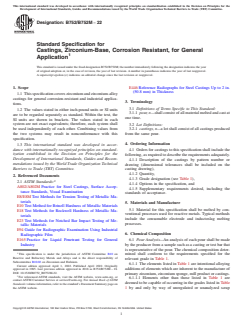
1.1 This specification covers zirconium and zirconium-alloy castings for general corrosion-resistant and industrial applications.
1.2 The values stated in either inch-pound units or SI units are to be regarded separately as standard. Within the text, the SI units are shown in brackets. The values stated in each system are not exact equivalents; therefore, each system shall be used independently of each other. Combining values from the two systems may result in nonconformance with this specification.
1.3 This international standard was developed in accordance with internationally recognized principles on standardization established in the Decision on Principles for the Development of International Standards, Guides and Recommendations issued by the World Trade Organization Technical Barriers to Trade (TBT) Committee.
- Status
- Published
- Publication Date
- 31-Mar-2022
- Technical Committee
- B10 - Reactive and Refractory Metals and Alloys
- Drafting Committee
- B10.02 - Zirconium and Hafnium
Buy Documents
ASTM B752/B752M-22 - Standard Specification for Castings, Zirconium-Base, Corrosion Resistant, for General Application
REDLINE ASTM B752/B752M-22 - Standard Specification for Castings, Zirconium-Base, Corrosion Resistant, for General Application
Overview
ASTM B752/B752M-22 is the standard specification issued by ASTM International for zirconium and zirconium-alloy castings intended for general corrosion-resistant and industrial applications. This specification outlines the criteria for the production, chemical composition, mechanical properties, testing, and quality assurance of cast zirconium-base components. The standard is crucial for ensuring that zirconium castings meet defined performance and safety requirements, particularly in environments where corrosion resistance is critical.
Key Topics
Scope and Coverage
- Applies to zirconium and zirconium-alloy castings used in corrosive and industrial environments.
- Details applicable to both inch-pound and SI units, with requirements kept separate to prevent errors in fabrication and compliance.
Material and Manufacturing
- Specifies conventional melting processes suitable for reactive metals, including consumable electrode and inductoslag methods.
- Chemical composition requirements are provided for major elements such as zirconium, hafnium, iron, chromium, hydrogen, nitrogen, carbon, oxygen, phosphorus, tin, and niobium.
- Includes guidelines for product analysis and heat treatment where necessary.
Ordering Information
- Orders must clearly specify casting description, quantity, required grade, specification options, and any supplementary acceptance criteria.
Inspection and Certification
- Visual inspection and adherence to dimensional tolerances are required.
- Certification by the supplier is mandatory, ensuring compliance with all requirements and providing results from specified testing.
Repair and Quality Control
- Repair welding procedures and operator qualifications must meet defined quality standards.
- Major repairs, especially those involving welds after hydrostatic testing, require stress relief and further inspection.
Applications
Zirconium and zirconium-alloy castings manufactured to ASTM B752/B752M-22 are widely used in sectors where both high mechanical performance and superior corrosion resistance are required. Key applications include:
- Chemical processing equipment: Pumps, valves, and pipe fittings in acidic or highly reactive environments benefit from zirconium’s resistance to corrosion.
- Nuclear power: Components that must endure long-term exposure to corrosive coolants or radioactive environments leverage zirconium's unique properties.
- Petrochemical industry: Utilized for process vessels and parts that handle harsh chemicals.
- Industrial manufacturing: Where durability in challenging environments extends the operational life of critical machinery.
By adhering to this standard, industries can reliably specify and procure components that will maintain integrity and performance in aggressive service conditions.
Related Standards
Several ASTM standards complement or are referenced in ASTM B752/B752M-22 to ensure comprehensive testing and quality control:
- ASTM A802/A802M – Visual standards for steel castings
- ASTM E8/E8M – Test methods for tension testing of metallic materials
- ASTM E10 and E18 – Methods for Brinell and Rockwell hardness testing
- ASTM E23 – Notched bar impact testing
- ASTM E94 and E446 – Radiographic examination guidelines and reference radiographs
- ASTM E165 – Liquid penetrant testing for surface discontinuities
Following these related standards ensures rigorous assessment of mechanical properties, surface quality, and internal structure, supporting the reliable use of zirconium castings across demanding industries.
Keywords: ASTM B752/B752M, zirconium castings, zirconium alloys, corrosion resistance, industrial castings, chemical composition, heat treatment, quality assurance, reactive metals, industrial standards, casting specification.
Relations
- Effective Date
- 01-Apr-2024
- Effective Date
- 01-Jan-2024
- Effective Date
- 01-Jul-2018
- Effective Date
- 01-Jul-2017
- Effective Date
- 15-Jul-2016
- Effective Date
- 01-Apr-2016
- Effective Date
- 01-Jan-2016
- Effective Date
- 01-Feb-2015
- Effective Date
- 01-May-2014
- Effective Date
- 01-Jun-2013
- Effective Date
- 01-Dec-2012
- Effective Date
- 15-Nov-2012
- Effective Date
- 01-Jul-2012
- Effective Date
- 01-Jun-2012
- Effective Date
- 15-May-2012
Buy Documents
ASTM B752/B752M-22 - Standard Specification for Castings, Zirconium-Base, Corrosion Resistant, for General Application
REDLINE ASTM B752/B752M-22 - Standard Specification for Castings, Zirconium-Base, Corrosion Resistant, for General Application
Get Certified
Connect with accredited certification bodies for this standard

Element Materials Technology
Materials testing and product certification.

Inštitut za kovinske materiale in tehnologije
Institute of Metals and Technology. Materials testing, metallurgical analysis, NDT.
Sponsored listings
Frequently Asked Questions
ASTM B752/B752M-22 is a technical specification published by ASTM International. Its full title is "Standard Specification for Castings, Zirconium-Base, Corrosion Resistant, for General Application". This standard covers: ABSTRACT This specification covers zirconium and zirconium-alloy castings for general corrosion-resistant and industrial applications. Material for this specification shall be melted by conventional processes used for reactive metals. Typical methods include the consumable electrode and inductoslag melting processes. The material shall conform to the required chemical composition for zirconium, hafnium, iron, chromium, hydrogen, nitrogen, carbon, oxygen, phosphorus, tin, and niobium. Product analysis and heat treatment shall be performed on the material, and shall conform within the specified check analysis tolerances. SCOPE 1.1 This specification covers zirconium and zirconium-alloy castings for general corrosion-resistant and industrial applications. 1.2 The values stated in either inch-pound units or SI units are to be regarded separately as standard. Within the text, the SI units are shown in brackets. The values stated in each system are not exact equivalents; therefore, each system shall be used independently of each other. Combining values from the two systems may result in nonconformance with this specification. 1.3 This international standard was developed in accordance with internationally recognized principles on standardization established in the Decision on Principles for the Development of International Standards, Guides and Recommendations issued by the World Trade Organization Technical Barriers to Trade (TBT) Committee.
ABSTRACT This specification covers zirconium and zirconium-alloy castings for general corrosion-resistant and industrial applications. Material for this specification shall be melted by conventional processes used for reactive metals. Typical methods include the consumable electrode and inductoslag melting processes. The material shall conform to the required chemical composition for zirconium, hafnium, iron, chromium, hydrogen, nitrogen, carbon, oxygen, phosphorus, tin, and niobium. Product analysis and heat treatment shall be performed on the material, and shall conform within the specified check analysis tolerances. SCOPE 1.1 This specification covers zirconium and zirconium-alloy castings for general corrosion-resistant and industrial applications. 1.2 The values stated in either inch-pound units or SI units are to be regarded separately as standard. Within the text, the SI units are shown in brackets. The values stated in each system are not exact equivalents; therefore, each system shall be used independently of each other. Combining values from the two systems may result in nonconformance with this specification. 1.3 This international standard was developed in accordance with internationally recognized principles on standardization established in the Decision on Principles for the Development of International Standards, Guides and Recommendations issued by the World Trade Organization Technical Barriers to Trade (TBT) Committee.
ASTM B752/B752M-22 is classified under the following ICS (International Classification for Standards) categories: 77.150.10 - Aluminium products. The ICS classification helps identify the subject area and facilitates finding related standards.
ASTM B752/B752M-22 has the following relationships with other standards: It is inter standard links to ASTM E23-24, ASTM E8/E8M-24, ASTM E18-18, ASTM E18-17, ASTM E8/E8M-16, ASTM E23-16a, ASTM E23-16, ASTM E8/E8M-15, ASTM E10-14, ASTM E8/E8M-13, ASTM E18-12, ASTM E23-12c, ASTM E23-12b, ASTM E23-12a, ASTM E23-12. Understanding these relationships helps ensure you are using the most current and applicable version of the standard.
ASTM B752/B752M-22 is available in PDF format for immediate download after purchase. The document can be added to your cart and obtained through the secure checkout process. Digital delivery ensures instant access to the complete standard document.
Standards Content (Sample)
This international standard was developed in accordance with internationally recognized principles on standardization established in the Decision on Principles for the
Development of International Standards, Guides and Recommendations issued by the World Trade Organization Technical Barriers to Trade (TBT) Committee.
Designation:B752/B752M −22
Standard Specification for
Castings, Zirconium-Base, Corrosion Resistant, for General
Application
This standard is issued under the fixed designation B752/B752M; the number immediately following the designation indicates the year
of original adoption or, in the case of revision, the year of last revision. A number in parentheses indicates the year of last reapproval.
A superscript epsilon (´) indicates an editorial change since the last revision or reapproval.
1. Scope E446 Reference Radiographs for Steel Castings Up to 2 in.
(50.8 mm) in Thickness
1.1 Thisspecificationcoverszirconiumandzirconium-alloy
castings for general corrosion-resistant and industrial applica-
3. Terminology
tions.
3.1 Definitions of Terms Specific to This Standard:
1.2 The values stated in either inch-pound units or SI units
3.1.1 pour, n—shall consist of all material melted and cast at
are to be regarded separately as standard. Within the text, the
one time.
SI units are shown in brackets. The values stated in each
system are not exact equivalents; therefore, each system shall
3.2 Lot Definitions:
be used independently of each other. Combining values from 3.2.1 castings, n—a lot shall consist of all castings produced
the two systems may result in nonconformance with this
from the same pour.
specification.
4. Ordering Information
1.3 This international standard was developed in accor-
dance with internationally recognized principles on standard-
4.1 Orders for castings to this specification shall include the
ization established in the Decision on Principles for the
following, as required to describe the requirements adequately.
Development of International Standards, Guides and Recom-
4.1.1 Description of the castings by pattern number or
mendations issued by the World Trade Organization Technical
drawing (dimensional tolerances shall be included on the
Barriers to Trade (TBT) Committee.
casting drawing),
4.1.2 Quantity,
2. Referenced Documents
4.1.3 Grade designation (see Table 1),
2.1 ASTM Standards:
4.1.4 Options in the specification, and
A802/A802M Practice for Steel Castings, Surface Accep-
4.1.5 Supplementary requirements desired, including the
tance Standards, Visual Examination
standards of acceptance.
E8/E8M Test Methods for Tension Testing of Metallic Ma-
terials
5. Materials and Manufacture
E10 Test Method for Brinell Hardness of Metallic Materials
5.1 Material for this specification shall be melted by con-
E18 Test Methods for Rockwell Hardness of Metallic Ma-
ventional processes used for reactive metals. Typical methods
terials
include the consumable electrode and inductoslag melting
E23 Test Methods for Notched Bar Impact Testing of Me-
processes.
tallic Materials
E94 Guide for Radiographic Examination Using Industrial
6. Chemical Composition
Radiographic Film
E165 Practice for Liquid Penetrant Testing for General 6.1 Pour Analysis—An analysis of each pour shall be made
Industry
by the producer from a sample such as a casting or test bar that
is representative of the pour. The chemical composition deter-
This specification is under the jurisdiction of ASTM Committee B10 on
mined shall conform to the requirements specified for the
Reactive and Refractory Metals and Alloys and is the direct responsibility of
relevant grade in Table 1.
Subcommittee B10.02 on Zirconium and Hafnium.
6.1.1 The elements listed in Table 1 are intentional alloying
Current edition approved April 1, 2022. Published April 2022. Originally
additions of elements which are inherent to the manufacture of
approved in 1985. Last previous edition approved in 2018 as B752/B752M – 18.
DOI: 10.1520/B0752_B0752M-22.
primaryzirconium,zirconiumsponge,millproductorcastings.
For referenced ASTM standards, visit the ASTM website, www.astm.org, or
6.1.1.1 Elements other than those listed in Table 1 are
contact ASTM Customer Service at service@astm.org. For Annual Book of ASTM
deemed to be capable of occurring in the grades listed in Table
Standards volume information, refer to the standard’s Document Summary page on
the ASTM website. 1 by and only by way of unregulated or unanalyzed scrap
Copyright © ASTM International, 100 Barr Harbor Drive, PO Box C700, West Conshohocken, PA 19428-2959. United States
B752/B752M−22
A
TABLE 1 Chemical Requirements
7. Heat Treatment
Composition, %
7.1 Unless otherwise specified in the contract, all castings
UNS Grade Designation
willbesuppliedintheas-castconditionexceptwhenpost-weld
R61702 R61704 R61705
heat treatment is required.
Zirconium and hafnium, 98.8 97.1 95.1
min.
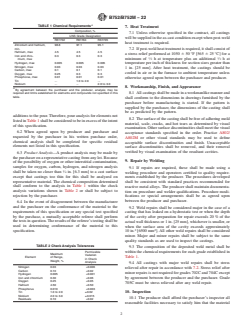
7.2 If post-weld heat treatment is required, it shall consist of
Hafnium, max 4.5 4.5 4.5
a stress relief performed at 1050 6 50 °F [565 6 25 °C] for a
Iron and chro- 0.3 0.3 0.3
1 1
minimum of ⁄2 h at temperature plus an additional ⁄2hat
mium, max
Hydrogen, max 0.005 0.005 0.005
temperature per inch of thickness for section sizes greater than
Nitrogen, max 0.03 0.03 0.03
1 in. [25 mm]. After heat treatment, the castings should be
Carbon, max 0.1 0.1 0.1
cooled in air or in the furnace to ambient temperature unless
Oxygen, max 0.25 0.3 0.3
Phosphorus, max 0.01 0.01 0.01
otherwise agreed upon between the purchaser and producer.
Tin . 1.0 to 2.0 .
Niobium . . 2.0 to 3.0
8. Workmanship, Finish, and Appearance
A
By agreement between the purchaser and the producer, analysis may be
required and limits established for elements and compounds not specified in this 8.1 Allcastingsshallbemadeinaworkmanlikemannerand
table.
shall conform to the dimensions in drawings furnished by the
purchaser before manufacturing is started. If the pattern is
supplied by the purchaser, the dimensions of the casting shall
be as predicted by the pattern.
additions to the pour. Therefore, pour analysis for elements not
8.2 The surface of the casting shall be free of adhering mold
listedin Table1shallbeconsideredtobeinexcessoftheintent
material, scale, cracks, and hot tears as determined by visual
of this specification.
examination.Othersurfacediscontinuitiesshallmeetthevisual
6.2 When agreed upon by producer and purchaser and
acceptance standards specified in the order. Practice A802/
requested by the purchaser in his written purchase order,
A802M or other visual standards may be used to define
chemical analysis shall be completed for specific residual
acceptable surface discontinuities and finish. Unacceptable
elements not listed in this specification.
surface discontinuities shall be removed, and their removal
verified by visual examination of the resultant cavities.
6.3 Product Analysis—A product analysis may be made by
the purchaser on a representative casting from any lot. Because
9. Repair by Welding
of the possibility of oxygen or other interstitial contamination,
samples for oxygen, carbon, hydrogen, and nitrogen analysis
9.1 If repairs are required, these shall be made using a
shall be taken no closer than ⁄4 in. [6.3 mm] to a cast surface
welding procedure and operators certified to quality require-
except that castings too thin for this shall be analyzed on
ments established by the producer. The procedures developed
representative material. The chemical composition determined
shall be consistent with standard practices recommended for
shall conform to the analysis in Table 1 within the check
reactive metal alloys. The producer shall maintain documenta-
analysis variations shown in Table 2 or shall be subject to
tion on procedure and welder qualifications. Procedure modi-
rejection by the purchaser.
fications or special arrangements shall be as agreed upon
between the producer and purchaser.
6.4 In the event of disagreement between the manufacturer
and the purchaser on the conformance of the material to the
9.2 Weld repairs shall be considered major in the case of a
requirements of this specification or any special test specified
casting that has leaked on a hydrostatic test or when the depth
by the purchase, a mutually acceptable referee shall perform
of the cavity after preparation for repair exceeds 20 % of the
the tests in question.The results of the referee’s testing shall be
actual wall thickness or 1 in. [25 mm], whichever is smaller, or
used in determining conformance of the material to this
when the surface area of the cavity exceeds approximately
2 2
specification.
10 in. [6500 mm ]. All other weld repairs shall be considered
minor. Major and minor repairs shall be subject to the same
quality standards as are used to inspect the castings.
TABLE 2 Check Analysis Tolerances
9.3 The composition of the deposited weld metal shall be
Permissible
within the chemical requirements for each grade established in
Maximum
Variation
Element of Range, Table 1.
in Check
Weight, %
Analysis
9.4 All castings with major weld repairs shall be stress
Nitrogen 0.03 +0.006
relieved after repair in accordance with 7.2. Stress relief after
Carbon 0.10 +0.02
minor repairs is not required for grades 702C and 704C except
Hydrogen 0.005 +0.001
Iron and chromium 0.30 +0.06 by agreement between the producer and the purchaser.
...
This document is not an ASTM standard and is intended only to provide the user of an ASTM standard an indication of what changes have been made to the previous version. Because
it may not be technically possible to adequately depict all changes accurately, ASTM recommends that users consult prior editions as appropriate. In all cases only the current version
of the standard as published by ASTM is to be considered the official document.
Designation: B752/B752M − 18 B752/B752M − 22
Standard Specification for
Castings, Zirconium-Base, Corrosion Resistant, for General
Application
This standard is issued under the fixed designation B752/B752M; the number immediately following the designation indicates the year
of original adoption or, in the case of revision, the year of last revision. A number in parentheses indicates the year of last reapproval.
A superscript epsilon (´) indicates an editorial change since the last revision or reapproval.
1. Scope
1.1 This specification covers zirconium and zirconium-alloy castings for general corrosion-resistant and industrial applications.
1.2 The values stated in either inch-pound units or SI units are to be regarded separately as standard. Within the text, the SI units
are shown in brackets. The values stated in each system are not exact equivalents; therefore, each system shall be used
independently of each other. Combining values from the two systems may result in nonconformance with this specification.
1.3 This international standard was developed in accordance with internationally recognized principles on standardization
established in the Decision on Principles for the Development of International Standards, Guides and Recommendations issued
by the World Trade Organization Technical Barriers to Trade (TBT) Committee.
2. Referenced Documents
2.1 ASTM Standards:
A802/A802M Practice for Steel Castings, Surface Acceptance Standards, Visual Examination
E8/E8M Test Methods for Tension Testing of Metallic Materials
E10 Test Method for Brinell Hardness of Metallic Materials
E18 Test Methods for Rockwell Hardness of Metallic Materials
E23 Test Methods for Notched Bar Impact Testing of Metallic Materials
E94 Guide for Radiographic Examination Using Industrial Radiographic Film
E165 Practice for Liquid Penetrant Testing for General Industry
E446 Reference Radiographs for Steel Castings Up to 2 in. (50.8 mm) in Thickness
3. Terminology
3.1 Definitions of Terms Specific to This Standard:
3.1.1 pour, n—shall consist of all material melted and cast at one time.
3.2 Lot Definitions:
3.2.1 castings, n—a lot shall consist of all castings produced from the same pour.
This specification is under the jurisdiction of ASTM Committee B10 on Reactive and Refractory Metals and Alloys and is the direct responsibility of Subcommittee
B10.02 on Zirconium and Hafnium.
Current edition approved Oct. 1, 2018April 1, 2022. Published December 2018April 2022. Originally approved in 1985. Last previous edition approved in 20112018 as
ɛ2
B752 – 06 (2011)B752/B752M – 18. . DOI: 10.1520/B0752_B0752M - 18. DOI: 10.1520/B0752_B0752M-22.
For referenced ASTM standards, visit the ASTM website, www.astm.org, or contact ASTM Customer Service at service@astm.org. For Annual Book of ASTM Standards
volume information, refer to the standard’s Document Summary page on the ASTM website.
Copyright © ASTM International, 100 Barr Harbor Drive, PO Box C700, West Conshohocken, PA 19428-2959. United States
B752/B752M − 22
4. Ordering Information
4.1 Orders for castings to this specification shall include the following, as required to describe the requirements adequately.
4.1.1 Description of the castings by pattern number or drawing (dimensional tolerances shall be included on the casting drawing),
4.1.2 Quantity,
4.1.3 Grade Designationdesignation (see Table 1),
4.1.4 Options in the specification, and
4.1.5 Supplementary requirements desired, including the standards of acceptance.
5. Materials and Manufacture
5.1 Material for this specification shall be melted by conventional processes used for reactive metals. Typical methods include the
consumable electrode and inductoslag melting processes.
6. Chemical Composition
6.1 Pour Analysis—An analysis of each pour shall be made by the producer from a sample such as a casting or test bar that is
representative of the pour. The chemical composition determined shall conform to the requirements specified for the relevant grade
in Table 1.
6.1.1 The elements listed in Table 1 are intentional alloying additions of elements which are inherent to the manufacture of primary
zirconium, zirconium sponge, mill product or castings.
6.1.1.1 Elements other than those listed in Table 1 are deemed to be capable of occurring in the grades listed in Table 1 by and
only by way of unregulated or unanalyzed scrap additions to the pour. Therefore, pour analysis for elements not listed in Table 1
shall be considered to be in excess of the intent of this specification.
6.2 When agreed upon by producer and purchaser and requested by the purchaser in his written purchase order, chemical analysis
shall be completed for specific residual elements not listed in this specification.
6.3 Product Analysis—A product analysis may be made by the purchaser on a representative casting from any lot. Because of the
possibility of oxygen or other interstitial contamination, samples for oxygen, carbon, hydrogen, and nitrogen analysis shall be taken
no closer than ⁄4 in. [6.3 mm] to a cast surface except that castings too thin for this shall be analyzed on representative material.
A
TABLE 1 Chemical Requirements
Grade Designation,
Composition, %
702CUNS Grade Designation 704C 705C
R61702 R61704 R61705
Zirconium and hafnium, 98.8 97.1 95.1
min.
Hafnium, max 4.5 4.5 4.5
Iron and chro- 0.3 0.3 0.3
mium, max
Hydrogen, max 0.005 0.005 0.005
Nitrogen, max 0.03 0.03 0.03
Carbon, max 0.1 0.1 0.1
Oxygen, max 0.25 0.3 0.3
Phosphorus, max 0.01 0.01 0.01
Tin . 1.0 to 2.0 .
Niobium . . 2.0 to 3.0
A
By agreement between the purchaser and the producer, analysis may be
required and limits established for elements and compounds not specified in this
table.
B752/B752M − 22
The chemical composition determined shall conform to the analysis in Table 1 within the check analysis variations shown in Table
2 or shall be subject to rejection by the purchaser.
6.4 In the event of disagreement between the manufacturer and the purchaser on the conformance of the material to the
requirements of this specification or any special test specified by the purchase, a mutually acceptable referee shall perform the tests
in question. The results of the referee’s testing shall be used in determining conformance of the material to this specification.
7. Heat Treatment
7.1 Unless otherwise specified in the contract, all castings will be supplied in the as-cast condition except when post-weld heat
treatment is required.
7.2 If post-weld heat treatment is required, it shall consist of a stress relief performed at 1050 6 50°F50 °F [565 6 25°C]25 °C]
1 1
for a minimum of ⁄2 h at temperature plus an additional ⁄2 h at temperature per inch of thickness for section sizes greater than
1 in. [25 mm]. After heat treatment, the castings should be cooled in air or in the furnace to ambient temperature unless otherwise
agreed upon between the purchaser and producer.
8. Workmanship, Finish, and Appearance
8.1 All castings shall be made in a workmanlike manner and shall conform to the dimensions in drawings furnished by the
purchaser before manufacturing is started. If the pattern is supplied by the purchaser, the dimensions of the casting shall be as
predicted by the pattern.
8.2 The surface of the casting shall be free of adhering mold material, scale, cracks, and hot tears as determined by visual
examination. Other surface discontinuities shall meet the visual acceptance standards specified in the order. Practice A802/A802M
or other visual standards may be used to define acceptable surface discontinuities and finish. Unacceptable surface discontinuities
shall be removed, and their removal verified by visual examination of the resultant cavities.
9. Repair by Welding
9.1 If repairs are required, these shall be made using a welding procedure and operators certified to quality requirements
established by the producer. The procedures developed shall be consistent with standard practices recommended for reactive metal
alloys. The producer shall maintain documentation on procedure and welder qualifications. Procedure modifications or special
arrangements shall be as agreed upon between the producer and purchaser.
9.2 Weld repairs shall be considered major in the case of a casting that has leaked on a hydrostatic test or when the depth of the
cavity after preparation for repair exceeds 20 % of the actual wall thickness or 1 in. [25 mm], whichever is smaller, or when the
2 2
surface area of the cavity exceeds approximately 10 in.10 in. [6500 mm [6500 mm ]. All other weld repairs shall be considered
minor. Major and minor repairs shall be subject to the same quality standards as are used to inspect the castings.
9.3 The composition of the deposited weld metal shall be within the chemical requirements for each grade established in Table
1.
TABLE 2 Check Analysis Tolerances
Permissible
Maximum
Variation
Element of Range,
in Check
Weight, %
Analysis
Nitrogen 0.03 +0.006
Carbon 0.10 +0.02
Hydrogen 0.005 +0.001
Iron and chromium 0.30 +0.06
Oxygen 0.25 +0.05
Hafnium 4.50 +0.50
Phosphorus 0.010 +0.003
Tin 1.0 to 2.0 ±0.02
Niobium 2.0 to 3.0 ±0.015
Residuals 0.10 +0.02
...