

ASTM D7868-21
(Practice)Standard Practice for Determining the Dry Fall (Fog) Properties of Protective Coatings
General Information
- Abstract
SIGNIFICANCE AND USE
5.1 Attachment of overspray particles to vehicles and other surfaces not intended to be coated can result in property damage and insurance claims. Dry fall coatings are formulated such that overspray particles dry as they move through the air, and before they land on horizontal surfaces. These particles can then be brushed off, vacuumed or washed from the surfaces with no damage. This practice can be used to evaluate the dry fall properties of coatings prior to large scale use. The practice can also be used to evaluate whether the coating(s) possess the same dry fall properties when the fallout collects on surfaces with an elevated temperature.
SCOPE
1.1 This practice covers a procedure for qualitatively evaluating the dry fall properties of coatings. The establishment of the test environment and the evaluation procedures are described.
1.2 This practice uses panels containing an automotive finish since these types of surfaces are often the primary concern relating to overspray damage. Panels coated with other systems may be used as collection surfaces when they are deemed to be more representative.
1.3 The values stated in inch-pound units are to be regarded as standard. The values given in parentheses are mathematical conversions to SI units that are provided for information only and are not considered standard.
1.4 This standard does not purport to address all of the safety concerns, if any, associated with its use. It is the responsibility of the user of this standard to establish appropriate safety, health, and environmental practices and determine the applicability of regulatory limitations prior to use.
1.5 This international standard was developed in accordance with internationally recognized principles on standardization established in the Decision on Principles for the Development of International Standards, Guides and Recommendations issued by the World Trade Organization Technical Barriers to Trade (TBT) Committee.
- Status
- Published
- Publication Date
- 31-Oct-2021
- Technical Committee
- D01 - Paint and Related Coatings, Materials, and Applications
- Drafting Committee
- D01.46 - Industrial Protective Coatings
Buy Documents

ASTM D7868-21 - Standard Practice for Determining the Dry Fall (Fog) Properties of Protective Coatings
REDLINE ASTM D7868-21 - Standard Practice for Determining the Dry Fall (Fog) Properties of Protective Coatings
Overview
ASTM D7868-21, titled Standard Practice for Determining the Dry Fall (Fog) Properties of Protective Coatings, is an international standard developed by ASTM. This standard provides a qualitative procedure to evaluate the dry fall properties of protective coatings, primarily focusing on the potential for overspray particles to dry before settling on neighboring surfaces. It is particularly relevant in minimizing property damage and managing insurance claims resulting from coating overspray, especially for environments where vehicles and other sensitive surfaces are present.
Dry fall coatings are designed so that airborne overspray particles desiccate and transform into a dust or powder before landing, allowing easy removal without causing damage. ASTM D7868-21 presents a reliable method for assessing these properties under realistic conditions prior to large-scale coating applications.
Key Topics
- Purpose: Evaluates the ability of protective coatings to form a non-adherent, removable layer of overspray dust, thereby mitigating accidental damage to unintended surfaces.
- Test Environment: Describes the use of enclosed test chambers and collection surfaces to simulate real-world overspray scenarios.
- Test Surfaces: Commonly utilizes automotive-finish panels; other substrates may be used to more accurately reflect specific project conditions.
- Removal Methods: Assesses removal using techniques such as dry brushing, washing with car wash concentrate, or using mineral spirits, based on the degree of attachment.
- Variable Conditions: Includes evaluation on both ambient and elevated surface temperature collection panels to reflect common field situations.
- Documentation: Specifies systematic reporting requirements, including environmental conditions, application method, and the effectiveness of overspray removal techniques.
Applications
ASTM D7868-21 finds wide practical use in industrial and commercial paint applications. Its main applications include:
- Evaluation Before Large-Scale Projects: Provides a structured approach to verifying that a coating product’s dry fall characteristics meet project requirements, reducing risks of overspray damage to vehicles, equipment, and nearby property.
- Specification for Industrial Coatings: Used by facilities managers, coatings manufacturers, and painting contractors to qualify products for use in factories, warehouses, parking garages, and similar environments.
- Quality Control and Product Development: Aids coatings formulators in developing and refining products specifically engineered to prevent costly overspray adhesion.
- Insurance and Risk Management: Supports evidence-based decisions in risk assessment and in responding to insurance claims related to paint overspray incidents.
- Evaluation on Heated Surfaces: Ensures coatings perform as required even when overspray settles on surfaces exposed to elevated temperatures, such as rooftops or sunlit vehicles.
Related Standards
Several related ASTM standards help ensure complete quality assessments and performance evaluations for coatings and surface preparation:
- ASTM D610: Practice for Evaluating Degree of Rusting on Painted Steel Surfaces – an essential standard for assessing corrosion resistance.
- ASTM D5402: Practice for Assessing the Solvent Resistance of Organic Coatings Using Solvent Rubs – useful for determining coating durability.
- Other dry fall, fog, and overspray-related standards may also apply depending on specific project needs.
Summary
ASTM D7868-21 sets out consistent methods for determining the dry fall properties of protective coatings, improving confidence in product selection, damage prevention, and overall coatings performance in settings where overspray is a concern. By following this standard practice, stakeholders can ensure both regulatory compliance and higher satisfaction in coating applications where clean, damage-free surroundings are critical.
Keywords: ASTM D7868-21, dry fall coatings, fog properties, protective coatings, overspray, industrial painting, coating evaluation, paint overspray removal.
Relations
- Refers
ASTM D610-08(2019) - Standard Practice for Evaluating Degree of Rusting on Painted Steel Surfaces - Effective Date
- 01-Jan-2019
- Effective Date
- 01-Jun-2015
- Refers
ASTM D610-08(2012) - Standard Practice for Evaluating Degree of Rusting on Painted Steel Surfaces - Effective Date
- 01-Nov-2012
- Effective Date
- 01-Aug-2011
- Effective Date
- 01-Feb-2008
- Refers
ASTM D610-07 - Standard Test Method for Evaluating Degree of Rusting on Painted Steel Surfaces - Effective Date
- 01-Jul-2007
- Effective Date
- 01-Aug-2006
- Refers
ASTM D610-01 - Standard Test Method for Evaluating Degree of Rusting on Painted Steel Surfaces - Effective Date
- 10-May-2001
- Refers
ASTM D610-95 - Standard Test Method for Evaluating Degree of Rusting on Painted Steel Surfaces - Effective Date
- 10-May-2001
- Effective Date
- 10-Dec-1999
Buy Documents
ASTM D7868-21 - Standard Practice for Determining the Dry Fall (Fog) Properties of Protective Coatings
REDLINE ASTM D7868-21 - Standard Practice for Determining the Dry Fall (Fog) Properties of Protective Coatings
Frequently Asked Questions
ASTM D7868-21 is a standard published by ASTM International. Its full title is "Standard Practice for Determining the Dry Fall (Fog) Properties of Protective Coatings". This standard covers: SIGNIFICANCE AND USE 5.1 Attachment of overspray particles to vehicles and other surfaces not intended to be coated can result in property damage and insurance claims. Dry fall coatings are formulated such that overspray particles dry as they move through the air, and before they land on horizontal surfaces. These particles can then be brushed off, vacuumed or washed from the surfaces with no damage. This practice can be used to evaluate the dry fall properties of coatings prior to large scale use. The practice can also be used to evaluate whether the coating(s) possess the same dry fall properties when the fallout collects on surfaces with an elevated temperature. SCOPE 1.1 This practice covers a procedure for qualitatively evaluating the dry fall properties of coatings. The establishment of the test environment and the evaluation procedures are described. 1.2 This practice uses panels containing an automotive finish since these types of surfaces are often the primary concern relating to overspray damage. Panels coated with other systems may be used as collection surfaces when they are deemed to be more representative. 1.3 The values stated in inch-pound units are to be regarded as standard. The values given in parentheses are mathematical conversions to SI units that are provided for information only and are not considered standard. 1.4 This standard does not purport to address all of the safety concerns, if any, associated with its use. It is the responsibility of the user of this standard to establish appropriate safety, health, and environmental practices and determine the applicability of regulatory limitations prior to use. 1.5 This international standard was developed in accordance with internationally recognized principles on standardization established in the Decision on Principles for the Development of International Standards, Guides and Recommendations issued by the World Trade Organization Technical Barriers to Trade (TBT) Committee.
SIGNIFICANCE AND USE 5.1 Attachment of overspray particles to vehicles and other surfaces not intended to be coated can result in property damage and insurance claims. Dry fall coatings are formulated such that overspray particles dry as they move through the air, and before they land on horizontal surfaces. These particles can then be brushed off, vacuumed or washed from the surfaces with no damage. This practice can be used to evaluate the dry fall properties of coatings prior to large scale use. The practice can also be used to evaluate whether the coating(s) possess the same dry fall properties when the fallout collects on surfaces with an elevated temperature. SCOPE 1.1 This practice covers a procedure for qualitatively evaluating the dry fall properties of coatings. The establishment of the test environment and the evaluation procedures are described. 1.2 This practice uses panels containing an automotive finish since these types of surfaces are often the primary concern relating to overspray damage. Panels coated with other systems may be used as collection surfaces when they are deemed to be more representative. 1.3 The values stated in inch-pound units are to be regarded as standard. The values given in parentheses are mathematical conversions to SI units that are provided for information only and are not considered standard. 1.4 This standard does not purport to address all of the safety concerns, if any, associated with its use. It is the responsibility of the user of this standard to establish appropriate safety, health, and environmental practices and determine the applicability of regulatory limitations prior to use. 1.5 This international standard was developed in accordance with internationally recognized principles on standardization established in the Decision on Principles for the Development of International Standards, Guides and Recommendations issued by the World Trade Organization Technical Barriers to Trade (TBT) Committee.
ASTM D7868-21 is classified under the following ICS (International Classification for Standards) categories: 87.040 - Paints and varnishes. The ICS classification helps identify the subject area and facilitates finding related standards.
ASTM D7868-21 has the following relationships with other standards: It is inter standard links to ASTM D610-08(2019), ASTM D5402-15, ASTM D610-08(2012), ASTM D5402-06(2011), ASTM D610-08, ASTM D610-07, ASTM D5402-06, ASTM D610-01, ASTM D610-95, ASTM D5402-93(1999). Understanding these relationships helps ensure you are using the most current and applicable version of the standard.
ASTM D7868-21 is available in PDF format for immediate download after purchase. The document can be added to your cart and obtained through the secure checkout process. Digital delivery ensures instant access to the complete standard document.
Standards Content (Sample)
This international standard was developed in accordance with internationally recognized principles on standardization established in the Decision on Principles for the
Development of International Standards, Guides and Recommendations issued by the World Trade Organization Technical Barriers to Trade (TBT) Committee.
Designation: D7868 − 21
Standard Practice for
Determining the Dry Fall (Fog) Properties of Protective
Coatings
This standard is issued under the fixed designation D7868; the number immediately following the designation indicates the year of
original adoption or, in the case of revision, the year of last revision. A number in parentheses indicates the year of last reapproval. A
superscript epsilon (´) indicates an editorial change since the last revision or reapproval.
1. Scope 3. Terminology
1.1 This practice covers a procedure for qualitatively evalu- 3.1 Definitions:
ating the dry fall properties of coatings. The establishment of 3.1.1 dry fall/fog coating, n—an interior or exterior coating
the test environment and the evaluation procedures are de- specially formulated so that the fine particles of overspray dry
scribed. to a dust or powder during a free fall of a certain distance at
specific temperature and humidity ranges, and will not adhere
1.2 This practice uses panels containing an automotive
to surfaces on which the overspray is subsequently deposited.
finish since these types of surfaces are often the primary
concern relating to overspray damage. Panels coated with other
4. Summary of Practice
systems may be used as collection surfaces when they are
4.1 A structural frame is erected and enclosed unless a dry
deemed to be more representative.
fall/fog test chamber or laboratory space is pre-designated.
1.3 The values stated in inch-pound units are to be regarded
Spray targets are placed at the top, inside the enclosure. Four
as standard. The values given in parentheses are mathematical
steel panels coated with an automotive basecoat/clear coat
conversions to SI units that are provided for information only
system are placed on the enclosure floor to collect the dry fall.
and are not considered standard.
(Panels coated with other systems or uncoated panels, or both,
1.4 This standard does not purport to address all of the
can be used when they are deemed to be more representative.)
safety concerns, if any, associated with its use. It is the
A duplicate panel set is maintained at the prevailing air
responsibility of the user of this standard to establish appro-
temperature, while the other duplicate panel set is heated in
priate safety, health, and environmental practices and deter-
oven and placed inside the enclosure immediately prior to
mine the applicability of regulatory limitations prior to use.
atomizing the coating. The coating is atomized against the
1.5 This international standard was developed in accor-
targets at each of two distances and the panels are removed for
dance with internationally recognized principles on standard-
evaluation. Two of the coated steel panels remain at laboratory
ization established in the Decision on Principles for the
ambient conditions, while the “pre-heated” panels are returned
Development of International Standards, Guides and Recom-
to a laboratory oven.The heated and ambient coated panels are
mendations issued by the World Trade Organization Technical
cleaned and evaluated after 24-h for dry fall attachment.
Barriers to Trade (TBT) Committee.
5. Significance and Use
2. Referenced Documents
5.1 Attachment of overspray particles to vehicles and other
2.1 ASTM Standards:
surfaces not intended to be coated can result in property
D610 Practice for Evaluating Degree of Rusting on Painted
damage and insurance claims. Dry fall coatings are formulated
Steel Surfaces
such that overspray particles dry as they move through the air,
D5402 Practice for Assessing the Solvent Resistance of
andbeforetheylandonhorizontalsurfaces.Theseparticlescan
Organic Coatings Using Solvent Rubs
then be brushed off, vacuumed or washed from the surfaces
with no damage. This practice can be used to evaluate the dry
fall properties of coatings prior to large scale use. The practice
This practice is under the jurisdiction of ASTM Committee D01 on Paint and
can also be used to evaluate whether the coating(s) possess the
Related Coatings, Materials, and Applications and is the direct responsibility of
Subcommittee D01.46 on Industrial Protective Coatings.
same dry fall properties when the fallout collects on surfaces
Current edition approved Nov. 1, 2021. Published November 2021. Originally
with an elevated temperature.
approved in 2013. Last previous edition approved in 2017 as D7868 – 13 (2017).
DOI: 10.1520D7868-21.
6. Reagents
For referenced ASTM standards, visit the ASTM website, www.astm.org, or
contact ASTM Customer Service at service@astm.org. For Annual Book of ASTM
6.1 Commercially available Car Washing Concentrate.
Standards volume information, refer to the standard’s Document Summary page on
the ASTM website. 6.2 Mineral Spirits.
Copyright © ASTM International, 100 Barr Harbor Drive, PO Box C700, West Conshohocken, PA 19428-2959. United States
D7868 − 21
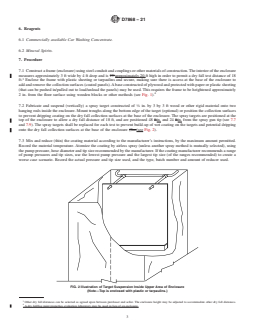
7.2 Fabricate and suspend (vertically) a spray target con-
structed of ⁄8 in. by 3 by 3 ft wood or other rigid material onto
two hanging rods inside the enclosure. Mount troughs along
the bottom edge of the target (optional) or position the
collection surfaces to prevent dripping coating on the dry fall
collection surfaces at the base of the enclosure. The spray
targets are positioned at the top of the enclosure to allow a dry
fall distance of 18 ft, and are positioned 48 in. and 24 in. from
the spray gun tip (see 7.7 and 7.9). The spray targets shall be
replaced for each test to prevent build-up of wet coating on the
targets and potential dripping onto the dry fall collection
surfaces at the base of the enclosure (see Fig. 2).
7.3 Mix and reduce (thin) the coating material according to
the manufacturer’s instructions, by the maximum amount
permitted. Record the material temperature. Atomize the coat-
ing by airless spray (unless another spray method is mutually
selected), using the pump pressure, hose diameter and tip size
recommended by the manufacturer. If the coating manufacturer
recommends a range of pump pressures and tip sizes, use the
lowest pump pressure and the largest tip size (of the ranges
recommended) to create a worse case scenario. Record the
actual pressure and tip size used, and the type, batch number
and amount of reducer used.
7.4 Record the date and time of day. Measure and record the
air temperature, relative humidity and dew point temperature
inside the enclosure. Testing should be performed when the air
temperature is between 60 and 80°F (16 and 27°C) and the
relative humidity is between 40 and 85 %. The enclosure
should not be mechanically ventilated.
7.5 Place duplicate 4 by 6 in. steel panels coated with an
automotive system (basecoat/clear coat) near the center of the
enclosure base. The color of the coating on the panels shall be
black unless another panel color is mutually selected or
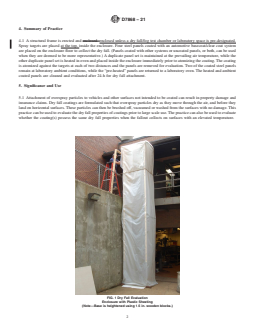
FIG. 1 Dry Fall Evaluation
required for contrast to the color of the dry fall product being
Enclosure with Plastic Sheeting
(Note—Base is heightened using 1.5 in. wooden blocks.) evaluated. Record the coating system on the panels as well
...
This document is not an ASTM standard and is intended only to provide the user of an ASTM standard an indication of what changes have been made to the previous version. Because
it may not be technically possible to adequately depict all changes accurately, ASTM recommends that users consult prior editions as appropriate. In all cases only the current version
of the standard as published by ASTM is to be considered the official document.
Designation: D7868 − 13 (Reapproved 2017) D7868 − 21
Standard Practice for
Determining the Dry Fall (Fog) Properties of Protective
Coatings
This standard is issued under the fixed designation D7868; the number immediately following the designation indicates the year of
original adoption or, in the case of revision, the year of last revision. A number in parentheses indicates the year of last reapproval. A
superscript epsilon (´) indicates an editorial change since the last revision or reapproval.
1. Scope
1.1 This practice covers a procedure for qualitatively evaluating the dry fall properties of coatings. The establishment of the test
environment and the evaluation procedures are described.
1.2 This practice uses panels containing an automotive finish since these types of surfaces are often the primary concern relating
to overspray damage. Panels coated with other systems may be used as collection surfaces when they are deemed to be more
representative.
1.3 The values stated in inch-pound units are to be regarded as standard. The values given in parentheses are mathematical
conversions to SI units that are provided for information only and are not considered standard.
1.4 This standard does not purport to address all of the safety concerns, if any, associated with its use. It is the responsibility
of the user of this standard to establish appropriate safety, health, and environmental practices and determine the applicability of
regulatory limitations prior to use.
1.5 This international standard was developed in accordance with internationally recognized principles on standardization
established in the Decision on Principles for the Development of International Standards, Guides and Recommendations issued
by the World Trade Organization Technical Barriers to Trade (TBT) Committee.
2. Referenced Documents
2.1 ASTM Standards:
D610 Practice for Evaluating Degree of Rusting on Painted Steel Surfaces
D5402 Practice for Assessing the Solvent Resistance of Organic Coatings Using Solvent Rubs
3. Terminology
3.1 Definitions:
3.1.1 dry/fall/fog dry fall/fog coating, n—an interior or exterior coating specially formulated so that the fine particles of overspray
dry to a dust or powder during a free fall of a certain distance at specific temperature and humidity ranges, and will not adhere
to surfaces on which the overspray is subsequently deposited.
This practice is under the jurisdiction of ASTM Committee D01 on Paint and Related Coatings, Materials, and Applications and is the direct responsibility of
Subcommittee D01.46 on Industrial Protective Coatings.
Current edition approved Dec. 1, 2017Nov. 1, 2021. Published December 2017November 2021. Originally approved in 2013. Last previous edition approved in 20132017
as D7868 – 13. 13 (2017). DOI: 10.1520D7868-13R17.10.1520D7868-21.
For referenced ASTM standards, visit the ASTM website, www.astm.org, or contact ASTM Customer Service at service@astm.org. For Annual Book of ASTM Standards
volume information, refer to the standard’s Document Summary page on the ASTM website.
Copyright © ASTM International, 100 Barr Harbor Drive, PO Box C700, West Conshohocken, PA 19428-2959. United States
D7868 − 21
4. Summary of Practice
4.1 A structural frame is erected and enclosed. enclosed unless a dry fall/fog test chamber or laboratory space is pre-designated.
Spray targets are placed at the top, inside the enclosure. Four steel panels coated with an automotive basecoat/clear coat system
are placed on the enclosure floor to collect the dry fall. (Panels coated with other systems or uncoated panels, or both, can be used
when they are deemed to be more representative.) A duplicate panel set is maintained at the prevailing air temperature, while the
other duplicate panel set is heated in oven and placed inside the enclosure immediately prior to atomizing the coating. The coating
is atomized against the targets at each of two distances and the panels are removed for evaluation. Two of the coated steel panels
remain at laboratory ambient conditions, while the “pre-heated” panels are returned to a laboratory oven. The heated and ambient
coated panels are cleaned and evaluated after 24-h for dry fall attachment.
5. Significance and Use
5.1 Attachment of overspray particles to vehicles and other surfaces not intended to be coated can result in property damage and
insurance claims. Dry fall coatings are formulated such that overspray particles dry as they move through the air, and before they
land on horizontal surfaces. These particles can then be brushed off, vacuumed or washed from the surfaces with no damage. This
practice can be used to evaluate the dry fall properties of coatings prior to large scale use. The practice can also be used to evaluate
whether the coating(s) possess the same dry fall properties when the fallout collects on surfaces with an elevated temperature.
FIG. 1 Dry Fall Evaluation
Enclosure with Plastic Sheeting
(Note—Base is heightened using 1.5 in. wooden blocks.)
D7868 − 21
6. Reagents
6.1 Commercially available Car Washing Concentrate.
6.2 Mineral Spirits.
7. Procedure
7.1 Construct a frame (enclosure) using steel conduit and couplings or other materials of construction. The interior of the enclosure
measures approximately 3 ft wide by 4 ft deep and is 19 approximately 20 ft high in order to permit a dry fall test distance of 18
ft. Enclose the frame with plastic sheeting or tarpaulins and secure, making sure there is access at the base of the enclosure to
add and remove the collection surfaces (coated panels). A base constructed of plywood and protected with paper or plastic sheeting
(that can be pushed in/pulled out to load/unload the panels) may be used. This requires the frame to be heightened approximately
2 in. from the floor surface using wooden blocks or other methods (see Fig. 1).
7.2 Fabricate and suspend (vertically) a spray target constructed of ⁄8 in. by 3 by 3 ft wood or other rigid material onto two
hanging rods inside the enclosure. Mount troughs along the bottom edge of the target (optional) or position the collection surfaces
to prevent dripping coating on the dry fall collection surfaces at the base of the enclosure. The spray targets are positioned at the
top of the enclosure to allow a dry fall distance of 18 ft, and are positioned 48 ftin. and 24 ftin. from the spray gun tip (see 7.7
and 7.9). The spray targets shall be replaced for each test to prevent build-up of wet coating on the targets and potential dripping
onto the dry fall collection surfaces at the base of the enclosure (See(see Fig. 2).
7.3 Mix and reduce (thin) the coating material according to the manufacturer’s instructions, by the maximum amount permitted.
Record the material temperature. Atomize the coating by airless spray (unless another spray method is mutually selected), using
the pump pressure, hose diameter and tip size recommended by the manufacturer. If the coating manufacturer recommends a range
of pump pressures and tip sizes, use the lowest pump pressure and the largest tip size (of the ranges recommended) to create a
worse case scenario. Record the actual
...