

ASTM E2113-23
(Test Method)Standard Test Method for Length Change Calibration of Thermomechanical Analyzers
General Information
- Abstract
SIGNIFICANCE AND USE
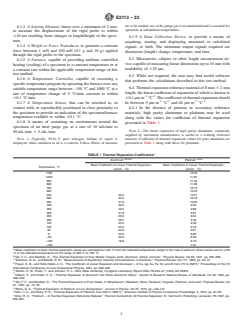
5.1 Performance verification or calibration is essential to the accurate determination of quantitative dimension change measurements.
5.2 This test method may be used for instrument performance validation, regulatory compliance, research and development and quality assurance purposes.
SCOPE
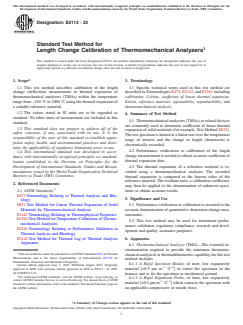
1.1 This test method describes calibration of the length change (deflection) measurement or thermal expansion of thermomechanical analyzers (TMAs) within the temperature range from –150 °C to 1000 °C using the thermal expansion of a suitable reference material.
1.2 The values stated in SI units are to be regarded as standard. No other units of measurement are included in this standard.
1.3 This standard does not purport to address all of the safety concerns, if any, associated with its use. It is the responsibility of the user of this standard to establish appropriate safety, health, and environmental practices and determine the applicability of regulatory limitations prior to use.
1.4 This international standard was developed in accordance with internationally recognized principles on standardization established in the Decision on Principles for the Development of International Standards, Guides and Recommendations issued by the World Trade Organization Technical Barriers to Trade (TBT) Committee.
- Status
- Published
- Publication Date
- 31-Jul-2023
- Technical Committee
- E37 - Thermal Measurements
- Drafting Committee
- E37.10 - Fundamental, Statistical and Mechanical Properties
Buy Documents
ASTM E2113-23 - Standard Test Method for Length Change Calibration of Thermomechanical Analyzers
REDLINE ASTM E2113-23 - Standard Test Method for Length Change Calibration of Thermomechanical Analyzers
Overview
ASTM E2113-23: Standard Test Method for Length Change Calibration of Thermomechanical Analyzers provides a comprehensive procedure for calibrating thermomechanical analyzers (TMA) with respect to length change, also known as deflection or thermal expansion. Accurate calibration is essential for obtaining reliable and quantitative measurements of the dimensional changes of materials when subjected to controlled temperature changes. This standard is internationally recognized and developed in accordance with World Trade Organization (WTO) guidelines for standardization.
Thermomechanical analysis is essential in the study of materials' thermal properties, assuring the precision and repeatability of measurement data used in research, quality assurance, and regulatory compliance.
Key Topics
- Calibration Procedure: Describes the method for calibrating TMAs using reference materials with known thermal expansion coefficients over a temperature range of –150 °C to 1000 °C.
- Instrument Performance Verification: Outlines requirements for confirming the accuracy of TMAs, including temperature sensors, furnaces, specimen holders, and force transducers.
- Reference Materials: Specifies suitable reference materials such as high-purity aluminum or platinum, with well-characterized thermal expansion properties.
- Calculation of Calibration Coefficient: Explains how to determine and apply a calibration coefficient to convert measured data into accurate length change values.
- Precision and Bias: Details methods for estimating precision and identifying sources of measurement bias.
- Regulatory and Quality Compliance: Ensures methods meet requirements for research, development, and quality control in industrial environments.
Applications
- Instrument Performance Validation: Used to verify that thermomechanical analyzers are performing within defined specifications before material testing begins.
- Regulatory Compliance: Supports laboratories and manufacturers in meeting regulatory requirements for accurate thermal expansion and dimensional change measurements.
- Research and Development: Provides reliable calibration for research in material science, polymers, metals, ceramics, and composites.
- Quality Assurance: Enhances the reliability of production quality checks for products where material dimensional stability under temperature fluctuation is critical.
- Interlaboratory Comparability: Helps support consistent results across different laboratories and equipment models by providing a standardized calibration approach.
Related Standards
Several ASTM standards support and relate to ASTM E2113-23, expanding its utility in thermal analysis:
- ASTM E831: Test Method for Linear Thermal Expansion of Solid Materials by Thermomechanical Analysis.
- ASTM E1363: Test Method for Temperature Calibration of Thermomechanical Analyzers.
- ASTM E473: Terminology Relating to Thermal Analysis and Rheology.
- ASTM E1142: Terminology Relating to Thermophysical Properties.
- ASTM E2161: Terminology Relating to Performance Validation in Thermal Analysis and Rheology.
- ASTM E3142: Test Method for Thermal Lag of Thermal Analysis Apparatus.
Practical Value
- Ensures measurement accuracy: By providing clear requirements for apparatus, reference materials, and calculations, ASTM E2113-23 ensures TMAs deliver dependable results.
- Supports a wide range of industries: Widely applicable in materials science, manufacturing, academia, and quality control laboratories.
- Facilitates international harmonization: Developed with international guidelines, supporting global trade and regulatory alignment.
- Enhances traceability and reporting: Requires detailed documentation of calibration procedures, reference materials, and results for transparency and repeatability.
Keywords: thermomechanical analyzer calibration, thermal expansion, length change calibration, ASTM E2113-23, performance validation, quality assurance, thermal analysis, reference material, precision measurement, regulatory compliance
Relations
- Effective Date
- 01-Oct-2023
- Effective Date
- 01-Oct-2023
- Effective Date
- 01-Apr-2019
- Effective Date
- 15-Jan-2018
- Refers
ASTM E1363-16 - Standard Test Method for Temperature Calibration of Thermomechanical Analyzers - Effective Date
- 01-Dec-2016
- Effective Date
- 01-Sep-2015
- Effective Date
- 01-May-2015
- Effective Date
- 15-Aug-2014
- Effective Date
- 15-Aug-2014
- Effective Date
- 01-Aug-2014
- Effective Date
- 01-Apr-2014
- Effective Date
- 15-Feb-2014
- Effective Date
- 01-Nov-2013
- Refers
ASTM E1363-13 - Standard Test Method for Temperature Calibration of Thermomechanical Analyzers - Effective Date
- 01-Apr-2013
- Effective Date
- 01-Mar-2013
Buy Documents
ASTM E2113-23 - Standard Test Method for Length Change Calibration of Thermomechanical Analyzers
REDLINE ASTM E2113-23 - Standard Test Method for Length Change Calibration of Thermomechanical Analyzers
Get Certified
Connect with accredited certification bodies for this standard

DIN CERTCO
DIN Group product certification.

Smithers Quality Assessments
US management systems and product certification.
Sponsored listings
Frequently Asked Questions
ASTM E2113-23 is a standard published by ASTM International. Its full title is "Standard Test Method for Length Change Calibration of Thermomechanical Analyzers". This standard covers: SIGNIFICANCE AND USE 5.1 Performance verification or calibration is essential to the accurate determination of quantitative dimension change measurements. 5.2 This test method may be used for instrument performance validation, regulatory compliance, research and development and quality assurance purposes. SCOPE 1.1 This test method describes calibration of the length change (deflection) measurement or thermal expansion of thermomechanical analyzers (TMAs) within the temperature range from –150 °C to 1000 °C using the thermal expansion of a suitable reference material. 1.2 The values stated in SI units are to be regarded as standard. No other units of measurement are included in this standard. 1.3 This standard does not purport to address all of the safety concerns, if any, associated with its use. It is the responsibility of the user of this standard to establish appropriate safety, health, and environmental practices and determine the applicability of regulatory limitations prior to use. 1.4 This international standard was developed in accordance with internationally recognized principles on standardization established in the Decision on Principles for the Development of International Standards, Guides and Recommendations issued by the World Trade Organization Technical Barriers to Trade (TBT) Committee.
SIGNIFICANCE AND USE 5.1 Performance verification or calibration is essential to the accurate determination of quantitative dimension change measurements. 5.2 This test method may be used for instrument performance validation, regulatory compliance, research and development and quality assurance purposes. SCOPE 1.1 This test method describes calibration of the length change (deflection) measurement or thermal expansion of thermomechanical analyzers (TMAs) within the temperature range from –150 °C to 1000 °C using the thermal expansion of a suitable reference material. 1.2 The values stated in SI units are to be regarded as standard. No other units of measurement are included in this standard. 1.3 This standard does not purport to address all of the safety concerns, if any, associated with its use. It is the responsibility of the user of this standard to establish appropriate safety, health, and environmental practices and determine the applicability of regulatory limitations prior to use. 1.4 This international standard was developed in accordance with internationally recognized principles on standardization established in the Decision on Principles for the Development of International Standards, Guides and Recommendations issued by the World Trade Organization Technical Barriers to Trade (TBT) Committee.
ASTM E2113-23 is classified under the following ICS (International Classification for Standards) categories: 83.080.01 - Plastics in general. The ICS classification helps identify the subject area and facilitates finding related standards.
ASTM E2113-23 has the following relationships with other standards: It is inter standard links to ASTM E473-23b, ASTM E1142-23b, ASTM E831-19, ASTM E3142-18, ASTM E1363-16, ASTM E2161-15, ASTM E1142-15, ASTM E473-14, ASTM E1142-14b, ASTM E831-14, ASTM E1142-14a, ASTM E1142-14, ASTM E831-13, ASTM E1363-13, ASTM E2161-13. Understanding these relationships helps ensure you are using the most current and applicable version of the standard.
ASTM E2113-23 is available in PDF format for immediate download after purchase. The document can be added to your cart and obtained through the secure checkout process. Digital delivery ensures instant access to the complete standard document.
Standards Content (Sample)
This international standard was developed in accordance with internationally recognized principles on standardization established in the Decision on Principles for the
Development of International Standards, Guides and Recommendations issued by the World Trade Organization Technical Barriers to Trade (TBT) Committee.
Designation: E2113 − 23
Standard Test Method for
Length Change Calibration of Thermomechanical Analyzers
This standard is issued under the fixed designation E2113; the number immediately following the designation indicates the year of
original adoption or, in the case of revision, the year of last revision. A number in parentheses indicates the year of last reapproval. A
superscript epsilon (´) indicates an editorial change since the last revision or reapproval.
1. Scope* 3. Terminology
1.1 This test method describes calibration of the length 3.1 Specific technical terms used in this test method are
change (deflection) measurement or thermal expansion of described in Terminologies E473, E1142, and E2161 including
thermomechanical analyzers (TMAs) within the temperature calibration, Celsius, coeffıcient of linear thermal expansion,
range from –150 °C to 1000 °C using the thermal expansion of Kelvin, reference material, repeatability, reproducibility, and
a suitable reference material. thermomechanical analysis.
1.2 The values stated in SI units are to be regarded as
4. Summary of Test Method
standard. No other units of measurement are included in this
4.1 Thermomechanical analyzers (TMAs) or related devices
standard.
are commonly used to determine coefficient of linear thermal
1.3 This standard does not purport to address all of the
expansion of solid materials (for example, Test Method E831).
safety concerns, if any, associated with its use. It is the
The test specimen is heated at a linear rate over the temperature
responsibility of the user of this standard to establish appro-
range of interest and the change in length (dimension) is
priate safety, health, and environmental practices and deter-
electronically recorded.
mine the applicability of regulatory limitations prior to use.
4.2 Performance verification or calibration of the length
1.4 This international standard was developed in accor-
change measurement is needed to obtain accurate coefficient of
dance with internationally recognized principles on standard-
thermal expansion data.
ization established in the Decision on Principles for the
Development of International Standards, Guides and Recom-
4.3 The thermal expansion of a reference material is re-
mendations issued by the World Trade Organization Technical corded using a thermomechanical analyzer. The recorded
Barriers to Trade (TBT) Committee.
thermal expansion is compared to the known value of the
reference material. The resultant ratio, a calibration coefficient,
2. Referenced Documents
may then be applied to the determination of unknown speci-
2.1 ASTM Standards: mens to obtain accurate results.
E473 Terminology Relating to Thermal Analysis and Rhe-
5. Significance and Use
ology
E831 Test Method for Linear Thermal Expansion of Solid 5.1 Performance verification or calibration is essential to the
Materials by Thermomechanical Analysis accurate determination of quantitative dimension change mea-
E1142 Terminology Relating to Thermophysical Properties surements.
E1363 Test Method for Temperature Calibration of Thermo-
5.2 This test method may be used for instrument perfor-
mechanical Analyzers
mance validation, regulatory compliance, research and devel-
E2161 Terminology Relating to Performance Validation in
opment and quality assurance purposes.
Thermal Analysis and Rheology
E3142 Test Method for Thermal Lag of Thermal Analysis 6. Apparatus
Apparatus
6.1 Thermomechanical Analyzer (TMA)—The essential in-
strumentation required to provide the minimum thermome-
This test method is under the jurisdiction of ASTM Committee E37 on Thermal
chanical analytical or thermodilatometric capability for this test
Measurements and is the direct responsibility of Subcommittee E37.10 on
method includes:
Fundamental, Statistical and Mechanical Properties.
6.1.1 A Rigid Specimen Holder, of inert, low expansivity
Current edition approved Aug. 1, 2023. Published August 2023. Originally
-1 -1
material [<0.5 μm m °C ] to center the specimen in the
approved in 2000. Last previous edition approved in 2018 as E2113 – 18. DOI:
10.1520/E2113-23.
furnace and to fix the specimen to mechanical ground.
For referenced ASTM standards, visit the ASTM website, www.astm.org, or
6.1.2 A Rigid Expansion Probe, of inert, low expansivity
contact ASTM Customer Service at service@astm.org. For Annual Book of ASTM
-1 -1
material [<0.5 μm m °C ] which contacts the specimen with
Standards volume information, refer to the standard’s Document Summary page on
the ASTM website. an applicable compressive or tensile force.
*A Summary of Changes section appears at the end of this standard
Copyright © ASTM International, 100 Barr Harbor Drive, PO Box C700, West Conshohocken, PA 19428-2959. United States
E2113 − 23
are to be studied, use of dry purge gas is recommended and is essential for
6.1.3 A Sensing Element, linear over a minimum of 2 mm,
operation at subambient temperatures.
to measure the displacement of the rigid probe to within
610 nm resulting from changes in length/height of the speci-
6.1.9 A Data Collection Device, to provide a means of
men.
acquiring, storing, and displaying measured or calculated
6.1.4 A Weight or Force Transducer, to generate a constant
signals, or both. The minimum output signals required are
force between 1 mN and 100 mN (0.1 g and 10 g) applied
dimension (length) change, temperature, and time.
through the rigid probe to the specimen.
6.2 Micrometer, calipers or other length measurement de-
6.1.5 A Furnace, capable of providing uniform controlled
vice capable of measuring linear dimensions up to 10 mm with
heating (cooling) of a specimen to a constant temperature or at
readability of 625 μm.
a constant rate within the applicable temperature range of this
test method.
6.3 While not required, the user may find useful software
6.1.6 A Temperature Controller, capable of executing a
that performs the calculations described in this test method.
specific temperature program by operating the furnace over any
6.4 Thermal expansion reference material of 8 mm 6 2 mm
suitable temperature range between –150 °C and 1000 °C at a
length, the linear coefficient of expansion of which is known to
rate of temperature change of 5 °C/min constant to within
-1 -1
60.1 °C ⁄min. 60.1 μm m °C . The coefficient of thermal expansion should
-1 -1 -1 -1
be between 9 μm m °C and 40 μm m °C .
6.1.7 A Temperature Sensor, that can be attached to, in
contact with, or reproducibly positioned in close proximity to
6.4.1 In the absence of primary or secondary reference
the specimen to provide an indication of the specimen/furnace
materials, high purity aluminum or platinum may be used
temperature readable to within 60.1 °C.
along with the values for coefficient of thermal expansion
6.1.8 A means of sustaining an environment around the
presented in Table 1.
specimen of an inert purge gas at a rate of 10 mL/min to
NOTE 2—The linear expansion of high purity aluminum, commonly
50 mL ⁄min 6 5 mL ⁄min.
supplied by instrument manufactures, is useful as a working reference
NOTE 1—Typically, 99.9+ % pure nitrogen, helium or argon is material. Coefficient of thermal expansion values for pure aluminum are
employed, when oxidation in air is a concern. Unless effects of moisture presented in Table 1 along with those for platinum.
A
TABLE 1 Thermal Expansion Coefficients
BCDEF GHIJ
Aluminum Platinum
Mean Coefficient of Linear Thermal Expansion, Mean Coefficient of Linear Thermal Expansion,
Temperature, °C
μm/(m · °C) μm/(m · °C)
1100 12.33
1000 11.87
900 11.26
800 11.08
700 10.75
600 10.45
550 35.3 10.31
500 33.2 10.18
450 31.8 10.05
400 30.5 9.92
350 29.2 9.80
300 27.8 9.67
250 26.8 9.64
200 26.2 9.45
150 25.5 9.38
100 24.5 9.18
50 23.6 9.01
0 22.6 8.85
–50 20.9 8.59
–100 18.8 8.19
–150 7.37
A
Mean coefficient of linear thermal expansion values are calculated for ±50 °C from the indicated temperature except in the case of platinum where values are for ±100
°C of the indicated temperature for the range of 200 °C to 700 °C.
B
Nix, F. C., and MacNair, D., “The Thermal Expansion of Pure Metals: Copper, Gold, Aluminum, Nickel, and Iron,” Physical Review, Vol 60, 1941, pp. 597–605.
C
Simmons, R. O., and Balluffi, R. W., “Measurements of Equilibrium Vacancy Concentrations in Aluminum,” Physical Review, Vol 117, 1960, pp. 52–31.
D
Fraser, D. B., and Hollis Hallet, A. C., “The Coefficient of Linear Expansion and Gruneisen γ of Cu, Ag, Au, Fe, Ni, and Al from 4°K to 300°K,” Proceedings of the 7th
International Conference on Low-Temperature Physics, 1961, pp. 689–692.
E
Altman, H. W., Rubin, T., and Johnson, H. L., Ohio State University, Cryogenic Laboratory Report OSU-TR-264–27 (1954) AD 26970.
F
Hidnert, P., and Krider, H. S., “Thermal Expansion of Aluminum and Some Aluminum Alloys,” Journal of Research National Bureau of Standards, Vol 48, 1952, pp.
209–220.
G
Nix, F. C., and MacNair, D., “The Thermal Expansion of Pure metals. II: Molybdenum, Palladium, Silver, Tantalum, Tungsten, Platinum, and Lead,” Physical Review, Vol
61, 1942, pp. 74–78.
H
White, G. K., “Thermal Expansion of Platinum at Low Temperature,” Journal of Physics, Vol 2F, 1972, pp. L30–L31.
I
Hahn, T. A., and Kirby, R. K., “Thermal Expansion of Platinum from 293 to 1900 K,” American Institute of Physics Conference Proceedings, 3, 1972, pp. 87–95.
J
Kirby, R. K., “Platinum – A Thermal Expansion Reference Material,” Thermal Conductivity 24/Thermal Expansion 12, Technomic Publishing, Lancaster, PA 1997, pp.
...
This document is not an ASTM standard and is intended only to provide the user of an ASTM standard an indication of what changes have been made to the previous version. Because
it may not be technically possible to adequately depict all changes accurately, ASTM recommends that users consult prior editions as appropriate. In all cases only the current version
of the standard as published by ASTM is to be considered the official document.
Designation: E2113 − 18 E2113 − 23
Standard Test Method for
Length Change Calibration of Thermomechanical Analyzers
This standard is issued under the fixed designation E2113; the number immediately following the designation indicates the year of
original adoption or, in the case of revision, the year of last revision. A number in parentheses indicates the year of last reapproval. A
superscript epsilon (´) indicates an editorial change since the last revision or reapproval.
1. Scope Scope*
1.1 This test method describes calibration of the length change (deflection) measurement or thermal expansion of thermome-
chanical analyzers (TMAs) within the temperature range from –150 °C to 1000 °C using the thermal expansion of a suitable
reference material.
1.2 The values stated in SI units are to be regarded as standard. No other units of measurement are included in this standard.
1.3 This standard does not purport to address all of the safety concerns, if any, associated with its use. It is the responsibility
of the user of this standard to establish appropriate safety, health, and environmental practices and determine the applicability of
regulatory limitations prior to use.
1.4 This international standard was developed in accordance with internationally recognized principles on standardization
established in the Decision on Principles for the Development of International Standards, Guides and Recommendations issued
by the World Trade Organization Technical Barriers to Trade (TBT) Committee.
2. Referenced Documents
2.1 ASTM Standards:
E473 Terminology Relating to Thermal Analysis and Rheology
E831 Test Method for Linear Thermal Expansion of Solid Materials by Thermomechanical Analysis
E1142 Terminology Relating to Thermophysical Properties
E1363 Test Method for Temperature Calibration of Thermomechanical Analyzers
E2161 Terminology Relating to Performance Validation in Thermal Analysis and Rheology
E3142 Test Method for Thermal Lag of Thermal Analysis Apparatus
3. Terminology
3.1 Specific technical terms used in this test method are described in Terminologies E473, E1142, and E2161 including
calibration, Celsius, coeffıcient of linear thermal expansion, Kelvin, reference material, repeatability, reproducibility, and
thermomechanical analysis.
4. Summary of Test Method
4.1 Thermomechanical analyzers (TMAs) or related devices are commonly used to determine coefficient of linear thermal
This test method is under the jurisdiction of ASTM Committee E37 on Thermal Measurements and is the direct responsibility of Subcommittee E37.10 on Fundamental,
Statistical and Mechanical Properties.
Current edition approved June 1, 2018Aug. 1, 2023. Published June 2018August 2023. Originally approved in 2000. Last previous edition approved in 20132018 as
E2113 – 13.E2113 – 18. DOI: 10.1520/E2113-18.10.1520/E2113-23.
For referenced ASTM standards, visit the ASTM website, www.astm.org, or contact ASTM Customer Service at service@astm.org. For Annual Book of ASTM Standards
volume information, refer to the standard’s Document Summary page on the ASTM website.
*A Summary of Changes section appears at the end of this standard
Copyright © ASTM International, 100 Barr Harbor Drive, PO Box C700, West Conshohocken, PA 19428-2959. United States
E2113 − 23
expansion of solid materials (for example, Test Method E831). The test specimen is heated at a linear rate over the temperature
range of interest and the change in length (dimension) is electronically recorded.
4.2 Performance verification or calibration of the length change measurement is needed to obtain accurate coefficient of thermal
expansion data.
4.3 The thermal expansion of a reference material is recorded using a thermomechanical analyzer. The recorded thermal expansion
is compared to the known value of the reference material. The resultant ratio, a calibration coefficient, may then be applied to the
determination of unknown specimens to obtain accurate results.
5. Significance and Use
5.1 Performance verification or calibration is essential to the accurate determination of quantitative dimension change
measurements.
5.2 This test method may be used for instrument performance validation, regulatory compliance, research and development and
quality assurance purposes.
6. Apparatus
6.1 Thermomechanical Analyzer (TMA)—(TMA)—The essential instrumentation required to provide the minimum thermome-
chanical analytical or thermodilatometric capability for this test method includes:
-1 -1
6.1.1 A Rigid Specimen Holder, of inert, low expansivity material [<0.5 μm m °C ] to center the specimen in the furnace and
to fix the specimen to mechanical ground.
-1 -1
6.1.2 A Rigid Expansion Probe, of inert, low expansivity material [<0.5 μm m °C ] which contacts the specimen with an
applicable compressive or tensile force.
6.1.3 A Sensing Element, linear over a minimum of 2 mm, to measure the displacement of the rigid probe to within 610 nm
610 nm resulting from changes in length/height of the specimen.
6.1.4 A Weight or Force Transducer, to generate a constant force between 1 mN and 100 mN (0.1 g and 10 g) applied through
the rigid probe to the specimen.
6.1.5 A Furnace, capable of providing uniform controlled heating (cooling) of a specimen to a constant temperature or at a
constant rate within the applicable temperature range of this test method.
6.1.6 A Temperature Controller, capable of executing a specific temperature program by operating the furnace over any suitable
temperature range between –150 °C and 1000 °C at a rate of temperature change of 5 °C/min constant to within 60.160.1 °C
°C/min. ⁄min.
6.1.7 A Temperature Sensor, that can be attached to, in contact with, or reproducibly positioned in close proximity to the specimen
to provide an indication of the specimen/furnace temperature readable to within 60.1 °C.
6.1.8 A means of sustaining an environment around the specimen of an inert purge gas at a rate of 10 mL/min to 5050 mL ⁄min
6 5 5 mL mL/min.⁄min.
NOTE 1—Typically, 99.9+ % 99.9+ % pure nitrogen, helium or argon is employed, when oxidation in air is a concern. Unless effects of moisture are to
be studied, use of dry purge gas is recommended and is essential for operation at subambient temperatures.
6.1.9 A Data Collection Device, to provide a means of acquiring, storing, and displaying measured or calculated signals, or both.
The minimum output signals required are dimension (length) change, temperature, and time.
6.2 Micrometer, calipers or other length measurement device capable of measuring linear dimensions up to 10 mm with readability
of 625 μm.
E2113 − 23
6.3 While not required, the user may find useful software that performs the calculations described in this test method.
6.4 Thermal expansion reference material of 8 mm 6 2 mm length, the linear coefficient of expansion of which is known to 60.1
-1 -1 -1 -1 -1 -1
μm m °C . The coefficient of thermal expansion should be between 9 μm m °C and 40 μm m °C .
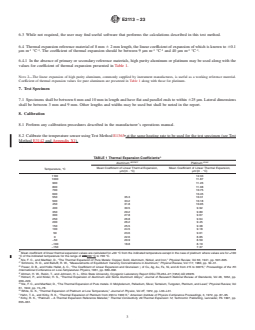
6.4.1 In the absence of primary or secondary reference materials, high purity aluminum or platinum may be used along with the
values for coefficient of thermal expansion presented in Table 1.
NOTE 2—The linear expansion of high purity aluminum, commonly supplied by instrument manufactures, is useful as a working reference material.
Coefficient of thermal expansion values for pure aluminum are presented in Table 1 along with those for platinum.
7. Test Specimen
7.1 Specimens shall be between 6 mm and 10 mm in length and have flat and parallel ends to within 625 μm. Lateral dimensions
shall be between 3 mm and 9 mm. Other lengths and widths may be used but shall be noted in the report.
8. Calibration
8.1 Perform any calibration procedures described in the manufacturer’s operations manual.
8.2 Calibrate the temperature sensor using Test Method E1363. at the same heating rate to be used for the test specimen (see Test
Method E3142 and Appendix X1).
A
TABLE 1 Thermal Expansion Coefficients
BCDEF GHIJ
Aluminum Platinum
Mean Coefficient of Linear Thermal Expansion, Mean Coefficient of Linear Thermal Expansion,
Temperature, °C
μm/(m · °C) μm/(m · °C)
1100 12.33
1000 11.87
900 11.26
800 11.08
700 10.75
600 10.45
550 35.3 10.31
500 33.2 10.18
450 31.8 10.05
400 30.5 9.92
350 29.2 9.80
300 27.8 9.67
250 26.8 9.64
200 26.2 9.45
150 25.5 9.38
100 24.5 9.18
50 23.6 9.01
0 22.6 8.85
–50 20.9 8.59
–100 18.8 8.19
–150 7.37
A
Mean coefficient of linear thermal expansion values are calculated for ±50 °C from the indicated temperature except in the case of platinum where values are for ±100
°C of the indicated temperature for the range of 200200 °C to 700 °C.
B
Nix, F. C., and MacNair, D., “The Thermal Expansion of Pure Metals: Copper, Gold, Aluminum, Nickel, and Iron,” Physical Review, Vol 60, 1941, pp. 597–605.
C
Simmons, R. O., and Balluffi, R. W., “Measurements of Equilibrium Vacancy Concentrations in Aluminum,” Physical Review, Vol 117, 1960, pp. 52–31.
D
Fraser, D. B., and Hollis Hallet, A. C., “The Coefficient of Linear Expansion and Gruneisen γ of Cu, Ag, Au, Fe, Ni, and Al from 4°K to 300°K,” Proceedings of the 7th
International Conference on Low-Temperature Physics, 1961, pp. 689–692.
E
Altman, H. W., Rubin, T., and Johnson, H. L., Ohio State University, Cryogenic Laboratory Report OSU-TR-264–27 (1954) AD 26970.
F
Hidnert, P., and Krider, H. S., “Thermal Expansion of Aluminum and Some Aluminum Alloys,” Journal of Research National Bureau of Standards, Vol 48, 1952, pp.
209–220
...