

ASTM E677-94(2016)
(Specification)Standard Specification for Interchangeable Spherical Ground Joints
General Information
- Abstract
ABSTRACT
This specification covers standard dimensional requirements for obtaining interchangeable spherical ground joints. This specification does not include physical, chemical, and design characteristics of material used. Dimensional requirements include socket member design, ball member design, size designation, dimensions, and interchangeability. Ground joints shall be tested for ball and socket dimensions and leakage. Leak rate shall be calculated based on change in differential pressure, evacuated volume and time of test.
SCOPE
1.1 This specification covers standard dimensional requirements for obtaining, within practical limits, interchangeability in spherical ground joints for ordinary laboratory and industrial applications. It covers dimensional interchangeability of the ground surfaces only and does not involve design characteristics of the item except where specified, nor does it involve physical or chemical characteristics of the material used.
Note 1: The dimensions pertaining to spherical ground joints were taken from the Commercial Standard CS 21–58 of the U.S. Department of Commerce.
Note 2: Although glass is the most commonly used material for ground joints, other materials may be used as specified. Spherical joints constructed from glass shall conform to Specifications E438 and E671.
1.2 The following precautionary caveat pertains only to the Test Method portion, Section 4, of this specification. This standard does not purport to address all of the safety concerns, if any, associated with its use. It is the responsibility of the user of this standard to establish appropriate safety and health practices and determine the applicability of regulatory limitations prior to use.
- Status
- Published
- Publication Date
- 31-Aug-2016
- Technical Committee
- E41 - Laboratory Apparatus
- Drafting Committee
- E41.01 - Laboratory Ware and Supplies


Overview
ASTM E677-94(2016) - Standard Specification for Interchangeable Spherical Ground Joints establishes the dimensional requirements needed to ensure the interchangeability of spherical ground joints commonly used in laboratory and industrial applications. The standard provides clear guidelines for the socket and ball member designs, the size designation, critical dimensions, and the interchangeability requirements, including leak rate testing. While it focuses on the geometry and fit of joint components, it does not cover the physical, chemical, or detailed design characteristics of materials used in the joints.
This standard was developed in accordance with internationally recognized principles on standardization, supporting safety and compatibility in laboratory practices worldwide.
Key Topics
- Dimensional Requirements: Specifies standard sizes and shapes for spherical ground joint components (ball and socket members), ensuring global compatibility.
- Interchangeability: Stipulates the tolerances and measurements necessary so that parts from different manufacturers can be assembled interchangeably.
- Size Designation: Joints are classified using nominal gaging diameters and inside diameters, formatted as “diameter/inside diameter” in millimeters (e.g., 18/7).
- Testing and Leak Rate: Outlines a specific method for testing the ball and socket dimensions and for measuring leakage under reduced pressure conditions, setting acceptable leak rate limits based on the joint size.
- Marking and Identification: Requires each joint to be marked with the SJ symbol, joint size, and manufacturer's trademark to confirm conformity.
- Material Considerations: Although glass is the predominant material, the standard allows for other appropriate materials, with strict adherence if glass is used.
Applications
Interchangeable spherical ground joints play a critical role in laboratory glassware, industrial apparatus, and scientific research where secure, leak-resistant, and easily replaceable joints are crucial. Practical applications include:
- Chemical Laboratories: Used for apparatus such as condensers, flasks, reaction vessels, and distillation joints, where interchangeable connections allow flexible assembly and rapid equipment changes.
- Industrial Processes: Applied in pilot plants and production settings requiring fast assembly and disassembly for cleaning or maintenance.
- Educational Institutions: Ensures that student laboratory glassware is reliable and interchangeable, supporting equipment longevity and resource efficiency.
- Standardized Manufacturing: Enables manufacturers worldwide to produce compatible components, supporting globalization of laboratory equipment supply chains.
Related Standards
ASTM E677-94(2016) references several associated standards to support safe and effective implementation:
- ASTM E438: Specification for Glasses in Laboratory Apparatus - covers the physical and chemical requirements for glass used in laboratory equipment.
- ASTM E671: Specification for Maximum Permissible Thermal Residual Stress in Annealed Glass Laboratory Apparatus.
- ASTM E1157: Specification for Sampling and Testing of Reusable Laboratory Glassware - guidance for ensuring product quality.
- ASTM E920/E921: Specifications for Packaging Laboratory Apparatus - addresses packaging requirements for domestic and export shipping.
- ASTM E1133: Practice for Performance Testing of Packaged Laboratory Apparatus.
Other relevant references include the U.S. Department of Commerce Commercial Standard CS 21 on interchangeable taper-ground joints, stopcocks, stoppers, and spherical-ground joints, which influenced ASTM E677 dimensional requirements.
Practical Value
Adhering to ASTM E677-94(2016) guarantees international compatibility and quality for manufacturers, laboratories, and equipment suppliers. By following this specification:
- Laboratories can quickly replace or interchange glassware components without custom fittings.
- Manufacturers can ensure their products meet industry-accepted benchmarks for dimensional accuracy and leak resistance.
- Procurement and inventory management are simplified with uniform size designations and markings, reducing costs and errors.
- End users benefit from greater safety, equipment life span, and experimental repeatability in laboratory and industrial settings.
Keywords: spherical ground joints, ASTM E677, laboratory glassware, interchangeable joints, dimensional requirements, leak rate testing, scientific apparatus standardization.
Relations
- Effective Date
- 01-Sep-2016
- Effective Date
- 01-Feb-2024
- Effective Date
- 01-Jul-2019
- Effective Date
- 01-Jan-2018
- Effective Date
- 01-Nov-2013
- Effective Date
- 01-Dec-2011
- Effective Date
- 01-Dec-2011
- Effective Date
- 01-Dec-2011
- Effective Date
- 01-Sep-2010
- Effective Date
- 15-May-2010
- Effective Date
- 01-Apr-2010
- Effective Date
- 01-Nov-2008
- Effective Date
- 01-Nov-2006
- Effective Date
- 01-Nov-2006
- Effective Date
- 01-Oct-2005
Get Certified
Connect with accredited certification bodies for this standard

ECOCERT
Organic and sustainability certification.

Eurofins Food Testing Global
Global leader in food, environment, and pharmaceutical product testing.

Intertek Bangladesh
Intertek certification and testing services in Bangladesh.
Sponsored listings
Frequently Asked Questions
ASTM E677-94(2016) is a technical specification published by ASTM International. Its full title is "Standard Specification for Interchangeable Spherical Ground Joints". This standard covers: ABSTRACT This specification covers standard dimensional requirements for obtaining interchangeable spherical ground joints. This specification does not include physical, chemical, and design characteristics of material used. Dimensional requirements include socket member design, ball member design, size designation, dimensions, and interchangeability. Ground joints shall be tested for ball and socket dimensions and leakage. Leak rate shall be calculated based on change in differential pressure, evacuated volume and time of test. SCOPE 1.1 This specification covers standard dimensional requirements for obtaining, within practical limits, interchangeability in spherical ground joints for ordinary laboratory and industrial applications. It covers dimensional interchangeability of the ground surfaces only and does not involve design characteristics of the item except where specified, nor does it involve physical or chemical characteristics of the material used. Note 1: The dimensions pertaining to spherical ground joints were taken from the Commercial Standard CS 21–58 of the U.S. Department of Commerce. Note 2: Although glass is the most commonly used material for ground joints, other materials may be used as specified. Spherical joints constructed from glass shall conform to Specifications E438 and E671. 1.2 The following precautionary caveat pertains only to the Test Method portion, Section 4, of this specification. This standard does not purport to address all of the safety concerns, if any, associated with its use. It is the responsibility of the user of this standard to establish appropriate safety and health practices and determine the applicability of regulatory limitations prior to use.
ABSTRACT This specification covers standard dimensional requirements for obtaining interchangeable spherical ground joints. This specification does not include physical, chemical, and design characteristics of material used. Dimensional requirements include socket member design, ball member design, size designation, dimensions, and interchangeability. Ground joints shall be tested for ball and socket dimensions and leakage. Leak rate shall be calculated based on change in differential pressure, evacuated volume and time of test. SCOPE 1.1 This specification covers standard dimensional requirements for obtaining, within practical limits, interchangeability in spherical ground joints for ordinary laboratory and industrial applications. It covers dimensional interchangeability of the ground surfaces only and does not involve design characteristics of the item except where specified, nor does it involve physical or chemical characteristics of the material used. Note 1: The dimensions pertaining to spherical ground joints were taken from the Commercial Standard CS 21–58 of the U.S. Department of Commerce. Note 2: Although glass is the most commonly used material for ground joints, other materials may be used as specified. Spherical joints constructed from glass shall conform to Specifications E438 and E671. 1.2 The following precautionary caveat pertains only to the Test Method portion, Section 4, of this specification. This standard does not purport to address all of the safety concerns, if any, associated with its use. It is the responsibility of the user of this standard to establish appropriate safety and health practices and determine the applicability of regulatory limitations prior to use.
ASTM E677-94(2016) is classified under the following ICS (International Classification for Standards) categories: 71.040.20 - Laboratory ware and related apparatus. The ICS classification helps identify the subject area and facilitates finding related standards.
ASTM E677-94(2016) has the following relationships with other standards: It is inter standard links to ASTM E677-94(2010), ASTM E438-92(2024), ASTM E920-97(2019), ASTM E438-92(2018), ASTM E920-97(2013), ASTM E438-92(2011), ASTM E1157-87(2018)e1, ASTM E1157-87(2011), ASTM E1133-86(2010), ASTM E921-97(2010), ASTM E671-98(2010), ASTM E920-97(2008), ASTM E1157-87(2006), ASTM E438-92(2006), ASTM E1133-86(2005). Understanding these relationships helps ensure you are using the most current and applicable version of the standard.
ASTM E677-94(2016) is available in PDF format for immediate download after purchase. The document can be added to your cart and obtained through the secure checkout process. Digital delivery ensures instant access to the complete standard document.
Standards Content (Sample)
This international standard was developed in accordance with internationally recognized principles on standardization established in the Decision on Principles for the
Development of International Standards, Guides and Recommendations issued by the World Trade Organization Technical Barriers to Trade (TBT) Committee.
Designation: E677 −94 (Reapproved 2016)
Standard Specification for
Interchangeable Spherical Ground Joints
This standard is issued under the fixed designation E677; the number immediately following the designation indicates the year of
original adoption or, in the case of revision, the year of last revision. A number in parentheses indicates the year of last reapproval. A
superscript epsilon (´) indicates an editorial change since the last revision or reapproval.
1. Scope E1157 Specification for Sampling and Testing of Reusable
Laboratory Glassware
1.1 This specification covers standard dimensional require-
2.2 U.S. Department of Commerce Standard:
ments for obtaining, within practical limits, interchangeability
CS 21 Interchangeable Taper-Ground Joints, Stopcocks,
insphericalgroundjointsforordinarylaboratoryandindustrial
Stoppers, and Spherical-Ground Joints
applications. It covers dimensional interchangeability of the
ground surfaces only and does not involve design characteris-
3. Requirements
tics of the item except where specified, nor does it involve
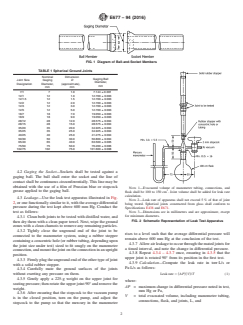
3.1 Socket Member—The design of the socket member is
physical or chemical characteristics of the material used.
shown in Fig. 1. The contour of the ground area shall be
NOTE 1—The dimensions pertaining to spherical ground joints were
spherical, with a radius of curvature equal to one half of the
taken from the Commercial Standard CS 21–58 of the U.S. Department of
Commerce. gaging ball diameter specified in Table 1 as a minimum. The
NOTE 2—Although glass is the most commonly used material for
contour of the shoulder shall be essentially spherical and
ground joints, other materials may be used as specified. Spherical joints
concentric with the ground area. When tested in accordance
constructed from glass shall conform to Specifications E438 and E671.
with 4.2, socket members shall show a continuous circumfer-
1.2 The following precautionary caveat pertains only to the
ential line of contact with the gaging ball.
Test Method portion, Section 4, of this specification. This
3.2 Ball Member—The design of the ball member is shown
standarddoesnotpurporttoaddressallofthesafetyconcerns,
in Fig. 1. The contour of the ground area shall be spherical,
ifany,associatedwithitsuse.Itistheresponsibilityoftheuser
with a radius of curvature equal to one half of the gaging ball
of this standard to establish appropriate safety and health
diameter as specified in Table 1 as a maximum. The contour of
practices and determine the applicability of regulatory limita-
the shoulder shall be essentially spherical, approximately
tions prior to use.
concentric with the ground area and with a slightly smaller
radius to provide a short offset at or slightly beyond the line of
2. Referenced Documents
the gaging diameter. Ball members shall meet the reduced
2.1 ASTM Standards:
pressure test (4.3) when assembled with a socket member
E438 Specification for Glasses in Laboratory Apparatus
complying with 3.1.
E671 Specification for Maximum Permissible Thermal Re-
3.3 Size Designation—The size designation of joints shall
sidual Stress in Annealed Glass Laboratory Apparatus
be the accepted nominal gaging diameter, plus the inside
E920 Specification for Commercially Packaged Laboratory
diameter of the joint within the ball member, both expressed in
Apparatus
millimetres and separated by a line. Therefore, the designation
E921 Specification for Export Packaged Laboratory Appa-
18/7 means that the nominal gaging diameter of the joint is 18
ratus
mm and the inside diameter of the joint is 7 mm.
E1133 Practice for Performance Testing of Packaged Labo-
ratory Apparatus for United States Government Procure- 3.4 Dimensions—The size designations and essential di-
ments mensions of joints are shown in Table 1. Only the sizes listed
shall be considered standard.
3.5 Interchangeability—When assembled ball-and-socket
This specification is under the jurisdiction of ASTM Committee E41 on
members are paired at random and tested under reduced
Laboratory Apparatus and is the direct responsibility of Subcommittee E41.01 on
pressure, the leak rates shall not exceed those specified in 4.3.
Laboratory Ware and Supplies.
Current edition approved Sept. 1, 2016. Published September 2016. Originally
4. Test Methods
approved in 1980. Last previous edition approved in 2004 as E677 – 94 (2010).
DOI: 10.1520/E0677-94R16.
4.1 Gaging the Ball—Gaging balls shall have dimensions
For referenced ASTM standards, visit the ASTM website, www.astm.org, or
and tolerances shown in Table 1.
contact ASTM Customer Service at service@astm.org. For Annual Book of ASTM
Standards volume information, refer to the standard’s Document Summary page on
the ASTM website. Discontinued 1979—U.S. Department of Commerce, Washington, DC 20234.
Copyright © ASTM International, 100 Barr Harbor Drive, PO Box C700, West Conshohocken, PA 19428-2959. United States
E677 − 94 (2016)
FIG. 1 Diagram of Ball-and-Socket Members
TABLE 1 Spherical Ground Joints
Nominal Dimension
Gaging Ball
Joint Size Gaging D
Diameter,
Designation Diameter, (approximate),
mm
mm mm
7/1 7 1.0 7.144 ± 0.001
12/1 12 1.0 12.700 ± 0.003
12/1.5 12 1.5 12.700 ± 0.003
12/2 12 2.0
...