

ASTM D4976-12a(2020)
(Specification)Standard Specification for Polyethylene Plastics Molding and Extrusion Materials
General Information
- Abstract
ABSTRACT
This specification provides the standard requirements for polyethylene plastic molding and extrusion materials. The tests involved in this specification are intended to provide information for identifying materials in accordance with the groups, classes, and grades covered. Polyethylene plastic materials are classified into two groups in accordance with the molecular structure which may be branched or linear. Test specimens shall be compression molded, conditioned in a standard or controlled laboratory atmosphere, and tested to determine the materials' physical and electrical properties. The specimens shall comply with the following requirements: flow rate; density; tensile stress at yield; nominal strain at break; secant flexural modulus; environmental stress-crack resistance; slow crack growth resistance; thermal stress crack resistance; permittivity; dissipation factor; volume resistivity; water immersion stability; flammability; and weatherability.
SCOPE
1.1 This specification provides for the identification of polyethylene plastics molding and extrusion materials in such a manner that the supplier and the user can agree on the acceptability of different commercial lots or shipments. The tests involved in this specification are intended to provide information for identifying materials in accordance with the groups, classes, and grades covered. It is not the function of this specification to provide specific engineering data for design purposes.
1.2 Other requirements necessary to identify particular characteristics important to specialized applications shall be agreed upon between the user and the supplier, by using the suffixes given in Section 1.3.
1.3 Ethylene plastic materials, being thermoplastic, are reprocessable and recyclable (see Note 1). This specification allows for the use of those ethylene plastic materials, provided that any specific requirements as governed by the producer and the end user are met.
Note 1: See Guide D7209 for information and definitions related to recycled plastics.
1.4 The values stated in SI units are regarded as standard.
1.5 The following precautionary caveat pertains to the test method portion only, Section 12, of this specification. This standard does not purport to address all of the safety concerns, if any, associated with its use. It is the responsibility of the user of this standard to establish appropriate safety, health, and environmental practices and determine the applicability of regulatory limitations prior to use.
1.6 For information regarding plastic pipe materials see Specification D3350. For information regarding wire and cable materials, see Specification D1248.
Note 2: There is no known ISO equivalent to this standard.
1.7 This international standard was developed in accordance with internationally recognized principles on standardization established in the Decision on Principles for the Development of International Standards, Guides and Recommendations issued by the World Trade Organization Technical Barriers to Trade (TBT) Committee.
- Status
- Published
- Publication Date
- 30-Nov-2020
- Technical Committee
- D20 - Plastics
- Drafting Committee
- D20.15 - Thermoplastic Materials
Overview
ASTM D4976-12a(2020), Standard Specification for Polyethylene Plastics Molding and Extrusion Materials, provides the standardized requirements and classification system for polyethylene (PE) plastics used in molding and extrusion processes. Developed by ASTM International, this standard establishes criteria that allow suppliers and users to agree on the acceptability of various polyethylene lots, ensuring consistent physical and electrical properties. The specification covers both branched and linear molecular structures, emphasizing the importance of uniformity, reliability, and quality in commercial transactions and manufacturing.
Key Topics
- Material Identification: Polyethylene plastics are classified by group (branched or linear), class (density), and grade (flow rate/melt index). This systematic approach aids in proper selection, specification, and verification of compatible materials.
- Test Requirements: Key tests include:
- Flow rate (melt index)
- Density
- Tensile stress at yield and nominal strain at break
- Secant flexural modulus
- Environmental and thermal stress-crack resistance
- Slow crack growth resistance
- Permittivity, dissipation factor, and volume resistivity for electrical properties
- Flammability and weatherability
- Specimen Preparation and Conditioning: Standard protocols for molding, conditioning, and testing specimens guarantee reproducible results, referencing relevant ASTM test methods for each property.
- Suffix Callouts: Optional suffixes allow for added or specific property requirements (such as electrical, flammability, and weatherability), tailored to specialized applications through mutual agreement.
- Recyclability: The standard allows the use of recycled polyethylene, provided performance requirements are met, thereby supporting sustainable manufacturing practices.
Applications
ASTM D4976 is crucial for industries that utilize polyethylene plastic materials in molding and extrusion processes. Its applications include:
- Injection molding and extrusion of parts for consumer goods, automotive components, and various industrial products.
- Quality assurance in procurement: Ensures shipments meet agreed quality by standardizing acceptance criteria based on clearly defined test methods.
- Product development: Facilitates material selection for designers and engineers by providing classification and performance benchmarks.
- Electrical and cable applications: When specific electrical properties are needed, optional suffixes address requirements such as volume resistivity and permittivity.
- Outdoor products and construction materials: Weatherability and flammability ratings guide the selection of polyethylene grades for applications exposed to sunlight, moisture, or potential ignition sources.
- Supporting recycled content: Guidance for using reprocessed materials is included, in line with resource recovery and sustainability initiatives.
Related Standards
Several other ASTM standards are referenced or related to ASTM D4976, including:
- ASTM D1248: Specification for Polyethylene Plastics Extrusion Materials for Wire and Cable
- ASTM D3350: Specification for Polyethylene Plastics Pipe and Fittings Materials
- ASTM D7209: Guide for Waste Reduction, Resource Recovery, and Use of Recycled Polymeric Materials and Products
- ASTM D638: Test Method for Tensile Properties of Plastics
- ASTM D790: Test Methods for Flexural Properties of Plastics
- ASTM D1238: Test Method for Melt Flow Rates of Thermoplastics by Extrusion Plastometer
Practical Value
By following ASTM D4976-12a(2020), manufacturers and users of polyethylene molding and extrusion materials benefit from:
- Consistent material quality and traceability
- Improved supplier-buyer communication
- Streamlined procurement and acceptance processes
- Reduced risk of non-conforming products
- Clear documentation for audits and regulatory compliance
The use of this specification is foundational in achieving reliable performance, interchangeability of materials, and sustainable practices in the use of polyethylene plastics.
Relations
- Effective Date
- 01-Apr-2024
- Effective Date
- 01-Feb-2024
- Refers
ASTM D1238-23a - Standard Test Method for Melt Flow Rates of Thermoplastics by Extrusion Plastometer - Effective Date
- 15-Nov-2023
- Effective Date
- 01-Nov-2023
- Effective Date
- 01-Oct-2023
- Effective Date
- 01-Jan-2020
- Effective Date
- 01-Dec-2019
- Effective Date
- 01-Dec-2019
- Effective Date
- 01-Aug-2019
- Effective Date
- 01-May-2019
- Effective Date
- 15-Apr-2019
- Effective Date
- 01-Feb-2019
- Effective Date
- 15-Jan-2019
- Effective Date
- 01-Dec-2018
- Effective Date
- 01-Nov-2018
Get Certified
Connect with accredited certification bodies for this standard

DIN CERTCO
DIN Group product certification.

Smithers Quality Assessments
US management systems and product certification.
Sponsored listings
Frequently Asked Questions
ASTM D4976-12a(2020) is a technical specification published by ASTM International. Its full title is "Standard Specification for Polyethylene Plastics Molding and Extrusion Materials". This standard covers: ABSTRACT This specification provides the standard requirements for polyethylene plastic molding and extrusion materials. The tests involved in this specification are intended to provide information for identifying materials in accordance with the groups, classes, and grades covered. Polyethylene plastic materials are classified into two groups in accordance with the molecular structure which may be branched or linear. Test specimens shall be compression molded, conditioned in a standard or controlled laboratory atmosphere, and tested to determine the materials' physical and electrical properties. The specimens shall comply with the following requirements: flow rate; density; tensile stress at yield; nominal strain at break; secant flexural modulus; environmental stress-crack resistance; slow crack growth resistance; thermal stress crack resistance; permittivity; dissipation factor; volume resistivity; water immersion stability; flammability; and weatherability. SCOPE 1.1 This specification provides for the identification of polyethylene plastics molding and extrusion materials in such a manner that the supplier and the user can agree on the acceptability of different commercial lots or shipments. The tests involved in this specification are intended to provide information for identifying materials in accordance with the groups, classes, and grades covered. It is not the function of this specification to provide specific engineering data for design purposes. 1.2 Other requirements necessary to identify particular characteristics important to specialized applications shall be agreed upon between the user and the supplier, by using the suffixes given in Section 1.3. 1.3 Ethylene plastic materials, being thermoplastic, are reprocessable and recyclable (see Note 1). This specification allows for the use of those ethylene plastic materials, provided that any specific requirements as governed by the producer and the end user are met. Note 1: See Guide D7209 for information and definitions related to recycled plastics. 1.4 The values stated in SI units are regarded as standard. 1.5 The following precautionary caveat pertains to the test method portion only, Section 12, of this specification. This standard does not purport to address all of the safety concerns, if any, associated with its use. It is the responsibility of the user of this standard to establish appropriate safety, health, and environmental practices and determine the applicability of regulatory limitations prior to use. 1.6 For information regarding plastic pipe materials see Specification D3350. For information regarding wire and cable materials, see Specification D1248. Note 2: There is no known ISO equivalent to this standard. 1.7 This international standard was developed in accordance with internationally recognized principles on standardization established in the Decision on Principles for the Development of International Standards, Guides and Recommendations issued by the World Trade Organization Technical Barriers to Trade (TBT) Committee.
ABSTRACT This specification provides the standard requirements for polyethylene plastic molding and extrusion materials. The tests involved in this specification are intended to provide information for identifying materials in accordance with the groups, classes, and grades covered. Polyethylene plastic materials are classified into two groups in accordance with the molecular structure which may be branched or linear. Test specimens shall be compression molded, conditioned in a standard or controlled laboratory atmosphere, and tested to determine the materials' physical and electrical properties. The specimens shall comply with the following requirements: flow rate; density; tensile stress at yield; nominal strain at break; secant flexural modulus; environmental stress-crack resistance; slow crack growth resistance; thermal stress crack resistance; permittivity; dissipation factor; volume resistivity; water immersion stability; flammability; and weatherability. SCOPE 1.1 This specification provides for the identification of polyethylene plastics molding and extrusion materials in such a manner that the supplier and the user can agree on the acceptability of different commercial lots or shipments. The tests involved in this specification are intended to provide information for identifying materials in accordance with the groups, classes, and grades covered. It is not the function of this specification to provide specific engineering data for design purposes. 1.2 Other requirements necessary to identify particular characteristics important to specialized applications shall be agreed upon between the user and the supplier, by using the suffixes given in Section 1.3. 1.3 Ethylene plastic materials, being thermoplastic, are reprocessable and recyclable (see Note 1). This specification allows for the use of those ethylene plastic materials, provided that any specific requirements as governed by the producer and the end user are met. Note 1: See Guide D7209 for information and definitions related to recycled plastics. 1.4 The values stated in SI units are regarded as standard. 1.5 The following precautionary caveat pertains to the test method portion only, Section 12, of this specification. This standard does not purport to address all of the safety concerns, if any, associated with its use. It is the responsibility of the user of this standard to establish appropriate safety, health, and environmental practices and determine the applicability of regulatory limitations prior to use. 1.6 For information regarding plastic pipe materials see Specification D3350. For information regarding wire and cable materials, see Specification D1248. Note 2: There is no known ISO equivalent to this standard. 1.7 This international standard was developed in accordance with internationally recognized principles on standardization established in the Decision on Principles for the Development of International Standards, Guides and Recommendations issued by the World Trade Organization Technical Barriers to Trade (TBT) Committee.
ASTM D4976-12a(2020) is classified under the following ICS (International Classification for Standards) categories: 83.080.20 - Thermoplastic materials. The ICS classification helps identify the subject area and facilitates finding related standards.
ASTM D4976-12a(2020) has the following relationships with other standards: It is inter standard links to ASTM F1473-24, ASTM D883-24, ASTM D1238-23a, ASTM D883-23, ASTM D2565-23, ASTM D883-20, ASTM D4804-19a, ASTM D3801-19a, ASTM D883-19c, ASTM D4804-19, ASTM D883-19a, ASTM D883-19, ASTM D3801-19, ASTM D883-18a, ASTM D883-18. Understanding these relationships helps ensure you are using the most current and applicable version of the standard.
ASTM D4976-12a(2020) is available in PDF format for immediate download after purchase. The document can be added to your cart and obtained through the secure checkout process. Digital delivery ensures instant access to the complete standard document.
Standards Content (Sample)
This international standard was developed in accordance with internationally recognized principles on standardization established in the Decision on Principles for the
Development of International Standards, Guides and Recommendations issued by the World Trade Organization Technical Barriers to Trade (TBT) Committee.
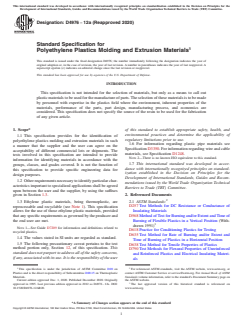
Designation:D4976 −12a (Reapproved 2020)
Standard Specification for
Polyethylene Plastics Molding and Extrusion Materials
This standard is issued under the fixed designation D4976; the number immediately following the designation indicates the year of
original adoption or, in the case of revision, the year of last revision. A number in parentheses indicates the year of last reapproval. A
superscript epsilon (´) indicates an editorial change since the last revision or reapproval.
This standard has been approved for use by agencies of the U.S. Department of Defense.
INTRODUCTION
This specification is not intended for the selection of materials, but only as a means to call out
plastic materials to be used for the manufacture of parts.The selection of these materials is to be made
by personnel with expertise in the plastics field where the environment, inherent properties of the
materials, performance of the parts, part design, manufacturing process, and economics are
considered. This specification does not specify the source of the resin to be used for the fabrication
of any given article.
1. Scope* of this standard to establish appropriate safety, health, and
environmental practices and determine the applicability of
1.1 This specification provides for the identification of
regulatory limitations prior to use.
polyethylene plastics molding and extrusion materials in such
1.6 For information regarding plastic pipe materials see
a manner that the supplier and the user can agree on the
Specification D3350. For information regarding wire and cable
acceptability of different commercial lots or shipments. The
materials, see Specification D1248.
tests involved in this specification are intended to provide
NOTE 2—There is no known ISO equivalent to this standard.
information for identifying materials in accordance with the
1.7 This international standard was developed in accor-
groups, classes, and grades covered. It is not the function of
dance with internationally recognized principles on standard-
this specification to provide specific engineering data for
ization established in the Decision on Principles for the
design purposes.
Development of International Standards, Guides and Recom-
1.2 Otherrequirementsnecessarytoidentifyparticularchar-
mendations issued by the World Trade Organization Technical
acteristics important to specialized applications shall be agreed
Barriers to Trade (TBT) Committee.
upon between the user and the supplier, by using the suffixes
given in Section 1.3. 2. Referenced Documents
1.3 Ethylene plastic materials, being thermoplastic, are 2.1 ASTM Standards:
reprocessable and recyclable (see Note 1). This specification D257 Test Methods for DC Resistance or Conductance of
allows for the use of those ethylene plastic materials, provided Insulating Materials
D568 Method ofTest for Burning and/or Extent andTime of
that any specific requirements as governed by the producer and
the end user are met. Burning of Flexible Plastics in a Vertical Position (With-
drawn 1991)
NOTE 1—See Guide D7209 for information and definitions related to
D618 Practice for Conditioning Plastics for Testing
recycled plastics.
D635 Test Method for Rate of Burning and/or Extent and
1.4 The values stated in SI units are regarded as standard.
Time of Burning of Plastics in a Horizontal Position
1.5 The following precautionary caveat pertains to the test
D638 Test Method for Tensile Properties of Plastics
method portion only, Section 12, of this specification. This
D790 Test Methods for Flexural Properties of Unreinforced
standard does not purport to address all of the safety concerns,
and Reinforced Plastics and Electrical Insulating Materi-
if any, associated with its use. It is the responsibility of the user
als
1 2
This specification is under the jurisdiction of ASTM Committee D20 on For referenced ASTM standards, visit the ASTM website, www.astm.org, or
Plastics and is the direct responsibility of Subcommittee D20.15 on Thermoplastic contact ASTM Customer Service at service@astm.org. For Annual Book of ASTM
Materials. Standards volume information, refer to the standard’s Document Summary page on
Current edition approved Dec. 1, 2020. Published December 2020. Originally the ASTM website.
approved in 1995. Last previous edition approved in 2012 as D4976 - 12a. DOI: The last approved version of this historical standard is referenced on
10.1520/D4976-12AR20. www.astm.org.
*A Summary of Changes section appears at the end of this standard
Copyright © ASTM International, 100 Barr Harbor Drive, PO Box C700, West Conshohocken, PA 19428-2959. United States
D4976−12a (2020)
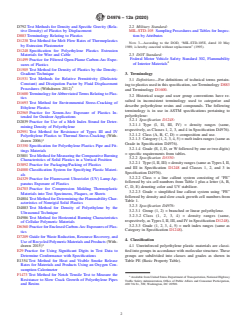
D792 Test Methods for Density and Specific Gravity (Rela- 2.2 Military Standard:
tive Density) of Plastics by Displacement MIL-STD-105 Sampling Procedures and Tables for Inspec-
D883 Terminology Relating to Plastics tion by Attributes
D1238 Test Method for Melt Flow Rates of Thermoplastics
NOTE 3—According to the DOD, “MIL-STD-105E, dated 10 May
by Extrusion Plastometer
1989, is hereby canceled without replacement” (1995).
D1248 Specification for Polyethylene Plastics Extrusion
2.3 DOT Standard:
Materials for Wire and Cable
Federal Motor Vehicle Safety Standard 302, Flammability
D1499 Practice for Filtered Open-Flame Carbon-Arc Expo-
of Interior Materials
sures of Plastics
D1505 Test Method for Density of Plastics by the Density-
3. Terminology
Gradient Technique
D1531 Test Methods for Relative Permittivity (Dielectric
3.1 Definitions—For definitions of technical terms pertain-
Constant) and Dissipation Factor by Fluid Displacement
ing to plastics used in this specification, seeTerminology D883
Procedures (Withdrawn 2012)
and Terminology D1600.
D1600 Terminology forAbbreviatedTerms Relating to Plas-
3.2 Historical usage and user group conventions have re-
tics
sulted in inconsistent terminology used to categorize and
D1693 Test Method for Environmental Stress-Cracking of
describe polyethylene resins and compounds. The following
Ethylene Plastics
terminology is in use in ASTM specifications pertaining to
D2565 Practice for Xenon-Arc Exposure of Plastics In-
polyethylene:
tended for Outdoor Applications
3.2.1 Specification D1248:
D2839 Practice for Use of a Melt Index Strand for Deter-
3.2.1.1 Type (I, II, III, IV) = density ranges (same,
mining Density of Polyethylene
respectively, as Classes 1, 2, 3, and 4 in Specification D4976).
D2951 Test Method for Resistance of Types III and IV
3.2.1.2 Class (A, B, C, D) = composition and use.
Polyethylene Plastics to Thermal Stress-Cracking (With-
3 3.2.1.3 Category (1, 2, 3, 4, 5) = melt index ranges (same as
drawn 2006)
Grade in Specification D4976).
D3350 Specification for Polyethylene Plastics Pipe and Fit-
3.2.1.4 Grade (E, J, D, or W followed by one or two digits)
tings Materials
= specific requirements from tables.
D3801 TestMethodforMeasuringtheComparativeBurning
3.2.2 Specification D3350:
Characteristics of Solid Plastics in a Vertical Position
3.2.2.1 Type (I, II, III) = density ranges (same asTypes I, II,
D3892 Practice for Packaging/Packing of Plastics
and III in Specification D1248 and Classes 1, 2, and 3 in
D4000 Classification System for Specifying Plastic Materi-
Specification D4976).
als
3.2.2.2 Class = a line callout system consisting of “PE”
D4329 Practice for Fluorescent Ultraviolet (UV) Lamp Ap-
followed by six cell numbers from Table 1 plus a letter (A, B,
paratus Exposure of Plastics
C, D, E) denoting color and UV stabilizer.
D4703 Practice for Compression Molding Thermoplastic
3.2.2.3 Grade = simplified line callout system using “PE”
Materials into Test Specimens, Plaques, or Sheets
followed by density and slow crack growth cell numbers from
D4804 Test Method for Determining the Flammability Char-
Table 1.
acteristics of Nonrigid Solid Plastics
3.2.3 Specification D4976:
D4883 Test Method for Density of Polyethylene by the
3.2.3.1 Group (1, 2) = branched or linear polyethylene.
Ultrasound Technique
3.2.3.2 Class (1, 2, 3, 4) = density ranges (same,
D4986 Test Method for Horizontal Burning Characteristics
respectively, asTypes I, II, III, and IVin Specification D1248).
of Cellular Polymeric Materials
3.2.3.3 Grade (1, 2, 3, 4, 5) = melt index ranges (same as
D6360 Practice for Enclosed Carbon-Arc Exposures of Plas-
Category in Specification D1248).
tics
D7209 Guide for Waste Reduction, Resource Recovery, and
4. Classification
Use of Recycled Polymeric Materials and Products (With-
drawn 2015)
4.1 Unreinforced polyethylene plastic materials are classi-
E29 Practice for Using Significant Digits in Test Data to fied into groups in accordance with molecular structure. These
Determine Conformance with Specifications
groups are subdivided into classes and grades as shown in
E1354 Test Method for Heat and Visible Smoke Release Table PE (Basic Property Table).
Rates for Materials and Products Using an Oxygen Con-
sumption Calorimeter
F1473 Test Method for Notch Tensile Test to Measure the
Available from United States Department of Transportation, National Highway
Resistance to Slow Crack Growth of Polyethylene Pipes
Traffic Safety Administration, Office of Public Affairs and Consumer Participation,
and Resins 400 7th St., SW, Washington, DC 20590.
D4976−12a (2020)
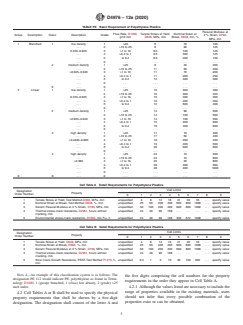
TABLE PE Basic Requirement of Polyethylene Plastics
Flexural Modulus at
Flow Rate, D1238, Tensile Stress at Yield, Nominal Strain at
Group Description Class Description Grade 2 % Strain, D790,
g/10 min D638, MPa, min Break, D638,min,%
MPa, min
1 Branched 1 low density 1 >25 8 70 100
. . . 2 >10 to 25 8 90 125
0.910–0.925 3 >1 to 10 8.5 100 125
. . . 4 >0.4 to 1 9.5 300 125
. . . 5 to 0.4 9.5 400 150
... 0 ... ... ... ...
2 medium density 1 >25 8 40 200
. . . 2 >10 to 25 11 50 200
>0.925–0.940 3 >1 to 10 11 70 200
. . . 4 >0.4 to 1 11 200 250
. . . 5 to 0.4 12 400 300
... 0 ... ... ... ...
0 . 0 . . . .
2 Linear 1 low density 1 >25 10 300 300
. . . 2 >10 to 25 10 300 325
0.910–0.925 3 >1 to 10 10 300 350
. . . 4 >0.4 to 1 10 400 350
. . . 5 to 0.4 12 500 400
... 0 ... ... ... ...
2 medium density 1 >25 14 90 500
. . . 2 >10 to 25 14 100 500
>0.925–0.940 3 >1 to 10 14 100 550
. . . 4 >0.4 to 1 15 200 600
. . . 5 to 0.4 19 400 600
... 0 ... ... ... ...
3 high density 1 >25 17 10 400
. . . 2 >10 to 25 17 50 400
>0.a940–0.960 3 >1 to 10 18 200 450
. . . 4 >0.4 to 1 19 400 500
. . . 5 to 0.4 20 600 600
... 0 ... ... ... ...
4 high density 1 >25 24 10 500
. . . 2 >10 to 25 24 10 600
>0.960 3 >1 to 10 25 30 800
. . . 4 >0.4 to 1 28 300 900
. . . 5 to 0.4 28 400 1000
... 0 ... ... ... ...
0 0 . 0 . . . .
Cell Table A Detail Requirements for Polyethylene Plastics
Cell Limits
Designation
Property
Order Number
0 1 2 3 4 5 678 9
1 Tensile Stress at Yield, Test Method D638, MPa, min unspecified 4 8 12 16 21 30 35 . . . specify value
2 Nominal Strain at Break, Test Method D638, %, min unspecified 25 50 200 400 600 800 1000 . . . specify value
3 Secant Flexural Modulus at 2 % Strain, D790, MPa, min unspecified 50 100 200 400 600 800 1000 . . . specify value
4 Thermal stress-crack resistance, D2951, hours without unspecified 24 48 96 168 . . . . . . . . . . . . specify value
cracking, min
5 Environmental stress-crack resistance, D1693, min F , h unspecified 24 48 96 168 336 672 1008 . . . specify value
Cell Table B Detail Requirements for Polyethylene Plastics
Cell Limits
Designation
Property
Order Number
0 1 2 3 4 5 678 9
1 Tensile Stress at Yield, D638, MPa, min unspecified 4 8 12 16 21 30 35 . . . specify value
2 Nominal Strain at Break, D638, %, min unspecified 25 50 200 400 600 800 1000 . . . specify value
3 Secant Flexural Modulus at 2 % Strain, D790, MPa, min unspecified 50 100 200 400 600 800 1000 . . . specify value
4 Thermal stress-crack resistance, D2951, hours without unspecified 24 48 96 168 . . . . . . . . . . . . specify value
cracking, min
5 Slow Crack Growth Resistance, PENT-Test Method F1473,h, unspecified 0.3 1 3 10 30 100 300 . . . specify value
min
NOTE 4—An example of this classification system is as follows: The
the five digits comprising the cell numbers for the property
designation PE 112 would indicate PE, polyethylene as found in Termi-
requirements in the order they appear in Cell Table A.
nology D1600, 1 (group) branched, 1 (class) low density, 2 (grade) >25
4.2.1 Although the values listed are necessary to include the
melt index.
range of properties available in the existing materials, users
4.2 Cell Tables A or B shall be used to specify the physical
should not infer that every possible combination of the
property requirements that shall be shown by a five-digit
properties exist or can be obtained.
designation. The designation shall consist of the letter A and
D4976−12a (2020)
NOTE 5—It is recognized that some high-density polyethylene plastics
plastics shall be assessed by Test Method D4986. A foamed
of very high molecular weight have densities slightly less than 0.960, yet
plastic shall be classified HBF if: (a) the rate of burning in the
in all other respects they are characteristic of Class 4 materials. Similarly,
test does not exceed 40 mm per minute over a 100 mm span b)
there are other polyethylene plastics of very high molecular weight having
the test specimen ceases to burn before flaming or glowing
densities slightly less than 0.941 that, in all other respects, are more
reaches the 125 mm gage mark.
characteristic of Class 2 than of Class 3 materials.
NOTE 6—Use the following terms in describing polyethylene plastics:
5.1.2.3 The burning characteristics in a vertical orientation
Class 1 (0.910 to 0.925) = low density,
of polyethylene plastics shall be assessed by Test Method
Class 2 (>0.925 to 0.940) = medium density,
D3801. A plastic shall be classified V0, V1 or V2 as indicated
Class 3 (>0.940 to 0.960) = high density,
in Appendix X1 of Test Method D3801.
Class 4 (>0.960) = high density, and
Although Classes 3 and 4 cover two ranges of density, both are described 5.1.2.4 The burning characteristics in a vertical orientation
by the term “high density.”
of nonrigid polyethylene plastics that, due to specimen thick-
ness or lack of rigidity, would distort or shrink when tested
5. Suffixes
using Test Method D3801 shall be assessed by Test Method
5.1 Whenusingthecall-outforthematerialscoveredbythis
D4804.Aplastic shall be classifiedVTM0,VTM1 orVTM2 as
specification, the following suffixes can be used for specific indicated in Appendix X1 of Test Method D4804.
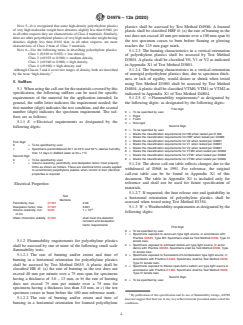
requirements of the material for the application intended. In 5.1.2.5 G = Flammability requirements as designated by
general, the suffix letter indicates the requirement needed; the the following digits: as designated by the following digits:
first number (digit) indicates the test condition, and the second
First digit
number (digit) indicates the specimen requirement. The suf- 0 = To be specified by user.
1 = Rigid
fixes are as follows:
2 = Foam
5.1.1 E = Electrical requirements as designated by the
3 = Non-rigid
Second Digit
following digits:
0 = To be specified by user.
1 = Meets the classification requirements for HB when tested per D 635
2 = Meets the classification requirements for HBF when tested per D4986
3 = Meets the classification requirements for V0 when tested per D3801
First Digit
4 = Meets the classification requirements for V1 when tested per D3801
0 = To be specified by user.
5 = Meets the classification requirements for V2 when tested per D3801
1 = Specimens preconditioned 40 h at 23°C and 50 % relative humidity,
6 = Meets the classification requirements for VTM0 when tested per D4804
then 14 days in distilled water at 23 ± 1°C.
7 = Meets the classification requirements for VTM1 when tested per D4804
Second Digit
8 = Meets the classification requirements for VTM2 when tested per D4804
0 = To be specified by user.
1 = Volume resistivity, permittivity, and dissipation factor meet property
5.1.2.6 The above call-out table reflects changes due to the
limits as shown as follows. These are electrical limits usually applied
withdrawal of D568 in 1991. For reference, the original
to unreinforced polyethylene plastics when control of their electrical
properties is required. call-out table can be be found in Appendix X1 of this
document. The table in Appendix X1 is included only for
reference and shall not be used for future specification of
Electrical Properties:
materials.
5.1.2.7 If requested, the heat release rate and ignitability in
Test
a horizontal orientation of polyethylene plastics shall be
Methods
assessed when tested using Test Method E1354.
Permittivity, max D1531 2.30
Dissipation factor, max D1531 0.001
5.1.3 W = Weatherability requirements as designated by the
Volume resistivity, min D257 1×10
following digits:
Ω-cm
Water immersion stability D1531 shall meet the dielectric
constant and dissipation
factor requirements
First Digit
0 = To be specified by user.
1 = Specimens exposed to xenon-arc type light source, in accordance with
Practice D2565, Type BH. Specimens shall be Test Method D638, Type IV
5.1.2 Flammability requirements for polyethylene plastics
tensile bars.
2 = Specimens exposed to enclosed carbon-arc type light source, in accor-
shall be assessed by one or more of the following small scale
dance with Practice D6360. Specimens shall be Test Method D638, Type
flammability tests:
IV tensile bars.
5.1.2.1 The rate of burning and/or extent and time of
3 = Specimens exposed to fluorescent-UV-condensation type light source, in
accordance with Practice D4329. Specimens shall be Test Method D638,
burning in a horizontal orientation for polyethylene plastics
Type IV tensile bars.
shall be assessed by Test Method D635. A plastic shall be
4 = Specimens exposed to filtered open-flame carbon arc type light source in
classified HB if: (a) the rate of burning in the test does not accordance with Practice D1499. Specimens shall be Test Method D638,
Type IV tensile bars
exceed 40 mm per minute over a 75 mm span for specimens
Second Digit
having a thickness of 3.0 – 13 mm, or b) the rate of burning
0 = To be specified by user.
does not exceed 75 mm per minute over a 75 mm for
specimens having a thickness less than 3.0 mm, or c) the test
specimen ceases to burn before the 100 mm reference mark.
By publication of this specification and its use of flammability ratings, ASTM
5.1.2.2 The rate of burning and/or extent and time of
doesnotsuggestthattheiruseinanywayreflectshazardspresentedunderactualfire
burning in a horizontal orie
...