

ASTM F1962-22
(Guide)Standard Guide for Use of Maxi-Horizontal Directional Drilling for Placement of Polyethylene Pipe or Conduit Under Obstacles, Including River Crossings
General Information
- Abstract
ABSTRACT
This guide describes the design, selection considerations, and installation procedures for the placement of polyethylene pipe or conduit below ground using maxi-horizontal directional drilling equipment. The pipes or conduits may be used for various applications including telecommunications, electric power, natural gas, petroleum, water lines, sewer lines, or other fluid transport. Horizontal directional drilling is a form of trenchless technology. The equipment and procedures are intended to minimize surface damage, restoration requirements, and disruption of vehicular or maritime traffic with little or no interruption of other existing lines or services. Mini-horizontal directional drilling (min-HDD) is typically used for the relatively shorter distances and smaller diameter pipes associated with local utility distribution lines. In comparison, maxihorizontal directional drilling (maxi-HDD) is typically used for longer distances and larger diameter pipes common in major river crossings. Applications that are intermediate to the mini-HDD or maxi-HDD categories may utilize appropriate “medi” equipment of intermediate size and capabilities. In such cases, the design guidelines and installation practices would follow those described for the mini- or maxi-HDD categories, as judged to be most suitable for each situation.
SCOPE
1.1 This guide describes the design, selection considerations, and installation procedures for the placement of polyethylene (PE) pipe or conduit below ground using maxi-horizontal directional drilling equipment. The pipes or conduits may be used for various applications including telecommunications, electric power, natural gas, petroleum, water lines, sewer lines, or other fluid transport.
1.2 Horizontal directional drilling is a form of trenchless technology. The equipment and procedures are intended to minimize surface damage, restoration requirements, and disruption of vehicular or maritime traffic with little or no interruption of other existing lines or services. Mini-horizontal directional drilling (mini-HDD) is typically used for the relatively shorter distances and smaller diameter pipes associated with local utility distribution lines. In comparison, maxi-horizontal directional drilling (maxi-HDD) is typically used for longer distances and larger diameter pipes common in major river crossings. Applications that are intermediate to the mini-HDD or maxi-HDD categories may utilize appropriate “medi” equipment of intermediate size and capabilities. In such cases, the design guidelines and installation practices would follow those described for the mini- or maxi-HDD categories, as judged to be most suitable for each situation.
1.3 The values stated in inch-pound units are to be regarded as standard. The values given in parentheses are mathematical conversions to SI units that are provided for information only and are not considered standard.
1.4 This standard does not purport to address all of the safety concerns, if any, associated with its use. It is the responsibility of the user of this standard to establish appropriate safety, health, and environmental practices and determine the applicability of regulatory limitations prior to use. Section 6 contains general safety information related to the use of maxi-horizontal directional drilling equipment.
1.5 This international standard was developed in accordance with internationally recognized principles on standardization established in the Decision on Principles for the Development of International Standards, Guides and Recommendations issued by the World Trade Organization Technical Barriers to Trade (TBT) Committee.
- Status
- Published
- Publication Date
- 14-Nov-2022
- Technical Committee
- F17 - Plastic Piping Systems
- Drafting Committee
- F17.67 - Trenchless Plastic Pipeline Technology
Buy Documents
ASTM F1962-22 - Standard Guide for Use of Maxi-Horizontal Directional Drilling for Placement of Polyethylene Pipe or Conduit Under Obstacles, Including River Crossings
REDLINE ASTM F1962-22 - Standard Guide for Use of Maxi-Horizontal Directional Drilling for Placement of Polyethylene Pipe or Conduit Under Obstacles, Including River Crossings
Overview
ASTM F1962-22 is a comprehensive standard guide that addresses the use of maxi-horizontal directional drilling (maxi-HDD) for the placement of polyethylene (PE) pipe or conduit under obstacles, such as river crossings. Developed by ASTM, this guide outlines best practices for design, selection considerations, and installation procedures for underground PE pipes and conduits. The standard is key for stakeholders in industries including telecommunications, electric power, natural gas, water, sewer, and fluid transport, aiming to deliver underground utility solutions while minimizing surface disruption and environmental impact.
Key Topics
- Maxi-HDD Technology: Maxi-horizontal directional drilling enables trenchless installation of large-diameter PE pipes over long distances and through challenging terrains, like beneath rivers and highways, with minimal surface damage.
- Design & Selection Considerations: The guide offers detailed procedures for assessing site conditions, selecting pipe materials, determining appropriate equipment sizes, and ensuring compatibility with existing underground infrastructure.
- Installation Procedures: Recommendations on pilot hole creation, bore enlargement, and pipe pullback help ensure safe and effective installation. Special considerations are included for handling water supply, fluid disposal, site stability, and optimal placement of entry and exit points.
- Safety & Environmental Protection: The standard emphasizes adherence to OSHA regulations, protective measures for personnel, proper disposal of drilling fluids, and control of potential environmental contamination.
- Permitting & Regulatory Compliance: Guidance is provided for securing necessary local, state, and federal permits, as well as for planning within environmentally sensitive or regulated areas.
Applications
- River and Waterway Crossings: Maxi-HDD is especially valuable for installing pipelines and conduits beneath rivers, avoiding disruption to aquatic ecosystems and river traffic.
- Infrastructure Projects: The method is ideal for crossing highways, railways, and urban landscapes where open trenching is impractical, costly, or disruptive.
- Utility Installations: Used for telecommunications, power cables, water, and gas lines, maxi-HDD supports both new installations and the upgrade or replacement of aging infrastructure.
- Challenging Subsurface Conditions: The standard provides guidance for handling varied soil and rock types, complex geology, and situations where minimal surface impact is required.
Related Standards
For thorough planning and safe, compliant installation of PE pipes using maxi-HDD, users should consult the following associated standards:
- ASTM D420 - Guide for Site Characterization for Engineering Design and Construction Purposes
- ASTM D1586 - Test Method for Standard Penetration Test (SPT) and Split-Barrel Sampling of Soils
- ASTM D2113 - Practice for Rock Core Drilling and Sampling of Rock for Site Exploration
- ASTM F714 - Specification for Polyethylene (PE) Plastic Pipe (DR-PR) Based on Outside Diameter
- ASTM F2160 - Specification for Solid Wall HDPE Conduit Based on Controlled Outside Diameter
- ASTM F2620 - Practice for Heat Fusion Joining of Polyethylene Pipe and Fittings
- ANSI/EIA/TIA-590 - Standard for Physical Location and Protection of Below-Ground Fiber Optic Cable Plant
- AWWA C901/C906 - Polyethylene Pipe and Fittings for Water Service and Waterworks Applications
Practical Value
Implementing ASTM F1962-22 as a design and installation standard provides tangible benefits for project planners, contractors, and engineers:
- Reduced Surface Disruption: HDD methods dramatically limit restoration costs and traffic interruptions, supporting better overall project economics.
- Compliance and Safety: The guide supports adherence to environmental and safety regulations while reducing risks to personnel and property.
- Project Success: Comprehensive site investigation, appropriate equipment selection, and effective planning increase the likelihood of successful pipeline installations.
- Broad Applicability: Relevant to both small utility projects and large-scale infrastructure crossings, this guide serves as an essential reference for a wide range of HDD applications.
For reliable, safe, and efficient underground installation of polyethylene conduit or pipe under obstacles, ASTM F1962-22 establishes industry best practices and a foundation for compliance with regulatory requirements.
Relations
- Effective Date
- 01-Feb-2024
- Effective Date
- 01-Apr-2020
- Refers
ASTM D2513-18 - Standard Specification for Polyethylene (PE) Gas Pressure Pipe, Tubing, and Fittings - Effective Date
- 15-Apr-2018
- Effective Date
- 01-Feb-2018
- Effective Date
- 01-Jun-2017
- Refers
ASTM D4318-17 - Standard Test Methods for Liquid Limit, Plastic Limit, and Plasticity Index of Soils - Effective Date
- 01-Jun-2017
- Effective Date
- 15-Dec-2016
- Refers
ASTM D2513-16 - Standard Specification for Polyethylene (PE) Gas Pressure Pipe, Tubing, and Fittings - Effective Date
- 01-Dec-2016
- Effective Date
- 01-Aug-2016
- Effective Date
- 01-Aug-2014
- Effective Date
- 25-Apr-2014
- Effective Date
- 25-Apr-2014
- Effective Date
- 01-Mar-2014
- Effective Date
- 01-Nov-2013
- Effective Date
- 01-Jun-2013
Buy Documents
ASTM F1962-22 - Standard Guide for Use of Maxi-Horizontal Directional Drilling for Placement of Polyethylene Pipe or Conduit Under Obstacles, Including River Crossings
REDLINE ASTM F1962-22 - Standard Guide for Use of Maxi-Horizontal Directional Drilling for Placement of Polyethylene Pipe or Conduit Under Obstacles, Including River Crossings
Get Certified
Connect with accredited certification bodies for this standard

Institut za varilstvo d.o.o. (Welding Institute)
Slovenia's leading welding institute since 1952. ISO 3834, EN 1090, pressure equipment certification, NDT personnel, welder qualification. Only IIW Au
Sponsored listings
Frequently Asked Questions
ASTM F1962-22 is a guide published by ASTM International. Its full title is "Standard Guide for Use of Maxi-Horizontal Directional Drilling for Placement of Polyethylene Pipe or Conduit Under Obstacles, Including River Crossings". This standard covers: ABSTRACT This guide describes the design, selection considerations, and installation procedures for the placement of polyethylene pipe or conduit below ground using maxi-horizontal directional drilling equipment. The pipes or conduits may be used for various applications including telecommunications, electric power, natural gas, petroleum, water lines, sewer lines, or other fluid transport. Horizontal directional drilling is a form of trenchless technology. The equipment and procedures are intended to minimize surface damage, restoration requirements, and disruption of vehicular or maritime traffic with little or no interruption of other existing lines or services. Mini-horizontal directional drilling (min-HDD) is typically used for the relatively shorter distances and smaller diameter pipes associated with local utility distribution lines. In comparison, maxihorizontal directional drilling (maxi-HDD) is typically used for longer distances and larger diameter pipes common in major river crossings. Applications that are intermediate to the mini-HDD or maxi-HDD categories may utilize appropriate “medi” equipment of intermediate size and capabilities. In such cases, the design guidelines and installation practices would follow those described for the mini- or maxi-HDD categories, as judged to be most suitable for each situation. SCOPE 1.1 This guide describes the design, selection considerations, and installation procedures for the placement of polyethylene (PE) pipe or conduit below ground using maxi-horizontal directional drilling equipment. The pipes or conduits may be used for various applications including telecommunications, electric power, natural gas, petroleum, water lines, sewer lines, or other fluid transport. 1.2 Horizontal directional drilling is a form of trenchless technology. The equipment and procedures are intended to minimize surface damage, restoration requirements, and disruption of vehicular or maritime traffic with little or no interruption of other existing lines or services. Mini-horizontal directional drilling (mini-HDD) is typically used for the relatively shorter distances and smaller diameter pipes associated with local utility distribution lines. In comparison, maxi-horizontal directional drilling (maxi-HDD) is typically used for longer distances and larger diameter pipes common in major river crossings. Applications that are intermediate to the mini-HDD or maxi-HDD categories may utilize appropriate “medi” equipment of intermediate size and capabilities. In such cases, the design guidelines and installation practices would follow those described for the mini- or maxi-HDD categories, as judged to be most suitable for each situation. 1.3 The values stated in inch-pound units are to be regarded as standard. The values given in parentheses are mathematical conversions to SI units that are provided for information only and are not considered standard. 1.4 This standard does not purport to address all of the safety concerns, if any, associated with its use. It is the responsibility of the user of this standard to establish appropriate safety, health, and environmental practices and determine the applicability of regulatory limitations prior to use. Section 6 contains general safety information related to the use of maxi-horizontal directional drilling equipment. 1.5 This international standard was developed in accordance with internationally recognized principles on standardization established in the Decision on Principles for the Development of International Standards, Guides and Recommendations issued by the World Trade Organization Technical Barriers to Trade (TBT) Committee.
ABSTRACT This guide describes the design, selection considerations, and installation procedures for the placement of polyethylene pipe or conduit below ground using maxi-horizontal directional drilling equipment. The pipes or conduits may be used for various applications including telecommunications, electric power, natural gas, petroleum, water lines, sewer lines, or other fluid transport. Horizontal directional drilling is a form of trenchless technology. The equipment and procedures are intended to minimize surface damage, restoration requirements, and disruption of vehicular or maritime traffic with little or no interruption of other existing lines or services. Mini-horizontal directional drilling (min-HDD) is typically used for the relatively shorter distances and smaller diameter pipes associated with local utility distribution lines. In comparison, maxihorizontal directional drilling (maxi-HDD) is typically used for longer distances and larger diameter pipes common in major river crossings. Applications that are intermediate to the mini-HDD or maxi-HDD categories may utilize appropriate “medi” equipment of intermediate size and capabilities. In such cases, the design guidelines and installation practices would follow those described for the mini- or maxi-HDD categories, as judged to be most suitable for each situation. SCOPE 1.1 This guide describes the design, selection considerations, and installation procedures for the placement of polyethylene (PE) pipe or conduit below ground using maxi-horizontal directional drilling equipment. The pipes or conduits may be used for various applications including telecommunications, electric power, natural gas, petroleum, water lines, sewer lines, or other fluid transport. 1.2 Horizontal directional drilling is a form of trenchless technology. The equipment and procedures are intended to minimize surface damage, restoration requirements, and disruption of vehicular or maritime traffic with little or no interruption of other existing lines or services. Mini-horizontal directional drilling (mini-HDD) is typically used for the relatively shorter distances and smaller diameter pipes associated with local utility distribution lines. In comparison, maxi-horizontal directional drilling (maxi-HDD) is typically used for longer distances and larger diameter pipes common in major river crossings. Applications that are intermediate to the mini-HDD or maxi-HDD categories may utilize appropriate “medi” equipment of intermediate size and capabilities. In such cases, the design guidelines and installation practices would follow those described for the mini- or maxi-HDD categories, as judged to be most suitable for each situation. 1.3 The values stated in inch-pound units are to be regarded as standard. The values given in parentheses are mathematical conversions to SI units that are provided for information only and are not considered standard. 1.4 This standard does not purport to address all of the safety concerns, if any, associated with its use. It is the responsibility of the user of this standard to establish appropriate safety, health, and environmental practices and determine the applicability of regulatory limitations prior to use. Section 6 contains general safety information related to the use of maxi-horizontal directional drilling equipment. 1.5 This international standard was developed in accordance with internationally recognized principles on standardization established in the Decision on Principles for the Development of International Standards, Guides and Recommendations issued by the World Trade Organization Technical Barriers to Trade (TBT) Committee.
ASTM F1962-22 is classified under the following ICS (International Classification for Standards) categories: 23.040.20 - Plastics pipes. The ICS classification helps identify the subject area and facilitates finding related standards.
ASTM F1962-22 has the following relationships with other standards: It is inter standard links to ASTM F714-24, ASTM D4767-11(2020), ASTM D2513-18, ASTM D420-18, ASTM D4318-17e1, ASTM D4318-17, ASTM D2513-16a, ASTM D2513-16, ASTM D5084-16, ASTM D3035-14a, ASTM D2513-14e1, ASTM D2513-14, ASTM D3035-14, ASTM F2620-13, ASTM F714-13. Understanding these relationships helps ensure you are using the most current and applicable version of the standard.
ASTM F1962-22 is available in PDF format for immediate download after purchase. The document can be added to your cart and obtained through the secure checkout process. Digital delivery ensures instant access to the complete standard document.
Standards Content (Sample)
This international standard was developed in accordance with internationally recognized principles on standardization established in the Decision on Principles for the
Development of International Standards, Guides and Recommendations issued by the World Trade Organization Technical Barriers to Trade (TBT) Committee.
Designation: F1962 − 22
Standard Guide for
Use of Maxi-Horizontal Directional Drilling for Placement of
Polyethylene Pipe or Conduit Under Obstacles, Including
River Crossings
This standard is issued under the fixed designation F1962; the number immediately following the designation indicates the year of
original adoption or, in the case of revision, the year of last revision.Anumber in parentheses indicates the year of last reapproval.A
superscript epsilon (´) indicates an editorial change since the last revision or reapproval.
1. Scope* 1.5 This international standard was developed in accor-
dance with internationally recognized principles on standard-
1.1 This guide describes the design, selection
ization established in the Decision on Principles for the
considerations,andinstallationproceduresfortheplacementof
Development of International Standards, Guides and Recom-
polyethylene (PE) pipe or conduit below ground using maxi-
mendations issued by the World Trade Organization Technical
horizontaldirectionaldrillingequipment.Thepipesorconduits
Barriers to Trade (TBT) Committee.
may be used for various applications including
telecommunications, electric power, natural gas, petroleum,
2. Referenced Documents
water lines, sewer lines, or other fluid transport.
2.1 ASTM Standards:
1.2 Horizontal directional drilling is a form of trenchless
D420Guide for Site Characterization for Engineering De-
technology. The equipment and procedures are intended to
sign and Construction Purposes
minimize surface damage, restoration requirements, and dis-
D422Test Method for Particle-SizeAnalysis of Soils (With-
ruption of vehicular or maritime traffic with little or no
drawn 2016)
interruption of other existing lines or services. Mini-horizontal
D1586TestMethodforStandardPenetrationTest(SPT)and
directional drilling (mini-HDD) is typically used for the
Split-Barrel Sampling of Soils
relatively shorter distances and smaller diameter pipes associ-
D1587Practice for Thin-Walled Tube Sampling of Fine-
ated with local utility distribution lines. In comparison, maxi-
Grained Soils for Geotechnical Purposes
horizontaldirectionaldrilling(maxi-HDD)istypicallyusedfor
D2113Practice for Rock Core Drilling and Sampling of
longer distances and larger diameter pipes common in major
Rock for Site Exploration
river crossings. Applications that are intermediate to the
D2166Test Method for Unconfined Compressive Strength
mini-HDD or maxi-HDD categories may utilize appropriate
of Cohesive Soil
“medi”equipmentofintermediatesizeandcapabilities.Insuch
D2435Test Methods for One-Dimensional Consolidation
cases, the design guidelines and installation practices would
Properties of Soils Using Incremental Loading
follow those described for the mini- or maxi-HDD categories,
D2513Specification for Polyethylene (PE) Gas Pressure
as judged to be most suitable for each situation.
Pipe, Tubing, and Fittings
1.3 Thevaluesstatedininch-poundunitsaretoberegarded
D2850Test Method for Unconsolidated-Undrained Triaxial
as standard. The values given in parentheses are mathematical
Compression Test on Cohesive Soils
conversions to SI units that are provided for information only
D3035SpecificationforPolyethylene(PE)PlasticPipe(DR-
and are not considered standard.
PR) Based on Controlled Outside Diameter
1.4 This standard does not purport to address all of the
D4186Test Method for One-Dimensional Consolidation
safety concerns, if any, associated with its use. It is the Properties of Saturated Cohesive Soils Using Controlled-
responsibility of the user of this standard to establish appro-
Strain Loading
priate safety, health, and environmental practices and deter- D4220 Practices for Preserving and Transporting Soil
mine the applicability of regulatory limitations prior to use.
Samples
Section6containsgeneralsafetyinformationrelatedtotheuse
of maxi-horizontal directional drilling equipment.
For referenced ASTM standards, visit the ASTM website, www.astm.org, or
This guide is under the jurisdiction ofASTM Committee F17 on Plastic Piping contact ASTM Customer Service at service@astm.org. For Annual Book of ASTM
Systems and is the direct responsibility of Subcommittee F17.67 on Trenchless Standards volume information, refer to the standard’s Document Summary page on
Plastic Pipeline Technology. the ASTM website.
Current edition approved Nov. 15, 2022. Published December 2022. Last The last approved version of this historical standard is referenced on
previous edition approved in 2020 as F1962–20. DOI: 10.1520/F1962-22. www.astm.org.
*A Summary of Changes section appears at the end of this standard
Copyright © ASTM International, 100 Barr Harbor Drive, PO Box C700, West Conshohocken, PA 19428-2959. United States
F1962 − 22
D4318Test Methods for Liquid Limit, Plastic Limit, and 3.1.1 horizontal directional drilling, HDD, n—a technique
Plasticity Index of Soils for installing pipes or utility lines below ground using a
D4767Test Method for Consolidated Undrained Triaxial surface-mounted drill rig that launches and places a drill string
Compression Test for Cohesive Soils at a shallow angle to the surface and has tracking and steering
D5084Test Methods for Measurement of Hydraulic Con- capabilities.
ductivity of Saturated Porous Materials Using a Flexible 3.1.1.1 Discussion—Thedrillstringcreatesapilotborehole
Wall Permeameter in an essentially horizontal path or shallow arc which may
F714Specification for Polyethylene (PE) Plastic Pipe (DR- subsequently be enlarged to a larger diameter during a second-
PR) Based on Outside Diameter ary operation which typically includes reaming and then
F1804Practice for DeterminingAllowable Tensile Load for pullback of the pipe or utility line. Tracking of the initial bore
Polyethylene (PE) Gas Pipe During Pull-In Installation pathisaccomplishedbyamanuallyoperatedoverheadreceiver
F2160Specification for Solid Wall High Density Polyethyl- or a remote tracking system. Steering is achieved by control-
ene (HDPE) Conduit Based on Controlled Outside Diam- ling the orientation of the drill head which has a directional
eter (OD) bias and pushing the drill string forward with the drill head
F2620PracticeforHeatFusionJoiningofPolyethylenePipe oriented in the direction desired. Continuous rotation of the
and Fittings drill string allows the drill head to bore a straight path. The
procedure uses fluid jet or mechanical cutting, or both, with a
2.2 Other Standards:
low, controlled volume of drilling fluid flow to minimize the
ANSIPreferred Number Series 10
creation of voids during the initial boring or backreaming
ANSI/EIA/TIA-590StandardforPhysicalLocationandPro-
operations. The drilling fluid helps stabilize the bore hole,
tection of Below-Ground Fiber Optic Cable Plant
remove cuttings, provide lubricant for the drill string and
AWWA C901Polyethylene (PE) Pressure Pipe and Tubing,
plastic pipe, and cool the drill head. The resultant slurry
3/4in.(19mm)through3in.(76mm),forWaterService
surrounds the pipe, typically filling the annulus between the
AWWAC906Polyethylene (PE) Pressure Pipe and Fittings,
pipe and the bored cavity.
4 in. thru 65 in. (100 mm through 1650 mm), for
Waterworks
3.1.2 maxi-horizontal directional drilling, maxi-HDD, n—a
OSHA-3075Controlling Electrical Hazards
classofHDD,sometimesreferredtoasdirectionaldrilling,for
GR356 Generic Requirements for Optical Cable Innerduct
boring holes of up to several thousand feet in length and
placing pipes of up to 48 in. (1 ⁄4 m) diameter or greater at
3. Terminology
depths up to 200 ft (60 m).
3.1.2.1 Discussion—Maxi-HDD is appropriate for placing
3.1 Definitions:
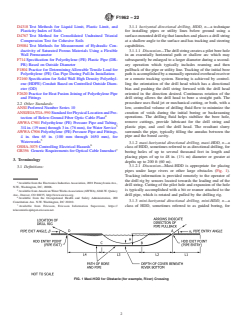
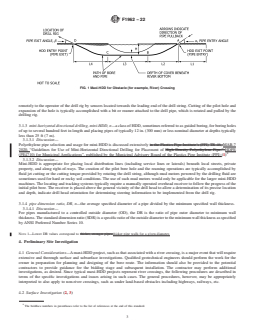
pipes under large rivers or other large obstacles (Fig. 1).
Tracking information is provided remotely to the operator of
the drill rig by sensors located towards the leading end of the
AvailablefromtheElectronicsIndustriesAssociation,2001PennsylvaniaAve.,
drill string. Cutting of the pilot hole and expansion of the hole
N.W., Washington, DC, 20006.
is typically accomplished with a bit or reamer attached to the
Available fromAmericanWaterWorksAssociation (AWWA), 6666W. Quincy
Ave., Denver, CO 80235, http://www.awwa.org.
drill pipe, which is rotated and pulled by the drilling rig.
Available from the Occupational Health and Safety Administration, 200
3.1.3 mini-horizontal directional drilling, mini-HDD, n—a
Constitution Ave. N.W. Washington, DC 20210.
Available from Ericsson, Ericsson Information Superstore, https:// class of HDD, sometimes referred to as guided boring, for
telecominfo.njdepot.ericsson.net.
FIG. 1 Maxi-HDD for Obstacle (for example, River) Crossing
F1962 − 22
boringholesofuptoseveralhundredfeetinlengthandplacing proposedcrossingsite.Horizontalandverticalreferencesmust
pipes of typically 12 in. (300 mm) or less nominal diameter at be established for referencing hydrographic and geotechnical
depths typically less than 25 ft (7 m).
data. The survey should typically include overbank profiles on
3.1.3.1 Discussion—Polyethylene pipe selection and usage
the anticipated path center-line, extending about 150 ft (75 m)
for mini-HDD is discussed extensively MAB-7 2020, “Guide-
landward of the bore entry point to the length of the (pre-
lines for Use of Mini-Horizontal Directional Drilling for
fabricated) pull section landward of the bore exit point. The
Placement of HDPE (PE4710) for Municipal Applications”,
survey information should be related to topographical features
publishedbytheMunicipalAdvisoryBoardofthePlasticsPipe
inthevicinityoftheproposedcrossing.Existingtopographical
Institute (PPI) (1)
informationmaybeavailablefromtheU.S.GeologicalSurvey,
3.1.3.2 Discussion—Mini-HDD is appropriate for placing
or Federal, state, or county publications.Aerial photographs or
local distribution lines (including service lines or laterals)
ordnance surveys may be useful, especially for crossing
beneathlocalstreets,privateproperty,andalongright-of-ways.
land-based obstacles in urban areas, since these may indicate
The creation of the pilot bore hole and the reaming operations
the presence of demolished buildings and the possibility of old
are typically accomplished by fluid jet cutting or the cutting
foundations, as well any filled areas (4). It is also necessary to
torque provided by rotating the drill string, although mud
check available utility records to help identify the precise
motors powered by the drilling fluid are sometimes used for
location of existing below-ground facilities in the vicinity,
hard or rocky soil conditions. The use of such mud motors
including electric power, natural gas, petroleum, water, sewer,
would only be applicable for the larger mini-HDD machines.
or telecommunications lines. The presence of existing
Thelocatingandtrackingsystemstypicallyrequireamanually
pipelines, support pilings, etc., containing significant steel
operated overhead receiver to follow the progress of the initial
mass should be noted since this may cause interference with
pilot bore. The receiver is placed above the general vicinity of
magnetically sensitive equipment guidance or location instru-
the drill head to allow a determination of its precise location
mentation.
and depth, indicate drill head orientation for determining
4.2.1.1 Drill Rig (Bore Entry) Side—The available area
steering information to be implemented from the drill rig.
requiredonthesideofthedrillrigmustbesufficientfortherig
3.1.4 pipe dimension ratio, DR, n—the average specified
itself and its ancillary equipment. In general, the size of the
diameter of a pipe divided by the minimum specified wall
requiredareaontherigsidewilldependuponthemagnitudeof
thickness.
the operation, including length of bore and diameter of pipe to
3.1.4.1 Discussion—For pipes manufactured to a controlled
be placed. Typically, a temporary workspace of approximately
outside diameter (OD), the DR is the ratio of pipe outer
150 ft (45 m) width by 250 ft (75 m) length will be sufficient.
diameter to minimum wall thickness. The standard dimension
These dimensions may vary from 100 by 150 ft (30 by 45 m)
ratio (SDR) is a specific ratio of the outside diameter to the
for shorter crossings of 1000 ft (300 m) or less, to 200 by 300
minimum wall thickness as specified by ANSI Preferred
ft (60 by 90 m) for medium or long crossings.
Number Series 10.
4.2.1.2 Water Supply—Water storage and facilities for
NOTE1—LowerDRvaluescorrespondtothickerpipewallsforagiven
mixing, storing, and pumping drilling fluid will require signifi-
diameter.
cantspace.Althoughitisstandardpracticetodrawfreshwater
4. Preliminary Site Investigation
found at the location for mixing the drilling fluid, alternate
water supplies may be required to obtain proper drilling fluid
4.1 General Considerations—Amaxi-HDD project, such as
characteristics. Hard or salty water is undesirable, although
that associated with a river crossing, is a major event that will
additives may be used to create the proper pH value. It may be
require extensive and thorough surface and subsurface inves-
necessary to provide access for trucks to transport water or to
tigations. Qualified geotechnical engineers should perform the
provide for the installation of a relatively long surface pipe or
work for the owner in preparation for planning and designing
of the bore route. The information should also be provided to hose connecting a remote hydrant.
the potential contractors to provide guidance for the bidding
4.2.1.3 Pipe (Bore Exit) Side—Assuming the pipe to be
stage and subsequent installation. The contractor may perform
placed is too large a diameter to be supplied on a reel (for
additional investigations, as desired. Since typical maxi-HDD
example, larger than 6 in. (150 mm)), sufficient space is
projectsrepresentrivercrossings,thefollowingproceduresare
requiredatthesideoppositethatofthedrillrig,wherethebore
described in terms of the specific investigations and issues
willexitandthepipebeinserted,toaccommodateacontinuous
arisinginsuchcases.Thegeneralprocedures,however,maybe
straightlengthofpre-fabricatedpipe.Thespaceforthestraight
appropriately interpreted to also apply to non-river crossings,
lengthwillbeginapproximately50to100ft(15to30m)from
such as under land-based obstacles including highways,
the anticipated bore exit and extend straight landward at a
railways, etc.
width of 35 to 50 ft (10 to 15 m), depending upon the pipe
4.2 Surface Investigation (2, 3) diameter. In the immediate vicinity of the bore exit (pipe
entry), an area of typically 50 ft (15 m) width by 100 ft (30 m)
4.2.1 Topographic Survey—A survey should be conducted
to accurately define the working areas described in 4.1 for the length is required; for relatively large diameter pipes (larger
than24in.(600mm),orincasesofdifficultsoilconditions,an
8 area of 100 ft (30 m) width by 150 ft (45 m) length should be
Theboldfacenumbersinparenthesesrefertothelistofreferencesattheendof
this standard. provided.
F1962 − 22
4.2.2 Hydrographic/Potamological Survey—For crossing beexamined.Theresultsofthisstudywillbeusedtodefinethe
significant waterways, a survey should be conducted to accu- initially recommended bore penetration profile path.
4.3.2 Test Borings (2, 3, 5)—Site-specific data must be
rately describe the bottom contours and river stability to
establish suitability for the design life of the pipeline. obtainedtofullycharacterizeandverifytheconditionsthrough
which the proposed bore path will be created. Refer to Guide
Typically, depths should be established along the anticipated
D420, Test Method D1586, Test Method D1587, Test Method
center-line, and approximately 200 ft (60 m) upstream and
D2113andPracticeD4220.Datacollectionshouldbeaimedat
downstream; closer readings may be required if it is necessary
identifying earth materials at the site and at exploring subsur-
to monitor future river activity. Consideration should be given
face stratification (including identification of the boundary
to future changes in river bank terrain. Washouts, bank
between rock and other strata, presence of cobbles or boulders
migrations, or scour can expose pipe.
and other anomalies such as old tree stumps and fill debris).
4.2.3 Drilling Fluid Disposal—The means for disposal of
The location, depth, and number of borings should be deter-
the drilling fluid wastes must be considered. The volume of
mined by the engineer based on the preliminary study, antici-
drilling fluid used will depend upon the soil characteristics but
patedfuturechangesinsiteconditions(rivermeanders,scours,
istypicallyontheorderof1to3timesthevolumeofremoved
etc.), and modifications of soil conditions during construction.
soil. Most drilling fluids use bentonite or polymer additives
These borings should be located at a sufficient lateral distance
which are not generally considered to be hazardous. However,
(to either side) from the proposed bore path to avoid boring
local regulations should be followed regarding disposal.
into the test hole, and the holes should be sealed with grouting
4.2.3.1 Drilling Fluid Recirculation —Occasionally,drilling
to avoid potential leakage paths for drilling fluid during the
fluid recirculation is used to reduce overall material and
actual installation. Following completion of the detailed route
disposal costs. If drilling fluid recirculation is contemplated, a
design (Section 7), additional test borings may be desirable at
means must be considered for transporting any fluid exhausted
critical points such as bends.
from the opposite (bore exit) side, during the pullback
NOTE 2—In environmentally and other sensitive areas, possible restric-
operation, to the rig side. This may be accomplished by truck,
tions may exist on the location or number of test borings.
barge, or a temporary recirculation pipe line on the bottom of
4.3.3 In addition to test borings, dynamic cone testing or
the waterway (for river-crossings). The recirculation line must
developing non-intrusive techniques such as ground penetrat-
be adequate to prevent accidental discharge into the waterway.
ing radar or sonar may be used to identify stratification and
4.3 Subsurface Investigation—The overall technical and
areaswithanomalies.Suchprobingtechniquesmaybeapplied
economic feasibility of the maxi-HDD process is highly
in the proximity of known conditions determined by a boring
dependent upon the properties of the soil formation through
to obtain proper calibration, and then extended towards un-
which the penetration will be accomplished. Thus, an accurate
testedareasatrelativelycloseintervalstoidentifyirregularities
and thorough geotechnical investigation must be performed by
between borings. If needed, additional borings may then be
a qualified engineer, including review of existing information
made at intermediate points of interest (4, 5).
and site specific studies for the proposed location. This
4.3.4 Soil Analysis (3, 6, 7)—The geotechnical study should
informationwillbeusedtoproducedesigndrawings(including
evaluate several parameters, including soil classifications,
final bore route, pipe design, and bore design), construction
(Refer to Test Methods D4318 and D422.) strength and
specifications, and permit applications as well as to provide
deformationproperties,(RefertoTestMethodsD1586,D2166,
information for the contractors upon which to select appropri-
D2435, D2850, D4186, and D4767.) and groundwater table
ate tools and methods for the actual construction. While the
behavior. (Refer to Test Method D5084.)Although some field
guidelines given in the following sections point out general
evaluation and in-situ testing should be included, the geotech-
procedures or types of information, or both, which could be
nicalinvestigationshouldemphasizelaboratorytestinginorder
developed, unforeseeable site-specific variables make the thor-
to obtain more accurate and meaningful quantitative results. If
oughness and accuracy of any site characterization study
rockisencountered,theboringsshouldpenetratesufficientlyto
directly dependent on the skill, experience, and inquisitiveness
verify whether or not it is bedrock. The relevant soil testing
oftheinvestigatingengineer.Therefore,theinvestigatorshould methods listed in Section 2 should be followed. In general, the
define the configuration, extent, and constituency of the inves- following specific data should be obtained from the borings:
tigation. Site characterization information must go beyond just 4.3.4.1 Standard classification of soils, (Refer to Test
defining soil conditions along the bore path to include a
Method D4318),
forecast of future conditions (that is, river meanders and
4.3.4.2 Gradation curves for granular soils, as described in
scours)andtoanticipatetheeffectofthemaxi-HDDprocesson Test Method D422,
site conditions.
4.3.4.3 Standardpenetrationtestvalues,asdescribedinTest
Method D1586,
4.3.1 Preliminary Study—The subsurface investigation
4.3.4.4 Coredsamplesofrockwithrockqualitydesignation
should begin with a review of existing data such as may be
(RQD) and percent recovery,
obtained from published soil reports (for example, Soil Con-
servation Service Report, U.S. Geological Survey, U.S. Army 4.3.4.5 Unconfined compressive strength, as described in
Test Method D2166,
Corps of Engineers reports, etc.) or records from previous
4.3.4.6 Moh’s hardness for rock samples,
construction projects. In particular, data from nearby pipe or
cable river-crossings, or bridge foundation construction should 4.3.4.7 Possible contamination (hazardous waste),
F1962 − 22
4.3.4.8 Groundwater location, type, and behavior, and conditions. The conditions under which “difficulties may
4.3.4.9 Electrical resistivity or mineralogical constituents. occur” may require modifications of routine procedures or
4.3.5 For river crossings, the results from the preliminary equipment, such as the use of special purpose drill heads or
study and site specific tests should be combined in a compre- optimized drilling fluids. Some cases will entail “substantial
hensive report describing the geotechnical subsurface condi- problems” and may not be economically feasible for direc-
tions beneath the river bottom plus the stream’s potential for tional drilling using present technology. The potential for
meandering and scouring. The results must then be considered problems to occur increases with the presence of gravels,
by the owner, the engineer, and potential contractors, with boulders, or cobbles or with transitions from non-lithified
regard to compatibility with the state-of-the-art of directional material into solid rock. In such cases, other drilling locations
drilling technology for cost-effectively completing the task. If orconstructionalternativesshouldbeconsideredunlessspecial
necessary, the crossing location may be altered to a more circumstances dictate the need for directional drilling at the
favorable crossing site. In this case, many of the surface and presentlocation,evenathighcostsassociatedwithspecialrock
subsurface investigations may have to be repeated for the new drilling techniques, etc.
proposed crossing location and bore path.
5. Safety and Environmental Considerations
4.3.6 Feasibility—Soil conditions are a major factor affect-
ing the feasibility and cost of using maxi-HDD in a given
5.1 General Considerations—Injurytopersonnelmayresult
geographic area. Table 1 indicates the suitability of horizontal
fromthemechanicalandhydraulicmachineoperationsdirectly
directional drilling as a function of the general characteristics
related to the drilling operation or from striking of electric
of the soil conditions in the area and depths of interest (4, 6).
power lines or buried pipelines. In addition, the scale of
The “generally suitable” category presumes knowledgeable,
maxi-HDD operations may involve additional equipment and
experienced contractors or personnel using appropriate equip-
accessories required for the lifting and handling of heavy drill
ment.Suchcontractorsareassumedtohaveaminimumofone
rods, drill heads, reamers, etc., as well as the product pipe or
year field experience and completed approximately 30 000 ft
conduit. Additional precautions relating to specific auxiliary
(10 km) of construction in related projects. The size and type
equipment must be followed, but is beyond the scope of this
machinesconsideredappropriateforparticularinstallationsare
standard.Non-essentialpersonnelandbystandersshouldnotbe
a function of bore length, final hole diameter, and soil
allowed in the immediate vicinity of the maxi-HDD equip-
conditions.Various type drill heads, mud motors, reamers, and
ment.Barriersandwarningsshouldbeplacedaminimumof30
drilling fluid capabilities are available for various ground
ft (10 m) from the edge of the equipment or associated
hardware. Safety precautions are to be followed by all person-
nel and at both ends of the bore path. Inadvertent contact with
TABLE 1 Soil Conditions and Suitability of Horizontal Directional
A
electric power, natural gas, or petroleum lines may result in
Drilling
Soil Conditions Generally Difficulties Substantial hazards to personnel or contamination. If possible, any in-
Suitable May Occur Problems
service pipeline in the proximity of the bore should be
Soft to very soft clays, silts, and X
de-activated during the construction. In general, the possibility
organic deposits
of injury or environmental impact caused by damage to
Medium to very stiff clays and silts X working or powered subsurface facilities or pipelines during
the initial boring or backreaming operations is reduced by
Hard clays and highly weathered X
appropriate adherence to regulations and damage prevention
shales
procedures, as outlined in Section 6.
Very loose to loose sands above and X
5.2 Work Clothing—Warning—Loose clothing or jewelry
below the water table (not more than
30 % gravel by weight)
shouldnotbewornsincetheymaysnagonmovingmechanical
parts. Safety glasses or OSHAapproved goggles, or both, and
Medium to dense sands above or X
OSHA approved head gear should be worn at all times.
below the water table (not more than
30 % gravel by weight)
Protective work shoes and gloves must be worn by all
personnel.
Very loose to dense gravelly sand, X
(30 % to 50 % gravel by weight)
5.3 Machine Safety Practices—Contractors must comply
with all applicable OSHA, state, and local regulations, and
Very loose to dense gravelly sand X
(50 % to 85 % gravel by weight) accepted industry practices.All personnel in the vicinity of the
drill rig or at the opposite end of the bore must be properly
Very loose to very dense gravel X
trainedandeducatedregardingthepotentialhazardsassociated
Soils with significant cobbles, X
with the maxi-HDD equipment. For electrical hazards, see
boulders, and obstructions
OSHA 3075. Personnel must be knowledgeable of safe oper-
ating procedures, safety equipment, and proper precautions.
Weathered rocks, marls, chalks, and X
firmly cemented soils
Courses and seminars are available in the industry, including
training provided by the equipment suppliers.
Slightly weathered to unweathered X
5.3.1 The operation of the drill rig requires rotation and
rocks
A advancement or retraction of the drill rods. Drill rig operation
For additional information, see Ref. (6).
istypicallyaccomplishedusingchaindrives,gearsystems,and
F1962 − 22
vises which may potentially lead to personal injury due to the unless it becomes mixed with toxic pollutants. The waste
moving mechanical components. All safety shields or guards material is usually considered as typical excavation spoils and
must be properly mounted. The equipment must be checked at can be disposed or by means similar to other spoils. If other
the beginning of each work day to verify proper operation. additives are of concern or hazardous material disposal is
required, it may be necessary to de-water the spoils, transport
5.3.2 HydraulicFluid—Thehydraulicoillinespoweringthe
drill rig operate under pressures of several thousand psi the solids to an appropriate disposal site, and treat the water to
meet disposal requirements.
(hundredsofbars).Thehosesandconnectorsmustbeproperly
maintained to avoid leaks. 5.4.2 The utility access pits which may be present at both
ends of the bore are convenient receptacles for collecting used
5.3.2.1 Warning—If a leak is suspected, it should be
drilling fluid. If not present for utility access, small pits should
checked by using a piece of cardboard or other object, but not
be provided at both ends to serve as such receptacles. Depend-
hands or any other part of the body. The high pressure
ing upon soil permeability, the pits may be lined with an
hydraulic fluid can penetrate the skin, burn, or cause blood
appropriate material or membrane. The pits should be emptied
poisoning. Before disconnecting any hydraulic lines, the sys-
as necessary. Some maxi-HDD systems use drilling fluid
tem pressure should be relieved.
recirculating systems to reduce the volume of spoils. If the
5.3.3 Drilling Fluid—Drilling fluid pressures will vary de-
geotechnical investigation revealed the existence of soil con-
pending upon the equipment design and operator preference;
ditions conductive to fluid migration, such as through pre-
pressures of several thousand psi (hundreds of bars) are
fractures in surrounding clay or soil mass permeability, this
possible. The hoses and connections must be properly main-
condition must be anticipated and accounted for in the drilling
tained to avoid leaks.
operation.
5.3.3.1 Warning—Suspected leaks should be checked by
using a piece of cardboard or other object. Avoid the use of
6. Regulations and Damage Prevention
hands or any other part of the body to check for a leak. Before
6.1 General Considerations—The owner of the proposed
individual drill rods are inserted or removed from the drill
pipeline should obtain any required drilling permits and is
string, it must be verified that the drilling fluid pressure has
responsible for obtaining approvals from the Federal, state, or
beenshutoffandallowedtodecrease;otherwise,highpressure
localjurisdictionsorotheragenciesthatmaybeaffectedbythe
fluid will squirt from the joint and possibly cause injury to
work. The preliminary investigations (Section 4) should iden-
personnel. The drilling fluid pressure gage must be checked to
tify appropriate site locations and paths, including safe sepa-
verify the pressure has been relieved before disconnecting any
rations from other facilities such as electric power, natural gas,
rods.
orpetroleumlines.Iftheconstraintsforaparticularmaxi-HDD
NOTE 3—If the pressure does not decrease in a short interval following
bore are such as to be in the vicinity of known facilities, the
pressure shut off, the fluid jet openings at the drill head may be clogged.
affected owners must be contacted and strict procedures for
Special care must then be made when disconnecting the rod. It may be
location and marking followed. If a maxi-HDD bore intercon-
necessarytoretractthedrillstringorexposethedrillheadtoclearthejets
nects points under the jurisdiction of several states or govern-
before continuing the operation. To avoid injury from the drill head and
drilling fluid, all personnel should maintain a safe distance from the exit
ing bodies, then the regulations of all parties must be
pointoftheboreasthedrillheadsurfaces.Thepressureshouldbeshutoff
considered, including relevant permits. Special restrictions
as soon as the drill head exits.
may exist, including restoration regulations, in environmen-
5.4 Construction Effects on Site—It is assumed that the
tally sensitive habitat areas.
preliminary site investigations included analyses to verify the
6.2 Environmental, Health, and Safety Plan—When
stability of embankments, roads, or other major features to be
required, each contractor that will work on the project must
traversed. It is necessary to ensure that the maxi-HDD opera-
submit an environmental, health, and safety plan. Items to
tion will not negatively impact the site upon completion. In
consider are the responsibilities of the plan, reporting, em-
many cases, it will be appropriate to use grouting to seal the
ployee training, MSDS sheets for materials being used, emer-
final bore path hole or the end portions of the hole following
gency telephone numbers for police, fire department, and
the installation of the pipe to prevent future flow or environ-
medical assistance, fire prevention, sanitation, and industrial
mental contamination. Particularly sensitive areas include
hygiene.
statutorily designated areas, such as wetlands, natural and
6.3 Environmental and Archaeological Impact Study—Most
scenic waterways, or contaminated or waste disposal sites. If
projects using maxi-HDD will require procurement of various
the bore will pass through, or in close proximity to, a
environmental permits. When an environmental permitting
contaminated area, special spoils monitoring and disposal
plan must be prepared, it should include a list of required
procedures must be followed, consistent with applicable
permits (for example, USAE, USEPA), the time needed to
Federal, state, or local regulations.
prepare permits, and an estimated date of issuance. Items to
5.4.1 Drilling Fluid—The most common drilling fluid addi-
consider are solid and hazardous materials and waste
tive is bentonite, a naturally occurring clay. When added to
management, wetlands, burial grounds, land use, air pollution,
water, the resulting fluid provides desired properties including
noise, water supply and discharge, traffic control and river and
viscosity, low density, and lubricity. The bentonite material
railroad transportation.
usedshouldbeNationalSanitationFoundation(NSF)certified.
Disposal should be in accordance with local laws and regula- 6.4 Waterways (see ANSI/EIA/TIA-590)—The U.S. Army
tions. The bentonite-water slurry is not a hazardous material Corps of Engineers (USAE) regulates activities involving
F1962 − 22
interstatebodiesofwater,includingmarshesandtributaries,as Thisappliestobendsinhorizontal(plan)orvertical(profile)
wellasintrastatewaterswhichcouldaffectinterstateorforeign planes.
commerce. The organization is responsible for work affecting
7.3 The proposed path should avoid unnecessary bends.
such waterways, including to the headwaters of freshwater
Such trajectories may be difficult to follow and may lead to
streams, wetlands, swamps and lakes. The Regional District
oversteering and excessive bends, resulting in increased
Engineer of the USAE will advise applicants of the types of
stresses in the drill rods and greater required pulling forces
permitsrequiredforsuchproposedprojects.Inaddition,astate
duringtheinstallationofthepipe.Thelocalradiusofcurvature
orlocal,orboth,agencyenvironmentalreviewandpermitmay
of the path at any point may be estimated by:
be required.
∆S
R 5 (2)
6.5 Railroad Crossings (see ANSI/EIA/TIA-590)—The
∆φ
chief engineer of the railroad should be consulted for the
where:
approvedmethodsof crossing the railroad line. For spurtracks
R = local radius of curvature along path segment, ft (m),
or sidings, the tract owner should be consulted. Railroads
∆S = distance along path, ft (m), and
normally require cased pipes at crossings to prevent track
∆φ = angular change in direction, rad.
washouts or damage in the event of pipeline rupture. (At the
NOTE4—Theangleinradiansisequaltotheangleindegrees×0.0175.
time of writing of this standard, an American Railway Engi-
(One radian equals 57.3°.)
neeringAssociation (AREA) committee is studying the use of
Thus, if ∆S is selected to be equal to 30 ft (10 m) (for
HDD for uncased and cased crossing of railroads for both
example, one rod length for some maxi-HDD machines) a
plastic and steel gas pipelines.)
change of 0.1 rad (6°) corresponds to a radius of curvature of
300 ft (100 m).
7. Bore Path Layout and Design
7.4 BorePathsProfile(VerticalPlane)Trajectory (2, 3)—A
7.1 General Considerations—For maxi-HDD projects, such
typical obstacle crossing, such as that represented by a river is
as river crossings, the bore path should be designed and
illustrated in Fig. 1.
specified by the engineer representing the owner prior to the
7.4.1 The following parameters must be specified in defin-
contractorbiddingprocess.Baseduponthepreliminarysurface
ing the bore path:
andsubsurfaceinvestigations,thepathwillbeselectedtoplace
7.4.1.1 Bore entry (pipe exit) point,
the pipe within stable ground and isolated from river activities
7.4.1.2 Bore exit (pipe entry) point,
forthedesignlifeoftheutilityline.Thegroundthroughwhich
7.4.1.3 Bore entry (pipe exit) angle,
the path will traverse must be compatible with maxi-HDD
7.4.1.4 Bore exit (pipe entry) angle,
technology.Ingeneral,formaxi-HDDprojects,thedesignpath
7.4.1.5 Depth of path, (for example, depth of cover of pipe
willliewithinaverticalplane.Ifnecessary,lateralcurvatureis
beneath river bottom), and
possible, consistent with the capabilities of the equipment and
7.4.1.6 Path curvatures.
the product pipe. The path should be clearly designated in an
7.4.2 Bore Entry (Pipe Exit)—The bore entry point must be
integrated report summarizing the results of the surface and
accurately specified consistent with the pipe route, equipment
subsurface investigations, and should be used for pricing,
requirements, and preliminary topographical investigations.
planning, and executing the operation.
Bore entry angles should be in the range of 8 to 20° (0.15 to
7.2 Steering and Drill Rod Constraints—The planned path
0.35rad)fromthegroundsurface,preferably12to15°(0.20to
mustbeconsistentwiththesteeringcapabilityofthedrillstring
0.25rad)fromthegroundsurface.Theseanglesarecompatible
and the allowable radius of curvature of the steel drill rods
with typical equipment capabilities.
baseduponthecorrespondingbendingstressesinthesteelrods
7.4.3 Bore Exit (Pipe Entry)—The bore exit point must also
and joints. Although some soil conditions will inhibit sharp
be accurately specified consistent with the pipe length and
steering maneuvers, path limitations will often be based upon
topographical investigations. Bore exit angles should be rela-
fatiguestrengthconsiderationsoftherods.Agivenrodmaybe
tively shallow, preferably less than 10° (0.15 rad). A shallow
able to withstand a single bend cycle corresponding to a
angle will facilitate the insertion of the pipe into the bore hole
relatively sharp radius of curvature, but the rotation of the rod
while maintaining the minimum radius of curvature require-
during the boring operation results in flexural cycles which
ments. Relatively steep angles will require greater elevation of
may eventually cause cumulative fatigue failure. The diameter
the pipe to maintain the required bend radii.
of the drill rod is an important parameter affecting its stiffness,
7.4.4 Path Profile—The proposed path should optimally lay
steering capability, and the allowable bend radii. A conserva-
withinaverticalplaneincludingtheboreentryandexitpoints.
tive industry guideline indicates the minimum bend radius
The arcs of the bore path and straight sections (that is, after
should be approximately:
achievingdesireddepth)mustbedefined,includingtheradiiof
R 51200 D (1)
~ ! curvature and approximate points of tangency of curved and
rod min rod
straight segments. The curvatures must be compatible with
where:
both the steel drill rods (Eq 1) and the PE pipe or conduit
(R ) = medium recommended bend radius of drill rod,
rod min
(Section 8). It should be noted that even larger bend radii
in. (mm), and
(lower curvatures) will further reduce lateral flexural bending
D = nominal diameter of drill rod, in. (mm).
rod
loads on the pipe and drill rods as they traverse the route,
F1962 − 22
thereby helping avoid additional increases in tensile loads diameter pipe of continuous length may be provided on reels.
associatedwiththeirstiffnesseffects.Typically,thepathshould Table X1.1 gives modulus and strength values for typical
ensure a minimum depth of cover of 15 ft (5 m) beneath the pressure-rated HDPE and MDPE resins.
river bottom as projected over the design life of the pipe line,
8.1.3 Cable Conduit Applications —For cable conduit
including allowance for scouring (3, 5). This will overcome
applications,includingelectricpowerandtelecommunications,
buoyancy effects and help overcome the tendency for the drill
small diameter pipe may be supplied on a continuous reel
head to rise towards the free surface, thereby complicating the
including internal pull line or the cable itself, as pre-installed
steering operation.
by the manufacturer. In addition, the pipe may be provided
withtheinteriorsurfacepre-lubricated.Suchfeatureswillbein
NOTE 5—The Directional Crossing Contractors Associations (DCCA)
accordance with that specified by the owner or engineer.
(8) recommends a minimum depth of 20 ft beneath the river bottom.
Requirements for telecommunications applications, including
7.4.4.1 Average Radius of Curvature —The average radius
HDPE pipe with various internal surface profiles, including
of curvature for a path segment (that is,A-B or C-D in Fig. 1)
smoothwall or ribbed are specified in GR356.
reaching to or from a depth required to pass beneath an
obstacle, may be estimated from the bore exit or entry angle,
8.2 Pipe Loading:
respectively, and the depth of the bore:
8.2.1 Operational and Installation Loads—The pipe will be
subject to loads during its long-term operation and during the
2H
R 5 (3)
avg 2 installation process. It is the responsibility of the owner (or the
θ
owner’s contractor or engineer) to determine the design and
where:
selection of the pipe to serve the function intended and
R = average radius of curvature along path segment, ft
avg withstand the operational stresses at the directionally drilled
(m),
section as well as at other sections along the pipe line. This
θ = bore exit or entry angle to surface, rad, and
practice deals primarily with the loads imposed during the
H = depth of bore beneath surface, ft (m).
directional drilling process and earth and groundwater loads
The corresponding horizontal distance required to achieve during operation (post-installation).
the depth or rise to the surface may be estimated by:
8.2.2 Internal (Operational) Pressure Loads—It is the re-
sponsibilityoftheowner(orowner’scontractororengineer)to
2H
L 5 (4)
determinethenominaldiameterandwallthicknessappropriate
θ
for the intended application. For example, if the pipe will be
where:
usedforthepressurizedflowofliquidsorgases,itisnecessary
L = horizontal transition distance, ft (m).
to determine the nominal diameter based on flow capacity
requirements and the minimum wall thickness (or DR) to
It must be noted that departures from a uniform radius will
withstand the corresponding circumferential stresses on a long
result in locally smaller radii.
termbasis.SpecificationD2513,D3035,F714,F2160,AWWA
7.4.4.2 The resultant path will determine the stresses to be
C901, and AWWA C906 may be used to determine an initial
exerted upon the pipe during the installation and service life.
estimate of the corresponding maximum dimension ratio (DR)
The product pipe design must therefore be analyzed based
for PE pipe.
upon the final selected path, following the pipe design and
8.2.3 External (Operational) Hydraulic and Earth Loads—
selection procedures given in Section 8.
The pipe will be subjected to hydrostatic external pressure due
8. Pipe Design and Selection Considerations
to the height of water or drilling fluid (or slurry) above the
maximumdepthofplacementrelativetotheentryorexitpoint,
8.1 General Guidelines:
8.1.1 Maxi-HDD applications typically require detailed and earth loads and live loads due to load transfer through the
deformation of the soil around the borehole (9). If borehole
analysis of the pipe or conduit in relation to its intended
application. Due to the large, anticipated pulling loads and deformation is minimal (such as in rock) or does not deform
the pipe, the only loading applied to the pipe is the hydrostatic
potentially high external pressure, a careful analysis of the PE
pipe must be performed, subject to the route geometry, to external pressure. When earth load does reach the pipe, load
verifyordetermineanappropriateDR(orpipewallthickness). reductions from the geostatic stress (arching) may be antici-
The analysis should consider both the installation forces pated. The reductions may be s
...
This document is not an ASTM standard and is intended only to provide the user of an ASTM standard an indication of what changes have been made to the previous version. Because
it may not be technically possible to adequately depict all changes accurately, ASTM recommends that users consult prior editions as appropriate. In all cases only the current version
of the standard as published by ASTM is to be considered the official document.
Designation: F1962 − 20 F1962 − 22
Standard Guide for
Use of Maxi-Horizontal Directional Drilling for Placement of
Polyethylene Pipe or Conduit Under Obstacles, Including
River Crossings
This standard is issued under the fixed designation F1962; the number immediately following the designation indicates the year of
original adoption or, in the case of revision, the year of last revision. A number in parentheses indicates the year of last reapproval. A
superscript epsilon (´) indicates an editorial change since the last revision or reapproval.
1. Scope*
1.1 This guide describes the design, selection considerations, and installation procedures for the placement of polyethylene (PE)
pipe or conduit below ground using maxi-horizontal directional drilling equipment. The pipes or conduits may be used for various
applications including telecommunications, electric power, natural gas, petroleum, water lines, sewer lines, or other fluid transport.
1.2 Horizontal directional drilling is a form of trenchless technology. The equipment and procedures are intended to minimize
surface damage, restoration requirements, and disruption of vehicular or maritime traffic with little or no interruption of other
existing lines or services. Mini-horizontal directional drilling (min-HDD)(mini-HDD) is typically used for the relatively shorter
distances and smaller diameter pipes associated with local utility distribution lines. In comparison, maxi-horizontal directional
drilling (maxi-HDD) is typically used for longer distances and larger diameter pipes common in major river crossings. Applications
that are intermediate to the mini-HDD or maxi-HDD categories may utilize appropriate “medi” equipment of intermediate size and
capabilities. In such cases, the design guidelines and installation practices would follow those described for the mini- or maxi-HDD
categories, as judged to be most suitable for each situation.
1.3 The values stated in inch-pound units are to be regarded as standard. The values given in parentheses are mathematical
conversions to SI units that are provided for information only and are not considered standard.
1.4 This standard does not purport to address all of the safety concerns, if any, associated with its use. It is the responsibility
of the user of this standard to establish appropriate safety, health, and environmental practices and determine the applicability of
regulatory limitations prior to use. Section 6 contains general safety information related to the use of maxi-horizontal directional
drilling equipment.
1.5 This international standard was developed in accordance with internationally recognized principles on standardization
established in the Decision on Principles for the Development of International Standards, Guides and Recommendations issued
by the World Trade Organization Technical Barriers to Trade (TBT) Committee.
2. Referenced Documents
2.1 ASTM Standards:
D420 Guide for Site Characterization for Engineering Design and Construction Purposes
This guide is under the jurisdiction of ASTM Committee F17 on Plastic Piping Systems and is the direct responsibility of Subcommittee F17.67 on Trenchless Plastic
Pipeline Technology.
Current edition approved Nov. 1, 2020Nov. 15, 2022. Published November 2020December 2022. Last previous edition approved in 20112020 as F1962–11 which was
withdrawn July 2020 and reinstated in November 2020. DOI: 10.1520/F1962-11.–20. DOI: 10.1520/F1962-22.
For referenced ASTM standards, visit the ASTM website, www.astm.org, or contact ASTM Customer Service at service@astm.org. For Annual Book of ASTM Standards
volume information, refer to the standard’s Document Summary page on the ASTM website.
*A Summary of Changes section appears at the end of this standard
Copyright © ASTM International, 100 Barr Harbor Drive, PO Box C700, West Conshohocken, PA 19428-2959. United States
F1962 − 22
D422 Test Method for Particle-Size Analysis of Soils (Withdrawn 2016)
D1586 Test Method for Standard Penetration Test (SPT) and Split-Barrel Sampling of Soils
D1587 Practice for Thin-Walled Tube Sampling of Fine-Grained Soils for Geotechnical Purposes
D2113 Practice for Rock Core Drilling and Sampling of Rock for Site Exploration
D2166 Test Method for Unconfined Compressive Strength of Cohesive Soil
D2435 Test Methods for One-Dimensional Consolidation Properties of Soils Using Incremental Loading
D2447 Specification for Polyethylene (PE) Plastic Pipe, Schedules 40 and 80, Based on Outside Diameter (Withdrawn 2010)
D2513 Specification for Polyethylene (PE) Gas Pressure Pipe, Tubing, and Fittings
D2850 Test Method for Unconsolidated-Undrained Triaxial Compression Test on Cohesive Soils
D3035 Specification for Polyethylene (PE) Plastic Pipe (DR-PR) Based on Controlled Outside Diameter
D4186 Test Method for One-Dimensional Consolidation Properties of Saturated Cohesive Soils Using Controlled-Strain
Loading
D4220 Practices for Preserving and Transporting Soil Samples
D4318 Test Methods for Liquid Limit, Plastic Limit, and Plasticity Index of Soils
D4767 Test Method for Consolidated Undrained Triaxial Compression Test for Cohesive Soils
D5084 Test Methods for Measurement of Hydraulic Conductivity of Saturated Porous Materials Using a Flexible Wall
Permeameter
F714 Specification for Polyethylene (PE) Plastic Pipe (DR-PR) Based on Outside Diameter
F1804 Practice for Determining Allowable Tensile Load for Polyethylene (PE) Gas Pipe During Pull-In Installation
F2160 Specification for Solid Wall High Density Polyethylene (HDPE) Conduit Based on Controlled Outside Diameter (OD)
F2620 Practice for Heat Fusion Joining of Polyethylene Pipe and Fittings
2.2 Other Standards:
ANSI Preferred Number Series 10
ANSI/EIA/TIA-590 Standard for Physical Location and Protection of Below-Ground Fiber Optic Cable Plant
AWWA C901 Polyethylene (PE) Pressure Pipe and Tubing, 3/4 in. (19 mm) through 3 in. (76 mm), for Water Service
AWWA C906 Polyethylene (PE) Pressure Pipe and Fittings, 4 in. thru 65 in. (100 mm through 1650 mm), for Waterworks
OSHA-3075 Controlling Electrical Hazards
TR-NWT-000356GR356 Generic Requirements for Optical Cable Innerduct
3. Terminology
3.1 Definitions:
3.1.1 horizontal directional drilling, HDD, n—a technique for installing pipes or utility lines below ground using a
surface-mounted drill rig that launches and places a drill string at a shallow angle to the surface and has tracking and steering
capabilities.
3.1.1.1 Discussion—
The drill string creates a pilot bore hole in an essentially horizontal path or shallow arc which may subsequently be enlarged to
a larger diameter during a secondary operation which typically includes reaming and then pullback of the pipe or utility line.
Tracking of the initial bore path is accomplished by a manually operated overhead receiver or a remote tracking system. Steering
is achieved by controlling the orientation of the drill head which has a directional bias and pushing the drill string forward with
the drill head oriented in the direction desired. Continuous rotation of the drill string allows the drill head to bore a straight path.
The procedure uses fluid jet or mechanical cutting, or both, with a low, controlled volume of drilling fluid flow to minimize the
creation of voids during the initial boring or backreaming operations. The drilling fluid helps stabilize the bore hole, remove
cuttings, provide lubricant for the drill string and plastic pipe, and cool the drill head. The resultant slurry surrounds the pipe,
typically filling the annulus between the pipe and the bored cavity.
3.1.2 maxi-horizontal directional drilling, maxi-HDD, n—a class of HDD, sometimes referred to as directional drilling, for boring
holes of up to several thousand feet in length and placing pipes of up to 48 in. (1 ⁄4 m) diameter or greater at depths up to 200
ft (60 m).
3.1.2.1 Discussion—
Maxi-HDD is appropriate for placing pipes under large rivers or other large obstacles (Fig. 1). Tracking information is provided
The last approved version of this historical standard is referenced on www.astm.org.
Available from the Electronics Industries Association, 2001 Pennsylvania Ave., N.W., Washington, DC, 20006.
Available from American Water Works Association (AWWA), 6666 W. Quincy Ave., Denver, CO 80235, http://www.awwa.org.
Available from the Occupational Health and Safety Administration, 200 Constitution Ave. N.W. Washington, DC 20210.
Available from Bellcore, 60 New England Ave., Room 1B252, Piscataway, NJ, 08854-4196.Ericsson, Ericsson Information Superstore, https://
telecominfo.njdepot.ericsson.net.
F1962 − 22
FIG. 1 Maxi-HDD for Obstacle (for example, River) Crossing
remotely to the operator of the drill rig by sensors located towards the leading end of the drill string. Cutting of the pilot hole and
expansion of the hole is typically accomplished with a bit or reamer attached to the drill pipe, which is rotated and pulled by the
drilling rig.
3.1.3 mini-horizontal directional drilling, mini-HDD, n—a class of HDD, sometimes referred to as guided boring, for boring holes
of up to several hundred feet in length and placing pipes of typically 12 in. (300 mm) or less nominal diameter at depths typically
less than 25 ft (7 m).
3.1.3.1 Discussion—
Polyethylene pipe selection and usage for mini-HDD is discussed extensively in the Plastics Pipe Institute’s (PPI) TR-46, MAB-7
2020, “Guidelines for Use of Mini-Horizontal Directional Drilling for Placement of High Density Polyethylene Pipe.” HDPE
(PE4710) for Municipal Applications”, published by the Municipal Advisory Board of the Plastics Pipe Institute (PPI) (1)
3.1.3.2 Discussion—
Mini-HDD is appropriate for placing local distribution lines (including service lines or laterals) beneath local streets, private
property, and along right-of-ways. The creation of the pilot bore hole and the reaming operations are typically accomplished by
fluid jet cutting or the cutting torque provided by rotating the drill string, although mud motors powered by the drilling fluid are
sometimes used for hard or rocky soil conditions. The use of such mud motors would only be applicable for the larger mini-HDD
machines. The locating and tracking systems typically require a manually operated overhead receiver to follow the progress of the
initial pilot bore. The receiver is placed above the general vicinity of the drill head to allow a determination of its precise location
and depth, indicate drill head orientation for determining steering information to be implemented from the drill rig.
3.1.4 pipe dimension ratio, DR, n—the average specified diameter of a pipe divided by the minimum specified wall thickness.
3.1.4.1 Discussion—
For pipes manufactured to a controlled outside diameter (OD), the DR is the ratio of pipe outer diameter to minimum wall
thickness. The standard dimension ratio (SDR) is a specific ratio of the outside diameter to the minimum wall thickness as specified
by ANSI Preferred Number Series 10.
NOTE 1—Lower DR values correspond to thicker, stronger pipes.thicker pipe walls for a given diameter.
4. Preliminary Site Investigation
4.1 General Considerations—A maxi-HDD project, such as that associated with a river crossing, is a major event that will require
extensive and thorough surface and subsurface investigations. Qualified geotechnical engineers should perform the work for the
owner in preparation for planning and designing of the bore route. The information should also be provided to the potential
contractors to provide guidance for the bidding stage and subsequent installation. The contractor may perform additional
investigations, as desired. Since typical maxi-HDD projects represent river crossings, the following procedures are described in
terms of the specific investigations and issues arising in such cases. The general procedures, however, may be appropriately
interpreted to also apply to non-river crossings, such as under land-based obstacles including highways, railways, etc.
4.2 Surface Investigation (2, 3)
The boldface numbers in parentheses refer to the list of references at the end of this standard.
F1962 − 22
4.2.1 Topographic Survey—A survey should be conducted to accurately define the working areas described in 4.1 for the proposed
crossing site. Horizontal and vertical references must be established for referencing hydrographic and geotechnical data. The
survey should typically include overbank profiles on the anticipated path center-line, extending about 150 ft (75 m) landward of
the bore entry point to the length of the (pre-fabricated) pull section landward of the bore exit point. The survey information should
be related to topographical features in the vicinity of the proposed crossing. Existing topographical information may be available
from the U.S. Geological Survey, or Federal, state, or county publications. Aerial photographs or ordnance surveys may be useful,
especially for crossing land-based obstacles in urban areas, since these may indicate the presence of demolished buildings and the
possibility of old foundations, as well any filled areas (4). It is also necessary to check available utility records to help identify the
precise location of existing below-ground facilities in the vicinity, including electric power, natural gas, petroleum, water, sewer,
or telecommunications lines. The presence of existing pipelines, support pilings, etc., containing significant steel mass should be
noted since this may cause interference with magnetically sensitive equipment guidance or location instrumentation.
4.2.1.1 Drill Rig (Bore Entry) Side—The available area required on the side of the drill rig must be sufficient for the rig itself and
its ancillary equipment. In general, the size of the required area on the rig side will depend upon the magnitude of the operation,
including length of bore and diameter of pipe to be placed. Typically, a temporary workspace of approximately 150 ft (45 m) width
by 250 ft (75 m) length will be sufficient. These dimensions may vary from 100 by 150 ft (30 by 45 m) for shorter crossings of
1000 ft (300 m) or less, to 200 by 300 ft (60 by 90 m) for medium or long crossings.
4.2.1.2 Water Supply—Water storage and facilities for mixing, storing, and pumping drilling fluid will require significant space.
Although it is standard practice to draw fresh water found at the location for mixing the drilling fluid, alternate water supplies may
be required to obtain proper drilling fluid characteristics. Hard or salty water is undesirable, although additives may be used to
create the proper pH value. It may be necessary to provide access for trucks to transport water or to provide for the installation
of a relatively long surface pipe or hose connecting a remote hydrant.
4.2.1.3 Pipe (Bore Exit) Side—Assuming the pipe to be placed is too large a diameter to be supplied on a reel (for example, larger
than 6 in. (150 mm)), sufficient space is required at the side opposite that of the drill rig, where the bore will exit and the pipe be
inserted, to accommodate a continuous straight length of pre-fabricated pipe. The space for the straight length will begin
approximately 50 to 100 ft (15 to 30 m) from the anticipated bore exit and extend straight landward at a width of 35 to 50 ft (10
to 15 m), depending upon the pipe diameter. In the immediate vicinity of the bore exit (pipe entry), an area of typically 50 ft (15
m) width by 100 ft (30 m) length is required; for relatively large diameter pipes (larger than 24 in. (600 mm), or in cases of difficult
soil conditions, an area of 100 ft (30 m) width by 150 ft (45 m) length should be provided.
4.2.2 Hydrographic/Potamological Survey—For crossing significant waterways, a survey should be conducted to accurately
describe the bottom contours and river stability to establish suitability for the design life of the pipeline. Typically, depths should
be established along the anticipated center-line, and approximately 200 ft (60 m) upstream and downstream; closer readings may
be required if it is necessary to monitor future river activity. Consideration should be given to future changes in river bank terrain.
Washouts, bank migrations, or scour can expose pipe.
4.2.3 Drilling Fluid Disposal—The means for disposal of the drilling fluid wastes must be considered. The volume of drilling fluid
used will depend upon the soil characteristics but is typically on the order of 1 to 3 times the volume of removed soil. Most drilling
fluids use bentonite or polymer additives which are not generally considered to be hazardous. However, local regulations should
be followed regarding disposal.
4.2.3.1 Drilling Fluid Recirculation —Occasionally, drilling fluid recirculation is used to reduce overall material and disposal
costs. If drilling fluid recirculation is contemplated, a means must be considered for transporting any fluid exhausted from the
opposite (bore exit) side, during the pullback operation, to the rig side. This may be accomplished by truck, barge, or a temporary
recirculation pipe line on the bottom of the waterway (for river-crossings). The recirculation line must be adequate to prevent
accidental discharge into the waterway.
4.3 Subsurface Investigation—The overall technical and economic feasibility of the maxi-HDD process is highly dependent upon
the properties of the soil formation through which the penetration will be accomplished. Thus, an accurate and thorough
geotechnical investigation must be performed by a qualified engineer, including review of existing information and site specific
studies for the proposed location. This information will be used to produce design drawings (including final bore route, pipe design,
and bore design), construction specifications, and permit applications as well as to provide information for the contractors upon
which to select appropriate tools and methods for the actual construction. While the guidelines given in the following sections point
out general procedures or types of information, or both, which could be developed, unforeseeable site-specific variables make the
thoroughness and accuracy of any site characterization study directly dependent on the skill, experience, and inquisitiveness of the
F1962 − 22
investigating engineer. Therefore, the investigator should define the configuration, extent, and constituency of the investigation.
Site characterization information must go beyond just defining soil conditions along the bore path to include a forecast of future
conditions (that is, river meanders and scours) and to anticipate the affecteffect of the maxi-HDD process on site conditions.
4.3.1 Preliminary Study—The subsurface investigation should begin with a review of existing data such as may be obtained from
published soil reports (for example, Soil Conservation Service Report, U.S. Geological Survey, U.S. Army Corps of Engineers
reports, etc.) or records from previous construction projects. In particular, data from nearby pipe or cable river-crossings, or bridge
foundation construction should be examined. The results of this study will be used to define the initially recommended bore
penetration profile path.
4.3.2 Test Borings (2, 3, 5)—Site-specific data must be obtained to fully characterize and verify the conditions through which the
proposed bore path will be created. Refer to Guide D420, Test Method D1586, Test Method D1587, Test Method D2113 and
Practice D4220. Data collection should be aimed at identifying earth materials at the site and at exploring subsurface stratification
(including identification of the boundary between rock and other strata, presence of cobbles or boulders and other anomalies such
as old tree stumps and fill debris). The location, depth, and number of borings should be determined by the engineer based on the
preliminary study, anticipated future changes in site conditions (river meanders, scours, etc.), and modifications of soil conditions
during construction. These borings should be located at a sufficient lateral distance (to either side) from the proposed bore path
to avoid boring into the test hole, and the holes should be sealed with grouting to avoid potential leakage paths for drilling fluid
during the actual installation. Following completion of the detailed route design (Section 7), additional test borings may be
desirable at critical points such as bends.
NOTE 2—In environmentally and other sensitive areas, possible restrictions may exist on the location or number of test borings.
4.3.3 In addition to test borings, dynamic cone testing or developing non-intrusive techniques such as ground penetrating radar
or sonar may be used to identify stratification and areas with anomalies. Such probing techniques may be applied in the proximity
of known conditions determined by a boring to obtain proper calibration, and then extended towards untested areas at relatively
close intervals to identify irregularities between borings. If needed, additional borings may then be made at intermediate points
of interest (4, 5).
4.3.4 Soil Analysis (3, 6, 7)—The geotechnical study should evaluate several parameters, including soil classifications, (Refer to
Test Methods D4318 and D422.) strength and deformation properties, (Refer to Test Methods D1586, D2166, D2435, D2850,
D4186, and D4767.) and groundwater table behavior. (Refer to Test Method D5084.) Although some field evaluation and in-situ
testing should be included, the geotechnical investigation should emphasize laboratory testing in order to obtain more accurate and
meaningful quantitative results. If rock is encountered, the borings should penetrate sufficiently to verify whether or not it is
bedrock. The relevant soil testing methods listed in Section 2 should be followed. In general, the following specific data should
be obtained from the borings:
4.3.4.1 Standard classification of soils, (Refer to Test Method D4318),
4.3.4.2 Gradation curves for granular soils, as described in Test Method D422,
4.3.4.3 Standard penetration test values, as described in Test Method D1586,
4.3.4.4 Cored samples of rock with rock quality designation (RQD) and percent recovery,
4.3.4.5 Unconfined compressive strength, as described in Test Method D2166,
4.3.4.6 Moh’s hardness for rock samples,
4.3.4.7 Possible contamination (hazardous waste),
4.3.4.8 Groundwater location, type, and behavior, and
4.3.4.9 Electrical resistivity or mineralogical constituents.
4.3.5 For river crossings, the results from the preliminary study and site specific tests should be combined in a comprehensive
report describing the geotechnical subsurface conditions beneath the river bottom plus the stream’s potential for meandering and
scouring. The results must then be considered by the owner, the engineer, and potential contractors, with regard to compatibility
F1962 − 22
with the state-of-the-art of directional drilling technology for cost-effectively completing the task. If necessary, the crossing
location may be altered to a more favorable crossing site. In this case, many of the surface and subsurface investigations may have
to be repeated for the new proposed crossing location and bore path.
4.3.6 Feasibility—Soil conditions are a major factor affecting the feasibility and cost of using maxi-HDD in a given geographic
area. Table 1 indicates the suitability of horizontal directional drilling as a function of the general characteristics of the soil
conditions in the area and depths of interest (4, 6). The “generally suitable” category presumes knowledgeable, experienced
contractors or personnel using appropriate equipment. Such contractors are assumed to have a minimum of one year field
experience and completed approximately 30 000 ft (10 km) of construction in related projects. The size and type machines
considered appropriate for particular installations are a function of bore length, final hole diameter, and soil conditions. Various
type drill heads, mud motors, reamers, and drilling fluid capabilities are available for various ground conditions. The conditions
under which “difficulties may occur” may require modifications of routine procedures or equipment, such as the use of special
purpose drill heads or optimized drilling fluids. Some cases will entail “substantial problems” and may not be economically
feasible for directional drilling using present technology. The potential for problems to occur increases with the presence of gravels,
boulders, or cobbles or with transitions from non-lithified material into solid rock. In such cases, other drilling locations or
construction alternatives should be considered unless special circumstances dictate the need for directional drilling at the present
location, even at high costs associated with special rock drilling techniques, etc.
5. Safety and Environmental Considerations
5.1 General Considerations—Injury to personnel may result from the mechanical and hydraulic machine operations directly
related to the drilling operation or from striking of electric power lines or buried pipelines. In addition, the scale of maxi-HDD
operations may involve additional equipment and accessories required for the lifting and handling of heavy drill rods, drill heads,
reamers, etc., as well as the product pipe or conduit. Additional precautions relating to specific auxiliary equipment must be
followed, but is beyond the scope of this standard. Non-essential personnel and bystanders should not be allowed in the immediate
vicinity of the maxi-HDD equipment. Barriers and warnings should be placed a minimum of 30 ft (10 m) from the edge of the
equipment or associated hardware. Safety precautions are to be followed by all personnel and at both ends of the bore path.
Inadvertent contact with electric power, natural gas, or petroleum lines may result in hazards to personnel or contamination. If
TABLE 1 Soil Conditions and Suitability of Horizontal Directional
A
Drilling
Soil Conditions Generally Difficulties Substantial
Suitable May Occur Problems
Soft to very soft clays, silts, and X
organic deposits
Medium to very stiff clays and silts X
Hard clays and highly weathered X
shales
Very loose to loose sands above and X
below the water table (not more than
30 % gravel by weight)
Medium to dense sands above or X
below the water table (not more than
30 % gravel by weight)
Very loose to dense gravelly sand, X
(30 % to 50 % gravel by weight)
Very loose to dense gravelly sand X
(50 % to 85 % gravel by weight)
Very loose to very dense gravel X
Soils with significant cobbles, X
boulders, and obstructions
Weathered rocks, marls, chalks, and X
firmly cemented soils
Slightly weathered to unweathered X
rocks
A
For additional information, see Ref. (6).
F1962 − 22
possible, any in-service pipeline in the proximity of the bore should be de-activated during the construction. In general, the
possibility of injury or environmental impact caused by damage to working or powered subsurface facilities or pipelines during
the initial boring or backreaming operations is reduced by appropriate adherence to regulations and damage prevention procedures,
as outlined in Section 6.
5.2 Work Clothing—Warning—Loose clothing or jewelry should not be worn since they may snag on moving mechanical parts.
Safety glasses or OSHA approved goggles, or both, and OSHA approved head gear should be worn at all times. Protective work
shoes and gloves must be worn by all personnel.
5.3 Machine Safety Practices—Contractors must comply with all applicable OSHA, state, and local regulations, and accepted
industry practices. All personnel in the vicinity of the drill rig or at the opposite end of the bore must be properly trained and
educated regarding the potential hazards associated with the maxi-HDD equipment. For electrical hazards, see OSHA 3075.
Personnel shallmust be knowledgeable of safe operating procedures, safety equipment, and proper precautions. Courses and
seminars are available in the industry, including training provided by the equipment suppliers.
5.3.1 The operation of the drill rig requires rotation and advancement or retraction of the drill rods. Drill rig operation is typically
accomplished using chain drives, gear systems, and vises which may potentially lead to personal injury due to the moving
mechanical components. All safety shields or guards must be properly mounted. The equipment must be checked at the beginning
of each work day to verify proper operation.
5.3.2 Hydraulic Fluid—The hydraulic oil lines powering the drill rig operate under pressures of several thousand psi (hundreds
of bars). The hoses and connectors must be properly maintained to avoid leaks.
5.3.2.1 Warning—If a leak is suspected, it should be checked by using a piece of cardboard or other object, but not hands or any
other part of the body. The high pressure hydraulic fluid can penetrate the skin, burn, or cause blood poisoning. Before
disconnecting any hydraulic lines, the system pressure should be relieved.
5.3.3 Drilling Fluid—Drilling fluid pressures will vary depending upon the equipment design and operator preference; pressures
of several thousand psi (hundreds of bars) are possible. The hoses and connections must be properly maintained to avoid leaks.
5.3.3.1 Warning—Suspected leaks should be checked by using a piece of cardboard or other object. Avoid the use of hands or
any other part of the body to check for a leak. Before individual drill rods are inserted or removed from the drill string, it must
be verified that the drilling fluid pressure has been shut off and allowed to decrease; otherwise, high pressure fluid will squirt from
the joint and possibly cause injury to personnel. The drilling fluid pressure gage must be checked to verify the pressure has been
relieved before disconnecting any rods.
NOTE 3—If the pressure does not decrease in a short interval following pressure shut off, the fluid jet openings at the drill head may be clogged. Special
care must then be made when disconnecting the rod. It may be necessary to retract the drill string or expose the drill head to clear the jets before continuing
the operation. To avoid injury from the drill head and drilling fluid, all personnel should maintain a safe distance from the exit point of the bore as the
drill head surfaces. The pressure should be shut off as soon as the drill head exits.
5.4 Construction Effects on Site—It is assumed that the preliminary site investigations included analyses to verify the stability of
embankments, roads, or other major features to be traversed. It is necessary to ensure that the maxi-HDD operation will not
negatively impact the site upon completion. In many cases, it will be appropriate to use grouting to seal the final bore path hole
or the end portions of the hole following the installation of the pipe to prevent future flow or environmental contamination.
Particularly sensitive areas include statutorily designated areas, such as wetlands, natural and scenic waterways, or contaminated
or waste disposal sites. If the bore will pass through, or in close proximity to, a contaminated area, special spoils monitoring and
disposal procedures must be followed, consistent with applicable Federal, state, or local regulations.
5.4.1 Drilling Fluid—The most common drilling fluid additive is bentonite, a naturally occurring clay. When added to water, the
resulting fluid provides desired properties including viscosity, low density, and lubricity. The bentonite material used should be
National Sanitation Foundation (NSF) certified. Disposal should be in accordance with local laws and regulations. The
bentonite-water slurry is not a hazardous material unless it becomes mixed with toxic pollutants. The waste material is usually
considered as typical excavation spoils and can be disposed or by means similar to other spoils. If other additives are of concern
or hazardous material disposal is required, it may be necessary to de-water the spoils, transport the solids to an appropriate disposal
site, and treat the water to meet disposal requirements.
5.4.2 The utility access pits which may be present at both ends of the bore are convenient receptacles for collecting used drilling
F1962 − 22
fluid. If not present for utility access, small pits should be provided at both ends to serve as such receptacles. Depending upon soil
permeability, the pits may be lined with an appropriate material or membrane. The pits should be emptied as necessary. Some
maxi-HDD systems use drilling fluid recirculating systems to reduce the volume of spoils. If the geotechnical investigation
revealed the existence of soil conditions conductive to fluid migration, such as through pre-fractures in surrounding clay or soil
mass permeability, this condition must be anticipated and accounted for in the drilling operation.
6. Regulations and Damage Prevention
6.1 General Considerations—The owner of the proposed pipeline should obtain any required drilling permits and is responsible
for obtaining approvals from the Federal, state, or local jurisdictions or other agencies that may be affected by the work. The
preliminary investigations (Section 4) should identify appropriate site locations and paths, including safe separations from other
facilities such as electric power, natural gas, or petroleum lines. If the constraints for a particular maxi-HDD bore are such as to
be in the vicinity of known facilities, the affected owners must be contacted and strict procedures for location and marking
followed. If a maxi-HDD bore interconnects points under the jurisdiction of several states or governing bodies, then the regulations
of all parties must be considered, including relevant permits. Special restrictions may exist, including restoration regulations, in
environmentally sensitive habitat areas.
6.2 Environmental, Health, and Safety Plan—When required, each contractor that will work on the project must submit an
environmental, health, and safety plan. Items to consider are the responsibilities of the plan, reporting, employee training, MSDS
sheets for materials being used, emergency telephone numbers for police, fire department, and medical assistance, fire prevention,
sanitation, and industrial hygiene.
6.3 Environmental and Archaeological Impact Study—Most projects using maxi-HDD will require procurement of various
environmental permits. When an environmental permitting plan must be prepared, it should include a list of required permits (for
example, USAE, USEPA), the time needed to prepare permits, and an estimated date of issuance. Items to consider are solid and
hazardous materials and waste management, wetlands, burial grounds, land use, air pollution, noise, water supply and discharge,
traffic control and river and railroad transportation.
6.4 Waterways (see ANSI/EIA/TIA-590)—The U.S. Army Corps of Engineers (USAE) regulates activities involving interstate
bodies of water, including marshes and tributaries, as well as intrastate waters which could affect interstate or foreign commerce.
The organization is responsible for work affecting such waterways, including to the headwaters of freshwater streams, wetlands,
swamps and lakes. The Regional District Engineer of the USAE will advise applicants of the types of permits required for such
proposed projects. In addition, a state or local, or both, agency environmental review and permit may be required.
6.5 Railroad Crossings (see ANSI/EIA/TIA-590)—The chief engineer of the railroad should be consulted for the approved
methods of crossing the railroad line. For spur tracks or sidings, the tract owner should be consulted. Railroads normally require
cased pipes at crossings to prevent track washouts or damage in the event of pipeline rupture. (At the time of writing of this
standard, an American Railway Engineering Association (AREA) committee is studying the use of HDD for uncased and cased
crossing of railroads for both plastic and steel gas pipelines.)
7. Bore Path Layout and Design
7.1 General Considerations—For maxi-HDD projects, such as river crossings, the bore path should be designed and specified by
the engineer representing the owner prior to the contractor bidding process. Based upon the preliminary surface and subsurface
investigations, the path will be selected to place the pipe within stable ground and isolated from river activities for the design life
of the utility line. The ground through which the path will traverse must be compatible with maxi-HDD technology. In general,
for maxi-HDD projects, the design path will lie within a vertical plane. If necessary, lateral curvature is possible, consistent with
the capabilities of the equipment and the product pipe. The path should be clearly designated in an integrated report summarizing
the results of the surface and subsurface investigations, and should be used for pricing, planning, and executing the operation.
7.2 Steering and Drill Rod Constraints—The planned path must be consistent with the steering capability of the drill string and
the allowable radius of curvature of the steel drill rods based upon the corresponding bending stresses in the steel rods and joints.
Although some soil conditions will inhibit sharp steering maneuvers, path limitations will often be based upon fatigue strength
considerations of the rods. A given rod may be able to withstand a single bend cycle corresponding to a relatively sharp radius of
curvature, but the rotation of the rod during the boring operation results in flexural cycles which may eventually cause cumulative
fatigue failure. The diameter of the drill rod is an important parameter affecting its stiffness, steering capability, and the allowable
bend radii. A conservative industry guideline indicates the minimum bend radius should be approximately:
F1962 − 22
R 5 1200 D (1)
~ !
rod rod
min
where:
(R ) = medium recommended bend radius of drill rod, in. (mm), and
rod min
D = nominal diameter of drill rod, in. (mm).
rod
This applies to bends in horizontal (plan) or vertical (profile) planes.
7.3 The proposed path should avoid unnecessary bends. Such trajectories may be difficult to follow and may lead to oversteering
and excessive bends, resulting in increased stresses in the drill rods and greater required pulling forces during the installation of
the pipe. The local radius of curvature of the path at any point may be estimated by:
ΔS
R 5 (2)
Δφ
where:
R = local radius of curvature along path segment, ft (m),
ΔS = distance along path, ft (m), and
Δφ = angular change in direction, rad.
NOTE 4—The angle in radians is equal to the angle in degrees × 0.0175. (One radian equals 57.3°.)
Thus, if ΔS is selected to be equal to 30 ft (10 m) (for example, one rod length for some maxi-HDD machines) a change of 0.1
rad (6°) corresponds to a radius of curvature of 300 ft (100 m).
7.4 Bore Paths Profile (Vertical Plane) Trajectory (2, 3) —A typical obstacle crossing, such as that represented by a river is
illustrated in Fig. 1.
7.4.1 The following parameters must be specified in defining the bore path:
7.4.1.1 Bore entry (pipe exit) point,
7.4.1.2 Bore exit (pipe entry) point,
7.4.1.3 Bore entry (pipe exit) angle,
7.4.1.4 Bore exit (pipe entry) angle,
7.4.1.5 Depth of path, (for example, depth of cover of pipe beneath river bottom), and
7.4.1.6 Path curvatures.
7.4.2 Bore Entry (Pipe Exit)—The bore entry point must be accurately specified consistent with the pipe route, equipment
requirements, and preliminary topographical investigations. Bore entry angles should be in the range of 8 to 20° (0.15 to 0.35 rad)
from the ground surface, preferably 12 to 15° (0.20 to 0.25 rad) from the ground surface. These angles are compatible with typical
equipment capabilities.
7.4.3 Bore Exit (Pipe Entry)—The bore exit point must also be accurately specified consistent with the pipe length and
topographical investigations. Bore exit angles should be relatively shallow, preferably less than 10° (0.15 rad). A shallow angle
will facilitate the insertion of the pipe into the bore hole while maintaining the minimum radius of curvature requirements.
Relatively steep angles will require greater elevation of the pipe to maintain the required bend radii.
7.4.4 Path Profile—The proposed path should optimally lay within a vertical plane including the bore entry and exit points. The
arcs of the bore path and straight sections (that is, after achieving desired depth) must be defined, including the radii of curvature
and approximate points of tangency of curved and straight segments. The curvatures must be compatible with both the steel drill
rods (Eq 1) and the PE pipe or conduit (Section 8). It should be noted that even larger bend radii (lower curvatures) will further
reduce lateral flexural bending loads on the pipe and drill rods as they traverse the route, thereby helping avoid additional increases
in tensile loads associated with their stiffness effects. Typically, the path should ensure a minimum depth of cover of 15 ft (5 m)
F1962 − 22
beneath the river bottom as projected over the design life of the pipe line, including allowance for scouring (3, 5). This will
overcome buoyancy effects and help overcome the tendency for the drill head to rise towards the free surface, thereby complicating
the steering operation.
NOTE 5—The Directional Crossing Contractors Associations (DCCA) (8) recommends a minimum depth of 20 ft beneath the river bottom.
7.4.4.1 Average Radius of Curvature —The average radius of curvature for a path segment (that is, A-B or C-D in Fig. 1) reaching
to or from a depth required to pass beneath an obstacle, may be estimated from the bore exit or entry angle, respectively, and the
depth of the bore:
2H
R 5 (3)
avg 2
θ
where:
R = average radius of curvature along path segment, ft (m),
avg
θ = bore exit or entry angle to surface, rad, and
H = depth of bore beneath surface, ft (m).
The corresponding horizontal distance required to achieve the depth or rise to the surface may be estimated by:
2H
L 5 (4)
θ
where:
L = horizontal transition distance, ft (m).
It must be noted that departures from a uniform radius will result in locally smaller radii.
7.4.4.2 The resultant path will determine the stresses to be exerted upon the pipe during the installation and service life. The
product pipe design must therefore be analyzed based upon the final selected path, following the pipe design and selection
procedures given in Section 8.
8. Pipe Design and Selection Considerations
8.1 General Guidelines:
8.1.1 Maxi-HDD applications typically require detailed analysis of the pipe or conduit in relation to its intended application. Due
to the large, anticipated pulling loads and potentially high external pressure, a careful analysis of the PE pipe must be performed,
subject to the route geometry, to verify or determine an appropriate DR (or pipe wall thickness). The analysis should consider both
the installation forces occurring during pull-back and the long-term operational loads.
8.1.2 PE Pipe—Pipes made from either high density polyethylene (HDPE) or medium density polyethylene (MDPE) are suited
for directional drilling. PE pipe specifications include Specifications D2447, D2513, D3035, F2160and, F714. , AWWA C901, and
AWWA C906. If such pipe is provided in short segments, the individual units should be joined using a butt-fusion technique in
accordance with Practice F2620. This will allow the inherent strength of the PE pipe to be maintained during the placement process
and when subjected to other operational stresses. Small diameter pipe of continuous length may be provided on reels. Table X1.1
gives modulus and strength values for typical pressure-rated HDPE and MDPE resins.
8.1.3 Cable Conduit Applications —For cable conduit applications, including electric power and telecommunications, small
diameter pipe may be supplied on a continuous reel including internal pull line or the cable itself, as pre-installed by the
manufacturer. In addition, the pipe may be provided with the interior surface pre-lubricated. Such features will be in accordance
with that specified by
...