

ASTM C1908-21
(Test Method)Standard Test Method for Pummel Adhesion Testing of Two-ply Laminated Architectural Glass
General Information
- Abstract
SIGNIFICANCE AND USE
5.1 Pummel adhesion of laminated glass is a method used to measure the relative adhesive bond strength between the interlayer and glass substrate interface. The interlayer to substrate adhesion has a great effect on the impact resistance of laminates as well as long term stability. This test method is intended to provide three levels of grading. This test method is not intended to provide more precision. The laminate bond strength, in most applications, must be controlled to avoid potential problems of delamination at low adhesion and impact failures or undesirable post breakage characteristics at high adhesion.
SCOPE
1.1 This test method determines the relative strength of the adhesive bond between interlayer and glass, inks, coatings, frit or other materials adhered to the glass surface to which interlayers may bond (hereinafter, glass substrate).
1.2 This test method outlines a test method to be used on laminated architectural glass with two layers of glass substrate bonded by an interlayer. Glass substrate can be undecorated, decorated, uncoated, coated, annealed or strengthened, flat or patterned. One or more of the surfaces of glass may have a surface with ink, coatings, frit, patterns, a low-e type coating etc.
1.3 This test method is a qualitative test which covers manual and semi-automatic mechanical pummel testing and visual rating of tested specimens.
1.4 Units—The values stated in SI units are to be regarded as standard. The values given in parentheses after SI units are provided for information only and are not considered standard.
1.5 This standard does not purport to address all of the safety concerns, if any, associated with its use. It is the responsibility of the user of this standard to establish appropriate safety, health, and environmental practices and determine the applicability of regulatory limitations prior to use.
1.6 This international standard was developed in accordance with internationally recognized principles on standardization established in the Decision on Principles for the Development of International Standards, Guides and Recommendations issued by the World Trade Organization Technical Barriers to Trade (TBT) Committee.
- Status
- Published
- Publication Date
- 31-Aug-2021
- Technical Committee
- C14 - Glass and Glass Products
- Drafting Committee
- C14.08 - Flat Glass
Overview
ASTM C1908-21: Standard Test Method for Pummel Adhesion Testing of Two-ply Laminated Architectural Glass provides an industry-accepted method to evaluate the relative adhesive bond strength between the interlayer and glass substrate in laminated architectural glass. This qualitative test is essential for ensuring impact resistance, laminate durability, and long-term performance by preventing issues such as delamination or unwanted post-breakage behavior. The method is widely recognized for its practical value in grading the adhesive bond into three categories-zero, low, or high adhesion-offering crucial information for manufacturers, specifiers, and quality control personnel in the architectural glass sector.
Key Topics
- Qualitative Test for Adhesion: The pummel adhesion test determines how strongly the interlayer is bonded to the glass, including surfaces that may be decorated, coated, or patterned.
- Testing Methods: Covers both manual and semi-automatic pummel testing procedures, using a ball peen hammer or alternative automated devices, and a series of controlled strikes to the laminate.
- Visual Assessment: Post-test, specimens are visually rated based on how much glass remains adhered to the interlayer, supporting effective batch comparison and grading.
- Sample Conditioning: Test specimens are conditioned-commonly at room temperature or -18°C-to ensure results reflect realistic application scenarios.
- Safety Requirements: Includes mandatory protective equipment such as cut-resistant gloves, dust masks, and hearing protection to safeguard test operators from hazards like glass dust and flying fragments.
Applications
The pummel adhesion test described in ASTM C1908-21 is critical across several practical applications in architectural glass manufacturing and specification:
- Impact Resistance Assurance: By assessing how well the interlayer adheres to the glass, manufacturers can confirm compliance with safety standards required for impact-resistant glazing products.
- Durability and Lifecycle Evaluation: The grading outcomes (zero, low, or high pummel adhesion) help predict the long-term behavior of laminated glass, minimizing risks of delamination or spalling under stress or after breakage.
- Quality Control: Routine testing allows production teams to monitor and maintain consistent laminate quality, ensuring that products meet both regulatory and customer requirements.
- Product Development: Provides R&D and engineering teams with data to optimize interlayer types, glass coatings, or decorative treatments for both aesthetic and performance objectives.
- Specification and Acceptance: Assists architects, contractors, and specifiers in evaluating glass products for use in facades, doors, skylights, and other glazed components where adhesive properties are critical for safety and durability.
Related Standards
For comprehensive architectural glass testing and specification, the following ASTM standards are also relevant:
- ASTM C1172 – Specification for Laminated Architectural Flat Glass: Details the requirements for laminated glass products used in building applications.
- ASTM C162 – Terminology of Glass and Glass Products: Provides definitions for terms used throughout ASTM glass standards.
- Referenced Methods: The procedures in C1908-21 align with internationally recognized principles set by the World Trade Organization (WTO) for the development of international standards, ensuring compatibility and global acceptance.
Keywords: pummel adhesion test, laminated glass, architectural glass, glass substrate, interlayer adhesion, delamination, glass coatings, impact resistance, ASTM C1908-21, quality control, glazing products.
Relations
- Effective Date
- 01-Oct-2023
- Effective Date
- 01-Nov-2015
- Effective Date
- 15-Sep-2014
- Effective Date
- 01-May-2009
- Effective Date
- 01-May-2009
- Effective Date
- 01-Oct-2005
- Effective Date
- 01-Oct-2005
- Effective Date
- 01-Jun-2004
- Effective Date
- 10-Jul-2003
- Effective Date
- 10-Jul-2003
- Effective Date
- 10-May-1999
- Effective Date
- 29-Aug-1996
Frequently Asked Questions
ASTM C1908-21 is a standard published by ASTM International. Its full title is "Standard Test Method for Pummel Adhesion Testing of Two-ply Laminated Architectural Glass". This standard covers: SIGNIFICANCE AND USE 5.1 Pummel adhesion of laminated glass is a method used to measure the relative adhesive bond strength between the interlayer and glass substrate interface. The interlayer to substrate adhesion has a great effect on the impact resistance of laminates as well as long term stability. This test method is intended to provide three levels of grading. This test method is not intended to provide more precision. The laminate bond strength, in most applications, must be controlled to avoid potential problems of delamination at low adhesion and impact failures or undesirable post breakage characteristics at high adhesion. SCOPE 1.1 This test method determines the relative strength of the adhesive bond between interlayer and glass, inks, coatings, frit or other materials adhered to the glass surface to which interlayers may bond (hereinafter, glass substrate). 1.2 This test method outlines a test method to be used on laminated architectural glass with two layers of glass substrate bonded by an interlayer. Glass substrate can be undecorated, decorated, uncoated, coated, annealed or strengthened, flat or patterned. One or more of the surfaces of glass may have a surface with ink, coatings, frit, patterns, a low-e type coating etc. 1.3 This test method is a qualitative test which covers manual and semi-automatic mechanical pummel testing and visual rating of tested specimens. 1.4 Units—The values stated in SI units are to be regarded as standard. The values given in parentheses after SI units are provided for information only and are not considered standard. 1.5 This standard does not purport to address all of the safety concerns, if any, associated with its use. It is the responsibility of the user of this standard to establish appropriate safety, health, and environmental practices and determine the applicability of regulatory limitations prior to use. 1.6 This international standard was developed in accordance with internationally recognized principles on standardization established in the Decision on Principles for the Development of International Standards, Guides and Recommendations issued by the World Trade Organization Technical Barriers to Trade (TBT) Committee.
SIGNIFICANCE AND USE 5.1 Pummel adhesion of laminated glass is a method used to measure the relative adhesive bond strength between the interlayer and glass substrate interface. The interlayer to substrate adhesion has a great effect on the impact resistance of laminates as well as long term stability. This test method is intended to provide three levels of grading. This test method is not intended to provide more precision. The laminate bond strength, in most applications, must be controlled to avoid potential problems of delamination at low adhesion and impact failures or undesirable post breakage characteristics at high adhesion. SCOPE 1.1 This test method determines the relative strength of the adhesive bond between interlayer and glass, inks, coatings, frit or other materials adhered to the glass surface to which interlayers may bond (hereinafter, glass substrate). 1.2 This test method outlines a test method to be used on laminated architectural glass with two layers of glass substrate bonded by an interlayer. Glass substrate can be undecorated, decorated, uncoated, coated, annealed or strengthened, flat or patterned. One or more of the surfaces of glass may have a surface with ink, coatings, frit, patterns, a low-e type coating etc. 1.3 This test method is a qualitative test which covers manual and semi-automatic mechanical pummel testing and visual rating of tested specimens. 1.4 Units—The values stated in SI units are to be regarded as standard. The values given in parentheses after SI units are provided for information only and are not considered standard. 1.5 This standard does not purport to address all of the safety concerns, if any, associated with its use. It is the responsibility of the user of this standard to establish appropriate safety, health, and environmental practices and determine the applicability of regulatory limitations prior to use. 1.6 This international standard was developed in accordance with internationally recognized principles on standardization established in the Decision on Principles for the Development of International Standards, Guides and Recommendations issued by the World Trade Organization Technical Barriers to Trade (TBT) Committee.
ASTM C1908-21 is classified under the following ICS (International Classification for Standards) categories: 81.040.20 - Glass in building. The ICS classification helps identify the subject area and facilitates finding related standards.
ASTM C1908-21 has the following relationships with other standards: It is inter standard links to ASTM C162-23, ASTM C162-05(2015), ASTM C1172-14, ASTM C1172-09e1, ASTM C1172-09, ASTM C162-05, ASTM C162-05(2010), ASTM C162-04, ASTM C162-03, ASTM C1172-03, ASTM C162-99, ASTM C1172-96e1. Understanding these relationships helps ensure you are using the most current and applicable version of the standard.
ASTM C1908-21 is available in PDF format for immediate download after purchase. The document can be added to your cart and obtained through the secure checkout process. Digital delivery ensures instant access to the complete standard document.
Standards Content (Sample)
This international standard was developed in accordance with internationally recognized principles on standardization established in the Decision on Principles for the
Development of International Standards, Guides and Recommendations issued by the World Trade Organization Technical Barriers to Trade (TBT) Committee.
Designation: C1908 − 21
Standard Test Method for
Pummel Adhesion Testing of Two-ply Laminated
Architectural Glass
This standard is issued under the fixed designation C1908; the number immediately following the designation indicates the year of
original adoption or, in the case of revision, the year of last revision. A number in parentheses indicates the year of last reapproval. A
superscript epsilon (´) indicates an editorial change since the last revision or reapproval.
1. Scope C1172 Specification for Laminated Architectural Flat Glass
1.1 This test method determines the relative strength of the
3. Terminology
adhesive bond between interlayer and glass, inks, coatings, frit
or other materials adhered to the glass surface to which
3.1 Definitions:
interlayers may bond (hereinafter, glass substrate).
3.1.1 Refer to terminology in Specifications C162 and
C1172.
1.2 This test method outlines a test method to be used on
3.2 Definitions of Terms Specific to This Standard:
laminated architectural glass with two layers of glass substrate
bonded by an interlayer. Glass substrate can be undecorated, 3.2.1 ball peen hammer, n—(also known as a machinist’s
hammer),atypeofhammerhavingtwoheads,onehemispheri-
decorated, uncoated, coated, annealed or strengthened, flat or
patterned. One or more of the surfaces of glass may have a cal (peen) and the other flat.
surface with ink, coatings, frit, patterns, a low-e type coating
3.2.2 cardboard backer panel, n—used in rating the
etc.
pummel, a very thick (3 mm (0.125 in.) or greater) cellulose
1.3 This test method is a qualitative test which covers fiberpapermaterial,usuallypalebrownincolor(typicallyused
manual and semi-automatic mechanical pummel testing and
for making boxes), sized to fit completely under the specimen
visual rating of tested specimens. to be rated.
1.4 Units—The values stated in SI units are to be regarded
3.2.3 glass substrate, n—laminate comprised of glass and
as standard. The values given in parentheses after SI units are
interlayer which may include inks, coatings, frit, or other
provided for information only and are not considered standard.
materials adhered to the glass surface to which interlayers may
bond.
1.5 This standard does not purport to address all of the
safety concerns, if any, associated with its use. It is the
3.2.4 laminate(s), n—two pieces of glass bonded together
responsibility of the user of this standard to establish appro-
by a interlayer
priate safety, health, and environmental practices and deter-
3.2.5 pummel, v—the act of systematically striking the
mine the applicability of regulatory limitations prior to use.
laminatedglasssamplewithadefinedhardobjectsuchasaball
1.6 This international standard was developed in accor-
peen hammer.
dance with internationally recognized principles on standard-
ization established in the Decision on Principles for the 3.2.6 pummel box, n—an enclosed area in which glass
Development of International Standards, Guides and Recom-
specimens are pummeled, having a primary function of con-
mendations issued by the World Trade Organization Technical taining glass particles and dust coming from pummeling
Barriers to Trade (TBT) Committee.
laminates; a secondary function of providing a frame on which
to mount lighting to aid in the visual evaluation; this may be an
2. Referenced Documents
enclosed room; acoustic damping material may be used on the
2.1 ASTM Standards:
walls of the box or room.
C162 Terminology of Glass and Glass Products
3.2.7 pummel rating, n—visually assessed amount of glass
versus interlayer characterized as high, medium, low or zero
This test method is under the jurisdiction of ASTM Committee C14 on Glass
and abbreviated PU.
and Glass Products and is the direct responsibility of Subcommittee C14.08 on Flat
Glass.
3.2.8 short wave UV lamp, n—lamp capable of emitting
Current edition approved Sept. 1, 2021. Published October 2021. DOI: 10.1520/
short wave UV light in the range of 254 nm.
C1908-21.
For referenced ASTM standards, visit the ASTM website, www.astm.org, or
3.2.9 split shot, n—small spherical piece of lead or tin, size
contact ASTM Customer Service at service@astm.org. For Annual Book of ASTM
number 5, which is cut part way through; typically used to
Standards volume information, refer to the standard’s Document Summary page on
the ASTM website. weight a fishing line.
Copyright © ASTM International, 100 Barr Harbor Drive, PO Box C700, West Conshohocken, PA 19428-2959. United States
C1908 − 21
3.2.10 strike plate, n—a hard metal flat surface with a 45° 7. Hazards
angle which allows the pulverized glass to slide away from the
7.1 Glass dust, glass particulate, and hammer strikes.
specimen.
3.2.11 two-ply, n—two glass layers, which are the outer 8. Sampling, Test Specimens, and Test Units
layers of the laminated glass (for example, glass | interlayer(s)
8.1 Specimens cut to a minimum 76 mm (3 in.) wide and
| glass).
between 150 and 300 mm (6 and 12 in.) long to make it easier
to hold during the test.
4. Summary of Test Method
8.2 A minimum of two laminate specimens per sample set.
4.1 This test method involves rapid systematic and progres-
sive striking of a laminate in an effort to pummel the glass
9. Calibration and Standardization
substrate to expose the interlayer. Energy is necessary to
9.1 Hammer shall be weighed, and properly dimensioned
separate the two different materials at their interface. The
with no damage to the head.
percentage of remaining particulates of the glass substrate
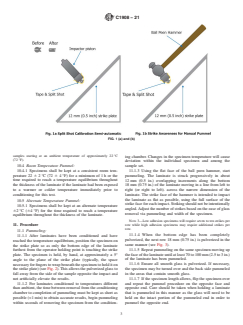
9.2 Impact Consistency of Semi-automatic Pummeler—Split
which are adhered to the interlayer is then visually assessed to
shot thickness shall be measured then attached to the face of
determine a ratio of exposed interlayer. The less interlayer
the hammer head with tape.Asingle impact of the strike plate
visible after pummeling, the higher the adhesion of the
with the hammer, having a single split shot attached shall be
interlayer to the surface it was in contact with.
executed with the face of the hammer head parallel to the
surface of the strike plate. The split shot is removed from the
5. Significance and Use
hammer head and the thickness re-measured after impact (Fig.
5.1 Pummeladhesionoflaminatedglassisamethodusedto
1(a)).Aminimum of three impacts are needed with a new split
measure the relative adhesive bond strength between the
shot for each impact. The change in the thickness of the split
interlayer and glass substrate interface. The interlayer to
shot from original to post strike is measured.An average of the
substrate adhesion has a great effect on the impact resistance of
three hits is taken.Aminimum change of 3 mm (0.125 in.) for
laminates as well as long term stability. This test method is
each impact is required to ensure sufficient force is being
intended to provide three levels of grading. This test method is
applied with a standard deviation between the three split shots
not intended to provide more precision. The laminate bond
of 0.10 mm (0.004 in.) being acceptable.
strength, in most applications, must be controlled to avoid
NOTE 1—Split shot attached to the flat face of the ball peen hammer is
potential problems of delamination at low adhesion and impact
also used to provide the person carrying out the test a sense of how hard
failures or undesirable post breakage characteristics at high
to strike the laminated glass (Fig. 1(b)).
adhesion.
10. Conditioning
6. Apparatus
10.1 Specimens shall be conditioned at the prescribed tem-
6.1 Safety Equipment (Minimum):
perature for the interlayer being tested for a time long enough
6.1.1 Face Shield.
to reach temperature equilibrium throughout the thickness of
6.1.2 Dust Mask.
the laminate.
6.1.3 Cut Resistant Clothing, clothing such as jacket or
10.1.1 To determine the conditioning temperature for the
similar.
type of interlayer in the laminated glass, consult the interlayer
6.1.4 Heavy Cut Resistant Glove.
manufacturer.
6.1.5 Hearing Protection, in accordance with occupational
10.1.1.1 Laminated glass of the same configuration of the
exposure limits.
specimens being tested may be prepared with an embedded
thermocouple in the interlayer and measured to determine
6.2 Tools:
exact time and temperature.
6.2.1 Freezer or Cold Cabinet, capable of maintaining –18
10.1.1.2 Thermal conductivity calculations may be used to
62°C(0 6 4 °F).
determine time to equilibrium.
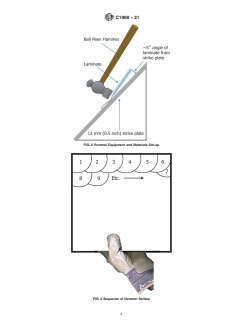
6.3 Ball Peen Hammer, nominally 0.45 6 0.05 kg (16 6
10.2 Air movement in the conditioning cabinet shall be
1.8 oz), with wood or fiberglass handle. Overall length of
present and assist in temperature uniformity within the cham-
hammer is 330 6 13 mm (13 6 0.5 in.) with the head length
ber. No cold spots should occur due to fans or coolant vents.
of 105 66mm(4 6 0.25 in.). The flat head strike face 26 6
10.2.1 Allow sufficient space between specimens for air to
2mm(1 6 0.8 in.)
circulate freely.
6.3.1 Split Shot, size number 5.
6.3.2 Strike Plate.
10.3 Frozen Pummel:
6.3.3 Cardboard Backer Panels.
10.3.1 Specimensshallbeplacedinacoldaircabinetat–18
6.3.4 Short Wave UV Light, capable of emitting in the range
62°C(0 6 4 °F) for the minimum time required to reach a
of 254 nm.
temperature equilibrium throughout the thickness of the lami-
nate.
6.4 As an alternative, an automated hammering device with
a flat metal head with the same strike face dimensions to that
NOTE 2—Depending on the type of cold cabinet and space between the
of a ballpeen hammer as stated in 6.3 may be used. laminates for air circulation, this typically takes between 4 and6hfor
C1908 − 21
FIG. 1 (a) and (b)
samples starting at an ambient temperature of approximately 22 °C
ing chamber. Changes in the specimen temperature will cause
(72 °
...