

ASTM C1652/C1652M-21
(Test Method)Standard Test Method for Measuring Optical Distortion in Flat Glass Products Using Digital Photography of Grids
General Information
- Abstract
SIGNIFICANCE AND USE
5.1 This test method provides accurate data for evaluation of the optical properties of the glass being inspected.
5.2 The procedure described is useful for observing the roll wave introduced during the tempering process of flat architectural glass. (1)
5.3 This test method is also useful for inspection of laminated and tempered automotive glass in transmitted light, in both flat and curved geometries.
SCOPE
1.1 This test method covers the determination of optical distortion of heat-strengthened and fully tempered architectural glass substrates which have been processed in a heat controlled continuous or oscillating conveyance oven. See Specifications C1036 and C1048 for discussion of the characteristics of glass so processed. In this test method the reflected image of processed glass is photographed and the photographic image analyzed to quantify the distortion due to surface waviness. The test method is also useful to quantify optical distortion observed in transmitted light in laminated glass assemblies.
1.2 The values stated in either SI units or inch-pound units are regarded separately as standard. The values stated in each system may not be exact equivalents; therefore, each system shall be used independently of the other. Combining values from the two systems may result in nonconformance with the standard.
1.3 There is no known ISO equivalent to this test method.
1.4 This standard does not purport to address all of the safety concerns, if any, associated with its use. It is the responsibility of the user of this standard to establish appropriate safety, health, and environmental practices and determine the applicability of regulatory limitations prior to use.
1.5 This international standard was developed in accordance with internationally recognized principles on standardization established in the Decision on Principles for the Development of International Standards, Guides and Recommendations issued by the World Trade Organization Technical Barriers to Trade (TBT) Committee.
- Status
- Published
- Publication Date
- 31-Aug-2021
- Technical Committee
- C14 - Glass and Glass Products
- Drafting Committee
- C14.11 - Optical Properties
Buy Documents
ASTM C1652/C1652M-21 - Standard Test Method for Measuring Optical Distortion in Flat Glass Products Using Digital Photography of Grids
REDLINE ASTM C1652/C1652M-21 - Standard Test Method for Measuring Optical Distortion in Flat Glass Products Using Digital Photography of Grids
Overview
ASTM C1652/C1652M-21: Standard Test Method for Measuring Optical Distortion in Flat Glass Products Using Digital Photography of Grids provides a standardized method for evaluating the optical distortion of flat glass, including heat-strengthened, fully tempered, and laminated glass. Using digital photography and a grid pattern, this method allows for precise measurement of surface waviness and optical quality. This standard is particularly significant for architectural and automotive glass manufacturers and quality testing laboratories, providing objective and reliable data to optimize glass production and ensure compliance with industry specifications.
Key Topics
- Optical Distortion Measurement: Quantifies distortion in glass by analyzing digitally photographed images of grids, both in reflection and in transmission.
- Surface Waviness (Roll Wave) Detection: Effective for identifying and evaluating roll wave distortions caused during the tempering process of flat glass, leading to improved quality control.
- Application to Various Glass Types: Suitable for heat-strengthened, fully tempered, and laminated glass, and capable of handling both flat and curved geometries commonly found in architectural and automotive applications.
- Digital Image Analysis: Utilizes digital cameras, printed grids, and analytical software to measure subtle changes in grid spacing, providing both tabular and graphical results.
- Standardized Reporting: Ensures consistency with detailed reporting requirements, including mean optical power, standard deviation, the type of analysis conducted, and photographic evidence of distortion.
- Calibration Procedures: Outlines robust calibration and system zero-verification processes to assure measurement accuracy and repeatability.
Applications
The ASTM C1652/C1652M-21 standard is widely used across several disciplines:
- Architectural Glass Quality Control: Essential for manufacturers and specifiers to evaluate the optical distortion of façade glass and windows, ensuring clarity and compliance with contract or specification standards.
- Automotive Glass Inspection: Used for assessing optical properties of windshields and other glass components in vehicles, both for flat and curved pieces. Ensures safety and driver visibility by detecting warping or localized distortion.
- Product R&D and Process Optimization: Facilitates investigation of production variables (such as heating, cooling, and handling) and their impact on the final product’s optical properties, enabling process refinement.
- Third-Party Testing Laboratories: Provides accredited laboratories with a recognized, repeatable methodology for certifying glass products for clients worldwide.
- Specification Compliance: Supports manufacturers in meeting the requirements set out in related ASTM specifications for flat, heat-strengthened, and tempered glass.
Related Standards
- ASTM C162 - Terminology of Glass and Glass Products: Provides essential definitions and terminology used in ASTM C1652/C1652M-21.
- ASTM C1036 - Specification for Flat Glass: Covers the general quality and characteristics for flat glass, complementing the distortion measurement method.
- ASTM C1048 - Specification for Heat-Strengthened and Fully Tempered Flat Glass: Specifies performance criteria for specialty glass types tested using the C1652/C1652M-21 method.
- ASTM C1651 - Measurement of Roll Wave Optical Distortion in Heat-Treated Flat Glass: Presents an alternative or complementary method for detailed roll wave analysis.
- ASTM F733 - Practice for Optical Distortion and Deviation of Transparent Parts Using the Double-Exposure Method: Another technique referenced for measuring distortion in transparent materials.
Practical Value
By adhering to ASTM C1652/C1652M-21, users ensure consistent, objective assessment of optical distortion in flat glass products, which is critical for structural safety, aesthetic quality, and regulatory compliance in construction and automotive industries. The method’s digital, analytical approach enhances testing efficiency and accuracy, promoting higher product quality and customer satisfaction.
Keywords: optical distortion, flat glass, tempered glass, roll wave, architectural glass, automotive glass, digital grid photography, ASTM C1652/C1652M-21, glass inspection, quality control.
Relations
- Effective Date
- 01-Oct-2023
- Effective Date
- 01-Nov-2019
- Effective Date
- 01-Oct-2018
- Effective Date
- 01-Aug-2018
- Effective Date
- 01-Nov-2015
- Effective Date
- 01-Dec-2014
- Effective Date
- 15-Mar-2012
- Effective Date
- 15-Mar-2012
- Effective Date
- 01-Oct-2011
- Effective Date
- 01-Oct-2011
- Effective Date
- 01-Oct-2011
- Effective Date
- 15-May-2009
- Effective Date
- 01-Sep-2008
- Effective Date
- 15-Oct-2006
- Effective Date
- 01-Oct-2005
Buy Documents
ASTM C1652/C1652M-21 - Standard Test Method for Measuring Optical Distortion in Flat Glass Products Using Digital Photography of Grids
REDLINE ASTM C1652/C1652M-21 - Standard Test Method for Measuring Optical Distortion in Flat Glass Products Using Digital Photography of Grids
Frequently Asked Questions
ASTM C1652/C1652M-21 is a standard published by ASTM International. Its full title is "Standard Test Method for Measuring Optical Distortion in Flat Glass Products Using Digital Photography of Grids". This standard covers: SIGNIFICANCE AND USE 5.1 This test method provides accurate data for evaluation of the optical properties of the glass being inspected. 5.2 The procedure described is useful for observing the roll wave introduced during the tempering process of flat architectural glass. (1) 5.3 This test method is also useful for inspection of laminated and tempered automotive glass in transmitted light, in both flat and curved geometries. SCOPE 1.1 This test method covers the determination of optical distortion of heat-strengthened and fully tempered architectural glass substrates which have been processed in a heat controlled continuous or oscillating conveyance oven. See Specifications C1036 and C1048 for discussion of the characteristics of glass so processed. In this test method the reflected image of processed glass is photographed and the photographic image analyzed to quantify the distortion due to surface waviness. The test method is also useful to quantify optical distortion observed in transmitted light in laminated glass assemblies. 1.2 The values stated in either SI units or inch-pound units are regarded separately as standard. The values stated in each system may not be exact equivalents; therefore, each system shall be used independently of the other. Combining values from the two systems may result in nonconformance with the standard. 1.3 There is no known ISO equivalent to this test method. 1.4 This standard does not purport to address all of the safety concerns, if any, associated with its use. It is the responsibility of the user of this standard to establish appropriate safety, health, and environmental practices and determine the applicability of regulatory limitations prior to use. 1.5 This international standard was developed in accordance with internationally recognized principles on standardization established in the Decision on Principles for the Development of International Standards, Guides and Recommendations issued by the World Trade Organization Technical Barriers to Trade (TBT) Committee.
SIGNIFICANCE AND USE 5.1 This test method provides accurate data for evaluation of the optical properties of the glass being inspected. 5.2 The procedure described is useful for observing the roll wave introduced during the tempering process of flat architectural glass. (1) 5.3 This test method is also useful for inspection of laminated and tempered automotive glass in transmitted light, in both flat and curved geometries. SCOPE 1.1 This test method covers the determination of optical distortion of heat-strengthened and fully tempered architectural glass substrates which have been processed in a heat controlled continuous or oscillating conveyance oven. See Specifications C1036 and C1048 for discussion of the characteristics of glass so processed. In this test method the reflected image of processed glass is photographed and the photographic image analyzed to quantify the distortion due to surface waviness. The test method is also useful to quantify optical distortion observed in transmitted light in laminated glass assemblies. 1.2 The values stated in either SI units or inch-pound units are regarded separately as standard. The values stated in each system may not be exact equivalents; therefore, each system shall be used independently of the other. Combining values from the two systems may result in nonconformance with the standard. 1.3 There is no known ISO equivalent to this test method. 1.4 This standard does not purport to address all of the safety concerns, if any, associated with its use. It is the responsibility of the user of this standard to establish appropriate safety, health, and environmental practices and determine the applicability of regulatory limitations prior to use. 1.5 This international standard was developed in accordance with internationally recognized principles on standardization established in the Decision on Principles for the Development of International Standards, Guides and Recommendations issued by the World Trade Organization Technical Barriers to Trade (TBT) Committee.
ASTM C1652/C1652M-21 is classified under the following ICS (International Classification for Standards) categories: 81.040.20 - Glass in building. The ICS classification helps identify the subject area and facilitates finding related standards.
ASTM C1652/C1652M-21 has the following relationships with other standards: It is inter standard links to ASTM C162-23, ASTM F733-19, ASTM C1048-18, ASTM C1651-11(2018), ASTM C162-05(2015), ASTM F733-09(2014), ASTM C1048-12e1, ASTM C1048-12, ASTM C1651-11, ASTM C1036-11e1, ASTM C1036-11, ASTM F733-09, ASTM C1651-08, ASTM C1036-06, ASTM C162-05. Understanding these relationships helps ensure you are using the most current and applicable version of the standard.
ASTM C1652/C1652M-21 is available in PDF format for immediate download after purchase. The document can be added to your cart and obtained through the secure checkout process. Digital delivery ensures instant access to the complete standard document.
Standards Content (Sample)
This international standard was developed in accordance with internationally recognized principles on standardization established in the Decision on Principles for the
Development of International Standards, Guides and Recommendations issued by the World Trade Organization Technical Barriers to Trade (TBT) Committee.
Designation:C1652/C1652M −21
Standard Test Method for
Measuring Optical Distortion in Flat Glass Products Using
Digital Photography of Grids
This standard is issued under the fixed designation C1652/C1652M; the number immediately following the designation indicates the
year of original adoption or, in the case of revision, the year of last revision. A number in parentheses indicates the year of last
reapproval. A superscript epsilon (´) indicates an editorial change since the last revision or reapproval.
INTRODUCTION
Transmitted and reflected distortion in annealed, heat strengthened, and tempered glass can be
measured by several methods.(1, 2, 3, 4) Qualitative methods are based on the observation of
wavinessintheglassasviewedinofreflectedortransmittedimagesinasetofequidistantlines,called
Zebra Lines. Quantitative measuring techniques are based on several methods, some of which are:
(1) Measuring local curvature using mechanical radius gauges (1, 5, 6, and Test Method C1651).
(2) Moiré Fringe analysis (7, 8).
(3) Double exposure of transmitted grid images (Practice F733).
(4) Projection of an array of round dots (9).
(5) Dual laser beams (10).
The user should be familiar with techniques that are available so as to select the most suitable after
considering the precision, speed, and test specification requirements.The test method described in this
document uses a digital camera to capture a transmitted or reflected image of a set of equidistant lines.
Changes in the spacing of lines are used to quantifying the distortion.
1. Scope 1.4 This standard does not purport to address all of the
safety concerns, if any, associated with its use. It is the
1.1 This test method covers the determination of optical
responsibility of the user of this standard to establish appro-
distortionofheat-strengthenedandfullytemperedarchitectural
priate safety, health, and environmental practices and deter-
glass substrates which have been processed in a heat controlled
mine the applicability of regulatory limitations prior to use.
continuous or oscillating conveyance oven. See Specifications
1.5 This international standard was developed in accor-
C1036 and C1048 for discussion of the characteristics of glass
dance with internationally recognized principles on standard-
so processed. In this test method the reflected image of
ization established in the Decision on Principles for the
processed glass is photographed and the photographic image
Development of International Standards, Guides and Recom-
analyzed to quantify the distortion due to surface waviness.
mendations issued by the World Trade Organization Technical
The test method is also useful to quantify optical distortion
Barriers to Trade (TBT) Committee.
observed in transmitted light in laminated glass assemblies.
1.2 The values stated in either SI units or inch-pound units
2. Referenced Documents
are regarded separately as standard. The values stated in each 3
2.1 ASTM Standards:
system may not be exact equivalents; therefore, each system
C162 Terminology of Glass and Glass Products
shall be used independently of the other. Combining values
C1036 Specification for Flat Glass
from the two systems may result in nonconformance with the
C1048 Specification for Heat-Strengthened and Fully Tem-
standard.
pered Flat Glass
1.3 There is no known ISO equivalent to this test method.
C1651 Test Method for Measurement of Roll Wave Optical
Distortion in Heat-Treated Flat Glass
F733 Practice for Optical Distortion and Deviation ofTrans-
This test method is under the jurisdiction of ASTM Committee C14 on Glass
parent Parts Using the Double-Exposure Method
and Glass Products and is the direct responsibility of Subcommittee C14.11 on
Optical Properties.
Current edition approved Sept. 1, 2021. Published November 2021. Originally
approved in 2006. Last previous edition approved in 2014 as C1652/C1652M – 14. For referenced ASTM standards, visit the ASTM website, www.astm.org, or
DOI: 10.1520/C1652_C1652M-21. contact ASTM Customer Service at service@astm.org. For Annual Book of ASTM
The boldface numbers in parentheses refer to a list of references at the end of Standards volume information, refer to the standard’s Document Summary page on
this standard. the ASTM website.
Copyright © ASTM International, 100 Barr Harbor Drive, PO Box C700, West Conshohocken, PA 19428-2959. United States
C1652/C1652M−21
2.2 Other Standards: 4. Summary of Test Method
U.S.Patent7345698 OpticalSystemforImagingDistortions
4.1 This test procedure was designed to provide an accurate
in Moving Reflective Sheets (2003)
method of quantifying the optical distortion of glass as it is
revealed in reflected or transmitted images. The optical distor-
3. Terminology
tion in reflected light can be related to a surface waviness,
3.1 See Terminology C162 of Glass and Glass Products.
known as roll wave in tempered glass products, or, in trans-
mitted light, related to curvature and local thickness variations
3.2 Definitions:
in laminated glass products. The test method is based on the
3.2.1 focal length, F—The focal length of a specular
use of a digital camera which is used to record the appearance
reflector, due to the curvature at a point equals R/2 (see 3.2.3);
of an accurately printed grid pattern which has been reflected
in transmitted light, local thickness changes introduce a con-
from or transmitted through a lite of glass. Mathematical
vergence or divergence, equivalent to a lens with a focal length
analyses performed on computer of the changes in the grid
F.
pattern along with the laws of optics and the geometrical
3.2.2 optical power, D—The optical power due to the
arrangement makes it possible to quantify the lens power or
curvature at a point is D = 1/F; the optical power is expressed
optical distortion of each element of the glass surface defined
in diopters, (Units 1/m), or as is typical, in millidiopters; the
by the grid.
optical power is also used to quantify optical distortion, the
4.2 A uniformly spaced set of parallel lines, usually set at
deformation of images reflected from flat glass, or transmitted
45° angle to horizontal, may be used instead of a grid. If such
by laminated or bent glass, or both.
a set of lines is used, the mathematics of calculation will be
3.2.3 radius of curvature, R—The local radius of curvature
slightly altered from those expressed in Appendix X1.
at a point on the surface, in meters; R and R are respectively
x y
measured in planes x (usually horizontal) and y (usually
5. Significance and Use
vertical).
5.1 This test method provides accurate data for evaluation
3.2.4 roll wave—A repetitive, wave-like departure from
of the optical properties of the glass being inspected.
flatness in otherwise flat glass that results from heat-treating
5.2 The procedure described is useful for observing the roll
the glass in a horizontal conveyance system; roll wave ex-
wave introduced during the tempering process of flat architec-
cludes edge effects such as edge kink, and distortion induced
tural glass. (1)
by assembly or installation.
5.3 This test method is also useful for inspection of
laminated and tempered automotive glass in transmitted light,
in both flat and curved geometries.
Available from the U.S. Patent and Trademark Office, https://www.uspto.gov.
FIG. 1Test Configurations of Reflective Analysis
C1652/C1652M−21
6. Apparatus (80 candles), measured at the surface of the screen. Four
Quartz-Halogen flood lamps, 500 watts each, can provide
6.1 The items shown in Fig. 1 are required to practice this
satisfactory results.
test method:
6.6.2 In a brightly illuminated area, two times higher
6.2 An accurately printed flat screen containing a pattern of
illumination power is needed to assure good photographic
equidistant black lines on a white background.
contrast.
NOTE 1—The ruled area of the screen should have at least twice the
7. Sampling
dimensions of the area on the glass to be examined.
7.1 The number of specimens and frequency of testing is to
6.2.1 The line spacing or pitch p (center to center or
be determined by the user.
corresponding edge to corresponding edge distance between
adjacent lines) defines the spatial resolution of the system. A
8. Calibration and Standardization
50 mm [2 in] pitch in both horizontal and vertical directions
8.1 System calibration is a two-step procedure.
provides satisfactory resolution for the examination of tem-
pered glass in reflection mode. A smaller pitch can be used
8.2 Verification of System Zero
when examination of smaller deformations in laminated glass
8.2.1 Set the camera at a distance 2L from the screen.
iscarriedoutusingthistestmethod.Thewidthoftheblackline
Capture the image of the screen without a glass panel in place
is typically 6 mm [ ⁄4 in]. The line-to-line distance must be
and process the image through the analysis software. The
uniform, in both horizontal and vertical directions. The unifor-
image analysis should indicate small values of D throughout
mity of the line-to-line spacing, p, is critical, because the
the inspection area, typically less than 5 mdpt.
systeminterpretsanon-uniformspacingasopticaldistortion.A
8.3 Verification of Calibration (Span Calibration)
uniformity of the pitch of 0.2 mm [0.008 in] is satisfactory in
8.3.1 This system calibration is determined by the screen
reflective measurements.
uniformity and distance, L, to the camera as shown in Fig. 1,
6.3 A digital camera equipped with an a planar lens and an
Fig. 2, and Fig. 3.
image pixel resolution compatible with the software require-
8.3.2 Place a panel with known distortion in the test
ments.
position. Record the screen image and process it through the
software. The calculated distortion should not differ from the
6.4 A computer using an operating system compatible with
known value by more than 5 mdpt.
the software and any peripherals needed to satisfy the data
8.3.3 The known value of distortion should be established
logging and reporting requirements.
usingtraceable,curvaturemeasuringmethods.Duallaserbeam
6.5 A software program capable of performing the evalua-
and interferometry are suitable for this purpose.
tion of changes in line-spacing, p, and computation of the
optical distortion, D, throughout the inspected region. 9. Procedure
6.6 Lighting sufficient to provide photographic contrast. 9.1 Set Up Grid Screen:
6.6.1 The screen must be illuminated with uniform diffused 9.1.1 Ruled screen board should be vertical, in an upright
background lighting with a minimum illuminance of 850 lux
position.
FIG. 2Test Configuration for Off-set Camera
C1652/C1652M−21
FIG. 3Test Configuration in Transmitted Light
9.1.2 When used in reflective mode, the board should have 9.5.1 Place the glass to be analyzed in the field of view of
a hole, sufficient for viewing through with a digital camera, cut the camera looking through the hole in the center of the grid
in its center. board.
9.1.3 When the screen is wall-mounted, so that viewing 9.5.2 Makesurethatalloftheglassshowsareflectionofthe
grid and that the grid and glass are on the same centerline and
through a hole in its center is not possible, the camera can be
mounted next to the screen or above it. In this configuration are parallel.
9.5.3 Visually inspect the reflected image to assure that the
(see Fig. 2), a V-shaped line drawn from the center of the glass
to the center of the screen (L ), and from the center of the glass roll wave is oriented horizontally or vertically.
9.5.4 Assure a sharp focus.
to the center of the camera lens (L ) represents a geometric,
specular reflection. The glass must be perpendicular to the 9.5.5 Add an identification number for the glass by printing
with a felt marker on an erasable board just above or below the
bisector of line L and L and the camera back must be
1 2
perpendicular to line L . sample, or by placing a printed label on the screen.
9.1.4 The grid board typically should be somewhat larger
9.6 Take Photograph:
than twice the dimensions of the glass to be measured. For
9.6.1 Take a digital photograph of
...
This document is not an ASTM standard and is intended only to provide the user of an ASTM standard an indication of what changes have been made to the previous version. Because
it may not be technically possible to adequately depict all changes accurately, ASTM recommends that users consult prior editions as appropriate. In all cases only the current version
of the standard as published by ASTM is to be considered the official document.
Designation: C1652/C1652M − 14 C1652/C1652M − 21
Standard Test Method for
Measuring Optical Distortion in Flat Glass Products Using
Digital Photography of Grids
This standard is issued under the fixed designation C1652/C1652M; the number immediately following the designation indicates the
year of original adoption or, in the case of revision, the year of last revision. A number in parentheses indicates the year of last
reapproval. A superscript epsilon (´) indicates an editorial change since the last revision or reapproval.
INTRODUCTION
Transmitted and reflected distortion in annealed, heat strengthened, and tempered glass can be
measured by several methods.(1, 2, 3, 4) Qualitative methods are based on the observation of
waviness in the glass as viewed in of reflected or transmitted images in a set of equidistant lines, called
Zebra Lines. Quantitative measuring techniques are based on several methods, some of which are:
(1(1)) Measuring local curvature using mechanical radius gages (gauges (1, 5, 6, and Test Method
C1651)).
(2(2)) Moiré Fringe analysis (7, 8)).
(3(3)) Double exposure of transmitted grid images (Practice F733) ).
(4(4)) Projection of an array of round dots (9)).
(5(5)) Dual laser beams (10)).
The user should be familiar with techniques that are available so as to select the most suitable after
considering the precision, speed, and test specification requirements. The test method described in this
document uses a digital camera to capture a transmitted or reflected image of a set of equidistant lines.
Changes in the spacing of lines are used to quantifying the distortion.
1. Scope
1.1 This test method covers the determination of optical distortion of heat-strengthened and fully tempered architectural glass
substrates which have been processed in a heat controlled continuous or oscillating conveyance oven. See Specifications C1036
and C1048 for discussion of the characteristics of glass so processed. In this test method the reflected image of processed glass
is photographed and the photographic image analyzed to quantify the distortion due to surface waviness. The test method is also
useful to quantify optical distortion observed in transmitted light in laminated glass assemblies.
1.2 The values stated in either SI units or inch-pound units are regarded separately as standard. The values stated in each system
may not be exact equivalents; therefore, each system shall be used independently of the other. Combining values from the two
systems may result in nonconformance with the standard.
1.3 There is no known ISO equivalent to this standard.test method.
This test method is under the jurisdiction of ASTM Committee C14 on Glass and Glass Products and is the direct responsibility of Subcommittee C14.11 on Optical
Properties.
Current edition approved May 1, 2014Sept. 1, 2021. Published May 2014November 2021. Originally approved in 2006. Last previous edition approved in 20062014 as
C1652/C1652M – 06.14. DOI: 10.1520/C1652_C1652M-14.10.1520/C1652_C1652M-21.
The boldface numbers in parentheses refer to a list of references at the end of this standard.
Copyright © ASTM International, 100 Barr Harbor Drive, PO Box C700, West Conshohocken, PA 19428-2959. United States
C1652/C1652M − 21
1.4 This standard does not purport to address all of the safety concerns, if any, associated with its use. It is the responsibility of
the user of this standard to establish appropriate safety and health practices and determine the applicability of regulatory
limitations prior to use.
1.4 This standard does not purport to address all of the safety concerns, if any, associated with its use. It is the responsibility
of the user of this standard to establish appropriate safety, health, and environmental practices and determine the applicability of
regulatory limitations prior to use.
1.5 This international standard was developed in accordance with internationally recognized principles on standardization
established in the Decision on Principles for the Development of International Standards, Guides and Recommendations issued
by the World Trade Organization Technical Barriers to Trade (TBT) Committee.
2. Referenced Documents
2.1 ASTM Standards:
C162 Terminology of Glass and Glass Products
C1036 Specification for Flat Glass
C1048 Specification for Heat-Strengthened and Fully Tempered Flat Glass
C1651 Test Method for Measurement of Roll Wave Optical Distortion in Heat-Treated Flat Glass
F733 Practice for Optical Distortion and Deviation of Transparent Parts Using the Double-Exposure Method
2.2 Other Standards:
U.S. Patent 7 345 6987345698 Optical System for Imaging Distortions in Moving Reflective Sheets (2003)
3. Terminology
3.1 See Terminology C162 of Glass and Glass Products.
3.2 Definitions:
3.2.1 focal length, F—The focal length of a specular reflector, due to the curvature at a point equals R/2. (SeeR/2 (see 3.2.3.) In);
in transmitted light, local thickness changes introduce a convergence or divergence, equivalent to a lens with a focal length F.
3.2.2 optical power, D—The optical power due to the curvature at a point is D = 1/F. The1/F; the optical power is expressed in
diopters, (Units 1/m), or as is typical, in millidiopters. Themillidiopters; the optical power is also used to quantify optical distortion,
the deformation of images reflected from flat glass, or transmitted by laminated or bent glass, or both.
3.2.3 radius of curvature, R—The local radius of curvature at a point on the surface, in meters.meters; R and R are respectively
x y
measured in planes x (usually horizontal) and y (usually vertical).
3.2.4 roll wave—A repetitive, wave-like departure from flatness in otherwise flat glass that results from heat-treating the glass in
a horizontal conveyance system. Rollsystem; roll wave excludes edge effects such as edge kink, and distortion induced by
assembly or installation.
4. Summary of Test Method
4.1 This test procedure was designed to provide an accurate method of quantifying the optical distortion of glass as it is revealed
in reflected or transmitted images. The optical distortion in reflected light can be related to a surface waviness, known as roll wave
in tempered glass products, or, in transmitted light, related to curvature and local thickness variations in laminated glass products.
The test method is based on the use of a digital camera which is used to record the appearance of an accurately printed grid pattern
which has been reflected from or transmitted thoughthrough a lite of glass. Mathematical analyses performed on computer of the
changes in the grid pattern along with the laws of optics and the geometrical arrangement makes it possible to quantify the lens
power or optical distortion of each element of the glass surface defined by the grid.
4.2 A uniformly spaced set of parallel lines, usually set at 45° angle to horizontal, may be used instead of a grid. If such a set of
lines is used, the mathematics of calculation will be slightly altered from those expressed in Appendix X1.
For referenced ASTM standards, visit the ASTM website, www.astm.org, or contact ASTM Customer Service at service@astm.org. For Annual Book of ASTM Standards
volume information, refer to the standard’s Document Summary page on the ASTM website.
Available from the U.S. Patent and Trademark Office, https://www.uspto.gov.
C1652/C1652M − 21
5. Significance and Use
5.1 This test method provides accurate data for evaluation of the optical properties of the glass being inspected.
5.2 The procedure described is useful for measuringobserving the roll wave introduced during the tempering process of flat
architectural glass. (1)
5.3 This test method is also useful for inspection of laminated and tempered automotive glass in transmitted light, in both flat and
curved geometries.
6. Apparatus
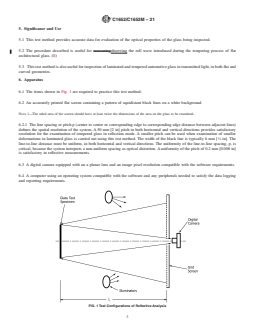
6.1 The items shown in Fig. 1 are required to practice this test method:
6.2 An accurately printed flat screen containing a pattern of equidistant black lines on a white background.
NOTE 1—The ruled area of the screen should have at least twice the dimensions of the area on the glass to be examined.
6.2.1 The line spacing or pitch p (center to center or corresponding edge to corresponding edge distance between adjacent lines)
defines the spatial resolution of the system. A 50 mm [2 in] pitch in both horizontal and vertical directions provides satisfactory
resolution for the examination of tempered glass in reflection mode. A smaller pitch can be used when examination of smaller
deformations in laminated glass is carried out using this test method. The width of the black line is typically 6 mm [ ⁄4 in]. The
line-to-line distance must be uniform, in both horizontal and vertical directions. The uniformity of the line-to-line spacing, p, is
critical, because the system interprets a non-uniform spacing as optical distortion. A uniformity of the pitch of 0.2 mm [0.008 in]
is satisfactory in reflective measurements.
6.3 A digital camera equipped with an a planar lens and an image pixel resolution compatible with the software requirements.
6.4 A computer using an operating system compatible with the software and any peripherals needed to satisfy the data logging
and reporting requirements.
FIG. 1 Test Configurations of Reflective Analysis
C1652/C1652M − 21
6.5 A software program capable of performing the evaluation of changes in line-spacing, p, and computation of the optical
distortion, D, throughout the inspected region.
6.6 Lighting sufficient to provide photographic contrast.
6.6.1 The screen must be illuminated with uniform diffused background lighting with a minimum illuminance of 850 lux (80
candles), measured at the surface of the screen. Four Quartz-Halogen flood lamps, 500 watts each, can provide satisfactory results.
6.6.2 In a brightly illuminated area, two times higher illumination power is needed to assure good photographic contrast.
7. Sampling
7.1 The number of specimens and frequency of testing is to be determined by the user.
8. Calibration and Standardization
8.1 System calibration is a two-step procedure.
8.2 Verification of System Zero
8.2.1 Set the camera at a distance 2L from the screen. Capture the image of the screen without a glass panel in place and process
the image through the analysis software. The image analysis should indicate small values of D throughout the inspection area,
typically less than 5 mdpt.
8.3 Verification of Calibration (Span Calibration)
8.3.1 This system calibration is determined by the screen uniformity and distance, L, to the camera as shown in Fig. 1, Fig. 2, and
Fig. 3.
8.3.2 Place a panel with known distortion in the test position. Record the screen image and process it through the software. The
calculated distortion should not differ from the known value by more than 5 mdpt.
8.3.3 The known value of distortion should be established using traceable, curvature measuring methods. Dual laser beam and
interferometry are suitable for this purpose.
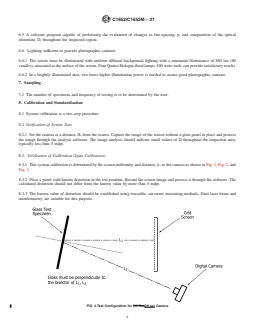
FIG. 2 Test Configuration for Off-SetOff-set Camera
C1652/C1652M − 21
FIG. 3 Test Configuration in Transmitted Light
9. Procedure
9.1 Set up the grid screen: Up Grid Screen:
9.1.1 Ruled screen board should be vertical, in an upright position.
9.1.2 When used in reflective mode, the board should have a hole, sufficient for viewing through with a digital camera, cut in its
center.
9.1.3 When the screen is wall-mounted, so that viewing through a hole in its center is not possible, the camera can be mounted
next to the screen or above it. In this configuration (see Fig. 2), a V-shaped line drawn from the center of the glass to the center
of the screen (L ), and from the center of the glass to the center of the camera lens (L ) represents a geometric, specular reflection.
1 2
The screenglass must be perpendicular to the bisector of line L and L and the camera back must be perpendicular to line L .
1 2 2
9.1.4 The grid board typically should be somewhat larger than twice the dimensions of the glass to be measured. For example,
to analyze a 600mm by 1200 mm [24 in by 48 in] glass, use a 1500 mm by 2500 mm [60 in by 100in] grid board.
9.2 Set up the glass sample: Up Glass Sample:
9.2.1 Place the glass parallel to the grid board as shown in Fig. 1, at a measured distance L. The distance should be the largest
available, since the sensitivity of the measurement is directly proportional to the spacing, L. Four meters [160 in] yields satisfactory
results.
9.2.2 For simplicity of computations, the overall distance between the screen and the camera should be L, so that, L = L = L.
1 2
Nevertheless, the distances are not required to be equal.
9.2.3 Visually inspect the reflected image to assure that the roll wave is oriented horizon
...