

ASTM C1172-19
(Specification)Standard Specification for Laminated Architectural Flat Glass
General Information
- Abstract
ABSTRACT
This specification covers the quality requirements for cut sizes of flat laminated glass consisting of two or more lites of glass bonded with an interlayer material for use in building glazing. Depending on the number, thickness and treatment of plies, and the number and thickness of interlayers, the glass shall be laminated for applications including but not limited to safety security, detention, hurricane/cyclic-wind resistance, blast resistant, bullet resistant and sound reduction glazing applications. The following test methods shall be performed to meet the specified requirements: impact test for safety glazing; test for missile impact and cyclic pressure; test for security glazing; test for detention glazing; test for bullet resisting glazing; test for burglary resisting glazing; overall bow and warp; and size.
SCOPE
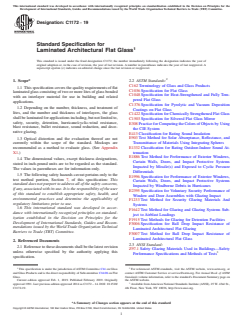
1.1 This specification covers the quality requirements of flat laminated glass consisting of two or more lites of glass bonded with an interlayer material for use in building and related applications.
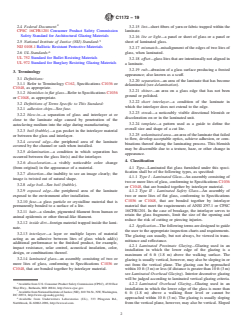
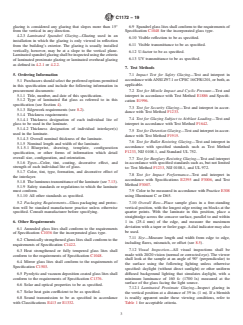
1.2 Depending on the number, thickness, and treatment of lites, and the number and thickness of interlayers, the glass shall be laminated for applications including, but not limited to, safety, security, detention, hurricane/cyclic-wind resistance, blast resistance, bullet resistance, sound reduction, and decorative glazing.
1.3 Optical distortion and the evaluation thereof are not currently within the scope of the standard. Mockups are recommended as a method to evaluate glass. (See Appendix X1.)
1.4 The dimensional values, except thickness designations, stated in inch-pound units are to be regarded as the standard. The values in parentheses are for information only.
1.5 The following safety hazards caveat pertains only to the test method portion, Section 7, of this specification: This standard does not purport to address all of the safety concerns, if any, associated with its use. It is the responsibility of the user of this standard to establish appropriate safety, health, and environmental practices and determine the applicability of regulatory limitations prior to use.
1.6 This international standard was developed in accordance with internationally recognized principles on standardization established in the Decision on Principles for the Development of International Standards, Guides and Recommendations issued by the World Trade Organization Technical Barriers to Trade (TBT) Committee.
- Status
- Published
- Publication Date
- 31-Jan-2019
- Technical Committee
- C14 - Glass and Glass Products
- Drafting Committee
- C14.08 - Flat Glass
Overview
ASTM C1172-19: Standard Specification for Laminated Architectural Flat Glass defines the quality requirements for cut sizes of flat laminated glass consisting of two or more lites bonded with an interlayer material. Laminated architectural flat glass is widely used in building glazing applications, offering key benefits such as enhanced safety, security, sound reduction, and resistance to environmental and man-made hazards. This standard applies to glass products installed in settings that require specific performance characteristics, including safety, blast, bullet, and hurricane/cyclic-wind resistance.
Laminated glass products covered under ASTM C1172-19 are critical for modern architectural glazing due to their reliable performance, quality assurance, and suitability for a broad range of high-demand environments.
Key Topics
ASTM C1172-19 addresses several essential aspects of laminated architectural flat glass:
- Product Construction: Specifies flat laminated glass made from two or more plies (lites) of glass bonded together with an interlayer, tailored for architectural glazing.
- Application Types: Supports designs for safety, security, hurricane/cyclic-wind resistance, blast resistance, bullet resistance, sound attenuation, and decorative purposes.
- Quality Requirements: Defines tolerances for thickness, length, width, bow, warp, and acceptable levels of process blemishes such as bubbles, delaminations, and visual defects.
- Glazing Installations: Distinguishes between vertical, overhead, and spandrel glazing, each with its own inspection criteria.
- Test Methods: Outlines required performance tests including:
- Impact resistance for safety glazing
- Missile and cyclic pressure tests for storm and security glazing
- Blast and bullet resistance evaluation
- Sound insulation and solar performance measurements
Applications
Laminated architectural flat glass in accordance with ASTM C1172-19 is widely used in:
- Commercial Buildings: Entrances, curtain walls, and partitions requiring safety or security glass.
- Residential Construction: Window and door panels in locations subject to human impact or severe weather conditions.
- Critical Infrastructure: Facilities that mandate enhanced blast, bullet, and burglary resistance, such as government and detention buildings.
- Hurricane and Cyclone-Prone Areas: Storm-proof windows and doors that comply with building codes for impact and cyclic pressure performance.
- Sound Reduction: Specialized glazing for noise mitigation in urban or transportation-adjacent projects.
- Decorative and Custom Glazing: Applications that blend aesthetics with structural performance, such as colored, tinted, or patterned laminated glass.
Related Standards
ASTM C1172-19 references and is used alongside several other important glass and glazing standards, including:
- ASTM C1036: Specification for Flat Glass
- ASTM C1048: Specification for Heat-Strengthened and Fully Tempered Flat Glass
- ASTM E1886 & E1996: Test methods for impact and cyclic pressure on glazing systems
- ANSI Z97.1 & CPSC 16CFR1201: Safety glazing specifications
- UL 752 & UL 972: Standards for bullet and burglary resisting glazing materials
- NIJ 0108.1: Ballistic resistant protective materials
- ASTM E413 & E1332: Sound insulation and attenuation classifications
Practical Value
Specifying ASTM C1172-19 compliant laminated architectural flat glass ensures optimal performance in security, safety, sound reduction, and sustainability objectives for building projects. The standard provides architects, engineers, specifiers, and contractors a clear set of requirements, facilitating code compliance and reducing risk during design and procurement phases. By referencing ASTM C1172-19, stakeholders can confidently select glazing suitable for challenging environments while meeting building regulations and delivering reliable, long-term facade performance.
For projects demanding verification of glass quality, impact resistance, and durability, adherence to ASTM C1172-19 is essential for achieving expected protection and peace of mind.
Relations
- Effective Date
- 01-Feb-2024
- Effective Date
- 01-Oct-2023
- Effective Date
- 01-Oct-2019
- Effective Date
- 15-Apr-2019
- Effective Date
- 01-Apr-2019
- Effective Date
- 01-Oct-2018
- Effective Date
- 01-Aug-2018
- Effective Date
- 01-May-2017
- Effective Date
- 01-Nov-2015
- Effective Date
- 01-Apr-2015
- Effective Date
- 01-Oct-2014
- Effective Date
- 01-Jun-2014
- Effective Date
- 01-Oct-2013
- Effective Date
- 01-Oct-2013
- Effective Date
- 01-Sep-2013
Frequently Asked Questions
ASTM C1172-19 is a technical specification published by ASTM International. Its full title is "Standard Specification for Laminated Architectural Flat Glass". This standard covers: ABSTRACT This specification covers the quality requirements for cut sizes of flat laminated glass consisting of two or more lites of glass bonded with an interlayer material for use in building glazing. Depending on the number, thickness and treatment of plies, and the number and thickness of interlayers, the glass shall be laminated for applications including but not limited to safety security, detention, hurricane/cyclic-wind resistance, blast resistant, bullet resistant and sound reduction glazing applications. The following test methods shall be performed to meet the specified requirements: impact test for safety glazing; test for missile impact and cyclic pressure; test for security glazing; test for detention glazing; test for bullet resisting glazing; test for burglary resisting glazing; overall bow and warp; and size. SCOPE 1.1 This specification covers the quality requirements of flat laminated glass consisting of two or more lites of glass bonded with an interlayer material for use in building and related applications. 1.2 Depending on the number, thickness, and treatment of lites, and the number and thickness of interlayers, the glass shall be laminated for applications including, but not limited to, safety, security, detention, hurricane/cyclic-wind resistance, blast resistance, bullet resistance, sound reduction, and decorative glazing. 1.3 Optical distortion and the evaluation thereof are not currently within the scope of the standard. Mockups are recommended as a method to evaluate glass. (See Appendix X1.) 1.4 The dimensional values, except thickness designations, stated in inch-pound units are to be regarded as the standard. The values in parentheses are for information only. 1.5 The following safety hazards caveat pertains only to the test method portion, Section 7, of this specification: This standard does not purport to address all of the safety concerns, if any, associated with its use. It is the responsibility of the user of this standard to establish appropriate safety, health, and environmental practices and determine the applicability of regulatory limitations prior to use. 1.6 This international standard was developed in accordance with internationally recognized principles on standardization established in the Decision on Principles for the Development of International Standards, Guides and Recommendations issued by the World Trade Organization Technical Barriers to Trade (TBT) Committee.
ABSTRACT This specification covers the quality requirements for cut sizes of flat laminated glass consisting of two or more lites of glass bonded with an interlayer material for use in building glazing. Depending on the number, thickness and treatment of plies, and the number and thickness of interlayers, the glass shall be laminated for applications including but not limited to safety security, detention, hurricane/cyclic-wind resistance, blast resistant, bullet resistant and sound reduction glazing applications. The following test methods shall be performed to meet the specified requirements: impact test for safety glazing; test for missile impact and cyclic pressure; test for security glazing; test for detention glazing; test for bullet resisting glazing; test for burglary resisting glazing; overall bow and warp; and size. SCOPE 1.1 This specification covers the quality requirements of flat laminated glass consisting of two or more lites of glass bonded with an interlayer material for use in building and related applications. 1.2 Depending on the number, thickness, and treatment of lites, and the number and thickness of interlayers, the glass shall be laminated for applications including, but not limited to, safety, security, detention, hurricane/cyclic-wind resistance, blast resistance, bullet resistance, sound reduction, and decorative glazing. 1.3 Optical distortion and the evaluation thereof are not currently within the scope of the standard. Mockups are recommended as a method to evaluate glass. (See Appendix X1.) 1.4 The dimensional values, except thickness designations, stated in inch-pound units are to be regarded as the standard. The values in parentheses are for information only. 1.5 The following safety hazards caveat pertains only to the test method portion, Section 7, of this specification: This standard does not purport to address all of the safety concerns, if any, associated with its use. It is the responsibility of the user of this standard to establish appropriate safety, health, and environmental practices and determine the applicability of regulatory limitations prior to use. 1.6 This international standard was developed in accordance with internationally recognized principles on standardization established in the Decision on Principles for the Development of International Standards, Guides and Recommendations issued by the World Trade Organization Technical Barriers to Trade (TBT) Committee.
ASTM C1172-19 is classified under the following ICS (International Classification for Standards) categories: 81.040.20 - Glass in building. The ICS classification helps identify the subject area and facilitates finding related standards.
ASTM C1172-19 has the following relationships with other standards: It is inter standard links to ASTM C1503-24, ASTM C162-23, ASTM E1886-19, ASTM F3006-19, ASTM F1915-05(2019), ASTM C1048-18, ASTM C1503-18, ASTM E308-17, ASTM C162-05(2015), ASTM E308-15, ASTM E1996-14a, ASTM E1996-14, ASTM E1886-13a, ASTM E2395-06(2013), ASTM E1886-13. Understanding these relationships helps ensure you are using the most current and applicable version of the standard.
ASTM C1172-19 is available in PDF format for immediate download after purchase. The document can be added to your cart and obtained through the secure checkout process. Digital delivery ensures instant access to the complete standard document.
Standards Content (Sample)
This international standard was developed in accordance with internationally recognized principles on standardization established in the Decision on Principles for the
Development of International Standards, Guides and Recommendations issued by the World Trade Organization Technical Barriers to Trade (TBT) Committee.
Designation:C1172 −19
Standard Specification for
Laminated Architectural Flat Glass
This standard is issued under the fixed designation C1172; the number immediately following the designation indicates the year of
original adoption or, in the case of revision, the year of last revision. A number in parentheses indicates the year of last reapproval. A
superscript epsilon (´) indicates an editorial change since the last revision or reapproval.
1. Scope* 2.2 ASTM Standards:
C162 Terminology of Glass and Glass Products
1.1 This specification covers the quality requirements of flat
C1036 Specification for Flat Glass
laminated glass consisting of two or more lites of glass bonded
C1048 Specification for Heat-Strengthened and Fully Tem-
with an interlayer material for use in building and related
pered Flat Glass
applications.
C1376 Specification for Pyrolytic and Vacuum Deposition
1.2 Depending on the number, thickness, and treatment of
Coatings on Flat Glass
lites, and the number and thickness of interlayers, the glass
C1422 Specification for Chemically Strengthened Flat Glass
shallbelaminatedforapplicationsincluding,butnotlimitedto,
C1503 Specification for Silvered Flat Glass Mirror
safety, security, detention, hurricane/cyclic-wind resistance,
E308 PracticeforComputingtheColorsofObjectsbyUsing
blast resistance, bullet resistance, sound reduction, and deco-
the CIE System
rative glazing.
E413 Classification for Rating Sound Insulation
1.3 Optical distortion and the evaluation thereof are not E903 Test Method for Solar Absorptance, Reflectance, and
Transmittance of Materials Using Integrating Spheres
currently within the scope of the standard. Mockups are
recommended as a method to evaluate glass. (See Appendix E1332 Classification for Rating Outdoor-Indoor Sound At-
tenuation
X1.)
E1886 Test Method for Performance of Exterior Windows,
1.4 The dimensional values, except thickness designations,
Curtain Walls, Doors, and Impact Protective Systems
stated in inch-pound units are to be regarded as the standard.
Impacted by Missile(s) and Exposed to Cyclic Pressure
The values in parentheses are for information only.
Differentials
1.5 The following safety hazards caveat pertains only to the
E1996 Specification for Performance of Exterior Windows,
test method portion, Section 7, of this specification: This
Curtain Walls, Doors, and Impact Protective Systems
standard does not purport to address all of the safety concerns,
Impacted by Windborne Debris in Hurricanes
if any, associated with its use. It is the responsibility of the user
E2395 Specification for Voluntary Security Performance of
of this standard to establish appropriate safety, health, and
Window and Door Assemblies with Glazing Impact
environmental practices and determine the applicability of
F1233 Test Method for Security Glazing Materials And
regulatory limitations prior to use.
Systems
1.6 This international standard was developed in accor-
F1642 Test Method for Glazing and Glazing Systems Sub-
dance with internationally recognized principles on standard-
ject to Airblast Loadings
ization established in the Decision on Principles for the
F1915 Test Methods for Glazing for Detention Facilities
Development of International Standards, Guides and Recom-
F3006 Specification for Ball Drop Impact Resistance of
mendations issued by the World Trade Organization Technical
Laminated Architectural Flat Glazing
Barriers to Trade (TBT) Committee.
F3007 Test Method for Ball Drop Impact Resistance of
Laminated Architectural Flat Glass
2. Referenced Documents
2.3 ANSI Standard:
2.1 Reference to these documents shall be the latest revision
Z97.1 Safety Glazing Materials Used in Buildings—Safety
unless otherwise specified by the authority applying this
Performance Specifications and Methods of Tests
specification.
1 2
This specification is under the jurisdiction of ASTM Committee C14 on Glass For referenced ASTM standards, visit the ASTM website, www.astm.org, or
and Glass Products and is the direct responsibility of Subcommittee C14.08 on Flat contact ASTM Customer Service at service@astm.org. For Annual Book of ASTM
Glass. Standards volume information, refer to the standard’s Document Summary page on
Current edition approved Feb. 1, 2019. Published February 2019. Originally the ASTM website.
approved 1991. Last previous edition approved 2014 as C1172 – 14. DOI: 10.1520/ Available from American National Standards Institute (ANSI), 25 W. 43rd St.,
C1172-19. 4th Floor, New York, NY 10036, http://www.ansi.org.
*A Summary of Changes section appears at the end of this standard
Copyright © ASTM International, 100 Barr Harbor Drive, PO Box C700, West Conshohocken, PA 19428-2959. United States
C1172−19
2.4 Federal Document: 3.2.15 lint—short fibers of yarn or fabric trapped within the
CPSC 16CFR1201 Consumer Product Safety Commission laminate.
Safety Standard for Architectural Glazing Materials
3.2.16 lite or light—a panel or sheet of glass or a panel or
2.5 National Institute of Justice (NIJ) Standard: sheet of laminated glass.
NIJ 0108.1 Ballistic Resistant Protective Materials
3.2.17 mismatch—misalignment of the edges of two lites of
2.6 UL Standards: glass, when laminated.
UL 752 Standard for Bullet Resisting Materials
3.2.18 offset—glass lites that are intentionally not aligned in
UL 972 Standard for Burglary Resisting Glazing Materials
a laminate.
3.2.19 rub—abrasion of a glass surface producing a frosted
3. Terminology
appearance; also known as a scuff.
3.1 Definitions:
3.2.20 separation—an area of the laminate that has become
3.1.1 Refer to Terminology C162, Specifications C1036 or
delaminated (see delamination).
C1048, as appropriate.
3.2.21 shiner—an area on a glass edge that has not been
3.1.2 blemishes in flat glass—Refer to Specifications C1036
ground or polished.
or C1048, as appropriate.
3.2.22 short interlayer—a condition of the laminate in
3.2 Definitions of Terms Specific to This Standard:
which the interlayer does not extend to the edge.
3.2.1 adhesion chips—See fuse.
3.2.23 streak—a noticeably visible directional blemish or
3.2.2 blow-in—a separation of glass and interlayer at or
discoloration on or in the laminated unit.
close to the laminate edge caused by penetration of the
3.2.24 template—a pattern used as a guide to define the
autoclaving medium into the edge during manufacturing.
overall size and shape of a cut lite.
3.2.3 boil (bubble)—a gas pocket in the interlayer material
3.2.25 unlaminated area—an area of the laminate that failed
or between the glass and interlayer.
to flow, develop acceptable optics, achieve adhesion, or com-
3.2.4 covered edge—the peripheral area of the laminate
binations thereof during the laminating process. This blemish
covered by the channel or sash when installed.
may be discernible due to a texture, haze, or other change in
3.2.5 delamination—a condition in which separation has
appearance.
occurred between the glass lite(s) and the interlayer.
4. Classification
3.2.6 discoloration—a visibly noticeable color change
4.1 Type—Laminated flat glass furnished under this speci-
(from original) in the appearance of a material.
fication shall be of the following types, as specified:
3.2.7 distortion—the inability to see an image clearly; the
4.1.1 Type I - Laminated Glass—An assembly consisting of
image is twisted out of natural shape.
two or more lites of glass, conforming to Specifications C1036
3.2.8 edge boil—See boil (bubble).
or C1048, that are bonded together by interlayer material.
3.2.9 exposed edge—the peripheral area of the laminate
4.1.2 Type II - Laminated Safety Glass—An assembly of
exposed to the environment after installation.
two or more lites of flat glass, conforming to Specifications
C1036 or C1048, that are bonded together by interlayer
3.2.10 fuse—a glass particle or crystalline material that is
material that meet the requirements of ANSI Z97.1 or CPSC
permanently bonded to a surface of a lite.
16CFR1201. In the case of breakage, the interlayer serves to
3.2.11 hair—a slender, pigmented filament from human or
retain the glass fragments, limit the size of the opening and
animal epidermis or other thread-like filament.
reduce the risk of cutting or piercing injuries.
3.2.12 inside dirt—foreign material trapped inside the lami-
4.2 Application—The following terms are designed to guide
nate.
the user to the appropriate inspection charts and requirements.
3.2.13 interlayer—a layer or multiple layers of material
The glazing can usually, but not always, be viewed in trans-
acting as an adhesive between lites of glass which add(s)
mittance and reflectance.
additional performance to the finished product, for example,
4.2.1 Laminated Proximate Glazing—Glazing used in an
impact resistance, solar control, acoustical insulation, color,
installation in which the lower edge of the glazing is a
design, or combinations thereof.
maximum of 6 ft (1.8 m) above the walking surface. The
3.2.14 laminated glass—an assembly consisting of two or
glazing is usually vertical, however, may also be sloping in or
more lites of glass, conforming to Specifications C1036 or
out from the vertical plane. The glazing can be approached
C1048, that are bonded together by interlayer material.
within 10 ft (3 m) or less (if distance is greater than 10 ft (3 m)
see Laminated Overhead Glazing). Interior decorative glazing
will be judged according to laminated vertical glazing criteria.
4.2.2 Laminated Overhead Glazing—Glazing used in an
Available from U.S. Consumer Product Safety Commission (CPSC), 4330 East
West Hwy., Bethesda, MD 20814, http://www.cpsc.gov.
installation in which the lower edge of the glass is more than
AvailablefromNationalInstituteofJustice(NIJ),8107thSt.,NW,Washington,
6 ft (1.8 m) above a walking floor level or cannot be
DC 20531, http://www.ojp.usdoj.gov/nij.
approached within 10 ft (3 m). The glazing is usually sloping
Available from Underwriters Laboratories (UL), 333 Pfingsten Rd.,
Northbrook, IL 60062-2096, http://www.ul.com. from the vertical plane, however, may also be vertical. Sloped
C1172−19
glazing is considered any glazing that slopes more than 15° 6.9 Spandrel glass lites shall conform to the requirements of
from the vertical in any direction. Specification C1048 for the incorporated glass type.
4.2.3 Laminated Spandrel Glazing—Glazing used in an
6.10 Visible reflection to be as specified.
installation in which the glazing is only viewed in reflection
6.11 Visible transmittance to be as specified.
from the building’s exterior. The glazing is usually installed
vertically, however, may be at a slope to the vertical plane.
6.12 U-factor to be as specified.
Laminatedspandrelglazingshallbeinspectedusingthecriteria
6.13 UV transmittance to be as specified.
of laminated proximate glazing or laminated overhead glazing
as defined in 4.2.1 or 4.2.2.
7. Test Methods
5. Ordering Information
7.1 Impact Test for Safety Glazing—Test and interpret in
accordance withANSI Z97.1 or CPSC 16CFR1201, or both, as
5.1 Purchasers should select the preferred options permitted
applicable.
in this specification and include the following information in
procurement documents:
7.2 Test for Missile Impact and Cyclic Pressure—Test and
5.1.1 Title, number, and date of this specification.
interpret in accordance with Test Method E1886 and Specifi-
5.1.2 Type of laminated flat glass as referred to in this
cation E1996.
specification (see Section 4).
7.3 Test for Security Glazing—Test and interpret in accor-
5.1.3 Edgework requirements (see 8.2).
dance with Test Method F1233.
5.1.4 Thickness requirements:
7.4 Test for Glazing Subject to Airblast Loading—Test and
5.1.4.1 Thickness designation of each individual lite of
interpret in accordance with Test Method F1642.
glass to be used in the laminate.
5.1.4.2 Thickness designation of individual interlayer(s)
7.5 Test for Detention Glazing—Test and interpret in accor-
used in the laminate.
dance with Test Method F1915.
5.1.4.3 Overall nominal thickness of the laminate.
7.6 Test for Bullet Resisting Glazing—Test and interpret in
5.1.5 Nominal length and width of the laminate.
accordance with specified standards such as Test Method
5.1.5.1 Blueprint, drawing, template, configuration
F1233, NIJ 0108.1, and Standard UL 752.
specification, or other forms of information which detail
overall size, configuration, and orientation.
7.7 Test for Burglary Resisting Glazing—Test and interpret
5.1.6 Types—Color, tint, coating, decorative effect, and
in accordance with specified standards such as, but not limited
strength of each individual lite of glass.
to: Test Method F1233, NIJ 0108.1, and UL 972.
5.1.7 Color, tint, type, formation, and decorative effect of
7.8 Test for Impact Performance—Test and interpret in
the interlayer.
accordance with Specifications E2395 and F3006, and Test
5.1.8 Theluminoustransmittanceofthelaminate(see7.13).
Method F3007.
5.1.9 Safety standards or regulations to which the laminate
must conform. 7.9 Color to be measured in accordance with Practice E308
5.1.10 All other standards as specified. using Illuminant C or D65.
5.2 Packaging Requirements—Glass packaging and protec- 7.10 Overall Bow—Place sample glass in a free-standing
tion will be standard manufacturer practice unless otherwise vertical po
...
This document is not an ASTM standard and is intended only to provide the user of an ASTM standard an indication of what changes have been made to the previous version. Because
it may not be technically possible to adequately depict all changes accurately, ASTM recommends that users consult prior editions as appropriate. In all cases only the current version
of the standard as published by ASTM is to be considered the official document.
Designation: C1172 − 14 C1172 − 19
Standard Specification for
Laminated Architectural Flat Glass
This standard is issued under the fixed designation C1172; the number immediately following the designation indicates the year of
original adoption or, in the case of revision, the year of last revision. A number in parentheses indicates the year of last reapproval. A
superscript epsilon (´) indicates an editorial change since the last revision or reapproval.
1. Scope*
1.1 This specification covers the quality requirements of flat laminated glass consisting of two or more lites of glass bonded with
an interlayer material for use in building and related applications.
1.2 Depending on the number, thickness, and treatment of lites, and the number and thickness of interlayers, the glass shall be
laminated for applications including, but not limited to, safety, security, detention, hurricane/cyclic-wind resistance, blast
resistance, bullet resistance, sound reduction, and decorative glazing.
1.3 Optical distortion and the evaluation thereof are not currently within the scope of the standard. Mockups are recommended
as a method to evaluate glass. (See Appendix X1.)
1.4 The dimensional values, except thickness designations, stated in inch-pound units are to be regarded as the standard. The
values in parentheses are for information only.
1.5 The following safety hazards caveat pertains only to the test method portion, Section 7, of this specification: This standard
does not purport to address all of the safety concerns, if any, associated with its use. It is the responsibility of the user of this
standard to establish appropriate safety safety, health, and healthenvironmental practices and determine the applicability of
regulatory limitations prior to use.
1.6 This international standard was developed in accordance with internationally recognized principles on standardization
established in the Decision on Principles for the Development of International Standards, Guides and Recommendations issued
by the World Trade Organization Technical Barriers to Trade (TBT) Committee.
2. Referenced Documents
2.1 Reference to these documents shall be the latest revision unless otherwise specified by the authority applying this
specification.
2.2 ASTM Standards:
C162 Terminology of Glass and Glass Products
C1036 Specification for Flat Glass
C1048 Specification for Heat-Strengthened and Fully Tempered Flat Glass
C1376 Specification for Pyrolytic and Vacuum Deposition Coatings on Flat Glass
C1422 Specification for Chemically Strengthened Flat Glass
C1503 Specification for Silvered Flat Glass Mirror
E308 Practice for Computing the Colors of Objects by Using the CIE System
E413 Classification for Rating Sound Insulation
E903 Test Method for Solar Absorptance, Reflectance, and Transmittance of Materials Using Integrating Spheres
E1332 Classification for Rating Outdoor-Indoor Sound Attenuation
E1886 Test Method for Performance of Exterior Windows, Curtain Walls, Doors, and Impact Protective Systems Impacted by
Missile(s) and Exposed to Cyclic Pressure Differentials
E1996 Specification for Performance of Exterior Windows, Curtain Walls, Doors, and Impact Protective Systems Impacted by
Windborne Debris in Hurricanes
E2395 Specification for Voluntary Security Performance of Window and Door Assemblies with Glazing Impact
This specification is under the jurisdiction of ASTM Committee C14 on Glass and Glass Products and is the direct responsibility of Subcommittee C14.08 on Flat Glass.
Current edition approved Sept. 15, 2014Feb. 1, 2019. Published October 2014February 2019. Originally approved 1991. Last previous edition approved 20092014 as
ε1
C1172 – 09C1172 – 14. . DOI: 10.1520/C1172-14.10.1520/C1172-19.
For referenced ASTM standards, visit the ASTM website, www.astm.org, or contact ASTM Customer Service at service@astm.org. For Annual Book of ASTM Standards
volume information, refer to the standard’s Document Summary page on the ASTM website.
*A Summary of Changes section appears at the end of this standard
Copyright © ASTM International, 100 Barr Harbor Drive, PO Box C700, West Conshohocken, PA 19428-2959. United States
C1172 − 19
F1233 Test Method for Security Glazing Materials And Systems
F1642 Test Method for Glazing and Glazing Systems Subject to Airblast Loadings
F1915 Test Methods for Glazing for Detention Facilities
F3006 Specification for Ball Drop Impact Resistance of Laminated Architectural Flat Glazing
F3007 Test Method for Ball Drop Impact Resistance of Laminated Architectural Flat Glass
2.3 ANSI Standard:
Z97.1 Safety Glazing Materials Used in Buildings—Safety Performance Specifications and Methods of Tests
2.4 Federal Document:
CPSC 16CFR1201 Consumer Product Safety Commission Safety Standard for Architectural Glazing Materials
2.5 National Institute of Justice (NIJ) Standard:
NIJ 0108.1 Ballistic Resistant Protective Materials
2.6 UL Standards:
UL 752 Standard for Bullet Resisting Materials
UL 972 Standard for Burglary Resisting Glazing Materials
3. Terminology
3.1 Definitions:
3.1.1 Refer to Terminology C162, Specifications C1036 or C1048, as appropriate.
3.1.2 blemishes in flat glass—Refer to Specifications C1036 or C1048, as appropriate.
3.2 Definitions of Terms Specific to This Standard:
3.2.1 adhesion chips—See fuse.
3.2.2 blow-in—a separation of glass and interlayer at or close to the laminate edge caused by penetration of the autoclaving
medium into the edge during manufacturing.
3.2.3 boil (bubble)—a gas pocket in the interlayer material or between the glass and interlayer.
3.2.4 covered edge—the peripheral area of the laminate covered by the channel or sash when installed.
3.2.5 delamination—a condition in which separation has occurred between the glass lite(s) and the interlayer.
3.2.6 discoloration—a visibly noticeable color change (from original) in the appearance of a material.
3.2.7 distortion—the inability to see an image clearly; the image is twisted out of natural shape.
3.2.8 edge boil—See boil (bubble).
3.2.9 exposed edge—the peripheral area of the laminate exposed to the environment after installation.
3.2.10 fuse—a glass particle or crystalline material that is permanently bonded to a surface of a lite.
3.2.11 hair—a slender, pigmented filament from human or animal epidermis or other thread-like filament.
3.2.12 inside dirt—foreign material trapped inside the laminate.
3.2.13 interlayer—a layer or multiple layers of material acting as an adhesive between lites of glass which add(s) additional
performance to the finished product, for example, impact resistance, solar control, acoustical insulation, color, design, or
combinations thereof.
3.2.14 laminated glass—an assembly consisting of two or more lites of glass, conforming to Specifications C1036 or C1048,
that are bonded together by interlayer material.
3.2.15 lint—short fibers of yarn or fabric trapped within the laminate.
3.2.16 lite or light—a panel or sheet of glass or a panel or sheet of laminated glass.
3.2.17 mismatch—misalignment of the edges of two lites of glass, when laminated.
3.2.18 offset—glass lites that are intentionally not aligned in a laminate.
3.2.19 rub—abrasion of a glass surface producing a frosted appearance; also known as a scuff.
3.2.20 separation—an area of the laminate that has become delaminated (see delamination).
3.2.21 shiner—an area on a glass edge that has not been ground or polished.
3.2.22 short interlayer—a condition of the laminate in which the interlayer does not extend to the edge.
3.2.23 streak—a noticeably visible directional blemish or discoloration on or in the laminated unit.
Available from American National Standards Institute (ANSI), 25 W. 43rd St., 4th Floor, New York, NY 10036, http://www.ansi.org.
Available from U.S. Consumer Product Safety Commission (CPSC), 4330 East West Hwy., Bethesda, MD 20814, http://www.cpsc.gov.
Available from National Institute of Justice (NIJ), 810 7th St., NW, Washington, DC 20531, http://www.ojp.usdoj.gov/nij.
Available from Underwriters Laboratories (UL), 333 Pfingsten Rd., Northbrook, IL 60062-2096, http://www.ul.com.
C1172 − 19
3.2.24 template—a pattern used as a guide to define the overall size and shape of a cut lite.
3.2.25 unlaminated area—an area of the laminate that failed to flow, develop acceptable optics, achieve adhesion, or
combinations thereof during the laminating process. This blemish may be discernible due to a texture, haze, or other change in
appearance.
4. Classification
4.1 Type—Laminated flat glass furnished under this specification shall be of the following types, as specified:
4.1.1 Type I - Laminated Glass—An assembly consisting of two or more lites of glass, conforming to Specifications C1036 or
C1048, that are bonded together by interlayer material.
4.1.2 Type II - Laminated Safety Glass—An assembly of two or more lites of flat glass, conforming to Specifications C1036 or
C1048, that are bonded together by interlayer material that meet the requirements of ANSI Z97.1 or CPSC 16CFR1201. In the case
of breakage, the interlayer serves to retain the glass fragments, limit the size of the opening and reduce the risk of cutting or
piercing injuries.
4.2 Application—The following terms are designed to guide the user to the appropriate inspection charts and requirements. The
glazing can usually, but not always, be viewed in transmittance and reflectance.
4.2.1 Laminated Proximate Glazing—Glazing used in an installation in which the lower edge of the glazing is a maximum of
6 ft (1.8 m) above the walking surface. The glazing is usually vertical, however, may also be sloping in or out from the vertical
plane. The glazing can be approached within 10 ft (3 m) or less (if distance is greater than 10 ft (3 m) see Laminated Overhead
Glazing). Interior decorative glazing will be judged according to laminated vertical glazing criteria.
4.2.2 Laminated Overhead Glazing—Glazing used in an installation in which the lower edge of the glass is more than 6 ft (1.8
m) above a walking floor level or cannot be approached within 10 ft (3 m). The glazing is usually sloping from the vertical plane,
however, may also be vertical. Sloped glazing is considered any glazing that slopes more than 15° from the vertical in any
direction.
4.2.3 Laminated Spandrel Glazing—Glazing used in an installation in which the glazing is only viewed in reflection from the
building’s exterior. The glazing is usually installed vertically, however, may be at a slope to the vertical plane. Laminated spandrel
glazing shall be inspected using the criteria of laminated proximate glazing or laminated overhead glazing as defined in 4.2.1 or
4.2.2.
5. Ordering Information
5.1 Purchasers should select the preferred options permitted in this specification and include the following information in
procurement documents:
5.1.1 Title, number, and date of this specification.
5.1.2 Type of laminated flat glass as referred to in this specification (see Section 4).
5.1.3 Edgework requirements (see 8.2).
5.1.4 Thickness requirements:
5.1.4.1 Thickness designation of each individual lite of glass to be used in the laminate.
5.1.4.2 Thickness designation of individual interlayer(s) used in the laminate.
5.1.4.3 Overall nominal thickness of the laminate.
5.1.5 Nominal length and width of the laminate.
5.1.5.1 Blueprint, drawing, template, configuration specification, or other forms of information which detail overall size,
configuration, and orientation.
5.1.6 Types—Color, tint, coating, decorative effect, and strength of each individual lite of glass.
5.1.7 Color, tint, type, formation, and decorative effect of the interlayer.
5.1.8 The luminous transmittance of the laminate (see 7.13).
5.1.9 Safety standards or regulations to which the laminate must conform.
5.1.10 All other standards as specified.
5.2 Packaging Requirements—Glass packaging and protection will be standard manufacturer practice unless otherwise
specified. Consult manufacturer before specifying.
6. Other Requirements
6.1 Annealed glass lites shall conform to the requirements of Specification C1036 for the incorporated glass type.
6.2 Chemically strengthened glass lites shall conform to the requirements of Specification C1422.
6.3 Heat strengthened or fully tempered glass lites shall conform to the requirements of Specification C1048.
6.4 Mirror glass lites shall conform to the requirements of Specification C1503.
6.5 Pyrolytic and vacuum deposition coated glass lites shall conform to the requirements of Specification C1376.
6.6 Solar and optical properties to be as specified.
C1172 − 19
6.7 Solar heat gain coefficient to be as specified.
6.8 Sound transmission to be as specified in accordance with Classifications E413 or E1332.
6.9 Spandrel glass lites shall conform to the requirements of Specification C1048 for the incorporated glass type.
6.10 Visible reflection to be as specified.
6.11 Visible transmittance to be as specified.
6.12 U-factor to be as specified.
6.13 UV transmittance to be as specified.
7. Test Methods
7.1 Impact Test for Safety Glazing—Test and interpret in accordance with ANSI Z97.1 or CPSC 16CFR1201, or both, as
applicable.
7.2 Test for Missile Impact and Cyclic Pressure—Test and interpret in accordance with Test Method E1886 and Specification
E1996.
7.3 Test for Security Glazing—Test and interpret in accordance with Test Method F1233.
7.4 Test for Glazing Subject to Airblast Loading—Test
...