

ASTM E2847-21
(Test Method)Standard Test Method for Calibration and Accuracy Verification of Wideband Infrared Thermometers
General Information
- Abstract
SIGNIFICANCE AND USE
5.1 This test method provides guidelines and basic test methods for the accuracy verification of infrared thermometers. It includes test set-up and calculation of uncertainties. It is intended to provide the user with a consistent method, while remaining flexible in the choice of calibration equipment. It is understood that the uncertainty obtained depends in large part upon the apparatus and instrumentation used. Therefore, since this guide is not prescriptive in approach, it provides detailed instruction in uncertainty evaluation to accommodate the variety of apparatus and instrumentation that may be employed.
5.2 This test method is intended primarily for calibrating handheld infrared thermometers. However, the techniques described in this guide may also be appropriate for calibrating other classes of radiation thermometers. It may also be of help to those calibrating thermal imagers.
5.3 This test method specifies the necessary elements of the report of calibration for an infrared thermometer. The required elements are intended as a communication tool to help the end user of these instruments make accurate measurements. The elements also provide enough information, so that the results of the calibration can be reproduced in a separate laboratory.
SCOPE
1.1 This test method covers electronic instruments intended for measurement of temperature by detecting the intensity of thermal radiation exchanged between the subject of measurement and the sensor.
1.2 The devices covered by this test method are referred to as infrared thermometers in this document.
1.3 The infrared thermometers covered in this test method are instruments that are intended to measure temperatures below 1000°C, measure thermal radiation over a wide bandwidth in the infrared region, and are direct-reading in temperature.
1.4 This test method covers best practice in calibrating infrared thermometers. It addresses concerns that will help the user perform more accurate calibrations. It also provides a structure for calculation of uncertainties and reporting of calibration results to include uncertainty.
1.5 Details on the design and construction of infrared thermometers are not covered in this test method.
1.6 This test method does not cover infrared thermometry above 1000°C. It does not address the use of narrowband infrared thermometers or infrared thermometers that do not indicate temperature directly.
1.7 The values stated in SI units are to be regarded as the standard. The values given in parentheses are for information only.
1.8 This standard does not purport to address all of the safety concerns, if any, associated with its use. It is the responsibility of the user of this standard to establish appropriate safety, health, and environmental practices and determine the applicability of regulatory limitations prior to use.
1.9 This international standard was developed in accordance with internationally recognized principles on standardization established in the Decision on Principles for the Development of International Standards, Guides and Recommendations issued by the World Trade Organization Technical Barriers to Trade (TBT) Committee.
- Status
- Published
- Publication Date
- 31-Oct-2021
- Technical Committee
- E20 - Temperature Measurement
- Drafting Committee
- E20.02 - Radiation Thermometry
Buy Documents
ASTM E2847-21 - Standard Test Method for Calibration and Accuracy Verification of Wideband Infrared Thermometers
REDLINE ASTM E2847-21 - Standard Test Method for Calibration and Accuracy Verification of Wideband Infrared Thermometers
Overview
ASTM E2847-21 is the internationally recognized standard test method for calibration and accuracy verification of wideband infrared thermometers. Published by ASTM International, this standard provides comprehensive guidelines and best practices for verifying the performance of electronic instruments that measure temperature by detecting thermal radiation emitted from a surface. The primary focus is on handheld infrared thermometers measuring below 1000°C, but the guidance extends to other classes of radiation thermometers and can be adapted for thermal imagers.
Key Topics
Calibration of Infrared Thermometers
ASTM E2847-21 outlines procedures for comparing the temperature readouts from infrared thermometers to traceable thermal radiation sources. Calibration may involve either cavity sources (approximating blackbody conditions) or flatplate sources, both requiring precise knowledge of radiance temperature and controlled emissivity.Uncertainty Evaluation
The standard emphasizes thorough uncertainty calculations, detailing sources such as:- Emissivity estimation and variation
- Size-of-source effect
- Temperature gradients and uniformity of the radiation source
- Ambient conditions and reflected temperature
- Alignment, distance, and atmospheric effects
- Detector noise and display resolution
The method provides a clear structure for building uncertainty budgets, underpinning accuracy in measurement results and reporting.
Calibration Procedure
It specifies preparation steps, alignment protocols, and measurement techniques. Proper setup includes temperature stabilization, correct emissivity settings, accurate distance measurement, and alignment of the instrument to minimize errors.Reporting Requirements
ASTM E2847-21 details required elements for calibration documentation, ensuring transparency and reproducibility. Calibration reports should include instrument details, calibration points, measured and source temperatures, uncertainty budgets, ambient conditions, and traceability statements.
Applications
ASTM E2847-21 is essential in industries where precise non-contact temperature measurement is critical, such as:
- Manufacturing: Verifying process temperatures without contact in metallurgical, plastics, and ceramics production.
- Quality Assurance: Ensuring equipment and products meet stringent thermal specifications with objectively validated instruments.
- Laboratory Calibration: Supporting accredited calibration laboratories in providing traceable, reproducible results for clients across a variety of sectors.
- Maintenance and Safety: Accurate thermometers are critical for equipment monitoring, preventive maintenance, and safety compliance in industrial and clinical environments.
By following ASTM E2847-21, organizations can be confident in the integrity of their temperature measurements, facilitating compliance with regulatory requirements and quality management systems.
Related Standards
To support a robust infrared thermometer calibration program, ASTM E2847-21 references and aligns with several related standards:
- ASTM E344: Terminology Relating to Thermometry and Hydrometry.
- ASTM E1256: Test Methods for Radiation Thermometers (Single Waveband Type).
- ASTM E2758: Guide for Selection and Use of Wideband, Low Temperature Infrared Thermometers.
These documents provide additional detail on terminology, device selection, and test methods, contributing to a comprehensive approach to infrared temperature measurement and calibration.
By implementing ASTM E2847-21, organizations ensure accuracy, traceability, and confidence in all aspects of wideband infrared thermometer calibration, supporting operational excellence and compliance across temperature-dependent industries.
Relations
- Effective Date
- 01-Dec-2023
- Effective Date
- 01-Sep-2019
- Effective Date
- 01-Apr-2018
- Effective Date
- 01-Nov-2016
- Effective Date
- 01-Jul-2015
- Effective Date
- 01-Mar-2015
- Effective Date
- 01-May-2013
- Effective Date
- 01-May-2012
- Effective Date
- 01-May-2011
- Effective Date
- 01-Dec-2010
- Effective Date
- 01-Nov-2010
- Effective Date
- 01-May-2010
- Effective Date
- 15-Nov-2008
- Effective Date
- 01-Nov-2007
- Effective Date
- 01-Jun-2007
Buy Documents
ASTM E2847-21 - Standard Test Method for Calibration and Accuracy Verification of Wideband Infrared Thermometers
REDLINE ASTM E2847-21 - Standard Test Method for Calibration and Accuracy Verification of Wideband Infrared Thermometers
Get Certified
Connect with accredited certification bodies for this standard

BSMI (Bureau of Standards, Metrology and Inspection)
Taiwan's standards and inspection authority.
Sponsored listings
Frequently Asked Questions
ASTM E2847-21 is a standard published by ASTM International. Its full title is "Standard Test Method for Calibration and Accuracy Verification of Wideband Infrared Thermometers". This standard covers: SIGNIFICANCE AND USE 5.1 This test method provides guidelines and basic test methods for the accuracy verification of infrared thermometers. It includes test set-up and calculation of uncertainties. It is intended to provide the user with a consistent method, while remaining flexible in the choice of calibration equipment. It is understood that the uncertainty obtained depends in large part upon the apparatus and instrumentation used. Therefore, since this guide is not prescriptive in approach, it provides detailed instruction in uncertainty evaluation to accommodate the variety of apparatus and instrumentation that may be employed. 5.2 This test method is intended primarily for calibrating handheld infrared thermometers. However, the techniques described in this guide may also be appropriate for calibrating other classes of radiation thermometers. It may also be of help to those calibrating thermal imagers. 5.3 This test method specifies the necessary elements of the report of calibration for an infrared thermometer. The required elements are intended as a communication tool to help the end user of these instruments make accurate measurements. The elements also provide enough information, so that the results of the calibration can be reproduced in a separate laboratory. SCOPE 1.1 This test method covers electronic instruments intended for measurement of temperature by detecting the intensity of thermal radiation exchanged between the subject of measurement and the sensor. 1.2 The devices covered by this test method are referred to as infrared thermometers in this document. 1.3 The infrared thermometers covered in this test method are instruments that are intended to measure temperatures below 1000°C, measure thermal radiation over a wide bandwidth in the infrared region, and are direct-reading in temperature. 1.4 This test method covers best practice in calibrating infrared thermometers. It addresses concerns that will help the user perform more accurate calibrations. It also provides a structure for calculation of uncertainties and reporting of calibration results to include uncertainty. 1.5 Details on the design and construction of infrared thermometers are not covered in this test method. 1.6 This test method does not cover infrared thermometry above 1000°C. It does not address the use of narrowband infrared thermometers or infrared thermometers that do not indicate temperature directly. 1.7 The values stated in SI units are to be regarded as the standard. The values given in parentheses are for information only. 1.8 This standard does not purport to address all of the safety concerns, if any, associated with its use. It is the responsibility of the user of this standard to establish appropriate safety, health, and environmental practices and determine the applicability of regulatory limitations prior to use. 1.9 This international standard was developed in accordance with internationally recognized principles on standardization established in the Decision on Principles for the Development of International Standards, Guides and Recommendations issued by the World Trade Organization Technical Barriers to Trade (TBT) Committee.
SIGNIFICANCE AND USE 5.1 This test method provides guidelines and basic test methods for the accuracy verification of infrared thermometers. It includes test set-up and calculation of uncertainties. It is intended to provide the user with a consistent method, while remaining flexible in the choice of calibration equipment. It is understood that the uncertainty obtained depends in large part upon the apparatus and instrumentation used. Therefore, since this guide is not prescriptive in approach, it provides detailed instruction in uncertainty evaluation to accommodate the variety of apparatus and instrumentation that may be employed. 5.2 This test method is intended primarily for calibrating handheld infrared thermometers. However, the techniques described in this guide may also be appropriate for calibrating other classes of radiation thermometers. It may also be of help to those calibrating thermal imagers. 5.3 This test method specifies the necessary elements of the report of calibration for an infrared thermometer. The required elements are intended as a communication tool to help the end user of these instruments make accurate measurements. The elements also provide enough information, so that the results of the calibration can be reproduced in a separate laboratory. SCOPE 1.1 This test method covers electronic instruments intended for measurement of temperature by detecting the intensity of thermal radiation exchanged between the subject of measurement and the sensor. 1.2 The devices covered by this test method are referred to as infrared thermometers in this document. 1.3 The infrared thermometers covered in this test method are instruments that are intended to measure temperatures below 1000°C, measure thermal radiation over a wide bandwidth in the infrared region, and are direct-reading in temperature. 1.4 This test method covers best practice in calibrating infrared thermometers. It addresses concerns that will help the user perform more accurate calibrations. It also provides a structure for calculation of uncertainties and reporting of calibration results to include uncertainty. 1.5 Details on the design and construction of infrared thermometers are not covered in this test method. 1.6 This test method does not cover infrared thermometry above 1000°C. It does not address the use of narrowband infrared thermometers or infrared thermometers that do not indicate temperature directly. 1.7 The values stated in SI units are to be regarded as the standard. The values given in parentheses are for information only. 1.8 This standard does not purport to address all of the safety concerns, if any, associated with its use. It is the responsibility of the user of this standard to establish appropriate safety, health, and environmental practices and determine the applicability of regulatory limitations prior to use. 1.9 This international standard was developed in accordance with internationally recognized principles on standardization established in the Decision on Principles for the Development of International Standards, Guides and Recommendations issued by the World Trade Organization Technical Barriers to Trade (TBT) Committee.
ASTM E2847-21 is classified under the following ICS (International Classification for Standards) categories: 17.200.20 - Temperature-measuring instruments. The ICS classification helps identify the subject area and facilitates finding related standards.
ASTM E2847-21 has the following relationships with other standards: It is inter standard links to ASTM E344-23, ASTM E344-19, ASTM E344-18, ASTM E344-16, ASTM E1256-15, ASTM E2758-15, ASTM E344-13, ASTM E344-12, ASTM E1256-11a, ASTM E1256-10, ASTM E344-10, ASTM E2758-10, ASTM E344-08, ASTM E1256-95(2007), ASTM E344-07. Understanding these relationships helps ensure you are using the most current and applicable version of the standard.
ASTM E2847-21 is available in PDF format for immediate download after purchase. The document can be added to your cart and obtained through the secure checkout process. Digital delivery ensures instant access to the complete standard document.
Standards Content (Sample)
This international standard was developed in accordance with internationally recognized principles on standardization established in the Decision on Principles for the
Development of International Standards, Guides and Recommendations issued by the World Trade Organization Technical Barriers to Trade (TBT) Committee.
Designation:E2847 −21
Standard Test Method for
Calibration and Accuracy Verification of Wideband Infrared
Thermometers
This standard is issued under the fixed designation E2847; the number immediately following the designation indicates the year of
original adoption or, in the case of revision, the year of last revision. A number in parentheses indicates the year of last reapproval. A
superscript epsilon (´) indicates an editorial change since the last revision or reapproval.
1. Scope ization established in the Decision on Principles for the
Development of International Standards, Guides and Recom-
1.1 This test method covers electronic instruments intended
mendations issued by the World Trade Organization Technical
for measurement of temperature by detecting the intensity of
Barriers to Trade (TBT) Committee.
thermal radiation exchanged between the subject of measure-
ment and the sensor.
2. Referenced Documents
1.2 The devices covered by this test method are referred to
2.1 ASTM Standards:
as infrared thermometers in this document.
E344 Terminology Relating to Thermometry and Hydrom-
1.3 The infrared thermometers covered in this test method
etry
are instruments that are intended to measure temperatures
E1256 Test Methods for Radiation Thermometers (Single
below 1000°C, measure thermal radiation over a wide band-
Waveband Type)
width in the infrared region, and are direct-reading in tempera-
E2758 Guide for Selection and Use of Wideband, Low
ture.
Temperature Infrared Thermometers
1.4 This test method covers best practice in calibrating
3. Terminology
infrared thermometers. It addresses concerns that will help the
3.1 Definitions of Terms Specific to This Standard:
user perform more accurate calibrations. It also provides a
3.1.1 cavity bottom, n—the portion of the cavity radiation
structure for calculation of uncertainties and reporting of
source forming the end of the cavity.
calibration results to include uncertainty.
3.1.1.1 Discussion—The cavity bottom is the primary area
1.5 Details on the design and construction of infrared
where an infrared thermometer being calibrated measures
thermometers are not covered in this test method.
radiation.
1.6 This test method does not cover infrared thermometry
3.1.2 cavity radiation source, n—a concave shaped geom-
above 1000°C. It does not address the use of narrowband
etry approximating a perfect blackbody of controlled tempera-
infrared thermometers or infrared thermometers that do not
ture and defined emissivity used for calibration of radiation
indicate temperature directly.
thermometers.
1.7 The values stated in SI units are to be regarded as the 3.1.2.1 Discussion—Acavity radiation source is a subset of
standard. The values given in parentheses are for information
thermal radiation sources.
only. 3.1.2.2 Discussion—To be a cavity radiation source of
practicalvalueforcalibration,atleast90 %ofthefield-of-view
1.8 This standard does not purport to address all of the
of a radiation thermometer is expected to be incident on the
safety concerns, if any, associated with its use. It is the
cavity bottom. In addition, the ratio of the length of the cavity
responsibility of the user of this standard to establish appro-
versus the cavity diameter is expected to be greater than or
priate safety, health, and environmental practices and deter-
equal to 5:1.
mine the applicability of regulatory limitations prior to use.
1.9 This international standard was developed in accor- 3.1.3 cavity walls, n—the inside surfaces of the concave
dance with internationally recognized principles on standard-
shape forming a cavity radiation source.
3.1.4 customer, n—the individual or institution to whom the
calibration or accuracy verification is being provided.
This test method is under the jurisdiction of ASTM Committee E20 on
Temperature Measurement and is the direct responsibility of Subcommittee E20.02
on Radiation Thermometry. For referenced ASTM standards, visit the ASTM website, www.astm.org, or
Current edition approved Nov. 1, 2021. Published December 2021. Originally contact ASTM Customer Service at service@astm.org. For Annual Book of ASTM
approved in 2011. Last previous edition approved in 2014 as E2847 – 14. DOI: Standards volume information, refer to the standard’s Document Summary page on
10.1520/E2847-21. the ASTM website.
Copyright © ASTM International, 100 Barr Harbor Drive, PO Box C700, West Conshohocken, PA 19428-2959. United States
E2847−21
3.1.5 distance-to-size ratio (D:S), n—see field-of-view. 5. Significance and Use
3.1.6 effective emissivity, n—the ratio of the amount of
5.1 This test method provides guidelines and basic test
energy over a given spectral band exiting a thermal radiation
methodsfortheaccuracyverificationofinfraredthermometers.
source to that predicted by Planck’s Law at a given tempera-
It includes test set-up and calculation of uncertainties. It is
ture.
intended to provide the user with a consistent method, while
remaining flexible in the choice of calibration equipment. It is
3.1.7 field-of-view, n—a usually circular, flat surface of a
understood that the uncertainty obtained depends in large part
measured object from which the radiation thermometer re-
upon the apparatus and instrumentation used. Therefore, since
ceives radiation. (1)
this guide is not prescriptive in approach, it provides detailed
3.1.7.1 Discussion—Many handheld infrared thermometers
instruction in uncertainty evaluation to accommodate the
manufacturers include distance-to-size ratio (D:S) in their
variety of apparatus and instrumentation that may be em-
specifications. Distance-to-size ratio relates to the following
ployed.
physical situation: at a given distance (D), the infrared ther-
mometer measures a size (S) or diameter, and a certain
5.2 This test method is intended primarily for calibrating
percentage of the thermal radiation received by the infrared
handheld infrared thermometers. However, the techniques
thermometer is within this size. Field-of-view is a measure of
described in this guide may also be appropriate for calibrating
the property described by distance-to-size ratio. (1)
other classes of radiation thermometers. It may also be of help
to those calibrating thermal imagers.
3.1.8 flatplate radiation source, n—a planar surface of
controlled temperature and defined emissivity used for calibra-
5.3 This test method specifies the necessary elements of the
tions of radiation thermometers.
report of calibration for an infrared thermometer. The required
3.1.8.1 Discussion—A flatplate radiation source is a subset
elements are intended as a communication tool to help the end
of thermal radiation sources.
user of these instruments make accurate measurements. The
3.1.9 measuring temperature range, n—temperature range elementsalsoprovideenoughinformation,sothattheresultsof
for which the radiation thermometer is designed. (1) the calibration can be reproduced in a separate laboratory.
3.1.10 purge, n—a process that uses a dry gas to remove the
6. Sources of Uncertainty
possibility of vapor on a measuring surface.
6.1 Uncertainties are present in all calibrations. Uncertain-
3.1.11 radiance temperature, n—temperature of an ideal (or
ties are underestimated when their effects are underestimated
perfect) blackbody radiator having the same radiance over a
or omitted. The predominant sources of uncertainty are de-
given spectral band as that of the surface being measured. (2)
scribed in Section 10 and are listed in Table 1 and Table X1.1
3.1.12 thermal radiation source, n—a geometrically shaped
of Appendix X1.
object of controlled temperature and defined emissivity used
6.2 Typically, the most prevalent sources of uncertainties in
for calibration of radiation thermometers.
this method of calibration are: (1) emissivity estimation of the
3.1.13 usage temperature range, n—temperature range for
calibration source, (2) size-of-source of the infrared
which a radiation thermometer is designed to be utilized by the
thermometer,(3)temperaturegradientsontheradiationsource,
end user.
(4) improper alignment of the infrared thermometer with
respect to the radiation source, (5) calibration temperature of
4. Summary of Practice
the radiation source, (6) ambient temperature and (7) reflected
4.1 The practice consists of comparing the readout tempera-
temperature. The order of prevalence of these uncertainties
ture of an infrared thermometer to the radiance temperature of
may vary, depending on use of proper procedure and the type
a radiation source. The radiance temperature shall correspond
of thermal radiation source used. Depending on the tempera-
to the spectral range of the infrared thermometer under test.
ture of the radiation source, the calibration method of the
4.2 The radiation source may be of two types. Ideally, the
radiation source, the optical characteristics of the infrared
source will be a cavity source having an emissivity close to
thermometer and the detector and filter characteristics of the
unity (1.00). However, because the field-of-view of some
infrared thermometers is larger than typical blackbody cavity
TABLE 1 Components of Uncertainty
apertures, a large-area flatplate source may be used for these
Uncertainty Component Discussion Evaluation Method
calibrations. In either case, the traceable measurement of the
Source Uncertainties
radiance temperature of the source shall be known, along with
U Calibration Temperature 10.4 10.4.1
calculated uncertainties.
U Source Emissivity 10.5 10.2.3, X2.4 (example)
U Reflected Ambient Radiation 10.6 10.2.2, X2.5 (example)
4.3 The radiance temperature of the source shall be trace-
U Source Heat Exchange 10.7 10.7.1
able to a national metrology institute such as the National U Ambient Conditions 10.8 10.8.1
U Source Uniformity 10.9 10.9.1
Institute of Standards and Technology (NIST) in Gaithersburg, 6
Infrared Thermometer Uncertainties
Maryland or the National Research Council (NRC) in Ottawa,
U Size-of-Source Effect 10.11 Test Methods E1256
Ontario, Canada.
U Ambient Temperature 10.12 Appendix X3
U Atmospheric Absorption 10.13 X2.3
U Noise 10.14 10.14.1
The boldface numbers in parentheses refer to a list of references at the end of U Display Resolution 10.15 10.15.2
this standard.
E2847−21
infrared thermometer, the contribution of these uncertainties will result in a smaller uncertainty. A smaller conical angle Φ
may change significantly in the overall uncertainty budget. will also result in a smaller uncertainty.
7.1.3.2 The location of a reference or a control probe, or
7. Apparatus
both, and the thermal conductivity of the cavity walls are
7.1 Thermal Radiation Source:
important considerations in cavity source construction. In
7.1.1 There are two different classes of thermal radiation
general, a reference or control probe should be as close as
sources which can be used for infrared thermometer calibra-
practical to the center of the area where the infrared thermom-
tions: a cavity source and a flatplate source. Some sources may
eter will typically measure, typically the cavity bottom. If there
be considered a hybrid of both categories. Each of these
is a separation between the location of the reference probe and
sources has advantages and disadvantages. The cavity source
the cavity surface, cavity walls with a higher thermal conduc-
provides a source of radiation that has a more predictable
tivity will result in a smaller uncertainty due to temperature
emissivity. However, the flatplate source can usually be made
gradients in this region.
less expensively, and can be made with a diameter large
7.1.3.3 The walls of the cavity source can be treated in
enough to calibrate infrared thermometers with low distance to
several different ways. A painted or ceramic surface will
size ratios (D:S).
generally result in higher emissivity than an oxidized metal
7.1.2 Ideally, the size of the thermal radiation source should
surface. By the same measure an oxidized metal surface will
be specified by the infrared thermometer manufacturer. In
generally result in higher emissivity than a non-oxidized metal
many cases, this information may not be available. In these
surface. In some cases, it may be impossible to paint the cavity
cases a field-of-view test should be completed as discussed in
source surface. This is especially true at high temperatures.
E1256.The portion of signal incident on the infrared thermom-
7.1.3.4 The effective emissivity of the cavity source shall be
eter that does not come from the source should be accounted
calculated to determine the radiance temperature of the cavity.
for in the uncertainty budget.
Calculation of effective emissivity is beyond the scope of this
7.1.3 Cavity Source:
standard. Determination of effective emissivity can be math-
7.1.3.1 Acavity source can be constructed in several shapes
ematically calculated or modeled.
as shown in Fig. 1. In general, a high length-to-diameter ratio
(L:D) or radius-to-diameter ratio (R:D) in the spherical case 7.1.4 Flatplate Source:
FIG. 1Cavity Shapes
E2847−21
7.1.4.1 A flatplate source is a device that consists of a 7.3.1 The thermal radiation source shall be calibrated with a
painted circular or rectangular plate. The emissivity is likely to transfer standard traceable to a national metrological institute
be less well defined than with a cavity source. This can be such as the National Institute of Standards and Technology
partially overcome by performing a radiometric transfer (see (NIST) or National Research Council (NRC). If a reference
Scheme II in 7.3.7) to the flatplate source. However, the thermometer (radiometric or contact) is used during the cali-
radiometric transfer should be carried out with an instrument bration of the unit-under-test, this serves as the calibration of
operating over a similar spectral band as the infrared thermom- the radiation source. In this case, the reference thermometer
eter under test. shall have a calibration traceable to a national metrological
7.1.4.2 A cavity source is the preferred radiometric source institute.
for infrared thermometer calibrations. The cavity source has
7.3.2 This calibration of the thermal radiation source may
two main advantages over a flatplate source. First, the cavity
take place in the calibration laboratory, or it may be done by a
source has better defined emissivity and an emissivity much
third party calibration laboratory. The interval of these checks
closer to unity due to its geometric shape. Second, along with
is determined by the calibration laboratory. The drift related to
the emissvity being closer to unity, the effects of reflected
the calibration interval is part of the calibration uncertainties
temperature are lessened. Temperature uniformity on the flat-
for the infrared thermometer calibration.
plate source may be more of a concern as well. However, a
7.3.3 Regardless of whether a cavity source or a flatplate
flatplate source has a main advantage over a cavity source.The
source is used, there are two approaches to calibrating the
temperature controlled flatplate surface can be much larger
source: contact calibration (Fig. 3, Scheme I) and radiometric
than a typical cavity source opening, allowing for much
calibration (Fig. 3, Scheme II). (3)
smaller D:S ratios (greater field-of-view).
7.3.4 InFig.3thearrowsshowthepathoftraceabilitytothe
7.2 Aperture:
International System of Units (SI) through a national metro-
7.2.1 An additional aperture may not be needed for all
logical institute (NMI). The reference radiation source is the
calibrations. An aperture is typically used to control scatter. If
cavitysourceorblackbodysourceusedtocalibratetheinfrared
used, the aperture should be temperature-controlled or reflec-
thermometer. In Scheme I, it is shown that the ∆T measure-
tive. An aperture should be used if recommended by the
ment and the emissivity correction shall be added into the
infrared thermometer manufacturer. If an aperture is used for
temperature calculation. The ∆T measurement is based on the
calibration, this information should be stated in the report of
difference in temperature between the reference thermometer
calibration. The information that shall be included is the
and the cavity walls. The emissivity correction is based on the
aperture distance, the aperture size, and the measuring dis-
radiation source not having the same emissivity as the infrared
tance.ApossibleconfigurationforapertureuseisshowninFig.
thermometer’s emissivity setting. The symbol λ1 refers to the
2.
wavelength and bandwidth of the transfer radiation thermom-
7.2.2 In Fig. 2,d is the aperture distance. The measuring
apr eter and the infrared thermometer.
distance is shown by d .
meas
7.3.5 In either scheme, the transfer standard shall be trace-
7.3 Transfer Standard: able to a national metrological institute.
FIG. 2Use of an Aperture for a Calibration
E2847−21
7.7 Calibrations Below the Dew-Point or Frost-Point:
7.7.1 For calibrations where the set-point of the radiation
source is below the dew or frost point, it may be necessary to
purge the area around the source with a dry gas such as dried
nitrogen or dried air to prevent ice buildup. It may be desirable
to use a vacuum for this purpose. It is beyond the scope of this
standard to recommend a specific design or method for such a
purge.
8. Preparation of Apparatus
8.1 Infrared Thermometer:
8.1.1 The infrared thermometer should be allowed to reach
ambient temperature before any measurements are made. The
amount of time may be specified by the manufacturer. If this is
not the case, experimentation may need to be done to deter-
mine the proper time for the device to thermally stabilize. This
uncertaintyshouldbeaccountedforintheambienttemperature
section of the uncertainty budget.
8.1.2 If a lens cleaning is required, it shall be performed
following the manufacturer’s guidelines.
FIG. 3Calibration Schemes I and II
8.2 Radiation Source:
8.2.1 The radiation source should be set to the desired
calibration temperature and allowed to stabilize at the set
7.3.6 In Scheme I, a contact thermometer is used as the
calibration temperature.Any effects due to settling time should
transfer standard. The emissivity uncertainties become of
be accounted for in the uncertainty budget.
greater concern. This is especially the case when using a
8.2.2 If a purge device is used with the radiation source for
flatplate source.
the calibration, it should be in place before the radiation source
7.3.7 In Scheme II, a radiation thermometer is used as the
is stabilized.
transfer standard. In this scheme, the emissivity and heat
exchange uncertainties are greatly reduced. This is especially 9. Procedure
significant in the case of using a flatplate source. the radiation
9.1 Calibration Points:
thermometershouldoperateoverasimilarspectralrangeasthe
9.1.1 The number of calibration points used during a cali-
infrared thermometer to be calibrated. Any differences in
bration should be determined by the customer. If the customer
spectral range will result in additional uncertaintes. For
does not know what points to use for a calibration, a recom-
instance,iftheradiationsourceiscalibratedwithan8to14µm
mendation may be made. For an infrared thermometer used
radiation thermometer, and an infrared thermometer witha7to
over a narrow range of temperature, one point may be enough.
14 µm spectral response is being calibrated, even this differ-
For an infrared thermometer used over a wide range of
ence in bandwidth shall be accounted for in the uncertainty
temperature, a minimum of three calibration points should be
budget, since the radiance temperature (due mostly to the
chosen. These points should represent at least the minimum,
effective emissivity) will be different.
maximum and midpoint temperature of the infrared thermom-
7.4 Ambient Temperature Thermometer: eter usage temperature range. The usage range may not be the
7.4.1 The ambient temperature should be monitored during same as the measuring temperature range of the infrared
the calibration to ensure that it is within the laboratory’s limits. thermometer.
This should be done using a calibrated thermometer. At a
9.1.2 The order of calibration points may be arbitrary.
minimum, the laboratory’s ambient temperature limits should However, it is important to note that heating of the infrared
be recorded on the report of calibration.
thermometer by the calibration source may cause a condition
similar to thermal shock. This is especially true when going
7.5 Mounting Device:
from a calibration source at a higher temperature to a calibra-
7.5.1 The infrared thermometer may be mounted on a tripod
tion source at a lower temperature. Thus, it is best practice to
or similar mounting fixture. Mounting may not be required in
calibrateatlowertemperaturepointsbeforehighertemperature
the case of a manually held calibration. In this case the hand is
points.
the mounting device.
9.2 Steps 9.3 to 9.6 should be repeated for each calibration
7.6 Distance Measuring Device:
point.
7.6.1 The distance between the radiation source and the
infrared thermometer is a critical factor in calibration. This 9.3 Reflected Temperature:
distance should be either measured during the infrared ther- 9.3.1 If required, set the infrared thermometer’s reflected
mometer calibration or set by fixturing. This measuring dis- temperature setting to the radiation source’s reflected tempera-
tance along with the target size shall be recorded on the report ture. This setting should represent the temperature of the
of calibration. ambient surroundings facing the thermal radiation source. The
E2847−21
reflected temperature setting may be called background tem- 9.5.3 ‘X’- and ‘Y’-Axes Alignment:
perature or ambient temperature on some devices. Many 9.5.3.1 Alignmentinthe‘X’and‘Y’directionsmaybedone
infrared thermometers do not have a manual reflected tempera- using lasers provided with the infrared thermometer or it may
ture setting. On these devices, reflected temperature is com- be done by maximizing the signal. Use of laser pointers is a
pensated for internally. quicker method, but the laser pointer may not represent the
optical center of the infrared thermometer. A given infrared
9.4 Emissivity Setting:
thermometer may have some other optical alignment device
9.4.1 The emissivity setting of the infrared thermometer
such as light-emitting diodes that may be used as well.
should match the emissivity or emissivity setting of the
Maximizing the signal is the preferred method.
radiation source.
9.5.3.2 If using laser alignment, center the laser on the
9.4.2 Some infrared thermometers have a fixed emissivity
center of the radiation source.
setting and some radiation sources have a fixed emissivity. In
9.5.3.3 If maximizing the signal, for calibration points
a case where both settings are fixed and are not equal, a
above ambient, the position of the infrared thermometer shall
mathematicaladjustmentshallbemade.Anexampleofsuchan
be adjusted vertically and horizontally to produce maximum
adjustment can be found in X2.3.
temperature while also maintaining the line of sight perpen-
9.4.3 The preferred method is to adjust the infrared ther-
dicular to the source. This is illustrated in Fig. 5.Inthe
mometer emissivity setting to the radiation source’s emissivity.
example in Fig. 5, the maximum temperature observed on the
If the radiation source receives a contact calibration (Fig. 3,
infrared thermometer’s readout is 300.3°C. For calibration
Scheme I), this emissivity would be the emissivity of the
points below ambient, the temperature shall be minimized.
surface. If the radiation source receives a radiometric calibra-
9.5.3.4 In cases where the size of the radiation source is
tion (Fig. 3, Scheme II), the emissivity would be the emissivity
much larger than the field-of-view of the radiation
setting of the transfer standard. If the emissivity setting of the
thermometer, the temperature may plateau instead of reaching
infrared thermometer cannot be set exactly to the effective
a simple maximum or minimum. In such cases, a defined
emissivity of the thermal radiation source, then a correction
change in temperature should be observed while moving the
may be made as is shown in X2.3.
infrared thermometer along an axis. Then the infrared ther-
9.5 Alignment:
mometershouldbecenteredmidwaybetweenthesetwopoints.
9.5.1 Preparation:
This shall be done for both axes.This is illustrated in Fig. 6.In
9.5.1.1 If an additional aperture is used for the calibration,
this case, the infrared thermometer is moved from side to side.
ensure that the aperture is properly emplaced at the specified
Aplateauinthetemperaturereadoutof300.3°Cisobserved.In
distance as shown in Fig. 2. If the aperture is temperature-
this case the user shall observe a drop-off in the temperature
controlled, ensure that the aperture is within its specified
readout of 3.0°C. This means the user should be looking for a
temperature limits.
reading of 297.3°C. Points ‘A’ and ‘B’ indicate where this
9.5.1.2 In Fig. 4, the measuring distance is designated by
drop-off occurs. Point ‘C’ represents the mid-point of ‘A’ and
‘d’. The ‘X’axis refers to the horizontal direction; the ‘Y’axis
‘B’.
refers to the vertical direction; and the ‘Z’ axis refers to the
9.5.3.5 The defined change should be at least 1 % of the
direction coming out of the cavity or flat plate. In the case of
infrared thermometer plateau reading in °C or 1°C, whichever
the flatplate, the ‘Z’ axis is always normal to the flatplate
is greater. For example, if the infrared thermometer readout is
surface.
120.0°C, the defined change should be at least 1.2°C. If the
9.5.1.3 If a fixture is being used to hold the infrared
infrared thermometer readout is 50.0°C, the defined change
thermometer for calibration, mount the infrared thermometer.
should be at least 1.0°C.
9.5.1.4 If the infrared thermometer calibration mounting is
9.6 Measurement:
manual, hold the infrared thermometer in front of the radiation
9.6.1 Perform measurements according to the manufactur-
source at the specified distance.
er’s procedures. The measurement time should be a period
9.5.1.5 Ensure that the infrared thermometer is roughly
significantly longer than the infrared thermometer’s response
level and normal to the target surface. Ideally, the angle
time. It may be necessary to take more than one measurement
between the normal to a flatplate source and the line of sight of
to determine repeatability and reduce uncertainty due to noise.
the infrared thermometer should be less than 5°. When using a
Record the measured temperature.
cavitysource,theangleofincidenceshouldbesmallenoughto
allow for the infrared thermometer’s field-of-view to see the
9.7 Adjustment:
uniform part of the cavity bottom.
9.7.1 In some cases the adjustment may be done by
...
This document is not an ASTM standard and is intended only to provide the user of an ASTM standard an indication of what changes have been made to the previous version. Because
it may not be technically possible to adequately depict all changes accurately, ASTM recommends that users consult prior editions as appropriate. In all cases only the current version
of the standard as published by ASTM is to be considered the official document.
Designation: E2847 − 14 E2847 − 21
Standard Test Method for
Calibration and Accuracy Verification of Wideband Infrared
Thermometers
This standard is issued under the fixed designation E2847; the number immediately following the designation indicates the year of
original adoption or, in the case of revision, the year of last revision. A number in parentheses indicates the year of last reapproval. A
superscript epsilon (´) indicates an editorial change since the last revision or reapproval.
1. Scope
1.1 This test method covers electronic instruments intended for measurement of temperature by detecting the intensity of thermal
radiation exchanged between the subject of measurement and the sensor.
1.2 The devices covered by this test method are referred to as infrared thermometers in this document.
1.3 The infrared thermometers covered in this test method are instruments that are intended to measure temperatures below
1000°C, measure thermal radiation over a wide bandwidth in the infrared region, and are direct-reading in temperature.
1.4 This guide test method covers best practice in calibrating infrared thermometers. It addresses concerns that will help the user
perform more accurate calibrations. It also provides a structure for calculation of uncertainties and reporting of calibration results
to include uncertainty.
1.5 Details on the design and construction of infrared thermometers are not covered in this test method.
1.6 This test method does not cover infrared thermometry above 1000°C. It does not address the use of narrowband infrared
thermometers or infrared thermometers that do not indicate temperature directly.
1.7 The values stated in SI units are to be regarded as the standard. The values given in parentheses are for information only.
1.8 The values stated in inch-pound units are to be regarded as standard. The values given in parentheses are mathematical
conversions to SI units that are provided for information only and are not considered standard.This standard does not purport to
address all of the safety concerns, if any, associated with its use. It is the responsibility of the user of this standard to establish
appropriate safety, health, and environmental practices and determine the applicability of regulatory limitations prior to use.
1.9 This international standard was developed in accordance with internationally recognized principles on standardization
established in the Decision on Principles for the Development of International Standards, Guides and Recommendations issued
by the World Trade Organization Technical Barriers to Trade (TBT) Committee.
This practice test method is under the jurisdiction of ASTM Committee E20 on Temperature Measurement and is the direct responsibility of Subcommittee E20.02 on
Radiation Thermometry.
Current edition approved May 1, 2014Nov. 1, 2021. Published May 2014December 2021. Originally approved in 2011. Last previous edition approved in 20132014 as
ε1
E2847E2847 – 14.–13 . DOI: 10.1520/E2847–14.10.1520/E2847-21.
Copyright © ASTM International, 100 Barr Harbor Drive, PO Box C700, West Conshohocken, PA 19428-2959. United States
E2847 − 21
2. Referenced Documents
2.1 ASTM Standards:
E344 Terminology Relating to Thermometry and Hydrometry
E1256 Test Methods for Radiation Thermometers (Single Waveband Type)
E2758 Guide for Selection and Use of Wideband, Low Temperature Infrared Thermometers
3. Terminology
3.1 Definitions of Terms Specific to This Standard:
3.1.1 cavity bottom, n—the portion of the cavity radiation source forming the end of the cavity.
3.1.1.1 Discussion—
The cavity bottom is the primary area where an infrared thermometer being calibrated measures radiation.
3.1.2 cavity radiation source, n—a concave shaped geometry approximating a perfect blackbody of controlled temperature and
defined emissivity used for calibration of radiation thermometers.
3.1.2.1 Discussion—
A cavity radiation source is a subset of thermal radiation sources.
3.1.2.2 Discussion—
To be a cavity radiation source of practical value for calibration, at least 90 % of the field-of-view of a radiation thermometer is
expected to be incident on the cavity bottom. In addition, the ratio of the length of the cavity versus the cavity diameter is expected
to be greater than or equal to 5:1.
3.1.3 cavity walls, n—the inside surfaces of the concave shape forming a cavity radiation source.
3.1.4 customer, n—the individual or institution to whom the calibration or accuracy verification is being provided.
3.1.5 distance-to-size ratio (D:S), n—see field-of-view.
3.1.6 effective emissivity, n—the ratio of the amount of energy over a given spectral band exiting a thermal radiation source to that
predicted by Planck’s Law at a given temperature.
3.1.7 field-of-view, n—a usually circular, flat surface of a measured object from which the radiation thermometer receives
radiation. (1)
3.1.7.1 Discussion—
Many handheld infrared thermometers manufacturers include distance-to-size ratio (D:S) in their specifications. Distance-to-size
ratio relates to the following physical situation: at a given distance (D), the infrared thermometer measures a size (S) or diameter,
and a certain percentage of the thermal radiation received by the infrared thermometer is within this size. Field-of-view is a
measure of the property described by distance-to-size ratio. (1)
3.1.8 flatplate radiation source, n—a planar surface of controlled temperature and defined emissivity used for calibrations of
radiation thermometers.
3.1.8.1 Discussion—
A flatplate radiation source is a subset of thermal radiation sources.
3.1.9 measuring temperature range, n—temperature range for which the radiation thermometer is designed. (1)
3.1.10 purge, n—a process that uses a dry gas to remove the possibility of vapor on a measuring surface.
3.1.11 radiance temperature, n—temperature of an ideal (or perfect) blackbody radiator having the same radiance over a given
spectral band as that of the surface being measured. (2)
For referenced ASTM standards, visit the ASTM website, www.astm.org, or contact ASTM Customer Service at service@astm.org. For Annual Book of ASTM Standards
volume information, refer to the standard’s Document Summary page on the ASTM website.
The boldface numbers in parentheses refer to a list of references at the end of this standard.
E2847 − 21
3.1.12 thermal radiation source, n—a geometrically shaped object of controlled temperature and defined emissivity used for
calibration of radiation thermometers.
3.1.13 usage temperature range, n—temperature range for which a radiation thermometer is designed to be utilized by the end
user.
4. Summary of Practice
4.1 The practice consists of comparing the readout temperature of an infrared thermometer to the radiance temperature of a
radiation source. The radiance temperature shall correspond to the spectral range of the infrared thermometer under test.
4.2 The radiation source may be of two types. Ideally, the source will be a cavity source having an emissivity close to unity (1.00).
However, because the field-of-view of some infrared thermometers is larger than typical blackbody cavity apertures, a large-area
flatplate source may be used for these calibrations. In either case, the traceable measurement of the radiance temperature of the
source shall be known, along with calculated uncertainties.
4.3 The radiance temperature of the source shall be traceable to a national metrology institute such as the National Institute of
Standards and Technology (NIST) in Gaithersburg, Maryland or the National Research Council (NRC) in Ottawa, Ontario, Canada.
5. Significance and Use
5.1 This guide test method provides guidelines and basic test methods for the accuracy verification of infrared thermometers. It
includes test set-up and calculation of uncertainties. It is intended to provide the user with a consistent method, while remaining
flexible in the choice of calibration equipment. It is understood that the uncertainty obtained depends in large part upon the
apparatus and instrumentation used. Therefore, since this guide is not prescriptive in approach, it provides detailed instruction in
uncertainty evaluation to accommodate the variety of apparatus and instrumentation that may be employed.
5.2 This guide test method is intended primarily for calibrating handheld infrared thermometers. However, the techniques
described in this guide may also be appropriate for calibrating other classes of radiation thermometers. It may also be of help to
those calibrating thermal imagers.
5.3 This guide test method specifies the necessary elements of the report of calibration for an infrared thermometer. The required
elements are intended as a communication tool to help the end user of these instruments make accurate measurements. The
elements also provide enough information, so that the results of the calibration can be reproduced in a separate laboratory.
6. Sources of Uncertainty
6.1 Uncertainties are present in all calibrations. Uncertainties are underestimated when their effects are underestimated or omitted.
The predominant sources of uncertainty are described in Section 10 and are listed in Table 1 and Table X1.1 of Appendix X1.
6.2 Typically, the most prevalent sources of uncertainties in this method of calibration are: (1) emissivity estimation of the
TABLE 1 Components of Uncertainty
Uncertainty Component Discussion Evaluation Method
Source Uncertainties
U Calibration Temperature 10.4 10.4.1
U Source Emissivity 10.5 10.2.3, X2.4 (example)
U Reflected Ambient Radiation 10.6 10.2.2, X2.5 (example)
U Source Heat Exchange 10.7 10.7.1
U Ambient Conditions 10.8 10.8.1
U Source Uniformity 10.9 10.9.1
Infrared Thermometer Uncertainties
U Size-of-Source Effect 10.11 Test Methods E1256
U Ambient Temperature 10.12 Appendix X3
U Atmospheric Absorption 10.13 X2.3
U Noise 10.14 10.14.1
U Display Resolution 10.15 10.15.2
E2847 − 21
calibration source, (2) size-of-source of the infrared thermometer, (3) temperature gradients on the radiation source, (4) improper
alignment of the infrared thermometer with respect to the radiation source, (5) calibration temperature of the radiation source, (6)
ambient temperature and (7) reflected temperature. The order of prevalence of these uncertainties may vary, depending on use of
proper procedure and the type of thermal radiation source used. Depending on the temperature of the radiation source, the
calibration method of the radiation source, the optical characteristics of the infrared thermometer and the detector and filter
characteristics of the infrared thermometer, the contribution of these uncertainties may change significantly in the overall
uncertainty budget.
7. Apparatus
7.1 Thermal Radiation Source:
7.1.1 There are two different classes of thermal radiation sources which can be used for infrared thermometer calibrations: a cavity
source and a flatplate source. Some sources may be considered a hybrid of both categories. Each of these sources has advantages
and disadvantages. The cavity source provides a source of radiation that has a more predictable emissivity. However, the flatplate
source can usually be made less expensively, and can be made with a diameter large enough to calibrate infrared thermometers
with low distance to size ratios (D:S).
7.1.2 Ideally, the size of the thermal radiation source should be specified by the infrared thermometer manufacturer. In many cases,
this information may not be available. In these cases a field-of-view test should be completed as discussed in E1256. The portion
of signal incident on the infrared thermometer that does not come from the source should be accounted for in the uncertainty
budget.
7.1.3 Cavity Source:
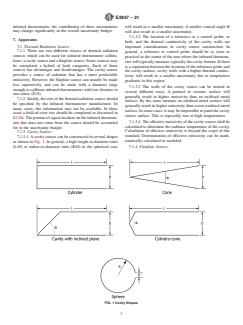
7.1.3.1 A cavity source can be constructed in several shapes as shown in Fig. 1. In general, a high length-to-diameter ratio (L:D)
FIG. 1 Cavity Shapes
E2847 − 21
or radius-to-diameter ratio (R:D) in the spherical case will result in a smaller uncertainty. A smaller conical angle Φ will also result
in a smaller uncertainty.
7.1.3.2 The location of a reference or a control probe, or both, and the thermal conductivity of the cavity walls are important
considerations in cavity source construction. In general, a reference or control probe should be as close as practical to the center
of the area where the infrared thermometer will typically measure, typically the cavity bottom. If there is a separation between the
location of the reference probe and the cavity surface, cavity walls with a higher thermal conductivity will result in a smaller
uncertainty due to temperature gradients in this region.
7.1.3.3 The walls of the cavity source can be treated in several different ways. A painted or ceramic surface will generally result
in higher emissivity than an oxidized metal surface. By the same measure an oxidized metal surface will generally result in higher
emissivity than a non-oxidized metal surface. In some cases, it may be impossible to paint the cavity source surface. This is
especially true at high temperatures.
7.1.3.4 The effective emissivity of the cavity source shall be calculated to determine the radiance temperature of the cavity.
Calculation of effective emissivity is beyond the scope of this standard. Determination of effective emissivity can be
mathematically calculated or modeled.
7.1.4 Flatplate Source:
7.1.4.1 A flatplate source is a device that consists of a painted circular or rectangular plate. The emissivity is likely to be less well
defined than with a cavity source. This can be partially overcome by performing a radiometric transfer (see Scheme II in 7.3.7)
to the flatplate source. However, the radiometric transfer should be carried out with an instrument operating over a similar spectral
band as the infrared thermometer under test.
7.1.4.2 A cavity source is the preferred radiometric source for infrared thermometer calibrations. The cavity source has two main
advantages over a flatplate source. First, the cavity source has better defined emissivity and an emissivity much closer to unity due
to its geometric shape. Second, along with the emissvity being closer to unity, the effects of reflected temperature are lessened.
Temperature uniformity on the flatplate source may be more of a concern as well. However, a flatplate source has a main advantage
over a cavity source. The temperature controlled flatplate surface can be much larger than a typical cavity source opening, allowing
for much smaller D:S ratios (greater field-of-view).
7.2 Aperture:
7.2.1 An additional aperture may not be needed for all calibrations. An aperture is typically used to control scatter. If used, the
aperture should be temperature-controlled or reflective. An aperture should be used if recommended by the infrared thermometer
manufacturer. If an aperture is used for calibration, this information should be stated in the report of calibration. The information
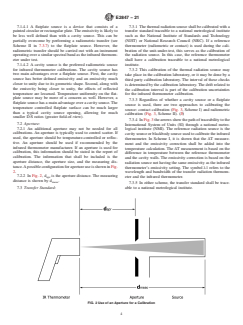
that shall be included is the aperture distance, the aperture size, and the measuring distance. A possible configuration for aperture
use is shown in Fig. 2.
7.2.2 In Fig. 2, d is the aperture distance. The measuring distance is shown by d .
apr meas
7.3 Transfer Standard:
7.3.1 The thermal radiation source shall be calibrated with a transfer standard traceable to a national metrological institute such
as the National Institute of Standards and Technology (NIST) or National Research Council (NRC). If a reference thermometer
(radiometric or contact) is used during the calibration of the unit-under-test, this serves as the calibration of the radiation source.
In this case, the reference thermometer shall have a calibration traceable to a national metrological institute.
7.3.2 This calibration of the thermal radiation source may take place in the calibration laboratory, or it may be done by a third
party calibration laboratory. The interval of these checks is determined by the calibration laboratory. The drift related to the
calibration interval is part of the calibration uncertainties for the infrared thermometer calibration.
7.3.3 Regardless of whether a cavity source or a flatplate source is used, there are two approaches to calibrating the source: contact
calibration (Fig. 3, Scheme I) and radiometric calibration (Fig. 3, Scheme II). (3)
7.3.4 In Fig. 3 the arrows show the path of traceability to the International System of Units (SI) through a national metrological
institute (NMI). The reference radiation source is the cavity source or blackbody source used to calibrate the infrared thermometer.
E2847 − 21
FIG. 2 Use of an Aperture for a Calibration
FIG. 3 Calibration Schemes I and II
In Scheme I, it is shown that the ΔT measurement and the emissivity correction shall be added into the temperature calculation.
The ΔT measurement is based on the difference in temperature between the reference thermometer and the cavity walls. The
emissivity correction is based on the radiation source not having the same emissivity as the infrared thermometer’s emissivity
setting. The symbol λ1 refers to the wavelength and bandwidth of the transfer radiation thermometer and the infrared thermometer.
7.3.5 In either scheme, the transfer standard shall be traceable to a national metrological institute.
7.3.6 In Scheme I, a contact thermometer is used as the transfer standard. The emissivity uncertainties become of greater concern.
This is especially the case when using a flatplate source.
7.3.7 In Scheme II, a radiation thermometer is used as the transfer standard. In this scheme, the emissivity and heat exchange
uncertainties are greatly reduced. This is especially significant in the case of using a flatplate source. the radiation thermometer
should operate over a similar spectral range as the infrared thermometer to be calibrated. Any differences in spectral range will
E2847 − 21
result in additional uncertaintes. For instance, if the radiation source is calibrated with an 8 to 14 μm radiation thermometer, and
an infrared thermometer with a 7 to 14 μm spectral response is being calibrated, even this difference in bandwidth shall be
accounted for in the uncertainty budget, since the radiance temperature (due mostly to the effective emissivity) will be different.
7.4 Ambient Temperature Thermometer:
7.4.1 The ambient temperature should be monitored during the calibration to ensure that it is within the laboratory’s limits. This
should be done using a calibrated thermometer. At a minimum, the laboratory’s ambient temperature limits should be recorded on
the report of calibration.
7.5 Mounting Device:
7.5.1 The infrared thermometer may be mounted on a tripod or similar mounting fixture. Mounting may not be required in the case
of a manually held calibration. In this case the hand is the mounting device.
7.6 Distance Measuring Device:
7.6.1 The distance between the radiation source and the infrared thermometer is a critical factor in calibration. This distance should
be either measured during the infrared thermometer calibration or set by fixturing. This measuring distance along with the target
size shall be recorded on the report of calibration.
7.7 Calibrations Below the Dew-Point or Frost-Point:
7.7.1 For calibrations where the set-point of the radiation source is below the dew or frost point, it may be necessary to purge the
area around the source with a dry gas such as dried nitrogen or dried air to prevent ice buildup. It may be desirable to use a vacuum
for this purpose. It is beyond the scope of this standard to recommend a specific design or method for such a purge.
8. Preparation of Apparatus
8.1 Infrared Thermometer:
8.1.1 The infrared thermometer should be allowed to reach ambient temperature before any measurements are made. The amount
of time may be specified by the manufacturer. If this is not the case, experimentation may need to be done to determine the proper
time for the device to thermally stabilize. This uncertainty should be accounted for in the ambient temperature section of the
uncertainty budget.
8.1.2 If a lens cleaning is required, it shall be performed following the manufacturer’s guidelines.
8.2 Radiation Source:
8.2.1 The radiation source should be set to the desired calibration temperature and allowed to stabilize at the set calibration
temperature. Any effects due to settling time should be accounted for in the uncertainty budget.
8.2.2 If a purge device is used with the radiation source for the calibration, it should be in place before the radiation source is
stabilized.
9. Procedure
9.1 Calibration Points:
9.1.1 The number of calibration points used during a calibration should be determined by the customer. If the customer does not
know what points to use for a calibration, a recommendation may be made. For an infrared thermometer used over a narrow range
of temperature, one point may be enough. For an infrared thermometer used over a wide range of temperature, a minimum of three
calibration points should be chosen. These points should represent at least the minimum, maximum and midpoint temperature of
the infrared thermometer usage temperature range. The usage range may not be the same as the measuring temperature range of
the infrared thermometer.
E2847 − 21
9.1.2 The order of calibration points may be arbitrary. However, it is important to note that heating of the infrared thermometer
by the calibration source may cause a condition similar to thermal shock. This is especially true when going from a calibration
source at a higher temperature to a calibration source at a lower temperature. Thus, it is best practice to calibrate at lower
temperature points before higher temperature points.
9.2 Steps 9.3 to 9.6 should be repeated for each calibration point.
9.3 Reflected Temperature:
9.3.1 If required, set the infrared thermometer’s reflected temperature setting to the radiation source’s reflected temperature. This
setting should represent the temperature of the ambient surroundings facing the thermal radiation source. The reflected temperature
setting may be called background temperature or ambient temperature on some devices. Many infrared thermometers do not have
a manual reflected temperature setting. On these devices, reflected temperature is compensated for internally.
9.4 Emissivity Setting:
9.4.1 The emissivity setting of the infrared thermometer should match the emissivity or emissivity setting of the radiation source.
9.4.2 Some infrared thermometers have a fixed emissivity setting and some radiation sources have a fixed emissivity. In a case
where both settings are fixed and are not equal, a mathematical adjustment shall be made. An example of such an adjustment can
be found in X2.3.
9.4.3 The preferred method is to adjust the infrared thermometer emissivity setting to the radiation source’s emissivity. If the
radiation source receives a contact calibration (Fig. 3, Scheme I), this emissivity would be the emissivity of the surface. If the
radiation source receives a radiometric calibration (Fig. 3, Scheme II), the emissivity would be the emissivity setting of the transfer
standard. If the emissivity setting of the infrared thermometer cannot be set exactly to the effective emissivity of the thermal
radiation source, then a correction may be made as is shown in X2.3.
9.5 Alignment:
9.5.1 Preparation:
9.5.1.1 If an additional aperture is used for the calibration, ensure that the aperture is properly emplaced at the specified distance
as shown in Fig. 2. If the aperture is temperature-controlled, ensure that the aperture is within its specified temperature limits.
9.5.1.2 In Fig. 4, the measuring distance is designated by ‘d’. The ‘X’ axis refers to the horizontal direction; the ‘Y’ axis refers
to the vertical direction; and the ‘Z’ axis refers to the direction coming out of the cavity or flat plate. In the case of the flatplate,
the ‘Z’ axis is always normal to the flatplate surface.
9.5.1.3 If a fixture is being used to hold the infrared thermometer for calibration, mount the infrared thermometer.
9.5.1.4 If the infrared thermometer calibration mounting is manual, hold the infrared thermometer in front of the radiation source
at the specified distance.
9.5.1.5 Ensure that the infrared thermometer is roughly level and normal to the target surface. Ideally, the angle between the
normal to a flatplate source and the line of sight of the infrared thermometer should be less than 5°. When using a cavity source,
the angle of incidence should be small enough to allow for the infrared thermometer’s field-of-view to see the uniform part of the
cavity bottom.
9.5.1.6 If the infrared thermometer is equipped with a lens cap, remove the lens cap before measuring.
9.5.2 ‘Z’-Axis Alignment:
9.5.2.1 Set the distance from the source using the measuring device. The distance may be measured from the aperture, from the
cavity source opening, or from the radiation source surface.
E2847 − 21
FIG. 4 Calibration Setup Showing Measuring Devices
NOTE 1—In most cases, it may not be good practice to touch the radiation source surface. In such cases, an alternate point of known distance from the
surface may be used for the distance measurement.
9.5.3 ‘X’- and ‘Y’-Axes Alignment:
9.5.3.1 Alignment in the ‘X’ and ‘Y’ directions may be done using lasers provided with the infrared thermometer or it may be done
by maximizing the signal. Use of laser pointers is a quicker method, but the laser pointer may not represent the optical center of
the infrared thermometer. A given infrared thermometer may have some other optical alignment device such as light-emitting
diodes that may be used as well. Maximizing the signal is the preferred method.
9.5.3.2 If using laser alignment, center the laser on the center of the radiation source.
9.5.3.3 If maximizing the signal, for calibration points above ambient, the position of the infrared thermometer shall be adjusted
vertically and horizontally to produce maximum temperature while also maintaining the line of sight perpendicular to the source.
This is illustrated in Fig. 5. In the example in Fig. 5, the maximum temperature observed on the infrared thermometer’s readout
is 300.3°C. For calibration points below ambient, the temperature shall be minimized.
E2847 − 21
FIG. 5 X-Y Alignment in the Maximizing Case
9.5.3.4 In cases where the size of the radiation source is much larger than the field-of-view of the radiation thermometer, the
temperature may plateau instead of reaching a simple maximum or minimum. In such cases, a defined change in temperature
should be observed while moving the infrared thermometer along an axis. Then the infrared thermometer should be centered
midway between these two points. This shall be done for both axes. This is illustrated in Fig. 6. In this case, the infrared
thermometer is moved from side to side. A plateau in the temperature readout of 300.3°C is observed. In this case the user shall
observe a drop-off in the temperature readout of 3.0°C. This means the user should be looking for a reading of 297.3°C. Points
‘A’ and ‘B’ indicate where this drop-off occurs. Point ‘C’ represents the mid-point of ‘A’ and ‘B’.
9.5.3.5 The defined change should be at least 1 % of the infrared thermometer plateau reading in °C or 1°C, whichever
...