

ASTM D5576-00(2021)e1
(Practice)Standard Practice for Determination of Structural Features in Polyolefins and Polyolefin Copolymers by Infrared Spectrophotometry (FT-IR)
General Information
- Abstract
ABSTRACT
This practice covers infrared spectrophotometry procedures for determining the molecular structural features such as types and number of branches in polyolefins and polyolefin copolymers. The structural features expressed by these determinations affect the ultimate polymeric properties and are useful in showing correlations with many performance properties. The apparatus is comprised of double beam or Fourier transform infrared spectrophotometer, hot plate, microscope slides, compression molding press, metal plates, brass shims, micrometer, and film mounts. Materials shall include polyethylene terephthalate, aluminum, or matte finished teflon-fiberglass sheet. The concentration shall be calculated using either the Beer-Lambert law with the appropriate molar absorptivity or an appropriate calibration curve.
SCOPE
1.1 This practice covers infrared procedures for determining the molecular structural features in polyolefins and polyolefin copolymers. The structural features of primary concern are the types and numbers of branches. Although this practice centers its attention on polyolefins and polyolefin copolymers, the techniques, with proper modification, can be used for some other polymers as well.
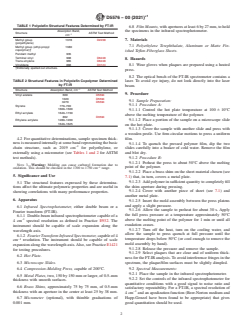
Note 1: Quantitative determinations require either an internal or an external evaluation of sample thickness. ASTM test methods available for specific features are listed in Tables 1 and 2.
1.2 This standard does not purport to address all of the safety concerns, if any, associated with its use. It is the responsibility of the user of this standard to establish appropriate safety, health, and environmental practices and determine the applicability of regulatory limitations prior to use.
Note 2: There is no known ISO equivalent to this standard.
1.3 This international standard was developed in accordance with internationally recognized principles on standardization established in the Decision on Principles for the Development of International Standards, Guides and Recommendations issued by the World Trade Organization Technical Barriers to Trade (TBT) Committee.
- Status
- Published
- Publication Date
- 14-Jan-2021
- Technical Committee
- D20 - Plastics
- Drafting Committee
- D20.70 - Analytical Methods


Overview
ASTM D5576-00(2021)e1 is the standard practice published by ASTM International for the determination of structural features in polyolefins and polyolefin copolymers using infrared spectrophotometry, particularly Fourier Transform Infrared Spectrophotometry (FT-IR). This standard outlines precise procedures to analyze the types and numbers of molecular branches within these polymers, a key factor influencing their physical and chemical properties. Infrared analysis by FT-IR provides a non-destructive, reliable method for quantifying specific structural elements, facilitating the correlation of molecular structure with polymer performance characteristics.
Key Topics
Scope of Practice
- Applies to the determination of structural features such as types and quantities of branches in polyolefins and copolymers.
- Techniques may be adapted for use with other polymer types with suitable modifications.
- Quantitative determinations require thickness evaluation-either internal (via spectral bands) or external (via micrometer).
Equipment and Materials
- Uses double beam or FT-IR spectrophotometers capable of 4 cm⁻¹ spectral resolution.
- Requires support equipment: hot plate, microscope slides, compression molding press, metal plates, brass shims, micrometer, and film mounts.
- Suitable materials for films include polyethylene terephthalate, aluminum, or matte-finished Teflon-fiberglass sheets.
Sample Preparation and Analysis
- Standardized methods for preparing uniform polymer films, ensuring reproducibility and accuracy.
- Evaluation of films involves either direct FT-IR measurement or use of calibration curves according to the Beer-Lambert law.
- Key absorption bands identified for various structural features (such as methyl, vinyl, or styrene groups).
Reporting and Safety
- Requires documented identification of material, test conditions, and observed anomalies.
- Emphasizes safety precautions, especially regarding hot equipment and optical lasers.
Applications
This standard is widely utilized in the polymers and plastics industry and in analytical laboratories for:
- Quality Control: Determining branching characteristics and structural features critical to predicting and ensuring product consistency and performance, such as density, flexibility, and melting behavior.
- Research and Development: Supporting formulation of new polyolefin materials and copolymers by correlating molecular structure with end-use properties.
- Regulatory Compliance: Ensuring standardization of procedures and facilitating comparisons across labs and manufacturing units by following well-defined ASTM methods.
- Troubleshooting and Material Identification: Quickly identifying anomalies and compositional differences in polymer samples through spectral analysis.
Related Standards
For practitioners needing to expand or complement their analysis, ASTM D5576 references several other standards, including:
- ASTM D883: Terminology Relating to Plastics
- ASTM D1505: Test Method for Density of Plastics by the Density-Gradient Technique
- ASTM D3124: Test Method for Vinylidene Unsaturation in Polyethylene by Infrared Spectrophotometry
- ASTM D5594: Test Method for Determination of the Vinyl Acetate Content of Ethylene-Vinyl Acetate (EVA) Copolymers by FT-IR
- ASTM E131 / E168: Terminology and practices for molecular spectroscopy and quantitative infrared analysis
- ASTM E932 / E1421: Practices for describing and measuring the performance of infrared and FT-IR spectrometers
Summary
ASTM D5576-00(2021)e1 ensures a consistent, scientifically proven method for characterizing the structure of polyolefins and polyolefin copolymers by FT-IR. By adhering to this standard, laboratories and manufacturers can accurately determine structural features that are critical for product performance and innovation, while aligning with industry best practices for polymer analysis and infrared spectrophotometry.
Keywords: polyolefins, polyolefin copolymers, FT-IR, infrared spectrophotometry, polymer structure, ASTM D5576, branching analysis, plastics testing, film preparation, quality control, analytical standards
Relations
- Effective Date
- 01-Apr-2024
- Effective Date
- 01-Feb-2024
- Effective Date
- 01-Nov-2023
- Effective Date
- 01-Jan-2020
- Effective Date
- 01-Nov-2019
- Effective Date
- 01-Aug-2019
- Effective Date
- 15-Apr-2019
- Effective Date
- 01-Feb-2019
- Effective Date
- 01-Dec-2018
- Effective Date
- 01-Nov-2018
- Effective Date
- 01-Aug-2018
- Refers
ASTM D1600-18 - Standard Terminology for Abbreviated Terms Relating to Plastics (Withdrawn 2024) - Effective Date
- 01-Jan-2018
- Effective Date
- 15-Aug-2017
- Effective Date
- 01-Feb-2014
- Effective Date
- 15-Apr-2013
Get Certified
Connect with accredited certification bodies for this standard

DIN CERTCO
DIN Group product certification.

Smithers Quality Assessments
US management systems and product certification.
Sponsored listings
Frequently Asked Questions
ASTM D5576-00(2021)e1 is a standard published by ASTM International. Its full title is "Standard Practice for Determination of Structural Features in Polyolefins and Polyolefin Copolymers by Infrared Spectrophotometry (FT-IR)". This standard covers: ABSTRACT This practice covers infrared spectrophotometry procedures for determining the molecular structural features such as types and number of branches in polyolefins and polyolefin copolymers. The structural features expressed by these determinations affect the ultimate polymeric properties and are useful in showing correlations with many performance properties. The apparatus is comprised of double beam or Fourier transform infrared spectrophotometer, hot plate, microscope slides, compression molding press, metal plates, brass shims, micrometer, and film mounts. Materials shall include polyethylene terephthalate, aluminum, or matte finished teflon-fiberglass sheet. The concentration shall be calculated using either the Beer-Lambert law with the appropriate molar absorptivity or an appropriate calibration curve. SCOPE 1.1 This practice covers infrared procedures for determining the molecular structural features in polyolefins and polyolefin copolymers. The structural features of primary concern are the types and numbers of branches. Although this practice centers its attention on polyolefins and polyolefin copolymers, the techniques, with proper modification, can be used for some other polymers as well. Note 1: Quantitative determinations require either an internal or an external evaluation of sample thickness. ASTM test methods available for specific features are listed in Tables 1 and 2. 1.2 This standard does not purport to address all of the safety concerns, if any, associated with its use. It is the responsibility of the user of this standard to establish appropriate safety, health, and environmental practices and determine the applicability of regulatory limitations prior to use. Note 2: There is no known ISO equivalent to this standard. 1.3 This international standard was developed in accordance with internationally recognized principles on standardization established in the Decision on Principles for the Development of International Standards, Guides and Recommendations issued by the World Trade Organization Technical Barriers to Trade (TBT) Committee.
ABSTRACT This practice covers infrared spectrophotometry procedures for determining the molecular structural features such as types and number of branches in polyolefins and polyolefin copolymers. The structural features expressed by these determinations affect the ultimate polymeric properties and are useful in showing correlations with many performance properties. The apparatus is comprised of double beam or Fourier transform infrared spectrophotometer, hot plate, microscope slides, compression molding press, metal plates, brass shims, micrometer, and film mounts. Materials shall include polyethylene terephthalate, aluminum, or matte finished teflon-fiberglass sheet. The concentration shall be calculated using either the Beer-Lambert law with the appropriate molar absorptivity or an appropriate calibration curve. SCOPE 1.1 This practice covers infrared procedures for determining the molecular structural features in polyolefins and polyolefin copolymers. The structural features of primary concern are the types and numbers of branches. Although this practice centers its attention on polyolefins and polyolefin copolymers, the techniques, with proper modification, can be used for some other polymers as well. Note 1: Quantitative determinations require either an internal or an external evaluation of sample thickness. ASTM test methods available for specific features are listed in Tables 1 and 2. 1.2 This standard does not purport to address all of the safety concerns, if any, associated with its use. It is the responsibility of the user of this standard to establish appropriate safety, health, and environmental practices and determine the applicability of regulatory limitations prior to use. Note 2: There is no known ISO equivalent to this standard. 1.3 This international standard was developed in accordance with internationally recognized principles on standardization established in the Decision on Principles for the Development of International Standards, Guides and Recommendations issued by the World Trade Organization Technical Barriers to Trade (TBT) Committee.
ASTM D5576-00(2021)e1 is classified under the following ICS (International Classification for Standards) categories: 83.080.20 - Thermoplastic materials. The ICS classification helps identify the subject area and facilitates finding related standards.
ASTM D5576-00(2021)e1 has the following relationships with other standards: It is inter standard links to ASTM D5594-18a(2024), ASTM D883-24, ASTM D883-23, ASTM D883-20, ASTM D3124-98(2019), ASTM D883-19c, ASTM D883-19a, ASTM D883-19, ASTM D883-18a, ASTM D883-18, ASTM D5594-18, ASTM D1600-18, ASTM D883-17, ASTM D1600-14, ASTM D1600-13. Understanding these relationships helps ensure you are using the most current and applicable version of the standard.
ASTM D5576-00(2021)e1 is available in PDF format for immediate download after purchase. The document can be added to your cart and obtained through the secure checkout process. Digital delivery ensures instant access to the complete standard document.
Standards Content (Sample)
This international standard was developed in accordance with internationally recognized principles on standardization established in the Decision on Principles for the
Development of International Standards, Guides and Recommendations issued by the World Trade Organization Technical Barriers to Trade (TBT) Committee.
´1
Designation: D5576 −00 (Reapproved 2021)
Standard Practice for
Determination of Structural Features in Polyolefins and
Polyolefin Copolymers by Infrared Spectrophotometry (FT-
IR)
This standard is issued under the fixed designation D5576; the number immediately following the designation indicates the year of
original adoption or, in the case of revision, the year of last revision.Anumber in parentheses indicates the year of last reapproval.A
superscript epsilon (´) indicates an editorial change since the last revision or reapproval.
ε NOTE—Table 1 was editorially updated in January and the epsilon note was added in February 2021.
1. Scope* D1600TerminologyforAbbreviatedTermsRelatingtoPlas-
tics
1.1 Thispracticecoversinfraredproceduresfordetermining
D2238TestMethodsforAbsorbanceofPolyethyleneDueto
the molecular structural features in polyolefins and polyolefin
−1 3
Methyl Groupsat 1378 cm (Withdrawn 2021)
copolymers.The structural features of primary concern are the
D3124Test Method forVinylidene Unsaturation in Polyeth-
types and numbers of branches.Although this practice centers
ylene by Infrared Spectrophotometry
its attention on polyolefins and polyolefin copolymers, the
D3594Test Method for Copolymerized Ethyl Acrylate In
techniques, with proper modification, can be used for some
Ethylene-Ethyl Acrylate Copolymers (Withdrawn 2019)
other polymers as well.
D5594Test Method for Determination of the Vinyl Acetate
NOTE 1—Quantitative determinations require either an internal or an
Content of Ethylene-VinylAcetate (EVA) Copolymers by
external evaluation of sample thickness.ASTM test methods available for
specific features are listed in Tables 1 and 2.
Fourier Transform Infrared Spectroscopy (FT-IR)
D6248Test Method for Vinyl and Trans Unsaturation in
1.2 This standard does not purport to address all of the
Polyethylene by Infrared Spectrophotometry (Withdrawn
safety concerns, if any, associated with its use. It is the
2021)
responsibility of the user of this standard to establish appro-
E131Terminology Relating to Molecular Spectroscopy
priate safety, health, and environmental practices and deter-
E168Practices for General Techniques of Infrared Quanti-
mine the applicability of regulatory limitations prior to use.
tative Analysis
NOTE 2—There is no known ISO equivalent to this standard.
E932PracticeforDescribingandMeasuringPerformanceof
1.3 This international standard was developed in accor-
Dispersive Infrared Spectrometers
dance with internationally recognized principles on standard-
E1421Practice for Describing and Measuring Performance
ization established in the Decision on Principles for the
of Fourier Transform Mid-Infrared (FT-MIR) Spectrom-
Development of International Standards, Guides and Recom-
eters: Level Zero and Level One Tests
mendations issued by the World Trade Organization Technical
IEEE/ASTMSI-10Standard for Use of the International
Barriers to Trade (TBT) Committee.
System of Units (SI): The Modern System
2. Referenced Documents
3. Terminology
2.1 ASTM Standards:
3.1 Definitions—For definitions of plastics terms used in
D883Terminology Relating to Plastics
this practice see Terminology D883 and D1600.
D1505Test Method for Density of Plastics by the Density-
3.2 Units, symbols and abbreviations used in this practice
Gradient Technique
appear in Terminology E131 or IEEE/ASTMSI-10.
4. Summary of Practice
ThispracticeisunderthejurisdictionofASTMCommitteeD20onPlasticsand
4.1 Infrared absorption bands suitable for quantitative
is the direct responsibility of Subcommittee D20.70 on Analytical Methods.
analysis by FT-IR are listed in Tables 1 and 2. These are only
Current edition approved Jan. 15, 2021. Published January 2021. Originally
approved in 1994. Last previous edition approved in 2013 as D5576-00(2013).
typical bands and are not to be construed as exhaustive.
DOI: 10.1520/D5576-00R21E01.
For referenced ASTM standards, visit the ASTM website, www.astm.org, or
contact ASTM Customer Service at service@astm.org. For Annual Book of ASTM
Standards volume information, refer to the standard’s Document Summary page on The last approved version of this historical standard is referenced on
the ASTM website. www.astm.org.
*A Summary of Changes section appears at the end of this standard
Copyright © ASTM International, 100 Barr Harbor Drive, PO Box C700, West Conshohocken, PA 19428-2959. United States
´1
D5576 − 00 (2021)
TABLE 1 Polyolefin Structural Features Determined by FT-IR
6.8 Film Mounts,withaperturesatleast6by27mm,tohold
Absorption Band, the specimens in the infrared spectrophotometer.
Structure ASTM Test Method
–1
cm
7. Materials
Methyl group 1378 D2238
(polyethylene)
7.1 Polyethylene Terephthalate, Aluminum or Matte Fin-
Methyl group (ethyl-propyl 1380
copolymer)†
ished Teflon-Fiberglass Sheets.
Pendant methyl 935
Terminal vinyl 908 D6248
8. Hazards
Trans-vinylene 965 D6248
Vinylidene 888 D3124
8.1 Wear gloves when plaques are prepared using a heated
†Editorially spelled out structure.
press.
8.2 The optical bench of the FT-IR spectrometer contains a
TABLE 2 Structural Features in Polyolefin Copolymer Determined
laser. To avoid eye injury, do not look directly into the laser
by FT-IR
beam.
–1
Structure Absorption Band, cm ASTM Test Method
9. Procedure
Vinyl acetate 609 D5594
1020 D5594
9.1 Sample Preparation:
3270 D5594
9.1.1 Procedure A:
Styrene 770–700
1600–1500
9.1.1.1 Control the hot plate temperature at 100 610°C
Ethyl acrylate 1640–1730
above the melting temperature of the polymer.
862 D3594
9.1.1.2 Place a portion of the sample on a microscope slide
Ethylene acrylate 1280–1200
1640–1625
on the hot plate.
9.1.1.3 Cover the sample with another slide and press with
a wooden pestle. Use firm circular motions to press a uniform
4.2 Forquantitativedeterminations,samplespecimenthick-
film.
nessismeasuredinternallyatsomebandrepresentingthebasic 9.1.1.4 To quench the
...