

ASTM D2149-13(2021)
(Test Method)Standard Test Method for Permittivity (Dielectric Constant) and Dissipation Factor of Solid Dielectrics at Frequencies to 10 MHz and Temperatures to 500 °C
General Information
- Abstract
SIGNIFICANCE AND USE
4.1 Permittivity and dissipation factor are sensitive to changes in chemical composition, impurities, and homogeneity. Measurement of these properties is, therefore, useful for quality control and for determining the effect of environments such as moisture, heat, or radiation.
SCOPE
1.1 This test method covers the determination of the relative permittivity (dielectric constant) and dissipation factor of solid dielectrics from 50 Hz to 10 MHz over a range of temperatures from −80 to 500 °C.2,3 Two procedures are included as follows:
1.1.1 Procedure A—Using Micrometer Electrode.
1.1.2 Procedure B—Using Precision Capacitor.
Note 1: In common usage the word “relative” is frequently dropped.
1.2 This standard does not purport to address all of the safety concerns, if any, associated with its use. It is the responsibility of the user of this standard to establish appropriate safety, health, and environmental practices and determine the applicability of regulatory limitations prior to use.
1.3 This international standard was developed in accordance with internationally recognized principles on standardization established in the Decision on Principles for the Development of International Standards, Guides and Recommendations issued by the World Trade Organization Technical Barriers to Trade (TBT) Committee.
- Status
- Published
- Publication Date
- 28-Feb-2021
- Technical Committee
- D09 - Electrical and Electronic Insulating Materials
- Drafting Committee
- D09.12 - Electrical Tests

Overview
ASTM D2149-13(2021) is an internationally recognized standard developed by ASTM International. This standard outlines the test methods for determining the permittivity (dielectric constant) and dissipation factor of solid dielectric materials over a broad frequency range (50 Hz to 10 MHz) and an extensive temperature span (−80°C to 500°C). These measurements are crucial for assessing the electrical insulation qualities of materials, which is vital for quality control and understanding the influence of environmental factors such as moisture, heat, and radiation.
Key Topics
- Permittivity and Dielectric Constant: The standard provides procedures for measuring the relative permittivity of solid insulation, a key property indicating how much electric charge a material can store.
- Dissipation Factor: This is the ratio of resistive (lossy) to capacitive (energy-storing) currents and reflects dielectric losses in the material.
- Frequency and Temperature Ranges: The procedures cover measurements from 50 Hz up to 10 MHz and from −80°C up to 500°C, addressing a wide variety of real-world conditions.
- Measurement Procedures:
- Procedure A: Utilizes a micrometer electrode arrangement.
- Procedure B: Employs a precision capacitor, suitable for stable frequency measurements.
- Specimen Preparation and Conditioning: The standard specifies requirements for test specimens, including size, surface finish, and pre-conditioning to ensure reliable and repeatable results.
- Instrumentation and Calibration: Recommendations for measuring circuits, specimen holders, and temperature-controlled environments are provided to minimize measurement errors.
Applications
ASTM D2149-13(2021) is primarily used for:
- Quality Control: Regular measurement of permittivity and dissipation factor reveals changes in material composition, impurities, or inhomogeneities, ensuring consistent product performance.
- Research and Development: Materials scientists and engineers use this test method to evaluate how electrical insulation properties vary with frequency, temperature, and environmental exposure.
- Material Comparison: The standard allows for direct comparison between different solid dielectrics, helping select optimal materials for electrical and electronic applications.
- Environmental Testing: By measuring properties under varying conditions, manufacturers can determine how materials respond to moisture, heat, or radiation, supporting durability assessments and product certification.
- Industrial Sectors: Widely adopted in the electrical, electronics, and power generation industries where reliable insulation materials are critical to operational safety and efficiency.
Related Standards
Several other ASTM and international standards complement or reference the procedures described in ASTM D2149-13(2021):
- ASTM D150: Test Methods for AC Loss Characteristics and Permittivity (Dielectric Constant) of Solid Electrical Insulation
- ASTM D1711: Terminology Relating to Electrical Insulation
- ASTM E197: Specification for Enclosures and Servicing Units for Electrical and Electronic Equipment
- ISO/IEC Standards: International standards on dielectric testing and electrical insulation may also align with the measurement principles of ASTM D2149-13(2021).
By adhering to the protocols of ASTM D2149-13(2021), organizations ensure precise, reproducible measurement of dielectric properties, supporting informed material selection, effective quality assurance, and compliance with global industry requirements.
Keywords: ASTM D2149-13, dielectric constant, permittivity, dissipation factor, solid dielectrics, electrical insulation testing, dielectric loss, precision capacitor, micrometer electrode, high temperature dielectric testing.
Relations
- Effective Date
- 01-Mar-2024
- Effective Date
- 01-Nov-2015
- Effective Date
- 01-Nov-2014
- Effective Date
- 01-May-2014
- Effective Date
- 01-Nov-2013
- Effective Date
- 01-Aug-2011
- Effective Date
- 01-May-2008
- Effective Date
- 01-Mar-2004
- Effective Date
- 10-Mar-2002
- Effective Date
- 10-Oct-1999
- Effective Date
- 10-Feb-1998
Get Certified
Connect with accredited certification bodies for this standard

IMQ S.p.A. (Certification)
Italian electrical product certification.

SLG Prüf- und Zertifizierungs GmbH
German testing and certification body.

UL Solutions
Global safety science company with testing, inspection and certification.
Sponsored listings
Frequently Asked Questions
ASTM D2149-13(2021) is a standard published by ASTM International. Its full title is "Standard Test Method for Permittivity (Dielectric Constant) and Dissipation Factor of Solid Dielectrics at Frequencies to 10 MHz and Temperatures to 500 °C". This standard covers: SIGNIFICANCE AND USE 4.1 Permittivity and dissipation factor are sensitive to changes in chemical composition, impurities, and homogeneity. Measurement of these properties is, therefore, useful for quality control and for determining the effect of environments such as moisture, heat, or radiation. SCOPE 1.1 This test method covers the determination of the relative permittivity (dielectric constant) and dissipation factor of solid dielectrics from 50 Hz to 10 MHz over a range of temperatures from −80 to 500 °C.2,3 Two procedures are included as follows: 1.1.1 Procedure A—Using Micrometer Electrode. 1.1.2 Procedure B—Using Precision Capacitor. Note 1: In common usage the word “relative” is frequently dropped. 1.2 This standard does not purport to address all of the safety concerns, if any, associated with its use. It is the responsibility of the user of this standard to establish appropriate safety, health, and environmental practices and determine the applicability of regulatory limitations prior to use. 1.3 This international standard was developed in accordance with internationally recognized principles on standardization established in the Decision on Principles for the Development of International Standards, Guides and Recommendations issued by the World Trade Organization Technical Barriers to Trade (TBT) Committee.
SIGNIFICANCE AND USE 4.1 Permittivity and dissipation factor are sensitive to changes in chemical composition, impurities, and homogeneity. Measurement of these properties is, therefore, useful for quality control and for determining the effect of environments such as moisture, heat, or radiation. SCOPE 1.1 This test method covers the determination of the relative permittivity (dielectric constant) and dissipation factor of solid dielectrics from 50 Hz to 10 MHz over a range of temperatures from −80 to 500 °C.2,3 Two procedures are included as follows: 1.1.1 Procedure A—Using Micrometer Electrode. 1.1.2 Procedure B—Using Precision Capacitor. Note 1: In common usage the word “relative” is frequently dropped. 1.2 This standard does not purport to address all of the safety concerns, if any, associated with its use. It is the responsibility of the user of this standard to establish appropriate safety, health, and environmental practices and determine the applicability of regulatory limitations prior to use. 1.3 This international standard was developed in accordance with internationally recognized principles on standardization established in the Decision on Principles for the Development of International Standards, Guides and Recommendations issued by the World Trade Organization Technical Barriers to Trade (TBT) Committee.
ASTM D2149-13(2021) is classified under the following ICS (International Classification for Standards) categories: 29.035.30 - Glass and ceramic insulating materials. The ICS classification helps identify the subject area and facilitates finding related standards.
ASTM D2149-13(2021) has the following relationships with other standards: It is inter standard links to ASTM D1711-24, ASTM D1711-15, ASTM D1711-14a, ASTM D1711-14, ASTM D1711-13, ASTM D1711-11a, ASTM D1711-08, ASTM D150-98(2004), ASTM D1711-02, ASTM D1711-99, ASTM D150-98. Understanding these relationships helps ensure you are using the most current and applicable version of the standard.
ASTM D2149-13(2021) is available in PDF format for immediate download after purchase. The document can be added to your cart and obtained through the secure checkout process. Digital delivery ensures instant access to the complete standard document.
Standards Content (Sample)
This international standard was developed in accordance with internationally recognized principles on standardization established in the Decision on Principles for the
Development of International Standards, Guides and Recommendations issued by the World Trade Organization Technical Barriers to Trade (TBT) Committee.
Designation: D2149 − 13 (Reapproved 2021)
Standard Test Method for
Permittivity (Dielectric Constant) and Dissipation Factor of
Solid Dielectrics at Frequencies to 10 MHz and
Temperatures to 500 °C
This standard is issued under the fixed designation D2149; the number immediately following the designation indicates the year of
original adoption or, in the case of revision, the year of last revision.Anumber in parentheses indicates the year of last reapproval.A
superscript epsilon (´) indicates an editorial change since the last revision or reapproval.
1. Scope Tests Above and Below Room Temperature (Withdrawn
1981)
1.1 Thistestmethodcoversthedeterminationoftherelative
permittivity (dielectric constant) and dissipation factor of solid
3. Terminology
dielectricsfrom50Hzto10MHzoverarangeoftemperatures
2,3
3.1 Definitions:
from−80to500°C. Twoproceduresareincludedasfollows:
3.1.1 Permittivity and dissipation factor are fully defined in
1.1.1 Procedure A—Using Micrometer Electrode.
Terminology D1711. Briefly, the permittivity of an insulating
1.1.2 Procedure B—Using Precision Capacitor.
materialistheratioofthecapacitancebetweentwoconductors
NOTE 1—In common usage the word “relative” is frequently dropped.
when embedded in the material to the capacitance between the
1.2 This standard does not purport to address all of the
same configuration of conductors in a vacuum (or air). The
safety concerns, if any, associated with its use. It is the
dissipation factor is the ratio of the resistive to capacitive
responsibility of the user of this standard to establish appro-
currents in the dielectric. The product of the permittivity and
priate safety, health, and environmental practices and deter-
dissipation factor is the loss index.
mine the applicability of regulatory limitations prior to use.
1.3 This international standard was developed in accor-
4. Significance and Use
dance with internationally recognized principles on standard-
4.1 Permittivity and dissipation factor are sensitive to
ization established in the Decision on Principles for the
changes in chemical composition, impurities, and homogene-
Development of International Standards, Guides and Recom-
ity. Measurement of these properties is, therefore, useful for
mendations issued by the World Trade Organization Technical
quality control and for determining the effect of environments
Barriers to Trade (TBT) Committee.
such as moisture, heat, or radiation.
2. Referenced Documents
5. Apparatus
2.1 ASTM Standards:
5.1 Measuring Circuits—Suitable measuring circuits are
D150Test Methods forAC Loss Characteristics and Permit-
described in Test Methods D150. For measurements from
tivity (Dielectric Constant) of Solid Electrical Insulation
50Hz to 100 kHz a substitution method using a low-voltage
D1711Terminology Relating to Electrical Insulation
capacitance bridge is recommended. For measurements at
E197Specification for Enclosures and Servicing Units for
1MHz and above, a resonant-circuit susceptance variation
method is recommended.The Q of the circuit has to be at least
1 200exceptforverylowlossmaterials,forwhicha Qof500or
This test method is under the jurisdiction of ASTM Committee D09 on
Electrical and Electronic Insulating Materials and is the direct responsibility of
higher is desirable.
Subcommittee D09.12 on Electrical Tests.
5.2 Test Enclosure—Unless testing only at room
Current edition approved March 1, 2021. Published May 2021. Originally
approved in 1963. Last previous edition approved in 2013 as D2149–13. DOI:
temperature, it is necessary to adapt a Hartshorn-Ward type
10.1520/D2149-13R21.
specimen holder to a temperature-controlled test enclosure.
“Alternating-Current Loss and Permittivity Measurements,” Chapter 2 of
Whereapplicable,usetherequirementsforagradeAenclosure
Engineering Dielectrics Volume IIB Electrical Properties of Solid Insulating
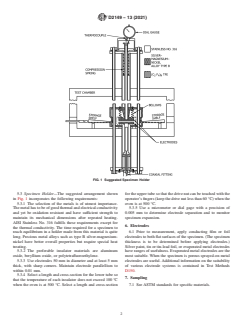
as in Specification E197.Asuggested arrangement is shown in
Materials: Measurement Techniques, ASTM STP 926, ASTM International, 1987.
“Dielectric Loss in Solids,” Chapter 1 of Engineering Dielectrics Volume IIA
Fig. 1. This arrangement provides terminal connections away
Electrical Properties of Solid Insulating Materials: Molecular Structure and
from the temperature zone.
Electrical Behavior, ASTM STP 783, ASTM International, 1983.
For referenced ASTM standards, visit the ASTM website, www.astm.org, or
contact ASTM Customer Service at service@astm.org. For Annual Book of ASTM
Standards volume information, refer to the standard’s Document Summary page on The last approved version of this historical standard is referenced on
the ASTM website. www.astm.org.
Copyright © ASTM International, 100 Barr Harbor Drive, PO Box C700, West Conshohocken, PA 19428-2959. United States
D2149 − 13 (2021)
FIG. 1 Suggested Specimen Holder
5.3 Specimen Holder—The suggested arrangement shown for the upper tube so that the drive nut can be touched with the
in Fig. 1 incorporates the following requirements: operator’sfingers(keepthedrivenutlessthan60°C)whenthe
5.3.1 The selection of the metals is of utmost importance. oven is at 500 °C.
Themetalhastobeofgoodthermalandelectricalconductivity 5.3.5 Use a micrometer or dial gage with a precision of
and yet be oxidation resistant and have sufficient strength to 0.005 mm to determine electrode separation and to monitor
maintain its mechanical dimensions after repeated heating. specimen expansion.
AISI Stainless No. 316 fulfills these requirements except for
6. Electrodes
the thermal conductivity. The time required for a specimen to
reach equilibrium in a holder made from this material is quite 6.1 Prior to measurement, apply conducting film or foil
long. Precious metal alloys such as type B silver-magnesium- electrodestobothflatsurfacesofthespecimen.(Thespecimen
nickel have better overall properties but require special heat thickness is to be determined before applying electrodes.)
treating. Silver paint, tin or tin-lead foil, or evaporated metal electrodes
5.3.2 The preferable insulator materials are aluminum have ranges of usefulness. Evaporated metal electrodes are the
oxide, beryllium oxide, or polytetrafluoroethylene. most suitable. When the specimen is porous sprayed-on metal
5.3.3 Use electrodes 50 mm in diameter and at least 5 mm
electrodes are useful.Additional information on the suitability
thick, with sharp corners. Maintain electrode parallellism to of various electrode systems is contained in Test Methods
within 0.01 mm.
D150.
5.3.4 Select a length and cross-section for the lower tube so
7. Sampling
that the temperature of each insulator does not exceed 100°C
when the oven is at 500 °C. Select a length and cross-section 7.1 See ASTM standards for specific materials.
D2149 − 13 (2021)
8. Test Specimen 13. Procedure B (Using Precision Capacitor)
13.1 Procedure B can be used when the frequency can be
8.1 Use a disk test specimen with a diameter of 40.00 6
0.01 mm and a thickness of 2 to 3 mm. Finish the surfaces to keptconstantorwhenthemeasuringcircuit,asisthecasewith
thebridges,isstablewithfrequencychanges.Inthisprocedure
1.8 µm or better and maintain parallel surfaces to within
0.01mm. The samples have to be free of bubbles and other determine the ∆C at room temperature for each frequency
required as in Procedure A. Then center and clamp the
def
...