

ASTM D6839-21a
(Test Method)Standard Test Method for Hydrocarbon Types, Oxygenated Compounds, Benzene, and Toluene in Spark Ignition Engine Fuels by Multidimensional Gas Chromatography
General Information
- Abstract
SIGNIFICANCE AND USE
5.1 A knowledge of spark-ignition engine fuel composition is useful for regulatory compliance, process control, and quality assurance.
5.2 The quantitative determination of olefins and other hydrocarbon types in spark-ignition engine fuels is required to comply with government regulations.
5.3 This test method is not applicable to M85 fuels, which contain 85 % methanol.
SCOPE
1.1 This test method covers the quantitative determination of saturates, olefins, aromatics, and oxygenates in spark-ignition engine fuels by multidimensional gas chromatography. Each hydrocarbon type can be reported either by carbon number (see Note 1) or as a total.
Note 1: There can be an overlap between the C9 and C10 aromatics; however, the total is accurate. Isopropyl benzene is resolved from the C8 aromatics and is included with the other C9 aromatics.
1.2 This test method is not intended to determine individual hydrocarbon components except benzene and toluene.
1.3 This test method is divided into two parts, Part A and Part B.
1.3.1 Part A is applicable to the concentration ranges for which precision (Table 10 and Table 11) has been obtained:
Property
Units
Applicable range
Total aromatics
Volume %
19.32 to 46.29
Total saturates
Volume %
26.85 to 79.31
Total olefins
Volume %
0.40 to 26.85
Oxygenates
Volume %
0.61 to 9.85
Oxygen Content
Mass %
2.01 to 12.32
Benzene
Volume %
0.38 to 1.98
Toluene
Volume %
5.85 to 31.65
Methanol
Volume %
1.05 to 16.96
Ethanol
Volume %
0.50 to 17.86
MTBE
Volume %
0.99 to 15.70
ETBE
Volume %
0.99 to 15.49
TAME
Volume %
0.99 to 5.92
TAEE
Volume %
0.98 to 15.59
1.3.1.1 This test method is specifically developed for the analysis of automotive motor gasoline that contains oxygenates, but it also applies to other hydrocarbon streams having similar boiling ranges, such as naphthas and reformates.
1.3.2 Part B describes the procedure for the analysis of oxygenated groups (ethanol, methanol, ethers, C3 to C5 alcohols) in ethanol fuels containing an ethanol volume fraction between 50 % and 85 % (17 % to 29 % oxygen). The gasoline is diluted with an oxygenate-free component to lower the ethanol content to a value below 20 % before the analysis by GC. The diluting solvent should not be considered in the integration, this makes it possible to report the results of the undiluted sample after normalization to 100 %.
1.4 Oxygenates as specified in Test Method D4815 have been verified not to interfere with hydrocarbons. Within the round robin sample set, the following oxygenates have been tested: MTBE, ethanol, ETBE, TAME, iso-propanol, isobutanol, tert-butanol and methanol. Applicability of this test method has also been verified for the determination of n-propanol, acetone, and di-isopropyl ether (DIPE). However, no precision data have been determined for these compounds.
1.4.1 Other oxygenates can be determined and quantified using Test Method D4815 or D5599.
1.5 The method is harmonized with ISO 22854.
1.6 This test method includes a relative bias section for U.S. EPA spark-ignition engine fuel regulations for total olefins reporting based on Practice D6708 accuracy assessment between Test Method D6839 and Test Method D1319 as a possible Test Method D6839 alternative to Test Method D1319. The Practice D6708 derived correlation equation is only applicable for fuels in the total olefins concentration range from 0.2 % to 18.2 % by volume as measured by Test Method D6839. The applicable Test Method D1319 range for total olefins is from 0.6 % to 20.6 % by volume as reported by Test Method D1319.
1.7 This test method includes a relative bias section for reporting benzene based on Practice D6708 accuracy assessment between Test Method D6839 and Test Method D3606 (Procedure B) as a possible Test Method D6839 alternativ...
- Status
- Published
- Publication Date
- 30-Apr-2021
- Technical Committee
- D02 - Petroleum Products, Liquid Fuels, and Lubricants
- Drafting Committee
- D02.04.0L - Gas Chromatography Methods
Buy Documents
ASTM D6839-21a - Standard Test Method for Hydrocarbon Types, Oxygenated Compounds, Benzene, and Toluene in Spark Ignition Engine Fuels by Multidimensional Gas Chromatography
REDLINE ASTM D6839-21a - Standard Test Method for Hydrocarbon Types, Oxygenated Compounds, Benzene, and Toluene in Spark Ignition Engine Fuels by Multidimensional Gas Chromatography
Overview
ASTM D6839-21a outlines the standard test method for determining hydrocarbon types, oxygenated compounds, benzene, and toluene in spark-ignition engine fuels by multidimensional gas chromatography (GC). Developed by ASTM International, this method provides a robust approach for quantitatively analyzing the composition of automotive gasoline and similar fuel streams, including naphthas and reformates. It is widely used for regulatory compliance, process control, and quality assurance in the petroleum and fuel industries.
Key Topics
- Hydrocarbon Group Determination: Quantitative analysis of saturates, olefins, aromatics, and oxygenates, providing insight into total content or by carbon number.
- Benzene and Toluene Measurement: Specific measurement of benzene and toluene to meet strict environmental and regulatory requirements.
- Oxygenate Analysis: Determines concentration of oxygenates such as ethanol, methanol, MTBE, ETBE, TAME, and TAEE, ensuring fuels are within regulatory standards for oxygen content.
- Multidimensional Gas Chromatography: Utilizes a GC system with specialized columns, traps, and hydrogenation catalysts, managed by computer-controlled switching valves and temperature programming for group separation and quantification.
- Applicability Range: Suitable for automotive motor gasoline with oxygenate content and similar boiling range hydrocarbon streams, but not applicable to fuels containing 85% methanol (M85).
- Precision and Bias: Includes procedures for bias assessment, referencing other ASTM and ISO methods (e.g., D1319, D3606, D5580, D5769, D6550), and leverages Practice D6708 for correlation and accuracy.
Applications
- Regulatory Compliance: Supports conformance with government requirements for the allowable content of olefins, aromatics, oxygenates, benzene, and toluene in spark-ignition fuels.
- Process Control: Enables refineries and petrochemical plants to monitor and optimize the composition of gasoline and light hydrocarbon streams for both performance and emissions criteria.
- Fuel Quality Assurance: Provides reliable means to assess finished gasoline for key compositional metrics, ensuring product consistency and consumer safety.
- Alternative Fuel Analysis: Applicable to fuels containing ethanol (up to 85%), with appropriate dilution and normalization, aiding in the analysis of modern blended fuels and biofuels.
- Method Harmonization: Aligned with ISO 22854, allowing for harmonized global application and traceability of results.
Related Standards
- ASTM D1319 - Hydrocarbon types in liquid petroleum by fluorescent indicator adsorption.
- ASTM D3606 - Benzene and toluene determination in spark-ignition fuels by gas chromatography.
- ASTM D4815 - MTBE, ETBE, TAME, DIPE, and C1-C4 alcohols in gasoline by GC.
- ASTM D5580 - Aromatic content in gasoline by gas chromatography.
- ASTM D5599 - Oxygenates in gasoline by GC and flame ionization.
- ASTM D5769 - Benzene, toluene, and aromatics in gasoline by GC/MS.
- ASTM D6550 - Olefin content of gasolines by supercritical-fluid chromatography.
- ASTM D6708 - Statistical assessment for agreement between two test methods.
- ISO 22854 - Liquid petroleum products - Determination of hydrocarbon types and oxygenates in automotive gasoline by multidimensional gas chromatography.
Practical Value
ASTM D6839-21a is a fundamental method for laboratories and refineries seeking to achieve precise, repeatable, and traceable measurement of key fuel components. Its application ensures compliance with environmental standards while facilitating process optimization and quality control for gasoline and related fuel products. By leveraging advanced multidimensional gas chromatography, this standard offers streamlined, group-type determinations critical for the certification and regulation of modern fuels, supporting both operational efficiency and regulatory adherence in the global fuel supply chain.
Relations
- Effective Date
- 01-Mar-2024
- Effective Date
- 01-Mar-2024
- Effective Date
- 01-May-2019
- Effective Date
- 01-Apr-2018
- Effective Date
- 01-May-2017
- Effective Date
- 01-Apr-2016
- Effective Date
- 01-Jan-2016
- Effective Date
- 01-Dec-2015
- Effective Date
- 01-Oct-2015
- Effective Date
- 01-Jul-2015
- Effective Date
- 01-Jun-2015
- Effective Date
- 01-Jun-2015
- Effective Date
- 01-Apr-2015
- Effective Date
- 01-Oct-2014
- Effective Date
- 01-May-2013
Buy Documents
ASTM D6839-21a - Standard Test Method for Hydrocarbon Types, Oxygenated Compounds, Benzene, and Toluene in Spark Ignition Engine Fuels by Multidimensional Gas Chromatography
REDLINE ASTM D6839-21a - Standard Test Method for Hydrocarbon Types, Oxygenated Compounds, Benzene, and Toluene in Spark Ignition Engine Fuels by Multidimensional Gas Chromatography
Get Certified
Connect with accredited certification bodies for this standard

ECOCERT
Organic and sustainability certification.

Eurofins Food Testing Global
Global leader in food, environment, and pharmaceutical product testing.

Intertek Bangladesh
Intertek certification and testing services in Bangladesh.
Sponsored listings
Frequently Asked Questions
ASTM D6839-21a is a standard published by ASTM International. Its full title is "Standard Test Method for Hydrocarbon Types, Oxygenated Compounds, Benzene, and Toluene in Spark Ignition Engine Fuels by Multidimensional Gas Chromatography". This standard covers: SIGNIFICANCE AND USE 5.1 A knowledge of spark-ignition engine fuel composition is useful for regulatory compliance, process control, and quality assurance. 5.2 The quantitative determination of olefins and other hydrocarbon types in spark-ignition engine fuels is required to comply with government regulations. 5.3 This test method is not applicable to M85 fuels, which contain 85 % methanol. SCOPE 1.1 This test method covers the quantitative determination of saturates, olefins, aromatics, and oxygenates in spark-ignition engine fuels by multidimensional gas chromatography. Each hydrocarbon type can be reported either by carbon number (see Note 1) or as a total. Note 1: There can be an overlap between the C9 and C10 aromatics; however, the total is accurate. Isopropyl benzene is resolved from the C8 aromatics and is included with the other C9 aromatics. 1.2 This test method is not intended to determine individual hydrocarbon components except benzene and toluene. 1.3 This test method is divided into two parts, Part A and Part B. 1.3.1 Part A is applicable to the concentration ranges for which precision (Table 10 and Table 11) has been obtained: Property Units Applicable range Total aromatics Volume % 19.32 to 46.29 Total saturates Volume % 26.85 to 79.31 Total olefins Volume % 0.40 to 26.85 Oxygenates Volume % 0.61 to 9.85 Oxygen Content Mass % 2.01 to 12.32 Benzene Volume % 0.38 to 1.98 Toluene Volume % 5.85 to 31.65 Methanol Volume % 1.05 to 16.96 Ethanol Volume % 0.50 to 17.86 MTBE Volume % 0.99 to 15.70 ETBE Volume % 0.99 to 15.49 TAME Volume % 0.99 to 5.92 TAEE Volume % 0.98 to 15.59 1.3.1.1 This test method is specifically developed for the analysis of automotive motor gasoline that contains oxygenates, but it also applies to other hydrocarbon streams having similar boiling ranges, such as naphthas and reformates. 1.3.2 Part B describes the procedure for the analysis of oxygenated groups (ethanol, methanol, ethers, C3 to C5 alcohols) in ethanol fuels containing an ethanol volume fraction between 50 % and 85 % (17 % to 29 % oxygen). The gasoline is diluted with an oxygenate-free component to lower the ethanol content to a value below 20 % before the analysis by GC. The diluting solvent should not be considered in the integration, this makes it possible to report the results of the undiluted sample after normalization to 100 %. 1.4 Oxygenates as specified in Test Method D4815 have been verified not to interfere with hydrocarbons. Within the round robin sample set, the following oxygenates have been tested: MTBE, ethanol, ETBE, TAME, iso-propanol, isobutanol, tert-butanol and methanol. Applicability of this test method has also been verified for the determination of n-propanol, acetone, and di-isopropyl ether (DIPE). However, no precision data have been determined for these compounds. 1.4.1 Other oxygenates can be determined and quantified using Test Method D4815 or D5599. 1.5 The method is harmonized with ISO 22854. 1.6 This test method includes a relative bias section for U.S. EPA spark-ignition engine fuel regulations for total olefins reporting based on Practice D6708 accuracy assessment between Test Method D6839 and Test Method D1319 as a possible Test Method D6839 alternative to Test Method D1319. The Practice D6708 derived correlation equation is only applicable for fuels in the total olefins concentration range from 0.2 % to 18.2 % by volume as measured by Test Method D6839. The applicable Test Method D1319 range for total olefins is from 0.6 % to 20.6 % by volume as reported by Test Method D1319. 1.7 This test method includes a relative bias section for reporting benzene based on Practice D6708 accuracy assessment between Test Method D6839 and Test Method D3606 (Procedure B) as a possible Test Method D6839 alternativ...
SIGNIFICANCE AND USE 5.1 A knowledge of spark-ignition engine fuel composition is useful for regulatory compliance, process control, and quality assurance. 5.2 The quantitative determination of olefins and other hydrocarbon types in spark-ignition engine fuels is required to comply with government regulations. 5.3 This test method is not applicable to M85 fuels, which contain 85 % methanol. SCOPE 1.1 This test method covers the quantitative determination of saturates, olefins, aromatics, and oxygenates in spark-ignition engine fuels by multidimensional gas chromatography. Each hydrocarbon type can be reported either by carbon number (see Note 1) or as a total. Note 1: There can be an overlap between the C9 and C10 aromatics; however, the total is accurate. Isopropyl benzene is resolved from the C8 aromatics and is included with the other C9 aromatics. 1.2 This test method is not intended to determine individual hydrocarbon components except benzene and toluene. 1.3 This test method is divided into two parts, Part A and Part B. 1.3.1 Part A is applicable to the concentration ranges for which precision (Table 10 and Table 11) has been obtained: Property Units Applicable range Total aromatics Volume % 19.32 to 46.29 Total saturates Volume % 26.85 to 79.31 Total olefins Volume % 0.40 to 26.85 Oxygenates Volume % 0.61 to 9.85 Oxygen Content Mass % 2.01 to 12.32 Benzene Volume % 0.38 to 1.98 Toluene Volume % 5.85 to 31.65 Methanol Volume % 1.05 to 16.96 Ethanol Volume % 0.50 to 17.86 MTBE Volume % 0.99 to 15.70 ETBE Volume % 0.99 to 15.49 TAME Volume % 0.99 to 5.92 TAEE Volume % 0.98 to 15.59 1.3.1.1 This test method is specifically developed for the analysis of automotive motor gasoline that contains oxygenates, but it also applies to other hydrocarbon streams having similar boiling ranges, such as naphthas and reformates. 1.3.2 Part B describes the procedure for the analysis of oxygenated groups (ethanol, methanol, ethers, C3 to C5 alcohols) in ethanol fuels containing an ethanol volume fraction between 50 % and 85 % (17 % to 29 % oxygen). The gasoline is diluted with an oxygenate-free component to lower the ethanol content to a value below 20 % before the analysis by GC. The diluting solvent should not be considered in the integration, this makes it possible to report the results of the undiluted sample after normalization to 100 %. 1.4 Oxygenates as specified in Test Method D4815 have been verified not to interfere with hydrocarbons. Within the round robin sample set, the following oxygenates have been tested: MTBE, ethanol, ETBE, TAME, iso-propanol, isobutanol, tert-butanol and methanol. Applicability of this test method has also been verified for the determination of n-propanol, acetone, and di-isopropyl ether (DIPE). However, no precision data have been determined for these compounds. 1.4.1 Other oxygenates can be determined and quantified using Test Method D4815 or D5599. 1.5 The method is harmonized with ISO 22854. 1.6 This test method includes a relative bias section for U.S. EPA spark-ignition engine fuel regulations for total olefins reporting based on Practice D6708 accuracy assessment between Test Method D6839 and Test Method D1319 as a possible Test Method D6839 alternative to Test Method D1319. The Practice D6708 derived correlation equation is only applicable for fuels in the total olefins concentration range from 0.2 % to 18.2 % by volume as measured by Test Method D6839. The applicable Test Method D1319 range for total olefins is from 0.6 % to 20.6 % by volume as reported by Test Method D1319. 1.7 This test method includes a relative bias section for reporting benzene based on Practice D6708 accuracy assessment between Test Method D6839 and Test Method D3606 (Procedure B) as a possible Test Method D6839 alternativ...
ASTM D6839-21a is classified under the following ICS (International Classification for Standards) categories: 71.040.40 - Chemical analysis. The ICS classification helps identify the subject area and facilitates finding related standards.
ASTM D6839-21a has the following relationships with other standards: It is inter standard links to ASTM D3606-24, ASTM D6708-24, ASTM D6708-19, ASTM D6708-18, ASTM D5599-17, ASTM D6708-16a, ASTM D6708-16, ASTM D6550-15, ASTM D4307-99(2015), ASTM D6708-15, ASTM D5599-15, ASTM D5769-10(2015), ASTM D6550-10(2015), ASTM D1319-14, ASTM D1319-13. Understanding these relationships helps ensure you are using the most current and applicable version of the standard.
ASTM D6839-21a is available in PDF format for immediate download after purchase. The document can be added to your cart and obtained through the secure checkout process. Digital delivery ensures instant access to the complete standard document.
Standards Content (Sample)
This international standard was developed in accordance with internationally recognized principles on standardization established in the Decision on Principles for the
Development of International Standards, Guides and Recommendations issued by the World Trade Organization Technical Barriers to Trade (TBT) Committee.
Designation: D6839 − 21a
Standard Test Method for
Hydrocarbon Types, Oxygenated Compounds, Benzene, and
Toluene in Spark Ignition Engine Fuels by Multidimensional
Gas Chromatography
This standard is issued under the fixed designation D6839; the number immediately following the designation indicates the year of
original adoption or, in the case of revision, the year of last revision. A number in parentheses indicates the year of last reapproval. A
superscript epsilon (´) indicates an editorial change since the last revision or reapproval.
1. Scope* is diluted with an oxygenate-free component to lower the
ethanol content to a value below 20 % before the analysis by
1.1 This test method covers the quantitative determination
GC. The diluting solvent should not be considered in the
of saturates, olefins, aromatics, and oxygenates in spark-
integration, this makes it possible to report the results of the
ignitionenginefuelsbymultidimensionalgaschromatography.
undiluted sample after normalization to 100 %.
Each hydrocarbon type can be reported either by carbon
number (see Note 1) or as a total.
1.4 Oxygenates as specified in Test Method D4815 have
NOTE 1—There can be an overlap between the C and C aromatics;
9 10
been verified not to interfere with hydrocarbons. Within the
however, the total is accurate. Isopropyl benzene is resolved from the C
round robin sample set, the following oxygenates have been
aromatics and is included with the other C aromatics.
tested: MTBE, ethanol, ETBE, TAME, iso-propanol,
1.2 This test method is not intended to determine individual
isobutanol, tert-butanol and methanol.Applicability of this test
hydrocarbon components except benzene and toluene.
method has also been verified for the determination of
1.3 This test method is divided into two parts, Part A and n-propanol, acetone, and di-isopropyl ether (DIPE). However,
no precision data have been determined for these compounds.
Part B.
1.3.1 Part A is applicable to the concentration ranges for
1.4.1 Other oxygenates can be determined and quantified
which precision (Table 10 and Table 11) has been obtained:
using Test Method D4815 or D5599.
Property Units Applicable range
1.5 The method is harmonized with ISO 22854.
Total aromatics Volume % 19.32 to 46.29
Total saturates Volume % 26.85 to 79.31
1.6 ThistestmethodincludesarelativebiassectionforU.S.
Total olefins Volume % 0.40 to 26.85
EPA spark-ignition engine fuel regulations for total olefins
Oxygenates Volume % 0.61 to 9.85
Oxygen Content Mass % 2.01 to 12.32
reporting based on Practice D6708 accuracy assessment be-
Benzene Volume % 0.38 to 1.98
tween Test Method D6839 and Test Method D1319 as a
Toluene Volume % 5.85 to 31.65
possible Test Method D6839 alternative to Test Method
Methanol Volume % 1.05 to 16.96
Ethanol Volume % 0.50 to 17.86
D1319. The Practice D6708 derived correlation equation is
MTBE Volume % 0.99 to 15.70
onlyapplicableforfuelsinthetotalolefinsconcentrationrange
ETBE Volume % 0.99 to 15.49
from 0.2 % to 18.2 % by volume as measured by Test Method
TAME Volume % 0.99 to 5.92
TAEE Volume % 0.98 to 15.59
D6839. The applicable Test Method D1319 range for total
olefins is from 0.6 % to 20.6 % by volume as reported by Test
1.3.1.1 This test method is specifically developed for the
Method D1319.
analysis of automotive motor gasoline that contains
oxygenates, but it also applies to other hydrocarbon streams
1.7 This test method includes a relative bias section for
havingsimilarboilingranges,suchasnaphthasandreformates.
reporting benzene based on Practice D6708 accuracy assess-
1.3.2 Part B describes the procedure for the analysis of
ment between Test Method D6839 and Test Method D3606
oxygenated groups (ethanol, methanol, ethers, C to C alco-
3 5
(Procedure B) as a possible Test Method D6839 alternative to
hols) in ethanol fuels containing an ethanol volume fraction
Test Method D3606 (Procedure B). The Practice D6708
between 50 % and 85 % (17 % to 29 % oxygen). The gasoline
derived correlation equation is only applicable for fuels in the
benzeneconcentrationrangefrom0.52 %to1.67 %byvolume
as measured by Test Method D6839.
This test method is under the jurisdiction of ASTM Committee D02 on
Petroleum Products, Liquid Fuels, and Lubricants and is the direct responsibility of
1.8 This test method includes a relative bias section for
Subcommittee D02.04.0L on Gas Chromatography Methods.
reporting benzene based on Practice D6708 accuracy assess-
CurrenteditionapprovedMay1,2021.PublishedJuly2021.Originallyapproved
ment between Test Method D6839 and Test Method D5580 as
in 2002. Last previous edition approved in 2021 as D6839 – 21. DOI: 10.1520/
D6839-21A. a possible Test Method D6839 alternative to Test Method
*A Summary of Changes section appears at the end of this standard
Copyright © ASTM International, 100 Barr Harbor Drive, PO Box C700, West Conshohocken, PA 19428-2959. United States
D6839 − 21a
D5580. The Practice D6708 derived correlation equation is mendations issued by the World Trade Organization Technical
only applicable for fuels in the benzene concentration range Barriers to Trade (TBT) Committee.
from0.52 %to1.67 %byvolumeasmeasuredbyTestMethod
2. Referenced Documents
D6839.
2.1 ASTM Standards:
1.9 This test method includes a relative bias section for
D1319 Test Method for Hydrocarbon Types in Liquid Petro-
reporting benzene based on Practice D6708 accuracy assess-
leum Products by Fluorescent Indicator Adsorption
ment between Test Method D6839 and Test Method D5769 as
D3606 Test Method for Determination of Benzene and
a possible Test Method D6839 alternative to Test Method
Toluene in Spark Ignition Fuels by Gas Chromatography
D5769. The Practice D6708 derived correlation equation is
D4307 Practice for Preparation of Liquid Blends for Use as
only applicable for fuels in the benzene concentration range
Analytical Standards
from0.52 %to1.67 %byvolumeasmeasuredbyTestMethod
D4815 Test Method for Determination of MTBE, ETBE,
D6839.
TAME, DIPE, tertiary-Amyl Alcohol and C to C Alco-
1 4
1.10 This test method includes a relative bias section for
hols in Gasoline by Gas Chromatography
reporting total aromatics based on Practice D6708 accuracy
D5580 Test Method for Determination of Benzene, Toluene,
assessment between Test Method D6839 and Test Method
Ethylbenzene, p/m-Xylene, o-Xylene, C and Heavier
D1319 as a possible Test Method D6839 alternative to Test
Aromatics, and Total Aromatics in Finished Gasoline by
Method D1319. The Practice D6708 derived correlation equa-
Gas Chromatography
tion is only applicable for fuels in the total aromatics concen-
D5599 Test Method for Determination of Oxygenates in
trationrangefrom14.3 %to31.2 %byvolumeasmeasuredby
Gasoline by Gas Chromatography and Oxygen Selective
Test Method D6839.
Flame Ionization Detection
1.11 This test method includes a relative bias section for D5769 Test Method for Determination of Benzene, Toluene,
reporting total aromatics based on Practice D6708 accuracy and Total Aromatics in Finished Gasolines by Gas
assessment between Test Method D6839 and Test Method Chromatography/Mass Spectrometry
D5580 as a possible Test Method D6839 alternative to Test D6550 Test Method for Determination of Olefin Content of
Method D5580. The Practice D6708 derived correlation equa- Gasolines by Supercritical-Fluid Chromatography
tion is only applicable for fuels in the total aromatics concen- D6708 Practice for StatisticalAssessment and Improvement
trationrangefrom14.3 %to31.2 %byvolumeasmeasuredby of Expected Agreement Between Two Test Methods that
Test Method D6839. Purport to Measure the Same Property of a Material
2.2 Other Documents:
1.12 This test method includes a relative bias section for
ISO 4259 Petroleum products—Determination and applica-
reporting total aromatics based on Practice D6708 accuracy
tion of precision data in relation to methods of test
assessment between Test Method D6839 and Test Method
ISO 22854 Liquid petroleum products—Determination of
D5769 as a possible Test Method D6839 alternative to Test
hydrocarbon types and oxygenates in automotive-motor
Method D5769. The Practice D6708 derived correlation equa-
gasoline—Multidimensional gas chromatography
tion is only applicable for fuels in the total aromatics concen-
method
trationrangefrom14.3 %to30.1 %byvolumeasmeasuredby
Test Method D6839.
3. Terminology
1.13 This test method includes a relative bias section for
3.1 Definitions:
reporting total olefins based on Practice D6708 accuracy
3.1.1 oxygenate, n—an oxygen-containing organic
assessment between Test Method D6839 and Test Method
compound,whichmaybeusedasafuelorfuelsupplement,for
D6550 as a possible Test Method D6839 alternative to Test
example, various alcohols and ethers.
Method D6550. The Practice D6708 derived correlation equa-
tion is only applicable for fuels in the total olefins concentra- 3.2 Definitions of Terms Specific to This Standard:
3.2.1 hydrogenation, n—the process of adding hydrogen to
tion range from 1.5 % to 17.2 % by volume as measured by
Test Method D6839. olefin molecules as a result of a catalytic reaction.
3.2.1.1 Discussion—Hydrogenation is accomplished when
1.14 The values stated in SI units are to be regarded as
olefins in the sample contact platinum at a temperature of
standard. No other units of measurement are included in this
180 °C in the presence of hydrogen. The olefins are converted
standard.
intohydrogensaturatedcompoundsofthesamecarbonnumber
1.15 This standard does not purport to address all of the
and structure. Monoolefins and diolefins convert to paraffins
safety concerns, if any, associated with its use. It is the
while cycloolefins and cyclodienes convert to cycloparaffins.
responsibility of the user of this standard to establish appro-
priate safety, health, and environmental practices and deter-
mine the applicability of regulatory limitations prior to use.
For referenced ASTM standards, visit the ASTM website, www.astm.org, or
contact ASTM Customer Service at service@astm.org. For Annual Book of ASTM
1.16 This international standard was developed in accor-
Standards volume information, refer to the standard’s Document Summary page on
dance with internationally recognized principles on standard-
the ASTM website.
ization established in the Decision on Principles for the
Available fromAmerican National Standards Institute (ANSI), 25 W. 43rd St.,
Development of International Standards, Guides and Recom- 4th Floor, New York, NY 10036, http://www.ansi.org.
D6839 − 21a
3.2.2 trap, n—a device utilized to selectively retain specific 6.3 Commercial detergent additives utilized in spark-
portions (individual or groups of hydrocarbons or oxygenates) ignition engine fuels have been found not to interfere with this
of the test sample and to release the retained components by test method.
changing the trap temperature.
6.4 Dissolved water in spark-ignition engine fuels has been
3.3 Acronyms: found not to interfere with this test method.
3.3.1 ETBE—ethyl-tert-butylether
7. Apparatus
3.3.2 MTBE—methyl-tert-butylether
7.1 The complete system that was used to obtain the
3.3.3 TAME—tert-amyl-methylether
precision data shown in Section 14 is comprised of a computer
3.3.4 DIPE—di-isopropylether
controlled gas chromatograph, automated sample injector, and
specific hardware modifications. These modifications include
4. Summary of Test Method
columns, traps, a hydrogenator, and valves, which are de-
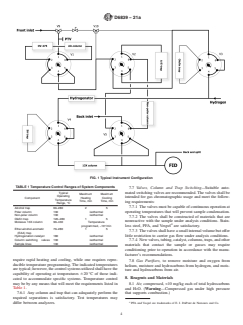
scribed in 7.7 and in Section 8. Fig. 1 illustrates a typical
4.1 A representative sample is introduced into a computer
instrument configuration (see Note 4). Other configurations,
controlled gas chromatographic system consisting of switching
components, or conditions may be utilized provided they are
valves, columns, and an olefin hydrogenation catalyst, all
capable of achieving the required component separations and
operating at various temperatures. The valves are actuated at
produce a precision that is equivalent to, or better than, that
predetermined times to direct portions of the sample to
shown in the precision tables.
appropriate columns and traps. As the analysis proceeds, the
columns separate these sample portions sequentially into
7.2 Gas Chromatograph, capable of temperature pro-
groups of different hydrocarbon types that elute to a flame
grammed operation at specified temperatures, equipped with a
ionization detector.
heated flash vaporization inlet, a flame ionization detector,
necessary flow controllers, and computer control.
4.2 The mass concentration of each detected compound or
hydrocarbon group is determined by the application of re-
7.3 Sample Introduction System, using an automatic liquid
sponse factors to the areas of the detected peaks followed by
injector, the injection volume shall be chosen in a way such
normalization to 100 %. For samples containing methanol or
that the capacity of the column is not exceeded and that the
other oxygenates that cannot be determined by this test
linearity of the detector is valid.
method, the hydrocarbon results are normalized to 100 %
7.3.1 An injection volume of 0.1 µL has been found
minus the value of the oxygenates as determined by another
satisfactory.
test method such as Test Method D4815 or D5599.
7.4 Gas Flow and Pressure Controllers, with adequate
4.3 The liquid volume concentration of each detected com-
precision to provide reproducible flow and pressure of the
pound or hydrocarbon group is determined by application of
carrier gas to the chromatographic system, hydrogen for the
density factors to the calculated mass concentration of the
hydrogenator, and hydrogen and air for the flame ionization
detected peaks followed by normalization to 100 %.
detector. Control of air flow for cooling specific system
componentsandforautomatedvalveoperationisalsorequired.
5. Significance and Use
7.5 Electronic Data Acquisition System, shall meet or ex-
5.1 A knowledge of spark-ignition engine fuel composition ceed the following specifications (see Note 2):
is useful for regulatory compliance, process control, and 7.5.1 Capacity for 150 peaks for each analysis.
quality assurance. 7.5.2 Normalized area percent calculation with response
factors.
5.2 The quantitative determination of olefins and other
7.5.2.1 Area summation of peaks that are split or of groups
hydrocarbon types in spark-ignition engine fuels is required to
of components that elute at specific retention times.
comply with government regulations.
7.5.3 Noise and spike rejection capability.
5.3 This test method is not applicable to M85 fuels, which
7.5.4 Sampling rate for fast (<0.5 s) peaks (>20 Hz to give
contain 85 % methanol.
10 points across peak).
7.5.5 Peak width detection for narrow and broad peaks.
6. Interferences
7.5.6 Perpendicular drop and tangent skimming, as re-
quired.
6.1 Some types of sulfur-containing compounds are irre-
versibly adsorbed in the olefin trap reducing its capacity to
NOTE 2—Standard supplied software is typically satisfactory.
retain olefins. Sulfur containing compounds are also adsorbed
7.6 Temperature Controllers of System Components—The
in the alcohol and ether-alcohol-aromatic (EAA) traps.
independent temperature control of numerous columns and
However, a variety of spark-ignition engine fuels have been
traps,thehydrogenationcatalyst,columnswitchingvalves,and
analyzedwithoutsignificantperformancedeteriorationofthese
sample lines is required. All of the system components that
traps.
contact the sample shall be heated to a temperature that will
6.2 Commercial dyes used to distinguish between grades prevent condensation of any sample component. Table 1 lists
and types of spark-ignition engine fuels have been found not to the system components and operating temperatures (see 7.6.1).
interfere with this test method. Some of the components require isothermal operation, some
D6839 − 21a
FIG. 1 Typical Instrument Configuration
TABLE 1 Temperature Control Ranges of System Components
7.7 Valves, Column and Trap Switching—Suitable auto-
Typical mated switching valves are recommended. The valves shall be
Maximum Maximum
Operating
intended for gas chromatographic usage and meet the follow-
Component Heating Cooling
Temperature
Time, min Time, min
ing requirements:
Range, °C
7.7.1 The valves must be capable of continuous operation at
Alcohol trap 60–280 2 5
Polar column 130 isothermal operating temperatures that will prevent sample condensation.
Non-polar column 130 isothermal
7.7.2 The valves shall be constructed of materials that are
Olefin trap 120–280 1 5
nonreactive with the sample under analysis conditions. Stain-
Molsieve 13X column 90–430 Temperature
programmed, ~10°/min
less steel, PFA, and Vespel are satisfactory.
Ether-alcohol-aromatic 70–280 1 5
7.7.3 Thevalvesshallhaveasmallinternalvolumebutoffer
(EAA) trap
little restriction to carrier gas flow under analysis conditions.
Hydrogenation catalyst 180 isothermal
Column switching valves 130 isothermal
7.7.4 Newvalves,tubing,catalyst,columns,traps,andother
Sample lines 130 isothermal
materials that contact the sample or gasses may require
conditioning prior to operation in accordance with the manu-
facturer’s recommendations.
require rapid heating and cooling, while one requires repro-
7.8 Gas Purifiers, to remove moisture and oxygen from
ducible temperature programming. The indicated temperatures
helium, moisture and hydrocarbons from hydrogen, and mois-
aretypical;however,thecontrolsystemsutilizedshallhavethe
ture and hydrocarbons from air.
capability of operating at temperatures 620 °C of those indi-
8. Reagents and Materials
cated to accommodate specific systems. Temperature control
may be by any means that will meet the requirements listed in 8.1 Air, compressed, <10 mg/kg each of total hydrocarbons
Table 1. and H O. (Warning—Compressed gas under high pressure
7.6.1 Any column and trap that can adequately perform the that supports combustion.)
required separations is satisfactory. Test temperatures may
differ between analyzers. PFA and Vespel are trademarks of E. I. DuPont de Nemours and Co.
D6839 − 21a
8.2 Carrier Gas, Helium or Nitrogen, 99.999 % pure, 8.4.4.1 Within a temperature range from 140 °C to 150 °C
<0.1 mg⁄kg H O. (Warning—Compressed gas under high this trap shall retain C and higher olefins and elute all
2 6
pressure.) non-olefiniccomponentsin3min.OlefinsuptoC mayormay
not elute in this time.
NOTE 3—The system’s operating parameters such as column & trap
8.4.4.2 At a temperature of 280 °C, this trap shall quantita-
temperatures, carrier gas flows and valve switching times are depending
on the type of carrier gas used. The use of nitrogen as carrier gas may not tively elute all retained olefins.
be possible on all configurations. Contact the equipment manufacturer for
8.4.5 Molsieve 13X Column—This column shall separate
specific information or instructions on the use of nitrogen.
paraffin and naphthene hydrocarbons by carbon number when
8.3 Hydrogen, 99.999 % pure, <0.1 mg/kg H O. temperature programmed from 90 °C to 430 °C at approxi-
(Warning—Extremely flammable gas under high pressure.)
mately 10 °⁄min.
8.4.6 Porapak Column—At a temperature from 130 °C to
8.4 Columns, Traps, and Hydrogenation Catalyst (System
140 °C, this column shall separate individual oxygenates,
Components)—Suitable columns and traps for reversible ab-
benzene, and toluene.
sorption of certain selected chemical groups must be used (an
example is given in Table 1, see also 7.6.1). Each system
NOTE 5—The use of a Porapak column is not required in all configu-
rations. For more information on a specific system, contact the equipment
component is independently temperature controlled as de-
manufacturer.
scribedin7.6andTable1.RefertoFig.1forthelocationofthe
components in the system (see Note 4). The following list of 8.4.7 Ether-Alcohol-Aromatic (EAA) Trap—Within a tem-
perature range from 105 °C to 130 °C, this trap shall retain all
components contains guidelines that are to be used to judge
suitability. The guidelines describe temperatures and times as of the ethers in the sample and elute all non-aromatic hydro-
usedinatypicalsystem.Alternativescanbeusedprovidedthat carbons boiling below 175 °C within the first 6 min after
the separation as described is obtained and the separation sample injection.
characteristics of the entire system are not limited. 8.4.7.1 At a temperature of 280 °C, this trap shall elute all
retained components.
NOTE4—Fig.1showsanadditionaltrap,Molsieve5A,androtaryvalve
8.4.8 HydrogenationCatalyst,platinum.Atatemperatureof
V4 that are not required for this test method. They are included in Fig. 1
because they were present in the instrumentation used to generate the 180 °C and an auxiliary hydrogen flow of 14 mL⁄min 6
precision data. They can be used for more detailed analyses outside the
2 mL⁄min, this catalyst shall quantitatively hydrogenate all
scope of this test method, where an iso-normal paraffin, iso-normal olefin
olefins to paraffinic compounds of the same structure without
determination is desired. There is no statistical data included in this test
cracking.
method relating to their use.
8.5 Test Mixture—A quantitative synthetic mixture of pure
8.4.1 Alcohol Trap—Within a temperature range from
hydrocarbons is required to verify that all instrument
140 °C to 160 °C, this trap must elute benzene, toluene, all
components, temperatures, and cut times are satisfactory to
paraffins, olefins, naphthenes, and ethers within the first 2 min
produce accurate analyses and to aid in making operating
after sample injection while retaining C + aromatics, all
adjustments as columns and traps age. The mixture may be
alcohols, and any other sample components.
purchased or prepared according to Practice D4307. Each
8.4.1.1 At a temperature of 280 °C, all retained components
component used in the test mixture preparations shall have a
from 8.4.1 shall elute within 2 min of when the trap is
minimum purity of 99 %. The actual concentration levels are
backflushed.
not critical but shall be accurately known.
8.4.2 Polar Column—At a temperature of 130 °C, this
8.5.1 System Validation Test Mixture, used to monitor and
column must retain all aromatic components in the sample
make adjustments to the total operation of the system. The
longer than the time required to elute all non-aromatic com-
composition and approximate component concentrations are
ponents boiling below 185 °C, within the first 5 min after
shown in Table 2.
sample injection.
8.4.2.1 The column shall elute benzene, toluene, and all 8.6 Quality Control Sample, used to routinely monitor the
non-aromatic components with a boiling point below 215 °C operation of the chromatographic system and verify that
within 10 min of the introduction of these compounds into the reported concentrations are within the precision of the test
column. method. Depending on the range and composition of the
8.4.2.2 This column shall elute all retained aromatic com- samples to be analyzed, more than one quality control sample
ponents from 8.4.2 within 10 min of when this column is may be necessary.Any sample that is similar in composition to
backflushed. samples typically analyzed may be designated as the quality
8.4.3 Non-Polar Column—At a temperature of 130 °C, this control (QC) sample. The QC sample shall be of sufficient
column shall elute and separate aromatics by carbon number volume to provide an ample supply for the intended period of
boiling below 200 °C. Higher boiling paraffins, naphthenes, use and it shall be homogeneous and stable under the antici-
and aromatics are backflushed. pated storage conditions.
8.4.4 Olefin Trap—Within a temperature range from 90 °C 8.6.1 The quality control sample should have similar com-
to 105 °C, this trap shall retain (trap) all olefins in the sample position and hydrocarbon distribution as the sample with
for at least 6.5 min and elute all non-olefinic components up to highest olefin concentration routinely analyzed.
C in less than 6.5 min after the sample is injected. Non- 8.6.2 The quality control sample should contain oxygenates
olefinic components C and higher shall be retained during this as analyzed in routine samples. Separate standards could be
time. used for different oxygenates.
D6839 − 21a
TABLE 2 System Validation Test Mixture
Approximate Approximate
Component Concentration Concentration Warning
Mass, % Volume, %
A
Cyclopentane 1.1 1.1
A
Pentane 1.1 1.4
A
Cyclohexane 2.1 2.1
A
2,3-Dimethylbutane 2.1 2.5
A
Hexane 2.1 2.5
A
1-Hexene 1.5 1.7
A
Methylcyclohexane 4.0 4.1
A
4-Methyl-1-hexene 1.6 1.8
B
Heptane 3.5 4.0
A
1-cis-2-Dimethylcyclohexane 5.0 5.0
B
2,2,4-Trimethylpentane 5.0 5.5
B
Octane 5.0 5.5
B
1-cis-2-cis-4-Trimethylcyclohexane 4.0 4.0
B
Nonane 4.5 4.9
B
Decane 4.5 4.8
B
Undecane 3.5 3.7
B
Dodecane 3.5 3.7
B
Benzene 2.2 1.9
B
Methylbenzene (Toluene) 2.2 2.0
B
trans-Decahydronaphthalene (Decalin) 4.0 3.5
B
Tetradecane 4.5 4.7
A
Ethylbenzene 4.5 4.0
A
1,2-Dimethylbenzene (o-Xylene) 4.0 3.6
A
Propylbenzene 5.0 4.5
A
1,2,4-Trimethylbenzene 4.5 4.0
A
1,2,3-Trimethylbenzene 5.0 4.5
B
1,2,4,5-Tetramethylbenzene 5.0 4.5
C
Pentamethylbenzene 5.0 4.5
Group Totals
Total Aromatics 37.4 33.5
Total Olefins 3.1 3.5
Total Saturates 59.5 63.0
Benzene 2.20 1.90
A
(Warning—Extremely flammable. Harmful if inhaled.)
B
(Warning—Flammable. Harmful if inhaled.)
C
(Warning—Harmful if inhaled.)
8.6.2.1 In the event that samples containing TAME or 9.3 The gas flow rates on commercial instruments are
ethanol need to be analyzed, it is best to use separate standards normally set prior to shipment and normally require little
sinceoptimalseparationofthesecomponentsrequiresdifferent adjustment. Optimize flow rates on other systems to achieve
alcohol trap temperature conditions. the required separations. Typical flow rates for the commercial
instrument used in the precision study are given in Table 3;
8.7 Diluting solvent, used in Part B, should not be interfer-
however,theflowscandiffersomewhatfromsystemtosystem.
ing with any other component in gasoline being analyzed.
9.3.1 Set air flow rates for column/trap cooling and for
Dodecane (C H ) or tridecane (C H ) are recommended
12 26 13 28
operation of air actuated valves, if required.
solvents.
9.4 System Conditioning—When gas connections have been
9. Preparation of Apparatus
disconnected or the flow turned off, as on initial start up,
condition the system by permitting carrier gas to flow through
9.1 Assemble the analyzer system (gas chromatograph with
the system for at least 30 min while the system is at ambient
independent temperature controlled components) as shown in
temperature. After the system has been conditioned, analyze
Fig. 1 or with a similar flow system. If using a commercial
the system validation test mixture, as described in Section 11,
system, install and place the system in service in accordance
discarding the results.
with the manufacturer’s instructions.
9.2 Impurities in the carrier gas, hydrogen, or air will have
10. Standardization
a detrimental effect on the performance of the columns and
traps. Therefore, it is important to install efficient gas purifiers 10.1 The elution of components from the columns and traps
in the gas lines as close to the system as possible and to use depends on the applied temperatures. The switching valves
good quality gases. The carrier gas and hydrogen gas connec- also need to be actuated at exact times to make separations of
tion lines shall be made of metal. Check that all gas compounds into groups, for example, to retain specific com-
connections, both exterior and interior to the system, are leak pounds in a column or trap while permitting other compounds
tight. toelute.Therefore,theseparationtemperaturesofthecolumns/
D6839 − 21a
TABLE 3 Typical Gas Flow Rates
10.2.1 If the specifications in 10.2 are not met, adjust the
Gas Flow Rate temperature of specific columns and traps or valve timing
He (Flow A) 22 ± 2 mL/min according to the manufacturer’s guidelines and reanalyze the
He (Flow B) 12 ± 1 mL/min
system validation test mixture until they are met.
H (hydrogenator) 14 ± 2 mL/min
H (FID) 30–35 mL/min 10.3 Analyze quality control samples; see 8.6. Verify that
Air (FID) 400–450 mL/min
results are consistent with those previously obtained and that
the separation of olefins and saturates is correct.
10.3.1 Breakthrough of olefins to the saturate fraction is
indicated by a rising baseline under the C to C saturates
5 6
traps and the valve timing are critical for correct operation of
region or additional peaks between the C and C peaks. If
4 6
thesystem.Theseparametersneedtobeverifiedonthestartup
breakthrough is observed, optimize the olefin trap temperature
of a new system (see Note 6) for correctness.They also require
or, if necessary, replace the trap.
evaluation and adjustment as necessary on a regular basis to
10.3.2 If the fraction containing C to C olefins and C to
4 6 7
correctforchangestocolumnsandtrapsasaresultofaging.To
C saturates shows peaks in the C region, optimize the olefin
10 7
do this, the analyst shall analyze several test mixtures and
trap temperatures or, if necessary, replace the trap.
make changes, as required, based on an evaluation of the
10.3.3 Loadability limits for olefins are listed in 1.3. These
resulting chromatograms and test reports.
limits depend on the condition of the olefin trap, and an aged
trap may not have this capacity. Use the quality control sample
10.2 UsingtheprocedureoutlinedinSection 11,analyzethe
(see 8.6) to verify olefin capacity.
system validation test mixture. Carefully examine the chro-
10.3.4 Check that the correct qualitative and quantitative
matogramobtainedtoverifythatalltheindividualcomponents
analysis of oxygenates are achieved for the quality control
of the test mixture are correctly identified as compared to the
sample. If qualitative or quantitative specifications are not met,
reference chromatogram (Figs. 2 and 3).Test results for groups
optimize the alcohol trap temperature and ether-alcohol-
by hydrocarbon number and group totals shall agree with the
aromatic trap temperature or replace the columns as necessary.
known composition (see Table 2) within the 95 % confidence
level or reproducibility of the group/component divided by the 10.4 Reanalyzethesystemvalidationtestmixturewhenever
square root of 2. Table 4 presents the calculated level for thequalitycontrolsampledoesnotconformtoexpectedresults
selected components or groups. If these specifications are met, (see 10.3) and make adjustments as necessary (see 10.2).
proceed to the analysis of the quality control samples (see
10.3).
Part A—PROCEDURE APPLICABLE TO AUTOMOTIVE MOTOR GASOLINE AND HYDROCARBON STREAMS
WITH SIMILAR BOILING RANGES
D6839 − 21a
FIG. 2 Example of a Gravimetric Test Blend Analysis 1/2
FIG. 3 Example of a Gravimetric Test Blend Analysis 2/2
D6839 − 21a
FIG. 4 Typical Gasoline Chromatogram 1/2
FIG. 5 Typical Gasoline Chromatogram 2/2
TABLE 4 Calculated Acceptance Levels for Validation Sample
Component Group Concentration Level Acceptance Level
Volume %
Aromatics 33.5 ±1.1
Olefins 3.5 ±0.9
Saturates 63.0 ±1.1
Benzene 1.9 ±0.11
11. Procedure
NOTE 6—Commercial systems will have all parameters predetermined
11.1 Load the necessary system setpoint conditions, which
and accessible through the software. Other constructed systems will
include initial component temperatures, times at which column
require experimentation and optimization of parameters to achieve the
and trap temperature are changed, the initial positions of
required component separation and precision.
switching valves, and times when valve switches occur (see
Note 6).
D6839 − 21a
A ,B
TABLE 5 Calculated Response Factors for Hydro
...
This document is not an ASTM standard and is intended only to provide the user of an ASTM standard an indication of what changes have been made to the previous version. Because
it may not be technically possible to adequately depict all changes accurately, ASTM recommends that users consult prior editions as appropriate. In all cases only the current version
of the standard as published by ASTM is to be considered the official document.
Designation: D6839 − 21 D6839 − 21a
Standard Test Method for
Hydrocarbon Types, Oxygenated Compounds, Benzene, and
BenzeneToluene in Spark Ignition Engine Fuels by
Multidimensional Gas Chromatography
This standard is issued under the fixed designation D6839; the number immediately following the designation indicates the year of
original adoption or, in the case of revision, the year of last revision. A number in parentheses indicates the year of last reapproval. A
superscript epsilon (´) indicates an editorial change since the last revision or reapproval.
1. Scope*
1.1 This test method covers the quantitative determination of saturates, olefins, aromatics, and oxygenates in spark-ignition engine
fuels by multidimensional gas chromatography. Each hydrocarbon type can be reported either by carbon number (see Note 1) or
as a total.
NOTE 1—There can be an overlap between the C and C aromatics; however, the total is accurate. Isopropyl benzene is resolved from the C aromatics
9 10 8
and is included with the other C aromatics.
1.2 This test method is not intended to determine individual hydrocarbon components except benzene.benzene and toluene.
1.3 This test method is divided into two parts, Part A and Part B.
1.3.1 Part A is applicable to automotive motor gasolinethe concentration ranges for which precision (Table 9) (Table 10 and Table
11) has been obtained obtained:
Property Units Applicable range
Total aromatics Volume % 19.32 to 46.29
Total saturates Volume % 26.85 to 79.31
Total olefins Volume % 0.40 to 26.85
Oxygenates Volume % 0.61 to 9.85
Oxygen Content Mass % 2.01 to 12.32
Benzene Volume % 0.38 to 1.98
Toluene Volume % 5.85 to 31.65
Methanol Volume % 1.05 to 16.96
Ethanol Volume % 0.50 to 17.86
MTBE Volume % 0.99 to 15.70
ETBE Volume % 0.99 to 15.49
TAME Volume % 0.99 to 5.92
TAEE Volume % 0.98 to 15.59
for total volume fraction of aromatics of up to 50 %; a total volume fraction of olefins from about 1.5 % up to 30 %; a
volume fraction of oxygenates, from 0.8 % up to 15 %; a total mass fraction of oxygen from about 1.5 % to about 3.7 %; and
a volume fraction of benzene of up to 2 %. Although this test method can be used to determine higher-olefin contents of up to
50 % volume fraction, the precision for olefins was tested only in the range from about 1.5 % volume fraction to about 30 %
volume fraction. The method has also been tested for an ether content up to 22 % volume fraction but no precision data has
been determined.
This test method is under the jurisdiction of ASTM Committee D02 on Petroleum Products, Liquid Fuels, and Lubricants and is the direct responsibility of Subcommittee
D02.04.0L on Gas Chromatography Methods.
Current edition approved April 1, 2021May 1, 2021. Published July 2021. Originally approved in 2002. Last previous edition approved in 20182021 as
D6839 – 18.D6839 – 21. DOI: 10.1520/D6839-21.10.1520/D6839-21A.
*A Summary of Changes section appears at the end of this standard
Copyright © ASTM International, 100 Barr Harbor Drive, PO Box C700, West Conshohocken, PA 19428-2959. United States
D6839 − 21a
1.3.1.1 This test method is specifically developed for the analysis of automotive motor gasoline that contains oxygenates, but it
also applies to other hydrocarbon streams having similar boiling ranges, such as naphthas and reformates.
1.3.2 Part B describes the procedure for the analysis of oxygenated groups (ethanol, methanol, ethers, C to C alcohols) in ethanol
3 5
fuels containing an ethanol volume fraction between 50 % and 85 % (17 % to 29 % oxygen). The gasoline is diluted with an
oxygenate-free component to lower the ethanol content to a value below 20 % before the analysis by GC. The diluting solvent
should not be considered in the integration, this makes it possible to report the results of the undiluted sample after normalization
to 100 %.
1.4 Oxygenates as specified in Test Method D4815 have been verified not to interfere with hydrocarbons. Within the round robin
sample set, the following oxygenates have been tested: MTBE, ethanol, ETBE, TAME, iso-propanol, isobutanol, tert-butanol and
methanol. The derived precision data for methanol do not comply with the precision calculation as presented in this International
Standard. Applicability of this test method has also been verified for the determination of n-propanol, acetone, and di-isopropyl
ether (DIPE). However, no precision data have been determined for these compounds.
1.4.1 Other oxygenates can be determined and quantified using Test Method D4815 or D5599.
1.5 The method is harmonized with ISO 22854.
1.6 This test method includes a relative bias section for U.S. EPA spark-ignition engine fuel regulations for total olefins reporting
based on Practice D6708 accuracy assessment between Test Method D6839 and Test Method D1319 as a possible Test Method
D6839 alternative to Test Method D1319. The Practice D6708 derived correlation equation is only applicable for fuels in the total
olefins concentration range from 0.2 % to 18.2 % by volume as measured by Test Method D6839. The applicable Test Method
D1319 range for total olefins is from 0.6 % to 20.6 % by volume as reported by Test Method D1319.
1.7 This test method includes a relative bias section for reporting benzene based on Practice D6708 accuracy assessment between
Test Method D6839 and Test Method D3606 (Procedure B) as a possible Test Method D6839 alternative to Test Method D3606
(Procedure B). The Practice D6708 derived correlation equation is only applicable for fuels in the benzene concentration range
from 0.52 % to 1.67 % by volume as measured by Test Method D6839.
1.8 This test method includes a relative bias section for reporting benzene based on Practice D6708 accuracy assessment between
Test Method D6839 and Test Method D5580 as a possible Test Method D6839 alternative to Test Method D5580. The Practice
D6708 derived correlation equation is only applicable for fuels in the benzene concentration range from 0.52 % to 1.67 % by
volume as measured by Test Method D6839.
1.9 This test method includes a relative bias section for reporting benzene based on Practice D6708 accuracy assessment between
Test Method D6839 and Test Method D5769 as a possible Test Method D6839 alternative to Test Method D5769. The Practice
D6708 derived correlation equation is only applicable for fuels in the benzene concentration range from 0.52 % to 1.67 % by
volume as measured by Test Method D6839.
1.10 This test method includes a relative bias section for reporting total aromatics based on Practice D6708 accuracy assessment
between Test Method D6839 and Test Method D1319 as a possible Test Method D6839 alternative to Test Method D1319. The
Practice D6708 derived correlation equation is only applicable for fuels in the total aromatics concentration range from 14.3 % to
31.2 % by volume as measured by Test Method D6839.
1.11 This test method includes a relative bias section for reporting total aromatics based on Practice D6708 accuracy assessment
between Test Method D6839 and Test Method D5580 as a possible Test Method D6839 alternative to Test Method D5580. The
Practice D6708 derived correlation equation is only applicable for fuels in the total aromatics concentration range from 14.3 % to
31.2 % by volume as measured by Test Method D6839.
1.12 This test method includes a relative bias section for reporting total aromatics based on Practice D6708 accuracy assessment
between Test Method D6839 and Test Method D5769 as a possible Test Method D6839 alternative to Test Method D5769. The
Practice D6708 derived correlation equation is only applicable for fuels in the total aromatics concentration range from 14.3 % to
30.1 % by volume as measured by Test Method D6839.
D6839 − 21a
1.13 This test method includes a relative bias section for reporting total olefins based on Practice D6708 accuracy assessment
between Test Method D6839 and Test Method D6550 as a possible Test Method D6839 alternative to Test Method D6550. The
Practice D6708 derived correlation equation is only applicable for fuels in the total olefins concentration range from 1.5 % to
17.2 % by volume as measured by Test Method D6839.
1.14 The values stated in SI units are to be regarded as standard. No other units of measurement are included in this standard.
1.15 This standard does not purport to address all of the safety concerns, if any, associated with its use. It is the responsibility
of the user of this standard to establish appropriate safety, health, and environmental practices and determine the applicability of
regulatory limitations prior to use.
1.16 This international standard was developed in accordance with internationally recognized principles on standardization
established in the Decision on Principles for the Development of International Standards, Guides and Recommendations issued
by the World Trade Organization Technical Barriers to Trade (TBT) Committee.
2. Referenced Documents
2.1 ASTM Standards:
D1319 Test Method for Hydrocarbon Types in Liquid Petroleum Products by Fluorescent Indicator Adsorption
D3606 Test Method for Determination of Benzene and Toluene in Spark Ignition Fuels by Gas Chromatography
D4307 Practice for Preparation of Liquid Blends for Use as Analytical Standards
D4815 Test Method for Determination of MTBE, ETBE, TAME, DIPE, tertiary-Amyl Alcohol and C to C Alcohols in
1 4
Gasoline by Gas Chromatography
D5580 Test Method for Determination of Benzene, Toluene, Ethylbenzene, p/m-Xylene, o-Xylene, C and Heavier Aromatics,
and Total Aromatics in Finished Gasoline by Gas Chromatography
D5599 Test Method for Determination of Oxygenates in Gasoline by Gas Chromatography and Oxygen Selective Flame
Ionization Detection
D5769 Test Method for Determination of Benzene, Toluene, and Total Aromatics in Finished Gasolines by Gas
Chromatography/Mass Spectrometry
D6550 Test Method for Determination of Olefin Content of Gasolines by Supercritical-Fluid Chromatography
D6708 Practice for Statistical Assessment and Improvement of Expected Agreement Between Two Test Methods that Purport
to Measure the Same Property of a Material
2.2 Other Documents:
ISO 4259 Petroleum products—Determination and application of precision data in relation to methods of test
ISO 22854 Liquid petroleum products—Determination of hydrocarbon types and oxygenates in automotive-motor gasoline—
Multidimensional gas chromatography method
3. Terminology
3.1 Definitions:
3.1.1 oxygenate, n—an oxygen-containing organic compound, which may be used as a fuel or fuel supplement, for example,
various alcohols and ethers.
3.2 Definitions of Terms Specific to This Standard:
3.2.1 hydrogenation, n—the process of adding hydrogen to olefin molecules as a result of a catalytic reaction.
3.2.1.1 Discussion—
Hydrogenation is accomplished when olefins in the sample contact platinum at a temperature of 180 °C in the presence of
hydrogen. The olefins are converted into hydrogen saturated compounds of the same carbon number and structure. Monoolefins
and diolefins convert to paraffins while cycloolefins and cyclodienes convert to cycloparaffins.
3.2.2 trap, n—a device utilized to selectively retain specific portions (individual or groups of hydrocarbons or oxygenates) of the
test sample and to release the retained components by changing the trap temperature.
3.3 Acronyms:
For referenced ASTM standards, visit the ASTM website, www.astm.org, or contact ASTM Customer Service at service@astm.org. For Annual Book of ASTM Standards
volume information, refer to the standard’s Document Summary page on the ASTM website.
Available from American National Standards Institute (ANSI), 25 W. 43rd St., 4th Floor, New York, NY 10036, http://www.ansi.org.
D6839 − 21a
3.3.1 ETBE—ethyl-tert-butylether
3.3.2 MTBE—methyl-tert-butylether
3.3.3 TAME—tert-amyl-methylether
3.3.4 DIPE—di-isopropylether
4. Summary of Test Method
4.1 A representative sample is introduced into a computer controlled gas chromatographic system consisting of switching valves,
columns, and an olefin hydrogenation catalyst, all operating at various temperatures. The valves are actuated at predetermined
times to direct portions of the sample to appropriate columns and traps. As the analysis proceeds, the columns separate these
sample portions sequentially into groups of different hydrocarbon types that elute to a flame ionization detector.
4.2 The mass concentration of each detected compound or hydrocarbon group is determined by the application of response factors
to the areas of the detected peaks followed by normalization to 100 %. For samples containing methanol or other oxygenates that
cannot be determined by this test method, the hydrocarbon results are normalized to 100 % minus the value of the oxygenates as
determined by another test method such as Test Method D4815 or D5599.
4.3 The liquid volume concentration of each detected compound or hydrocarbon group is determined by application of density
factors to the calculated mass concentration of the detected peaks followed by normalization to 100 %.
5. Significance and Use
5.1 A knowledge of spark-ignition engine fuel composition is useful for regulatory compliance, process control, and quality
assurance.
5.2 The quantitative determination of olefins and other hydrocarbon types in spark-ignition engine fuels is required to comply with
government regulations.
5.3 This test method is not applicable to M85 fuels, which contain 85 % methanol.
6. Interferences
6.1 Some types of sulfur-containing compounds are irreversibly adsorbed in the olefin trap reducing its capacity to retain olefins.
Sulfur containing compounds are also adsorbed in the alcohol and ether-alcohol-aromatic (EAA) traps. However, a variety of
spark-ignition engine fuels have been analyzed without significant performance deterioration of these traps.
6.2 Commercial dyes used to distinguish between grades and types of spark-ignition engine fuels have been found not to interfere
with this test method.
6.3 Commercial detergent additives utilized in spark-ignition engine fuels have been found not to interfere with this test method.
6.4 Dissolved water in spark-ignition engine fuels has been found not to interfere with this test method.
7. Apparatus
7.1 The complete system that was used to obtain the precision data shown in Section 14 is comprised of a computer controlled
gas chromatograph, automated sample injector, and specific hardware modifications. These modifications include columns, traps,
a hydrogenator, and valves, which are described in 7.7 and in Section 8. Fig. 1 illustrates a typical instrument configuration (see
Note 4). Other configurations, components, or conditions may be utilized provided they are capable of achieving the required
component separations and produce a precision that is equivalent to, or better than, that shown in the precision tables.
D6839 − 21a
FIG. 1 Typical Instrument Configuration
7.2 Gas Chromatograph, capable of temperature programmed operation at specified temperatures, equipped with a heated flash
vaporization inlet, a flame ionization detector, necessary flow controllers, and computer control.
7.3 Sample Introduction System, using an automatic liquid injector, the injection volume shall be chosen in a way such that the
capacity of the column is not exceeded and that the linearity of the detector is valid.
7.3.1 An injection volume of 0.1 μL has been found satisfactory.
7.4 Gas Flow and Pressure Controllers, with adequate precision to provide reproducible flow and pressure of the carrier gas to
the chromatographic system, hydrogen for the hydrogenator, and hydrogen and air for the flame ionization detector. Control of air
flow for cooling specific system components and for automated valve operation is also required.
7.5 Electronic Data Acquisition System, shall meet or exceed the following specifications (see Note 2):
7.5.1 Capacity for 150 peaks for each analysis.
7.5.2 Normalized area percent calculation with response factors.
7.5.2.1 Area summation of peaks that are split or of groups of components that elute at specific retention times.
7.5.3 Noise and spike rejection capability.
D6839 − 21a
TABLE 1 Temperature Control Ranges of System Components
Typical
Maximum Maximum
Operating
Component Heating Cooling
Temperature
Time, min Time, min
Range, °C
Alcohol trap 60–280 2 5
Polar column 130 isothermal
Non-polar column 130 isothermal
Olefin trap 120–280 1 5
Molsieve 13X column 90–430 Temperature
programmed, ~10°/min
Ether-alcohol-aromatic 70–280 1 5
(EAA) trap
Hydrogenation catalyst 180 isothermal
Column switching valves 130 isothermal
Sample lines 130 isothermal
7.5.4 Sampling rate for fast (<0.5 s) peaks (>20 Hz to give 10 points across peak).
7.5.5 Peak width detection for narrow and broad peaks.
7.5.6 Perpendicular drop and tangent skimming, as required.
NOTE 2—Standard supplied software is typically satisfactory.
7.6 Temperature Controllers of System Components—The independent temperature control of numerous columns and traps, the
hydrogenation catalyst, column switching valves, and sample lines is required. All of the system components that contact the
sample shall be heated to a temperature that will prevent condensation of any sample component. Table 1 lists the system
components and operating temperatures (see 7.6.1). Some of the components require isothermal operation, some require rapid
heating and cooling, while one requires reproducible temperature programming. The indicated temperatures are typical; however,
the control systems utilized shall have the capability of operating at temperatures 620 °C of those indicated to accommodate
specific systems. Temperature control may be by any means that will meet the requirements listed in Table 1.
7.6.1 The system components and temperatures listed in Any column and trap Table 1 and Section 8 are specific to the analyzer
used to obtain the precision data shown in Section 14. Other columns and traps that can adequately perform the required
separations are also satisfactory but may require different temperatures.is satisfactory. Test temperatures may differ between
analyzers.
7.7 Valves, Column and Trap Switching—Suitable automated switching valves are recommended. The valves shall be intended for
gas chromatographic usage and meet the following requirements:
7.7.1 The valves must be capable of continuous operation at operating temperatures that will prevent sample condensation.
7.7.2 The valves shall be constructed of materials that are nonreactive with the sample under analysis conditions. Stainless steel,
PFA, and Vespel are satisfactory.
7.7.3 The valves shall have a small internal volume but offer little restriction to carrier gas flow under analysis conditions.
7.7.4 New valves, tubing, catalyst, columns, traps, and other materials that contact the sample or gasses may require conditioning
prior to operation in accordance with the manufacturer’s recommendations.
7.8 Gas Purifiers, to remove moisture and oxygen from helium, moisture and hydrocarbons from hydrogen, and moisture and
hydrocarbons from air.
PFA and Vespel are trademarks of E. I. DuPont de Nemours and Co.
D6839 − 21a
8. Reagents and Materials
8.1 Air, compressed, <10 mg/kg each of total hydrocarbons and H O. (Warning—Compressed gas under high pressure that
supports combustion.)
8.2 Carrier Gas, Helium or Nitrogen, 99.999 % pure, <0.1 mg ⁄kg H O. (Warning—Compressed gas under high pressure.)
NOTE 3—The system’s operating parameters such as column & trap temperatures, carrier gas flows and valve switching times are depending on the type
of carrier gas used. The use of nitrogen as carrier gas may not be possible on all configurations. Contact the equipment manufacturer for specific
information or instructions on the use of nitrogen.
8.3 Hydrogen, 99.999 % pure, <0.1 mg/kg H O. (Warning—Extremely flammable gas under high pressure.)
8.4 Columns, Traps, and Hydrogenation Catalyst (System Components)—Suitable columns and traps for reversible absorption of
certain selected chemical groups must be used (an example is given in Table 1, see also 7.6.1). Each system component is
independently temperature controlled as described in 7.6 and Table 1. Refer to Fig. 1 for the location of the components in the
system (see Note 4). The following list of components contains guidelines that are to be used to judge suitability. The guidelines
describe temperatures and times as used in a typical system. Alternatives can be used provided that the separation as described is
obtained and the separation characteristics of the entire system are not limited.
NOTE 4—Fig. 1 shows an additional trap, Molsieve 5A, and rotary valve V4 that are not required for this test method. They are included in Fig. 1 because
they were present in the instrumentation used to generate the precision data. They can be used for more detailed analyses outside the scope of this test
method, where an iso-normal paraffin, iso-normal olefin determination is desired. There is no statistical data included in this test method relating to their
use.
8.4.1 Alcohol Trap—Within a temperature range from 140 °C to 160 °C, this trap must elute benzene, toluene, all paraffins, olefins,
naphthenes, and ethers within the first 2 min after sample injection while retaining C + aromatics, all alcohols, and any other
sample components.
8.4.1.1 At a temperature of 280 °C, all retained components from 8.4.1 shall elute within 2 min of when the trap is backflushed.
8.4.2 Polar Column—At a temperature of 130 °C, this column must retain all aromatic components in the sample longer than the
time required to elute all non-aromatic components boiling below 185 °C, within the first 5 min after sample injection.
8.4.2.1 The column shall elute benzene, toluene, and all non-aromatic components with a boiling point below 215 °C within 10
min of the introduction of these compounds into the column.
8.4.2.2 This column shall elute all retained aromatic components from 8.4.2 within 10 min of when this column is backflushed.
8.4.3 Non-Polar Column—At a temperature of 130 °C, this column shall elute and separate aromatics by carbon number boiling
below 200 °C. Higher boiling paraffins, naphthenes, and aromatics are backflushed.
8.4.4 Olefin Trap—Within a temperature range from 90 °C to 105 °C, this trap shall retain (trap) all olefins in the sample for at
least 6.5 min and elute all non-olefinic components up to C in less than 6.5 min after the sample is injected. Non-olefinic
components C and higher shall be retained during this time.
8.4.4.1 Within a temperature range from 140 °C to 150 °C this trap shall retain C and higher olefins and elute all non-olefinic
components in 3 min. Olefins up to C may or may not elute in this time.
8.4.4.2 At a temperature of 280 °C, this trap shall quantitatively elute all retained olefins.
8.4.5 Molsieve 13X Column—This column shall separate paraffin and naphthene hydrocarbons by carbon number when
temperature programmed from 90 °C to 430 °C at approximately 10 ° ⁄min.
8.4.6 Porapak Column—At a temperature from 130 °C to 140 °C, this column shall separate individual oxygenates, benzene, and
toluene.
D6839 − 21a
TABLE 2 System Validation Test Mixture
Approximate Approximate
Component Concentration Concentration Warning
Mass, % Volume, %
A
Cyclopentane 1.1 1.1
A
Pentane 1.1 1.4
A
Cyclohexane 2.1 2.1
A
2,3-Dimethylbutane 2.1 2.5
A
Hexane 2.1 2.5
A
1-Hexene 1.5 1.7
A
Methylcyclohexane 4.0 4.1
A
4-Methyl-1-hexene 1.6 1.8
B
Heptane 3.5 4.0
A
1- cis-2-Dimethylcyclohexane 5.0 5.0
A
1-cis-2-Dimethylcyclohexane 5.0 5.0
B
2,2,4-Trimethylpentane 5.0 5.5
B
Octane 5.0 5.5
B
1- cis-2- cis-4-Trimethylcyclohexane 4.0 4.0
B
1-cis-2-cis-4-Trimethylcyclohexane 4.0 4.0
B
Nonane 4.5 4.9
B
Decane 4.5 4.8
B
Undecane 3.5 3.7
B
Dodecane 3.5 3.7
B
Benzene 2.2 1.9
B
Methylbenzene (Toluene) 2.2 2.0
B
trans-Decahydronaphthalene (Decalin) 4.0 3.5
B
Tetradecane 4.5 4.7
A
Ethylbenzene 4.5 4.0
A
1,2-Dimethylbenzene (o-Xylene) 4.0 3.6
A
Propylbenzene 5.0 4.5
A
1,2,4-Trimethylbenzene 4.5 4.0
A
1,2,3-Trimethylbenzene 5.0 4.5
B
1,2,4,5-Tetramethylbenzene 5.0 4.5
C
Pentamethylbenzene 5.0 4.5
Group Totals
Total Aromatics 37.4 33.5
Total Olefins 3.1 3.5
Total Saturates 59.5 63.0
Benzene 2.20 1.90
A
(Warning—Extremely flammable. Harmful if inhaled.)
B
(Warning—Flammable. Harmful if inhaled.)
C
(Warning—Harmful if inhaled.)
NOTE 5—The use of a Porapak column is not required in all configurations. For more information on a specific system, contact the equipment
manufacturer.
8.4.7 Ether-Alcohol-Aromatic (EAA) Trap—Within a temperature range from 105 °C to 130 °C, this trap shall retain all of the
ethers in the sample and elute all non-aromatic hydrocarbons boiling below 175 °C within the first 6 min after sample injection.
8.4.7.1 At a temperature of 280 °C, this trap shall elute all retained components.
8.4.8 Hydrogenation Catalyst, platinum. At a temperature of 180 °C and an auxiliary hydrogen flow of 14 mL ⁄min 6 2 mL ⁄min,
this catalyst shall quantitatively hydrogenate all olefins to paraffinic compounds of the same structure without cracking.
8.5 Test Mixture—A quantitative synthetic mixture of pure hydrocarbons is required to verify that all instrument components,
temperatures, and cut times are satisfactory to produce accurate analyses and to aid in making operating adjustments as columns
and traps age. The mixture may be purchased or prepared according to Practice D4307. Each component used in the test mixture
preparations shall have a minimum purity of 99 %. The actual concentration levels are not critical but shall be accurately known.
8.5.1 System Validation Test Mixture, used to monitor and make adjustments to the total operation of the system. The composition
and approximate component concentrations are shown in Table 2.
8.6 Quality Control Sample, used to routinely monitor the operation of the chromatographic system and verify that reported
concentrations are within the precision of the test method. Depending on the range and composition of the samples to be analyzed,
more than one quality control sample may be necessary. Any sample that is similar in composition to samples typically analyzed
D6839 − 21a
TABLE 3 Typical Gas Flow Rates
Gas Flow Rate
He (Flow A) 22 ± 2 mL/min
He (Flow B) 12 ± 1 mL/min
H (hydrogenator) 14 ± 2 mL/min
H (FID) 30–35 mL/min
Air (FID) 400–450 mL/min
may be designated as the quality control (QC) sample. The QC sample shall be of sufficient volume to provide an ample supply
for the intended period of use and it shall be homogeneous and stable under the anticipated storage conditions.
8.6.1 The quality control sample should have similar composition and hydrocarbon distribution as the sample with highest olefin
concentration routinely analyzed.
8.6.2 The quality control sample should contain oxygenates as analyzed in routine samples. Separate standards could be used for
different oxygenates.
8.6.2.1 In the event that samples containing TAME or ethanol need to be analyzed, it is best to use separate standards since optimal
separation of these components requires different alcohol trap temperature conditions.
8.7 Diluting solvent, used in Part B, should not be interfering with any other component in gasoline being analyzed. Dodecane
(C H ) or tridecane (C H ) are recommended solvents.
12 26 13 28
9. Preparation of Apparatus
9.1 Assemble the analyzer system (gas chromatograph with independent temperature controlled components) as shown in Fig. 1
or with a similar flow system. If using a commercial system, install and place the system in service in accordance with the
manufacturer’s instructions.
9.2 Impurities in the carrier gas, hydrogen, or air will have a detrimental effect on the performance of the columns and traps.
Therefore, it is important to install efficient gas purifiers in the gas lines as close to the system as possible and to use good quality
gases. The carrier gas and hydrogen gas connection lines shall be made of metal. Check that all gas connections, both exterior and
interior to the system, are leak tight.
9.3 The gas flow rates on commercial instruments are normally set prior to shipment and normally require little adjustment.
Optimize flow rates on other systems to achieve the required separations. Typical flow rates for the commercial instrument used
in the precision study are given in Table 3; however, the flows can differ somewhat from system to system.
9.3.1 Set air flow rates for column/trap cooling and for operation of air actuated valves, if required.
9.4 System Conditioning—When gas connections have been disconnected or the flow turned off, as on initial start up, condition
the system by permitting carrier gas to flow through the system for at least 30 min while the system is at ambient temperature.
After the system has been conditioned, analyze the system validation test mixture, as described in Section 11, discarding the results.
10. Standardization
10.1 The elution of components from the columns and traps depends on the applied temperatures. The switching valves also need
to be actuated at exact times to make separations of compounds into groups, for example, to retain specific compounds in a column
or trap while permitting other compounds to elute. Therefore, the separation temperatures of the columns/traps and the valve timing
are critical for correct operation of the system. These parameters need to be verified on the start up of a new system (see Note 6)
for correctness. They also require evaluation and adjustment as necessary on a regular basis to correct for changes to columns and
traps as a result of aging. To do this, the analyst shall analyze several test mixtures and make changes, as required, based on an
evaluation of the resulting chromatograms and test reports.
10.2 Using the procedure outlined in Section 11, analyze the system validation test mixture. Carefully examine the chromatogram
obtained to verify that all the individual components of the test mixture are correctly identified as compared to the reference
chromatogram (Figs. 2 and 3). Test results for groups by hydrocarbon number and group totals shall agree with the known
D6839 − 21a
FIG. 2 Example of a Gravimetric Test Blend Analysis 1/2
FIG. 3 Example of a Gravimetric Test Blend Analysis 2/2
composition (see Table 2) within the 95 % confidence level or reproducibility of the group/component divided by the square root
of 2. Table 4 presents the calculated level for selected components or groups. If these specifications are met, proceed to the analysis
of the quality control samples (see 10.3).
10.2.1 If the specifications in 10.2 are not met, adjust the temperature of specific columns and traps or valve timing according to
the manufacturer’s guidelines and reanalyze the system validation test mixture until they are met.
10.3 Analyze quality control samples; see 8.6. Verify that results are consistent with those previously obtained and that the
separation of olefins and saturates is correct.
10.3.1 Breakthrough of olefins to the saturate fraction is indicated by a rising baseline under the C to C saturates region or
5 6
additional peaks between the C and C peaks. If breakthrough is observed, optimize the olefin trap temperature or, if necessary,
4 6
replace the trap.
10.3.2 If the fraction containing C to C olefins and C to C saturates shows peaks in the C region, optimize the olefin trap
4 6 7 10 7
temperatures or, if necessary, replace the trap.
D6839 − 21a
FIG. 4 Typical Gasoline Chromatogram 1/2
FIG. 5 Typical Gasoline Chromatogram 2/2
TABLE 4 Calculated Acceptance Levels for Validation Sample
Component Group Concentration Level Acceptance Level
Volume %
Aromatics 33.5 ±1.1
Olefins 3.5 ±0.9
Saturates 63.0 ±1.1
Benzene 1.9 ±0.11
10.3.3 Loadability limits for olefins are listed in 1.3. These limits depend on the condition of the olefin trap, and an aged trap may
not have this capacity. Use the quality control sample (see 8.6) to verify olefin capacity.
10.3.4 Check that the correct qualitative and quantitative analysis of oxygenates are achieved for the quality control sample. If
qualitative or quantitative specifications are not met, optimize the alcohol trap temperature and ether-alcohol-aromatic trap
temperature or replace the columns as necessary.
10.4 Reanalyze the system validation test mixture whenever the quality control sample does not conform to expected results (see
10.3) and make adjustments as necessary (see 10.2).
D6839 − 21a
A ,B
TABLE 5 Calculated Response Factors for Hydrocarbons
NOTE 1—Use a factor of 0.8830.874 for polynaphthenes.
No. of Mono-
Naph- Cyclo-
Carbon Paraffins Olefins and Aromatics
thenes Olefins
Atoms Diolefins
3 0.916 0.916
4 0.906 0.906
5 0.874 0.899 0.874 0.899
6 0.874 0.895 0.874 0.895 0.811
7 0.874 0.892 0.874 0.892 0.820
8 0.874 0.890 0.874 0.890 0.827
9 0.874 0.888 0.874 0.888 0.832
10 0.874 0.887 0.874 0.887 0.837
11+ 0.887 0.840
A
Based on percentage by mass of carbon, normalized to methane = 1.
B
Corrected for hydrogenation of olefins.
Part A—PROCEDURE APPLICABLE TO AUTOMOTIVE MOTOR GASOLINE AND HYDROCARBON STREAMS
WITH SIMILAR BOILING RANGES
11. Procedure
11.1 Load the necessary system setpoint conditions, which include initial component temperatures, times at which column and trap
temperature are changed, the initial positions of switching valves, and times when valve switches occur (see Note 6).
NOTE 6—Commercial systems will have all parameters predetermined and accessible through the software. Other constructed systems will require
experimentation and optimization of parameters to achieve the required component separation and precision.
11.2 When all component temperatures have stabilized at the analysis conditions, inject a representative aliquot of sample (or test
mixture) and start the analysis. Typically, 0.1 μL has been found to be suitable.
11.2.1 Starting the analysis should begin the data acquisition and should begin the timing function that controls all of the various
programmed temperature changes and valve switching.
11.2.2 Upon completion of its programmed cycle, the system should automatically stop, generate a chromatogram, and print a
report of concentrations.
12. Calculation
12.1 Calculations produce results that are reported in mass % and liquid volume %. Examine the report carefully to ensure that
all peaks have been properly identified and integrated.
12.1.1 Calculate the mass % of each identified hydrocarbon group of a particular carbon number and individual oxygenate using
Eq 1.
A 3F 3100
M 5 (1)
A 3F
(
where:
M = mass % of an identified hydrocarbon group of a particular carbon number or individual oxygenate,
A = integrated area of the hydrocarbon group of a particular carbon number or individual oxygenate,
F = relative response factor for the hydrocarbon group, RRf, calculated using Eq 2 or from Table 5. For oxygenates, use the
response factors from Table 6, or factors determined on the specific system (see 12.1.1.2), and
100 = factor to normalize corrected area % to 100 %.
12.1.1.1 Calculate the flame ionization detector response factor relative to methane, which is considered to have a response factor
of unity (1), for each hydrocarbon group type of a particular carbon number using Eq 2. Olefin response is calculated on a
hydrogenated basis.
D6839 − 21a
TABLE 6 Experimentally Determined Response Factors for
Oxygenates
Compound Response Factor
Ethanol 1.870
tert-Butanol 1.229
MTBE 1.334
ETBE 1.242
TAME 1.242
DIPE 1.317
Methanol 3.80
Methanol 3.000
n-Propanol 1.867
iso-Propanol 1.742
n-Butanol 1.546
iso-Butanol 1.390
sec-Butanol 1.390
C 3C 1 H 3H 30.7487
@~ ! ~ !#
aw n aw n
RRf 5 (2)
~C 3C !
aw n
where:
RRf = relative response factor for a hydrocarbon type group of a particular carbon number,
C = atomic mass of carbon, 12.011,
aw
C = number of carbon atoms in the hydrocarbon type group, of a particular carbon number,
n
H = atomic mass of hydrogen, 1.008,
aw
H = number of hydrogen atoms in the hydrocarbon type group of a particular carbon number, and
n
0.7487 = factor to normalize the result to a methane response of unity, (1).
12.1.1.2 Oxygenate flame ionization detector response factors used in the precision study were determined experimentally and are
listed in Table 6.
12.1.2 Calculate the liquid volume % of each identified hydrocarbon group and oxygenate using Eq 3.
M
D
V 5 (3)
M
(
D
where:
V = liquid volume % of an identified hydrocarbon group of a particular carbon number or individual oxygenate,
M = previously defined, Eq 1, and
D = average relative density, kg/L at 20 °C, (see Note 7) for the hydrocarbon group of a particular carbon number or individual
oxygenate. For hydrocarbons, use Table 7 and for oxygenates, use Table 8.
NOTE 7—Relative density of 15.5 °C can also be used but Tables 7 and 8 will not apply.
12.1.3 Calculate the oxygen content, w , from all identified oxygenate compounds, i, according to Eq 4:
O
n 3M
O O
w 5 Σ 3 w (4)
S D
O i
M
i i
where:
n = the number of oxygen atoms in the molecule, generally 1,
O
M = atomic mass of oxygen,
O
M = molecular mass of the oxygenated compound, and
i
w = percent mass fraction of the compound in the mixture.
i
12.1.3.1 Example—This example calculation uses MTBE (C H O) as the only oxygenate compound and the following atomic
5 12
masses:
D6839 − 21a
TABLE 7 Average Relative Density, kg/L at 20 °C, of Hydrocarbon
A
Type Groups
NOTE 1—Use an average relative density of 0.8832 for the polynaph-
thenes.
No. of Mono-
Naph- Cyclo-
Carbon Paraffins Olefins and Aromatics
thenes Olefins
Atoms Diolefins
3 0.5005 0.5139
4 0.5788 0.6037
5 0.7454 0.6262 0.7720 0.6474
6 0.7636 0.6594 0.7803 0.6794 0.8789
7 0.7649 0.6837 0.7854 0.7023 0.8670
8 0.7747 0.7025 0.8000 0.7229 0.8681
9 0.7853 0.7176 0.8073 0.7327 0.8707
10 0.8103 0.7300 0.8724
11+ 0.740 0.874
A
ASTM publication DS 4A, Physical Constants of Hydrocarbons. C11+ groups
utilize an average of data available from the Handbook of Chemistry and Physics,
69th Ed., 1988-1989. Available from ASTM International.
A
TABLE 8 Relative Density, kg/L at 20 °C, of Oxygenates
Oxygenate Relative Density
Ethanol 0.7967
tert-Butanol 0.7910
MTBE 0.7459
ETBE 0.7440
TAME 0.7710
DIPE 0.7240
Methanol 0.7965
n-Propanol 0.7925
iso-Propanol 0.7925
n-Butanol 0.8147
iso-Butanol 0.8052
sec-Butanol 0.8144
A
ASTM publication DS 4B, Physical Constants of Hydrocarbons, available from
ASTM International.
—C 12.011
—H 1.008
—O 16.000
n 3M
O O
w 5 Σ 3 w
S D
O i
M
i
1316.000
5 3w
i
5312.011112 31.00811316.000
5 0.1815 3w (5)
i
13. Report
13.1 Report the mass percent and liquid volume percent for each hydrocarbon group type to the nearest 0.1 % as listed in Table
9 and report the mass percent and liquid volume percent for individual carbon number components, each oxygenate, and the total
oxygen mass percent to the nearest 0.01 %.
13.1.1 Calculate the total for the saturates by summation of the C to C naphthenes, the C to C paraffins, the poly-naphthenes
5 10 3 10
and the C + saturates.
13.1.2 Calculate the total for the olefins by summation of the C to C cyclic olefins and the C to C mono and diolefins.
5 10 3 10
13.1.3 Calculate the total for the aromatics by summation of the C to C aromatics and the C + aromatics.
6 10 11
D6839 − 21a
TABLE 9 Reporting of Components
Hydrocarbon Group
Report, Mass % and LV %
Type and Oxygenates
Saturates Total, one decimal precision
Olefins Total, one decimal precision
Aromatics Total, one decimal precision
Oxygenates By Component, two decimals precision
Benzene Two decimals precision
Total Oxygen Two decimals precision
14. Precision and Bias
14.1 Precision—The precision of any individual measurement resulting from the application of this test method depends on
several factors related to the individual or group of components including the volatility, concentration, and degree to which the
component or group of components is resolved from closely eluting components or groups of components. As it is not practical
to determine the precision of measurement for every component or group of components at different levels of concentration
separated by this test method, Tables 10 and 11 present the repeatability and reproducibility values for selected, representative
components, and groups of components.
14.1.1 Repeatability—The difference between successive results obtained by the same operator with the same apparatus under
constant operating conditions on identical test materials would, in the long run, in the normal and correct operation of the test
method, exceed the repeatability values shown in Tables 10 and 11 only in one case in twenty.
14.1.2 Reproducibility—The difference between two single and independent results obtained by different operators working in
different laboratories on identical test materials would, in the long run, in the correct operation of the test method, exceed the values
shown in Tables 10 and 11 only in one case in twenty.
NOTE 8—Although the precision for benzene was determined in the range from 0.5 % to 1.6 % by mass, this test method can be used to determine a
mass fraction benzene concentration up to 5.0 %.
14.2 Bias—No information can be presented on the bias of the procedure in Test Method D6839 for measuring hydrocarbon types
because no material having an accepted reference value is available.
14.3 Relative Bias—A relative bias assessment of Test Method D6839 versus Test Method D1319 for the determination of total
olefins in spark-ignition engine fuel was conducted using data from the ASTM D02 Interlaboratory Crosscheck Program. The
assessment was performed in accordance with the requirements of Practice D6708 with a successful outcome. It was based on
measurements of total olefins in spark ignition fuels supplied between December 2010 and October 2014 by the Reformulated
Gasoline program of the ASTM Proficiency Testing Program (Interlaboratory Crosscheck Program) and is documented in Research
Report RR:D02-1818.
NOTE 9—In the United States, the EPA requires the measurement of total olefins in spark-ignition engine fuels by Test Method D1319. Effective Jan. 1,
2016, there is an allowance in the regulation to use other test methods if they are formally correlated with the specified test method by a consensus
organization, for example, ASTM. This relative bias statement is intended to satisfy the requirement and allow use of Test Method D6839 bias-corrected
results in the stated concentration ranges in place of Test Method D1319 for total olefins.
14.3.1 The degree of agreement between results from Test Method D6839 and Test Method D1319 can be further improved by
applying a correlation equation (Eq 6) (Research Report RR:D02-1818), and this correlation equation shall be utilized when
reporting compliance with EPA fuels program. There were no discernable sample-specific biases as defined in Practice D6708.
14.3.2 The correlation equation is:
Predicted Test Method D1319 = C (6)
D6839
Supporting data have been filed at ASTM International Headquarters and may be obtained by requesting Research Report RR:D02-1544. Contact ASTM Customer
Service at service@astm.org.
Supporting data have been filed at ASTM International Headquarters and may be obtained by requesting Research Report RR:D02-1818. Contact ASTM Customer
Service at service@astm.org.
D6839 − 21a
TABLE 10 Repeatability and Reproducibility for Selected
Oxygenate and Hydrocarbon Type Components and Groups of
Components
NOTE 1—The reporting unit for the covered range is in liquid volume
percent except for the level of oxygen, which is in weight percent.
Component or
Repeatability Reproducibility Covered Range
Group
Aromatics 0.012 (10 + X) 0.036· (10 + X) 20–45 v/v
0.46 0.46
Olefins 0.13 · X 0.72 · X 0–28 v/v
Saturates 0.5 1.6 25–80 v/v
Oxygen 0
...