

ASTM D696-16
(Test Method)Standard Test Method for Coefficient of Linear Thermal Expansion of Plastics Between −30°C and 30°C with a Vitreous Silica Dilatometer
General Information
- Abstract
SIGNIFICANCE AND USE
5.1 The coefficient of linear thermal expansion, α, between temperatures T1 and T2 for a specimen whose length is L0 at the reference temperature, is given by the following equation:
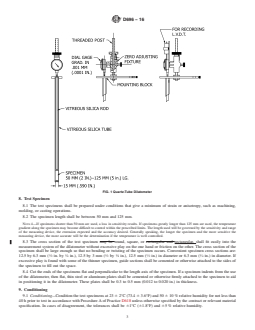
where L1 and L2 are the specimen lengths at temperatures T1 and T2, respectively. α is, therefore, obtained by dividing the linear expansion per unit length by the change in temperature.
5.2 The nature of most plastics and the construction of the dilatometer make −30 to +30°C (−22°F to +86°F) a convenient temperature range for linear thermal expansion measurements of plastics. This range covers the temperatures in which plastics are most commonly used. Where testing outside of this temperature range or when linear thermal expansion characteristics of a particular plastic are not known through this temperature range, particular attention shall be paid to the factors mentioned in 1.2.
Note 2: In such cases, special preliminary investigations by thermo-mechanical analysis, such as that prescribed in Practice D4065 for the location of transition temperatures, may be required to avoid excessive error. Other ways of locating phase changes or transition temperatures using the dilatometer itself may be employed to cover the range of temperatures in question by using smaller steps than 30°C (86°F) or by observing the rate of expansion during a steady rise in temperature of the specimen. Once such a transition point has been located, a separate coefficient of expansion for a temperature range below and above the transition point shall be determined. For specification and comparison purposes, the range from −30°C to +30°C (−22°F to +86°F) (provided it is known that no transition exists in this range) shall be used.
SCOPE
1.1 This test method covers determination of the coefficient of linear thermal expansion for plastic materials having coefficients of expansion greater than 1 µm/(m.°C) by use of a vitreous silica dilatometer. At the test temperatures and under the stresses imposed, the plastic materials shall have a negligible creep or elastic strain rate or both, insofar as these properties would significantly affect the accuracy of the measurements.
1.1.1 Test Method E228 shall be used for temperatures other than −30°C to 30°C.
1.1.2 This test method shall not be used for measurements on materials having a very low coefficient of expansion (less than 1 µm/(m.°C). For materials having very low coefficient of expansion, interferometer or capacitance techniques are recommended.
1.1.3 Alternative technique commonly used for measuring this property is thermomechanical analysis as described in Test Method E831, which permits measurement of this property over a scanned temperature range.
1.2 The thermal expansion of a plastic is composed of a reversible component on which are superimposed changes in length due to changes in moisture content, curing, loss of plasticizer or solvents, release of stresses, phase changes and other factors. This test method is intended for determining the coefficient of linear thermal expansion under the exclusion of these factors as far as possible. In general, it will not be possible to exclude the effect of these factors completely. For this reason, the test method can be expected to give only an approximation to the true thermal expansion.
1.3 The values stated in SI units are to be regarded as standard. The values in parentheses are for information only.
1.4 This standard does not purport to address all of the safety concerns, if any, associated with its use. It is the responsibility of the user of this standard to establish appropriate safety and health practices and determine the applicability of regulatory limitations prior to use.
Note 1: There is no known ISO equivalent to this standard.
- Status
- Published
- Publication Date
- 31-Mar-2016
- Technical Committee
- D20 - Plastics
- Drafting Committee
- D20.30 - Thermal Properties
Buy Documents
ASTM D696-16 - Standard Test Method for Coefficient of Linear Thermal Expansion of Plastics Between −30°C and 30°C with a Vitreous Silica Dilatometer
REDLINE ASTM D696-16 - Standard Test Method for Coefficient of Linear Thermal Expansion of Plastics Between −30°C and 30°C with a Vitreous Silica Dilatometer
Overview
ASTM D696-16: Standard Test Method for Coefficient of Linear Thermal Expansion of Plastics Between −30°C and 30°C with a Vitreous Silica Dilatometer is a widely referenced standard developed by ASTM International. This standard outlines a precise method for determining the coefficient of linear thermal expansion (CLTE) for plastic materials within the temperature range of −30°C to 30°C, using a vitreous silica dilatometer. Accurate measurement of thermal expansion is critical for plastics, as their dimensional stability can be significantly affected by temperature fluctuations. This method helps manufacturers, researchers, and quality assurance professionals in characterizing material properties and ensuring conformance to application requirements.
Key Topics
- Coefficient of Linear Thermal Expansion (CLTE): D696 defines the calculation of CLTE as the change in length per unit length per degree Celsius, based on measurements at two specified temperatures.
- Temperature Range: The procedure is specific to the range of −30°C to 30°C (−22°F to +86°F), which includes temperatures most commonly encountered in the use of plastics.
- Test Method Scope: Applicable to plastics with coefficients of expansion greater than 1 µm/(m·°C). Materials with lower CLTE should use alternative techniques such as interferometry or capacitance methods.
- Vitreous Silica Dilatometer: This method utilizes a precise quartz-tube dilatometer suited for stable, repeatable measurements, ensuring minimal impact from creep or elastic strain during testing.
- Accuracy Considerations: The standard includes guidance for preparing and conditioning specimens and details precautions to minimize the influence of external factors like moisture, curing state, and phase transitions.
Applications
ASTM D696-16 is essential for:
- Product Design and Engineering: Understanding the thermal expansion characteristics of plastics is vital for applications where dimensional changes can impact performance, fit, or safety, such as in automotive, aerospace, electronics, and construction industries.
- Materials Selection and Comparison: The standard enables engineers and material scientists to compare different polymers’ thermal behavior, under controlled and reproducible test conditions, facilitating appropriate material selection for temperature-sensitive applications.
- Quality Control and Specification Compliance: Manufacturers use this method as part of quality assurance processes to verify material consistency and ensure products meet dimensional stability requirements across specified temperature ranges.
- Research and Development: The technique supports R&D activities in polymer science for developing new materials or additives that modify thermal expansion properties, enhancing performance in demanding environments.
Related Standards
- ASTM D618: Practice for Conditioning Plastics for Testing, relevant for preparing samples prior to CLTE measurement.
- ASTM D883: Terminology Relating to Plastics, providing necessary definitions used in D696.
- ASTM D4065: Practice for Plastics-Dynamic Mechanical Properties, referenced for determining transition temperatures.
- ASTM E228: Test Method for Linear Thermal Expansion of Solid Materials With a Push-Rod Dilatometer, recommended for temperatures outside the D696 scope.
- ASTM E691: Practice for Conducting an Interlaboratory Study to Determine the Precision of a Test Method.
- ASTM E831: Test Method for Linear Thermal Expansion of Solid Materials by Thermomechanical Analysis, offering an alternative measurement technique over a scanned temperature range.
Practical Value
By adhering to ASTM D696-16, stakeholders gain a reliable, standardized approach for quantifying the coefficient of linear thermal expansion in plastics. Accurate thermal expansion data is critical for ensuring dimensional stability, product reliability, and performance across various industries using plastic materials. The clarity and precision provided by this standard help reduce errors, facilitate compliance with design specifications, and advance material science research.
Keywords: ASTM D696, coefficient of linear thermal expansion, plastics, thermal expansion, vitreous silica dilatometer, temperature range, dimensional stability, polymer testing, material specification.
Relations
- Effective Date
- 01-Apr-2016
- Effective Date
- 01-Feb-2024
- Effective Date
- 01-Nov-2023
- Effective Date
- 01-Jan-2020
- Effective Date
- 01-Aug-2019
- Effective Date
- 15-Apr-2019
- Effective Date
- 01-Feb-2019
- Effective Date
- 01-Dec-2018
- Effective Date
- 01-Nov-2018
- Effective Date
- 15-Aug-2017
- Effective Date
- 01-Sep-2016
- Effective Date
- 01-Aug-2014
- Effective Date
- 01-Nov-2013
- Effective Date
- 01-May-2013
- Effective Date
- 15-Nov-2012
Buy Documents
ASTM D696-16 - Standard Test Method for Coefficient of Linear Thermal Expansion of Plastics Between −30°C and 30°C with a Vitreous Silica Dilatometer
REDLINE ASTM D696-16 - Standard Test Method for Coefficient of Linear Thermal Expansion of Plastics Between −30°C and 30°C with a Vitreous Silica Dilatometer
Get Certified
Connect with accredited certification bodies for this standard

DIN CERTCO
DIN Group product certification.

Smithers Quality Assessments
US management systems and product certification.
Sponsored listings
Frequently Asked Questions
ASTM D696-16 is a standard published by ASTM International. Its full title is "Standard Test Method for Coefficient of Linear Thermal Expansion of Plastics Between −30°C and 30°C with a Vitreous Silica Dilatometer". This standard covers: SIGNIFICANCE AND USE 5.1 The coefficient of linear thermal expansion, α, between temperatures T1 and T2 for a specimen whose length is L0 at the reference temperature, is given by the following equation: where L1 and L2 are the specimen lengths at temperatures T1 and T2, respectively. α is, therefore, obtained by dividing the linear expansion per unit length by the change in temperature. 5.2 The nature of most plastics and the construction of the dilatometer make −30 to +30°C (−22°F to +86°F) a convenient temperature range for linear thermal expansion measurements of plastics. This range covers the temperatures in which plastics are most commonly used. Where testing outside of this temperature range or when linear thermal expansion characteristics of a particular plastic are not known through this temperature range, particular attention shall be paid to the factors mentioned in 1.2. Note 2: In such cases, special preliminary investigations by thermo-mechanical analysis, such as that prescribed in Practice D4065 for the location of transition temperatures, may be required to avoid excessive error. Other ways of locating phase changes or transition temperatures using the dilatometer itself may be employed to cover the range of temperatures in question by using smaller steps than 30°C (86°F) or by observing the rate of expansion during a steady rise in temperature of the specimen. Once such a transition point has been located, a separate coefficient of expansion for a temperature range below and above the transition point shall be determined. For specification and comparison purposes, the range from −30°C to +30°C (−22°F to +86°F) (provided it is known that no transition exists in this range) shall be used. SCOPE 1.1 This test method covers determination of the coefficient of linear thermal expansion for plastic materials having coefficients of expansion greater than 1 µm/(m.°C) by use of a vitreous silica dilatometer. At the test temperatures and under the stresses imposed, the plastic materials shall have a negligible creep or elastic strain rate or both, insofar as these properties would significantly affect the accuracy of the measurements. 1.1.1 Test Method E228 shall be used for temperatures other than −30°C to 30°C. 1.1.2 This test method shall not be used for measurements on materials having a very low coefficient of expansion (less than 1 µm/(m.°C). For materials having very low coefficient of expansion, interferometer or capacitance techniques are recommended. 1.1.3 Alternative technique commonly used for measuring this property is thermomechanical analysis as described in Test Method E831, which permits measurement of this property over a scanned temperature range. 1.2 The thermal expansion of a plastic is composed of a reversible component on which are superimposed changes in length due to changes in moisture content, curing, loss of plasticizer or solvents, release of stresses, phase changes and other factors. This test method is intended for determining the coefficient of linear thermal expansion under the exclusion of these factors as far as possible. In general, it will not be possible to exclude the effect of these factors completely. For this reason, the test method can be expected to give only an approximation to the true thermal expansion. 1.3 The values stated in SI units are to be regarded as standard. The values in parentheses are for information only. 1.4 This standard does not purport to address all of the safety concerns, if any, associated with its use. It is the responsibility of the user of this standard to establish appropriate safety and health practices and determine the applicability of regulatory limitations prior to use. Note 1: There is no known ISO equivalent to this standard.
SIGNIFICANCE AND USE 5.1 The coefficient of linear thermal expansion, α, between temperatures T1 and T2 for a specimen whose length is L0 at the reference temperature, is given by the following equation: where L1 and L2 are the specimen lengths at temperatures T1 and T2, respectively. α is, therefore, obtained by dividing the linear expansion per unit length by the change in temperature. 5.2 The nature of most plastics and the construction of the dilatometer make −30 to +30°C (−22°F to +86°F) a convenient temperature range for linear thermal expansion measurements of plastics. This range covers the temperatures in which plastics are most commonly used. Where testing outside of this temperature range or when linear thermal expansion characteristics of a particular plastic are not known through this temperature range, particular attention shall be paid to the factors mentioned in 1.2. Note 2: In such cases, special preliminary investigations by thermo-mechanical analysis, such as that prescribed in Practice D4065 for the location of transition temperatures, may be required to avoid excessive error. Other ways of locating phase changes or transition temperatures using the dilatometer itself may be employed to cover the range of temperatures in question by using smaller steps than 30°C (86°F) or by observing the rate of expansion during a steady rise in temperature of the specimen. Once such a transition point has been located, a separate coefficient of expansion for a temperature range below and above the transition point shall be determined. For specification and comparison purposes, the range from −30°C to +30°C (−22°F to +86°F) (provided it is known that no transition exists in this range) shall be used. SCOPE 1.1 This test method covers determination of the coefficient of linear thermal expansion for plastic materials having coefficients of expansion greater than 1 µm/(m.°C) by use of a vitreous silica dilatometer. At the test temperatures and under the stresses imposed, the plastic materials shall have a negligible creep or elastic strain rate or both, insofar as these properties would significantly affect the accuracy of the measurements. 1.1.1 Test Method E228 shall be used for temperatures other than −30°C to 30°C. 1.1.2 This test method shall not be used for measurements on materials having a very low coefficient of expansion (less than 1 µm/(m.°C). For materials having very low coefficient of expansion, interferometer or capacitance techniques are recommended. 1.1.3 Alternative technique commonly used for measuring this property is thermomechanical analysis as described in Test Method E831, which permits measurement of this property over a scanned temperature range. 1.2 The thermal expansion of a plastic is composed of a reversible component on which are superimposed changes in length due to changes in moisture content, curing, loss of plasticizer or solvents, release of stresses, phase changes and other factors. This test method is intended for determining the coefficient of linear thermal expansion under the exclusion of these factors as far as possible. In general, it will not be possible to exclude the effect of these factors completely. For this reason, the test method can be expected to give only an approximation to the true thermal expansion. 1.3 The values stated in SI units are to be regarded as standard. The values in parentheses are for information only. 1.4 This standard does not purport to address all of the safety concerns, if any, associated with its use. It is the responsibility of the user of this standard to establish appropriate safety and health practices and determine the applicability of regulatory limitations prior to use. Note 1: There is no known ISO equivalent to this standard.
ASTM D696-16 is classified under the following ICS (International Classification for Standards) categories: 83.080.01 - Plastics in general. The ICS classification helps identify the subject area and facilitates finding related standards.
ASTM D696-16 has the following relationships with other standards: It is inter standard links to ASTM D696-08e1, ASTM D883-24, ASTM D883-23, ASTM D883-20, ASTM D883-19c, ASTM D883-19a, ASTM D883-19, ASTM D883-18a, ASTM D883-18, ASTM D883-17, ASTM E228-11(2016), ASTM E831-14, ASTM E831-13, ASTM E691-13, ASTM D883-12e1. Understanding these relationships helps ensure you are using the most current and applicable version of the standard.
ASTM D696-16 is available in PDF format for immediate download after purchase. The document can be added to your cart and obtained through the secure checkout process. Digital delivery ensures instant access to the complete standard document.
Standards Content (Sample)
This international standard was developed in accordance with internationally recognized principles on standardization established in the Decision on Principles for the
Development of International Standards, Guides and Recommendations issued by the World Trade Organization Technical Barriers to Trade (TBT) Committee.
Designation: D696 − 16
Standard Test Method for
Coefficient of Linear Thermal Expansion of Plastics
Between −30°C and 30°C with a Vitreous Silica Dilatometer
This standard is issued under the fixed designation D696; the number immediately following the designation indicates the year of
original adoption or, in the case of revision, the year of last revision.Anumber in parentheses indicates the year of last reapproval.A
superscript epsilon (´) indicates an editorial change since the last revision or reapproval.
This standard has been approved for use by agencies of the U.S. Department of Defense.
1. Scope* responsibility of the user of this standard to establish appro-
priate safety, health, and environmental practices and deter-
1.1 This test method covers determination of the coefficient
mine the applicability of regulatory limitations prior to use.
of linear thermal expansion for plastic materials having coef-
ficients of expansion greater than 1µm⁄(m.°C) by use of a
NOTE 1—There is no known ISO equivalent to this standard.
vitreous silica dilatometer. At the test temperatures and under
1.5 This international standard was developed in accor-
the stresses imposed, the plastic materials shall have a negli-
dance with internationally recognized principles on standard-
gible creep or elastic strain rate or both, insofar as these
ization established in the Decision on Principles for the
properties would significantly affect the accuracy of the mea-
Development of International Standards, Guides and Recom-
surements.
mendations issued by the World Trade Organization Technical
1.1.1 TestMethodE228shallbeusedfortemperaturesother
Barriers to Trade (TBT) Committee.
than −30°C to 30°C.
1.1.2 This test method shall not be used for measurements 2. Referenced Documents
on materials having a very low coefficient of expansion (less
2.1 ASTM Standards:
than 1 µm/(m.°C). For materials having very low coefficient of
D618Practice for Conditioning Plastics for Testing
expansion, interferometer or capacitance techniques are rec-
D883Terminology Relating to Plastics
ommended.
D4065Practice for Plastics: Dynamic Mechanical Proper-
1.1.3 Alternative technique commonly used for measuring
ties: Determination and Report of Procedures
thispropertyisthermomechanicalanalysisasdescribedinTest
E228Test Method for Linear Thermal Expansion of Solid
Method E831, which permits measurement of this property
Materials With a Push-Rod Dilatometer
over a scanned temperature range.
E691Practice for Conducting an Interlaboratory Study to
1.2 The thermal expansion of a plastic is composed of a Determine the Precision of a Test Method
reversible component on which are superimposed changes in E831Test Method for Linear Thermal Expansion of Solid
length due to changes in moisture content, curing, loss of Materials by Thermomechanical Analysis
plasticizer or solvents, release of stresses, phase changes and
3. Terminology
other factors. This test method is intended for determining the
coefficient of linear thermal expansion under the exclusion of 3.1 Definitions—Definitions are in accordance with Termi-
these factors as far as possible. In general, it will not be
nology D883 unless otherwise specified.
possible to exclude the effect of these factors completely. For
4. Summary of Test Method
this reason, the test method can be expected to give only an
approximation to the true thermal expansion.
4.1 This test method is intended to provide a means of
determining the coefficient of linear thermal expansion of
1.3 The values stated in SI units are to be regarded as
plastics which are not distorted or indented by the thrust of the
standard. The values in parentheses are for information only.
dilatometer on the specimen. For materials that indent, see 8.4.
1.4 This standard does not purport to address all of the
The specimen is placed at the bottom of the outer dilatometer
safety concerns, if any, associated with its use. It is the
tube with the inner one resting on it. The measuring device
which is firmly attached to the outer tube is in contact with the
ThistestmethodisunderthejurisdictionofASTMCommitteeD20onPlastics
and is the direct responsibility of Subcommittee D20.30 on Thermal Properties
(Section D20.30.07). For referenced ASTM standards, visit the ASTM website, www.astm.org, or
Current edition approved April 1, 2016. Published April 2016. Originally contact ASTM Customer Service at service@astm.org. For Annual Book of ASTM
ɛ1
approved in 1942. Last previous edition approved in 2008 as D696–08 . DOI: Standards volume information, refer to the standard’s Document Summary page on
10.1520/D0696-16. the ASTM website.
*A Summary of Changes section appears at the end of this standard
Copyright © ASTM International, 100 Barr Harbor Drive, PO Box C700, West Conshohocken, PA 19428-2959. United States
D696 − 16
top of the inner tube and indicates variations in the length of temperature range, particular attention shall be paid to the
the specimen with changes in temperature. Temperature factors mentioned in 1.2.
changes are brought about by immersing the outer tube in a
NOTE 2—In such cases, special preliminary investigations by thermo-
liquid bath or other controlled temperature environment main-
mechanical analysis, such as that prescribed in Practice D4065 for the
tained at the desired temperature.
location of transition temperatures, may be required to avoid excessive
error. Other ways of locating phase changes or transition temperatures
5. Significance and Use
using the dilatometer itself may be employed to cover the range of
temperatures in question by using smaller steps than 30°C (86°F) or by
5.1 The coefficient of linear thermal expansion, α, between
observing the rate of expansion during a steady rise in temperature of the
temperatures T and T foraspecimenwhoselengthis L atthe
1 2 0 specimen. Once such a transition point has been located, a separate
reference temperature, is given by the following equation: coefficient of expansion for a temperature range below and above the
transition point shall be determined. For specification and comparison
α 5 L 2 L /@L ~T 2 T !# 5∆L/L ∆T
~ !
2 1 0 2 1 0
purposes, the range from −30°C to +30°C (−22°F to +86°F) (provided it
is known that no transition exists in this range) shall be used.
where L and L are the specimen lengths at temperatures T
1 2 1
and T , respectively. α is, therefore, obtained by dividing the
6. Apparatus
linear expansion per unit length by the change in temperature.
6.1 Fused-Quartz-Tube Dilatometer suitable for this test
5.2 The nature of most plastics and the construction of the
method is illustrated in Fig. 1.Aclearance of approximately 1
dilatometermake−30to+30°C(−22°Fto+86°F)aconvenient
mm is allowed between the inner and outer tubes.
temperature range for linear thermal expansion measurements
of plastics. This range covers the temperatures in which 6.2 Device for measuring the changes in length (dial gauge,
plasticsaremostcommonlyused.Wheretestingoutsideofthis LVDT, or the equivalent) is fixed on the mounting fixture.
temperature range or when linear thermal expansion character- Adjust its position to accommodate specimens of varying
istics of a particular plastic are not known through this length (see 8.2). The accuracy shall be such that the error of
FIG. 1 Quartz-Tube Dilatometer
D696 − 16
−5
indication will not exceed 61.0 µm (4×10 in.) for any 9. Conditioning
length change. The weight of the inner silica tube plus the
9.1 Conditioning—Condition the test specimens at
measuring device reaction shall not exert a stress of more than
23 62°C (73.4 63.6°F) and 50 610% relative humidity for
70 kPa (10 psi) on the specimen so that the specimen is not
not less than 40 h prior to test in accordance with ProcedureA
distorted or appreciably indented.
of Practice D618 unless otherwise specified by the contract or
relevant material specification. In cases of disagreement, the
6.3 Scale or Caliper capable of measuring the initial length
tolerances shall be 61°C (61.8°F) and 65% relative humid-
of the specimen with an accuracy of 60.5%.
ity.
6.4 Controlled Temperature Environment to control the
temperature of the specimen. Arrange the bath so a uniform
10. Procedure
temperature is assured over the length of the specimen. Means
10.1 Measure the length of two conditioned specimens at
shall be provided for stirring the bath and for controlling its
room temperature to the nearest 25 µm (0.001 in.) with the
temperature within 60.2°C (60.4°F) at the time of the
scale or caliper (see 6.3).
temperature and measuring device readings.
10.2 Cement or otherwise attach the steel plates to the ends
NOTE3—Ifafluidbathisused,itispreferableandnotdifficulttoavoid
of the specimen to prevent indentation (see 8.4). Measure the
contact between the bath liquid and the test specimen. If such contact is
new lengths of the specimens.
unavoidable, take care to select a fluid that will not affect the physical
properties of the material under test.
10.3 Mount each specimen in a dilatometer. Carefully
install the dilatometer in the −30°C (−22°F) controlled envi-
6.5 Thermometer or Thermocouple—The bath temperature
ronment. If liquid bath is used, make sure the top of the
shall be measured by a thermometer or thermocouple capable
specimen is at least 50 mm (2 in.) below the liquid level of the
of an accuracy of 60.1°C (60.2°F).
bath. Maintain the temperature of the bath in the range from
−32°C to −28°C (−26 to −18°F) 6 0.2°C (0.4°F) until the
7. Sampling
temperature of the specimen along the length is constant as
7.1 Sampling shall be conducted in accordance with the
denoted by no further movement indicated by the measuring
material specification for the material in question.
device over a period of 5 to 10 min. Record the actual
temperature and the measuring device reading.
8. Test Specimen
10.4 With
...
This document is not an ASTM standard and is intended only to provide the user of an ASTM standard an indication of what changes have been made to the previous version. Because
it may not be technically possible to adequately depict all changes accurately, ASTM recommends that users consult prior editions as appropriate. In all cases only the current version
of the standard as published by ASTM is to be considered the official document.
´1
Designation: D696 − 08 D696 − 16
Standard Test Method for
Coefficient of Linear Thermal Expansion of Plastics
Between −30°C and 30°C with a Vitreous Silica Dilatometer
This standard is issued under the fixed designation D696; the number immediately following the designation indicates the year of
original adoption or, in the case of revision, the year of last revision. A number in parentheses indicates the year of last reapproval. A
superscript epsilon (´) indicates an editorial change since the last revision or reapproval.
This standard has been approved for use by agencies of the U.S. Department of Defense.
ε NOTE—Editorially corrected parenthetical temperature values in 5.2 in March 2013.
1. Scope*
1.1 This test method covers determination of the coefficient of linear thermal expansion for plastic materials having coefficients
−6
of expansion greater than 1 × 101 μm /°C⁄(m.°C) by use of a vitreous silica dilatometer. At the test temperatures and under the
stresses imposed, the plastic materials shall have a negligible creep or elastic strain rate or both, insofar as these properties would
significantly affect the accuracy of the measurements.
NOTE 1—There is no known ISO equivalent to this standard.
1.1.1 Test Method E228 shall be used for temperatures other than −30°C to 30°C.
1.1.2 This test method shall not be used for measurements on materials having a very low coefficient of expansion (less than
−6
1 × 101 /°C). μm/(m.°C). For materials having very low coefficient of expansion, interferometer or capacitance techniques are
recommended.
1.1.3 Alternative technique commonly used for measuring this property is thermomechanical analysis as described in Test
Method E831, which permits measurement of this property over a scanned temperature range.
1.2 The thermal expansion of a plastic is composed of a reversible component on which are superimposed changes in length
due to changes in moisture content, curing, loss of plasticizer or solvents, release of stresses, phase changes and other factors. This
test method is intended for determining the coefficient of linear thermal expansion under the exclusion of these factors as far as
possible. In general, it will not be possible to exclude the effect of these factors completely. For this reason, the test method can
be expected to give only an approximation to the true thermal expansion.
1.3 The values stated in SI units are to be regarded as standard. The values in parentheses are for information only.
1.4 This standard does not purport to address all of the safety concerns, if any, associated with its use. It is the responsibility
of the user of this standard to establish appropriate safety and health practices and determine the applicability of regulatory
limitations prior to use.
NOTE 1—There is no known ISO equivalent to this standard.
2. Referenced Documents
2.1 ASTM Standards:
D618 Practice for Conditioning Plastics for Testing
D883 Terminology Relating to Plastics
D4065 Practice for Plastics: Dynamic Mechanical Properties: Determination and Report of Procedures
E228 Test Method for Linear Thermal Expansion of Solid Materials With a Push-Rod Dilatometer
E691 Practice for Conducting an Interlaboratory Study to Determine the Precision of a Test Method
E831 Test Method for Linear Thermal Expansion of Solid Materials by Thermomechanical Analysis
This test method is under the jurisdiction of ASTM Committee D20 on Plastics and is the direct responsibility of Subcommittee D20.30 on Thermal Properties (Section
D20.30.07).
Current edition approved Nov. 1, 2008April 1, 2016. Published November 2008April 2016. Originally approved in 1942. Last previous edition approved in 20032008 as
ɛ1
D696 – 03.D696 – 08 . DOI: 10.1520/D0696-08E01.10.1520/D0696-16.
For referenced ASTM standards, visit the ASTM website, www.astm.org, or contact ASTM Customer Service at service@astm.org. For Annual Book of ASTM Standards
volume information, refer to the standard’s Document Summary page on the ASTM website.
*A Summary of Changes section appears at the end of this standard
Copyright © ASTM International, 100 Barr Harbor Drive, PO Box C700, West Conshohocken, PA 19428-2959. United States
D696 − 16
3. Terminology
3.1 Definitions—Definitions are in accordance with Terminology D883 unless otherwise specified.
4. Summary of Test Method
4.1 This test method is intended to provide a means of determining the coefficient of linear thermal expansion of plastics which
are not distorted or indented by the thrust of the dilatometer on the specimen. For materials that indent, see 8.4. The specimen is
placed at the bottom of the outer dilatometer tube with the inner one resting on it. The measuring device which is firmly attached
to the outer tube is in contact with the top of the inner tube and indicates variations in the length of the specimen with changes
in temperature. Temperature changes are brought about by immersing the outer tube in a liquid bath or other controlled temperature
environment maintained at the desired temperature.
5. Significance and Use
5.1 The coefficient of linear thermal expansion, α, between temperatures T and T for a specimen whose length is L at the
1 2 0
reference temperature, is given by the following equation:
α5 L 2 L / L T 2 T 5 ΔL/L ΔT
@ ~ !#
~ 2 1! 0 2 1 0
where L and L are the specimen lengths at temperatures T and T , respectively. α is, therefore, obtained by dividing the linear
1 2 1 2
expansion per unit length by the change in temperature.
5.2 The nature of most plastics and the construction of the dilatometer make −30 to +30°C (−22°F to +86°F) a convenient
temperature range for linear thermal expansion measurements of plastics. This range covers the temperatures in which plastics are
most commonly used. Where testing outside of this temperature range or when linear thermal expansion characteristics of a
particular plastic are not known through this temperature range, particular attention shall be paid to the factors mentioned in 1.2
and special preliminary investigations by thermo-mechanical analysis, such as that prescribed in Practice .D4065 for the location
of transition temperatures, may be required to avoid excessive error. Other ways of locating phase changes or transition
temperatures using the dilatometer itself may be employed to cover the range of temperatures in question by using smaller steps
than 30°C (86°F) or by observing the rate of expansion during a steady rise in temperature of the specimen. Once such a transition
point has been located, a separate coefficient of expansion for a temperature range below and above the transition point shall be
determined. For specification and comparison purposes, the range from −30°C to +30°C (−22°F to +86°F) (provided it is known
that no transition exists in this range) shall be used.
NOTE 2—In such cases, special preliminary investigations by thermo-mechanical analysis, such as that prescribed in Practice D4065 for the location
of transition temperatures, may be required to avoid excessive error. Other ways of locating phase changes or transition temperatures using the dilatometer
itself may be employed to cover the range of temperatures in question by using smaller steps than 30°C (86°F) or by observing the rate of expansion
during a steady rise in temperature of the specimen. Once such a transition point has been located, a separate coefficient of expansion for a temperature
range below and above the transition point shall be determined. For specification and comparison purposes, the range from −30°C to +30°C (−22°F to
+86°F) (provided it is known that no transition exists in this range) shall be used.
6. Apparatus
6.1 Fused-Quartz-Tube Dilatometer suitable for this test method is illustrated in Fig. 1. A clearance of approximately 1 mm is
allowed between the inner and outer tubes.
6.2 Device for measuring the changes in length (dial gage,gauge, LVDT, or the equivalent) is fixed on the mounting fixture so
that fixture. Adjust its position may be adjusted to accommodate specimens of varying length (see 8.2). The accuracy shall be such
−5
that the error of indication will not exceed 61.0 μm (4 × 10 in.) for any length change. The weight of the inner silica tube plus
the measuring device reaction shall not exert a stress of more than 70 kPa (10 psi) on the specimen so that the specimen is not
distorted or appreciably indented.
6.3 Scale or Caliper capable of measuring the initial length of the specimen with an accuracy of 60.5 %.
6.4 Controlled Temperature Environment to control the temperature of the specimen. Arrange the bath so a uniform temperature
is assured over the length of the specimen. Means shall be provided for stirring the bath and for controlling its temperature within
60.2°C (60.4°F) at the time of the temperature and measuring device readings.
NOTE 3—If a fluid bath is used, it is preferable and not difficult to avoid contact between the bath liquid and the test specimen. If such contact is
unavoidable, take care to select a fluid that will not affect the physical properties of the material under test.
6.5 Thermometer or Thermocouple—The bath temperature shall be measured by a thermometer or thermocouple capable of an
accuracy of 60.1°C (60.2°F).
7. Sampling
7.1 Sampling shall be conducted in accordance with the material specification for the material in question.
D696 − 16
FIG. 1 Quartz-Tube Dilatometer
8. Test Specimen
8.1 The test specimens shall be prepared under conditions that give a minimum of strain or anisotropy, such as machining,
molding, or casting operations.
8.2 The specimen length shall be between 50 mm and 125 mm.
NOTE 4—If specimens shorter than 50 mm are used, a loss in sensitivity results. If specimens greatly longer than 125 mm are used, the temperature
gradient along the specimen may become difficult to control within the prescribed limits. The length used will be governed by the sensitivity and range
of the measuring device, the extension expected and the accuracy desired. Generally speaking, the longer the specimen and the more sensitive the
measuring device, the more accurate will be the determination if the temperature is well controlled.
8.3 The cross section of the test specimen may be round, square, or rectangular and rectangular, shall fit easily into the
measurement system of the dilatometer without excessive play on the one hand or friction on the other. The cross section of the
specimen shall be large enough so that no bending or twisting of the specimen occurs. Convenient specimen cross sections are:
1 1 1 1 1 1
12.5 by 6.3 mm ( ⁄2 in. by ⁄4 in.), 12.5 by 3 mm ( ⁄2 by ⁄8 in.), 12.5 mm ( ⁄2 in.) in diameter or 6.3 mm ( ⁄4 in.) in diameter. If
excessive play is found with some of the thinner specimen, guide sections shall be cemented or otherwise a
...