

ASTM E3348/E3348M-22
(Guide)Standard Guide for Body Armor for Non-Law Enforcement First Responders
General Information
- Abstract
SIGNIFICANCE AND USE
4.1 This guide is intended for non-law enforcement first responders facing increased exposure to scenes of violence where firearms or stabbing weapons may be used.
4.2 The use and wear conditions are different than for law enforcement, requiring specialized guidance on types of body armor and their limitations, levels of protection, threat assessment, use and care, compatibility with other required protective gear, and training.
SCOPE
1.1 This guide provides information to non-law enforcement first responders for the selection and use of body armor.
1.2 Non-law enforcement first responders, including but not limited to fire fighters, emergency medical service providers, fire investigators, and civilian/community response teams, require specialized guidance on types of body armor and their limitations, levels of protection, threat assessment, use and care, compatibility with other required protective gear, and training.
1.3 This guide is directed to authorities having jurisdiction (AHJs) and all non-law enforcement first responders and their agency or department leadership.
1.4 This guide is not intended for law enforcement and corrections personnel.
Note 1: See NIJ SAG 0101.06.
1.5 This guide is divided into the following sections:
Section
Title
1
Scope
2
Referenced Documents
3
Terminology
4
Significance and Use
5
Managing a Body Armor Program
6
Understanding Protection Levels
7
Selecting the Appropriate Body Armor
8
Sizing Body Armor to the End User(s)
9
Guidance on Purchasing
10
Verifying that Your Body Armor is NIJ Certified
11
Fit, Coverage, and Wear Guidance
12
Fire Fighter Guidance for Body Armor Use with Turnout Gear
13
Inspection, Care, and Maintenance
14
Keywords
Annex A1
Risk Assessment Guidance
Appendix X1
Body Armor Program Management Guidance
Appendix X2
Comparison of NIJ Ballistic Protection Levels
Appendix X3
General Federal Government Grant Programs
1.6 The values stated in either SI units or inch-pound units are to be regarded separately as standard. The values stated in each system are not necessarily exact equivalents; therefore, to ensure conformance with the standard, each system shall be used independently of the other, and values from the two systems shall not be combined.
1.6.1 The user of this standard will identify the system of units to be used, and it is critical to ensure that any cross-referenced standards maintain consistency of units between standards.
1.7 This standard does not purport to address all of the safety concerns, if any, associated with its use. It is the responsibility of the user of this standard to establish appropriate safety, health, and environmental practices and determine the applicability of regulatory limitations prior to use.
1.8 This international standard was developed in accordance with internationally recognized principles on standardization established in the Decision on Principles for the Development of International Standards, Guides and Recommendations issued by the World Trade Organization Technical Barriers to Trade (TBT) Committee.
- Status
- Published
- Publication Date
- 31-May-2022
- Technical Committee
- E54 - Homeland Security Applications
- Drafting Committee
- E54.04 - Public Safety Equipment
Overview
ASTM E3348/E3348M-22: Standard Guide for Body Armor for Non-Law Enforcement First Responders is an internationally recognized guidance document developed by ASTM International. It delivers comprehensive information for non-law enforcement first responders-such as fire fighters, emergency medical service (EMS) providers, fire investigators, and community response teams-on selecting, wearing, and maintaining body armor in situations where the risk of violence, including firearms and stabbing weapons, may be present.
This standard is designed to fill the gap between the unique requirements of first responders and the conventional needs of law enforcement officers. Developed by a multidisciplinary expert committee, it supports agency leadership and authorities having jurisdiction (AHJs) by providing actionable recommendations on body armor protection levels, threat assessment, integration with other protective equipment, and related training.
Key Topics
ASTM E3348/E3348M-22 addresses several critical aspects of body armor use for non-law enforcement personnel:
- Specialized Body Armor Types: Guidance on the limitations and selection criteria for soft armor, hard armor plates, and combination/multi-threat body armor.
- Protection Levels: Explanation of performance standards for ballistic and stab resistance, referencing National Institute of Justice (NIJ) standards such as 0101.06 for ballistic protection and 0115.00 for stab protection.
- Threat Assessment: Risk evaluation tailored to responder roles and anticipated incident types, supported by templates and practical guidance for agencies.
- Use and Care: Best practices for inspection, cleaning, and maintenance to ensure ongoing protective performance.
- Proper Fit and Sizing: Recommendations for individual and shared body armor, including key sizing metrics and adjustment guidelines.
- Compatibility: Advice on wearing body armor with other required protective gear, including fire-fighting turnout gear, and understanding operational limitations.
- Procurement and Verification: Steps to ensure body armor is NIJ certified and strategies for procurement, including sample bid language and verification procedures.
Applications
This standard provides essential information and practical value for a wide range of non-law enforcement responders and their leadership:
- Firefighters and EMS Personnel: Guidance on when and how to don body armor, particularly during active shooter or other mass casualty events.
- Fire Investigators and Community Response Teams: Support for threat assessment in potentially hostile environments, and guidance on risk-based deployment of protective equipment.
- Agency and Department Leadership: Tools to design and manage a body armor program, conduct risk assessments, manage inventory, and verify compliance with NIJ certification.
- Authorities Having Jurisdiction (AHJs): Clear criteria for adopting and enforcing departmental policies on the use, care, and storage of body armor for responder safety.
ASTM E3348/E3348M-22 is particularly relevant in the current climate, where non-law enforcement responders are being increasingly called into potentially violent incidents. Proper implementation of this guide enhances responder safety and aligns with best practices in public safety equipment management.
Related Standards
The following documents are referenced or related to ASTM E3348/E3348M-22 and provide additional technical context and support:
- ASTM E3003: Practice for Body Armor Wearer Measurement and Fitting of Armor
- ASTM E3195: Guide for Body Armor Program Management
- NFPA 3000: Standard for an Active Shooter/Hostile Event Response (ASHER) Program
- NIJ Standard 0101.06: Ballistic Resistance of Body Armor
- NIJ Standard 0115.00: Stab Resistance of Body Armor
- NIJ SAG 0101.06: Selection and Application Guide to Ballistic-Resistant Body Armor
These references help agencies and first responders ensure that their body armor programs meet established safety, performance, and administrative standards.
Keywords: body armor, non-law enforcement first responders, ASTM E3348/E3348M-22, fire fighters, EMS, threat assessment, NIJ certification, protective equipment, emergency response safety, ballistic-resistant armor, stab protection, program management.
Relations
- Effective Date
- 01-Apr-2024
- Effective Date
- 01-Aug-2020
- Effective Date
- 01-Feb-2020
- Effective Date
- 01-Aug-2019
- Effective Date
- 01-Oct-2018
- Effective Date
- 01-Dec-2015
- Effective Date
- 01-Nov-2015
Get Certified
Connect with accredited certification bodies for this standard

CIS Institut d.o.o.
Personal Protective Equipment (PPE) certification body. Notified Body NB-2890 for EU Regulation 2016/425 PPE.

Kiwa BDA Testing
Building and construction product certification.
Kmetijski inštitut Slovenije
Agricultural Institute of Slovenia. Soil testing, plant health, agricultural product analysis.
Sponsored listings
Frequently Asked Questions
ASTM E3348/E3348M-22 is a guide published by ASTM International. Its full title is "Standard Guide for Body Armor for Non-Law Enforcement First Responders". This standard covers: SIGNIFICANCE AND USE 4.1 This guide is intended for non-law enforcement first responders facing increased exposure to scenes of violence where firearms or stabbing weapons may be used. 4.2 The use and wear conditions are different than for law enforcement, requiring specialized guidance on types of body armor and their limitations, levels of protection, threat assessment, use and care, compatibility with other required protective gear, and training. SCOPE 1.1 This guide provides information to non-law enforcement first responders for the selection and use of body armor. 1.2 Non-law enforcement first responders, including but not limited to fire fighters, emergency medical service providers, fire investigators, and civilian/community response teams, require specialized guidance on types of body armor and their limitations, levels of protection, threat assessment, use and care, compatibility with other required protective gear, and training. 1.3 This guide is directed to authorities having jurisdiction (AHJs) and all non-law enforcement first responders and their agency or department leadership. 1.4 This guide is not intended for law enforcement and corrections personnel. Note 1: See NIJ SAG 0101.06. 1.5 This guide is divided into the following sections: Section Title 1 Scope 2 Referenced Documents 3 Terminology 4 Significance and Use 5 Managing a Body Armor Program 6 Understanding Protection Levels 7 Selecting the Appropriate Body Armor 8 Sizing Body Armor to the End User(s) 9 Guidance on Purchasing 10 Verifying that Your Body Armor is NIJ Certified 11 Fit, Coverage, and Wear Guidance 12 Fire Fighter Guidance for Body Armor Use with Turnout Gear 13 Inspection, Care, and Maintenance 14 Keywords Annex A1 Risk Assessment Guidance Appendix X1 Body Armor Program Management Guidance Appendix X2 Comparison of NIJ Ballistic Protection Levels Appendix X3 General Federal Government Grant Programs 1.6 The values stated in either SI units or inch-pound units are to be regarded separately as standard. The values stated in each system are not necessarily exact equivalents; therefore, to ensure conformance with the standard, each system shall be used independently of the other, and values from the two systems shall not be combined. 1.6.1 The user of this standard will identify the system of units to be used, and it is critical to ensure that any cross-referenced standards maintain consistency of units between standards. 1.7 This standard does not purport to address all of the safety concerns, if any, associated with its use. It is the responsibility of the user of this standard to establish appropriate safety, health, and environmental practices and determine the applicability of regulatory limitations prior to use. 1.8 This international standard was developed in accordance with internationally recognized principles on standardization established in the Decision on Principles for the Development of International Standards, Guides and Recommendations issued by the World Trade Organization Technical Barriers to Trade (TBT) Committee.
SIGNIFICANCE AND USE 4.1 This guide is intended for non-law enforcement first responders facing increased exposure to scenes of violence where firearms or stabbing weapons may be used. 4.2 The use and wear conditions are different than for law enforcement, requiring specialized guidance on types of body armor and their limitations, levels of protection, threat assessment, use and care, compatibility with other required protective gear, and training. SCOPE 1.1 This guide provides information to non-law enforcement first responders for the selection and use of body armor. 1.2 Non-law enforcement first responders, including but not limited to fire fighters, emergency medical service providers, fire investigators, and civilian/community response teams, require specialized guidance on types of body armor and their limitations, levels of protection, threat assessment, use and care, compatibility with other required protective gear, and training. 1.3 This guide is directed to authorities having jurisdiction (AHJs) and all non-law enforcement first responders and their agency or department leadership. 1.4 This guide is not intended for law enforcement and corrections personnel. Note 1: See NIJ SAG 0101.06. 1.5 This guide is divided into the following sections: Section Title 1 Scope 2 Referenced Documents 3 Terminology 4 Significance and Use 5 Managing a Body Armor Program 6 Understanding Protection Levels 7 Selecting the Appropriate Body Armor 8 Sizing Body Armor to the End User(s) 9 Guidance on Purchasing 10 Verifying that Your Body Armor is NIJ Certified 11 Fit, Coverage, and Wear Guidance 12 Fire Fighter Guidance for Body Armor Use with Turnout Gear 13 Inspection, Care, and Maintenance 14 Keywords Annex A1 Risk Assessment Guidance Appendix X1 Body Armor Program Management Guidance Appendix X2 Comparison of NIJ Ballistic Protection Levels Appendix X3 General Federal Government Grant Programs 1.6 The values stated in either SI units or inch-pound units are to be regarded separately as standard. The values stated in each system are not necessarily exact equivalents; therefore, to ensure conformance with the standard, each system shall be used independently of the other, and values from the two systems shall not be combined. 1.6.1 The user of this standard will identify the system of units to be used, and it is critical to ensure that any cross-referenced standards maintain consistency of units between standards. 1.7 This standard does not purport to address all of the safety concerns, if any, associated with its use. It is the responsibility of the user of this standard to establish appropriate safety, health, and environmental practices and determine the applicability of regulatory limitations prior to use. 1.8 This international standard was developed in accordance with internationally recognized principles on standardization established in the Decision on Principles for the Development of International Standards, Guides and Recommendations issued by the World Trade Organization Technical Barriers to Trade (TBT) Committee.
ASTM E3348/E3348M-22 is classified under the following ICS (International Classification for Standards) categories: 13.340.10 - Protective clothing. The ICS classification helps identify the subject area and facilitates finding related standards.
ASTM E3348/E3348M-22 has the following relationships with other standards: It is inter standard links to ASTM E3005-24, ASTM E3003-20, ASTM E3005-20, ASTM E3195-19, ASTM E3005-18, ASTM E3003-15, ASTM E3005-15. Understanding these relationships helps ensure you are using the most current and applicable version of the standard.
ASTM E3348/E3348M-22 is available in PDF format for immediate download after purchase. The document can be added to your cart and obtained through the secure checkout process. Digital delivery ensures instant access to the complete standard document.
Standards Content (Sample)
This international standard was developed in accordance with internationally recognized principles on standardization established in the Decision on Principles for the
Development of International Standards, Guides and Recommendations issued by the World Trade Organization Technical Barriers to Trade (TBT) Committee.
Designation: E3348/E3348M − 22
Standard Guide for
Body Armor for Non-Law Enforcement First Responders
ThisstandardisissuedunderthefixeddesignationE3348/E3348M;thenumberimmediatelyfollowingthedesignationindicatestheyear
of original adoption or, in the case of revision, the year of last revision. A number in parentheses indicates the year of last reapproval.
A superscript epsilon (´) indicates an editorial change since the last revision or reapproval.
INTRODUCTION
Non-law enforcement first responders, such as fire fighters, emergency medical service providers,
and non-law enforcement fire investigators are facing increased exposure to scenes of violence, and,
since the early 2000s, many departments have required that ballistic-resistant body armor be worn on
emergency calls. Since 2018, the wearing and use of body armor has been required for fire and
emergency medical personnel when operating in a warm zone. For the past 40 years, law enforcement
officers have been wearing body armor and guidance has been provided to them by the National
Institute of Justice. The concern for other responders is that the use and wear conditions are different
than for law enforcement: different limitations of body armor, levels of protection, threat assessment,
use and care, compatibility with other required protective gear, and training. This guide provides
necessary information developed by a multi-discipline group of experts within a consensus process.
Those benefiting from this guide include all non-law enforcement responders and their agency/
department leadership.
1. Scope 1.5 This guide is divided into the following sections:
1.1 This guide provides information to non-law enforce-
ment first responders for the selection and use of body armor.
Section Title
1 Scope
1.2 Non-law enforcement first responders, including but not
2 Referenced Documents
limited to fire fighters, emergency medical service providers,
3 Terminology
4 Significance and Use
fire investigators, and civilian/community response teams,
5 Managing a Body Armor Program
require specialized guidance on types of body armor and their
6 Understanding Protection Levels
limitations, levels of protection, threat assessment, use and
7 Selecting the Appropriate Body Armor
8 Sizing Body Armor to the End User(s)
care, compatibility with other required protective gear, and
9 Guidance on Purchasing
training.
10 Verifying that Your Body Armor is NIJ Certified
11 Fit, Coverage, and Wear Guidance
1.3 This guide is directed to authorities having jurisdiction
12 Fire Fighter Guidance for Body Armor Use with Turnout Gear
(AHJs) and all non-law enforcement first responders and their
13 Inspection, Care, and Maintenance
agency or department leadership.
14 Keywords
Annex A1 Risk Assessment Guidance
1.4 This guide is not intended for law enforcement and
Appendix X1 Body Armor Program Management Guidance
Appendix X2 Comparison of NIJ Ballistic Protection Levels
corrections personnel.
Appendix X3 General Federal Government Grant Programs
NOTE 1—See NIJ SAG 0101.06.
1.6 The values stated in either SI units or inch-pound units
are to be regarded separately as standard. The values stated in
This guide is under the jurisdiction of ASTM Committee E54 on Homeland
each system are not necessarily exact equivalents; therefore, to
Security Applications and is the direct responsibility of Subcommittee E54.04 on
ensure conformance with the standard, each system shall be
Public Safety Equipment.
used independently of the other, and values from the two
Current edition approved June 1, 2022. Published June 2022. DOI: 10.1520/
E3348_E3348M-22. systems shall not be combined.
Copyright © ASTM International, 100 Barr Harbor Drive, PO Box C700, West Conshohocken, PA 19428-2959. United States
E3348/E3348M − 22
1.6.1 The user of this standard will identify the system of 3.1.3.1 Discussion—Law enforcement and corrections offi-
units to be used, and it is critical to ensure that any cross- cers typically refer to body armor as a vest.
referenced standards maintain consistency of units between
3.1.4 carrier, n—a garment whose primary purpose is to
standards.
retain the armor panel(s) or plate(s) and provide a means of
1.7 This standard does not purport to address all of the supporting and securing the armor panel(s) or plate(s) to the
safety concerns, if any, associated with its use. It is the wearer.
responsibility of the user of this standard to establish appro-
3.1.5 hard armor, n—an item of personal protective equip-
priate safety, health, and environmental practices and deter-
ment that is constructed of rigid materials and is intended to
mine the applicability of regulatory limitations prior to use.
protect the wearer from threats that may include ballistic
1.8 This international standard was developed in accor-
threats, stabbing, fragmentation, or blunt impact, or combina-
dance with internationally recognized principles on standard-
tions thereof; synonymous with hard armor plate and plate.
ization established in the Decision on Principles for the
3.1.6 in conjunction with armor, n—soft or hard armor that
Development of International Standards, Guides and Recom-
is designed to provide a specific level of ballistic protection
mendations issued by the World Trade Organization Technical
only when layered with a specified model(s) of body armor.
Barriers to Trade (TBT) Committee.
3.1.7 soft armor, n—an item of personal protective equip-
2. Referenced Documents ment constructed of pliable/flexible materials intended to
protect the wearer from threats that may include ballistic
2.1 ASTM Standards:
threats, stabbing, fragmentation, or blunt impact.
E3003 Practice for Body Armor Wearer Measurement and
Fitting of Armor 3.1.8 strike face, n—the surface of an armor panel or plate
intended to face the oncoming threat.
E3005 Terminology for Body Armor
E3195 Guide for Body Armor Program Management
3.1.9 vest, n—type of body armor intended to protect the
2.2 NFPA Standards:
wearer’s torso.
NFPA 3000 Standard for an Active Shooter/Hostile Event
3.1.10 wear face, n—the surface of an armor panel or plate
Response (ASHER) Program
thatisintendedtobeplacedagainstorproximaltothewearer’s
2.3 NIJ Standards:
body.
NIJ Standard 0101.06 Ballistic Resistance of Body Armor
NIJ Standard 0115.00 Stab Resistance of Body Armor
4. Significance and Use
NIJ SAG 0101.06 Selection and Application Guide to
4.1 This guide is intended for non-law enforcement first
Ballistic-Resistant Body Armor for Law Enforcement,
responders facing increased exposure to scenes of violence
Corrections and Public Safety
where firearms or stabbing weapons may be used.
3. Terminology
4.2 The use and wear conditions are different than for law
3.1 Definitions from Terminology E3005:
enforcement, requiring specialized guidance on types of body
3.1.1 accessory, n—a body armor component that is detach-
armor and their limitations, levels of protection, threat
able or removable from the body armor and is intended to
assessment, use and care, compatibility with other required
provide extended area of coverage protection against threats
protective gear, and training.
that may include ballistic threats, stabbing, fragmentation,
blunt impact, or a combination of threats.
5. Managing a Body Armor Program
3.1.1.1 Discussion—Accessories are typically attachments
5.1 To assist public safety agencies or departments with
to tactical body armor providing protection to areas not
managing a body armor program, Guide E3195 was developed
covered by the vest, such as the shoulders, upper arms, neck,
which includes recommendations for policies, program roles
sides, pelvis, and groin. See tactical body armor. See vest.
and responsibilities, program planning, and inventory manage-
3.1.2 armor panel, n—a component of soft body armor
ment.
consisting of protective materials, typically enclosed in a panel
5.2 Body armor program management guidance from Guide
cover.
E3195, tailored specifically for non-law enforcement applica-
3.1.3 body armor, n—an item of personal protective equip-
tions requiring use of body armor, is provided in Appendix X1.
ment intended to protect the wearer from threats that may
include ballistic threats, stabbing, fragmentation, or blunt
6. Understanding Protection Levels
impact.
6.1 NIJ is the U.S. government agency responsible for
developing and maintaining performance standards for body
For referenced ASTM standards, visit the ASTM website, www.astm.org, or
armor worn by U.S. law enforcement, corrections officers, and
contact ASTM Customer Service at service@astm.org. For Annual Book of ASTM
other public safety personnel.
Standards volume information, refer to the standard’s Document Summary page on
the ASTM website.
6.2 There are three types of body armor addressed by NIJ
Available from National Fire Protection Association (NFPA), 1 Batterymarch
standards:
Park, Quincy, MA 02169-7471, http://www.nfpa.org.
6.2.1 Ballistic-resistant armor to protect against handgun
AvailablefromNationalInstituteofJustice(NIJ),8107thSt.,NW,Washington,
DC 20531, http://nij.gov. and rifle threats;
E3348/E3348M − 22
6.2.2 Stab-resistant armor to protect against edged or 6.3.3.1 Plates that are part of an ICW armor must be used
pointed weapons; and only with the designated soft armor panel. If not, the desired
6.2.3 Combination or multi-threat armor to protect against levelofballisticprotectionmaynotbeachieved.Consequently,
ballistic and stab threats. the hard armor plate component of the ICWarmor is labeled to
identify the corresponding model of soft armor panel with
6.3 For ballistic protection against handguns and rifles, it is
which it is to be used: “WARNING! This armor provides the
recommended that any body armor purchased be verified to
rated protection stated above ONLY when used in conjunction
contain ballistic-resistant panels or plates certified by the NIJ
5 6
with soft armor model XYZ123.”
compliance testing program (CTP) to NIJ Standard 0101.06,
7 6.3.4 Both panels and plates are secured to the wearer’s
or the latest version of that standard, when available.
torsobyacarrierthathasfittingadjustmentsandotherfeatures.
6.3.1 NIJ defines ballistic protection levels for handgun and
6.3.5 Ballistic-resistant body armor is not designed or tested
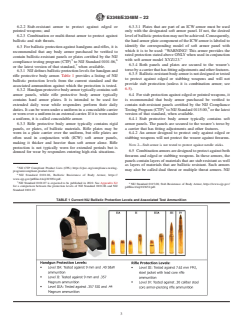
rifle protective body armor. Table 1 provides a listing of NIJ
to protect against edged or stabbing weapons and will not
ballistic protection levels from the current standard and the
provide stab protection (unless it is combination armor; see
associated ammunition against which the protection is tested.
6.5).
6.3.2 Handgunprotectivebodyarmortypicallycontainssoft
armor panels, while rifle protective body armor typically 6.4 For stab protection against edged or pointed weapons, it
contains hard armor plates. It is intended to be used for is recommended that body armor purchased be verified to
extended daily wear while responders perform their daily contain stab-resistant panels certified by the NIJ Compliance
5 8
duties. It can be worn under a uniform in a concealable carrier Testing Program (CTP) to NIJ Standard 0115.00, or the latest
orwornoverauniforminanexternalcarrier.Ifitiswornunder version of that standard, when available.
a uniform, it is called concealable armor. 6.4.1 Stab protective body armor typically contains soft
6.3.3 Rifle protective body armor typically contains rigid armor panels. The panels are secured to the wearer’s torso by
panels, or plates, of ballistic materials. Rifle plates may be a carrier that has fitting adjustments and other features.
worn in a plate carrier over the uniform, but rifle plates are 6.4.2 An armor designed to protect only against edged or
often used in conjunction with (ICW) soft armor panels, stabbing weapons will not protect the wearer against firearms.
making it thicker and heavier than soft armor alone. Rifle
NOTE 2—Stab armor is not tested to protect against needle sticks.
protection is not typically worn for extended periods but is
6.5 Combinationarmorsaredesignedtoprotectagainstboth
donned for wear by responders entering high-risk situations.
firearms and edged or stabbing weapons. In these armors, the
panels contain layers of materials that are stab resistant as well
as layers of materials that are ballistic resistant. Such armors
NIJ CTP Compliant Product Lists (CPL) https://cjtec.org/compliance-testing-
may also be called dual threat or multiple threat armors. NIJ
program/compliant-product-lists/.
NIJ Standard 0101.06, Ballistic Resistance of Body Armor, https://
www.ojp.gov/pdffiles1/nij/223054.pdf.
NIJ Standard 0101.07 is expected to be published in 2022. See Appendix X2 8
NIJ Standard 0115.00, Stab Resistance of Body Armor, https://www.ojp.gov/
for a comparison between the protection levels of NIJ Standard 0101.06 and NIJ
pdffiles1/nij/183652.pdf.
Standard 0101.07.
TABLE 1 Current NIJ Ballistic Protection Levels and Associated Test Ammunition
E3348/E3348M − 22
NOTE 3—Shared body armor is sometimes referred to as a “pool vest.”
provides a list of those combination armors that have been
tested and found to be compliant with both NIJ Standard
7.3 A critical first step in determining the type and level of
0101.06 and NIJ Standard 0115.00. Combination armors are
protection needed for responders is to perform a risk assess-
also listed on both the NIJ ballistic- and stab-resistant armor
ment.
compliant product lists.
7.3.1 For active shooter events, risk assessment guidance is
6.5.1 Because combination armors provide two types of
provided in NFPA 3000.
protection, they will likely be heavier, thicker, and less
7.3.2 For other types of events, general risk assessment
comfortable for the wearer. These operational considerations
guidance is provided in Annex A1.
must be evaluated as part of the purchasing and wear decision
7.4 Understanding the Environment of Use:
by the agency.
7.4.1 If required to wear body armor with turnout gear, it is
7. Selecting the Appropriate Body Armor
important to understand that the high-temperature fire environ-
ment will likely damage body armor. If body armor will be
7.1 Responders requiring body armor may be those likely to
usedinahigh-temperaturefireenvironment,itshouldbetested
respond to the following types of situations where firearms or
for performance in that environment.
stabbing weapons are expected or likely to be present, such as
those listed below:
8. Sizing Body Armor to the End User(s)
7.1.1 Active violence events;
7.1.2 Mass casualty events with potential for ballistic in-
8.1 Individual body armor should be sized and fitted for the
jury;
wearer. Practice E3003 provides detailed guidance for measur-
7.1.3 Civil disturbances, riots, or events with large crowds;
ing a body armor wearer and ensuring that the body armor is
7.1.4 Incidents involving domestic violence, family dispute,
properly adjusted and fitted.
or an address that has been flagged for known violence against
NOTE 4—Practice E3003 includes details for measuring and fitting both
public safety personnel;
male and female personnel.
7.1.5 Suicide where firearms or bladed weapons are known
or suspected to have been used; 8.2 Shared body armor should be made available to person-
7.1.6 Assisting law enforcement with welfare checks or nel in a range of sizes so that the user can select the best fitting
violent crime scenes; body armor from the available sizes in storage.
7.1.7 Arson investigation; and
8.2.1 When purchasing shared body armor, the measure-
7.1.8 Warm zone operations, both active and pre-staged
ments (at minimum, height, weight, and waist size) of the
(including rescue task force response).
department personnel who will wear the armor should be
considered, and a range of sizes should be purchased.
7.2 Department leadership should consider and identify
8.2.2 Some suppliers sell one-size-fits-most (or universal)
threats of concern expected using a risk assessment for their
carriers.Thesecarriersaremadetoholdsoftbodyarmorpanels
agency and identify which personnel require ballistic protec-
or plates on the wearer’s torso front and back, and have
tion.
expandable cummerbunds into which smaller protective acces-
7.2.1 It may be necessary for some personnel to be issued
sories can be inserted to provide protection on the sides of the
individual body armor that is to be worn on a regular basis as
torso. The carriers also have adjustable shoulder straps for
part of the duty uniform.
positioning the panels or plates correctly on the wearer’s torso.
7.2.2 For other personnel, it may be acceptable to make
available shared body armor that is stored until needed and 8.2.2.1 Themanufacturershouldbecontactedtoaskthesize
worn by multiple people. Shared body armor should be stored ranges for particular armor models and the corresponding
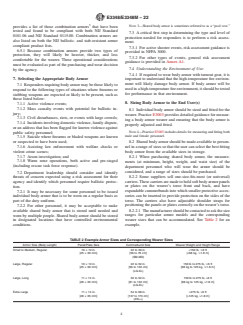
in designated locations that have controlled environmental wearer sizes that can be accommodated. See Table 2 for an
conditions. example.
TABLE 2 Example Armor Sizes and Corresponding Wearer Sizes
Armor Size (Body Length) Panel/Plate Size Cummerbund Size Wearer Weight and Height Range
Small to Medium, Regular 10 × 12 in. 22 to 30 in. <150 lb,#6ft
[25×30mm] [56to76cm] [<68 kg,#1.8 m]
(SM-MD)
Large, Regular 10 × 12 in. 22 to 52 in. 150 lb to 275 lb,#6ft
[25×30mm] [56 to 132 cm] [68 kg to 125 kg,#1.8 m]
(LG-XL)
Large, Long 11 × 14 in. 32 to 52 in. 150 lb to 275 lb, >6 ft
[28×35mm] [81 to 132 cm] [68 kg to 125 kg, >1.8 m]
(LG-XL)
Extra Large 11 × 14 in. 54 to 68 in. >275 lb, >6 ft
[28×35mm] [137 to 173 cm] [>125 kg, >1.8 m]
(2XL+)
E3348/E3348M − 22
9. Guidance on Purchasing 9.8 Atypical purchase specification for rifle protective body
armor might include the following wording to ensure that bids
9.1 Purchasers should follow the department polices for
comprise only NIJ-certified ballistic plates:
procurement, which should identify the required level(s) of
“The ballistic plates of the body armor shall have an NIJ-CTP
protection, department-approved types of carriers, and other
model designation listed on the NIJ BallisticArmor Compliant
department requirements.
Products List. The model designation shall have a rifle protec-
9.2 Generally, body armor purchases for a department fall
tion level (Level III, Level IV) as defined in NIJ Standard
into one of three categories:
0101.06.”
9.2.1 Small quantity departmental purchases;
9.9 Statements by a vendor or manufacturer that a model is
9.2.2 Largequantitydepartmentalpurchases(thatis,several
“just like” or “identical to” a model from the NIJ Ballistic
hundred units or more); or
Armor CPL or “meets the NIJ Standard” should not be
9.2.3 As-needed purchases procured through an open-ended
accepted. Only body armor with NIJ-certified ballistic panels
agreement (also called a term contract).
orplates(listedonthecurrentNIJBallisticArmorCPL)should
9.3 Departments are encouraged to take advantage of coop-
be purchased.
erative purchasing programs that allow them to share procure-
9.10 It is important to note that NIJ only certifies protective
ment contracts, which may save significant time and money in
panels and plates; NIJ does not certify carriers or accessories.
contract production and result in lower contract prices through
9.10.1 Purchase agreements should specify carrier require-
the power of aggregation. One such program in the U.S. is the
ments and any additional features:
National Association of State Procurement Officials (NASPO)
9.10.1.1 Covert carrier (under the duty uniform) vs. overt
ValuePoint program which offers the opportunity for agencies
carrier (over their duty uniform);
to take advantage of public cooperative contracting for the
9.10.1.2 External carrier label to identify the type of re-
purchase of body armor.
sponder (such as, fire, EMS);
9.3.1 Should a department or end user not wish to take
9.10.1.3 Fastener type (for example, zipper or hook and
advantage of cooperative purchasing programs, sample pro-
loop closures); or
curement language may be found in NIJ SAG 0101.06.
9.10.1.4 Other features, such as pockets, cargo loops, and
9.4 Purchases made through a competitive process involv-
similar features that may assist a responder in the execution of
ing several bids from different suppliers tend to provide the
his/her duties.
best value. This is particularly the case in large-quantity
9.11 Grant funding for purchasing personal protective
purchases.
equipment (PPE) may be available, and some government
9.5 Obtaining objective information on body armor on
resources are provided in Appendix X3. Use of federal grant
which to base purchasing decisions can be challenging. Sup-
funds requires that the body armor be NIJ certified.
pliers will naturally tend to present their products in the best
10. Verifying that Your Body Armor is NIJ Certified
possible light, which makes comparison between competing
products difficult. Once suppliers have presented their
10.1 NIJ Compliant Products Lists:
products, the next step is to verify that any products being
10.1.1 See the listings of body armor certified by NIJ.
considered are listed on the National Institute of Justice
10.2 Checking your Body Armor Label:
Compliant Products List (NIJ CPL). Any products not listed
10.2.1 Priortousingbodyarmor,itisrecommendedthatthe
should not be considered for purchase.
user open the carrier and examine the label on each protective
9.6 Procurement specifications should be clear and not
panel or plate. The label should have the NIJ Certification
ambiguous in any way. At the same time, over-specification
Mark shown in Fig. 1.
should be avoided (for example, identifying a specific product
instead of a level of protection) because that may tend to
eliminate competition and drive cost up. Rather, departments
should request bids for body armor that contains ballistic panel
or plate models listed on the NIJ CPL.
9.7 A typical purchase specification for soft armor vests
might include the following wording to ensure that bids
comprise only NIJ-certified ballistic panels:
“The ballistic panels of the body armor shall have an NIJ-CTP
model designation listed on the NIJ BallisticArmor Compliant
FIG. 1 NIJ Certification Mark
Products List. The model designation shall have a handgun
protection level (Level II, Level IIIA) as defined in NIJ
Standard 0101.06.”
10.3 NIJ Advisory and Safety Notices:
10.3.1 You should periodically check for NIJ advisory
notices or safety notices related to your body armor model.
These notices are posted by the CTP: https://cjtec.org/active-
Details may be found at: https://www.naspovaluepoint.org/portfolio/body-
armor2016-2021/. nij-advisory/.
E3348/E3348M − 22
10.3.2 NIJ advisory notices are issued when the NIJ has (base of the neck) to two to three finger-widths above the top
concerns with the body armor model(s) being reviewed and of the duty belt when standing. For over-the-uniform vests, the
evaluated. Until the issues are resolved, the model(s) in vest can be slightly longer without impeding movement or
question will be suspended from the Compliant Products List, comfort.Agap above the duty belt is normal and necessary to
pending completion of the review and evaluation process. The
prevent the vest from being pushed up into your throat when
CTP will promptly communicate all resolutions of advisory you are sitting. You should check the fit of your vest by sitting
notices.
down with the vest on. When seated, the front of the vest
10.3.3 NIJ safety notices identify body armor models that should ride just on top of the duty belt but should not shift up
have been removed from the CPL due to safety concerns. If
into the throat. If it does shift up, follow your agency
your body armor model has been removed from the CPL, it procedures for reporting issues with your body armor.
should be replaced as soon as possible.
11.2.2 You should perform a self-assessment to check the fit
of your vest when you receive it and periodically throughout
11. Fit, Coverage, and Wear Guidance
the lifetime of the armor. If your vest does not fit properly,
follow your agency procedures for reporting issues with your
11.1 With proper fit, body armor should ensure maximum
body armor.
coverage without hindering your mobility or ability to perform
normalduties.Althoughcomfortisasubjectiveterm,increased
11.3 Hard Armor for Rifle Protection:
comfort through proper fit is an important goal.
11.3.1 Hard armor plates may be worn alone in a plate
11.2 Soft Body Armor for Handgun Protection (often re-
carrier, may be inserted into vest carrier pockets (front and
ferred to as a “vest”):
back) and worn outside of soft armor, or may be worn as a
11.2.1 The following guidelines may help you determine if
matched set of plates and soft armor (in other words, in
a vest fits properly and provides appropriate coverage. These
conjunction with armor). Regardless, it is important that the
guidelines apply to vests that are worn over or under the duty
plates be correctly sized for your torso to provide as much
uniform.
coverage as possible while not interfering with your range of
11.2.1.1 Prior to putting on the vest, open the carrier and
motion.
examine the label on each ballistic panel. The label may say
11.3.2 To check the fit and coverage of your hard armor
“Wear face,” “Strike face,” “This side toward body,” or
plates, follow the guidelines below:
something similar. Verify the panel faces the correct direction
11.3.2.1 Examine the label on each plate.The label may say
in accordance with the label. Many armor panels are designed
“Wear face,” “Strike face,” “This side toward body,” or
to work in one direction only. Inserting the panels in the
something similar.
incorrect direction can result in the armor failing to perform as
11.3.2.2 When using plates with soft armor, the vest should
intended.Ifnecessary,removethepanelandre-insertitintothe
be fitted and adjusted per the above guidelines.Then, insert the
carrier in the correct direction. Close the carrier.
front and back plates into the carrier, making sure that the front
11.2.1.2 Put on the vest so that the front panel is over the
plate is inserted in the front of the carrier and the back plate is
front of your body and the back panel is over your back. The
inserted in the back of the carrier, and making sure that the
front panel can generally be identified by a neck scoop.
plates are in the correct orientation (right side up) and correct
11.2.1.3 After your armor is on, adjust the shoulder straps
direction (wear face toward torso, strike face away from torso).
(if possible) to position the vest comfortably on the torso and
(1) The positioning of the hard plate depends on the
adjust the side straps for a snug fit. Do not over tighten the side
location of the pockets on the soft armor carrier. Ideally, the
straps. It is natural to want to cinch the straps down as tightly
front and rear plates will be positioned to provide protection
as possible. The vest should fit snugly, but not so tightly that it
primarily to the vital organs in the chest, especially the heart.
affects breathing, including deep breathing during vigorous
(2) For plates worn on top of soft armor, the coverage will
activities. The vest should slide slightly on the body as the
not be as extensive as that of the underlying soft armor vest.
torso is rotated side to side. If the vest moves with the body, it
(3) For plates worn in a plate carrier, there will be no
is probably too tight.
protection on the sides of the torso as the plates only protect
11.2.1.4 To ensure appropriate coverage on the side, for
front and back.
both over-the-uniform and under-the-uniform vests, the sides
of the vest should always overlap by approximately two inches
11.3.2.3 When using plate carriers, insert the front and back
front over back (that is, the front panel should be on top of the plates into the carrier, making sure that the front plate is
back panel). This may prevent a bullet from the front from
inserted in the front of the carrier and the back plate is inserted
entering between the panels and entering the torso. This also in the back of the carrier, and making sure that the plates are in
provides additional protection against shots under the arm.
the correct orientation (right side up) and correct direction
11.2.1.5 Protective coverage under the arms should be as (wear face toward torso, strike face away from torso). Put the
high as possible without compromising the ability to obtain a
carrier on your torso. If you have not yet done so, adjust the
shooting position or causing discomfort when your arms are shoulder straps to position the carrier comfortably on the torso
lowered.
and adjust the side straps for a snug fit. Do not over tighten the
11.2.1.6 The length of the panels relative to the body is very side straps. It is natural to want to cinch the straps down as
important. For concealable (under-the-uniform) vests, the front tightly as possible. The carrier should fit snugly but not so
panel should extend from just below the suprasternal notch tightly that it affects breathing. Ideally, the front and rear plates
E3348/E3348M − 22
shouldbepositionedtoprovideprotectionprimarilytothevital detached, you should follow your department procedures for
organs in the chest, especially the heart. reporting issues with body armor. Having a legible, intact label
allows you to identify the model and protection level of an
11.4 Body armor carriers worn externally should be marked
armor. This is especially important if an NIJ safety or advisory
and labeled to distinguish the wearer from law enforcement.
notice is issued.
13.2.5 When checking the label, note the issue date and
12. Fire Fighter Guidance for Body Armor Use with
compare it to the supplier’s protective material warranty (also
Turnout Gear
found on the label). If your armor has been in service beyond
12.1 Over exertion and heat stress have been the leading
its declared warranty period, follow your department proce-
cause of death of fire fighters for decades.Adding body armor
dures for reporting issues with body armor. Serviceable armor
to turnout gear is expected to significantly increase the heat
should continue to be worn until a replacement armor is
stress level of the fire fighter.
available. Wearing armor that may have reduced effectiveness
12.2 It is recommended that body armor not be worn with
is better than not wearing any armor.
turnout gear.
13.3 Handling your Body Armor Panels and Plates:
12.2.1 If a department chooses to use body armor with
13.3.1 Armor panels must fit into the carrier in the way they
turnout gear, then studies should be conducted to understand
were designed. Ensure the armor panels fit into the carrier with
whether the additional ballistic protection causes more harm
the strike face and wear face correctly oriented. You can
than good in terms of heat stress.
determinethecorrectorientationbyreferringtothepanellabel.
12.2.2 Another option might be that if a ballistic vest is
The panel label will indicate whether the labeled side is the
required, then fire fighters should not wear turnout gear but
strike face or wear face.
perhapssomeotherflame-resistantclothingthatislessstressful
13.3.2 You should avoid needlessly flexing, bending,
in terms of heat.
compressing, or creasing soft armor panels when handling
12.3 If body armor is worn with turnout gear, it must be
them. Armor panels will flex and bend as they are worn, but
worn under the turnout gear to prevent damage or melting of
excessive wear of the panel may contribute to degradation of
components.
the protective materials over time.
12.3.1 Body armor may include polyester or other materials
13.3.3 You should handle hard armor plates carefully, par-
that are flammable and melt, which could cause significant
ticularly those incorporating ceramic materials, because they
injury to the wearer.
may be frag
...